The Week's Class Developments in Technology - 10-16 November 2026
The Union Left the Table, Capital Joined the Queue
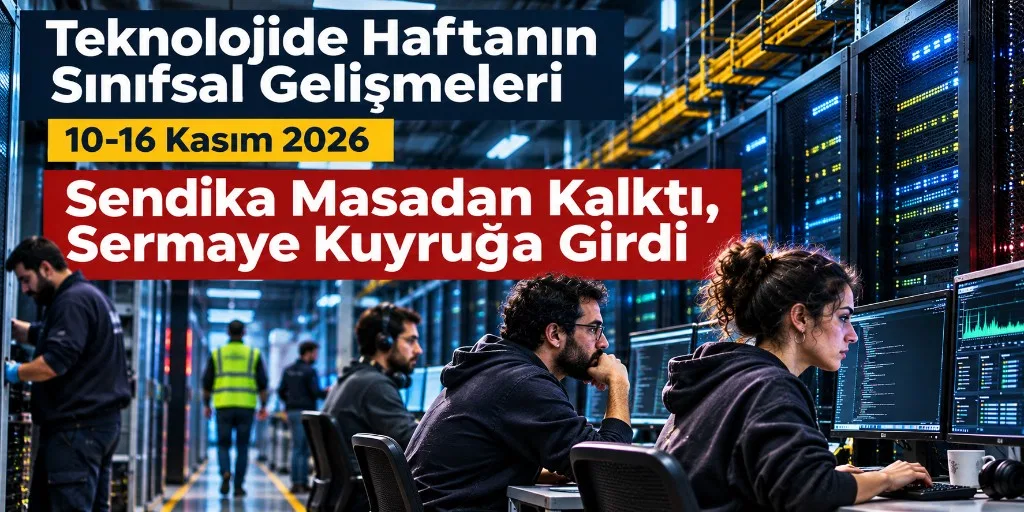
The Week's Class Struggle in Technology
10-16 November 2026
About this series: Every Monday this series gathers the previous week's developments in technology and labour. We take up each heading with the same three questions: What happened? What does it mean in class terms? Why does it matter for us? This is the sixth issue. The previous issues: The Week's Class Developments in Technology - 13-19 October 2026, The Week's Class Developments in Technology - 20-26 October 2026, The Week's Class Developments in Technology - 27 October-2 November 2026 and The Week's Class Developments in Technology - 3-9 November 2026. In the previous issue's "What to Watch Next Week" table we wrote that Micron would sit down again with the Taoyuan union on 17 November. As far as the union is concerned, that meeting will no longer take place: the union withdrew from the talks on 12 November. The detail is below.
The Week's Class Developments in Technology - Issue 6 · 10-16 November 2026
First, a Short Summary
Dear young comrades,
The one-sentence summary of this week is this: while labour got up from the table, capital joined the queue.
In Taiwan, the union at Micron's Taoyuan plant openly declared that it had lost the profit-sharing struggle and withdrew from the table. In the same days, demand for Anthropic's initial public offering in New York came to about six times the shares on sale. On one side, the withdrawal of a few thousand workers who wanted a permanent share of the profit; on the other, the institutional investors queuing to become partners in the future flow of that profit.
The picture in between is familiar too. In Australia, Qantas is moving 850 office jobs, mostly to India, through Accenture, and explained this with artificial intelligence; its union called it "artificial-intelligence washing". In Germany, Vodafone is preparing to show nearly one in five of its employees the door under the heading "more artificial intelligence". Qualcomm is running a "performance-focused" cut in India that begins with senior engineers. In the United States, labour's share of national income is at its lowest level since the records began in 1947.
In Turkey, dismissals have begun at Halk TV, where a trustee was appointed; chipped and camera surveillance in the plants has been carried into Parliament; and the explosion at HABAŞ has put before us, in the most bitter form, the contradiction "there is money for surveillance, none for safety".
The week's table, in brief:
What was left over from last week:
- Micron (Taiwan): The Taoyuan union accepted defeat on 12 November and withdrew from the talks; it will not attend the 17 November meeting. The larger union in Taichung had signed separately in October.
- Samsung Biologics (South Korea): A second strike, covering 6-27 November with about 400 members, continues; by court order, nine core stages of production are kept outside the strike.
- Microsoft: The decision period on the "voluntary exit" offer opened to about 60,000 people runs out at the beginning of December; those who accept will leave on 31 December.
- Anthropic: It launched its roadshow on 10 November; the offering saw about six times the demand. The price will be set on 18 November. We wrote.
- Data centres: The "no" wave from the ballot box spread to city councils. Edmond (Oklahoma) extended its moratorium; Boise (Idaho) brought in a moratorium on "mega data centres" that takes effect at once.
- Hermantown (Minnesota): Environmental organisations opened a second case against Google's data centre on 5 November.
- Astor and digital surveillance: The subject left a single plant and became a general question in Parliament; the question also names Kalyon PV, Arçelik and Turkcell Global.
- Halk TV: Dismissals have begun under the trustee management; a 30 per cent reduction in every department is being talked about.
- Those whose decision we cannot see: The contract vote of Oakland's public-sector computing workers, the Unifor (Toronto) and Teamsters organising at Amazon, the Gävle agreement, AEMO, Activision and the DeFacto question. We found no new development that reached the public this week; we keep watching.
What is new this week:
- Qantas-Accenture: About 850 office jobs, most of them to India. The union says "artificial-intelligence washing".
- Vodafone Germany: About 2,300 posts over two financial years; 19 per cent of the employees.
- Qualcomm India: It is being said that the cut which began in Bengaluru could reach about a thousand people.
- The year's numbers: The TrueUp counter passed 206,000 as of 13 November; in the United States, employers cited artificial intelligence for 121,000 cuts between January and October.
- Labour's share: It fell to 53 per cent in the third quarter in the United States, the lowest in the records. We wrote.
- COP31 and artificial intelligence: On 16 November, a thematic day on science, industry and technology in Antalya; the document on the table is only a voluntary pledge.
- Turkey: Press labour under the trustee, digital surveillance in Parliament, the censorship counter, and HABAŞ.
What We Published This Week
Between 9 and 15 November we published 22 pieces. We put first the ones directly tied to this week's headings in the series.
Artificial intelligence, capital and monopoly (5)
- 10 November: The Monopoly on the Roadshow. We read Anthropic's initial public offering as a four-month balance sheet running from the safety narrative to the share price.
- 10 November: Consciousness Is Not in the Skull. It Is in the World. A Marxist philosophical answer to the debate on artificial intelligence and consciousness.
- 11 November: How a CEO's Private Life Became a Matter of "National Security". What the investigation at NVIDIA tells us about monopoly capitalism.
- 13 November: There Was No Attack, There Was a Monopoly. The class structure of cloud infrastructure, through the Microsoft 365 outage and the "global cyber crisis" headlines.
- 14 November: Why Does Labour's Share Shrink as Artificial Intelligence Grows?. A class account of the gap between productivity and wages.
Labour, the plant and organisation (6)
- 9 November: The Computer's First Union: BİL-İŞ and Turkey in 1968. The story of the first computing union, founded at IBM Türk.
- 9 November: The Explosion at HABAŞ: This Is Not an Accident, It Is a Mode of Production.
- 9 November: Human Rights Begin with Labour: Why a Labour Constitution?.
- 9 November: The Consent of Labour: Why Does the Worker Submit, and When Does the Worker Stand Up?.
- 11 November: Factory for Sale by Owner. Our own compilation on closures and dismissals in industry.
- 13 November: In Front of the Turnstile: The Boss, the Yellow Union and the Workers Who United to Live, at HABAŞ.
Education, culture and memory (8)
- 10 November: The Revolutionary of His Age, Our Task: Remembering Mustafa Kemal on 10 November.
- 10 November: Whose Language Is Mathematics?.
- 12 November: The Account of the Chalk: Whose Child Is the Education Budget Written For?.
- 12 November: The Class Behind the Curtain: Morality That Bends for the Strong and Hardens against the Weak.
- 12 November: A Ring Stone, a Lifetime of Labour and Turkey's Cultural Memory.
- 12 November: Mourning Has a Class Too: Two Orphans, Two Futures in Süt Çiftliği.
- 14 November: Same Block, Separate Floors. A look at the second season of Bir Başkadır through the window of class.
- 15 November: Haluk Bilginer Is Our Pride.
Politics, the press and the climate (3)
- 11 November: The Price of Asking a Question. How the price of an unanswered parliamentary question was charged to the MP's circle.
- 15 November: The First Week of COP31: Fossil Silence at the Table, the Peoples' Voice in the Street.
- 15 November: New Sign, Old Class: Why the YENİ Parti Congress Cannot Be an Answer for the Working Class.
The Week's Table: Capital's Language, Labour's Question
| Development | Capital's language | Labour's question |
|---|---|---|
| Micron, Taoyuan | We are committed to negotiating in good faith; our door is open. | While profit breaks records, why is a permanent share reduced to a "one-off bonus"? |
| Micron, Fab 11E | We are reviewing investment plans. | Is halting construction a bargaining chip, or a warning? |
| Samsung Biologics | There is no disruption in production. | If the strike is banned in the core processes, what is left of the right to strike? |
| Qantas-Accenture | The partnership will speed up artificial intelligence and innovation. | If the work is being moved to a subcontractor in India, what has that to do with artificial intelligence? |
| Vodafone Germany | Simpler structures, more artificial intelligence, targeted investments. | If talks with the worker representatives start in 2027, on whose table was the decision taken today? |
| Qualcomm India | A performance-focused reduction. | Did a verification engineer of seven years become "without performance" in a single year? |
| Microsoft VEO | Flexibility for employees to shape their own next chapters. | What awaits, in January, the person who does not leave "voluntarily"? |
| Anthropic's offering | Record demand, strong confidence. | Which saving on labour is a sixfold demand already pricing in? |
| Anthropic's private placement | Our strategic partners are with us. | If the same companies sell the chip, rent the cloud and take the share, where is the competition? |
| Labour's share | The strongest period in productivity since the 1990s. | Why, while productivity rises, does the real wage rise by only 1 per cent? |
| Data centres | A contribution to the school, the road, the tax. | Who pays for the electricity, the water and the land, and to whom does the profit go? |
| The COP31 artificial-intelligence pledge | Climate-friendly artificial intelligence. | Who will call to account a company that does not keep a voluntary pledge? |
| Halk TV | Reduction and restructuring. | Why is the trustee's first act to show the worker who produces the news the door? |
| Astor, Kalyon PV | Occupational safety and process improvement. | There is money for the card around our necks; why is there none for safety at HABAŞ? |
The Union That Left the Table, the Strike That Stayed in the Field
Micron: A Union That Said "Our Defeat"
12 November 2026 · Taiwan · Profit-sharing, a union split
What happened?
The bargaining that had gone on for weeks between Micron, the US memory-chip maker, and the union at the Taoyuan plant ended with the union leaving the table. According to AFP, on 12 November the union formally accepted that its campaign to establish a new profit-sharing order had not succeeded, and said that they would have to carry the struggle on in the future. It announced that union members could sign an agreement with the company, and that it would not attend the meeting on 17 November. The same report notes that, at the end of the strike, only a handful of employees stopped work for a single day.
Let us recall. Looking at the examples of Samsung Electronics and SK Hynix in South Korea, the Taoyuan union wanted a permanent profit-sharing system in which 15 per cent of operating profit is set aside for the employees. The company had announced the "most generous" bonus package in its history; the union refused it, saying it did not want a one-off bonus. Micron has about 15,000 employees in Taiwan, and according to AFP the company produces some 50 to 60 per cent of its memory chips on the island.
The break came in October. On 21 October the Taichung union, at Micron's largest plant in Taiwan, signed a separate contract with the company and withdrew from mediation. According to the statement of Micron Taiwan's president, with this agreement the company accepted adding a quarterly profit-sharing bonus alongside the annual bonus, and raising the retirement contribution. The Taoyuan union was left alone. A member speaking to Rest of World described their surprise at the Taichung representatives' signature; the same report says the Taoyuan union has more than 2,300 members. The 24-hour warning strike on 22 October did not see the participation that was expected.
Meanwhile the company had largely halted construction of the new Fab 11E in Taoyuan. Sources speaking to Bloomberg described this "investment brake", which we wrote about in the previous issue, as a project of 3 to 4.5 billion dollars. In its reply to the union's open letter, Micron said it had not asked employees to waive any right, and that it would continue to negotiate.
A class reading
Three lessons sit on top of one another here.
The first is the divided table. At two plants of the same company on the same island, there were two separate unions. The company settled separately with the large one and left the small one alone. This is the oldest weakness of workplace unionism: capital decides from a single centre, while labour organises plant by plant, even shift by shift. The quarterly profit bonus Taichung obtained is a gain; but it has turned the demand for a permanent and auditable share, that is, the demand to make the division of profit into a rule, into a bonus mechanism that depends on the company's discretion. The difference looks small, but in substance it is about property: a rule creates a right; a bonus creates a favour.
The second is the investment strike. Halting the construction of a plant is the capital-side counterpart of the worker stopping work. Capital calls this "reviewing investment decisions", but the function is the same: to take future jobs hostage so as to pull back today's demand. Once Taiwan's Minister of Labour counted the Taichung agreement as a valid contract, it was also plain on which pan of the scale the state had placed its weight.
The third, and perhaps the most valuable, is calling the defeat by its name. That the union can say "our defeat" is not a weakness; it is a sign of maturity. An organisation that markets a defeat as a victory lies to its members; one that accepts the defeat starts the preparation for the next round with an honest balance sheet.
Why does it matter for us?
In Turkey, almost every discussion of organising in computing and electronics turns around a single workplace. The Micron example shows us that profit-sharing cannot be made into a rule without a bargaining power, at the level of the industry, that covers all of a company's units. The story of BİL-İŞ in 1968 asks the same question: how does a union born in a single company become the union of the industry? One proposal: building a network that at least shares information with the employees at your company's other sites, in its other subsidiaries, or among its subcontractors, is the first and the cheap step.
Samsung Biologics: The Strike the Court Drew
6-27 November 2026 · South Korea · The right to strike, the group pay guide
What happened?
The union at Samsung Biologics started its second strike six months after the first, in May. According to a union official speaking to Fierce Pharma, about 400 members are taking part in a strike that began on 6 November and will run until 27 November; the strike mainly covers employees in quality control, quality assurance and logistics. According to the same report, an injunction of the Seoul High Court had banned the strike at nine "core" stages of production on the Songdo campus.
The background of the strike is the picture we told in the previous issue: the company had proposed postponing the 3 November meeting by two weeks, giving as its reason the union's demand that management change its negotiating team. The union refused the postponement, the meeting was not held, and the strike decision came. The company says the strike has so far caused no disruption in production. According to the Korea Herald, the dues collected for the strike fund drew a reaction inside the union, and membership has fallen below 3,800.
A class reading
The strength of a strike is measured by the production it stops. When the court declares the very places where the strike would work, that is, the core production processes, a forbidden zone, what remains is a symbolic action. This is the legal path of recognising the right to strike on paper while emptying it in practice; a more refined sibling of the "postponement of strikes" applied in Turkey.
The point the union has underlined from the start also matters: even if Samsung Biologics is a separate company on the exchange, it runs its pay policy according to the group guide set by Samsung Electronics. The management sitting across the table is not the management that actually decides. This is the result, in labour bargaining, of the monopoly holding structure: the profit is in one place, the decision in another, and the addressee is nowhere to be found.
Why does it matter for us?
The same structure holds in Turkey's large holdings, including their computing subsidiaries. Bargaining with the "independent" management of a group company is bounded by the holding's pay policy. Knowing this is the precondition of directing demands to the right address. The strike-fund debate also reminds us of the importance of explaining the organisation's financial burden to the member, and of sharing it: the fund should be built before the strike, and in the open.
Those Whose Decision We Cannot See
In some of the headings we followed in previous issues, we found no new development that reached the public this week:
- Oakland: The member vote on IFPTE Local 21's tentative contract, which contains an artificial-intelligence clause.
- Amazon warehouses: The organising campaign Unifor launched in the Toronto area on 4 November, and the Teamsters' effort in Indiana. Unifor was saying that at the YVR2 warehouse in Delta (British Columbia) they were approaching the first Amazon collective agreement in North America.
- Gävle (Sweden), AEMO, Activision, the DeFacto question.
These headings remain in the "What to Watch Next Week" table.
Artificial Intelligence as the Excuse, Subcontracting as the Method
Qantas: Subcontracting Washed with Artificial Intelligence
10-11 November 2026 · Australia · Subcontracting, the migration of jobs
What happened?
Qantas, Australia's largest airline, announced that it had formed a seven-year partnership with Accenture, the consulting giant, and that about 850 office jobs would be affected within this frame. This is about 3 per cent of the company's workforce of 28,000 in Australia; most of the work will be transferred to Accenture's teams, which are weighted towards India. According to the email chief executive Vanessa Hudson sent to employees, the first changes will begin in mid-2027 in finance, procurement and marketing.
The Australian Services Union (ASU), which represents the affected employees, recalled that the company had earlier told them the jobs would not be moved abroad; Qantas denies having given such an assurance. According to a Reuters report of 11 November, the union and a Greens senator accused the company of "artificial-intelligence washing"; the ASU said Qantas was washing the job cuts in Australia with artificial intelligence. An academic from the University of Sydney, quoted in the same report, also said the decision was a classic piece of outsourcing. The Transport Workers' Union recalled that in 2020 the company subcontracted ground handling at 10 airports.
A class reading
The order the company itself tells is instructive: first the work will pass to Accenture, then it will be "transformed" with automation and artificial intelligence. The substance of today's move is not technology; it is the moving of labour to a geography where it is cheaper. Artificial intelligence works here not as a means of production but as an ideological cover: the new form of saying "it is not us doing this, it is the technology".
But this story has another face. The Accenture employee in Bengaluru who will take the job of the office worker in Sydney is not that worker's rival; they are another link of the same chain. The wage difference is itself the profit capital draws from the international division of labour. A nationalist reaction of the "Indians took our jobs" kind makes the owner of this profit invisible.
Why does it matter for us?
Turkey stands in two positions on this chain at once: a cheap base of call centres, software testing and content moderation for Europe, and also a country that can lose its own work to cheaper geographies. The first question to be asked at every company that announces an "artificial-intelligence transformation" should be this: is the work really being handed to a model, or to a subcontractor? Making this distinction is the way to see which step of the ladder we described in The Poverty of the White Collar has been moved, and to where.
Vodafone Germany: One in Five
9-10 November 2026 · Germany · Telecoms, worker representation
What happened?
On 9 November Marcel de Groot, chief executive of Vodafone Germany, told employees that about 2,300 posts would be removed or moved elsewhere over the next two financial years. This comes to about 19 per cent of more than 12,000 employees. According to the same report, talks with the works council (Betriebsrat) will begin at the start of 2027, and the company is looking for "socially acceptable solutions"; on the day of the announcement there was not yet a statement from the unions or the worker representatives. In the words of the company bulletin, the restructuring is built on simpler structures, more artificial intelligence and targeted investments; customer service is being folded into the sales units. The rival in the sector, O2 Telefónica, is also planning to cut 1,100 posts by the end of 2026.
A class reading
Germany's co-determination (Mitbestimmung) order gives worker representatives a say in dismissals. But the order that stands out in this news is this: the decision was announced, the figure is known, the reason is written; the talks with the worker representatives are a year later. When institutionalised participation is reduced not to the decision itself but to making the decision "socially workable", labour's role narrows to managing its own liquidation. The limit of the social-democratic model is exactly here.
Why does it matter for us?
Telecoms and customer service are also among the first areas the artificial-intelligence transformation will hit in Turkey. The organising of call-centre workers should demand that "artificial-intelligence assistant" projects be told to the workers while they are still at the planning stage, and be made a subject of bargaining. The clause won in Oakland, "notification to the union before artificial intelligence is used", is an important example for this reason.
Qualcomm India: A Reduction Dressed Up as "Performance"
9-11 November 2026 · India · Engineering labour
What happened?
Qualcomm's dismissals in India began in Bengaluru on 9 November. The company has about 52,000 employees worldwide and about 20,000 in India; analysts say the effect in India could be around a thousand people, and that a new round is expected in January. The cuts are part of the global reduction plan that chief executive Cristiano Amon sent to employees on 20 October and described as "performance-focused". Among the employees speaking to Calcalist is a senior design-verification engineer who had worked at the company for about seven years. The company did not officially confirm the figures.
A class reading
The word "performance" is the turning of a collective dismissal into individual fault. When a company loses its share of the smartphone market, it makes individual engineers pay the price through performance-evaluation forms. A structural crisis is thus turned into a story of personal failure; the person dismissed blames themselves. This is the last link of the measurement regime we called mental Taylorism: the labour that is measured is discarded according to the measure.
Why does it matter for us?
In software and hardware companies in Turkey too, "performance evaluation" is increasingly becoming the legal infrastructure of dismissal. Demanding that the evaluation criteria be written, known in advance and open to objection looks like an individual right, but it is in fact a collective defence.
The Year's Numbers: 206,000 and One Word
13 November 2026 · Global · Dismissal statistics
What happened?
The counter of TrueUp, which tracks dismissals, reached 206,817 technology employees in 712 events in 2026, as of 13 November. According to the figures of Challenger, Gray & Christmas, employers in the United States cited artificial intelligence in 121,401 cuts they announced between January and October; this is about 20 per cent of all the cuts announced, and 2.5 times last year's 48,414.
But there is an interesting detail inside the same data. Cuts justified by artificial intelligence peaked at 38,579 in May and fell to 1,265 in October. Of 34 US companies with a market value above 10 billion dollars that filed an official restructuring notice with the SEC, only 7 named artificial intelligence in that notice. The observation Andy Challenger made in Challenger's April report pointed the same way: whether or not jobs are replaced one by one with artificial intelligence, the money set aside for those jobs is moving to artificial intelligence.
A class reading
These numbers tell us two things. First, the sentence "artificial intelligence took our job" is most of the time not a technical finding; it is the name of a decision to allocate capital. Money that would have gone to wages is going to the data centre, the chip, the computation. Second, the excuse changes like a fashion: in May everyone was saying artificial intelligence, in October no one is. But the cuts continue. The word changes; the method stays.
Why does it matter for us?
When we read the dismissal announcements at our own workplace, the question "where is the money going" has to be added beside the question "why". Looking at the investment spending, the share buybacks and the executive bonuses the company made in the same quarter tells far more than the text of the excuse.
Microsoft: The Last Bend of the Voluntary Exit
The last day for a decision is the beginning of December · United States, Canada, India, United Kingdom
The calendar has become clear on the voluntary exit offer we took up in detail in previous issues: eligible employees will decide by the first week of December, and those who accept will leave the company on 31 December. The offer is open to about 60,000 people, 27 per cent of the workforce, and the conditions resemble the company's standard seniority package. Let us also recall that the company dismissed 4,800 people in July. What the word "voluntary" means will be decided by what happens in January to those who do not accept the offer. Whether a compulsory round comes after the "voluntary" programmes therefore continues to be one of the main headings this series will watch.
The Roadshow, the Ownership of Computation, and Labour's Share
Anthropic: Six Times the Demand
10-13 November 2026 · United States · Initial public offering, finance capital
What happened?
Anthropic launched the roadshow for its initial public offering on 10 November. The company is proposing to sell 825 million Class A shares, planned to trade on Nasdaq under the ticker "ANT", in a range of 70 to 78 dollars. Alongside the offering, a private placement of 26 billion dollars, at the offering price, will be made to seven chip and technology companies, among them Alphabet, Nvidia, Microsoft and TSMC; together the two come to about 90.4 billion dollars and pass the SpaceX record of June.
On 12 November Bloomberg wrote that the offering had seen demand of about six times the shares on sale. The price is expected to be set on 18 November and trading to begin on 19 November; at the top of the range the fully diluted valuation is about 1.4 trillion dollars. It is also reported that the company will set aside up to 20 per cent of the shares for individual investors.
A class reading
We read this picture in detail in The Monopoly on the Roadshow; let us repeat three points here.
First, the identity of the private placement. The companies that sell chips to Anthropic (Nvidia, TSMC) and that rent it cloud (Alphabet, Microsoft) are at the same time becoming its shareholders. The financial capital Lenin described a hundred years ago, that is, the fusion of industrial and bank capital, stands before us here as the fusion of chip, cloud and model capital. If the customer, the supplier and the partner sit at the same table, "market competition" is nothing but a piece of theatre.
Second, the content of the demand. When investors show six times the demand for a share, they are putting a price today on the profit that company will create in the future. The profit of an artificial-intelligence company also rests, to a large extent, on its customers saving on the cost of labour. Put roughly: this queue is the queue for money that will not go to wages in the future.
Third, drawing small savings into risk. The wide slice set aside for the individual investor presents the offering as something "everyone can join". Yet in a company where the voting rights are concentrated in the founders, the small shareholder is a partner not in the property, but only in the risk.
Why does it matter for us?
In Turkey too, artificial-intelligence and technology shares are marketed to the small investor over social media as "an opportunity not to be missed". As we saw in the fund crisis, in a country where the exchange can be a gain for those who have inside information and a trap for those outside, this language has to be read critically.
Labour's Share: The Lowest Since 1947
5 November 2026 · United States · Distribution
What happened?
According to the third-quarter figures of the US Bureau of Labor Statistics, while productivity showed its strongest rise of the last year, labour's share of national income fell to 53.0 per cent; this is the lowest level since the records began in 1947. In the same figures, the real hourly wage is seen to have risen by only 1.0 per cent in a year.
A class reading
This figure is the common denominator that brings together all the other news of the week. Productivity rises, the hours of work do not change, the wage stands still; the difference in between is written down as profit. What Marx called relative surplus value is exactly this: technology shortens the time the worker needs in order to produce their own wage, and the remaining time stays with capital. Artificial intelligence is the newest instrument speeding this process up. We took the subject up in detail in Why Does Labour's Share Shrink as Artificial Intelligence Grows?.
Why does it matter for us?
In Turkey the debate on labour's share mostly runs through inflation and the minimum wage. The real question is who the rise in productivity goes to. Writing a "productivity share" into the demands at the collective-agreement table, that is, a rate to be transferred directly from the rise in productivity into the wage, should be one of the most concrete demands of the age of artificial intelligence.
Data Centres: From the Ballot Box to the City Council
9-16 November 2026 · United States · Local resistance
What happened?
After nearly all of the proposals that set limits on data centres were accepted in the local ballots of 3 November, the wave spread to the city councils. According to Newsweek's compilation, the Edmond (Oklahoma) city council on 9 November unanimously extended the existing moratorium until 30 June 2027; the Boise (Idaho) city council on 10 November accepted a moratorium aimed at "mega data centres" in a form that takes effect at once. In Pitt County, North Carolina, a public session on the moratorium will be held on 16 November.
In Minnesota, the Minnesota Center for Environmental Advocacy (MCEA) opened its second case on 5 November against Google's data-centre project in Hermantown, objecting to the environmental review the city had renewed.
A class reading
A "no" given at the scale of the neighbourhood makes visible who the physical cost of computation (electricity, water, land, noise) is loaded onto. This is valuable. But if saying "not here" remains without asking "whose, then", the data centre simply moves to a poorer and less organised region. The next step of local resistance should be to ask the question of property: is an infrastructure possible under public control, whose energy and water are transparent and whose profit is shared with the local people?
Why does it matter for us?
Data-centre investments are growing in Turkey too, under the headings "domestic cloud" and "the artificial-intelligence drive". Reading the environmental impact (ÇED) reports of the projects with a large energy consumption in your neighbourhood or in your organised industrial zone, and following the objection processes, can be the first step of this debate in Turkey.
Artificial Intelligence at the Climate Table
COP31: A Voluntary Pledge, a Binding Bill
9-20 November 2026 · Antalya · Energy, climate
What happened?
COP31, under Turkey's presidency, has taken artificial intelligence onto its agenda for the first time at this scale. The Antalya Artificial Intelligence Pledge, which the presidency published on 27 October, invites governments and organisations to voluntary pledges on artificial intelligence and the climate; according to the same report, the World Resources Institute (WRI) warned that the text lacks strong accountability mechanisms. Bloomberg, for its part, recalls that the United States, the largest developer of data centres, is no longer part of the COP process. On 16 November a day themed on science, industry and technology will be held in Antalya.
A class reading
A voluntary pledge is the form of regulation capital likes best: you both look "responsible" and there is no price for not keeping it. The energy and water consumption of data centres, however, is not voluntary; it is binding. Its bill is cut to the public as a rise in electricity, as drought and as load on the grid. We assessed the first week of COP31 in a separate piece; the series' earlier pieces carry the titles Two Climate Summits in Antalya, and the Class of the Crisis and Whose Agenda at the Antalya Table?.
Why does it matter for us?
As the host country, Turkey's own data-centre and energy policy is also the test of this pledge. Demanding that the energy source, the water use and the employment information of new investments be open to the public is the way to turn the summit's slogan into a local instrument of calling to account.
From Turkey
Halk TV: The Trustee's First Act
10 November 2026 · Istanbul · Press labour
What happened?
Dismissals have begun at Halk TV, where the TMSF was appointed as trustee. According to a report by Evrensel, based on a post by the journalist Onur Dalar, who had worked at the channel, 6 people were called to the channel to be dismissed, and it was learned that the number of employees in every department would be reduced by 30 per cent. According to the same report, İbrahim Paşalı was brought to the chair of the new board of directors determined by the TMSF. Last week it had also been written that the employment of about 50 people at Sözcü was ended.
A class reading
We wrote the trustee apparatus earlier: taking the control of an institution from its elected or legitimate owners and giving it to a management appointed by political power. In a news channel, the first concrete result of this is that the worker who produces the news is shown the door. The criticisms directed at Halk TV's own working conditions (the May statement of DİSK Basın-İş is still valid) do not stop us opposing the lawlessness being lived today; on the contrary, the two criticisms are born from the same place. The security of the press worker should be left neither to the boss's whim nor to the trustee's instruction.
Why does it matter for us?
Journalism is also a form of knowledge labour, and it shares the same root as the insecurity the computing worker lives. The question we asked in Questions for Press Workers: Without Organisation There Is No Way Forward is even more current today: if you are not organised, there is no way forward.
Digital Surveillance in Parliament: From One Plant to a General Question
3-4 November 2026 · Ankara · Surveillance at the workplace
What happened?
Sevda Karaca, EMEP MP for Gaziantep, asked the Minister of Labour, in a parliamentary question, about the tracking devices that workers at Astor Enerji's plant in Sincan have to carry around their necks; the question also asks about the lifting of the asset measures applied to the company's main shareholders in the fund investigation. The next day İskender Bayhan, EMEP MP for Istanbul, generalised the subject: in his question he asks how many complaints have been received in the last five years about tracking by chip, GPS, camera and algorithmic performance systems, and how many inspections have been carried out, and he wants to learn whether the claims about Astor, Kalyon PV, Arçelik and Turkcell Global were examined. Evrensel carried the spirit of the question into the headline of the news with this sentence: "The bosses are watching the workers in the toilet, but you cannot prevent the workplace murders."
A week later, on 10 November, the same two MPs gave a new question on the explosion at HABAŞ in Aliağa; according to the report, at least 17 workers lost their lives in the explosion, and the number of workers killed in workplace murders in the last three weeks reached 19.
A class reading
These two questions should be read side by side. While an investment is made, in one plant, in a device that measures the minutes a worker spends in the toilet, in another plant the measures that would protect the worker's life are not taken. Technology in capital's hands is first an instrument of control; it turns into an instrument of safety only under the worker's organised pressure. Who has access to the data of a card that is attached under the name "occupational safety system" decides that card's real function. We told this, with the technical detail, in The Card Around Our Necks; and we took up HABAŞ in two pieces, through the explosion itself and through the resistance that followed.
Why does it matter for us?
We will watch whether the questions are answered by the Ministry, and whether the answer discloses the inspection numbers. The task that falls to computing workers is plain: we are the ones who build these systems, write them and maintain them. If we are working on a surveillance project, asking what the data is collected for, how long it is kept and to whom it is open is both a professional and a class responsibility.
The Competition Authority and Google: The Measure Continues
The investigation the Competition Authority opened on 2 November into Google's artificial-intelligence summaries and artificial-intelligence mode, and the interim measure it imposed, continue. Under the measure, Google will not be able to force news sites to be included in the artificial-intelligence system, and publishers will be able to decide whether their content is used in these summaries without losing search visibility. There was no new step that reached the public this week; we continue to watch Google's compliance and the publishers' stance.
The Censorship Counter
According to the figures of the Freedom of Expression Association (İFÖD), at least 2,137 X accounts were blocked from access in September and October; at least 207 more accounts were added on 1-2 November. Among those blocked, alongside journalists, lawyers, academics and political parties, is EngelliWeb's own account, which documents the access blocks. Every week we pay again the price of tying communication to a single platform.
The Common Class Meaning
We can gather this week's headings on four axes.
The first axis: the divided table. At Micron, two unions and two separate signatures; at Samsung Biologics, a company union bargaining alone while the pay policy is set at the group centre. When capital is managed from a single centre and labour is organised plant by plant, even the most determined union is left alone. The antidote is organising at the level of the industry and across companies; this is the core of our proposal Organising 2.0 and of what we discussed at the Emek-Ar symposium.
The second axis: the excuse changes, the method stays. Subcontracting at Qantas by saying "artificial intelligence"; a reduction of one in five at Vodafone by saying "more artificial intelligence"; a cut of senior engineers at Qualcomm by saying "performance". In May, artificial intelligence was a fashionable excuse; in October it was not. But the cut continues. In this picture artificial intelligence functions less as a productive force than as an ideological cover.
The third axis: the queue and the share. The sixfold demand at Anthropic's offering and labour's share in the United States falling to its lowest level since 1947 are two faces of the same coin. Capital is joining the queue for the money that will not go to wages. In front of this queue stand the same companies that sell the chip, rent the cloud and take the share.
The fourth axis: the trustee and surveillance. In Turkey the debate on technology and labour cannot be thought apart from political pressure. On one side, the trustee who shows the worker producing the news the door; on the other, the plant that measures the worker's time in the toilet but does not protect the worker's life. The common point of the two is that control runs from above downward, not from below upward.
What to Watch Next Week
| Date | Development | Why we are watching |
|---|---|---|
| 16 November | COP31 day on science, industry and technology | How will artificial intelligence and data centres come to the table? |
| 16 November | Pitt County (North Carolina) moratorium session | The spread of local resistance after the ballot |
| 17 November | The Micron Taoyuan meeting | The union will not attend; how will the company's process of individual signatures run? |
| 18-19 November | Anthropic's pricing and first day of trading | Will the price go above the range, and what will happen on the first day? |
| Second half of November | Nvidia's quarterly results (the date has not yet been confirmed by the company) | The pulse of the artificial-intelligence investment cycle |
| 20 November | The close of COP31 | Who will sign the Antalya Artificial Intelligence Pledge? |
| Until 27 November | The Samsung Biologics strike | Can a strike inside the court's limit get a result? |
| Beginning of December | The last day of Microsoft's voluntary exit offer | Will a compulsory round follow? |
| Continuing | Dismissals at Halk TV | The 30 per cent target, and the stance of the press unions |
| Continuing | The Karaca and Bayhan questions | Will the Ministry disclose the inspection numbers? |
| Continuing | The Competition Authority-Google investigation | Compliance with the interim measure |
| Continuing | The Qantas-ASU argument | Will the "artificial-intelligence washing" objection turn into a campaign? |
| January 2027 | The new round expected at Qualcomm | The widening of the "performance" excuse |
| Start of 2027 | Vodafone Germany-works council talks | What will the co-determination table be able to change? |
| Uncertain | The Oakland vote, Unifor and the Teamsters, Gävle, the Hermantown case, AEMO, Activision, the DeFacto question | Headings whose decision we cannot see |
Concrete Tasks: What Falls to Us
- Build an information network with the employees in the different units of your workplace. Micron's lesson is plain: a network that at least shares information among a company's different sites, subsidiaries and subcontractors is the first step against the divided table.
- Read announcements of "artificial-intelligence transformation" with two questions. Is the work really being handed to a model, or to a subcontractor or to another geography? Where is the money going?
- Ask that the criteria of performance evaluation be written and open to objection. The evaluation form should not become the individual cover of a collective dismissal.
- Add "productivity share" and "artificial-intelligence notification" clauses to collective-agreement demands. A part of the rise in productivity should be transferred directly into the wage; artificial-intelligence applications should be told to the workers before they are brought in, and should be a subject of bargaining.
- Map the holding structure. If you work in a group company, learn who actually sets the pay and personnel policy; direct the demand to the right address.
- Build the strike and solidarity fund in advance, and in the open. The Samsung Biologics example shows the tension that collecting the fund at the moment of crisis creates inside the organisation.
- Ask questions on surveillance projects. If you are working on a tracking, camera or performance system, question the purpose of the data, the period it is kept and the authority of access; document it if need be.
- Read the ÇED documents of the energy-intensive projects in your neighbourhood. Start reading now, so as to be ready when the data-centre debate arrives in Turkey.
- Stand with press workers. Make heard the voices of the journalists who lost their jobs at Halk TV and Sözcü; follow the calls of organisations such as DİSK Basın-İş.
- Do not tie your communication to a single platform. As the access blocks continue, email newsletters, RSS and alternatives based on free software gain importance. This blog's RSS feed is there for that.
- Correct this issue. If there is a development that is missing, wrong, or that escaped us, write to us in the comments or on social media; let us add it as a correction note in the next issue.
Closing: Calling the Defeat by Its Name
The most instructive sentence of this week came not from a victory communiqué but from a statement of defeat. A union in Taiwan, at the end of a struggle that had lasted for months, openly accepted that the campaign to establish a profit-sharing system had failed, and said it would carry the struggle on in the future.
We know what happens in the long history of the left movement when defeats are told as victories: the same mistakes are repeated, no balance sheet is drawn, and the young enter the next struggle with the wrong map. In Lenin's words, a party's seriousness is measured by its attitude to its own mistakes. This measure holds for a union too.
In the same week, at the other end of the same sector, a queue formed for the shares of artificial-intelligence companies, dismissals were washed with the words "performance" and "artificial intelligence", and labour's share hit a new floor. What we need in the face of all this is not to be against technology, but to ask in whose hands, and for whose benefit, the technology works. To ask this question, we first have to see our own situation honestly: where did we win, where did we lose, and why did we lose?
The unionists in Taoyuan asked this question. What falls to us is to look, with the same honesty, at our own workplace, our own organisation and our own sector.
Knowledge belongs to everyone.
Related Pieces and Sources
Previous issues of the series
- The Week's Class Developments in Technology - 3-9 November 2026
- The Week's Class Developments in Technology - 27 October-2 November 2026
- The Week's Class Developments in Technology - 20-26 October 2026
- The Week's Class Developments in Technology - 13-19 October 2026
Our pieces cited in this issue
- The Monopoly on the Roadshow
- Why Does Labour's Share Shrink as Artificial Intelligence Grows?
- There Was No Attack, There Was a Monopoly
- The Computer's First Union: BİL-İŞ and Turkey in 1968
- The Explosion at HABAŞ: This Is Not an Accident, It Is a Mode of Production
- In Front of the Turnstile
- The Card Around Our Necks
- The Poverty of the White Collar
- The Expropriation of the General Intellect and the AGI Illusion
- Six and a Half Trillion: The Money Wiped Off the Exchange, the Life Missing from the Table
- Who Blacked Out the Screen?
- Questions for Press Workers: Without Organisation There Is No Way Forward
- The First Week of COP31
- Two Climate Summits in Antalya, and the Class of the Crisis
- Whose Agenda at the Antalya Table?
- Organising 2.0
- Class Is Back at the Table
Sources
Micron
- AFP / Yahoo News, Taiwan union ends bonus talks with Micron after 'defeat', 12 November 2026.
- Malay Mail (AFP), Micron Taiwan union throws in the towel, admits 'defeat' in profit-share fight, 12 November 2026.
- Digitimes, Micron says it has not required waivers and will keep negotiating in Taoyuan labor dispute, 12 November 2026.
- Rest of World, A rare strike in Taiwan exposes labor unrest beneath the global AI rush.
- Taipei Times, the agreement of Micron and the Taichung union, 22 October 2026.
- The Star (Reuters), Micron Taiwan union presses profit-sharing demand, 15 September 2026.
- Briefs, Micron pauses Taiwan fab buildout as union fight clouds plans.
Samsung Biologics
- Fierce Pharma, Samsung Bio union vows strike as labor negotiations stall.
- Money Today, Samsung Biologics union launches strike, company vows to minimize production disruptions, 6 November 2026.
- Korea Herald, Samsung Biologics union launches second strike Friday amid member exodus, 5 November 2026.
Dismissals
- AI Weekly (Bloomberg), Qantas Cuts 850 Jobs in Seven-Year Accenture Outsourcing Deal.
- AeroCorner, Qantas Will Cut About 850 Corporate Jobs as Accenture Takes Over Back-Office Work, 10 November 2026.
- FourWeekMBA (Reuters), Qantas 850-Role Accenture Deal Draws 'AI Washing' Claims, 11 November 2026.
- IBTimes UK, Qantas to Axe 850 Australian Jobs.
- Dr. Web, Vodafone Deutschland: 2,300 posts, 10 November 2026.
- PPC Land, Vodafone Germany cuts 2,300 jobs over two years as AI use expands, 9 November 2026.
- Mobiflip, Vodafone plans to cut 2,300 posts in Germany.
- Upstox, Qualcomm begins India layoffs, around 1,000 jobs potentially at risk, 11 November 2026.
- Calcalist, Qualcomm's "performance-focused" layoffs reach India.
- Shattered, Tech Layoffs Hit 206,817 as AI Spend Estimate Nears $700B, 13 November 2026.
- Invezz, AI layoffs in 2026 so far: 121,401 US job cuts, 12 November 2026.
- Stocktitan, Layoffs 2026: List of Big Company Job Cuts, How Many and Why.
- MediaPost, Microsoft Offers Voluntary Buyouts To Employees.
Anthropic, labour's share, data centres
- Technobezz, Anthropic Launches IPO Roadshow With Shares Expected at $70 to $78, 10 November 2026.
- Bloomberg, Anthropic's IPO Is Said to Be About Six Times Oversubscribed, 12 November 2026.
- Quartz, Anthropic's IPO is said to be multiple times oversubscribed.
- Stock Analysis, Anthropic's IPO is said to be multiple times oversubscribed.
- InvestingLive, Anthropic IPO six times oversubscribed.
- TheStreet Pro, Q3 Productivity Hands Fed Doves Some Ammo, but Workers' Share Hits a Record Low, 5 November 2026.
- Newsweek, More cities move to ban data centers after midterm backlash.
- TechJack Solutions, Pitt County, NC Schedules Public Hearing on Data Center Moratorium.
- KAXE, Environmental groups sue Hermantown, Google, over data center review, 5 November 2026.
COP31
- Carbon Credits, COP31 Presidency Calls for AI Pledge.
- Energy Connects (Bloomberg), AI is part of solution for climate change, COP31 pledge says.
- EU Agenda (Beyond Fossil Fuels), Data centres and AI at COP31, 28 October 2026.
Turkey
- Evrensel, dismissals have begun at Halk TV, 10 November 2026.
- soL Haber, about 50 people were dismissed at Sözcü.
- Evrensel, Sevda Karaca's parliamentary question on Astor Enerji, 3 November 2026.
- Evrensel, Evrensel's reports on the parliamentary agenda, 4 November 2026.
- Evrensel, a parliamentary question from EMEP MPs on HABAŞ, 10 November 2026.
- Diken, an interim measure from the Competition Authority on Google's artificial-intelligence summaries.
- Diken, access blocks on 207 X accounts in two days, 2 November 2026.
- Newswire (Unifor), Amazon workers in the Greater Toronto Area launch fight for better jobs with Unifor, 4 November 2026.
Theoretical background
- Karl Marx, Capital, Volume I, Part Four: The Production of Relative Surplus Value.
- V. I. Lenin, Imperialism, the Highest Stage of Capitalism (1916).
- V. I. Lenin, "Left-Wing" Communism: An Infantile Disorder (1920).
This piece is issue 6 of Bilgi Müşterekleri's series "The Week's Class Developments in Technology" (week 47 of 2026). It is a living document and may be updated with corrections and additions. It is shared under a CC BY-SA 4.0 licence.