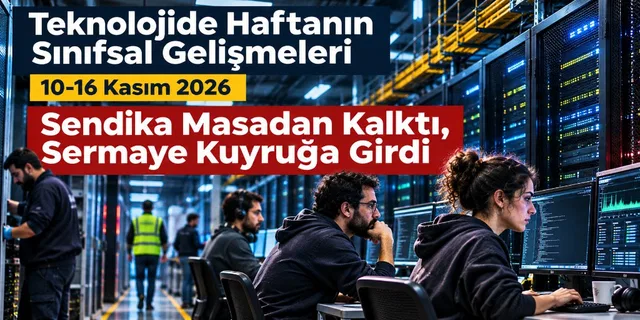
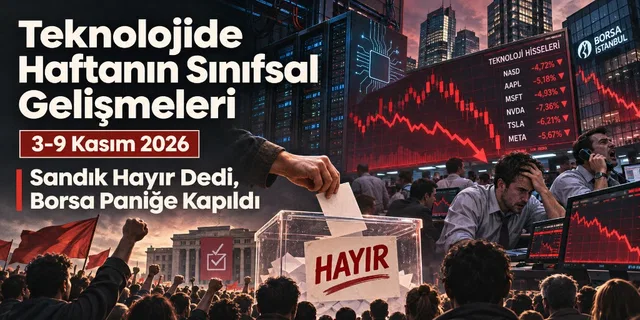
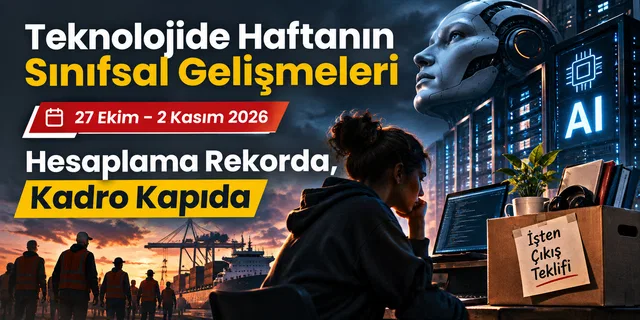
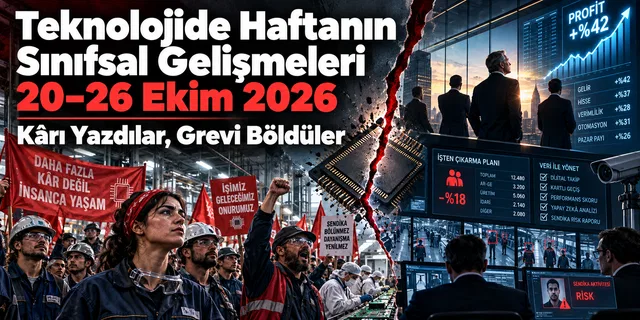
The Week's Class Developments in Technology - 17-23 November 2026
Capital Grows, Labour Loses Ground

About this series: This is the seventh issue. It was prepared using information available through the night of 22 November 2026; developments on 23 November are not included. Every Monday we gather technology and labour news and ask three questions: What happened? What does it mean in class terms? Why does it matter to us? This is a living document: please tell us about errors or omissions so that we can correct them.
First, a Short Summary
Dear young comrades,
The week in one sentence: as artificial intelligence capital enjoyed a historic week, the security of the workers who make that capital possible was diminished.
On Tuesday Nvidia reported quarterly revenue of $115.8 billion. On Wednesday Anthropic set its share price at $83; on Thursday the stock-exchange bell rang for the largest initial public offering on record. That Tuesday, Australia's Bunnings transferred 350 technology positions to a Tata partnership. That Thursday, in Lisbon, a voluntary exit programme targeting 950 posts was offered to a group of 1,400 people moderating content for Meta.
One story is about pricing social knowledge and computing power as private property. The other is about cutting labour costs. They are not necessarily linked by a direct causal chain, but they illuminate the same system.
The week was not all losses. More than 1,300 workers laying fibre networks in the United States authorised a strike. In Taiwan, Micron's Taoyuan union returned to mediation. Loudoun, the data-centre capital of the world, paused final decisions on certain applications. In Antalya, COP31 closed without agreement on an overall cover decision.
Continuing stories:
- Micron, Taiwan: Mediation resumed on 17 November without agreement. The union will put the company's proposal to a member vote; a second meeting is set for 26 November.
- Microsoft: Satya Nadella defended the voluntary exit programme but did not say whether compulsory cuts would follow. The decision deadline is in early December.
- Anthropic: The offering price was $83, raising about $81.3 billion; the first-day close was $97.17.
- Nvidia: Revenue was $115.8 billion and net income $65.3 billion, with an interim CEO in charge.
- Data centres: Loudoun County paused final decisions on certain applications for up to a year; Minneapolis's moratorium expired on 21 November without replacement rules.
- COP31: The conference closed without a cover decision on 22 November. The Antalya AI Pledge, announced on 16 November, contains no binding target.
- Qualcomm: The company notified California authorities of 520 permanent layoffs.
- Qantas and Accenture: The Bunnings decision intensified debate about “AI washing”.
New this week: Accenture's planned Meta-related cuts in Portugal; the Bunnings-TCS outsourcing deal; the Forged Fiber 37 strike vote; AI protections in collective agreements; job cuts at Yelp and Intel; the AI-assisted attack on the European Commission; and, in Turkey, MNT Tıp workers' dismissal dispute and access restrictions affecting 521 accounts in one week.
What We Published This Week
Our technology and labour articles published between 16 and 22 November:
- Hours Gained, Share Shrunk: AI, productivity and distribution in the ILO's new period.
- The AI-Assisted Attack on the European Commission: the class dimension of cybersecurity.
- The Work Has Not Disappeared: AI as a stated reason and alleged union discrimination at MNT Tıp.
The Week's Table
| Development | Capital's language | Labour's question |
|---|---|---|
| Nvidia results | “Our momentum is real” | What share of $65 billion in quarterly profit reaches the workers making the chips? |
| Nvidia shareholder returns | Returning value to shareholders | Why do Taoyuan workers seeking a share of profits face resistance while shareholders receive billions? |
| Anthropic IPO | Strong investor confidence | Who appropriates value distilled from society's shared knowledge? |
| Anthropic private sale | Strategic partnership | Is it competition when chip suppliers, cloud providers and shareholders overlap? |
| Accenture and Meta | Major changes in client demand | If Meta determines the work and Accenture cuts jobs, whom do workers bargain with? |
| Bunnings and TCS | Access to global expertise | If the work remains, what disappears: the work or the wage level? |
| Qualcomm | Performance-focused cuts | Whom do performance criteria protect when only the company controls them? |
| Microsoft | Employee initiative | What awaits those who do not accept voluntary exit? |
| Forged Fiber 37 | Negotiations continue | Why was a tentative agreement withdrawn? |
| Micron, Singapore | Investments proceed as planned | What message does new equipment in Singapore send to workers in Taoyuan? |
| Loudoun | Concern for investment | Why is it so difficult to pause after roughly 245 facilities? |
| COP31 and the Antalya pledge | AI as part of the climate solution | Whom does a pledge without a target bind? |
| European Commission attack | Necessary measures taken | Who accounts to workers when pay and leave systems are offline? |
| MNT Tıp | Transition to AI, downsizing | What does the union's account of eight dismissals and three new hires tell us? |
The Bell Rang for Capital
Nvidia: Record Revenue, Interim CEO, Enduring Ownership
17 November 2026 · United States · Semiconductors, ownership of computing, accumulation
What happened?
For the quarter ending 25 October, Nvidia reported $115.8 billion in revenue, up 103 per cent year on year and 20 per cent from the previous quarter. Data-centre sales accounted for $107.6 billion. Net income was $65.3 billion and the gross margin 74.8 per cent. Its next-quarter revenue forecast was $130 billion, subject to a margin of error.
The company returned $28.1 billion to shareholders through repurchases and dividends and had $227.3 billion in repurchase authorisation remaining. It reported an agreement to acquire Hugging Face, pending completion. The results were its first since founder Jensen Huang's resignation; chief financial officer Colette Kress was interim CEO while an independent board investigation continued.
Class reading. The person left, but ownership remained. As we asked in How a CEO's Private Life Became a Matter of “National Security”, capital does not depend on a single individual. A gross margin approaching 75 per cent also raises questions about concentrated market power. At the other end of the chain, Micron workers in Taoyuan have sought a permanent share of profits. A quarterly shareholder return and a workers' struggle for profit-sharing show how differently claims on the same productive network are treated.
Why it matters. An acquisition of Hugging Face would bring a major open-model repository under the ownership of a chip supplier. As we argued in How Should We Read the OpenAI and Hugging Face Affair?, the openness of models cannot be separated from ownership of repositories and hardware.
Anthropic: The Largest IPO on Record
18-19 November 2026 · United States · IPO, concentration, general intellect
What happened?
Anthropic priced its shares at $83, above the proposed $70-78 range. Selling 980 million shares raised roughly $81.3 billion. Trading began on Nasdaq under ANT at $111.50 and closed at $97.17. The offering valued the company at about $1.5 trillion.
Alongside the public sale, AMD, Broadcom, Google, Micron, Microsoft, Nvidia and TSMC bought $26 billion in non-voting Class N shares. BNN Bloomberg reported that Anthropic was unprofitable under standard accounting rules, had $6.2 billion in debt and had committed to $900 billion in computing and infrastructure spending over coming years, including $70 billion within twelve months. Its voting structure also concentrates control among founders and the Long-Term Benefit Trust.
Class reading. In The Monopoly on the Roadshow we described the contrast between public language and private ownership. The public offering raises funds without distributing control equally. Suppliers, customers and shareholders overlap: chip designers, manufacturers, memory suppliers and cloud providers have stakes in the model company. The valuation is also a bet on future returns that may include savings on labour. Marx's Grundrisse described the accumulation of social knowledge as general intellect; here that knowledge is priced through private shares.
Why it matters. Companies in Turkey pay for these systems in dollars while seeking productivity gains in their own workplaces. The question is not merely which model performs best, but who owns and controls the system and who benefits.
AI as a Pretext, Outsourcing as a Method
Accenture and Meta: Meta Determines the Work, Accenture Offers the Exit
19 November 2026 · Portugal · Outsourcing, content moderation, voluntary exit
What happened?
Reuters reported that Accenture aims to reduce about 950 posts by January through voluntary exits in teams serving Meta in Portugal, approximately 16 per cent of Accenture's Portuguese workforce. The Lisbon teams provide trust and safety services, including content moderation. According to another report, approximately 1,400 workers can apply. Accenture cited major changes in client demand; Reuters placed the plan alongside Meta's AI-related efficiency drive.
Class reading. Last week Accenture took on work from Qantas; this week it is seeking reductions elsewhere. Outsourcing lets capital acquire work and pass risk to workers. If a programme targets 950 posts from a group of 1,400, “voluntary” may describe the legal form without describing the pressure experienced by those offered the choice. Content moderators confront violent and abusive material, and some of their labour also supports the development of moderation systems.
Why it matters. Call centres, moderation firms and outsourced software teams in Turkey face the same split between the company directing the work and the employer on the payroll. Workers must identify both when organising and seeking legal advice; the responsibilities of principal and subcontractor depend on the facts and applicable law.
Bunnings and TCS: The Third “Partnership” of the Year
17 November 2026 · Australia · Outsourcing, offshoring
What happened?
Australian retailer Bunnings announced a technology partnership with Tata Consultancy Services. Around 230 permanent technology positions are to close and the work of around 120 contractors is to end; work moves to TCS teams in Australia, India and the Philippines, with a core team of approximately 500 remaining at Bunnings. The company presents lower costs and investment in customer experience as its rationale. Its announcement appeared alongside promotion of its AI shopping assistant.
The Australian Services Union criticised the decision as another instance of work being moved under the language of partnership. The debate follows the Qantas and Woolworths deals.
Class reading. The immediate change is not necessarily the disappearance of work through AI; the work is being reorganised and moved. Workers in India and the Philippines are not the enemy of workers in Australia. The beneficiary is the employer able to profit from differences in pay and bargaining power.
Why it matters. Turkey can be both a source of lower-cost software labour for European companies and a place from which work is outsourced. The Work Has Not Disappeared asks the same question: is automation eliminating a task or is management reorganising employment?
Qualcomm: “Performance” Reaches California
13-18 November 2026 · United States and India · Engineering labour, layoffs
What happened?
Qualcomm filed notice of permanent layoffs affecting 442 people in San Diego and 78 in Santa Clara, 520 in total. Its fiscal-year revenue fell by $1.16 billion to $37.2 billion. The cuts form part of a global reduction announced in October and described as following annual performance reviews. We covered the Indian part last week.
Class reading. “Performance” presents a collective management decision as an individual failing. Engineers' accumulated expertise offers no guarantee when the company's strategy changes. A high salary does not mean ownership of the means of production.
Why it matters. Performance criteria should be written down, known in advance and open to appeal. That demand is as important to organising in technology as wages.
In Brief: More Job Cuts
16-20 November 2026 · United States
- Yelp: A filing reported plans to cut about 5 per cent of full-time staff, with much of the savings redirected toward AI products.
- Intel: A 16 November notice reported 57 more Santa Clara positions eliminated. TheStreet reported that quarterly revenue rose 21 per cent while the workforce fell by 7,300.
- Microsoft: Nadella described the voluntary exit offer available to roughly 60,000 people as giving employees more initiative over their careers, but did not say whether compulsory cuts would follow.
Class reading. Yelp's explanation shows AI not simply as a tool performing work, but as an investment destination for money saved on staffing. A choice whose alternatives are set unilaterally is not the same as collective control.
Why it matters. A profitable company does not automatically provide job security. Workers' security depends on organisation and enforceable rights.
Those Still at the Table, Those Who Returned
Forged Fiber 37: Network Workers Authorise a Strike
17 November 2026 · United States · Telecommunications, first contract, strike authorisation
What happened?
The Communications Workers of America announced that more than 1,300 workers at AT&T subsidiary Forged Fiber 37 overwhelmingly supported authorising a strike. Vote totals were not released. The workers build and maintain fibre networks for homes and workplaces.
Negotiations for a first contract began in May. The union says the company withdrew a tentative agreement and has filed an unfair labour practice charge with the National Labor Relations Board. An authorisation is not itself a strike: workers were still working at the time of the report.
Class reading. Models and chips draw attention, but somebody must lay and maintain the cables. Network workers possess bargaining power precisely because digital infrastructure depends on their labour. Moving work into a separate subsidiary can also place established protections at risk and force workers to bargain from the beginning.
Why it matters. Telecommunications infrastructure in Turkey relies heavily on subcontracted field workers. The organisational distance between software workers and field technicians helps employers. Joint demands can challenge those divisions.
Micron: The Union Returns to the Table
17-20 November 2026 · Taiwan and Singapore · Profit-sharing, investment pressure
What happened?
Last week we reported that the Taoyuan union had acknowledged defeat in its profit-sharing campaign and said it would not attend the 17 November meeting. The picture changed: TrendForce, citing Liberty Times, reported that mediation resumed that day, without agreement. Differences concern a proposed collective agreement. The union plans a member vote and a second mediation meeting is scheduled for 26 November.
Micron also announced that the first equipment had arrived at its roughly $7 billion Singapore advanced-packaging facility, with initial output expected in early 2027. Bloomberg previously reported a pause in construction of the Taoyuan Fab 11E project. Micron said its Taiwan operations continued normally but did not directly address the reported construction pause.
Class reading. A lost campaign and a lost organisation are not the same thing. The union that acknowledged defeat returned to the table. Investment announcements in another country can also be understood as a reminder of capital's mobility, although the company's motive cannot be established from timing alone.
Why it matters. Employers' threats to move investment cannot be answered effectively in one country alone. Workers at different sites need channels to exchange information.
AI in Collective Agreements: The Problem Is Unilateral Authority
November 2026 · United States and Europe · Collective bargaining, algorithmic management
What happened?
A summary of a Guardian report describes concrete protections won by US public-sector unions. In Oakland, 94.1 per cent authorised a strike and a tentative three-year agreement was reached before the strike planned for 5 November. Workers whose jobs are displaced by AI are to be retrained or reassigned rather than dismissed. In Columbus, Ohio, the transit union secured a veto over the transit authority's driverless-vehicle plans.
In Europe, ETUC general secretary Esther Lynch argued that voluntary workplace AI guidelines are insufficient and binding rules are needed. A European Commission Quality Jobs Act proposal was expected in December.
Class reading. These demands are not an objection to technology itself. They challenge management's monopoly over decisions about work, assignments and performance. Oakland's protection followed a strike-authorisation vote; the order matters.
Why it matters. Collective agreements can demand prior notice, bargaining, reassignment instead of dismissal, appeals against automated decisions and shorter working time without loss of pay when productivity improves. See Hours Gained, Share Shrunk.
The Bill for Computing
Data Centres: Loudoun Pauses, Minneapolis Loses Its Moratorium
17-21 November 2026 · United States · Data centres, local resistance
What happened?
On 17 November Virginia's Loudoun County paused final decisions on certain legislative data-centre and electricity-substation applications for up to a year while reviewing its rules. The vote was seven to one, with one abstention. Developers may still submit applications and staff may continue reviewing them. Exceptions and exclusions apply; the county says 33 active applications could be affected. Virginia Mercury reported about 245 facilities built or under construction.
San Jose and Salt Lake City also adopted pauses. The Siting Report counted 218 new or updated measures between 5 and 18 November.
In Minneapolis, the city council failed on 20 November to override the mayor's veto, seven votes to five where nine were needed. The proposed rules would have limited data centres to existing downtown buildings and required disclosure of energy and water use. The six-month moratorium expired on 21 November without replacement rules.
Class reading. Loudoun's decision matters because data-centre tax revenues have long been presented as a benefit to schools and local services. Minneapolis shows that a council majority can still be blocked by a veto. Anthropic's long-term computing commitments will have physical counterparts in concrete, electricity and water somewhere.
Why it matters. For proposed projects in Turkey, communities should ask about environmental impact assessments, electricity connection capacity and water allocation. Rules should precede permission, not follow it.
COP31: No Cover Decision, a Pledge without Binding Targets
16-22 November 2026 · Antalya · Climate, AI, data centres
What happened?
COP31 ended without an overall cover decision on 22 November after countries including the EU, Panama and the Marshall Islands objected to a text that omitted fossil fuels. President Murat Kurum acknowledged the lack of consensus. The UN also reported progress on other matters, including a just-transition agreement.
Our coverage began by comparing the two climate summits in Antalya and asking whose agenda was on the official table. Our first-week assessment followed the fossil-fuel debate and protests. In A Class Diagnosis, an Incomplete Programme, we examined the Peoples' Climate Summit declaration from the perspective of class and ownership, including its call for transparent oversight of water use by data centres and AI infrastructure. Bargaining over the Climate in Antalya analyses the final draft and fossil capital's place at the table; it was written before the conference outcome was announced.
The COP presidency and ITU announced the Antalya AI Pledge on 16 November. Its themes include clean power for AI infrastructure, responsible design and procurement, environmental reporting and support for developing countries. It contains no binding target. The IEA estimates data-centre electricity use at 415 TWh in 2024 and around 945 TWh in 2030.
Class reading. A voluntary pledge and enforceable obligations are not the same. AI is presented as part of the climate solution while the sector's energy use is expected to rise substantially. Private profits and public costs must be considered together; see Confronting the Myth of the Cloud.
Why it matters. Accounts of climate organisations critical of COP31 were among those reportedly restricted in Turkey during the summit. A pledge to make AI sustainable should not silence the people asking how it is governed.
State, Shield and Trigger
19-20 November 2026 · EU, United States, China · Cybersecurity and military AI
What happened?
On 19 November a European Commission spokesperson confirmed that a publicly available AI tool had been used in the cyberattack detected on 22 October. The Commission did not name the tool or attribute the attack and said it had no evidence of a breach affecting all employees. Reports based on Politico identified HR, pay and leave applications among the systems taken offline.
US Treasury Secretary Scott Bessent said on 20 November that Donald Trump and Xi Jinping had agreed that humans should remain involved in military AI decisions.
Class reading. Cybersecurity is often discussed in terms of institutional reputation, although employees unable to access pay and leave systems are directly affected. Our related article is The AI-Assisted Attack on the European Commission. A promise of human involvement in military decisions also sits alongside competition between rival powers to develop military AI.
Why it matters. We need not choose between rival blocs. The question for each is who controls these systems and who bears their costs.
From Turkey
MNT Tıp: Eight Dismissed, Three Hired
17-19 November 2026 · Istanbul · Subcontracting, alleged union discrimination, AI
What happened?
Eight workers were dismissed by MNT Tıp, a subcontractor serving Istanbul Training and Research Hospital. Türkiye Sağlık-İş said the dismissals were due to union membership and announced reinstatement cases. Union official Recep Kaplan said three new workers had been hired afterward. Workers say one dismissal cited AI and that the promised transition had not actually occurred.
Class reading. The cases in Lisbon, Australia and Samatya differ in scale and circumstances, but each raises questions about outsourcing and how technological change is used to justify employment decisions. The union's account of new hires warrants scrutiny of both the AI explanation and the allegation of anti-union discrimination. See The Work Has Not Disappeared.
Why it matters. Workers and their representatives can ask which system was deployed, when and for which tasks, and whether replacement staff were hired. The courts will assess the specific evidence and legal conditions.
The Censorship Counter
17 November 2026 · Turkey · Access restrictions, freedom of expression
According to the Freedom of Expression Association (İFÖD):
| Period | X accounts blocked from access, at least |
|---|---|
| September 2026 | 1,270 |
| October 2026 | 867 |
| 1-2 November 2026 | 207 |
| The week reported on 17 November | 521 |
İFÖD's 17 November statement listed climate and energy specialist Önder Algedik and accounts belonging to the Salda Lake Protection Association, Climate Justice Forum and Ecology Union among those affected. During a summit hosted by Turkey, climate organisations criticising it were silenced. Reliance on a single platform makes this vulnerability more acute.
The Shared Class Meaning
First: productivity grows, security does not necessarily follow. Nvidia's revenue more than doubled year on year, while Qualcomm, Intel and Yelp cut staff. We do not claim a direct causal link between those individual events. They nevertheless show that technological capacity can expand without workers sharing equally in its gains.
Second: knowledge becomes social while ownership concentrates. Anthropic's IPO and associated private placement connect chip, cloud and model firms through a network of ownership. Nvidia's proposed Hugging Face acquisition raises the same issue for open models.
Third: capital acts across divisions while labour is fragmented. Meta determines demand while Accenture manages staffing; Bunnings transfers work to TCS; AT&T workers bargain at a subsidiary; a hospital contracts with MNT. Subcontracting can obscure the decision-maker facing workers.
Fourth: the issue is decision-making power, not the machine itself. From Oakland and Columbus to Forged Fiber, Taoyuan and Loudoun, organised workers and residents are asking to influence decisions that affect their work and communities.
What to Watch Next Week
| Date | Development | Why it matters |
|---|---|---|
| 26 November | Micron-Taoyuan mediation | What will the member vote say, and will there be an agreement? |
| Late November | Forged Fiber 37 bargaining | Will strike authorisation bring the tentative agreement back? |
| Late November | Accenture Portugal | What are the exit terms and how will workers respond? |
| Early December | Microsoft voluntary exit deadline | How many accept, and will compulsory cuts follow? |
| 1 December | Micron investor conference | How will the company describe Taiwan construction and the labour dispute? |
| December | EU Quality Jobs Act proposal | Will workplace AI be subject to binding rules? |
| Ongoing | Anthropic's first weeks of trading | How will the price develop and when may employee shares be sold? |
| Ongoing | Minneapolis and Loudoun | What new rules or applications follow? |
| Ongoing | MNT Tıp reinstatement cases | How will the AI rationale be tested? |
| Ongoing | Surveillance questions and the Google competition investigation | Ministerial responses and compliance with interim measures. |
| January 2027 | Qualcomm and Accenture Portugal | The reported next Qualcomm round and Accenture's target date. |
Concrete Tasks: What We Can Do
- Make an inventory of workplace AI. Which tools are used, who purchased them and what worker data do they collect?
- Ask three questions about an AI transformation. Was work transferred to a model or a subcontractor? Where did it go? Where were the savings allocated?
- Seek evidence when AI is cited in a dismissal. Ask which system was deployed, when and on what work, and whether replacements were hired. Follow the MNT cases.
- Do not assess a voluntary exit offer alone. Ask collectively about the target number, eligibility and what happens to those who refuse.
- Put five items in collective bargaining proposals. Prior notice, bargaining over implementation, reassignment instead of dismissal, appeal against automated decisions and shorter working time without loss of pay when productivity rises.
- Map the subcontracting chain. Identify the principal employer, the subcontractor and the party directing the work.
- Connect field and office workers. Software workers, system administrators, technicians, call-centre staff and moderators all work on the same network.
- Demand written, appealable performance criteria. A measure known only to the company protects the decision, not the worker.
- Ask for data-centre documentation. Environmental assessment, electricity connection capacity and water allocation should be available before permission is granted.
- Send us corrections and omissions. Readers with knowledge are contributors to this living document.
Closing: For Whom Did the Bell Ring?
The Nasdaq bell marked a week in which social knowledge was priced as private property. In Lisbon, Australia, San Diego and Samatya, workers faced different forms of insecurity. The week also showed something else: a union returned to the table after acknowledging defeat; fibre workers authorised a strike; public employees put AI protections into a draft agreement; and the centre of the data-centre industry paused decisions on some projects.
Technological development is neither automatic social progress nor automatic destruction. Ownership and organised struggle help determine who benefits from productivity. The bell rang for capital; whom the next bell will serve depends on the organisations we build today.
Knowledge belongs to everyone.
Related Articles and Sources
Previous issues
- 6-12 October 2026
- 13-19 October 2026
- 20-26 October 2026
- 27 October-2 November 2026
- 3-9 November 2026
- 10-16 November 2026
Sources
- NVIDIA, Financial Results for Third Quarter Fiscal 2027, 17 November 2026.
- Associated Press / BNN Bloomberg, Anthropic closes first day of trading at $97.17, 19 November 2026.
- Futurum, Anthropic IPO Makes Its Biggest Suppliers Shareholders, 20 November 2026.
- Reuters / Euronext, Accenture launches plan to cut 950 Meta-linked jobs in Portugal, 19 November 2026.
- Bunnings, Technology partnership announcement; Information Age, Bunnings to axe 350 tech jobs.
- CWA, AT&T Members Authorize Strike for Fair Contract, 19 November 2026.
- TrendForce, Micron Singapore facility and Taoyuan labour dispute, 20 November 2026.
- Loudoun County, Board Pauses Legislative Data Center and Substation Applications, 18 November 2026.
- UN News, COP31 ends without climate pact, 22 November 2026.
- ITU, COP31's Antalya AI Pledge, 16 November 2026.
- Reuters / RTÉ, AI tools used in cyberattack on European Commission, 19 November 2026.
- ANKA / Haberler.com, Sağlık-İş seeks reinstatement for eight workers.
- dokuz8HABER, İFÖD: 521 accounts blocked in the past week, 17 November 2026.
- Karl Marx, Grundrisse, “Fragment on Machines”; Capital, Volume 1, Chapter 13, “Machinery and Large-Scale Industry”.
- V. I. Lenin, Imperialism, the Highest Stage of Capitalism, sections on finance capital and monopolies.
This article is shared under the CC BY-SA 4.0 licence. You may reproduce, adapt and distribute it with attribution. This is a living document.