The Week's Class Developments in Technology - 3-9 November 2026
The Ballot Said No, the Market Panicked
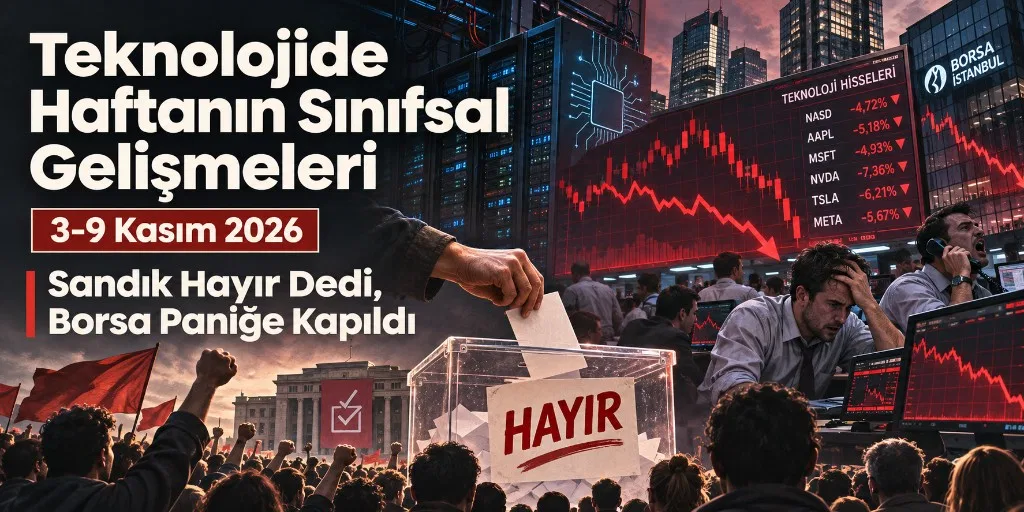
The Week's Class Struggle in Technology
3-9 November 2026
About this series: Every Monday we gather the developments of the previous week in the world of technology that matter for the class. We look at each heading through three questions: What happened? What does it mean in class terms? Why does it matter for us? We try to see not the news itself but the relation behind the news. This is the fifth issue of the series. You can reach the fourth issue, The Week's Class Developments in Technology - 27 October-2 November 2026, the third, The Week's Class Developments in Technology - 20-26 October 2026, the second, The Week's Class Developments in Technology - 13-19 October 2026, and the first, The Week's Class Struggle in Technology. In this issue we also report what became of the headings we said last week we would keep watching. We also have a correction: in the previous issue we wrote of the 5 November strike in Oakland as "next week"; the agreement had in fact come out on 31 October, before we closed the issue. The detail is below. This issue was expanded on the morning of 9 November 2026 after another pass through the week.
The Week's Class Developments in Technology - Issue 5 · 3-9 November 2026
First, a Short Summary
Dear young comrades,
The sentence that holds this week together is this: the ballot said no to the data centre, the market panicked, and the payroll was shown the door again. On 3 November data centres came to 41 local ballots in 10 states. According to Ballotpedia's count, in 40 of them the voters came out for a limit. Two days later the Nasdaq fell 5.52 per cent and entered a correction, and the semiconductor index melted by more than 12 per cent. The morning screens were showing a wipe of more than 2 trillion dollars; at the close, the value wiped from S&P 500 companies was about 3 trillion dollars. On Friday a partial rebound came in the chips, and the week still closed in the red. The detail is in the 9 November update of Where Did Two Trillion Dollars Go in a Single Day?. In one investor's words, "a real panic". In the same days Canva, in the first mass layoff since its founding, touched 22 per cent of its staff, 1,271 people. Squarespace cut 19 per cent. A week after showing 200 people the door, Dropbox announced 116 million dollars of net profit and 847 million dollars of share buybacks in nine months. Innodata, which closed the badges of 550 workers at noon in India, announced a "record quarter". In Taiwan, Micron's Taoyuan union came away empty-handed from the third mediation as well; the company halted construction of the new plant of 4.5 billion dollars. In Oakland, public-sector computing workers had an artificial-intelligence protection clause written into the contract before the strike date arrived. Google told the schools that want to turn artificial intelligence off, "then Search closes too". In Turkey the Competition Authority opened an investigation into Google's artificial-intelligence summaries and imposed an interim measure, an MP carried the chipped tracking at Astor to Parliament, and the Freedom of Expression Association (İFÖD) announced that 2,137 X accounts had been blocked from access in two months.
The week's table, in brief:
What was left over from last week
-
Micron: The third mediation on 6 November also ended without an agreement. The company, as Bloomberg reported a day before the meeting, halted construction of Fab 11E in Taoyuan almost completely. The fourth meeting is on 17 November.
-
Samsung Biologics: The company proposed postponing by two weeks the collective-agreement talks planned to start on 3 November; the reason is that the union wants the company's chief negotiator replaced.
-
Oakland: IFPTE Local 21 reached a three-year tentative agreement on 31 October; the contract contains a protection clause against the use of artificial intelligence. The 5 November strike was withdrawn.
-
Dropbox and Innodata: Both reported results on 5 November. At Dropbox profit was 116.1 million dollars; at Innodata revenue was a record, up 53 per cent.
-
Microsoft: The company said it expects 3,000 or fewer people to accept the "voluntary exit" offer it made to 60,000 people. It added that the offer does not replace layoffs. We wrote Forty Percent of the Code, a Quarter of the Staff.
-
Anthropic: On 2 November third-quarter figures were added to the prospectus. According to Bloomberg, the valuation investors were discussing fell, after the market crash, to 1.2-1.3 trillion dollars.
-
Hermantown: The environmental organisation MCEA and a neighbourhood initiative filed a new case on 4 November against the environmental review of the city and of Google. The same day two candidates who opposed the data centre were elected to the council.
-
Apple results (2 November): The company announced that the memory cost cut the margin and will cut it again in December.
-
Astor: EMEP MP Sevda Karaca asked the Minister of Labour about the chipped tracking in a question of 14 items.
-
DeFacto: The written question no. 7/51462, for the reinstatement of four computing workers, still stands on the record of the Grand National Assembly. On the morning of 9 November the ministry's reply had not been entered. We wrote Four Chairs at DeFacto's Door.
-
Gävle (1 November): Romanian workers on Microsoft's data-centre site in Sweden had a collective agreement written. The hourly wage is 260 kronor, and the unpaid-wage item is 15 million kronor. The detail is below.
-
Google, United Kingdom (2 November): Prospect agreed workplace access for about 7,000 employees. DeepMind is outside. The detail is below.
-
Pittsburg: The 45-day moratorium voted on 26 October was promulgated on 4 November. The approved first phase of the Avaio project is not stopping. An extension vote did not come out this week.
-
AEMO, Activision and Halk TV: We found no new decision that reached the public this week. At Halk TV the administrative leave continues "until further notice".
What is new this week
-
Canva (3-4 November): 1,271 people, 22 per cent of the staff, the first mass layoff in the company's history. We wrote A Generous Package, a Silent Table: What Do the Layoffs at Canva Tell Us?.
-
Squarespace (2 November): About 300 people, 19 per cent of the staff. In the same days a waiting list is open for Forma, its new artificial-intelligence platform.
-
Angi, Block, Amazon (3-6 November): At Angi about 300 posts, at Block a new round in customer and risk operations, at Amazon a WARN notice of 95 people in Washington. According to Challenger, the technology sector is in first place with 171,501 announced layoffs by the end of October.
-
The data centre at the ballot (3 November): In 40 of 41 ballots the voters came out for a limit. The sole exception is Harwood. We wrote The Data Centre Got Stuck at the Ballot Box.
-
The market (5-6 November): On Thursday the Nasdaq fell 5.52 per cent. The morning screen, a wipe of more than 2 trillion; at the close, about 3 trillion from S&P 500 companies. Friday's partial rebound closed by leaving the week in the red. We wrote Where Did Two Trillion Dollars Go in a Single Day?.
-
Google and schools (3 November): Students at schools that turn the artificial-intelligence tools off will not be able to reach Google Search either. We wrote Google Classroom's Real Class.
-
Google voluntary exit (announced on 4 November): The package was extended in June to Canada, France, Germany, Japan and Switzerland. Cloud and DeepMind are outside. Silicon and Class: An Epistemological Analysis of DeepMind's "From AGI to ASI" Report, Google Classroom's Real Class.
-
Amazon warehouses (4-5 November): An organising meeting with Unifor around Toronto. In Indiana the Teamsters announced it; Amazon said there is no certification. Gig Economy Dossier.
-
Turkey: The Competition Authority took a decision of an investigation and an interim measure on Google's artificial-intelligence summaries (The Price of the Summary). İFÖD announced that 1,270 X accounts in September and 867 in October were blocked from access. According to TÜİK, inflation in October was 2.58 per cent monthly and 29.77 per cent annually (One Wage in Ten Months). At Sözcü about 50 people were dismissed.
Below we first recall, with short summaries, the technology pieces we published this week, then open each development in detail.
This Week at Bilgi Müşterekleri: Our Technology Pieces
Between 2 and 8 November we published fourteen pieces on technology, labour, surveillance and the commons. If you missed them, start here.
Artificial intelligence, capital and the ballot
-
Parties Are Armies, Voters Are Soldiers: Curtis Yarvin's Post-Election Prescription (4 November) - The state project written in the court of techno-capital, and the class's answer.
-
US Election Results: A Blue Wave, the Same Shore (4 November) - The class balance sheet of the midterms. Why can the Democrats never be an alternative?
-
The Data Centre Got Stuck at the Ballot Box (5 November) - The class of the reaction rising at the ballot box against artificial intelligence, the electricity bill and the "new world".
-
Where Did Two Trillion Dollars Go in a Single Day? (5 November) - The ballot, the data centre and debt: a class reading of the collapse in artificial-intelligence shares.
Computing labour and the craft
-
Occupation or a Gift? (3 November) - OccupySaaS and the short life of an openness that is not a commons. Open source, the licence and the question of organisation.
-
The Class of Cognitive Surrender (4 November) - We read Addy Osmani's warning, "critical thinking while agents do the work", philosophically and in class terms.
-
A Generous Package, a Silent Table: What Do the Layoffs at Canva Tell Us? (5 November) - Why is the cost of artificial intelligence charged to the worker?
Platform monopoly, news and the school
-
Google Classroom's Real Class (3 November) - How does the monopoly that ties Search to Gemini turn schools into captive customers?
-
The Price of the Summary (4 November) - The Competition Board's Google decision, news labour, and the question of whose account the "economic value" will be written to.
Surveillance, identity and the bill
-
How Will Age Verification on Social Media Work, Technically? (2 November) - The e-Devlet token, the platform's control, and the anatomy of the screen tied to identity.
-
Whose Agenda at the Antalya Table? (2 November) - COP31's official agenda, the current debates, and the class of the crisis.
-
One Wage in Ten Months (3 November) - The price is updated every day, the wage once a year: the class calendar of inflation.
Organisation, language and thought
-
Class Is Back at the Table (8 November) - The questions opened by the Symposium on Classes and Politics in the 21st Century, and our Organising 2.0 proposal.
-
On Getting Free from the Language of Hegemony (8 November) - From Confucius to Gramsci, from Voloshinov to Freire: language, power and consent. On getting free from the language of hegemony.
The Week's Table: The Language of Capital, the Question of Labour
| Development | Capital's language | Labour's question |
|---|---|---|
| Micron, the third mediation | "We are improving the bonus system" | If the calculation system is put on the company screen rather than on the table, at which table is the bargaining done? |
| The halt to Fab 11E construction | "Our operations continue as normal" | Is construction halted a day before the meeting an investment decision, or a message? |
| Samsung Biologics | "Mutual respect and trust" | Is it the side that postpones the table that wants respect, or the side that interferes in whom the other will choose? |
| The Oakland contract | "The financial limits set by the council" | If the artificial-intelligence clause was written as the strike date approached, what got it written? |
| Canva | "Rebuilding Canva", "small, strengthened teams" | Is it not the 1,271 people left outside, while it was being rebuilt, who are rebuilding the company? |
| Squarespace | "Moving faster" | While the artificial-intelligence platform is on a waiting list, why is the staff already coming off the list? |
| The Dropbox results | "We beat the expectation, we raised the expectation" | When there is 116 million dollars of profit and 150 million dollars of buyback, by what necessity did 200 people go? |
| The Innodata results | "Another record quarter" | Was the record written by the data that the 550 people whose badges were closed had labelled? |
| Microsoft | "The chance for the employee to leave on their own terms" | If the offer does not replace the layoff, what is the word "voluntary" protecting? |
| The data centre at the ballot | "Economic benefit", "local employment" | While millions are spent on advertising, why did the neighbourhood still say no? |
| The market crash | "Regulatory risk", "a real panic" | If the result of a ballot is counted as a "risk", on whose consent did this investment rest? |
| The Anthropic valuation | "Market conditions" | A value that moves by half a trillion dollars in a week is the measure of whose labour? |
| Apple and memory | "Unprecedented memory prices" | The bill of the shortage is written first onto the price label. Then onto whom? |
| Google and schools | "Search and artificial intelligence are deeply integrated" | If the school's choice is "both, or neither", is this control, or compulsion? |
| Google's voluntary exit | "To support the important work ahead" | If DeepMind and Cloud are outside the package, whom does the word voluntary choose? |
| The Amazon warehouse | "A direct relationship" | If everyone's voice is heard, why is the union counted as coming from outside? |
| The Competition Authority decision | "User experience" | Where, in the value born of the summary, is the labour that produces the news? |
| The Astor question | "Work safety" | A device that cannot be taken off even in the toilet is for whose safety? |
Profit Sharing and the Right to Strike
Micron: The Third Table Also Empty, Construction Halted
Date: 5-6 November 2026 · Place: Taiwan · Subject: Semiconductors, profit sharing, the right to strike
What happened? In The Week's Class Developments in Technology - 27 October-2 November 2026 we wrote that the formula was being kept secret, and that the Taichung agreement contained a three-year strike-ban clause. On 5 November, according to Tom's Hardware, passing on Bloomberg's report, Micron halted construction at the 4.5-billion-dollar Fab 11E site in Taoyuan, apart from small security works. The company made no official statement; it said it had informed the local authorities and that its operations in Taiwan were "continuing as normal". The next day the third mediation meeting was held, hosted by Taoyuan City. As China Times reported, this was the fifth meeting in all, and again no agreement came out. The union said the company had brought no concrete offer in the first two mediations, that in the third it again received no concrete answer to its questions, and that what was told was the same as what was already being told to employees through internal channels. It also asked about the halting of construction; it received no answer. The company said that, in line with the union's demand, it would open next week a calculation system in which employees can see the bonus they will receive each quarter. The fourth meeting is on 17 November.
Background: Rest of World's file dated 5 November records the one-day action in October as the first strike in Taiwan's semiconductor sector. The action was small and symbolic, but the number behind it is large: the membership of Micron's two unions in Taiwan has risen in recent months from about 440 to over 13,000. The Taoyuan union has more than 2,300 members. Micron employs more than 15,000 people in Taiwan and makes more than 60 per cent of its DRAM production here. The sentence of union president Jerry Lin is plain: "It is not a problem that the company makes a profit, but the workers at the bottom should also take a share of the profit." President Lai Ching-te said the company and the workers should help each other "like fish and water".
A class reading: This week capital used two languages. The first is a technical language: "the calculation system will open next week". Putting the formula on the company screen instead of on the bargaining table takes the bonus out of being a right and turns it into a datum that is displayed. The worker sees the figure, but cannot have a say in how the figure was produced. The second is capital's oldest language: the investment strike. Construction halted a day before the meeting is the concrete form of saying "if you insist on your demands, the work goes somewhere else". It is no coincidence that the same report reminds us of the company's investments in Singapore, Japan and the United States. The mobility of capital is a weapon used against the worker who stays in place. But the picture is not one-way: membership rising from 440 to 13,000 also tells why this weapon was drawn now.
Why does it matter for us? The sentences "the investment will not come", "the plant will close", "the company will go to another country" are the invisible third party of every wage bargain in Turkey too. In computing the threat is shorter: "we will move the team to Eastern Europe or to India". Micron's story also gives a clue to the answer to be given to this threat. The threat arrives at the moment organising grows. Stepping back at that moment teaches capital that the threat works.
Samsung Biologics: The Table Postponed, the Negotiator Dispute
Date: 30 October-2 November 2026 · Place: South Korea · Subject: The right to strike, collective bargaining
What happened? In The Week's Class Developments in Technology - 27 October-2 November 2026 we wrote that the court ruling restricting the strike had been upheld, and that the union was discussing joining a federation. According to SBS's report of 2 November, the company proposed postponing by two weeks the collective-agreement talks planned to start on 3 November. The company's reason is that on 30 October the union asked for the company's chief negotiator to withdraw from the table entirely and to be replaced. The company calls this a "one-sided rejection" of the authority of management's bargaining committee; it also adds that the union is preparing a strike and "applying pressure through higher workers' organisations". The union had earlier described the talks as "all or nothing" and had announced that if they collapse it would go to strikes one after another. The "3 December, final round" calendar we passed on last week and this report do not fully match; the calendar is not settled.
A class reading: The phrase in the company's objection is instructive: "pressure through higher workers' organisations". What is legitimate for capital, that is, is that the union in the plant stays inside the plant. The moment the union turns to a federation, a confederation, to Parliament, "pressure" begins. Last week we said "the union has begun to look for power outside the plant"; what the company objected to this week is exactly this turn.
Why does it matter for us? This is also one of the sentences workplace unionism in Turkey hears most often: "we talk with our own employees, not with people who come from outside." The industry union, the confederation, the lawyer and the press coming to the table is what the employer avoids most. In computing too, the strongest answer to the offer "we will sort it out among ourselves" is to show that one is not alone.
Oakland: The Clause Written Before the Strike Date Arrived
Date: 31 October-2 November 2026 · Place: United States · Subject: Public-sector computing labour, the artificial-intelligence clause
What happened? First, a correction: in The Week's Class Developments in Technology - 27 October-2 November 2026 we wrote that IFPTE Local 21 had called a one-day strike on 5 November, and that this was something "we would watch next week". Yet according to the City of Oakland's statement of 31 October, the parties had that day agreed a three-year tentative contract. The contract contains a total pay rise of 9 per cent, being 2.5 per cent in January 2027, 2.5 per cent in January 2028 and 4 per cent in January 2029, support for public transport, an equity adjustment for low-paid posts, and a protection clause against the use of artificial intelligence. The union withdrew the 5 November strike notice. The city reported that the SEIU Local 1021 table had also been completed; Oaklandside wrote on 2 November that the city's large unions had prevented the strike by agreement. Members will vote on the contract, and then the council will approve it. The full text of the artificial-intelligence clause has not yet been made public.
A class reading: A month ago the city's pay offer ignored artificial intelligence. A strike date was announced, and a week later the clause entered the contract. What changed in between is not the technology. It is the balance of power. Capital and the state can keep saying "artificial intelligence is not a subject of the contract, it is a management right" only when there is no organised calendar across the table. Let us not make a large claim before we see the content of the clause; but even a public institution counting the use of artificial intelligence as a subject of the collective agreement is an important precedent.
Why does it matter for us? In Turkey, even the collective agreement in front of the public-sector computing worker is limited, and the right to strike is treated as if it did not exist. But the demand itself is the same: the worker should not be held responsible for the model's error, and the model should not be an excuse for the workload. Oakland showed that this demand can be put in writing in a union contract. We too can write these two sentences at the head of our own demands.
Gävle: Those Who Built the Data Centre Wrote a Contract
Date: 25 October-4 November 2026 · Place: Sweden · Subject: Data-centre construction, migrant labour, the collective agreement
What happened? Romanian workers on the construction of Microsoft's data centres in Gävle and Sandviken had a collective agreement written between Solidariska byggare, affiliated to SAC, and the Irish contractor Benbau. Members approved the text on 25 October. The agreement came into force on 1 November. The hourly wage is 260 Swedish kronor. The item for unpaid wages and compensation is 15 million kronor. In SVT's report of 3 November, organiser Pelle Sunvisson gave the number of members at Benbau as 78 and the number of workers on the site as about 150, and said that about 100,000 kronor falls to each person on average. Byggnadsarbetaren writes that the agreement covers about 200 employees. We could not close the gap between 78 and 200 in this issue. The union describes the text as the first Swedish collective agreement written by migrant workers and for migrant workers. Investigate Europe's file of 30 October writes that the agreement was tied a few days after the company was asked about the claims of unpaid wages and long hours.
A class reading: In The Data Centre Got Stuck at the Ballot Box the neighbourhood said no to the centre's bill. At the other end of the same week, the migrant worker building the centre had the wage written into a contract. They are two doors of the same demand: one is electricity and water, the other is the construction itself. In Where Did Two Trillion Dollars Go in a Single Day? we passed on the union-labour condition on Gina Hinojosa's list. Amy Acton, elected in Ohio, also ties the moratorium to the condition that the whole of the electricity cost is met and that the construction is done with union labour. Gävle shows that this condition can be written on the site without waiting for a law.
Why does it matter for us? On data-centre and energy sites in Turkey, the subcontractor, migrant labour and day labour are intertwined. The main employer does not sign the contract. The contractor does. Microsoft is not at the table. Benbau is. This split is familiar. The answer to the subcontracting chain that takes the main employer out of responsibility is, as in Gävle, to organise on the contractor's site and to put the wage in writing.
AEMO and Activision: The Silence Continues
Date: 2-8 November 2026 · Place: Australia, United States · Subject: Critical infrastructure, game labour
What happened? On 2 November AEMO published a new collective-agreement update on its site, but we could not reach the text. After the control-room workers' three rejections, and after back pay was taken off the table, we found no new decision or ballot result that reached the public. At Activision too, no report came out that the strike authorisation won by quality-assurance workers had been used, or that a new meeting had been held.
A class reading: The absence of news does not mean the struggle has ended. But one of capital's favourite weapons is to stretch the calendar: let the moment of leverage pass, let the authorisation lose its freshness, let the worker tire. We keep watching both headings for that reason.
The Payroll at the Door, the Profit in the Till
Canva: The First Mass Layoff in Thirteen Years
Date: 3-4 November 2026 · Place: Australia, global · Subject: Software, artificial intelligence, layoff
What happened? The design platform Canva, as The Week reported, announced that 1,271 people, about 22 per cent of its staff, would be laid off or repositioned. This is the first mass layoff in the company's thirteen-year history. The report says annual revenue stayed at 3.69 billion dollars, below the internal target of 5.2 billion dollars, that the number of active users fell by about 12 million in a year, and that large investors cut the company's value from a peak of 42 billion dollars to a range of 31 to 34.9 billion dollars. CEO Melanie Perkins called this the "hardest moment" in the company's history and said "new technology is transforming what people can create". According to Fast Company's round-up, the company's official sentence is this: "To prepare for the next ten years we need to rebuild Canva, and return to our roots of small and strengthened teams." The package is relatively generous: at least six months' pay, twelve months of health insurance, career support, and the right to keep the company computer. As The Verge reported, not all of the 1,271 people are being laid off: some will have their role changed, and some will be called to move to the centre in Sydney. From January, most hybrid workers are expected in the office two or three days a week. TechCrunch writes that the revenue-growth estimate was cut from 30 per cent to 20 per cent. We had worked through the class meaning of the call back to the office in The Machine Is New, the Chain Is Old: A Class Anatomy of Remote Work. The machine made remote work possible. The chain is calling the body back to the office.
A class reading: In A Generous Package, a Silent Table: What Do the Layoffs at Canva Tell Us? we summed this up as "a generous package, a silent table". Canva's trouble is that artificial intelligence cheapens design labour and that the user shifts from the tool directly to the model. Artificial intelligence, that is, is pulling Canva's market towards rival monopolies. The company charges the cost of this competition to its own worker. The generosity of the package is the instrument of making the decision itself undiscussable: six months' pay is paid as the price of never having sat at the table.
Why does it matter for us? People who work in design, content and product teams in Turkey are both users and rivals of Canva. It was seen once more this week that the sentence "new technology is transforming creativity" is also the sentence of transforming the bargaining power of creative labour. However good the package, if the worker has no say in who goes, this is not bargaining. It is an announcement.
Squarespace, Angi, Block, Amazon: The Large Sum of Small Cuts
Date: 2-6 November 2026 · Place: United States, global · Subject: Software, the platform, layoff
What happened? The website-building platform Squarespace, according to TechCrunch's report of 2 November, is cutting about 300 people, 19 per cent of its staff. The company announced this as a restructuring done "to move faster". The same report recalls that artificial-intelligence tools which produce a site from a short prompt have changed the sector, and that Squarespace has opened a waiting list for Forma, its new artificial-intelligence platform. According to The Next Web, in a report based on a note Business Insider saw, most of the cut is in the product and engineering teams. Those who go have at least 16 weeks' pay, benefits until May 2027, and the right to keep the computer. After the note, CEO Anthony Casalena made a broadcast of about one minute, with comments closed. The company had been sold to Permira in 2024 for about 7.2 billion dollars and had left the stock exchange. According to Fast Company's November round-up, the home-services platform Angi, together with its results on 3 November, cut about 300 posts, weighted toward middle management and support work. The day after its results, Block started a new round in the customer, education-and-content, and risk operations of Cash App and Square. Amazon gave a WARN notice of 95 people in Washington state. According to Challenger, Gray & Christmas, the technology sector is at the head of all sectors with 171,501 announced layoffs by the end of October; this is 21 per cent more than the same period last year.
A class reading: Look at the list of the jobs that were cut: customer operations, risk operations, support, the middle tier, the team that builds sites from templates. These are not the jobs artificial intelligence calls "automatable". They are the jobs capital says "I will now have the customer and the model do this work". Squarespace's story is ironic: the staff goes while the company's artificial-intelligence platform is still on a waiting list. What becomes the justification for the layoff is not the technology itself, but the expectation about the technology.
Why does it matter for us? In Turkey too, the call centre, customer service and fraud-prevention teams are among the most crowded white-collar jobs in banking and e-commerce. For the people who work in these jobs, the proletarianisation we told in Beyaz Yakalının Sefaleti took a concrete form this week on the lists in the United States.
Dropbox and Innodata: The Till After the Door
Date: 5 November 2026 · Place: United States, India · Subject: Results, layoff, data labour
What happened? In The Week's Class Developments in Technology - 27 October-2 November 2026 we had put both companies' results on the list to watch, with the question "will the profitability sentence be confirmed". Both reported on 5 November. According to the results Dropbox filed with the SEC, quarterly revenue almost stood still, at 637.3 million dollars (a rise of 0.5 per cent), but GAAP net profit was 116.1 million dollars. The company bought back 150.2 million dollars of shares in this quarter alone, and 847.3 million dollars in the first nine months of the year. The restructuring cost related to the layoffs was 8.1 million dollars this quarter. In the same statement it said it would buy Tigris Data with 350 million dollars in cash. The CEO called the quarter "a quarter in which we beat the expectation and raised the expectation". Innodata announced a record quarter: revenue up 53 per cent to 95.6 million dollars, net profit 10.3 million dollars. The company raised its annual growth expectation to above 42 per cent. The statement does not mention the about 550 workers in India who were dismissed by having their badges closed; it only notes that a programme at a large customer will end and is expected to be replaced by new programmes.
A class reading: Put these two tables side by side and there is no need for words. At Dropbox the cost of 200 people leaving is 8 million dollars; the money transferred to the shareholder by buyback in the same quarter is eighteen times that. The layoff here is not a necessity. It is a line in the redistribution of surplus value to the shareholder. At Innodata, the invisible labour of artificial intelligence is in front of us in its barest form: the badge of the worker who prepared the data that trained the model closes at noon, and a week later the company says "record" and passes in one sentence over the customer programme having changed. Who the customer is, why the programme ended, where the workers went: there is no place for these in the results. This was exactly what we told in The Human in the Loop.
Why does it matter for us? In Turkey the most frequent grounds for layoffs are "economic conditions" and "a necessary downsizing". The strongest weapon against this ground is the company's own figures. Asking for the results at publicly listed companies, and at companies that are not listed for the profit share the partners take and the bonuses paid to managers, empties the sentence of "necessity".
Microsoft: An Offer to Sixty Thousand, an Expectation of Three Thousand
Date: 30 October-6 November 2026 · Place: United States, India, United Kingdom, Canada · Subject: Voluntary exit, layoff
What happened? In The Week's Class Developments in Technology - 27 October-2 November 2026 we wrote that Microsoft had offered a "voluntary exit" to about 60,000 people. According to People Matters, in a report based on Business Insider, the company expects 3,000 or fewer people, corresponding to about 5 per cent of the eligible staff, to accept this offer. The deadline is early December; those who accept are expected to leave by the end of the year. The sentence in chief financial officer Amy Hood's internal note is this: "Our aim is to offer this chance to employees who choose to leave the company on their own terms." The company also stated that the programme does not replace layoffs, and that downsizing may continue depending on conditions.
A class reading: Showing the door to sixty thousand people and expecting three thousand to leave suggests that the aim of the offer is less to reduce the staff than to send a message. What is said to the remaining fifty-seven thousand is this: "The door is open, you can leave on your own terms; if you do not leave, the next terms may be ours." "Voluntariness" here is an instrument that disciplines those who stay.
Why does it matter for us? In Turkey the mutual-termination contracts called ikale arrive in the same language. Before you sign under the offer, calculate together, without fail, the reasonable benefit, the severance and notice pay, and the effect on unemployment benefit. The word "voluntary" can change your legal consequences.
Google: DeepMind Inside, the Door for the Others
Date: 2-4 November 2026 · Place: United Kingdom, Canada, France, Germany, Japan, Switzerland · Subject: Union access, voluntary exit
What happened? Two reports showed two faces of the same company. According to the Guardian's report of 2 November, the Prospect union agreed workplace organising access for Google's about 7,000 employees in the United Kingdom, including YouTube. DeepMind is outside the agreement. The Communication Workers Union and Unite are seeking a separate recognition for DeepMind. In September Prospect had made a similar access agreement for Meta's about 5,000 employees in the United Kingdom. The right to enter the workplace came into force on 30 October. If the membership reaches the recognition threshold, Prospect will want a say on pay, on flexible work, and on how artificial intelligence is brought in.
On 4 November Reuters wrote that the company had confirmed Google extended the voluntary exit package in June to Canada, France, Germany, Japan and Switzerland. How many people accepted was not disclosed. A spokesperson described the package as supporting the important work ahead. In past rounds Google Cloud and DeepMind had been left out. Reuters writes that this round too appears to be on the same line. About 5,000 people work in Switzerland. Those who accept are given one month's pay per year of service, with a ceiling of 12 months. Departures began in August. According to one person, in a team of about 50 at least four accepted. There is no total figure (Reuters).
A class reading: In Forty Percent of the Code, a Quarter of the Staff we wrote that Microsoft had shown the voluntary door to a quarter of the staff. Google uses the same word in a narrower geography. Whom the door is closed to is also a choice: DeepMind and Cloud are kept inside, the others are called to the exit. In Silicon and Class: An Epistemological Analysis of DeepMind's "From AGI to ASI" Report we had asked for whom this unit draws the model. This week the company gave part of the answer by keeping that unit outside both union access and the exit package. The labour closest to the model is placed far from both bargaining and organising. In Google Classroom's Real Class we had worked through how the package is tied to the school, and in The Price of the Summary how the same package reaches news labour. This week a third link appeared: while the door of the workplace is prised open by law, the door of the artificial-intelligence unit is closed from the inside.
Why does it matter for us? In computing in Turkey, the voluntary exit and the ikale arrive in the same sentence. Google's Swiss formula, one month per year of service and a ceiling of 12 months, is a measure for comparison. If an offer comes, put the reasonable benefit, the seniority and the unemployment benefit beside this ceiling. And ask this: where in the package is the artificial-intelligence team? If a unit is left outside, voluntariness is not a downsizing. It is the company choosing who will stay.
Amazon: A Meeting in the Warehouse, a Denial in the Company
Date: 4-5 November 2026 · Place: Canada, United States · Subject: Warehouse labour, unionising
What happened? According to CBC's report of 4 November, Amazon warehouse workers around Toronto opened an organising meeting with Unifor in Scarborough. The same morning leaflets were also handed out at the Bolton and Ajax warehouses. The workers want pay, safety, and the pace lowered. A worker who spoke to TorontoToday gave the starting wage in Scarborough as about 24 dollars and the demand as 30 dollars. The same report contains a claim that a warning comes for time away from the task of more than 30 minutes a day. This is a claim. The company did not confirm it. Amazon spokesperson Amy Diaz said most of what Unifor recounted was not true. Another spokesperson, Sam Stephenson, defended what the company calls a direct relationship: let everyone's voice be heard, not only a few people's. The only unionised Amazon facility in Canada is the Delta warehouse in British Columbia. Ontario holds more than half of the company's workforce in Canada.
The next day FreightWaves wrote that the Teamsters had announced that drivers who drive trucks inside the OIL9 facility in Merrillville, Indiana, and who are on Amazon's own payroll, had organised. The union had previously put forward the same claim in Shepherdsville, Kentucky, and in Liberty, Missouri. Amazon said the Teamsters are not a certified bargaining representative at even a single one of its facilities, and that this is a false narrative. An announcement is not a certification. We are writing both. The Washington notice of 95 people on the office side is not the subject of this section. That cut stands above, in the same round-up as Squarespace.
A class reading: In Gig Economy Dossier we had worked through the algorithmic boss, the piece rate, and the strike that has no name in the law. The Amazon warehouse is the staffed form of that dossier: the worker is on the company's payroll, the pace is still measured, and the union is still declared to be from outside. The direct-relationship sentence is the warehouse version of the "we talk with our own employees" sentence that Samsung Biologics used this week. In Four Chairs at DeFacto's Door the office form of the same door is standing. The meeting in the warehouse and the chair in the office are the same question: if you organise, what happens to your job?
Why does it matter for us? In Turkey the e-commerce warehouse and the courier are two ends of the same pace. The subcontractor keeps the union outside the door. The plain fact of the meeting in Ontario is this: the workers booked the hall, handed out the leaflet, and said the figure of the wage. Here too the first step is to write the figure of the pace and of the wage together.
The Ballot, the Market and the Ownership of Compute
The Data Centre Came to the Ballot, the Neighbourhood Won
Date: 3-5 November 2026 · Place: United States · Subject: The data centre, energy, local democracy
What happened? In the US midterms, data centres were not only the subject of the campaigns. They were voted on directly. According to Ballotpedia's count of 6 November, in 40 of 41 local ballots the voters came out for a limit or an opposing stance. The sole exception is Harwood, in North Dakota: the voters rejected a proposal for an additional review that also covered data centres. A full ban was voted in five places, a partial ban in twelve. CNBC writes that the ballots spread across 10 states, and that Ohio, with 21 ballots, held more than half the list. Governor-elect Amy Acton favours a moratorium that requires data centres to meet the whole of the electricity cost and construction to be done with union labour. The first day's AI Weekly count had written that the opposing stance won in 38 of more than 40 ballots. The full count is 40 to 1. According to Tech Policy Press's assessment, in places such as Sunbury, Pataskala, Urbana, Granville and Trenton in Ohio, ban or restriction proposals were accepted with votes above about 70 per cent. Groups tied to the sector had spent at least 2.54 million dollars, in Ohio alone, on advertisements telling the economic benefit of data centres. In Georgia, on the Public Service Commission, where the effect of data centres on the electricity bill was debated, the Democrats took the third seat as well and took the majority for the first time since 1996. AI Weekly reports that Elon Musk spent 224 million dollars on candidates favourable to data centres in Texas. After the election, Jamie Raskin in Congress opened an investigation into the non-disclosure agreements in data-centre projects. In Hermantown, which in The Week's Class Developments in Technology - 27 October-2 November 2026 we mentioned for capping the chamber at 85 people and approving at midnight, MCEA and the "Stop the Hermantown Data Center" initiative filed a new case on 4 November against the environmental review of the city and of Google. The same day two candidates who opposed the data centre, Emma Richtman and Candi Mock, were elected to the city council.
A class reading: In The Data Centre Got Stuck at the Ballot Box we summed this up as "the data centre got stuck at the ballot box". The neighbourhood did not vote against artificial intelligence. It voted against who is made to pay for the electricity bill, the water and the air. The data centre is the place where the ownership of compute presses onto the land, the water and the grid. There capital says "economic benefit", and the neighbourhood reads the bill. In an interview he gave to Truthout on 7 November, JS Tan marked the split inside this no: the proletarianising computing worker can fall on the same side as the neighbourhood, but the construction unions do not, for now, because the data centre is what gives the contract and the work. The contract in Gävle showed that this split can be closed on the site. But let us add a warning at once. This reaction at the ballot box does not change the class character of the Democratic Party that gathered it. As we told in US Election Results: A Blue Wave, the Same Shore, the blue wave breaks on the same shore. The bans and limits the neighbourhood won can, without its own organisation, turn into a subject of bargaining in the next wave of investment.
Why does it matter for us? In Turkey too, data-centre and renewable-energy investments are made by a decision of "public benefit", most of the time without the neighbourhood being asked. What we have learned since Akbelen is the same: read the plan, the zoning and the energy-connection document before the foundation is poured, and object locally, together. Ohio's 70 per cent showed us that this can be done.
The Market: Two Trillion in the Morning, Three at the Close
Date: 5 November 2026 · Place: United States, global · Subject: Artificial-intelligence shares, financialisation
What happened? Thursday's close was harsher than the morning screen. According to Reuters, the S&P 500 fell 4.36 per cent and closed at 7,353.73 points. The Dow retreated 3.44 per cent, losing 1,833 points. The Nasdaq closed at 24,315 points with a fall of 5.52 per cent, and confirmed the correction by going more than 10 per cent below the record of 6 October. The value wiped from S&P 500 companies was about 3 trillion dollars. The semiconductor index retreated by more than 12 per cent. The morning screens' 2 trillion dollars, and the Nasdaq at 5.4 per cent with more than 2 trillion off the Nasdaq-100 that InvestmentNews reported, were the early pressure of the day. One fund manager's sentence became that report's headline: "This is a real panic." As the reason, what was shown was the possibility of tighter supervision of data centres after the Democrats won Congress, Bernie Sanders's call for a national moratorium, and signals of a rate rise from the Fed.
Friday brought a partial rebound, and did not take the week back. The Nasdaq rose 1.1 per cent, to 24,579 points. The S&P 500 rose 0.32 per cent and closed at 7,376.86 points. The Dow retreated by about 0.5 per cent. The semiconductor index recovered by about 4 per cent. AMD rose 11 per cent, Nvidia 2.8 per cent. The whole week stayed in the red: the Nasdaq 3.4 per cent, the S&P 500 2.7 per cent, the Dow 0.9 per cent. AP wrote that the S&P 500's weekly loss was the worst since the tariff shock of April 2025. On Friday the Kospi fell 6 per cent, and SK Hynix retreated by more than 10 per cent. In October non-farm employment rose by 165,000, unemployment fell from 4.2 per cent to 4.1 per cent, and the probability of a December rate rise went to 78 per cent. The breakdown of these figures, and the sources, are in the 9 November update of Where Did Two Trillion Dollars Go in a Single Day?.
A class reading: The question we asked in Where Did Two Trillion Dollars Go in a Single Day? was this: where did two trillion dollars go in a single day? The morning screen said so. The close showed about 3 trillion in S&P 500 companies. The answer did not change: nowhere. Because that value was never a value that had been produced. It was the price of an expectation about future surplus value. That expectation rested on the assumption that the data centres would be built without trouble, that electricity would stay cheap, and that the neighbourhood would stay silent. If the result of a ballot can be counted as a "risk", it becomes clear that these investments rested not on consent, but on consent not being sought. The question we asked in Bubble or Debt? Meta's 145 Billion Dollars and the Class Character of the AI Bubble also keeps its currency: who gained while it inflated, and who will pay while it deflates?
Why does it matter for us? The bill of this crash is charged first not to the shareholders but, under the name of "cost discipline", to technology workers. When, in the layoff announcements that will come in the weeks ahead, you see the sentence "market conditions", remember this week.
Anthropic: The Valuation Moved by Half a Trillion in a Week
Date: 2-8 November 2026 · Place: United States · Subject: The public offering, artificial-intelligence capital
What happened? In The Week's Class Developments in Technology - 27 October-2 November 2026 we wrote of Anthropic's public S-1 filing. According to FinanceFeeds' round-up, on 2 November the company added third-quarter figures to the prospectus: revenue about 17 billion dollars, an operating loss of 567 million dollars, and purchase commitments and leases totalling about 895.4 billion dollars. There is still no price range, share count or date in the prospectus. In investor meetings a valuation of 1.5 to 2 trillion dollars was being discussed. According to reports based on Bloomberg on 8 November, after the post-election sell-off the figure being discussed fell to 1.2 to 1.3 trillion dollars; some investors mention 1.1 trillion. It is written that the marketing tour may start this week; the company did not comment.
A class reading: A new figure was added this week to the question we asked in Shares to the Public, Votes to the Founders: Anthropic's IPO and the Class Character of the Market Wave: 895 billion dollars of commitments. This is not the figure of a software company. It is the figure of a mass of capital tied to computing infrastructure. The valuation moving by half a trillion dollars in a week shows that what is being measured is not labour but expectation. But take care: even if the valuation falls, the commitment does not. The chip, energy and data-centre contracts stay in place. While the expectation falls, to whom will the burden of the commitment be passed? The answer to this question may arrive in the months ahead as a cost cut.
Why does it matter for us? Even the account table of a company built with the discourse of "safe artificial intelligence" is subject to the general laws of capital. This shows once more that what we have to discuss is not the intention of individual companies, but the form of property.
Apple and Memory: The Bill of the Shortage Was Written on the Label
Date: 2 November 2026 · Place: United States, global · Subject: Memory, hardware prices
What happened? As StockAnalysis reported, Apple raised its revenue in the September quarter by 12 per cent, to 114.5 billion dollars, but cut its gross-margin guidance for the December quarter from 47.9 per cent to 45-46 per cent. Chief financial officer Kevan Parekh tied most of the fall to memory chips. CEO John Ternus, who took office in September, called memory prices "unprecedented" and said they will rise after December as well. Apple had raised the prices of the iPad and the Mac in June, and of the iPhone in September, to meet the memory cost. The company also stated that Mac and iPad supply will stay limited this quarter because of the memory constraint.
A class reading: In Whose Is the Memory in Your Computer? we had put side by side Sam Altman counting the memory in the personal computer as "waste", and SK hynix treating three years of production as sold. This week the last link of the chain appeared: even the world's most profitable hardware company is buying memory by competing with the data centres, and writing the difference onto the price label. What creates the shortage is not the personal computer. It is the concentration of compute in a few monopolies. The one who pays the bill is everyone who uses their computer and their phone as a tool of work.
Why does it matter for us? Hardware that is already expensive in Turkey through the exchange rate and tax is becoming more expensive still with the memory shortage. The price of the machine we use at school, at home and while working on our own is now set not only by the exchange rate, but also by the ownership of global compute.
The School, Search and the Monopoly
Google: The School That Turns Off Artificial Intelligence Loses Search Too
Date: 3 November 2026 · Place: United States, global · Subject: Education, platform monopoly
What happened? According to TechCrunch's report of 3 November, Google announced that next year, for K-12 students, Gemini, NotebookLM and the artificial-intelligence tools in Classroom will stay off unless the school administration explicitly enables them. At first glance this looks like a possibility of control. But according to the same announcement, if a school restricts artificial intelligence entirely, students will not be able to reach Google Search either; they will see on the screen a message saying that search was turned off by the school. The reason given by Google's head of education, Chris Phillips, is short: "Search and artificial intelligence are deeply integrated." The announcement fell on the same day as the launch of Guided Learning, Google's new artificial-intelligence teacher tool for classrooms.
A class reading: In Google Classroom's Real Class we named this a "package monopoly". A monopoly ties products to one another in order to carry market power from one product to the other. The choice put in front of the school is "both, or neither". When the spread of Chromebooks and Google applications in schools is taken into account, this choice is not a choice. It is a compulsion. The student, the teacher and the parent are not even customers here. They are captive users.
Why does it matter for us? In Turkey too, the Ministry of National Education and the universities have tied email, storage and classroom management in large part to the services of two monopolies. The "all or nothing" choice put in front of the school in the United States today can come in front of our schools tomorrow. Defending a public and free-software infrastructure in education is therefore not a technical preference. It is a question of independence.
From Turkey
The Competition Authority: The Summary Will Not Be Compulsory
Date: 2 November 2026 · Place: Turkey · Subject: Platform monopoly, news labour
What happened? As Evrensel reported, the Competition Authority opened an investigation into Alphabet and Google's companies in Turkey, on the claim of abuse of a dominant position because of the artificial-intelligence summaries (AI Overviews) and the artificial-intelligence mode in Google Search. Under the interim measure to be applied while the investigation continues, Google will not be able to force news publishers to include their content in artificial-intelligence systems. Publishers will be able to decide whether their content is used in the summaries, without the risk of losing their visibility in search results. Google will also have to offer media organisations equal, transparent and non-discriminatory contract terms for content use and pricing. The report also recalls the Reuters Institute's forecast that traffic from search to news sites will fall 43 per cent in three years.
A class reading: The question we asked in The Price of the Summary is this: is the decision protecting news labour, or is it only refereeing in the share fight between the publisher company and the platform? The measure is important; for the first time an institution openly bans the imposition "either enter the summary or disappear in search". But the parties named in the contract are the platform and the publisher. The worker who writes the news, takes the photograph and stands in the field is not a party to this contract. The same week, while dozens of people are dismissed at Sözcü, the question of whose account the "economic value of the content" will be written to becomes more burning still.
Why does it matter for us? For press workers this decision opens a new heading the union can bring to the table: that a part of every kuruş that comes from the platform be tied to news labour, to posts and to the wage. If this demand is not written, the gain of the measure is again written only to the boss's account.
The First Week of Age Verification, the Two Months of the Access Block
Date: 1-8 November 2026 · Place: Turkey · Subject: Digital identity, censorship
What happened? In The Week's Class Developments in Technology - 27 October-2 November 2026 we wrote of the e-Devlet age verification that came into force on 1 November. In the first week we found no new official statement on the platforms' application, on the data collected, or on where the records are kept; the deadline for existing accounts is still 31 March 2027. The same week İFÖD, in a statement it made on 2 November, announced that 2,137 X accounts, 1,270 in September and 867 in October, had been blocked from access from Turkey in two months. Journalists, academics, economists, and İFÖD's own account are on this list.
A class reading: In How Will Age Verification on Social Media Work, Technically? we had told, in technical detail, the anatomy of the screen tied to identity. This week two data came side by side: on one side, every account being tied to a state identity; on the other, two thousand accounts being made invisible in two months. Identity is compulsory, speech is conditional. Thirty-One Points: The Freedom on the Net 2026 Report and the Screen Tied to Identity is the sum of these two tendencies.
Why does it matter for us? The access block is now the problem not only of the journalist but of every organised voice. The communication of the union, the association and the solidarity network must not be tied to a single platform; alternative channels, such as an email list, a site of one's own built with free software, and federated social networks, have to be set up now.
Astor: Chipped Tracking in Parliament
Date: 3 November 2026 · Place: Turkey · Subject: Digital surveillance, migrant labour
What happened? The chipped tracking at Astor, which came onto the agenda with Evrensel's report of 25 October and which we took up in technical detail in The Card Around Our Necks, was carried to Parliament this week. Sevda Karaca, EMEP member of parliament for Gaziantep, gave Labour Minister Vedat Işıkhan a question of 14 items. According to the question, the devices workers wear throughout the shift at the plant in Sincan, Ankara, record location, movement, and time spent in certain areas; workers cannot take the device off even in the toilet and the rest area. Karaca asks whether the data collected is used in wages, bonuses, performance or dismissal; whether digital surveillance and algorithmic performance monitoring are inside the "new-generation working models" discussed with TİSK and the confederations on 6 October; how many workplaces across Turkey have been inspected because of digital surveillance; and how much resource is allocated to this in the 2027 budget. The question also asks the wages, insurance and housing conditions of the Nepali workers at the plant, the Social Security Institution (SGK) and Turkish Employment Agency (İŞKUR) incentives the company received, and the lifting of the asset measures, in the fund investigation, on the main shareholders.
A class reading: The question puts surveillance in its right context: in the same plant, while the worker's movement is recorded second by second, the demand for an interim rise goes unanswered, the migrant worker is used as cheap labour, and the shareholder's wealth grows. Digital surveillance is an instrument of raising the rate of exploitation and of dividing the worker. The question's item on "new-generation working models" is also in the right place: algorithmic management is being set up in fact, before it enters legal regulation.
Why does it matter for us? The minister's reply may be one of the first official positions in Turkey on the legal limit of digital surveillance in the workplace. Under the Rules of Procedure of the Grand National Assembly, written questions must be answered within fifteen days. Let us watch the reply together; if it does not come, let us keep asking.
Press Labour: Administrative Leave Continues, the Staff Narrows
Date: 30 October-8 November 2026 · Place: Turkey · Subject: Media labour, layoff
What happened? After the trustee at Halk TV extended the workers' administrative leave on 30 October "until further notice", no new decision reached the public; what happens to the wage keeps its uncertainty. The same day Evrensel wrote that the employment of about 50 people at Sözcü had been ended by a restructuring decision, that the dismissals were not limited to those who wanted to leave, and that more is expected. On 1 November Erman Toroğlu announced live on air that he had resigned from Sözcü and reacted to the dismissals.
A class reading: In one news channel the state blacks out the archive and ties the wage to an order; in the other the boss narrows the staff by "restructuring". The two methods differ, the result is the same: news labour is made insecure. This shows that the question we asked in Questions for Press Workers: Without Organisation There Is No Way Forward is still current: without organisation there is no way forward.
Why does it matter for us? The unemployment of the press worker is the narrowing of society's right to receive news. Supporting the union struggle of news workers is a task of solidarity for computing workers too; because it is also we who build the infrastructure of these sites and keep the broadcast going.
Inflation at 29.77 Per Cent: The Four-Month Fall Has Ended
Date: 3 November 2026 · Place: Turkey · Subject: The wage, the cost of living
What happened? According to TÜİK, consumer prices in October rose 2.58 per cent monthly and 29.77 per cent annually. In Cumhuriyet's headline, the four-month series of falls has ended. The same week, discussion of the 2027 budget continued in the Plan and Budget Commission.
A class reading: As we told in One Wage in Ten Months, the price is updated every day, the wage once a year. The Class of Three Thousand Kilowatt-Hours, which we wrote last week, and The Class of the Budget: In 2027, from Whom Is It Taken, and to Whom Is It Given?, which we wrote this week, are the two ends of this calendar. Hardware made more expensive by the memory shortage is also the technology line of this table.
Why does it matter for us? In computing, wages are most of the time updated once a year, at the company's discretion, and most of the time below inflation. This is why the demand for an interim rise has to be put, as a team, in writing and with a figure, and why the date on which the wage will be updated, and by which index, has to be written into the contract.
The Common Class Meaning of These Developments
First axis: The ballot, the neighbourhood and consent
70 per cent in Ohio, a new case and two new council members in Hermantown, a majority on the bill commission in Georgia. This week, in the place where compute presses onto the land, the question of consent was asked, and the answer was mostly "no". The next day the market priced this no as a risk. The morning screens said 2 trillion. The close wiped about 3 trillion dollars from S&P 500 companies. These two days side by side showed how far the wave of artificial-intelligence investment depends on the neighbourhood's silence. But the ballot on its own is not enough: if the neighbourhood's gain is not protected by its own organisation, it is taken back in the next offer package.
Second axis: The door and the till
Canva 22 per cent, Squarespace 19 per cent, Angi 300, Block, Amazon. The same week Dropbox announced 116 million dollars of profit and 150 million dollars of share buybacks, and Innodata announced record revenue. Microsoft shows the door to 60,000 people and expects three thousand to leave. Google kept DeepMind and Cloud inside and confirmed the voluntary exit to the other countries. The layoff is no longer a response to crisis. It is the ordinary instrument of management of profitable companies. The ground may be "artificial intelligence" or "rebuilding"; but the figures show that the cut is a line in the redistribution of surplus value to the shareholder.
Third axis: The investment strike and the package monopoly
Micron halted construction of 4.5 billion dollars a day before the bargaining. Samsung Biologics postponed the table because the union looked for support from outside. Google told the school "artificial intelligence and search, both or neither". The same logic in three different fields: capital narrows the choices of the one across the table by carrying the monopoly power in its hand from one field to the other. The investment strike says to the worker, the package monopoly says to the school, and both say to the rest of society, "there is no other way".
Fourth axis: Identity compulsory, speech conditional, news labour insecure
In Turkey, the first week of age verification, 2,137 access blocks in two months, a wage tied to an order at Halk TV, a cut of 50 people at Sözcü. While the Competition Authority's decision partly corrects the balance between the platform and the publisher, the position of the worker who produces the news grows weaker still. The Astor question carried the face of surveillance in the plant to Parliament. In an order where the screen is tied to identity and speech is tied to a condition, to be organised is also to organise communication itself.
What We Will Watch Next Week
| Date | Development | Why we are watching |
|---|---|---|
| Week of 9 November | The Anthropic marketing tour | Will a price range and a share count be announced, and will the valuation expectation fall further? |
| 9-20 November | COP31, Antalya: Whose Agenda at the Antalya Table? | Will the demand of data centres and energy come onto the climate table, and if it does, in whose language? |
| 10-14 November | The Micron bonus calculation system | Will the system show the formula, or only the result? |
| 17 November | The fourth Micron-Taoyuan meeting | Will a concrete offer come, and will Fab 11E construction start again? |
| Mid-November | The Samsung Biologics table | Will the postponed talks start, and how will the negotiator dispute be resolved? |
| November | The Oakland contract vote | Will the full text of the artificial-intelligence clause be published, and will the members approve it? |
| 18 November | The departure of Dropbox's technology chief | Will a second round of the restructuring come? |
| Early December | The last day of Microsoft's exit offer | How many people will leave, and will a compulsory layoff follow? |
| Continuing | The Hermantown case and the congressional investigations | Will the local approval be turned back by the courts, and will the data-centre non-disclosure agreements come into the open? |
| Continuing | The Competition Authority investigation | How will Google comply with the measure, and will news labour enter the contracts? |
| Continuing | The reply to the Astor question | Will the ministry state a position on digital surveillance? |
| Continuing | How Will Age Verification on Social Media Work, Technically? and the access blocks | The platforms' application, where the records are kept, the number of blocks in November |
| 10 November | Consumer inflation and the CoreWeave results | Will Thursday's bill be passed on to the payroll and to the indebted cloud company? The detail is in Where Did Two Trillion Dollars Go in a Single Day?. |
| Continuing | The Google exit package and access in the United Kingdom | How many people will leave, will Prospect approach the recognition threshold, and will DeepMind sit at a separate table? |
| Continuing | Unifor, Toronto and the Teamsters, Indiana | Will the meeting turn into a membership count, and will the announcement turn into a certification? |
| Continuing | The Gävle agreement | Will 260 kronor and 15 million kronor be applied on the site, and will the gap between 78 and 200 close? |
| Continuing | Halk TV, AEMO, Activision QA | What becomes of the wage, the ballot result and the strike authorisation |
| Continuing | The DeFacto question | Will the ministry write a reply to 7/51462? |
Concrete Tasks: What Falls to Us
-
Read the company's figure. When the sentence "a necessary downsizing" comes, ask at publicly listed companies for the results, the share buyback and the managers' bonuses; at companies that are not listed, for the profit share distributed to the partners. Dropbox's profit of 116 million dollars and buyback of 150 million dollars showed why this question matters.
-
Calculate together against the words "voluntary" and "mutual". When an ikale or a voluntary-exit offer comes, assess the reasonable benefit, the severance and notice pay, and the effect on unemployment benefit not on your own, but with your team and, if possible, with a union lawyer.
-
Bring the bonus and wage formula to the table, not to the screen. If the company shows a "calculation system" or a "performance panel", ask for the written text of the formula and for the items with which it is calculated. What was seen at Micron is this: the figure that is displayed is not the figure that is bargained.
-
Write the artificial-intelligence clause at the head of the demands. Oakland showed this week that this can be done: the worker should not be held responsible for the model's output, the model should not be an excuse for the workload, and its use should be a subject of collective bargaining.
-
In the neighbourhood, read the data-centre and energy document. Read, before the foundation is poured, the zoning plan and the water and electricity connection document of a data centre, a solar plant or a wind plant planned in your area, and organise the objections together. In Ohio, 70 per cent came this way.
-
Document the tracking device in the workplace. Card, wristband, application or camera: ask in writing what it collects, who has access, and whether the data is tied to the wage or to performance. The Astor question showed that these questions can be carried as far as Parliament. Let us watch the reply together.
-
Defend free software in the school and the university. If you are an education worker, ask to which company, and on what terms, your school has tied its email, its storage and its classroom management. Google's "all or nothing" imposition showed that the price of dependence is certain to be charged one day.
-
Do not tie your communication to a single platform. Set up now the email list, the site of its own, and the federated social-network account of your union, your association, your solidarity network. 2,137 accounts were blocked in two months; the next one may be yours.
-
Stand in solidarity with press workers. Make visible the struggle for the rights of the workers on administrative leave at Halk TV and of the workers dismissed at Sözcü; share the calls of their unions.
-
Put the meeting in the warehouse and the chair in the office in the same sentence. In Toronto the workers said the figure of the wage. In Gävle the migrant construction worker had the contract written. The four people in Four Chairs at DeFacto's Door are still at the door. All three are the same question.
-
Correct this digest. As we noticed Oakland late this week, if there is a development that did not escape your eye, if you saw a document from Micron's calculation system, from the Samsung Biologics table, from Astor, or from the first days of age verification, write to us. This series grows by common labour.
Not Opposition to Technology, but a Say over Technology
Dear young comrades,
This week the voters of a town in Ohio said no to the data centre, even though millions were spent on advertisements. The next day the market priced that no as a risk. The morning was saying 2 trillion. The close wiped about 3 trillion. Friday gave a small part of it back, leaving the week in the red. In Taiwan, when a union of 440 people grew to 13,000, the company halted the plant's construction a day before the meeting. In Oakland, public-sector computing workers announced a strike date, and the artificial-intelligence clause entered the contract within a week. At Canva, 1,271 people were left outside the company's "being rebuilt". After showing 200 people the door, Dropbox gave 150 million dollars back to its shareholder. In India, the labour of the data workers whose badges were closed was written into the results a week later as a "record quarter". Google told the schools "all or nothing". In Turkey the screen was tied to identity, two thousand accounts were made invisible, and a device that cannot be taken off even in the toilet in a plant was carried to Parliament.
We produce this technology, we train it, we operate it, and we pay its bill. This week we saw one thing more: a say over where, how, and with whose consent the technology is built can be used only with an organised power. The neighbourhood at the ballot box, the union that announced a strike date, the growing membership, and the question carried to Parliament all point to the same lesson. The question is not to be against technology. It is whose hands it is in, under whose control, and to whose benefit. The answer is not in an individual way out either. It is in the common tie made with the friend at the next desk, with the neighbour in the neighbourhood, with the worker who labels the data, and with the news worker.
Until we meet again next Monday.
Knowledge belongs to everyone.
Pieces We Have Linked
Previous issues of the series
- The Week's Class Developments in Technology - 27 October-2 November 2026
- The Week's Class Developments in Technology - 20-26 October 2026
- The Week's Class Developments in Technology - 13-19 October 2026
- The Week's Class Struggle in Technology
Pieces we named in this issue
- The Data Centre Got Stuck at the Ballot Box
- Where Did Two Trillion Dollars Go in a Single Day?
- US Election Results: A Blue Wave, the Same Shore
- Parties Are Armies, Voters Are Soldiers: Curtis Yarvin's Post-Election Prescription
- A Generous Package, a Silent Table: What Do the Layoffs at Canva Tell Us?
- Shares to the Public, Votes to the Founders: Anthropic's IPO and the Class Character of the Market Wave
- Whose Is the Memory in Your Computer?
- Bubble or Debt? Meta's 145 Billion Dollars and the Class Character of the AI Bubble
- The Human in the Loop
- Beyaz Yakalının Sefaleti
- Google Classroom's Real Class
- The Price of the Summary
- How Will Age Verification on Social Media Work, Technically?
- Thirty-One Points: The Freedom on the Net 2026 Report and the Screen Tied to Identity
- The Card Around Our Necks
- Questions for Press Workers: Without Organisation There Is No Way Forward
- One Wage in Ten Months
- The Class of Three Thousand Kilowatt-Hours
- The Class of the Budget: In 2027, from Whom Is It Taken, and to Whom Is It Given?
- Whose Agenda at the Antalya Table?
Computing workers and organising
- The Computing Worker's Handbook (Guides page)
- Class Is Back at the Table
- Occupation or a Gift?
- The Class of Cognitive Surrender
- No One Was Fired, the Positions Melted Away
- Forty Percent of the Code, a Quarter of the Staff
- Silicon and Class: An Epistemological Analysis of DeepMind's "From AGI to ASI" Report
- Gig Economy Dossier
- The Machine Is New, the Chain Is Old: A Class Anatomy of Remote Work
- Four Chairs at DeFacto's Door
Sources
Micron
- Tom's Hardware (based on Bloomberg), the halt to construction of Taoyuan Fab 11E, 5 November 2026
- China Times, the third mediation also without a result, the fourth meeting on 17 November, 6 November 2026
- Rest of World, "Taiwan chip workers demand bigger share of AI profits", 5 November 2026
Samsung Biologics
- SBS, the company's proposal to postpone the talks by two weeks, 2 November 2026
- Money Today, the "final round" talks calendar, 30 October 2026
Oakland
- City of Oakland, "Oakland Reaches Tentative 3-Year Agreement with IFPTE Local 21", 31 October 2026
- Oaklandside, "1-day strike averted as Oakland's major unions reach deals with city", 2 November 2026
AEMO and Activision
- AEMO, Enterprise agreement update, 2 November 2026
- CWA, the strike authorisation of Activision QA workers, 15 October 2026
Layoffs
- The Week, Canva's first mass layoff, 4 November 2026
- TechCrunch, "Web host Squarespace lays off 19% of its employees", 2 November 2026
- Fast Company, the November layoff round-up: Amazon, Angi, Block, Canva, Squarespace, November 2026
- People Matters, the expected take-up of Microsoft's voluntary exit offer, 30 October 2026
Results
- Dropbox / SEC, third-quarter 2026 results, 5 November 2026
- Innodata, "Innodata Reports Record Third Quarter 2026 Results", 5 November 2026
- StockAnalysis, Apple's fiscal 2026 fourth-quarter results and the memory cost, 2 November 2026
The ballot and the market
- AI Weekly (based on 404 Media), "AI data centers lose 38 of 40-plus US ballot measures", 4 November 2026
- Tech Policy Press, "Data centers were on the ballot across the US and they lost. What comes next?", 5 November 2026
- KAXE, the new environmental case against Hermantown and Google, 5 November 2026
- InvestmentNews, "Nasdaq enters correction as AI stocks sink after midterm elections", 5 November 2026
- StreetInsider / Reuters, Friday's rebound, 6 November 2026
- AP, the rebound in chip shares, 6 November 2026
- BBC, the rebound after the trillions, 6 November 2026
Anthropic
- FinanceFeeds, "Anthropic IPO Roadshow Looms With No Price Range", 5 November 2026
- Tech Insider (based on Bloomberg and the FT), the valuation expectation falling to 1.2-1.3 trillion dollars, 8 November 2026
Gävle
- SVT, 15 million kronor for the Romanian workers, 3 November 2026
- Byggnadsarbetaren, the agreement and 15 million kronor, 30 October 2026
- Investigate Europe, 1.3 million euros for Microsoft data-centre workers, 30 October 2026
Google: school, union, voluntary exit
- The Guardian, Prospect's access at Google in the United Kingdom, 2 November 2026
- Reuters, the extension of the voluntary exit to five countries, 4 November 2026
Amazon warehouses
- CBC, Unifor organising around Toronto, 4 November 2026
- TorontoToday, the workers' demand on pay and pace, 4 November 2026
- FreightWaves, the Teamsters' announcement in Indiana and Amazon's denial, 5 November 2026
The ballot, the full count
- Ballotpedia, 40 of 41 ballots, 6 November 2026
- CNBC, the Harwood exception and Acton, 4 November 2026
- Truthout, Ashley Smith's interview with JS Tan and Clarissa Redwine, workplaces as a site of class struggle, 7 November 2026
Google and schools
- TechCrunch, "Google will let schools disable its AI tools, but not without sacrificing Search", 3 November 2026
Turkey
- Evrensel, the Competition Authority's artificial-intelligence investigation into Google, 2 November 2026
- Evrensel, İFÖD: 1,270 X accounts blocked in September, 867 in October, 2 November 2026
- Evrensel, Sevda Karaca's parliamentary question on Astor Enerji, 3 November 2026
- Evrensel, chipped tracking of workers at Astor, 25 October 2026
- Cumhuriyet, the Halk TV trustee extended the workers' administrative leave, 30 October 2026
- Evrensel, the employment of 50 people at Sözcü was ended, 30 October 2026
- Medyascope, Erman Toroğlu resigned from Sözcü live on air, 1 November 2026
- Gazete Oksijen, in October, inflation 29.77 per cent annually, 2.58 per cent monthly, 3 November 2026
- Cumhuriyet, TÜİK October inflation: the four-month series of falls has ended, 3 November 2026
This piece is issue 5 of Bilgi Müşterekleri's series "The Week's Class Developments in Technology" (week 46 of 2026). It is a living document and may be updated with corrections and additions. It is shared under a CC BY-SA 4.0 licence.