Questions for Press Workers: Without Organisation There Is No Way Forward
Twenty Questions, One Answer: The Union

Questions for Press Workers: Without Organisation There Is No Way Forward
Twenty Questions, One Answer: The Union. Not Only Against the Boss, but Against Detention, Trustees and Censorship Too
Dear Press Workers, Dear Young Comrades,
Today, in ten cities, at the same hour, we spoke the same sentence: "No to censorship, freedom for the news." From Istanbul to Van, from Diyarbakır to İzmir, thousands of people who do not know one another marched under the same banner. That is no small thing. A year ago, when a trustee was appointed to TELE1, everyone was angry in their own corner; today that anger has become a timetable, a route, a joint statement. The name of the difference is organisation.
Because everything journalists in this country have won, they won through organised struggle. Employment rights with Law No. 5953 in 1952; severance pay, early retirement and the press card with Law No. 212 in 1961; the prosecution of the perpetrators in the Metin Göktepe case; standing by the staff of the newspapers shut down under the state of emergency; and today, keeping the list of jailed journalists, sending observers to trials, writing reports to the international federations. None of this was a favour from a boss or a mercy from a government; all of it was the work of unionised journalists. And everything that has been lost was lost after unionised journalists were thrown out en masse from the big media groups in the 1990s. De-unionisation came first; the disinformation law, the trustees and the mass access bans came after. The order is no coincidence.
Why is organisation so decisive? Because what a journalist has on their own is courage, and courage is a resource that does not renew itself. It shrinks as the cost grows heavier and runs out as you are left alone. An organisation, by contrast, is a renewable resource: when one person tires, another takes over; when the cost is shared, it becomes bearable; a colleague's arrest stops being a personal tragedy and becomes a shared response. When a single journalist is jailed, the public remembers for three days; the union follows the case for three years. A single reporter cannot say "we will publish this story"; an organised newsroom can. Whoever says "journalism is not a crime" alone pays the price alone, and after a while stops saying it; when a union says the same sentence, the sentence goes on.
In France, where protests have filled the streets this week, a workplace not issuing a warning to someone who arrives late is not a courtesy but a clause in a contract; that the words "general strike" can be spoken in Europe comes not from moral superiority but from membership numbers. If they cannot be spoken here, the reason lies in the same place: unionised journalists are a minority in the press sector. A better statement will not change that; the number of members standing behind those who sign it will.
That is why the real question begins today: what will be left tomorrow? The lasting result of an action is the ties that do not dissolve after it. The questions below are not meant to test anyone; they are meant to let everyone, us included, see their own situation plainly. If you answer "no" to most of them, that is not a crime but a starting point. Everyone who marched today has already taken the first step. The questions are for the second.
Notes from Today's Squares
First, let us put today on record; because the memory of an action is a commons too, and if it is not recorded, it is lost.
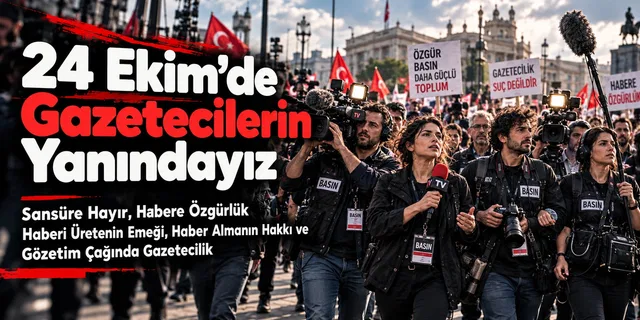
In Istanbul, the crowd that gathered at the Bull Statue in Kadıköy marched to the waterfront through a heavy police cordon. Staff from channels ranging from Habertürk to Halk TV, former staff of channels placed under trustees, BBC Türkçe reporters and freelance journalists were in the same column. The moment the march will be remembered for was the reading out of the names of jailed journalists one by one, with the crowd answering "Here!" after each name. A letter Murat Ağırel sent from prison was read out; three words from it are now a slogan: "Don't fall silent, don't be afraid, don't get used to it!" The joint statement's answer was three words too: "We are not afraid, we will not be silent, we will not obey."
In Ankara people marched from Kolej Junction to Sakarya Street, in İzmir from Alsancak to the port, in Antalya from Attalos to Cumhuriyet Square, in Van from Sanat Street to Kent Square; in Adana, Bursa, Eskişehir and Kocaeli, statements were read in front of the press monuments and Uğur Mumcu Park. In Diyarbakır the column set off from outside the courthouse and ended outside the Information and Communication Technologies Authority (BTK): at the door of the place where, after the courts, censorship does most of its work today. The Ankara Bar Association was there with its lawyers, and political parties with their leaders; but the backbone of the column was the banners of the organisations that made the call: TGS, DİSK Basın-İş, TGC, the Press Council, ÇGD, İGC and DFG. In other words, it was the organisations that built the square.
Let us note down today's slogans for tomorrow:
- No to censorship, freedom for the news!
- Journalism is not a crime!
- If we fall silent, the truth stays in the dark!
- A free press cannot be silenced!
- Don't stay silent; the longer you do, the sooner your turn comes!
- Journalists jailed, fund swindlers free!
- Freedom for İsmail, not for the fund swindlers!
- Freedom for Murat Ağırel!
- Don't fall silent, don't be afraid, don't get used to it!
These slogans have one thing in common: none of them is in the first person singular. "If we fall silent", "cannot be silenced", "your turn comes", "don't fall silent". All plural, all addressed to one another. The language of the slogans itself says that no one can be a journalist alone.
And one more thing seen today that is not often seen: journalists from different editorial lines, different political leanings and different organisations marched behind the same banner. DFG, the association of the Kurdish press, and the Press Council signed the same call. This unity did not come about by itself; it is the result of a partnership that has taken months, been rebuilt with every detention and tested with every trustee. The government's strategy is to pick journalists off one by one: today a reporter covering the funds, tomorrow a Kurdish journalist, the day after a columnist; each time getting people to say "that one is different". Today's column was the clearest answer to that strategy: none of them is different. Keeping this unity alive after the day of action, and even growing it, is the most important task of the period ahead. Because those who can pick us off one by one hesitate when we stand side by side.
Twenty Questions
Organisation
- Are you a member of your union (TGS or DİSK Basın-İş)? If not, what is stopping you: fear of the boss, the thought that "it makes no difference", the belief that "the union won't solve my real problem", or the fact that nobody has ever asked you?
- Is anyone else at your workplace in a union? Is there a representative or an informal committee? If not, could you call the first meeting yourself?
- In the past year, have you attended a union meeting, general assembly or training session, or do you know the union only as a signature at the bottom of a statement?
- Are you a member of a professional body (TGC, ÇGD, DFG, İGC, a local association)? Is your membership anything more than paying dues?
State pressure and political stance
- When a colleague is detained, what is your first reaction: a post on social media, or a call to your union or professional body? Which of the two actually protects that journalist?
- Where does your anger go? Are you angry at the government in the morning when you read the news of a detention, and at your news editor in the afternoon when they say "let's not run this"? Have you considered that the two are links in the same chain, and that the chain can only be resisted collectively?
- Article 217/A, access bans, trustees, identity verification through e-Devlet: what have you been able to do against these on your own? Do you know what your union has done on these issues, which reports it has written, which cases it has brought? If you don't know, could part of the responsibility be yours?
- When you complain that "society doesn't care", have you done any organised work to win that society over: have you, through your union, brought workers' unions, bar associations and student groups to your side, or did you just note the indifference and move on?
- Does your political stance, your saying "journalism is not a crime", rest on your individual courage or on an organisation behind you? When the courage runs out and the cost grows heavier, what will be left?
Job security and pay
- Is your employment contract governed by Press Labour Law No. 5953, or by the general Labour Law No. 4857, by subcontracting, or by "freelance" work paid against invoices? If you were arrested or fired tomorrow, what rights would you have, and how many months could you hold out?
- Is your pay above the floor wage demanded by DİSK Basın-İş (twice the minimum wage)? On that pay, can you afford to risk losing your job over a story? If not, isn't insecurity itself a form of censorship?
- In the past year, have you given concrete support (a job, money, a bridge to publish stories) to a colleague who lost their job at an outlet that was placed under a trustee or shut down? Did you do it on your own, or through a structure?
The news and self-censorship
- In the past year, is there a story you did not write, toned down or did not even take to your editor because "this will cause trouble"? Was the reason the prosecutor or the boss? Can you tell the two apart? If you can't, isn't that an answer in itself?
- When you object to the editorial line in the newsroom, is there a structure that will stand behind you, or is objecting an individual risk?
- Do click and engagement targets decide what you write? Have you considered that this is a working condition, and so something that can be collectively bargained over?
Solidarity
- In the past six months, have you written a letter to a jailed journalist? Have you followed a journalist's trial from the public gallery?
- When a journalist who is not from your outlet and not of your political line is detained, do you react the same way? For a reporter from the Kurdish press too? Isn't dividing solidarity along political lines a way of helping the government's strategy of picking journalists off one by one?
- Of the people you met in the square today, how many did you take contact details from? How many will you meet next week, and will you tie that meeting to a structure?
Digital security and the knowledge commons
- Do you talk to your sources over an end-to-end encrypted channel? If your phone is seized, will your sources be exposed? Is there a structure that will get this knowledge to everyone at your workplace?
- Have you documented your blocked stories and suspended accounts, and reported them to record-keeping projects such as EngelliWeb? Have you made the future of the profession (artificial intelligence, the algorithmic newsroom, job cuts) an agenda item in your union, or do you only complain about it in corners?
To-Do List
This week
- Join your union. If you are already a member, sign up one more person at your workplace; remind anyone who says "the union won't solve my problem" who called today's action.
- Meet up during the week with at least three people you met in the square today.
- Write a letter to a jailed journalist; put a hearing date in your calendar.
This month
- Hold a first informal meeting at your workplace with your unionised and non-unionised colleagues, with three items on the agenda: pay and hours, self-censorship, and what we will do if a colleague is detained.
- Read your contract; find out whether it falls under Law No. 5953, and learn your rights. If you do not know, ask your union's legal office.
- Take basic digital security measures on your phone and computer to protect your sources; teach a colleague to do the same.
- Find out what your union has done about Article 217/A, access bans and trustees; if you find it lacking, don't criticise from outside, put it on the agenda from inside.
This year
- Aim for a representative to be elected or a committee to be set up at your workplace.
- Become part of a solidarity network in your city for press workers who have lost their jobs (a job bridge, a fund, joint news production).
- Argue for your union to build lasting alliances with workers' unions, bar associations, student groups and neighbourhood solidarity networks; turn the sentence "society doesn't care" into a plan of work.
- Raise artificial intelligence and the algorithmic newsroom in your union; ask for demands to be drawn up on it.
- Argue for the action committees of the ten cities that marched side by side on 24 October to become a permanent coordination.
To Those Who Say "My Problem Isn't With the Boss"
We left a likely objection until the end, because the answer is easier to see after everything above. Today the trouble hanging over a journalist is not the boss but the state: every day a detention, an arrest, a house arrest, a trustee, hundreds of accounts made invisible overnight. It is understandable to think, "A union is an organisation against the employer; my problem is with the prosecutor, so it won't solve this." The trap of turning your anger on the news editor rather than the political system, and so losing sight of the real target, is a real trap too; let us not fall into it.
But let us see two things. First, the body that called today's action, keeps the list of the jailed, sends observers to the trials and stands in front of the building on the morning the trustee arrives was already the union. In Türkiye the press union has never been only a body that bargains over pay; it could not have been, because in this country a journalist's pay and a journalist's freedom have never been apart. Second, the line between the boss and the state is not as thick as people think. The media owner is a holding company that depends on public contracts; the government's pressure often arrives before the prosecutor does, with the sentence "let's not run this story" and with dismissals. A trustee appointment is an act of the state, but its result is unemployment. Journalists who organise at their workplace are at the same time organising against the government's quietest channel of pressure.
Just as it is a mistake to turn your anger on the boss and forget the system, it is the other face of the same mistake to turn your anger on the system and stay unorganised: in both cases the journalist is left alone. The union is where the two come together: security at the workplace, a shared voice in the square, follow-up in the courtroom, alliances in society. If solidarity stays a feeling, it lasts three days; if it becomes an organisation, it follows a trial for three years.
If your answers to these questions made you uncomfortable, good; they make us uncomfortable too. There is only one form of discomfort that is any use: the membership form, the first meeting, the first representative. Your anger is justified. Justified anger left on its own turns into exhaustion; organised, it turns into strength. That is the choice.
Journalism is not a crime. Unorganised journalism, however, is defenceless.
Sources
- Cumhuriyet, "Gazeteciler baskı ve sansüre karşı Kadıköy'de toplandı: Çok sayıda kentte eş zamanlı eylem" (Journalists gather in Kadıköy against pressure and censorship: simultaneous action in many cities), 24 October 2026.
- Artı Gerçek, "Gazeteciler bugün 10 ilde eylemde: Sansüre hayır! Habere özgürlük" (Journalists take action in 10 provinces today: No to censorship! Freedom for the news), 24 October 2026.
- Bursaport, "Basın özgürlüğü için Bursa'da eylem" (Action in Bursa for press freedom), 24 October 2026.
- Ege Saati, "Gazeteciler sansüre karşı Kadıköy'de eylem yaptı" (Journalists protest against censorship in Kadıköy), 24 October 2026.
- bianet, "Gazeteciler baskılara karşı yarın sokağa çıkıyor: İllere göre eylem takvimi" (Journalists take to the streets against pressure tomorrow: action schedule by province), 23 October 2026.
- Medyascope, "Gazetecilerden eylem çağrısı: 'Sansüre hayır, habere özgürlük'" (Journalists call for action: "No to censorship, freedom for the news"), 24 October 2026.
This piece follows on from We Stand with Journalists on 24 October.