A Genealogy of Patience: A Moral History from the Celali to the Harami
Tracing Four Hundred Years of Anger and Dignity from Başaran Aksu's Words "We Are Not Hypocrites, We Are Celalis"

"We Are Not Hypocrites, We Are Celalis": The Name Başaran Aksu Invoked, the History of the Celalis, and Reclaiming a Stigma
Why is a four-hundred-year-old name for "bandits" a word of honour today in the mouths of mining unionists?
In Brief
Dear Young Comrades,
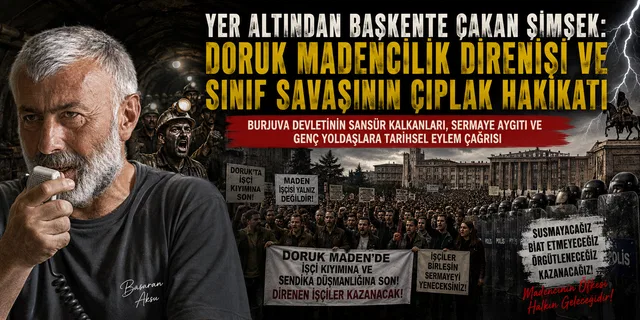
In the last week of August 2026, Gökay Çakır, President of the Bağımsız Maden-İş (Independent Miners' Union), and Başaran Aksu, the union's organising specialist, were arrested on charges of "inciting the public to hatred and hostility". One of the posts cited as grounds for the charge contained this sentence: "The Celalis will win, the haramis will lose!" (BirGün, 25 August 2026, in Turkish). Aksu ended the note he sent from prison with the same words: "We Are Miners, We Are Revolutionaries, We Are Celalis!" (e-komite, 27 August 2026, in Turkish).
This name was not chosen at random. Aksu had used it two years earlier, during the Fernas resistance, in reply to an MP who was also a mine owner and had called the miners "hypocrites": "We are not hypocrites, we are Celalis; we are their children." (Umut-Sen, November 2024, in Turkish).
In this piece we look for answers to three questions:
- Where does the Celali tradition come from? It is the wave of revolts that began with the uprising of Sheikh Celal of Bozok in 1519 and turned Anatolia upside down in the late sixteenth and early seventeenth centuries. Behind it lie currency debasement, inflation, the breakdown of the timar system, paid soldiers returning from war and peasants torn from the land.
- What does the name mean? For the Ottoman state, "Celali" was a stigma stuck on anyone who rose up against the order: a bandit. Today unionists are turning that stigma around: "You call us bandits; the real haramis, the real robbers, are those who do not pay for the sweat of our brows."
- Why is it still used today? Because the miner's roots reach back to the Anatolian peasant; because the state today still calls those who struggle "provocateurs", "hypocrites" and "traitors"; and because the working class wants to tell its own history in its own language.
We will also talk about its limits. The Celalis were not heroes but the children of an anger without a programme. Some of their leaders received pashaships from the state, others were buried in pits, while the peasants were caught between two fires.
What today's worker takes from the Celali is his anger and his dignity.
Where the worker parts ways with him is organisation.
A slogan, a charge
First, let us recall what happened.
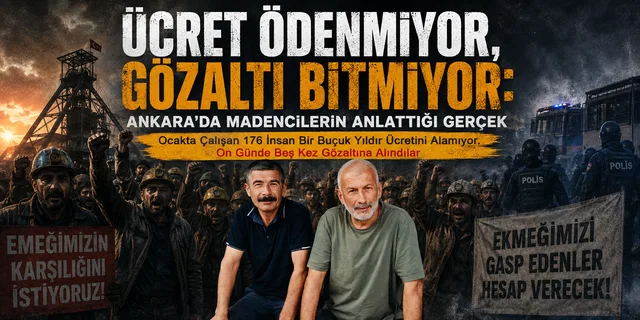
Throughout 2026, the workers of Doruk Madencilik and Eti Gümüş travelled a long road for their unpaid wages and severance pay. In April they marched from Eskişehir to Ankara and held a hunger strike in Kurtuluş Park (Kısa Dalga, in Turkish). In August they sat down in front of the Ministry of Energy and Natural Resources. On the sixteenth day of the protest, Başaran Aksu and two workers were detained in front of the ministry. The same evening, Gökay Çakır was detained at the union's headquarters in Soma (BirGün, in Turkish).
On 26 August both were remanded in custody. Çakır was sent to Akhisar, Aksu to Sincan. The next day, an agreement in principle was reached on the workers' claims. In other words, the miners won while the unionists were inside. Çakır wrote from prison: "Without you, there is no boss either." (BirGün, 27 August 2026, in Turkish). The two were released on 4 September, while Aksu was on hunger strike (Medyascope, in Turkish). The union's first post was the same sentence again: "The Celalis will win, the haramis will lose."
Nor was this Aksu's first arrest this year. In April he had been arrested over posts about Akbelen and Esra Işık, that time on a charge of "publicly disseminating misleading information". The court's decision even listed among its grounds the fact that he constantly moved from city to city because of his union work (Medyascope, 9 April 2026, in Turkish). Now let us ask this question: how can a word that refers to peasant uprisings of four hundred years ago be treated today as "incitement to hatred and hostility"? To find the answer, we first need to look at the word itself.
"We are not hypocrites, we are Celalis": Where the words were born
In October 2024, the workers of Fernas Madencilik in Soma were waging a resistance of more than 50 days against their dismissal for unionising. They marched from Soma to Ankara, went barefoot to Parliament and held a hunger strike (bianet). The company's owner was an AKP MP: Ferhat Nasıroğlu, MP for Batman. At a press conference he held in Parliament on 16 October 2024, Nasıroğlu described the miners and their supporters like this: "There is a group of hypocrites here. These hypocrites do not want this matter resolved." (sol.org.tr, in Turkish).
"Münafık", "hypocrite", is not an ordinary insult but a religious verdict. It means someone who practises duplicity from within and breaks the unity of the community of believers. For a boss to choose this word for workers demanding their wages is to carry class conflict onto the plane of faith, to declare the worker who wants what he is owed a "sower of discord".
That is why Başaran Aksu's reply matters. Aksu did not answer with a counter-insult; he set out a genealogy:
"On this road they labelled us 'hypocrites', but we are not hypocrites, we are Celalis; we are their children." "We come from the Celalis. Our roots go back to them." — Başaran Aksu, We are not hypocrites, we are Celalis!, Umut-Sen (in Turkish)
The same piece says one more thing clearly: union struggle is a limited struggle that produces compromise within the capitalist order, but it is a spark that can lead the working class to question the order. Let us keep this sentence in mind. We will come back to it at the end of the piece, when we talk about the limits of the Celalis.
Where does the word Celali come from?
Sheikh Celal of Bozok (1519)
The name comes from a person. In 1519, during the reign of Selim I, a Turkmen dervish called Sheikh Celal rose up in the Bozok region (today's Yozgat), proclaiming himself the Mahdi. Those who gathered around him were mostly poor Turkmen peasants and nomads. The uprising was bloodily suppressed near Tokat (Küre Ansiklopedi, in Turkish).
The revolt was short-lived, but its name remained. From then on, in the language of the Ottoman state, "Celali" became the common name for anyone in Anatolia who took up arms against the state. In other words, the word was born from the start as a category of the state. The rebels did not call themselves Celalis; the state named them so. In the registers of scribes and judges, the word meant the same as "bandit", "harami" (robber) and "people of sedition".
This point matters. When we learn the history of a word, we also learn who used it against whom. Celali was a name the rulers pinned on the oppressed.
A note: "celallenmek" is something else
The everyday Turkish verb "celallenmek" (to grow angry, to fly into a rage) comes from the Arabic celâl (majestic, awe-inspiring, the overpowering greatness of God). Sheikh Celal's name comes from the same root, but the name "Celali revolts" derives not directly from the word but from the person. Even so, it is not surprising that the two meanings blend in popular speech: a Celali is someone who has flown into a rage, that is, someone whose patience has run out.
The early wave: Kızılbaş uprisings
A significant share of the uprisings in the first half of the sixteenth century were Kızılbaş-Turkmen uprisings. Among them were those of Şahkulu (1511), Sheikh Celal (1519), Baba Zünnun (1526) and Kalender Şah (1527). In these uprisings, faith and class were intertwined. Turkmen poor under the pressure of the central state's taxation, settlement policy and timar system expressed their opposition in the language of heterodox belief. The Ottoman state, in turn, branded them as Safavid "sedition".
Engels's observation about the German Peasant War is useful here too: in pre-capitalist societies, class struggle often wears religious dress, because religion is the only ideological language the masses have. Sheikh Celal's claim to be the Mahdi and Thomas Müntzer's sermons are two examples, in two different lands, of the same historical logic.
The Great Celali Revolts: The unravelling of an order
When people say "the Celali revolts", the first thing historians think of is the great wave between the 1590s and 1610. It is also worth remembering that the revolts continued intermittently until the 1650s. A whole set of causes lay behind this wave. They all led to the same result: the displacement of Anatolia's producing classes.
The currency lost value, bread grew dear
The silver flowing from the Americas into Europe caused a great rise in prices across the Mediterranean world in the second half of the sixteenth century. Historians call this the "price revolution". The Ottoman treasury tried to meet the pressure in 1585–86 by debasing the akçe, that is, by reducing its silver content. The coin's silver content was cut by about 44 per cent (Küre Ansiklopedi, in Turkish). The result was something we know very well today: the purchasing power of people on fixed incomes melted away. Soldiers paid by the state and people with small incomes took the first blow.
Dear Young Comrades, stop here and think. Closing a deficit by debasing the currency is the oldest way of loading the burden onto the backs of wage earners and peasants. It happened this way four hundred years ago, and it is happening this way today.
The timar system broke down
In the classical Ottoman agrarian order, the land belonged to the state (mîrî). The peasant worked the land and paid his taxes to the timar-holding sipahi. With this income, the sipahi in turn went to war as a cavalryman. At the end of the sixteenth century, this order cracked in two ways. First, wars were now won by infantry with muskets, and the military value of the mounted sipahi declined. Second, to meet its need for cash, the state began to farm out taxes through iltizam, that is, to sell them to tax farmers who paid up front. The tax farmer tried to extract more than he had paid from the peasants.
To put it in Marxist terms, the form of appropriation of the surplus product changed. There was a shift to a more intensive, more monetised and more arbitrary form of exploitation. The peasant paid the price of this transformation first.
Paid soldiers returning from war: Sekbans and levends
The Long War with the Habsburgs (1593–1606) and the wars with Iran forced the state to recruit paid musketeers from among the Anatolian peasantry. They were called sekbans and levends. These armed young men, cut off from their villages, handed a musket, and left jobless when the war ended or their pay was not given, formed the backbone of the Celali armies.
There is a striking parallel here. The sekban was the "flexibly employed" soldier of his day: a precarious, temporary worker called up when needed and turned out onto the street when the job was done. The Celali army was, in a sense, an army of the dismissed.
The deserters of Haçova
After the Battle of Haçova (Mezőkeresztes) in 1596, Grand Vizier Cığalazade Sinan Pasha stripped thousands of timar-holding sipahis of their fiefs on the grounds that they had "deserted" during the battle. A significant share of those who lost their fiefs returned to Anatolia and joined the Celalis (Küre Ansiklopedi, in Turkish). The state produced its own rebels with its own hands.
Drought and famine
In his book The Climate of Rebellion in the Early Modern Ottoman Empire (2011), the historian Sam White showed how the severe droughts and famines of the 1590s, under the conditions of the "Little Ice Age", fuelled the revolts. Climate alone does not cause revolt, but it deepens poverty. For a peasant with no reserve granary, a single bad harvest means disaster. When we talk today about who bears the burden of the climate crisis, we need to return to this lesson.
The leaders and their ends
The leading names of the great wave were:
- Karayazıcı Abdülhalim: A sekban company commander. After 1598 he gathered great power in central Anatolia. For a time the state tried to placate him by granting him a sanjak governorship, then sent an army against him. He died shortly after his defeat.
- Deli Hasan: Karayazıcı's brother. In 1602 he besieged Ankara; he was then appointed governor-general of Bosnia and sent to Rumelia. In the end he was executed.
- Tavil Halil: Accepted the offer of the governor-generalship of Baghdad.
- Kalenderoğlu Mehmed: Made Manisa his base. Defeated by Kuyucu Murad Pasha, he fled to Iran in 1608.
- Canbuladoğlu Ali Pasha: Relying on his power in Aleppo, he set up an almost independent administration. He was defeated in 1607 and eliminated in 1610.
Behind these names, two methods are visible: granting office and putting to the sword. Kuyucu Murad Pasha ("Murad Pasha the Well-Digger") took his name from the second. In the campaign of suppression he waged between 1607 and 1610, the bodies of those killed were thrown into pits dug for the purpose. The sources of the time speak of losses in the tens of thousands.
The Great Flight
The heaviest price of this period was paid by the peasants. Caught between Celali bands, state armies and tax farmers, peasants abandoned their land and fled. In this process, which has gone down in history as the "Great Flight" (Büyük Kaçgun), villages emptied in many parts of Anatolia, and people took refuge in walled towns, in the mountains or in Rumelia. Towns such as Ankara built walls around themselves for protection (Küre Ansiklopedi, in Turkish). Anatolia's map of population and settlement was redrawn in this period.
Who were the Celalis? An honest look, against romanticism
Here we need to be honest with young comrades, because romanticising history gains us nothing.
The Celalis were not a unified class movement. Their ranks included peasants torn from the land, sekbans left without work, sipahis who had lost their fiefs, madrasa students who could find no position (suhtes), and at times local power holders pursuing their own interests. Most of their leaders were not peasants but commanders of armed companies, and what most of them wanted was not to overthrow the order but to win a place within it: a sanjak, a governor-generalship, a pashaship.
In her study Bandits and Bureaucrats (1994), the sociologist Karen Barkey explains this relationship through the concept of "bargaining". The Ottoman state knew how to buy Celali leaders as well as how to crush them. Granting a rebel a pashaship meant adding his army to the state's army. The title of Mustafa Akdağ's classic study, by contrast, put the matter from the people's point of view: Türk Halkının Dirlik ve Düzenlik Kavgası: Celâlî İsyanları (The Turkish People's Struggle for Livelihood and Order: The Celali Revolts).
Two observations need to be held together:
- The Celali movement was fed by the anger of the oppressed. The causes of that anger were real: debasement, taxation, famine, unemployment.
- But because this anger did not turn into a programme and an organisation, it was either spent on the personal advancement of the leaders or buried in pits. And it was usually the peasants who paid the price, both through the plunder of the Celali bands and through the punishment of the state.
This observation does not diminish the name Celali. On the contrary, it shows those who use the name today what to take from it and what to leave behind.
The Celali in popular memory: The age of Köroğlu
The Celali who is a "bandit" in the registers of the state stands somewhere else in the people's folk songs. Many folklorists, Pertev Naili Boratav foremost among them, have linked the shaping of the Köroğlu epic in Anatolia to the social setting of the Celali period. Köroğlu is a figure who rebels against the Bey of Bolu, gathers the "young lads" in the mountains, and takes from the rich to give to the poor. The epic's saying "the musket was invented, and valour was spoiled" also reads like an allusion to the musket age of the sekbans.
The rebellious hymns of the Kızılbaş bards of the same century are part of this memory too. The line "Şu kanlı zalımın ettiği işler" ("the deeds of this bloody tyrant") in the hymns attributed to Pir Sultan Abdal carried the people's view of their rulers through the centuries.
Popular memory does not make the fine distinctions of the historian. It asks: "Who was on our side, and who was against us?" In its answer to this question, the Celali, flaws and all, was counted as "one of us". Today's mineworkers of Soma, Kınık and Eskişehir also grew up within this memory.
Reclaiming the stigma: From "çapulcu" to "Celali"
There is a move found often in the history of the oppressed: taking the demeaning name pinned on them by the rulers and turning it into a word of honour. Let us give a few examples:
- During the French Revolution, aristocrats sneered at poor artisans who could not afford knee breeches (culottes) by calling them "sans-culottes" ("without breeches"). The name became the banner of the revolution's most radical section.
- In the sixteenth century in the Netherlands, nobles who opposed Spanish rule were called "beggars" (gueux). The beggar's bowl became a symbol of the independence movement.
- And an example our own generation lived through: in 2013, the Gezi protesters were called "çapulcu" (looters). The next day the squares filled with signs reading "Everyday I'm çapulling", and "çapulcu" became the identity of a generation.
"Celali" works by the same logic. The state and the boss call the miner a "hypocrite", a "provocateur", a "traitor". The miner replies: "Yes, we are the grandchildren of the people you have been calling bandits for four hundred years." This is a stronger move than rejecting the stigma. To reject the stigma is to stay on the defensive; to reclaim it is to seize the narrative.
Who are the haramis?
The second half of the slogan is at least as important as the first: "the haramis will lose."
In the Ottoman registers, "harami" means a highway robber, a plunderer, and was used as a synonym for Celali. The slogan separates the two words and sets them against each other. The Celali is the people rising up in righteous anger. The harami is the one who seizes what labour has earned.
So who are the haramis today? Think of the wages and severance pay that went unpaid for months to the workers of Doruk Madencilik and Eti Gümüş. The miner worked hundreds of metres underground, gave his labour, and did not receive its due. In the language of the law, this is called a "claim". In everyday language, its name is obvious.
Bertolt Brecht's famous question in The Threepenny Opera makes exactly this distinction: "What is robbing a bank compared with founding a bank?" Marx shows the same thing in the chapter of Capital on primitive accumulation: the history of capital is a history of expropriation "written in the annals of mankind in letters of blood and fire". What is legal and what is legitimate are not always the same thing. A boss who does not pay wages is legally a "debtor". A worker who demands what he is owed can be tried for "incitement to hatred and hostility".
The slogan sets right exactly this inverted moral order: it redefines who the bandits really are.
Why do union representatives use this name today?
Now let us come to our main question. There are five reasons why unionists from Bağımsız Maden-İş and the Umut-Sen tradition have reclaimed this name.
The miner's roots reach back to the Anatolian peasant
The miners of Soma, Kınık and Zonguldak are largely of peasant origin. Many still live in their villages and keep up their fields alongside the mine. Remember the villages of the 301 miners who lost their lives in the 2014 Soma massacre. So being the grandchild of the Celali is not a metaphor but the summary of a class journey. Yesterday's landless peasant is today's underground worker.
The state speaks the same language
In 1600 the Celali was called a "bandit"; in 2024 the miner was called a "hypocrite". In 2026, using the word "Celali" itself became grounds for arrest. The rulers' reflex of declaring those who oppose them immoral has not changed. The unionists point to this continuity: the language that accuses us is a continuation of the language that accused our ancestors.
The working class wants to tell its own history in its own language
The language of the left can sometimes feel distant from workers, like a translated language. "Celali", however, is a word the miner knows from his grandfather, from folk songs, from village stories. When a unionist uses this word, the worker understands what is being said without needing a long explanation. In Gramsci's terms, this is building class struggle from within the people's "common sense". But common sense must not be left as it is; it must be carried a step further.
Dignity is a demand as important as wages
The word that stands out in Aksu's Fernas piece is "unstained". When those who struggle are called "provocateurs" and "traitors", the worker has to defend not only his wages but also his reputation. Remember the placard carried in Ankara by the retiree Ali Şekeroğlu: "Not for money, for our dignity." The name Celali tells the miner that he descends from those who did not bow their heads. This, too, is part of the endurance of a person who goes on hunger strike and marches barefoot.
The claim to win
The slogan's verb is in the future tense: "will win". In history, the Celalis did not win. But the slogan does not mourn the past; it makes a promise to the future. It is a claim to take revenge for a historical defeat. The fact that the Doruk miners won their claims while their unionists were in prison showed that these words are not empty.
Then and now: A side-by-side reading
| The Celali age (1590–1610) | Today (2024–2026) |
|---|---|
| Debasement of the akçe, purchasing power halved | High inflation, wages melting away |
| Iltizam: the tax farmer who collected up front squeezing the peasant | Subcontracting and privatisation: the company that won the work by tender squeezing the worker |
| The sekban turned out onto the street when the job was done | The miner put out of the door without being paid |
| The sipahi stripped of his fief at Haçova | The Fernas worker dismissed for unionising |
| Peasants bearing the burden of drought and famine | The climate crisis landing on the backs of the poor in mining and power plant regions |
| The stigma of "bandit", "harami", "people of sedition" | The charges of "hypocrite", "provocateur", "inciting hatred and hostility" |
| A pashaship or a pit for the leaders | Detention and arrest for the unionist, pressure to "settle" for the worker |
| Unorganised anger, revolt without a programme | Committee, assembly and union; organised struggle that can win |
The last row is deliberately different. Because the working class, unlike the Celali, has the tools to change this table.
From Celali to class organisation: The limit of the name
Reclaiming the name Celali is a powerful move, but as Marxists we also need to see its limit. Aksu's own piece is aware of this limit: union struggle is limited; it is a spark.
The Celalis teach us three lessons from history:
- Unorganised anger can be bought. Karayazıcı was given a sanjak, Deli Hasan a governor-generalship, Tavil Halil Baghdad. Today, too, leaders of struggles can be offered seats, positions or a "special settlement". The only safeguard against this is that decisions are made by the rank and file, not by the leader. That is why the Umut-Sen tradition's principle of "from committee to resistance assembly" matters: negotiations are conducted not by the president or a specialist but by the workers in struggle (Umut-Sen, in Turkish).
- Revolt without a programme sets the oppressed against one another. When the Celali bands began to plunder, the peasants fled from the Celalis. Today, too, setting worker against peasant, miner against olive grower, is capital's oldest game. We wrote about Akbelen that the opposition between the power plant worker and the villager is not natural but constructed. The grandchild of the Celali must also be the comrade of the peasant.
- An isolated uprising is crushed; a class alliance wins. The Celalis remained scattered across Anatolia, and Kuyucu Murad Pasha crushed them one by one. Today, without a common organisation of miners, warehouse workers, couriers, textile workers and IT workers, every resistance can be left to stand alone.
Lenin's distinction between "spontaneity" and consciousness becomes concrete here. Celali is the name of spontaneous anger. The task of the working class is to turn this anger into consciousness, programme and organisation. The order of the three words in Başaran Aksu's prison note is meaningful in this respect: "We Are Miners, We Are Revolutionaries, We Are Celalis." First the class (miner), then the programme (revolutionary), then historical memory (Celali).
Concrete tasks
Dear Young Comrades, these are the tasks we can draw from this discussion:
- Let us learn our history and tell it. Let us read the Celali revolts, Köroğlu, Pir Sultan and Sheikh Bedreddin not from the state's registers but through the eyes of the oppressed. The works of Mustafa Akdağ, Karen Barkey and Sam White are good places to start.
- Let us build a language against the stigma. When we face stigmas such as "hypocrite", "provocateur" or "terrorist", let us seize the narrative instead of going on the defensive. Let us ask who the haramis are.
- Let us defend freedom of expression as a class issue. Arresting a unionist for using a historical word means silencing the worker's voice. Let us follow the investigations and trials targeting independent unionists and stand by them at their hearings.
- Let us make solidarity with the miners permanent. Not on the days of resistance, but every day. Let us contribute to unions' solidarity units, legal collectives and strike funds.
- Let us set up committees in our own workplaces. What left the Celali unorganised may be our weak point too. In IT, in the warehouse, in the café, in the factory, the first step is the workplace committee.
- Let us unite peasant and worker. In mining, energy and farming regions, let us bring the common demands of workers and peasants to the fore: public ownership, a just transition, job security, the land staying with the peasant.
Dear Comrades,
Four hundred years ago they called the poor of Anatolia "Celalis" and buried them in pits. They wrote them into the registers as "bandits". But the folk songs said something else.
Today the grandchildren of those poor climb out from underground and sit down at the ministry's door. Again they are given names, again they are put on trial. But this time the grandchildren are doing what their grandfathers could not: they set up committees, convene assemblies, unionise, and win.
The word "Celali" is not a call to hatred but a call to memory: not to forget whose sweat it is and who the haramis are. As Aksu put it: We are their children. And children organise in order to win where their fathers were defeated.
The Celalis will win, because this time they are organised.
Sources
- Başaran Aksu, We are not hypocrites, we are Celalis!, Umut-Sen, November 2024 (in Turkish)
- Başaran Aksu and Gökay Çakır, "We Are Miners, We Are Revolutionaries, We Are Celalis!", e-komite, 27 August 2026 (in Turkish)
- BirGün, Bağımsız Maden-İş President Çakır, who posted "The Celalis will win, the haramis will lose", detained, 25 August 2026 (in Turkish)
- BirGün, A letter from the arrested Bağımsız Maden-İş President Gökay Çakır: "Without you, there is no boss either", 27 August 2026 (in Turkish)
- Medyascope, Başaran Aksu and Gökay Çakır released, 4 September 2026 (in Turkish)
- Gazete Pencere, Unionists Gökay Çakır and Başaran Aksu released: We will continue the struggle, 5 September 2026 (in Turkish)
- Medyascope, Grounds: constantly changing cities for union activity. Başaran Aksu arrested, 9 April 2026 (in Turkish)
- Kısa Dalga, A workers' leader emerged from the Doruk miners' resistance: Who is Başaran Aksu? (in Turkish)
- sol.org.tr, The AKP boss said "hypocrites"; the Fernas miners replied: We will win, 17 October 2024 (in Turkish)
- bianet, Miners dismissed for unionizing march barefoot to parliament, 2024
- Küre Ansiklopedi, The Celali Revolts (in Turkish)
- Mustafa Akdağ, Türk Halkının Dirlik ve Düzenlik Kavgası: Celâlî İsyanları (in Turkish)
- Karen Barkey, Bandits and Bureaucrats: The Ottoman Route to State Centralization, Cornell University Press, 1994
- William J. Griswold, The Great Anatolian Rebellion, 1000–1020/1591–1611, 1983
- Sam White, The Climate of Rebellion in the Early Modern Ottoman Empire, Cambridge University Press, 2011
- Friedrich Engels, The Peasant War in Germany
- Karl Marx, Capital, Volume I, the part on "So-Called Primitive Accumulation"
Knowledge Commons — Knowledge Belongs to Everyone. Reproduce it.