Organising 2.0: An Idea for a Justified Revolt
An Update for Young Comrades: A Wide Network, a Strong Spine

Organising 2.0: An Idea for a Justified Revolt
An Update for Young Comrades: Alternative Models of Organising Emerging Around the World for Getting Out of the Trap
On the evening of 21 October, a post by Ayşen Şahin did the rounds. On Saturday, media workers will take to the streets in many cities; she will go too, but as a "duty". She asks: what will it bring, beyond easing our conscience, to face a 25-year-old authoritarian regime with 50-person press statements, 1,000-person rallies and 3,000-person square gatherings, methods that are even further behind than those of 60 years ago? And she adds: "Nothing quite sits right with me."
This is a justified revolt. This piece is not an objection to it but a proposal of ideas. We borrow the proposal's name from The Communist Manifesto 2.0, the essay we published in September: Organising 2.0. What we said there, we say here too: the core is the same; the world it runs in has changed.
In short:
- The revolt is justified. One-off actions, disconnected from each other and forgotten the next day, do not produce lasting power. Saying this is not defeatism; it is honesty.
- But the problem is not the method; it is the subject. Sixty years ago the streets were not full of individual citizens but of organised workers. They drew their strength from being able to stop something. Today the unionisation rate is 13.8 percent. The crowd can be seen, but it cannot make itself felt.
- The feeling of being trapped comes from looking with the wrong unit. Facing a state apparatus as individuals, we really are helpless. But when the unit shifts from the individual to the organisation, and the time horizon from the election to the generation, doors appear in the wall.
- Organising 1.0 is still necessary but no longer enough. Union, party, headquarters, congress: a model designed for the big factory of the 20th century. Today's scattered, flexible, surveilled, platformised labour needs new layers added on top of that model.
- Around the world, these layers are already being tested. In Serbia, spokesperson-less student plenums produced an electoral list. In Florence, sacked GKN workers occupied their factory and are trying to turn it into a cooperative. In Sudan, neighbourhood committees became Emergency Response Rooms that feed millions in wartime. In the US, car workers transformed their union from within and won with a surprise strike. In India, more than 400 farmers' organisations forced three laws to be withdrawn with year-long encampments. In Kenya, workers who label AI data founded their own association. Tenants' unions, minority unions, platform cooperatives, cross-border networks of newsrooms.
- The synthesis that comes out of all of them: a network with a spine. Many small, lasting committees at the local level (the network); open assemblies where decisions are made; a spine that links the committees together and provides resources and continuity (union, confederation, party, federation); and bonds of fraternity that reach across borders. A network without a spine falls apart (Hong Kong 2019, the Gezi forums). A spine without a network calcifies (today's union landscape).
- A concrete proposal for press freedom: to make 24 October the first step rather than the last. A campaign with a timetable, four common demands, workplace and neighbourhood committees, an escalation ladder measured by structure tests, readers' cooperatives, a "sister newsroom" for every jailed journalist, and action at the same hour in Europe.
Let us go on Saturday. But on the way back, let us talk about the door.
The piece has five parts: the justified revolt and the diagnosis; who is doing what; the feeling of being trapped; Organising 2.0 and models from around the world; our proposals. None of them is a prescription; all of them are proposals put on the table to discuss together. This text is also a version: it will be updated with your criticism.
Dear Young Comrades,
Your phone asks for an update every week. The app is the same app, but the operating system it runs on has changed; the old version either slows down or crashes. Organising is the same. The forms of organising we inherited were written in the world of the big factory, the single employer, the same workplace for life, the paper leaflet and the face-to-face meeting. Their core is still right: the lone worker is powerless; united workers are powerful. But the world they run in has changed. This piece is an attempt to carry that core into a new world.
Part One: The Justified Revolt and the Diagnosis
A Post, an Act of Honesty
Even the post's first sentence is a diagnosis: "This isn't something to write on a platform eager to read every sentence in the worst possible light, but staying silent doesn't work either." The author knows that what she is about to say will be read as "demoralising". She writes it anyway.
A reply underneath speaks from the same place: "The opposition's actions in the spirit of 'let's just stay visible until the election, they're on their way out anyway' have been tried and ended in great disappointment. We keep trying the same things and expecting different results."
Noticing that a practice is not working is the first condition of a new practice.
Not sitting right is not an illness; it is a form of knowledge. A knowledge that has not yet been able to name what is missing.
What Happened in Two Weeks?
When Ayşen Şahin says "the best of us are inside, the rest are waiting their turn", she is not speaking in the abstract:
- 9 October: Sözcü reporter Mustafa Balcı and freelance journalist Şaban Sevinç were arrested on suspicion of "publicly spreading disinformation". According to CPJ, Balcı was waiting for questions about his reporting on the fund scandal.
- 10 October: İsmail Saymaz and Murat Ağırel were placed under house arrest following an objection by the prosecutor's office.
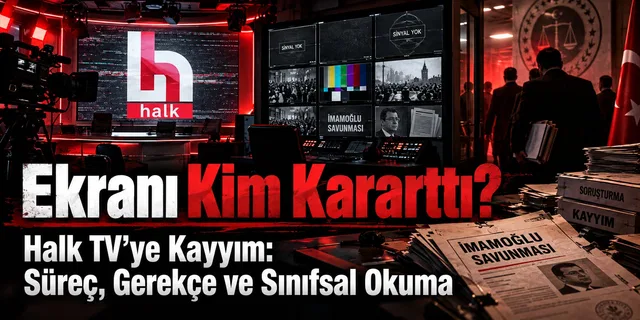
- 14 October: Police entered Halk TV's Istanbul building; the Savings Deposit Insurance Fund (TMSF) was appointed as trustee and broadcasting was halted. The justification was a bribery and bid-rigging investigation into the channel's owner, Cafer Mahiroğlu. As the EFJ stressed, the allegations concern the owner's business activities, not the channel's journalism.
- 15–16 October: Yeni Yaşam columnist Bahadır Altan was detained for writing, on the day of the Halk TV raid, that "statements are no longer enough; a united popular opposition and struggle in the streets is the only way"; he was released with a travel ban and a weekly reporting obligation.
- 17 October: T24 took to the Constitutional Court the access ban imposed on its entire site: citing 118 items, around 4 million items were blocked.
- 19 October: Murat Ağırel was arrested along with 15 others in the "Sarıgül investigation".
- 21 October: A solidarity rally outside Halk TV.
- 24 October: Simultaneous protests in 10 provinces on the first anniversary of the appointment of a trustee to TELE1.
In the background is the split in the main opposition: with the "absolute nullity" ruling in May, Kılıçdaroğlu was installed at the head of the CHP by court order, and in July Özgür Özel founded YENİ Parti with 90 MPs. We wrote earlier about the first link in the wave of censorship, the access bans in September.
Bahadır Altan's detention deserves attention. Saying "statements are not enough" was treated as a crime. The government knows that statements themselves are no threat to it; what it sees as a threat is the idea of going beyond statements. If the carriers of that idea are individuals, they will be punished one by one. Its carrier has to be an organisation.
A government shows what it fears by what it punishes.
Where the Revolt Is Justified
Fragmentation. Every institution makes its own statement, every party holds its own rally, every victim follows their own case alone. Where power should be gathered, it is scattered.
Ritualisation. The press statement has stopped being a form of action and become a form of record-keeping. It is read out, photographed, filed. Action is turning from a means of pressure on the government into a means of absolution for our own base.
Predictability. Arrest, the courthouse steps the next day, a rally at the weekend, a new agenda ten days later. The government can calculate the cost of its next move in advance, and every time the bill comes out low.
A response whose cost is known in advance is no deterrent. It is a good with a fixed price.
What Is Missing: Not the Method, but the Subject
The phrase "methods far further behind than those of 60 years ago" calls for the question to be shifted a little. In the mid-1960s, too, there were marches, rallies, banners and leaflets in the streets. The difference was not in the methods but in who was using them.
The 1963 Kavel strike was carried out before there was a law on the right to strike, and it forced that law. DİSK was founded in 1967. On 15–16 June 1970, hundreds of thousands of workers walked out of their factories and marched against an amendment restricting the freedom to choose one's union. The power of that march came from the machines standing idle behind the marchers.
| 1966–1970 | 2026 |
|---|---|
| The subject in the street: the organised worker | The subject in the street: the individual citizen |
| Action together with production stopping | Action at the weekend, outside working hours |
| Behind the crowd, machines stand idle | Behind the crowd, nothing stops |
| Goal: to impose a cost | Goal: to be visible |
| Gain: the law is withdrawn, the contract is signed | Gain: it makes the news, it goes on record |
| Continuity: the union, the workplace representative | Continuity: none until the next call |
Behind this table stands 12 September. The coup targeted the organised worker: it shut down DİSK, restricted the right to strike and put thresholds in the way of unionisation (12 September Dossier). Today the result is in the ministry's own statistics: as of July 2026, 13.8 percent of 17.6 million registered workers are union members.
Our methods are not behind those of 60 years ago. The subject is. We carry the same banner, but there is no factory standing behind us.
If we see the problem in the method, we will look for the solution in a more "viral" action. If we see the problem in the subject, we will look for the solution in organising. The short version of what we have written on the revolutionary subject: history is made not by crowds but by communities that have been able to organise themselves as a force.
Being Seen and Being Felt
Visibility actions aim to show something: press statements, rallies, petitions. They lift morale and help us find each other; but they cost the government nothing.
Cost actions aim to stop something: strikes, go-slows, boycotts, broadcast blackouts, mass resignations. They cannot be ignored.
What does not sit right with us is an opposition that has lost the capacity for cost actions and is stuck with visibility actions. That capacity will not come back overnight. But it is possible to make visibility actions part of a process that organises the capacity to impose costs. That is exactly what Organising 2.0 means.
Defending Halk TV: Defending Whom?
An investigation into a company owner's financial crimes does not require the state to run that company's news output. At TELE1, the trustee's first act was to stop the news bulletin.
Our line is clear: We are not defending the boss; we are defending the roughly 200 workers behind that screen and the right of millions of people to receive news. We do not have to defend the person, but everyone needs the law. As we shall see below, this dilemma can be resolved at the root by the reader- and worker-owned media models that Organising 2.0 proposes.
Part Two: Who Is Doing What?
The first remedy for scatteredness is a map. This inventory is not meant to shame anyone but to see the missing link.
A movement's strength is not the sum of its members but the sum of the bonds between them.
In Turkey
Press organisations. Those who issued the 24 October call: TGS, DİSK Basın-İş, ÇGD, the Journalists' Association, the Press Council, the İzmir Journalists' Association and the Dicle Fırat Journalists' Association. Provinces: Istanbul, Ankara, İzmir, Bursa, Eskişehir, Antalya, Adana, Kocaeli, Van, Diyarbakır. At 14.00. Slogans: "No to censorship, freedom for the news", "Enough! We can't breathe!" That DFG, the organisation of the Kurdish press, and the mainstream associations stand under the same call is a small but real step towards unity. What is missing is an afterwards: no timetable has been announced.
Media workers. A week after a trustee was appointed to TELE1, its on-screen faces, managers and staff resigned en masse: "This is not a retreat; it is a declaration of resistance." Then they began setting up Tele2 Haber. The trustee took the building; it could not take the labour that makes the news.
The legal front. Constitutional Court applications, defences, trial monitoring. Necessary but not enough: the law works when there is a social force behind it.
Political parties. According to press reports, TİP backed the call; Özgür Özel called for participation at the Halk TV rally; the press adviser to the İYİ Party's chair supported the call. The axis of the action should be the agenda of media workers, not of parties. A party saying "take to the streets" and a union saying "walk out of the workplace" are not the same thing: the first calls on voters, the second on power.
Confederations and professional chambers. The least visible link. DİSK Basın-İş is among those issuing the call; the headquarters of DİSK, KESK, Türk-İş and Hak-İş, the TMMOB (Union of Chambers of Turkish Engineers and Architects) and the TTB (Turkish Medical Association) are not. No decision to bring their members from the workplace into action has appeared yet.
| Actor | What it is doing | What it is in a position to do |
|---|---|---|
| Press organisations | Simultaneous action in 10 provinces | Announce a campaign with a timetable |
| Media workers | Mass resignation, setting up Tele2 | Unionise and form cooperatives in newsrooms |
| Lawyers | Constitutional Court applications, defence | Turn hearings into mass monitoring |
| Parties | Support, rallies | Put media workers' agenda first |
| Confederations, chambers | Not among those calling | Bring their members from the workplace into action |
| Readers, viewers | Sharing, attending | Subscriptions, co-ownership, committees |
Around the World
The IFJ and EFJ issued a joint statement with their member organisations in Turkey on the day of the Halk TV raid: lift the trusteeship, guarantee editorial independence, disclose the legal basis of the decision, release jailed journalists. On 6 October the EFJ had also called on X to stop blocking journalists' accounts without judicial oversight. The state makes the decision; a private monopoly carries it out.
CPJ called for the disinformation law to be repealed "without delay". According to CPJ's Turkey representative Özgür Öğret, at least 22 journalists were detained or arrested under this law in 2026.
The Turkey co-rapporteurs of the Parliamentary Assembly of the Council of Europe called what happened "a truly dark day for press freedom".
The Limit of a Statement
These statements are valuable. But: an international statement is also a press statement. Europe's institutional language says "deep concern", because the same governments carry on with their migration deals, arms trade and NATO bargaining with Turkey. This is not a moral criticism but a class observation. The real carriers of international solidarity are not governments; they are unions, newsrooms, readers and the diaspora.
Part Three: Where Does the Feeling of Being Trapped Come From?
Saying "organise" can feel like telling someone caught in a trap to "get out". Unionisation is at 13.8 percent, the best of us are inside, and whoever calls people into the streets is detained. So let us first look at the trap itself. It has four sources.
The unit error. Anyone who faces a state apparatus alone feels trapped, because alone they really are trapped. The error is to stretch this accurate observation into the conclusion that "we are all helpless". At the scale of the individual the wall looks insurmountable; at the scale of the organisation, doors appear in it.
Atomisation. Today's form of what Marx called alienation: flexible work, platform labour, remote work, non-union workplaces. People live the same problem but do not see each other. Social media shares out anger, but what we share is not an organisation; it is a feed. The feed is refreshed every day and accumulates nothing.
Learned helplessness. A mechanism long known in psychology: someone who repeatedly experiences that nothing they do can change the outcome stops trying even in situations where they could change it. When a generation experiences for ten years that every action comes to nothing, this mechanism works on a social scale. Its remedy is also known: a small but real experience of having an effect. A small victory won teaches more than a big march lost.
The time horizon. The electoral calendar has imposed a four- or five-year horizon on us. For someone thinking "until the election", every arrest is a defeat. The time of organising works differently. On a short horizon everything looks like a trap; on a long horizon the doors become visible.
The feeling of being trapped is the result of looking with the wrong unit and the wrong time. When you change the unit from the individual to the organisation, and time from the election to the generation, the wall looks different.
The formula Gramsci took over from Romain Rolland and returned to often in his prison years is useful here: pessimism of the intellect, optimism of the will. In our piece against the sophistries of despair we discussed the philosophical ground of this path.
The feeling of being trapped has one more source, and it is this piece's real subject: when we say "organisation", only one model comes to mind. Membership card, dues, headquarters, congress, a long hierarchy. That model can be shut down, its leaders arrested, kept below the threshold. Getting out of the trap means updating organising itself.
Part Four: Organising 2.0
Why an Update?
In the 1872 preface they wrote for a new edition of the Manifesto, Marx and Engels said that the general principles remain correct as a whole, but that their practical application everywhere and at all times depends on the historical conditions of the day. The same holds for organising.
The form of organising we inherited, let us call it Organising 1.0, matured between the end of the 19th century and the middle of the 20th, in the world of the big factory. Thousands of workers under the same roof, on the same shift, facing the same boss. The union organised in the factory; the party rose above the unions and the neighbourhoods; decisions were made at congresses through delegates; communication went through newspapers, leaflets and face-to-face meetings; the strongest weapon was the general strike.
This model won us a great deal: the eight-hour day, the right to strike, collective bargaining, social security. And it is still necessary. Without unions there is no collective agreement; without an organised political centre, scattered struggles do not connect with each other.
But the world it runs in has changed:
- The workplace has dispersed. Instead of the factory: subcontracting chains, platforms, remote work, courier apps, one-person "companies". People doing the same job do not see each other.
- The employer has become invisible. The courier's boss is an algorithm; the data labeller's boss is an intermediary company three countries away; the content moderator's boss is a supply chain.
- Surveillance has moved inside. The same phone is both a tool for organising and a tool for surveillance. A union's membership list sits on a software company's server; that server can become the target of an operation (our Aydo piece).
- Legal traps have multiplied. Sectoral thresholds, strike bans, access bans, trustees, the disinformation law.
- Capital is transnational; organisation has stayed national. The company that blocks Halk TV's accounts is in California; the institutions that could put pressure on it are in Brussels.
The core is the same; the world it runs in has changed. The lone worker is still powerless; united workers are still powerful. What has changed is the path to uniting.
Organising 1.0 and 2.0 Side by Side
This is not a "throw out the old, take the new" table. 2.0 does not replace 1.0; it adds layers on top of it.
| Dimension | Organising 1.0 | Organising 2.0 |
|---|---|---|
| Basic unit | Factory, sector | Workplace + neighbourhood + network; small, lasting committee |
| Membership | Card, dues, legal threshold | Graduated participation; a minority union that does not wait for the threshold |
| Decision-making | Congress, delegation, headquarters | Open assembly (plenum) + elected, recallable delegates |
| Leadership | General president, boards | Rotating spokespeople, organic leaders; transparent inside, faceless outside |
| Action | General strike or nothing | Escalation ladder: structure test, rolling strike, surprise, blackout |
| Communication | Newspaper, leaflet, meeting | Encrypted networks + its own publishing infrastructure + a face-to-face core |
| Security | Physical secrecy | Digital discipline, minimal data, data kept within the organisation |
| Ownership | The ownership question in the programme, absent in practice | Cooperative, occupation and conversion, reader-worker ownership |
| Care | Not the organisation's business | Solidarity network, mutual aid, care |
| Geography | National | Cross-border fraternity, a shared hour of action |
| Time | Congress cycle, electoral calendar | A generational horizon + small, measurable victories |
Now let us fill each row of this column with examples tested around the world.
Models Emerging Around the World
In choosing the examples we asked three questions: What was tried? How does it work? What are its limits? We included those who struggled as well as those who won.
Serbia: From a spokesperson-less plenum to an electoral list
What happened: On 1 November 2024 the canopy of Novi Sad railway station collapsed, killing 16 people. Students occupied their faculties. Every day at 11.52, the minute the canopy collapsed, they held 16 minutes of silence. In January 2025, the day after a junction blockade supported by farmers with their tractors, Prime Minister Vučević resigned. In March 2025 hundreds of thousands held the largest anti-government march in a generation.
How it works: Decisions are made by plenums in the faculties: assemblies open to all, deciding by direct vote, with no leader and no spokesperson. According to an analysis on ECPR's blog, in April 2025 the plenums gathered the rules for running in elections into a "Rulebook". Each university city decided separately: in Belgrade the plenums adopted the demand for early elections by 29 votes to 5, and running a list by 23 to 9. The candidate rules: former members of the ruling coalition's 20 parties and former leaders of opposition parties cannot stand. In August 2026 the plenums objected to 99 of more than 300 prospective candidates; in September 38 candidates were removed from the list. 85 student assemblies took part in the final vote on 6 September 2026. Rotating spokespeople were used against smear campaigns; the country was canvassed door to door; polling-station observers were trained.
Today: In September Vučić resigned the presidency and became a candidate for prime minister. Serbia goes to the polls on 25 October; in the only poll published this month, the students' list is ahead of the ruling party, at 44.5 percent to 42.7 percent.
Lesson: An open assembly increases both participation and ownership. A faceless movement cannot be targeted. A small ritual repeated every day can grow into a great movement within a year. And a plenum can produce a system of rules that reaches from the street to the ballot box.
Limit: Its programme is vague on how the fight against corruption is to be carried out. Uniting against corruption is easy; uniting against the property relations that produce corruption is hard. The plenums' decisions have no legal force; the accountability of the MPs to be elected is only "moral and political". The real test will begin after the election. And a coincidence: we are in the streets on 24 October; Serbia's students are at the ballot box on 25 October.
Florence, GKN: From an occupied factory to a community cooperative
What happened: On 9 July 2021, more than 400 workers at the GKN Driveline car-axle plant near Florence learned by email that they had been dismissed with immediate effect. They occupied the factory the same day. The occupation has now lasted five years.
How it works: The workers organised as the "Factory Collective" (Collettivo di Fabbrica), and their slogan became "Insorgiamo" (We Rise Up). They did two things, and both are the essence of Organising 2.0. First, they turned what was assumed to be their own issue into society's issue: allying with the climate justice movement, they drew up a plan to convert the factory into a place producing parts for public transport, and demanded nationalisation under workers' control. Second, they asked the ownership question in practice: the "GKN For Future" cooperative plans to recycle solar panels and produce cargo bikes, and is raising its capital from the public through a "popular shareholding" campaign. In December 2024 the Tuscany region passed a law on industrial consortia; the consortium was set up in July 2025 but is not yet operational. On 18 October 2025, during the national march in Florence, the airport was blockaded.
Lesson: Being sacked can be a beginning rather than an end. When a workplace struggle joins other struggles, such as climate, transport and the right to the city, it turns from a local resistance into a social project. The question "the boss has gone, the factory remains" is the most concrete form of the ownership question.
Limit: Five years. A large share of the workers had to move to other jobs in that time. Bureaucracy and lack of capital are the biggest obstacles. A cooperative cannot build a non-capitalist island inside the capitalist market; it can only build a bridgehead.
Sudan: From resistance committees to Emergency Response Rooms
What happened: The backbone of the movement that toppled Omar al-Bashir in 2018–2019 was the neighbourhood resistance committees. When war broke out between the army and the Rapid Support Forces in April 2023, these committees turned within a few days into Emergency Response Rooms.
How it works: Local rooms, most without legal registration, drawing on the traditional call to collective mobilisation, nafir. Linked to the resistance committees and the Sudan Doctors' Union. What they do: evacuation from conflict zones, clean water and medicine, fuel for hospitals, maintenance of water and communications infrastructure, neighbourhood kitchens feeding millions, response to cases of sexual violence. By December 2024 they had reached more than 11.5 million people; in 2024 they had around 4,600 volunteers. In 2025 they received the Right Livelihood Award, the Rafto Prize and the Chatham House Prize.
Lesson: A political organisation can, when necessary, turn into an organisation of life; and it survives because it can make that turn. Where the state has collapsed, the committee does what the state cannot. It builds the organisation's legitimacy not with slogans but with life itself.
Limit: Both sides in the war have targeted the rooms; volunteers have been detained, abducted and killed. Dependence on foreign funding is a risk to the organisation's independence. And most importantly: mutual aid keeps people alive, but it does not end the war. Whether revolutionary committees can become a force that stops the war is a different question.
US, UAW: Transforming the union from within, and the rolling strike
What happened: After a corruption scandal lasting years, the United Auto Workers (UAW) came under federal oversight. As a result, in a 2021 referendum the members won the right to elect the union president directly. A reformist group organised within the rank and file won that election; Shawn Fain became president in 2023.
How it works: In September 2023, for the first time in decades, the UAW struck all three big car companies at once. But not every plant at once: with a method called the "Stand Up Strike", first a few plants, then new ones every week. Which plant would strike was kept from the companies until the last minute and announced on a live stream. Plants not on strike "worked to rule". At the end of six weeks the contract won a 25 percent pay rise and the restoration of cost-of-living adjustments.
Lesson: There are two lessons. First, a calcified union can be transformed from within; rank-and-file organising and direct elections are the tools for this. Second, the "general strike or nothing" dilemma is a false dilemma. A rolling, surprise, escalating strike lowers the cost to workers and throws off the company's calculations.
Limit: This method was designed for a union with a legal right to strike and a large strike fund. Where the right to strike is restricted, the same logic has to be built with other tools.
India, SKM: A year-long encampment of 400 organisations
What happened: In autumn 2020 the Indian government passed three laws opening agriculture up to big companies. In November 2020 more than 400 farmers' organisations united as the United Farmers' Front (Samyukt Kisan Morcha) and set up camp at the entry points to Delhi. In November 2021 the government withdrew the laws.
How it works: Organisations that were ideologically very different agreed on peaceful action and a "common minimum programme". A seven-member coordination committee handled negotiations, the press, statements and strategy. In January 2021, between 100,000 and 300,000 people were living in the camps on Delhi's border: shared kitchens, libraries, health tents. Villagers went to the camps in rotation, so that the fields would not be left empty and the camps would not empty either.
Lesson: A common minimum programme lets different organisations act together without dissolving into each other. Rotating participation makes a resistance lasting more than a year possible. The camp becomes more than a place of action: a living space and a school.
Limit: The laws were withdrawn, but one of the movement's core demands, a guaranteed minimum support price, was not met. Stopping a law is not the same as stopping the accumulation of capital in agriculture.
Alphabet Workers Union: A minority union that does not wait for the threshold
What happened: In January 2021, workers at Alphabet, Google's parent company, founded a union affiliated with the US Communications Workers of America (CWA). Its membership of 230 at its founding rose to 700 within a few days.
How it works: This is a "minority union". It did not wait for a majority to gain legal recognition, and did not ask the employer or the state for approval. It cannot sign a collective agreement, but as an organised community it runs campaigns, challenges injustices, and also enrols subcontracted workers as members.
Lesson: Given Turkey's sectoral thresholds, this is a very important model. The threshold is an obstacle to the right to bargain collectively, not to organising. Organisation first, recognition after. We discussed in detail what this means for tech workers in The Computing Worker's Handbook (PDF, in Turkish).
Limit: A union without the right to bargain collectively ultimately depends on the employer's goodwill or on public pressure. A minority union is a starting point, not a destination.
Amazon and an independent union
In April 2022, at the Amazon warehouse on Staten Island, New York, the independent Amazon Labor Union, founded by the workers themselves, won its election despite the company's multimillion-dollar anti-union campaign. The organisers camped for months at the bus stop outside the warehouse, handed out food during breaks and talked to workers in their own languages. In 2024 they joined the Teamsters.
Lesson: An organisation founded by workers themselves, speaking their own language, can reach where a big, distant union cannot. Limit: Winning the election is not winning the contract; the company refused to come to the table, and the small independent union eventually needed the spine of a big union. The network went looking for a spine.
Kenya: The invisible workers of AI
What happened: Behind AI models are millions of workers who label data and filter out harmful content; a large share of them are in the Global South, working through intermediary companies, for low pay and in harsh psychological conditions. In 2023 the African Content Moderators Union was founded in Nairobi. In February 2025 the Data Labelers Association was founded; it reached 339 members in its first week.
How it works: The demands: fair pay, mental health support, legal aid in pay and employment disputes, and collective agreements with the intermediary companies that sit between the big tech firms and the workers. The association works together with the content moderators' union, with the independent worker platform Turkopticon and with the research institute DAIR.
Lesson: The association is the union's antechamber; organising begins without waiting for legal union status. And organising along the supply chain: the intermediary company facing the worker, the tech monopoly behind it, and the chain of contracts binding the two are seen on the same map. In the Socialist AI Manifesto (PDF, in Turkish) we called these workers "the invisible producers of the general intellect".
Tenants' unions: Collective bargaining against the landlord
What happened: ACORN, organised in Canada, England, Wales, Scotland, Ireland, France and the US, is a membership organisation of low- and middle-income tenants, workers and neighbourhood residents.
How it works: The forms of direct action ACORN describes: protests outside the landlord's office to get repairs done, stopping evictions with human chains, collectively refusing proposed rent rises, street theatre. Coalitions and reports to turn local gains into legal protections.
Lesson: The logic of the union can be carried outside the workplace. Rent is as much a class relation as the wage; collective bargaining against the landlord is a relative of collective bargaining against the boss. In the middle of Turkey's rent crisis, this is the most natural first task for neighbourhood committees.
Berlin: Expropriation won at the ballot box and shelved at the table
In September 2021, in a referendum initiated by the "Deutsche Wohnen & Co. Enteignen" (Expropriate Deutsche Wohnen & Co.) campaign, 59.1 percent of Berlin voters said yes to socialising roughly 240,000 homes held by big property companies. The campaign was carried out by thousands of volunteers knocking on doors neighbourhood by neighbourhood. The Senate referred the decision to an expert commission; in 2023 the commission concluded that socialisation was constitutionally possible. But the decision was shelved.
Lesson and limit: A campaign can win the majority's vote and still fail to win power. A vote is no substitute for an organised force. The bourgeois state knows a hundred ways not to implement a decision that threatens property.
Platform cooperatives: Making the algorithm common property
CoopCycle, founded in France in 2017, is a federation of bicycle courier cooperatives. It shares its common software under a licence that only cooperatives may use commercially: the code is a commons, but closed to capital.
The Drivers Cooperative is a driver-owned ride-hailing cooperative in New York. According to one study, it was founded in May 2021 with ownership shares for hundreds of drivers; it announced that it had registered around 12,000 drivers. But by summer 2024 the number of full-time drivers had fallen below 50. Platform costs approached 50,000 dollars a month, the app stopped working for a while when it could not pay for Google's mapping services, revenue fell by 60 percent and governance weakened. A new board was elected in September 2024, and the app was working again in 2025.
Lesson and limit: As long as a cooperative depends on the monopoly's infrastructure (maps, cloud, app store), it is fragile. Lack of capital, failure to retain technical labour and member education are the biggest problems. Even defeat is a lesson: cooperativism is not a model of entrepreneurship but a form of organising; it only lives when it is part of a movement and has public support. An important warning for experiments like our own Albatros Computing Cooperative.
Reader- and worker-owned media
The German daily taz, founded in 1978, has been a cooperative since 1992; today it has more than twenty thousand reader-members. The paper belongs not to a boss but to its readers. In France, Mediapart publishes without advertising, on subscription revenue, and has been owned by a non-profit fund since 2019. Here, the journalists who resigned from TELE1 and founded Tele2 are in a sense on the same path.
Lesson: The Halk TV dilemma ("are we defending the boss?") is resolved at the root here. When ownership belongs to readers and workers, there is no boss to be put under a trustee and no holding company to be seized. An access ban may still come; but silencing thousands of co-owners is much harder than silencing one boss.
Hong Kong 2019: The limit of a network without a spine
In 2019 the movement in Hong Kong organised under the slogan "be water": leaderless, centreless, coordinating in real time through messaging apps and forums. It was fast, creative and lasted for months. But when the national security law came in June 2020, a movement without lasting organisations, unions or local roots quickly fell apart. Most independent unions and opposition organisations closed over the following two years.
Lesson: A network without a spine grows fast and falls apart fast. Facelessness is a strength, but without a structure that provides continuity it becomes a weakness. The fading of the Gezi forums teaches the same lesson.
The seeds of 2.0 in our own history
None of these models is foreign to us. One Minute of Darkness for Constant Light (1997): the action that began on 1 February 1997, after the Susurluk scandal, in which millions turned their lights off at 21.00 every evening for a month, emerged, according to Bianet's account, from a small group around the Istanbul Coordination of Professional Chambers and spread by fax from office to office: a network with a spine. When the same method was tried again in 2024 at a party leader's call, it did not catch on: a call without a network. In the 1989 Spring Actions, public-sector workers invented forms of action within the limits of the strike ban: canteen boycotts, collectively growing beards, collective sick visits, walking to work. A homegrown version of rolling, graduated action. Families Seeking Justice, with a core that has been present at every earthquake trial for years, that keeps to a timetable and does not give up, got earthquake crimes removed from the judicial reform package in December 2025: a small but real victory. The TELE1 workers who founded Tele2 Haber: the first step towards boss-free broadcasting.
The seeds are there. Organising 2.0 is a proposal to turn these seeds into a conscious model rather than leaving them to chance.
The Models Side by Side
| Model | Example | What it remedies | Its limit |
|---|---|---|---|
| Open assembly (plenum) | Serbia | Having no say, crisis of representation | No legal force, vague programme |
| Occupation and conversion | GKN Florence | Dismissal, the ownership question | Long duration, lack of capital |
| From committee to solidarity network | Sudan | Collapse of the state, survival | Cannot end the war, repression |
| Transforming the union from within | UAW | A calcified union | Needs a legal right to strike |
| Rolling, surprise strike | UAW | The "general strike or nothing" dilemma | Needs a strike fund and the right to strike |
| Coalition and encampment | India SKM | Fragmentation, continuity | Core demands not met |
| Minority union | Alphabet | Legal thresholds | No collective agreement |
| Independent rank-and-file union | Amazon | A distant, big union | Needed a spine |
| From association to union | Kenya | Status barrier, supply chain | Weak legal protection |
| Tenants' union | ACORN | Rent, housing | Risk of staying local |
| Referendum campaign | Berlin | Making the ownership question a mass question | A vote is not power |
| Platform cooperative | CoopCycle, TDC | The algorithmic boss | Dependence on monopoly infrastructure |
| Readers' cooperative | taz, Mediapart | The boss-and-trustee dilemma | Growth and capital |
| Leaderless network | Hong Kong | Speed, not being a target | No spine, not lasting |
The Synthesis: A Network with a Spine
We can draw a synthesis from these examples. We call it the network with a spine. It has four layers.
The cell: a small, lasting committee. Between 5 and 30 people. In the workplace, the neighbourhood, the campus, the newsroom. People who know each other face to face, meet once a week and have a concrete task. The faculty in Serbia, the neighbourhood in Sudan, the village in India, the apartment block in ACORN.
The assembly: where decisions are made. An open meeting where committees decide on common matters. Everyone has a voice, direct votes, elected and recallable delegates. Plenums, forums, the road from city councils to people's assemblies (Taking Part in Local Government, PDF, in Turkish).
The spine: the structure that provides continuity and resources. Union, confederation, professional body, political organisation. Legal protection, a strike fund, education, long memory, national and international connections. The UAW's strike fund, the coordination committee in India, the Teamsters that the Amazon workers eventually joined. The spine does not run the network; it carries it.
The bridge: cross-border fraternity. The Kenyan association's ties to Turkopticon and DAIR, GKN's alliance with the international climate movement, the federations of journalists' unions. Since capital is transnational, the organisation facing it must be at least as transnational.
A network without a spine falls apart; a spine without a network calcifies. Organising 2.0 means bringing the network together with the spine, and the spine together with the network.
This synthesis does not contradict the Marxist tradition of organisation; it updates it. What Lenin argued for in What Is to Be Done? was linking scattered local circles through a common publication and a common organisation. In 1905 and 1917, the workers' councils, the soviets, were open assemblies that arose spontaneously; the party worked within them and with them. The relationship between network and spine, between assembly and organisation, is not a new question. What is new is the world in which this relationship is built.
Seven Principles of Organising 2.0
Shrink the unit, grow the number. Instead of 3,000 people for one day, 100 lasting committees.
Open up decisions, scatter the faces. Decisions in open assemblies; spokespeople in rotation; transparent inside, faceless outside.
Measure first, then escalate. See every action as a structure test. Using the method described by the American union organiser Jane McAlevey in No Shortcuts: first a petition, then a group photo, then a short work stoppage. Each step measures the organisation's strength and determines the size of the next step. Failure is not a personal defeat; it is measured data.
Don't wait for the threshold. Organise before legal status comes. The association is the union's antechamber; the minority union is the majority's antechamber.
Ask about ownership. Not just "give us our rights" but also "who should own this?" Cooperative, occupation, reader co-ownership.
Organise life. Mutual aid, solidarity networks, care. An organisation that organises people's survival gains legitimacy not through political slogans but through life itself. A burnt-out comrade is as much of a loss as a jailed comrade (Event Organising and Comradeship).
Cross the border. Capital is transnational, and so must the organisation be.
The Trap and the Door
| The feeling the trap creates | The door Organising 2.0 opens |
|---|---|
| "I can't do anything on my own" | Change the unit: a five-person committee |
| "Decisions are always made somewhere else" | Open assembly, plenum |
| "The organisation is distant and abstract" | A rank-and-file committee at the next desk, in the same building |
| "Whatever we do comes to nothing" | A small, winnable demand; a solidarity network |
| "Are we defending the boss?" | Reader- and worker-owned media |
| "Nobody will come" | Structure test: measure first, then take the step |
| "I'm next" | Rotating spokespeople, sharing the risk |
| "There's a threshold, we can't form a union" | Minority union, from association to union |
| "We can't hold a general strike" | Rolling, surprise, graduated action |
| "This is only happening to us" | Cross-border fraternity |
| "We have to hold out until the election" | A generational horizon, organising that accumulates |
No one gets out of a trap alone. But people who find each other inside the trap have already begun looking for the door.
Part Five: Our Proposals
Let us apply Organising 2.0 to the struggle for press freedom. These are not prescriptions but proposals we are opening up for discussion.
The Network: Right-to-Information Committees
Instead of a one-day gathering of 3,000 people, 100 lasting committees of 30. In the workplace, the neighbourhood, the campus, the newsroom. Their tasks: multiplying banned news, following the hearing calendar, getting to know local media workers, running workshops on getting around censorship, being ready for the next step. Committees that also take up the neighbourhood's other issues, such as rent, wages and earthquake trials, live longer.
The Assembly: An Assembly After Saturday
As people disperse on 24 October, the date of the next meeting could be announced in every city: an open assembly with press organisations, unions, chambers, committees and anyone who wants to take part. There, the campaign's timetable and demands are set together.
The Spine: Press Organisations and Confederations
Four demands, the same everywhere. Freedom for jailed journalists. Removal of the trustees appointed to media outlets. Repeal of Article 8/A of Law No. 5651. Publication of access-ban decisions together with their reasons.
An escalation ladder. A timetable announced in advance and measured by structure tests. For example: the first step, the 24 October action. The second step, a simultaneous 15-minute walkout in workplaces two weeks later. The third step, a joint blackout day for all independent outlets. The fourth step, a national day of action joined by the confederations. At each step participation is measured, and the next is adjusted accordingly. The Polish media blacking out their own screens in 2021 and English Wikipedia shutting down for 24 hours against censorship laws in 2012 show how the blackout step could work.
Calling the confederations from the workplace. DİSK, KESK, TMMOB, TTB and the other organisations taking up the campaign and bringing their members from the workplace into action. The next step is collective bargaining: a "right to information" clause.
A union in the newsroom. In a newsroom whose collective agreement includes clauses on editorial independence and conscientious objection, a trustee's job is much harder. It is possible to start without waiting for the threshold, on the logic of the minority union.
Ownership: Readers' Cooperatives
The long-term proposal: independent outlets turning into reader and worker cooperatives. In the short term: direct subscriptions, regular small donations, collective subscriptions by unions on behalf of their members, solidarity funds for sacked journalists. Let us also know the limits of reader solidarity: in Hong Kong, Apple Daily printed a million copies of its final issue and readers queued for it, but the paper closed anyway. Reader solidarity is necessary but not enough; it must join forces with an organised power.
Life: A Solidarity Network
Solidarity with the families of jailed journalists, rotating watches at hearings, legal support. As Families Seeking Justice have done for years in the earthquake trials: a core that is present at every hearing, keeps to a timetable and does not give up. As with the 45 journalists from 15 countries who carried on the investigations of Daphne Caruana Galizia, murdered in Malta: "If one journalist is inside, the story is in a hundred places."
The Bridge: Beyond the Border
At the same hour on both shores. Sharing the hour of the next action in Turkey with Europe: joint action in Berlin, Cologne, London, Paris, Brussels and Vienna with diaspora organisations and those countries' journalists' unions (such as the DJV and ver.di's dju in Germany, the NUJ in the United Kingdom and the SNJ in France). The 2017 campaign in Germany for Deniz Yücel showed what the diaspora and newsrooms can do; but part of that campaign's strength came from Yücel's German passport. Our job is to organise the same attention for journalists who have no such passport.
One journalist, one sister newsroom. Each jailed journalist is placed in the fraternal care of a newsroom or a union branch abroad. That newsroom publishes their reporting in its own language, follows their case and raises it with its own MP.
Union delegations at hearings. Turning press freedom organisations' trial monitoring into workers' delegations. The strongest form of international solidarity is a worker in another country stopping something at their own workplace: like the Rolls-Royce workers at East Kilbride in Scotland who in 1974 refused to repair the engines of the Chilean junta's warplanes, or the Dunnes Stores cashiers in Dublin who in 1984 refused to ring up South African goods and went on strike for months.
Holding the platform companies to account. The European offices of X, YouTube, Meta and Google are required under the EU's Digital Services Act to record transparently the reasons for content-restriction decisions. Amplifying the EFJ's call to X: a joint campaign with journalists' unions and digital rights organisations in Europe for every restriction request from Turkey to be made public.
The same week as Serbia. 24 October in Istanbul, 25 October in Belgrade. A solidarity message from press and student organisations in Turkey to the student plenums in Serbia. The young people in Georgia who have protested on Rustaveli Avenue almost every night since 28 November 2024, and the jailed journalist Mzia Amaglobeli, who shares the 2025 Sakharov Prize with Andrzej Poczobut: all are parts of the same map.
Two Kinds of Action Side by Side
| Duty action (a remnant of 1.0) | Campaign action (2.0) |
|---|---|
| A single day | A process with a timetable announced in advance |
| Each organisation its own statement | A shared, short, memorised list of demands |
| At the weekend, in the square | On weekdays, in the workplace, in the neighbourhood |
| Participant: the individual citizen | Participant: committee, assembly, union |
| Within the border | At the same hour on both sides of the border |
| Goal: to be seen | Goal: to impose a cost |
| Forgotten the next day | Measured, and prepared for the next step |
| Defends the boss's channel | Defends the worker, the reader, the right to information |
| Eases the conscience | Builds capacity |
Two Waiting Traps
"Let's stay visible until the election." This strategy sees the street as the ballot box's waiting room. But 2026 has shown that the ballot box itself can be shaped by court rulings, trustees and access bans. The ballot box cannot guarantee the safety of the road that leads to it. Berlin's lesson applies here too: what is won at the ballot box is shelved at the table if there is no organised force. As we said in our piece on Parliament: institutions are only as strong as the power standing behind them.
"Europe should do something." The international version of the same expectation. Both hand power over to somewhere else.
Those who wait do not win; they are kept waiting. Our internationalism is the internationalism of workplaces, not of embassies.
Concrete Tasks
Go on Saturday, but don't go alone. Bring a friend, a colleague, a neighbour. On the way back, talk about the next step.
Find five people. Meet once a week with five people who share the same concern. That is the core of a committee.
Choose a winnable goal. A hearing, a subscription campaign, a petition, a workshop. Keep it small, keep it real. Win, and see that you have won.
Measure. After every action, talk about how many came, who did not come, and why. Decide the next step accordingly.
Memorise the demands. Freedom for jailed journalists, remove the trustees, repeal 8/A, publish access-ban decisions with their reasons.
Talk at work. If you have a union, propose joining the campaign from the workplace. If not, don't wait for the threshold: start with a minority union, an association, a solidarity group.
Ask about ownership. Who owns the outlet you read? If there is an idea for a readers' cooperative, be one of the first members.
Multiply the news. Share the reporting of the jailed journalist. Learn and teach the mirrors, newsletters and RSS feeds of blocked sites.
If you are a tech worker, take on the technical load. Run a workshop on getting around censorship, prepare the infrastructure for the blackout day, set up the committee's digital security. Keep your data in your organisation, not on a company's server.
Adopt a jailed journalist. Learn about their case, follow the hearing calendar. If you have a connection with a newsroom abroad, propose a sister relationship.
If you are abroad, organise the next action. Reach out to your union, local journalists and diaspora associations. Share the hour of the action in Turkey.
Watch the world and learn. Follow Serbia's plenums, GKN's collective, Sudan's rooms, Kenya's data workers. Draw on them as you build your own committee.
Pass the microphone, share the load. Let no one be the only face; let no one do everything.
Take care of your comrade. Don't carry what doesn't sit right with you alone. Getting out of the trap is not a sprint; it is a changing of the watch.
Dear Comrades,
Ayşen Şahin's revolt is justified, and her question is one a generation must ask itself: What are we aiming for? The answer is not "a more surprising action". The answer is to rebuild the source of surprise: an organised, continuous, timetabled social force rooted in the workplace and the neighbourhood and reaching across borders.
Elsewhere in the world this force is being rebuilt. In the spokesperson-less assemblies of Belgrade, in an occupied factory in Florence, in the neighbourhood cooking pots boiling in the middle of the war in Khartoum, in the workers in Detroit who kept secret until the last minute which plant would strike, in the camps on Delhi's border, in the association of the invisible workers who feed AI in Nairobi. None of them was born overnight. All of them started small. All of them started with people caught in a trap finding each other.
The trap is real. But the feeling of being trapped comes from looking at the wall alone. When we find each other, change the unit and lengthen the time, doors begin to appear in the wall.
Let us go on Saturday. And on the way back, let us start weaving that network.
The tool is new, the principle is old: unity is strength. The slogan of Organising 2.0: a wide network, a strong spine.
This text is a version. We look forward to your criticism, the models we have left out and your own experiences. Those that are right will be worked into the next version, and contributors will be credited. We are not writing this text because we know we have won, but because we must win.
Workers of all countries, unite!
In comradeship. Knowledge belongs to everyone. Pass it on.
Sources
The post that prompted this piece
- Ayşen Şahin, post on X, 21 October 2026
Turkey: facts and actors
- Euronews Türkçe, Gazeteciler 24 Ekim Cumartesi günü 10 ilde yürüyüş yapacak, 21 October 2026
- Euronews Türkçe, Halk TV Dayanışma Mitingi, 21 October 2026
- Medyascope, Gazetecilerden eylem çağrısı: "Sansüre hayır, habere özgürlük", 20 October 2026
- BirGün, Gazeteciler susmayacak, 21 October 2026
- Medyascope, Sarıgül soruşturması: Murat Ağırel'in de aralarında bulunduğu 15 kişi tutuklandı, 19 October 2026
- Evrensel, T24 erişim engelini AYM'ye taşıdı, 17 October 2026
- Solidarity with OTHERS, A journalist who called for protests over the Halk TV takeover was detained and banned from leaving Turkey, October 2026
- Medyascope, TELE1'de çalışanlar istifa etti, 31 October 2025
- Medyascope, TELE1'den istifa eden gazeteciler Tele2 Haber'i kuruyor, 13 November 2025
- T-Vine, Özgür Özel quits CHP to launch Yeni Parti
- Karar, Bakanlık açıkladı: Türkiye'de sendikalaşma oranı yüzde 13,8 oldu, July 2026
The world: actors
- IFJ, Türkiye: Halk TV seized amid escalating crackdown on media, 14 October 2026
- EFJ, Turkey: Halk TV seized, broadcasts halted, 14 October 2026
- CPJ, Turkey: 4 more journalists arrested for 'spreading disinformation', 12 October 2026
- Stockholm Center for Freedom, Council of Europe monitors call Turkish TV takeover a 'dark day' for press freedom, 16 October 2026
Models of organising emerging around the world
- ECPR The Loop, From plenums to parliament: the rulebook behind Serbia's Student List
- Reuters/Internazionale, As Serbia votes, students emerge as greatest threat to Vucic's long rule, 21 October 2026
- Adam Mickiewicz University, 16 minutes of silence that are changing Serbia, April 2025
- Notes from Below, Ex GKN Florence: The Factory Collective Relaunches their Popular Shareholding Campaign, 16 January 2026
- Wikipedia, Emergency Response Rooms
- Chatham House, Emergency Response Rooms: Sudan's humanitarian lifeline, April 2026
- Jacobin, The UAW's Stand-Up Strike Strategy, 3 October 2023
- Wikipedia, Samyukt Kisan Morcha
- TNI, Lessons from the Indian Farmers' Movement
- MarketScale, Understanding Big Tech's Newest Union: Alphabet Workers Union, January 2021
- Computer Weekly, Kenyan AI workers form Data Labelers Association, 14 February 2025
- ACORN International, Tenant Organizing
- Internet Policy Review, The Blown Head Gasket Effect: Rise and struggles of The Drivers Cooperative in New York City
- tripleC, The Transformative Potential of Platform Cooperativism: The Case of CoopCycle
- European Parliament, 2025 Sakharov Prize goes to Andrzej Poczobut and Mzia Amaglobeli
- Jane McAlevey, No Shortcuts: Organizing for Power in the New Gilded Age, Oxford University Press, 2016
From Knowledge Commons
- The Communist Manifesto 2.0
- From Obscenity to National Security: The Anatomy of a Forty-Eight-Hour Wave of Censorship
- 12 September: The History, Balance Sheet, and Present of a Class Coup
- The Revolutionary Subject
- Parliament Is Opening, but What Is It For?
- The Aydo Software Operation
- Albatros Computing Cooperative and Software Cooperativism 101
- Reason and Praxis Against the Sophistries of Despair
- Event Organising and Comradeship
- The Computing Worker's Handbook (PDF, in Turkish)
- Socialist AI Manifesto (PDF, in Turkish)
- Taking Part in Local Government: From City Council to People's Assembly (PDF, in Turkish)
- All guides: bilgimusterekleri.org/en/guides/