Digital Commons in the Age of Algorithmic Enclosure: Artificial Intelligence and the Liberation of Knowledge Labor
An Organizing Guide for the Digital Proletariat Against Platform Capitalism

Capital, by its very nature, is compelled to expand and to commodify every public space that crosses its path. The capitalism that enclosed the common lands of England's peasants in the 18th century and dispossessed them is today carrying out the very same maneuver in the digital universe. As of the year 2026, the monopolization of digital means of production and distribution channels has turned into a veritable "extinction-level event" threat for knowledge workers.
In this article, we will conduct an economic-political analysis of Google's latest algorithmic maneuvers, pass artificial intelligence exploitation through a Marxist filter, and propose a "Digital Commons" model that will rescue humanity's collective intelligence.
Algorithm and Expropriation: Google I/O 2026 and "Zero-Click" Exploitation
The Google I/O 2026 conference held recently declared that the search engine paradigm is officially dead and has been replaced by an "AI-Response Engine." This is not a technical update; it is the breaking of the entire labor-value chain upon which the internet is built, in favor of capital.
How Are Press Sites and Content Managers Affected?
- The Hegemony of Zero-Click: Current data show that more than 60% of traditional Google searches, and nearly 90% of searches in AI Mode, now conclude without a single click to any website. Google crawls the living labor on the internet (the journalist's research, the writer's analysis), synthesizes it within its own AI Overviews layer, and keeps the user within its own ecosystem.
- Traffic Collapse and Value Usurpation: Google-sourced organic traffic for global publishers has dropped by an average of 33% over the past year. Content producers are subjected to an "asymmetric exploitation" in which the value they themselves produce (content) is nationalized by platform capitalism while they receive no share of that nationalization.
- GEO (Generative Engine Optimization) Servitude: Content managers are now being forced to produce content not for humans but so that AI engines can cite them as sources (GEO). This is the complete subjugation of labor by instrumental rationality.
A Marxist Analysis of Artificial Intelligence: Digitized Alienation
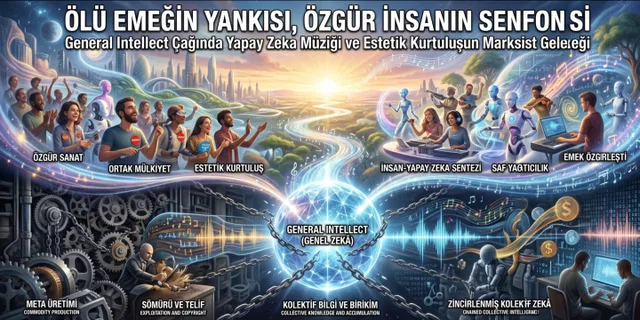
Karl Marx, in the famous "Fragment on Machines" section of the Grundrisse, foresaw that science and collective social knowledge (General Intellect) would become a direct productive force. Today, Large Language Models (LLMs) are the very embodiment of humanity's historical and contemporary collective intelligence. The problem, however, is that the ownership of this General Intellect lies in the hands of Silicon Valley monopolies.
"In the hands of capital, artificial intelligence is the most refined form of 'Fixed Capital.' It does not merely substitute for living labor (the writer, the scientist, the software developer); by absorbing the products of past labor, it transforms them into an instrument of domination over living labor."
The process of producing content with artificial intelligence gives rise to total alienation. The content producer, losing the subjectivity of the production process, is reduced to a "data miner" who feeds the artificial intelligence or an "editor robot" who controls its outputs. The knowledge produced, instead of possessing a use-value for the enlightenment of humanity, is transformed into an exchange-value that serves to increase the advertising revenue and share value of platforms.
The Communication Model of the Future: A Synthesis of Scientist, Producer, and Artificial Intelligence
While the capitalist construction of artificial intelligence enslaves the human to AI, the Marxist alternative positions artificial intelligence as an instrument of human liberation. In the future, the relationship among content producers, scientists, and artificial intelligence must not be one of hierarchy or exploitation, but a dialectical partnership.
- The Scientist (Methodology and Truth): The intellectual anchor who audits the "hallucinations" and disinformation produced by artificial intelligence and provides qualified, dialectical-materialist input to the system.
- The Content Producer (Aesthetics and Socialization): The subject who reproduces scientific and philosophical knowledge according to society's aesthetic and cultural needs, who constructs the "human sensibility" and narrative that artificial intelligence cannot possess.
- Artificial Intelligence (Collective Assistant): A public infrastructure that takes on the drudgery of knowledge production (data sorting, translation, raw text analysis) and liberates the human mind.
A Digital Commons–Based Method and Workflow Proposal
Against the walled gardens of monopolies like Google and OpenAI, we must restructure knowledge and artificial intelligence as a public good. A content production and distribution flow modeled on the logic of the "Commons" should be as follows:
The Commons Flow
| Stage | Process / Method | Ownership and Governance |
|---|---|---|
| 1. Data Commons | Scientists and content producers upload their work to decentralized, open-source data pools (e.g., IPFS-based libraries). | Collective/Cooperative: The data is closed to unauthorized scraping by commercial companies and open to social benefit. |
| 2. Sovereign AI | On these data pools, "Commons LLM" models financed by public funds or developed by open-source communities are trained. | Public/Community: Algorithmic transparency is essential; it is not profit-driven. |
| 3. Distributed Value Allocation | When the artificial intelligence produces an answer, a "Collective Royalty/Value Share" is transferred via smart contracts to the producers of the sources it drew upon (scientific articles, journalistic reporting). | Protocol-Based: Unlike Google, the production value of knowledge is paid its rightful share even when there is no click. |
| 4. Liquid Distribution (Federated Media) | Content is delivered directly to the user not under the monopoly of a single search engine, but through decentralized social networks (the Fediverse) and community applications. | User and Producer Councils: Instead of advertising-driven algorithms, curation is based on interest and truth. |
In Place of a Conclusion: Political Tasks and Concrete Organizing Practices
In the face of Google's move toward algorithmic enclosure, content producers trying to do better SEO resembles the 19th-century weavers (the Luddites) smashing factory machines with sledgehammers; it is a desperate effort that misses the structural solution. The enemy before us is not the algorithm itself, but the platform capitalism that owns that algorithm.
Today, in the world of 2026, the historic task before the digital proletariat (writers, scientists, software developers, artists) is not to defend, but to go on the offensive. This offensive must go beyond abstract intellectual critique and encompass concrete steps and new models of organization.
A. From Defensive Compliance to Offensive Action: Concrete Steps
There is a three-stage action plan that must be urgently implemented against the "data colonialism" of technology monopolies:
- Collective Data Strike and Opt-Out Policy: Individually placing a
robots.txtfile on our sites to block OpenAI or Google bots condemns us to digital invisibility. The solution is collective data strikes at the level of unions and publisher associations. Publishers, scientific journals, and content producers must simultaneously declare that they will provide no data flow to any search/answer engine that does not sign protocols for copyright and fair value sharing. The artificial intelligence of capital turns into an intellectual garbage heap without our living labor; we must become aware of our power. - Demand for Public Compute: Developing artificial intelligence is not merely a matter of algorithms but a matter of vast infrastructure and electricity (computational power / compute). Left politics must demand that states and local governments spend their budgets not on buying services from Silicon Valley but on building public, open-source, and free artificial intelligence infrastructures (Public LLMs). Just as electricity and water are public rights, so too must the infrastructure of the General Intellect be.
- Algorithmic Transparency and "Reverse Engineering" Laws: We must go beyond regulations like the European Union's AI Act; the algorithmic codes and weight matrices of monopolies such as Google, Meta, and OpenAI must be opened to public oversight. The operating logic of a system fed by the public's data cannot be hidden from humanity under the pretext of trade secrets.
B. The Organizing Models of the Future
Capitalism's union structure was designed for factories. In the age of digital and dispersed labor, we need new tools of organization:
1. Platform Cooperativism
We must build digital cooperatives in which there is no capitalist and the means of production belong to the workers themselves.
- How Does It Work? As alternatives to platforms like Medium, Substack, YouTube, or Spotify, platforms are built whose shares and governance rights belong to content producers, scientists, and software developers.
- Economic Model: Advertising revenues or subscription fees do not go into the pocket of a CEO or to stock-market speculators; after the platform's upkeep is covered, they are distributed directly to producers in proportion to their labor (on the principle of 1 worker = 1 vote).
2. Data Trusts and Intellectual Labor Unions (Data Trusts / Unions)
As individuals one by one, we have no chance of bargaining against Silicon Valley. But when we pool our data in a common reservoir, we become a center of power.
- How Does It Work? Writers, academics, and illustrators transfer the digital rights to their work to a "Data Union."
- Economic Model: When Google or any AI company wants to train on or use this data in its answers, it finds before it not an individual writer but a union representing millions of members. The union, via smart contracts, ensures that micro-payments (collective royalties) are transferred to its members from every AI query.
3. Algorithmic Soviets / Producer Councils
These are non-profit content and science networks rising upon the architecture of the decentralized internet (the Fediverse).
- How Does It Work? The governance of Mastodon, Lemmy, or entirely new academic networks to be developed is carried out not by algorithms trying to maximize advertising revenue, but by democratic councils (soviets) elected from among scientists, content producers, and readers.
- Economic Model: For a piece of content to come to the fore, the criterion is not its sensationalism (which would generate ad clicks) but its social benefit, scientific accuracy, and aesthetic value. These councils determine the algorithm's parameters.
+-------------------------------------------------------------+
**THE DIGITAL COMMONS FLOW **
[ Living Labor ] -> Scientist, Writer, Artist
v
[ Organization ] -> Data Trusts & Platform Cooperative |
v
[ Means of Production] -> Public / Open-Source Artificial Intelligence (LLM)
v
[ Distribution ] -> Decentralized Councils (Fediverse)
+-------------------------------------------------------------+
In Short;
Rescuing the future is possible not by rejecting technological development, but by shattering the capitalist property relations imposed upon that technology.
Artificial intelligence is the common heritage of humanity; tearing down the fences that turn it into the profit machine of a few companies is the foremost task of 21st-century socialism. Another internet, another future is possible, and we will build that future with our own hands, with our own code.
***Note: Working councils will be formed to discuss these models. We kindly ask those who wish to participate to reach out to us. ***
You might also be interested ...