Our Education Dossier Is Out: Whose School Is It?
Our New Education Dossier Is Out: 205 pages, 217 chapters. On Taking the School Back from the Market, Religious Communities, and the Algorithm

Comrade, Whose School Is It? The Answer Is Written Not in the Curriculum, but in the Budget
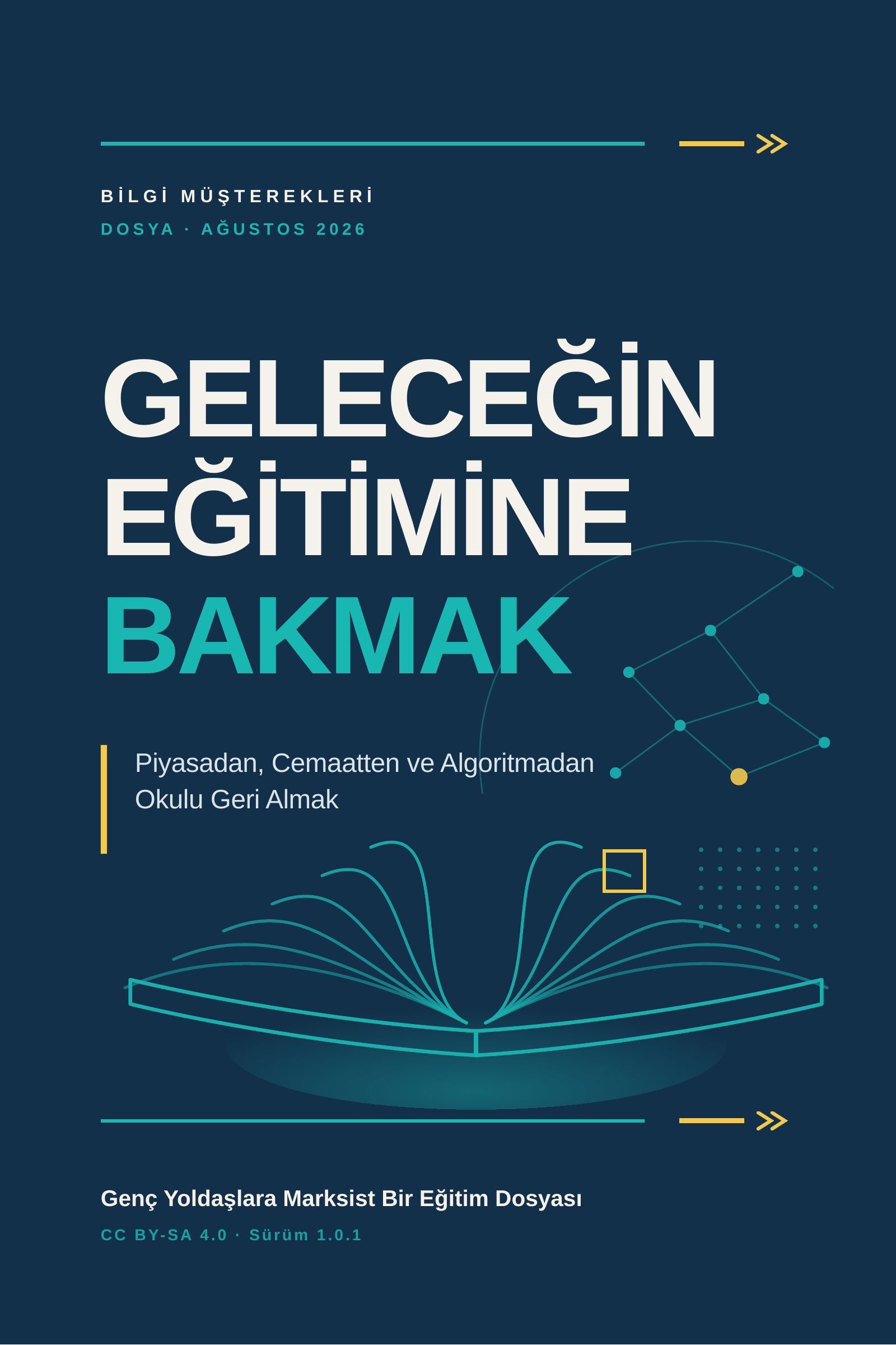
Our new dossier Looking at the Education of the Future is out. 205 pages, 13 parts, 217 chapters and six appendices. It was written on the occasion of Eğitim Sen's 6th Democratic Education Congress — but it is not a congress review. Free and under a CC BY-SA 4.0 licence: as PDF, EPUB and Markdown on our Guides page.
Comrade, this dossier opens with a question, and that question is harder than you think.
What is school for?
The first answer that came to mind was probably "to teach knowledge." Perhaps you said "to give a profession." Perhaps something finer: "to raise human beings."
Now ask the same question another way:
Whose interest does school serve?
The distance between the two questions — that is the subject of this dossier.
First, five easy traps
On the Turkish left, education is one of the most talked-about and least analysed fields. Everyone has a view; no one has a programme. And almost all of the views in circulation sit in one of five moulds:
The first: "Don't mix politics into education." The technocratic view that does not see that the curriculum, the exam, the architecture of the school and the form of teacher employment are themselves a politics.
The second: "The problem is a problem of secularism." It diagnoses religionisation correctly but treats marketisation and precarisation as secondary.
The third: "The problem is a problem of quality." It centres PISA rankings, "21st-century skills" and "AI literacy." It never asks about property.
The fourth: "School is already an apparatus; it cannot be saved." The pessimism that half-reads Althusser and abandons the field of struggle.
The fifth: "Technology will solve everything." The technical-solutionism that constitutes the teacher as a cost, the student as a user, and knowledge as content.
All five make the same mistake: they do not subject education to a historical-materialist analysis.
This dossier tried a sixth thing.
The tool in your hand: three questions
The most useful thing this dossier will leave you is not a theory, but a habit. For every policy, every document, every new technology, every "reform," ask the same three questions:
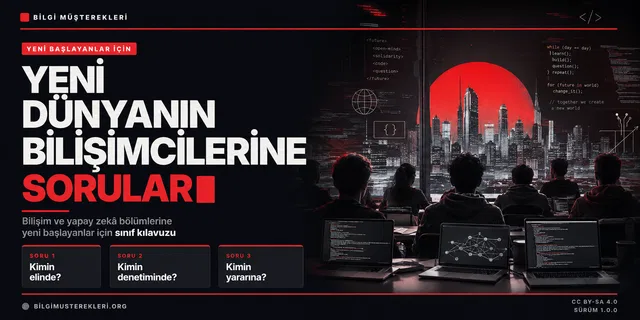
In whose hands? Under whose control? For whose benefit?
These three questions turn the "is it good or bad" debate into a "for whom" debate. And that is what we need most in education — because education is the field in which good intentions are spoken of most, and property least.
The central thesis
The claim that carries the whole of the text is this:
School is neither purely an instrument of emancipation nor purely an apparatus of domination. Under capitalism, school is a field in which labor-power is reproduced and in which a fight is waged over the form of that reproduction.
In Turkey this field was encircled from three sides: marketisation, religionisation, precarisation. At the end of the 2020s a fourth was added: algorithmic restructuring. These four are not separate policies; they are four faces of the same accumulation regime.
And a fifth layer, specific to Turkey, is laid over them: the national question.
School is not an apparatus; it is a field. And fields can be won.
The proof is not far away: in this country the state founded the Village Institutes in 1940, and in 1954 the same state closed them.
Ask, comrade: why does an apparatus tear out its own part?
Because that part was not doing what the apparatus was supposed to do.
What is in the dossier?
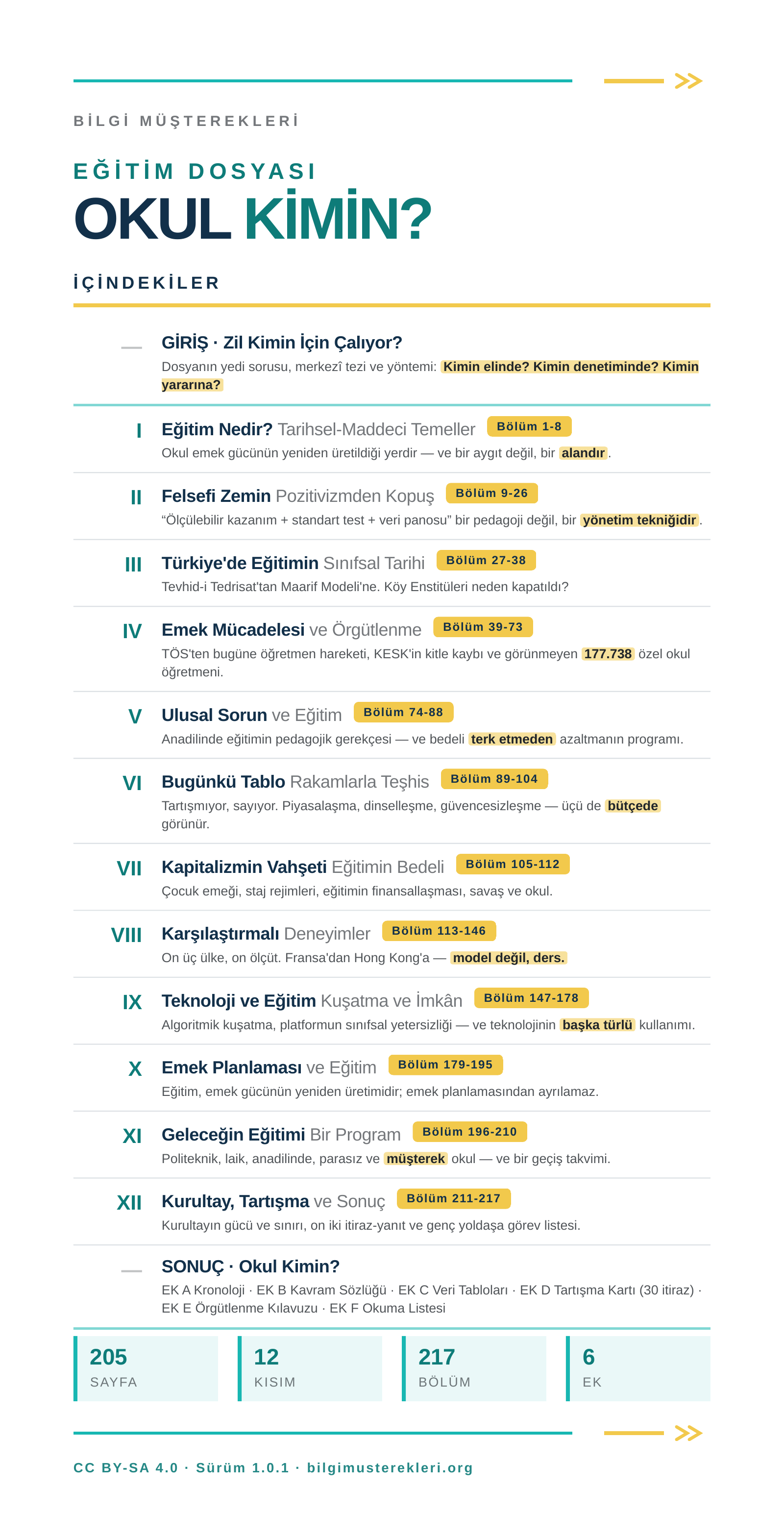
Thirteen parts. It was constructed to be read from beginning to end, but each part also stands on its own.
Part I — What is education? Marx's 1866 polytechnic programme, Gramsci's unitary school, Braverman's deskilling thesis, and the hidden curriculum. The founding of the thesis that school is not an apparatus but a field.
Part II — Philosophical ground: the break with positivism. The heart of the dossier. We show that the triad "measurable outcome + standardised test + data dashboard" is not a pedagogy but a technique of management. The history of psychometrics beginning with eugenics; Campbell's and Goodhart's laws; and, set against them, the Vygotsky–Leontyev–Ilyenkov–Davydov line.
Part III — The class history of education in Turkey. From the Unification of Education (Tevhid-i Tedrisat) to the Maarif Model. Why the Village Institutes were closed — and the connection with land reform.
Part IV — Labor struggle and organisation. The history of the teachers' movement in the world and in Turkey; a class analysis of KESK's loss of mass; and the 177,738 people who are almost never spoken of: private-school teachers.
Part V — The national question and education. The hardest part of the dossier. The pedagogical grounds for mother-tongue education, the cost of this position, and a twelve-point programme for reducing the cost without abandoning the demand.
Part VI — Today's picture. Diagnosis by the numbers. It does not argue; it counts.
Part VII — The brutality of capitalism. Child labor, internship regimes, the financialisation of education, war and school, refugee children.
Part VIII — Comparative experiences. France, Finland, Sweden, Chile, the USA, Cuba, Kerala, Vietnam — and China, Singapore, Hong Kong. Thirteen countries, ten criteria, a single table.
Part IX — Technology: encirclement and possibility. The Ministry of National Education's AI documents, data enclosure, algorithmic management; the class inadequacy of the platform model; and other models of using technology.
Part X — Labor planning and education. A critique of human-capital theory, cadre planning in Gosplan, the lesson of Cybersyn, and a draft of a ten-year education-labor plan.
Part XI — The education of the future: a programme. Polytechnic education, the unitary school, school councils, sixteen principles — and a transition timetable.
Part XII — The congress and the debate. Twelve objections, twelve answers.
Appendices. A chronology from 1845 to 2026, a glossary of concepts, data tables, a thirty-point debate card, an organising guide, and a reading list.
Four things that will surprise you
One: there is no such substance as "talent"
In the Soviet Union, at Zagorsk, there was a boarding school for deaf-blind children. They could neither hear nor see — that is, the two great entrance gates of language were closed.
Meshcheryakov and Ilyenkov, against the dominant view, began with these children not from abstract signs but from joint activity: the adult, guiding the child's hand with their own, made them hold the spoon, fed them, dressed them. The activity was at first entirely the adult's, then it was shared, and finally it passed to the child. As objects settled, signs entered; from signs to language, from language to literacy, from there to abstract thought.
Four of those who passed through this programme graduated from the psychology department of Moscow State University at the end of the 1970s.
Now think, comrade. If a child who cannot hear and cannot see can finish university in a correctly organised environment of activity — what is this thing we call "talent"?
Talent is not a substance found in the child's head. It is the sum of the activities they have been able to enter.
And a child does not choose which activities they will be able to enter. Class chooses in their place.
After this sentence it becomes harder to say "this child was never going to study anyway."
Two: today's newest education technology is a machine from the 1950s
The sector's brightest promise is "personalised learning": education for every child at their own pace, at their own level.
How does it work? The student solves a question → the system measures the errors → it selects the next question accordingly.
Now keep this description in mind and look at the "teaching machine" B. F. Skinner developed in the 1950s: break knowledge into small steps, ask a question at each step, reinforce the correct answer at once.
The same thing.
Today's newest education technology is the behaviourist teaching machine moved onto the screen. What has changed is not the pedagogy, but the capacity to collect data.
And in Freire's terms: adaptive learning software is the automated form of banking education. The student is still an account; the only difference is that a separate account is now opened for each child.
This is called "personalisation."
Three: the state opened investigations against 50,300 teachers and dismissed 11 of them
On 15–18 December 1969 more than a hundred thousand teachers in Turkey went on boycott — more than two-thirds of teachers. The proceedings opened afterwards:
| Proceeding | Number |
|---|---|
| Teachers investigated | 50,300 |
| Pay-cut penalties | 45,520 |
| Suspended from work | 2,118 |
| Internal exile within the province | 6,600 |
| School principals removed from post | 400 |
| Dismissed from the profession | 11 |
More than fifty thousand investigations — and only eleven dismissals.
The aim was not a purge. The aim was mass intimidation.
The number punished is small; the number deterred is large.
And this mechanism has not ended. Today 320 education workers have been investigated merely for taking part in an International Mother Language Day event on 21 February. Those 320 people are a number. The real number is those who thought of taking part in that event and then gave it up.
Four: Illich's utopia was realised as the market's dystopia
In 1971 Ivan Illich proposed that the school be abolished and replaced by voluntary, decentralised "learning webs": a sharing of knowledge that would break the expert monopoly, open to everyone, without diplomas.
Fifty years later those webs were built. Their name is online course platforms.
What was the result?
- On one large platform 75% of instructors earn under a thousand dollars a year; the top 1% takes more than half of total earnings.
- The share allocated to the instructor from the corporate-subscription pool was cut in two years from 25% to 15% — unilaterally, with an announcement text, with no body of appeal.
- And in 2026 the sector's two large players merged.
A fourteen-year story of "democratising education" ended with the centralisation of capital.
Lesson: Abolishing an institution does not abolish that institution's function — it only leaves to the market who will perform that function.
Turkey's X-ray: eleven figures
All the data used in the dossier were gathered, with source and date, in a separate data appendix. The eleven most striking:
| Share of private schooling, 2002 → 2026 | 1.9% → 8% |
| Religious Education budget, 2021 → 2025 | 11.9 → 109.8 billion TL (9.2 times) |
| Hourly-paid teachers (62 provinces) | 71,757 |
| Staffing-norm shortage (55 provinces) | 80,449 |
| Distance of a Head Teacher's pay from the poverty line | −22,454 TL |
| Students who died in MESEM | 20 |
| Children outside formal education | 611,612 |
| Public spending per student (pre-tertiary) | $4,032 — OECD average $13,527 |
| Kurdish-language teachers appointed in 15 years | 132 (199 appointments against ~2,000 graduates) |
| Investment share of the Ministry of National Education budget, 2002 → 2026 | 17.8% → 8.2% |
| Eğitim Sen's place in its service branch, 2002 → 2026 | 1st place (22.84%) → 4th place (6.24%) |
And one of them is a section on its own: the Ministry of National Education does not publish the number of hourly-paid teachers for the country as a whole. Every figure in circulation is province-level data compiled by the unions through right-to-information requests.
This is not a data gap. It is a preference not to publish.
Six lessons from the world
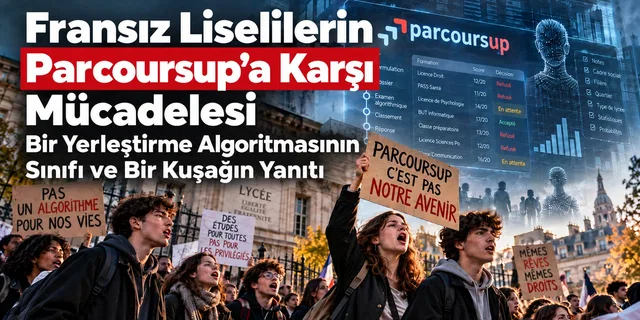
France. In the country with the world's strictest secularism law, 17.6% of students are in private schools whose budgets are 73% publicly funded; the public funds transferred in 2022 were 8 billion euros. And in those schools the share of the upper income group rose in twenty years from 26.4% to 40.2%. Lesson: secularism detached from the question of property empties itself.
Finland. The source of the legend was not education policy but the welfare state. And when the welfare state contracted: −64 points in mathematics relative to 2006, the share of low performers from 7% to 25%, instructional hours per diploma in vocational education from 3,500 to 2,100. Lesson: an education model cannot stand when the condition that brought it into being is withdrawn.
Chile. After forty years of a voucher regime, only one-third of students are in public schools. But the same country also produced the world's strongest student movement and won free higher education — on the condition of nominal duration. And 201,716 students lost their right for "being late." Who is late? Those who study while working. Lesson: the conditions of a right won are as important as the right itself.
China. In 2021 the for-profit private-tutoring sector was banned: a sector of ~$100 billion was demolished, more than a million people lost their jobs. And within three years the market resurfaced — because the gaokao's function of selection had not changed. Lesson: without changing the social relation that produces a market, banning that market does not abolish it. (Turkey lived a small-scale rehearsal of this when it closed the dershane sector in 2013.)
Singapore. World first in PISA in mathematics, reading and science. And second among 79 countries in the effect of socioeconomic origin on test scores. Teachers work 47 hours a week; 40% of those under 30 are considering leaving the profession. Lesson: when excellence is separated from equality, excellence wins — and "merit" becomes not the antidote to inequality, but its explanation.
Hong Kong. A 48-year-old union organising about 90% of teachers, with 95,000 members, was dissolved in a single summer (August 2021). In place of the critical-thinking course a compulsory mainland tour was put. Lesson: being organised is not, by itself, a guarantee.
We also built the counter-theses in their strongest form
Comrade, you can tell whether a text respects you from this: does it refute the other side from its weakest form, or from its strongest?
In the dossier twelve objections were built, as strongly as we could, in a separate section and answered. The hardest:
- "If the private school is high quality, so what? If families are choosing it, let's respect that."
- "Imam Hatip is a choice too. Why are you interfering with a religious family's choice?"
- "I learned software on Udemy and found a job. Platforms really do create opportunity."
- "Singapore's meritocracy works — they're first in PISA."
- "If you abolish the exam, patronage will come. The exam is at least objective."
- "If the union had never entered the Kurdish question, it would have three times the members today."
The last is the hardest, and the dossier does not skate past it. Our answer, in brief:
Factually incomplete — in the same period Türk Eğitim-Sen, which stands on a line diametrically opposed on the mother-tongue question, also lost 12,932 members; and there was no growth even when that clause was absent from the statute between 2005 and 2011. What actually grew is Eğitim-Bir-Sen (from 18,028 to 444,429, 24.6 times) — and this growth is explained not by a mother-tongue position but by the authorisation mechanism.
And we reject the counterfactual: A union that abandoned that position does not become "a socialist union with more members." It becomes a nationalist union with more members.
But the objection has a just share, and we concede it: The demand was long defended only inside a rights language; a bond of common interest with the Turkish worker was not built; it was not debated in the western provinces; it was not armed with pedagogical evidence.
The position is correct; the form of defence is inadequate. And what is to be corrected is not the position, but the form of defence.
We looked at our own side too
One of the dossier's methodological principles is this: criticism of our own tradition as well.
That is why these too are inside the text:
- The Village Institutes are not uncritically exalted. They were institutions of a single-party regime, their curricula were not independent of official ideology, and they were silent on the mother-tongue question. From them we take not the period, but the method.
- The rolling-back of the Soviet polytechnic school in the 1930s is a separate section. Why it was rolled back gives the dossier's most important lesson: there was no institutionalised subject to defend it.
- KESK's loss of mass is divided into four causes and weighted — and the fourth is the union's own share. The distance between the branch and the school, the internal language, exhaustion from symbolic action, not being visible on the everyday problem.
- And the consolation narrative "we were right but we were left alone" is rejected. A union's job is not to be right, but to win. Being right is a starting condition, not a result.
So what do we want?
It is easy to criticise; it is hard to say what you want. The last three parts of the dossier exist for this.
A polytechnic, secular, mother-tongue, free and common school. Financed by the state, governed by the council. A school that postpones streaming to age 16, that does not rank, that evaluates the child not by algorithm but by a human being.
And a transition timetable — first life, then security, then structure:
Urgent and non-negotiable: Abolition of MESEM (20 children died). Free meals in all schools. Abolition of hourly-paid teaching. Raising teachers' pay above the poverty line. Reinstatement of the 806 education workers dismissed by emergency decree (KHK).
Structural: Class size, publicisation of preschool, guidance teachers, mother-tongue education, and an education-data regime — a free-software mandate, data in public hands, a ban on automatic profiling, a ban on algorithmic assessment.
Transformative: Abolition of the LGS, the unitary school, school councils, a three-layer curriculum.
And not a single article in this programme is technically impossible.
Class size is a budget decision. A free meal is a budget decision. A multilingual classroom is a constitutional article and an appointment decision. Free software is a tender specification. A school council is a regulation.
None of them is a technology waiting to be invented in the future. All of them are decisions that can be taken today. What is missing is not possibility — it is power.
And a part for hope
This dossier may look like a narrative of encirclement. It is not.
Because on the same pages these too are present:
Once in this country, children built the walls of their own schools themselves, drew the electricity themselves, played the violin and asked whose the land was. They were closed — because they were working.
In 1980 69.2% of teachers in Turkey were united in a single organisation: TÖB-DER, 220,000 members, 670 branches. That organisation was closed, 210–229 of its members were killed — and the teachers' movement was rebuilt. In this country teacher organisation was zeroed twice and twice it got back on its feet.
In Chile it was lost in 2006 and won in 2011. The first wave constitutes the demand; the second wave takes it.
In Cuba in 1961, in eight months, the rate of those who could not read and write fell from 23.6% to 3.9%. The lesson is not technical but political: when education is treated as a budget line it takes years; when it is treated as a mobilisation the result is taken in a year.
And the annual cost of closing the world's 44-million teacher shortage is $120 billion — on the order of three times the projected size of the AI-in-education market for 2030 ($42.48 billion).
It is not that there are no resources. The resources are going somewhere else.
"There are no resources" is not a finding; it is a declaration of preference.
Where will you get it?
The dossier is free and under a CC BY-SA 4.0 licence. In three forms:
- PDF — print-ready A4 layout, 205 pages. For reproducing, for bringing to a reading group.
- EPUB — for reading on the phone and on an e-reader.
- Markdown — for carrying onto your own site, your wiki, or your organisation's publication.
→ Download from our Guides page
In addition, Appendix E — Organising Guide inside the dossier can be circulated independently: practical steps on mapping the school, reaching the hourly-paid teacher, writing a demand in the language of parents, founding and documenting a de facto school council. And Appendix D — Debate Card: thirty objections, thirty short answers.
Reproduce it, print it, work it in your reading group, add your own organisation's name and republish it. You do not need to ask permission. The only condition is that the derived text also circulate with the same freedom.
For a collective that writes against the enclosure of knowledge to enclose its text with copyright would be the most visible contradiction.
Last word
Young comrade, if a single thing from this piece is to stay in your mind, let it be this:
Education is not neutral; it teaches either to be silent or to ask.
School is not an apparatus; it is a field — and fields can be won.
That is why our question is not "how is education fixed": WHOSE SCHOOL IS IT?
And one more thing.
It will certainly come before you one day: a sentence that begins "education is not what it used to be." In that moment do not fight. Ask a question:
"So what is this school's budget, in lira? How much is the teacher paid? How many children are in the classroom? And who decided these three figures?"
Because the education debate is often an address-misdirection. And correcting the address is more effective than winning the argument.
This dossier too was written to be criticised. We gave disputed figures as ranges. We listed one by one, at the end of the text, the eight research gaps we could not close — we could not reach the full text of the Ministry of National Education's AI policy document, we could not find the size of the dershane sector, we could not pull comparative enrolment data for the Kurdish provinces. We wrote what we do not know as what we know.
Show the place you find wrong: with the source, with the grounds. We will publish the criticisms that come, and we will work those we find just into the text. Corrections are stated openly in the version notes; we do not change them in silence.
Because the common denominator of all the encirclements this dossier recounts was a single thing: the taking of speech and decision out of our hands.
Let us not fall into the same error with our own text.
The bell is ringing, comrade. But we will decide for whom the bell rings.
Comradely, Knowledge Commons
Publication note
Looking at the Education of the Future — Taking the School Back from the Market, Religious Communities, and the Algorithm A Marxist Education Dossier for Young Comrades Knowledge Commons, August 2026 — Version 1.0.1
205 pages · 13 parts · 217 chapters · 6 appendices. Freely available as PDF, EPUB and Markdown: Guides
The dossier was written on the occasion of Eğitim Sen's 6th Democratic Education Congress (25–29 August 2026, Ankara). The congress's eight commission headings — the struggle for democratic education in the neoliberal and neofascist period, secular education, mother-tongue-based multilingual public education, the autonomous-democratic university, gender equality, the democratic school, artificial intelligence and digital transformation, ecological education — are reflected directly in the dossier's architecture of parts.
This dossier is a sibling text to the dossier "Labor in the Age of Artificial Intelligence" (Part IX), the dossier "The Real China" (Chapters 132–137), the dossier "The Real Russia" (Part X), and the piece "Comrade, Who Divided Us? — Racism and Class" (Part V).
Data note. All figures used in the dossier are recorded, with source and date, in a separate data-appendix document. No number appearing in the text was written without a place there. The PISA 2025 results will be announced on 8 September 2026; the Turkey and Finland sections will be updated after that date.
Version note. 1.0.1 (August 2026) — First full version.
For criticism, contribution and corrections: bilgimusterekleri.org
Licence: CC BY-SA 4.0 — you may reproduce, distribute and adapt, provided you give credit and share under the same licence.
This is a living document; it grows by criticism. bilgimusterekleri.org