The Commune at the School Gate
What Do the Young in France Want, and Why Are They in the Street?

The Commune at the School Gate: What Do the Young in France Want, and Why Are They in the Street?
Dear Young Comrades,
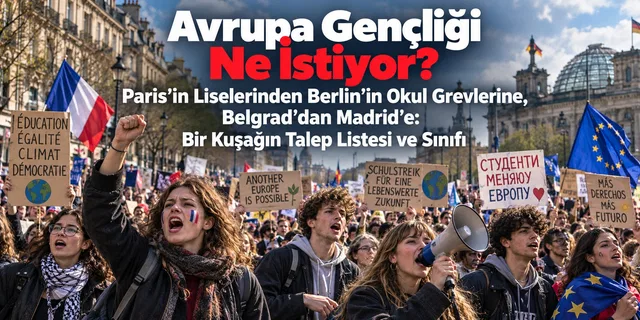
Five days ago, on 2 October, in the piece "What Does Europe's Youth Want?" we looked at the youth movements running from France to Germany, from Serbia to Spain, and we left a question behind: the list of demands looks reformist; why, then, is the wall in front of it the system itself? Since that day the movement in France has grown, it has crossed the border, the state's answer has hardened, and the government has been forced to step back.
This piece proposes an answer to that question. The name of the answer is the commune. Read one by one, the French lycée students' demands for a chair, a teacher, a meal and a dormitory are each a reform; read together, they are a call for what is held in common to be governed by those who use it, and according to need. To bring out what this call means is this piece's real concern. First a short summary, then the meaning of the call for the commune, then the detail of the events.

29 September 2026, Paris. Lycée students blockade the north-west gate of the school. Camille Hestaux, CC0, Wikimedia Commons.
Summary: At a Glance
- The call for the commune: When the young people's demands are brought together (a free school of decent quality, need instead of selection, housing and food outside the market, a say in the institutions, the refusal of the distinction between native and foreign), they demand that social reproduction be governed as a common (commun) sphere. In French, commune and commun are of the same root; one of the first acts of the Paris Commune of 1871 was free, secular education. The call for the commune is the name of carrying these demands through to the end.
- Why does it matter? Because these demands cannot be secured lastingly inside a capitalist budget; in every crisis they are the first lines to be cut. The emphasis on the commune makes visible the difference between the struggle at the level of "a little more budget" and the question "who will govern what is held in common?"
- What is happening? The blockade that began on 17 September at the Saint-Exupéry Lycée in Créteil, in support of a teachers' strike, spread in three weeks to more than 700 of France's roughly 3,700 lycées, and to about 30 universities. On 6 October, lycée students, university students and the education unions held the third large day of action nationwide.
- What do they want? Classes of a human size (today 32 to 35 people), teachers on permanent contracts, a school nurse and a psychologist, buildings that are not falling down, the abolition of the Parcoursup and MonMaster selection regime, grants and support for housing, a meal for 1 euro, and the reversal of the 16-fold fee increase for foreign students.
- Why now? The government foresees a cut of 54 billion euros in the 2027 budget; public-sector pay has been frozen for the fourth year in a row. The young are paying austerity's most visible bill at the school desk.
- What did the state do? First it branded the movement "urban violence" and "manipulation by LFI". According to Euronews, as of 5 October there have been more than 5,000 detentions, and 87 percent of those detained are not of legal age. Then Prime Minister Lecornu was forced to announce a five-point "action plan".
- And in Europe? On 1 October the movement leapt to Belgium (Liège, Arlon, Charleroi, Hannut). In Germany the school strikes against conscription reached their fourth wave. The common ground is this: the budget is going to austerity, to rearmament and to capital; the bill is left to the young.
The Call for the Commune: What Does It Mean?
First, a note of honesty
In the news sources we could reach, in the joint statements of the French lycée students, or on their banners, a call that uses the word "Commune" directly has not been documented. To show a movement as we would like it to be is the way not of understanding it, but of speaking in its place. So what we will do here is not to put a slogan into the young people's mouths. It is to bring out the call that is already inside their demands. A Marxist analysis does not content itself with what people say about themselves; it looks at what they are demanding objectively, and at which social relation this demand points to.
What do the demands say?
The call of the USL and the Union Étudiante on 6 October and the list of 29 demands gather under four principles:
- What is held in common should stand outside the market. A free school of decent quality, a meal for 1 euro, a frozen dormitory rent, a fee increase that has been withdrawn.
- Distribution should be made by need, not by selection. The abolition of Parcoursup and MonMaster; the refusal of the regime that distributes, under the name of "merit", a resource kept scarce, and distributes it by class.
- There should be a say in the institution. The right to organise and to demonstrate, and no punishment for taking action; the school and the university should be the affair of those who live there, not of the administrators.
- What is held in common should belong to everyone. Opposition to the fee increase for foreign students and to "racist measures"; the limit of what is held in common should be set not by the passport, but by the person who studies and works there.
When these four principles are brought together, what appears is not a budget line but a principle of social organisation: the spheres in which society reproduces itself (education, food, housing, health) should be taken out of the commodity, and governed by those who use them, and according to need. This has a name known in history.
From 1871 to 2026: what was the Commune?
The Paris Commune was the 72 days, between 18 March and 28 May 1871, in which the workers of a besieged city took power into their own hands. The Commune was born not as a utopia, but as the practice of meeting the most basic needs not by the state and the property owners, but by the people themselves. Some of its first decisions:
- The separation of church and state, and free, secular and compulsory education; with particular attention to the education of girls.
- The cancellation of the rent debts of the months of the siege; the return of goods left in pawn with the moneylenders.
- The banning of night work in the bakeries.
- The handing over to workers' cooperatives of workshops abandoned by their owners.
- Elected representatives being recallable at any moment, and public officials not being allowed to receive more than a worker's wage.
Marx, in The Civil War in France, defined the Commune as "the political form at last discovered, through which the economic emancipation of labour could be carried out." The importance of the Commune lay not only in what it gave, but in how it governed: a common sphere governed from below, instead of a right distributed from above.
Setting the two lists side by side
| The Paris Commune of 1871 | The demands of the French youth of 2026 |
|---|---|
| Free, secular and compulsory education | A free school of decent quality; an end to the overcrowded class, the lesson without a teacher, and the crumbling building |
| The cancellation of rent debts | The freezing of dormitory rents, the protection of the housing benefit (APL) |
| The return of pawned goods, measures against usury | An increase in grants; opposition to student debt and to the fee increase |
| The banning of night work in the bakeries | A humane arrangement of the school day, a lunch break of at least an hour and a half |
| Foreigners being able to hold office in the Commune (the Hungarian Leo Frankel became commissioner of labour) | The refusal of the 16-fold fee increase for foreign students, and of racist measures |
| A representative who can be recalled, government from below | The right to organise and to have a say in the institution, and no punishment of the activist |
| The handing of the workshops to workers' cooperatives | (Not yet) The government of the school and the university by assemblies of students and workers |
The last row of the table was left empty on purpose. Across 155 years, the two lists touch the same spheres of social reproduction. The difference is that the demands of 2026 are still demands addressed to the state, while those of 1871 were the decisions of a community governing itself. The meaning of the call for the commune lies exactly in this gap.
Why does the emphasis on the commune matter today?
First, for the lastingness of the demand. The demands for school, food and a dormitory can be met inside a capitalist budget only for a time. Every time the rate of profit is squeezed, capital sees the cost of reproducing labour-power (that is, the indirect part of the wage) as the first line to be cut. The cut of 54 billion euros is the freshest example of this. Every gain taken today with the Lecornu plan can be taken back again in tomorrow's budget. The emphasis on the commune carries the struggle from the level of "a little more budget" to the question "who will govern what is held in common?"
Second, for the form of organisation. The movement was born on TikTok, and it grew at the school gate. But if the blockade does not turn into a lasting structure, it scatters. The idea of the commune recalls that the blockade itself can be an experience of self-management: general assemblies that decide together who will open and close the gate, who will take the decisions, and how the food and the security will be organised, are the smallest cells of the commune.
Third, for the alliance. What made the Commune possible in 1871 was that workers, craftspeople, teachers and the National Guard shared the same fate in the same city. In 2026 too, the moment the movement grew stronger was the moment the lycée students met the education unions and the public workers on the same day. What is held in common requires a common struggle.

6 October 2026, Nancy. "Teacher on strike." Florian Cuny, CC BY-SA 4.0, Wikimedia Commons.
Fourth, for internationalism. The Commune was an experience that took foreign revolutionaries into its own government. Today the French chair, the Belgian fee and German military service are parts of the same equation. The call for the commune draws the limit of "what is held in common" not by the nation, but by the class.
The commune and the commons
As Bilgi Müşterekleri we work with the concept of the "commons"; this concept seeks an answer to the same question as the Commune. The principle we defend against the enclosure of knowledge, of software and of data is the same principle the French lycée student defends for the school: what is produced socially must be governed socially. The school is not a service; it is a commons. Enclosed code and a closed classroom are two faces of the same property relation.
From One Lycée's Gate to the Country: A Chronology
To set the events in order also answers, of itself, the debate over whether the movement was spontaneous or organised. The table below is compiled from Küre Ansiklopedi, Euronews and the French press.

30 September 2026, Grenoble. The gate of the Champollion Lycée, blockaded. David Monniaux, CC BY-SA 4.0, Wikimedia Commons.
| Date | Event |
|---|---|
| Mid-September | The first blockades, lycée by lycée, in Bretagne, the Nord and Calvados, on the ground of "human and material problems" |
| 17 September | Student support for the teachers' strike at the Saint-Exupéry Lycée in Créteil; it becomes the symbol of the movement |
| 28–29 September | The spread from Île-de-France (Val-de-Marne, Seine-Saint-Denis) to Marseille, Lille and Grenoble; on the national day of action of 29 September, about 400 lycées and 440 detentions |
| 1 October | The peak: 1,027 lycées affected, 1,949 detentions; the campuses of Rennes 2, Lyon 2, Lyon 3, Lille, Strasbourg, Bordeaux, Marseille, Rouen, Brest and Paris blocked; the first action in Liège, in Belgium |
| 2 October | More than 400 schools closed, and a shift to distance learning |
| 5 October | The Euronews balance sheet: more than 5,060 detentions (87 percent not of legal age), more than 170 injured students, 78 injured school staff; a second wave in Belgium |
| 6 October | "The third act": a march nationwide on the call of the USL and the Union Étudiante; the education unions in the street too; Lecornu announces the five-point plan |
The movement's first tools were TikTok and Snapchat; the blockade videos passed 1.5 million views. So the movement was born not by a button pressed from a single centre, but by tens of thousands of young people who live the same conditions coming to recognise one another. The organised structures (the Union syndicale lycéenne, the Union Étudiante) tied this spontaneity, in the second week, to a national calendar. Spontaneity and organisation are not each other's opposite here; they are two successive phases of it.

6 October 2026, Belfort. The movement's third act; CGT stewards are in the square too. Thomas Bresson, CC BY 4.0, Wikimedia Commons.
What Do They Want? Reading the List of Demands with a Class Eye
When the call of the USL and the Union Étudiante on 6 October and the list of 29 demands compiled on 5 October are read together, the demands fall into four clusters:
a) The material conditions of the school. The renewal of crumbling buildings; classrooms that do not heat, or that roast; pests; overcrowded classes (32 to 35 students, among the most overcrowded in Europe); a lunch break of at least an hour and a half.
b) Labour-power. The hiring of teachers on permanent contracts, the real filling of lessons left empty, a school nurse, a psychologist and a social worker. There is no doctor in the school; the cancellation of lessons because there is no teacher has become ordinary.
c) The regime of selection and of debt. The abolition of Parcoursup and MonMaster; the reversal of the 16-fold fee increase for foreign students (those from outside the EU); the housing benefit (APL) not being cut; an increase in grants; a CROUS meal for 1 euro for every student; the freezing of dormitory rents.
d) Political rights. No penalty of absence for taking action; the protection of the right to organise and to demonstrate on the campus.

6 October 2026, Paris. "We're missing our lessons, to teach you one." FreCha, CC BY-SA 4.0, Wikimedia Commons.
On this list there is neither the word "revolution" nor a party programme. But every item has a common direction: all of them concern the conditions of the reproduction of labour-power. As we also stressed in the previous piece, education, health, housing and food are social rights, won by the struggle of the working class in the period after the war, and they are an indirect part of the wage. When the rate of profit is squeezed, capital cuts here first, because from its point of view these lines are a "cost". The lycée student's class of 35, the frozen wage of the worker's family, and the closed ward of the public hospital are rows of the same budget table.
The sentence in the Union Étudiante's call says this plainly: these policies "crush those who work, while they make the rich richer." The class consciousness of the young is born not from the textbook, but from the classroom that has no chair to sit on.
Why Now? From Whom the 54 Billion Euros Were Cut
The trigger of the movement is the school desk, but the ground is the budget. The Lecornu government's 2027 budget foresees a saving of 54 billion euros; the wages of public employees have been frozen for the fourth year in a row, and the actions fell on the same days as the national strikes in the public sector. The far right, for its part, demands a cut that is harsher still.
On the other side the picture is this: in France the wealth of the billionaires has multiplied over the last thirty years and risen above a trillion euros; in the same period the public debt has also grown several times over. If wealth grows while the debt grows, the question arises of where the debt is flowing. At the same time, defence budgets are being raised all over Europe. So the matter is not "there is no money". It is the matter of which class the money will go to, and for which purpose.

6 October 2026, Nancy. "Tax the rich, not our futures." Florian Cuny, CC BY-SA 4.0, Wikimedia Commons.
| The state's account | What the street sees |
|---|---|
| "Resources are limited, we have to tighten our belts" | While billionaires' wealth and the armament budget grow, the only things cut are school, health and housing |
| "The movement is being manipulated by LFI and the far left" | The movement was born on TikTok and in the school corridor, by the young people's own organisation, the young people who live the same conditions |
| "This is no longer an action, it is urban violence" | 87 percent of those in detention are children; pepper spray was fired at close range at 14-year-olds |
| "A part of the demands is legitimate" | The demands accepted as legitimate could be answered, after 5,000 detentions, with a five-point plan |
| "The school is not a place for politics" | With how many teachers a school will open, and with classes of what size, is precisely the politics of the budget |
| "Selective entry (Parcoursup) is merit" | Selective entry is the distribution, by class, of a public resource kept scarce |
The State's Answer: First the Baton, Then the Plan
The state's response came in two phases.
The first phase: to declare them guilty. Interior Minister Laurent Nuñez said the blockades "were not ordinary forms of protest" and "resembled urban violence". Education Minister Édouard Geffray claimed that the "nature" of the movement "had changed" and that it had been "captured by violent groups". An intelligence assessment coming from the prime minister's office tied the organisation to "LFI and far-left extensions". Mélenchon, for his part, called on MPs to "step in" between the students and the police.
The point to be careful about here is this: the burning of schools, and the attacks aimed at teachers (including petrol being poured over a teacher), are real events, and they are unacceptable. But to pin these onto the essence of the movement is the state's known method. That 87 percent of the more than 5,000 detentions are children who are not of legal age shows where the centre of gravity of the violence is. The words of the president of the Human Rights League, "international law has been completely trampled", matter for this reason.
The second phase: a step back. On 6 October Prime Minister Lecornu announced a plan under five headings: the prevention of cancelled lessons, the improvement of the buildings, school organisation, transparency in university applications (Parcoursup), and student support. This is the movement's first concrete gain. But take note: the plan does not change the frame of the cut of 54 billion euros; it does not abolish Parcoursup, it "makes it transparent." So it is trying to manage the symptom without touching the logic of the system. The question in front of the movement is this: will it scatter over this scrap, or will it take the budget itself as its target?
Beyond the Border: The Same Bill in Europe
In the previous piece we had drawn the map of Europe. In the last week two developments stand out:
- Belgium: The movement leapt to Liège on 1 October, and on 5 October to Arlon, Charleroi and Hannut. Belgian students have an additional trouble: the higher-education registration fee (minerval) is being raised, for about 58 percent of students, from 835 euros to 1,194 euros; according to the unions the reforms will destroy close to 2,000 full-time teaching posts (Planet Today's compilation).
- Germany: On 25 September, on the call of the "School Strikes Against Conscription" alliance, against the return of conscription, more than 45,000 students came into the street in about 100 cities; 3,400 in Berlin, 1,900 in Hamburg. This is the fourth national school strike within ten months.

8 May 2026, Leipzig. An earlier wave of the school strike against conscription. The banner reads: "No war but class war." Roy Zuo, CC BY-SA 4.0, Wikimedia Commons.
The young person in France wants a chair in the classroom, the young person in Belgium a fee that can be paid, the young person in Germany not to be sent to the front. Three demands are three faces of a single equation: the social surplus product is being directed not to reproducing the life of the young, but to financing the profitability of capital and the rearmament of states. Some publications of the left write that the movement has spread to Spain and Portugal too; we could not confirm this information with independent sources, so we stay cautious here.
Seen from Turkey
The class sizes in France are familiar to us; in many schools in Turkey, classes of more than 40 students, double-shift schooling, and the meeting of cleaning and security staff out of money collected from parents are ordinary. The counterpart of Parcoursup here is the exam regime that changes every year at the passage to lycée and to university, and the vast market of cram schools and private courses built upon it. The housing crisis, for its part, has not been solved since the "barınamıyoruz" ("we have nowhere to live") movement of 2021.
The difference is here: in France the lycée student has a union (the USL), and this union can announce a national calendar; the unions of education workers can join the call too. In Turkey the organisation of the lycée student is almost treated as if it did not exist. What we wrote on democratic education pointed exactly to this gap: without lasting structures that bring the student and the teacher, the parent and the education worker, together around the same demand, even the most just anger scatters and goes.
Concrete Tasks for Young Comrades
On top of the seven tasks in the previous piece, with the lessons that come out of France's last week:
- Do not take the scrap for the gain, but do not belittle the gain either. The Lecornu plan is the product of the pressure the street created. Keep a watch-list that follows which item will be applied when, with how many posts, and from which budget line.
- Tie the demand to the budget. Instead of "more teachers", say "this many teachers in this school, from this line". Austerity is easily defended against abstract demands; it is hard to defend against a concrete figure.
- Do not fall into the trap of violence; document the violence of the state. Burning a school serves not the movement, but those who want to suppress the movement. Record the detentions, the injuries and the lawlessness with the date, the place and the witness; make contact with networks of lawyers beforehand.
- Be ready for the question "who is behind you?" The right answer: "Behind us is our class of 35, our lesson that has no teacher, and our dormitory whose rent we cannot pay."
- Make the alliance with the teacher and the parent into an institution. In France, the moment the movement grew stronger was the moment the lycée students met the education unions on the same day. Student–teacher–parent assemblies at the level of the school are the smallest unit of this alliance.
- Use the digital as a tool; do not put it in the place of the organisation. TikTok gave birth to the movement; but what tied it to a national calendar was the organisations that held meetings and took decisions. The algorithm gives visibility today, and cuts it tomorrow.
- Make the blockade the school of the commune. Do not content yourselves with closing the gate; take the decisions in a general assembly, elect spokespeople and recall them when necessary, and organise the food, the security and the communication together. A movement that learns to demand must also learn to govern.
- Build the international tie. The French chair, the Belgian fee, German military service and Turkey's class of 40 are parts of the same equation. Joint statements, messages of solidarity in both directions, translation and the sharing of information are the first steps of this tie.
Dear Young Comrades,
A few desks set at the gate of a lycée in Créteil changed, in three weeks, a country's budget debate, forced a prime minister to step back, and became an example to the young on the other side of the border. The price of this was heavy too: thousands of children in detention, hundreds of them injured.
The young of France want a very plain thing today: a humane school, a humane life. Do not be deceived by the plainness of this demand. A chair to sit on, a meal that fills the stomach, a dormitory to stay in, and the right not to be sent to the front, are not small demands in an order that writes its budget according to capital's profit and to rearmament.
In 1871 the workers of Paris did not begin with grand words either; they spoke of the rent, the bread and the school. Then they set about securing these in an order where no one decided in their name. This is the meaning of the Commune: to govern in common what is held in common. Today the same question is being asked again at the gate of a lycée in Créteil, on a march in Liège, and in a school strike in Berlin: this school, this city, this budget, whose are they?
The desk at the school gate may not be the commune's first barricade. But it is the place where we begin to say plainly what we want, and where we ask back for what is held in common. The call for the commune is the common voice of those who pass through that gate.
For better futures, together.
Sources
- Karl Marx, The Civil War in France, 1871
- Bilgi Müşterekleri, "What Does Europe's Youth Want?", 2 October 2026
- Euronews, "From school blockades to violence: what is driving student protests in France?", 5 October 2026
- Euronews, "French students blockade schools nationwide to demand more resources", 29 September 2026
- Euronews (FR), "Lycée blockades: violence, fires and clashes; Lecornu accuses LFI and the ultra-left", 1 October 2026
- Küre Ansiklopedi, "2026 France Student Protests"
- Syndicollectif, "Call of the youth organisations for 6 October 2026"
- Blog-Note, "The demands of the lycée students in October 2026", 5 October 2026
- Contre Attaque, "The youth movement: universities blocked, a large demonstration on 6 October", 1 October 2026
- Sud Radio, "Lycée blockades: Nuñez denounces urban violence"
- L'Économiste Maghrébin, "France: the lycée blockades spread against a background of political tension", 29 September 2026
- LCP, "Jean-Luc Mélenchon asks the Insoumis to step in"
- CNews, "Lycée blockades: 488 people detained", 6 October 2026
- France 3 Régions, "The lycée mobilisation of 6 October"
- Planet Today, "School Protests Spread From France to Belgium", October 2026
- Common Dreams, C.J. Polychroniou, "French students protest", 3 October 2026
- WSWS, school strikes in Germany and the student movement in France (for the figures; the publication's line should be assessed separately)
- Yeni Şafak (EN), "French student protests turn violent as hundreds of schools close"