French School Students' Struggle Against Parcoursup
The Class of a Placement Algorithm and a Generation's Answer

Who Sets the Queue?
French School Students' Struggle Against Parcoursup
Dear Young Comrades,
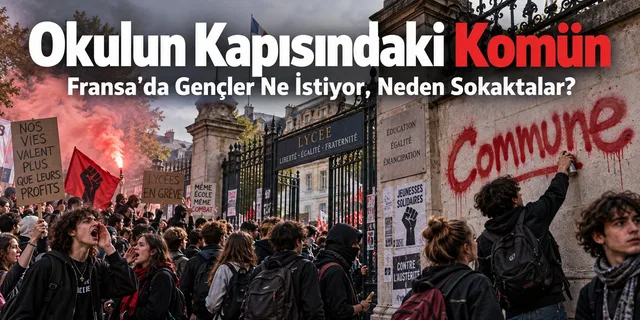
Tomorrow morning, Tuesday 13 October, the gates of hundreds of French lycées (upper secondary schools) will once again be barricaded with rubbish bins. In the movement's own terms, this is the fourth "act". On the same day, debate on the 2027 budget begins in the National Assembly. In Paris, the students want to march to Matignon, the Prime Minister's residence; the police prefecture is expected to ban that route, and the alternative under discussion ends a few steps from the Assembly where the budget will be debated.
Ten days ago, when we discussed the list of demands of Europe's youth, we read the blockades in France through class sizes, chairs and budgets. In this piece we focus on the most "technical"-looking item on that list, a computer platform: Parcoursup. Because that is where this generation's shortest and deepest question lies hidden: Who is putting my future in a queue, and by what measure?
First, a Summary
What is happening? The blockades that began outside lycées in France in the last ten days of September grew within three weeks into a nationwide youth movement. On the third big day of action, 6 October, classes were partly or fully suspended in 891 lycées according to the Ministry of Education; the Ministry of the Interior counted 256,000 demonstrators, the organisers 450,000. According to the government's own figures, more than 6,000 people have been arrested since the movement began, the great majority of them minors.
What do they want? The demands are very ordinary: a replacement for every absent teacher, classes that do not have thirty-six pupils, buildings that are not falling apart, a humane timetable, more money for education. And above all of these, one more demand: the abolition or root-and-branch reform of Parcoursup.
What is Parcoursup? Since 2018, the national platform through which young people finishing the lycée in France apply to higher education. Every student makes ten choices; every programme ranks its applications by its own criteria, very often with its own "local algorithms". In 2026 there were 1,046,000 applicants. The platform is not a single algorithm but a sorting machine made of thousands of black boxes.
What is the problem? It works on three levels. First, opacity: young people who are rejected cannot find out why. Second, inequality: some programmes weight grades by the "reputation" of the lycée the student comes from, so a high-achieving student from a poor neighbourhood can end up behind a student with lower grades from a rich one. Third, anxiety: most lycée students experience the process as a heavy source of stress, and families with money get past the uncertainty by hiring private "advisers".
What does the government say? Prime Minister Sébastien Lecornu called the demands "legitimate", launched "work" on five fronts and said of Parcoursup that "we will fix everything that can be fixed". But he firmly ruled out abolishing it. The same Prime Minister used the word "accident" rather than "police violence" for the children who lost an eye and a hand.
Our argument: Parcoursup's real problem is not its code; it is that it manages scarcity. There are few places and many applicants; that is not a natural phenomenon but a budget choice. The algorithm makes a political distribution of life chances look like a technical operation. The greatness of the French lycée students lies in seeing the politics behind the screen and, instead of leaving the problem at "make the algorithm more transparent", tying it to the demand for "a place for everyone".
Now to the details.
A Generation's Morning: How the Blockades Grew
The movement was not born of a trade union calendar or a party's call. It began outside individual lycées, multiplied on social media and soon set its own calendar: "act one", "act two", "act three". The figures show how the movement spread:
- 2 October: According to the Ministry of Education, 735 schools were affected. On the same day the minister, Édouard Geffray, received teachers' unions, parents' associations and school student organisations in turn. Riad Rani, president of the Union syndicale lycéenne (USL), left the meeting saying there was "no concrete announcement". (Europe 1, in French)
- 4 October: Prime Minister Lecornu sent his ministers a road-map letter and announced "five areas of work". (CIDJ, in French)
- 5 October: There were actions or disruption at 413 schools. The government opened an online consultation platform, to stay open until 23 October, to collect the students' complaints. (L'Etudiant, in French)
- 6 October, act three: 891 lycées were affected, 250 of them in the Paris region. In Paris the famous elite lycées Louis-le-Grand and Henri-IV were also blockaded. Higher education institutions such as the Sorbonne joined the movement. In the afternoon, parents, teachers, university students and trade unionists joined the marches; the largest parents' federation, the FCPE, was also on the streets. (Euronews, in French)
- 8 October: The students took to the streets again on the grounds that the government had not taken "a concrete step"; several education unions called strikes.
- 13 October, act four: A new day of action. Students in Paris want to march to Matignon, the Prime Minister's residence; the prefecture is preparing to ban the route as "risky". (Europe 1, in French)
There is a detail in this picture that should catch our attention: students at privileged lycées in central Paris say that, although their own buildings are in relatively good shape, they joined the blockades in solidarity with the lycées of the banlieues, the deprived suburbs. In one student's words, classes have "36 pupils". A banner in Brest sums up the spirit of the movement in a single sentence: "Our classes are overflowing, and so is our patience."
This, comrades, is class consciousness in its purest form: standing in the same ranks as those worse off, even when your own situation is relatively good.
The List of Demands: The Revolutionary Power of the Ordinary
The students' demands are almost identical in the accounts of the ministries, the unions and the press:
- A replacement for every teacher who does not turn up
- Less crowded classes
- Repairs to crumbling buildings: heating, toilets, classrooms that can cope with the heat
- Shorter school days, a longer lunch break
- More money for education
- The abolition of Parcoursup, or an end to its opacity and inequality
- An end to police violence
There is not a single "extreme" item on this list. All of them are things one would expect from the normal running of a public service. But that is exactly why it is powerful: If ordinary demands cannot be met, the problem lies not in the demands but in the order.
Why does Parcoursup have a special place on this list? Because the other items describe today's school, whereas Parcoursup describes tomorrow's door. A bad building is a hardship to be endured for three years. How the door opens shapes a whole life.
What Is Parcoursup and How Does It Work?
A short history
In France, a young person who passes the baccalauréat (the bac), the school-leaving exam, has a legal right to enter university. But this right on paper had long been a problem in programmes where there were not enough places.
- 2009–2017, the APB era: On the previous platform, Admission Post-Bac, places on some oversubscribed bachelor's programmes were allocated as a last resort by lottery. The lottery naturally drew a huge backlash.
- 2018, Parcoursup: The government abolished the lottery and replaced it with "examination of applications". Parcoursup was established by the law of 8 March 2018 on the "Guidance and Success of Students" (loi ORE). The platform opened on 15 January 2018.
This step, which looked "fairer" than a lottery on paper, in practice legalised selection itself. That is why French universities saw widespread occupations in the spring of 2018: students saw that the principle that "the bac opens the university door to everyone" was being quietly abolished.
How it works today
- Each applicant can make at most 10 choices. On some programmes a choice is split into sub-choices corresponding to different institutions; the total number of sub-choices across all choices cannot exceed 20.
- Each programme ranks applications by its own criteria: grades, chosen specialist subjects, a personal statement, teachers' assessments, information about the lycée.
- When there are many applications, programmes carry out a pre-ranking before files are examined by human eyes. The tools that do this pre-ranking are called "local algorithms" in France. Some programmes deal with tens of thousands of files, some with more than a hundred thousand; at this scale "case-by-case examination" is largely a fiction.
- Answers arrive in waves: "accepted", "rejected" or "waiting list". Young people spend the summer in front of a screen, waiting for their place in the queue to rise.
The figures
- In 2018, 666,000 applicants registered on the platform. The number of applicants was about 945,500 in 2024, 980,000 in 2025 and 1,046,000 in 2026.
- Applicants seeking a "reorientation", wanting to move from one programme to another, numbered 169,000 in 2024 and more than 200,000 in 2026. (L'Etudiant, in French)
This last figure matters: the system does not only screen people out at the door; it also produces those forced to come in through the wrong door. Every year two hundred thousand young people say they have lost a year on a programme they did not want.
What Is Inside the Black Box?
Opacity: those rejected cannot know why
Parcoursup's opacity is not only the students' complaint; it is also the finding of the French state's own oversight bodies.
- The Court of Audit (Cour des comptes), February 2020: It recommended that local algorithms and selection criteria be made public, and wrote that the platform was exposed to "risks that must imperatively be reduced". (Next, in French)
- The Constitutional Council, 3 April 2020: It called for more transparency, but it also protected the "secrecy of deliberations" in the programmes' admissions committees. In other words, the door was opened a crack, but the lock stayed in place.
- The platform's own Ethics and Scientific Committee (CESP): It says the reports published by programmes describe "the results of previous years" rather than this year's criteria, and that even the simplest criteria used in rejections are not stated.
- The Senate: Since 2019, Senator Pierre Ouzoulias has been saying that local algorithms fall outside the rules on personal data protection (the CNIL, the GDPR). (Sud Radio, in French)
According to opinion polls, in 2025 84 per cent of lycée students found the process stressful, and since 2023 almost one in two have said they do not find it transparent.
Inequality: the "exchange rate" of grades
The system's most painful side is a practice hidden behind the opacity: some programmes, especially elite ones in Paris, weight applicants' grades according to the ranking of the lycée they come from.
What this means, by way of example, is this: a student with an average of 17 at a lycée in a banlieue north of Paris can end up behind a student with an average of 14 at a "good" lycée in the city centre. The grade no longer works as a measure of achievement but like a currency, whose exchange rate depends on the "country" in which it was earned. And that exchange rate depends on the neighbourhood, and the neighbourhood depends to a great extent on class.
Former Defender of Rights Jacques Toubon voiced this risk years ago. The National Assembly's report published in February 2026 wrote that Parcoursup "contributes to the persistence of socio-cultural inequalities" and put forward 51 recommendations, among them removing the lycée's name from applications, gathering local algorithms in a database and abolishing the personal statement. (Sud Radio, in French)
Anxiety and the "advice market"
In her report of 3 June 2025, France's Defender of Rights (Défenseure des droits), Claire Hédon, described the guidance system as "hard to read, fragmented and unequal". She characterised Parcoursup as a "poorly understood and anxiety-inducing" tool. (L'Etudiant, in French)
Two of the report's findings are particularly meaningful for us:
- In schools there is on average one guidance psychologist for every 1,200 students. These specialists are the main source of advice for only 10 per cent of students. Many posts are vacant and go unfilled.
- This gap is filled by expensive private coaches, who are largely within reach only of well-off families.
So this is what happens: the state cuts public guidance, builds a platform that magnifies uncertainty, and then the way past that uncertainty is sold on the market. Looked at from Turkey, it is a familiar cycle, is it not? Cram schools, tutoring centres, "coaching" packages. Every gap opened in public education becomes an item in someone's turnover.
The Real Question: Why Are There No Places?
The strongest argument of Parcoursup's defenders is this: "There are more applicants than places. You have to rank them somehow. Do you want a lottery?" Even Senator Ouzoulias, despite his criticisms, says that "abolishing Parcoursup is impossible because there are far more applications than places".
This is exactly where the whole issue comes to a head. The scarcity of places is not a given; it is a decision.
In France the number of applicants to higher education rose by about a hundred thousand in two years. That is why the school student organisation USL and the Union étudiante are calling for 250,000 additional places in higher education from September 2027. This demand shows the real ground of the Parcoursup debate: however transparent you make the algorithm, you cannot fit fifteen hundred people into a hall for a thousand. Either you enlarge the hall, or you build a machine that decides who stays outside.
The French state chose the second. And it gave that machine technical names such as "platform", "algorithm" and "matching".
Comrade, the algorithm does not create scarcity; it manages it. But it makes the scarcity it manages look natural, and itself look neutral. That is ideology in its most modern form: a political decision made to look like the output of a piece of software.
Education Minister Geffray's remark that "saying Parcoursup sorts students is a shortcut; the platform brings applicants and programmes together" is precisely the language of this ideology. Of course the platform "brings together"; but while the number of places is fixed, every meeting means someone else's parting.
A Class Reading: What Does the Sorting Machine Reproduce?
School, a rehearsal for the division of labour
Marxist critique of education makes a basic point: in capitalist society, school does not only pass on knowledge; it reproduces the labour force by sorting it into classes. Who will be prepared for mental labour and who for manual labour; who to rule and who to be ruled? This division is legitimised not by birth but by "success". Everyone sits the same exam, everyone fills in the same form; the result is presented as "merit".
Parcoursup is the twenty-first-century form of this sorting. It differs from earlier forms in that the sorting:
- is carried out not by a central exam but by thousands of local criteria,
- relies on criteria that are invisible,
- disperses responsibility: no one makes the decision; "the system" does.
We could call this the reverse of the digital panopticon: in the panopticon the watcher is invisible and the watched is permanently visible. On Parcoursup young people pour their whole lives onto the screen, their grades, their statement, the name of their lycée; but they cannot see whose hand weighs them or which scales it uses.
The mask of "merit"
Grade weighting shows nakedly how this mask works. The system says, "we are assessing your grades". Yet by multiplying the grade by the reputation of the lycée where it was earned, it is in fact assessing the student's address. And an address is a class marker: rent, house prices, family income, migrant background.
In this way an old inequality acquires a new, "objective" cover. That is precisely why algorithmic inequality is more dangerous than open discrimination: it has no face to object to.
Mental Taylorism, school edition
In our Gig Economy Dossier we discussed how an app breaks a courier's labour into pieces and measures it. Parcoursup applies the same logic to a young person's future: youth is broken into scoreable parts. The choice of specialist subject is a score, the statement is a score, the lycée is a coefficient. A seventeen-year-old learns to be processed as a measurable input before even entering working life.
This is not only an education issue. It is habituation to algorithmic management from childhood. The young person who accepts Parcoursup's queue today will tomorrow find "natural" the AI filter that screens their job application, and then the app that plans their shifts. That is why the French students' "no" matters not only for themselves but for the working future of a whole generation.
The Language of the Algorithm, the Language of Class
| What the government and the platform say | What the students and the class see |
|---|---|
| "Parcoursup brings applicants and programmes together." | While places are fixed, every match means someone else stays outside. |
| "Selection is based on merit." | When grades are multiplied by the lycée's reputation, the address is measured; and the address is class. |
| "The problem is transparency; we will explain the criteria better." | The problem is not only invisibility but scarcity itself: 250,000 places are missing. |
| "Abolition is out of the question; we will fix everything that can be fixed." | Fixing is the polite form of sorting; the demand is a place for everyone. |
| "The platform has a simulator and guides for orientation." | With one psychologist for every 1,200 students, paid coaches fill the gap. |
| "The blockades are an attempt to destroy public services." | What destroys public services is a budget that does not hire teachers or repair buildings. |
| "Injuries during police operations are accidents." | An eye at fourteen, a hand at fifteen: not an accident but the price of a policy. |
The State's Two Hands: A Consultation Platform and the Riot Cop's Bullet
The French government responded to this movement with two hands.
The first hand, conciliatory: The five areas of work in Lecornu's letter of 4 October are: replacements for absent teachers, building repairs, fixing timetables, more transparency in Parcoursup for the 2027 round, and reasoned responses to proposals from lycée student councils. A consultation platform was opened from 5 to 23 October; it was decided that, from Wednesday to Friday, lessons in lycées would be suspended for half a day to hold an "hour of internal democracy"; and it was announced that 3,000 supply teachers had started work. The first decisions are expected at the end of October. (La Gazette France, in French)
These are not things to belittle. For a three-week lycée movement to force a government to write letters, open a platform, and stop lessons to talk to students is a gain. But note: none of the five areas includes "new places in higher education" or "an increase in the education budget". Building repairs were handed over to the regional councils, with a construction target of summer 2027. For timetables, the use of "digital tools, even artificial intelligence" is proposed. In other words, part of the problem is once again handed over to software.
The second hand, punitive: In the same week:
- In Lens, a 15-year-old lost his hand to a grenade that exploded outside a lycée. The police internal affairs unit (IGPN) opened an investigation.
- In the Val-d'Oise, a 14-year-old lost the sight of one eye; the prosecutor's office said the injuries were "compatible" with a shot from a rubber-bullet launcher (LBD).
- In Metz, footage of a schoolgirl's arrest spread on social media; an investigation was opened into a police officer on suspicion of sexual assault on a minor.
- The IGPN opened ten investigations in total. According to the government's own figures, since the movement began 215 students, 85 education staff and 715 police officers have been injured; more than 6,000 people have been arrested, most of them minors. (Euronews, in French)
On 6 October, in the Assembly, Lecornu rejected the expression "police violence" and used the word "accident". The government, meanwhile, while saying it found the demands "legitimate", began describing the demonstrations as "riots".
Here we must say two things with equal clarity.
First: burning schools or attacking teachers or head teachers is not in the movement's interest. We wrote this plainly in our previous piece too. The students themselves say so: in one student's words, "you have to tell the protesters apart from the looters; 99 per cent of lycée students are peaceful." Burning a building does not repair its roof; Lecornu is right about that. But it does not remove the question of who has failed to repair that roof for years.
Second: A child losing an eye is not called an accident. When the state's monopoly on violence fires rubber bullets at its own youth, the problem is not "disproportion" but a political choice. And that choice is made to intimidate a youth movement.
Meanwhile, from across the ocean, US President Trump posted a message blaming the situation in France on "Islam and out-of-control migration". This is reaction's universal answer to every class movement: The problem is not the budget, it is "the foreigner". There is not a single word about migration in the students' demands. What there is: chairs, teachers, buildings and an algorithm.
From 2018 to 2026: Not the First Time
French youth's fight with Parcoursup began in the year the platform was born.
- Spring 2018: There were occupations at universities stretching from the Tolbiac campus in Paris to Montpellier. Students opposed replacing the principle that "the university door is open to holders of the bac" with selection.
- December 2018: Blockades against Parcoursup and the lycée reform spread through lycées. Footage from Mantes-la-Jolie on 6 December, showing 151 school students forced by police to kneel with their hands behind their heads, is etched in the memory of a generation in France.
Eight years later, the same platform is back on the streets. What has changed? In 2018 the objection was to the principle: should there be selection or not? In 2026 the objection rests on experience: this generation has lived through Parcoursup, and has watched older sisters and brothers spend summers on waiting lists. It no longer speaks from a forecast but from testimony.
And something else has changed: in 2018 the school students were largely alone. In 2026 parents, teachers' unions, university students and trade unionists are joining the marches. The movement has begun to break out of the school walls.
What Does French Politics Say?
Parcoursup is now also an issue in the 2027 presidential election. The positions reported in the press, in brief:
- The government (Lecornu, Education Minister Geffray, Higher Education Minister Philippe Baptiste, spokesperson Maud Bregeon): The platform "works" and "deserves some improvements"; abolishing it is out of the question.
- France Unbowed (LFI) leader Jean-Luc Mélenchon: Promises all holders of the bac access to higher education without selection.
- The Greens' leader Marine Tondelier: Proposes a system without the personal statement and without opaque algorithms.
- Raphaël Glucksmann (Place Publique): Argues for a simple improvement.
This spectrum shows us that the debate runs between "how can we manage Parcoursup better" and "how can we abolish selection itself". For us the yardstick is clear: Every reform that proposes distributing scarcity more fairly risks making scarcity permanent. The real solution is to abolish scarcity.
Looking from Turkey
Turkey has no Parcoursup; it has ÖSYM (the Measuring, Selection and Placement Centre) and the YKS, the national university entrance exam. One is a dispersed system run on local algorithms, the other a single central exam. They look like opposites. But they are two different answers to the same question: If there are not enough places, who gets in?
France's experience teaches us a few things:
- Replacing the central exam with "the file" does not bring equality. The file rewards the cultural capital to write the statement, the name of a good lycée, the teacher's recommendation. Proposals heard now and then in Turkey for "portfolios instead of exams" should be weighed carefully in this light.
- Wherever public guidance is withdrawn, an advice market grows. France's private coaches and Turkey's cram school, tutoring and coaching sector are two countries' names for the same gap.
- An opaque algorithm is not neutral. In Turkey too, algorithmic decision tools are spreading in the public sector. Asking about the criteria behind decisions made in the name of "the system", in education, social assistance and employment, should be defended as a right of citizenship.
- Exam anxiety is not an individual disorder but a social pressure. In Turkey more than a million children applied for the 2026 LGS, the high school entrance exam. Reducing the pressure these children live under to a "coping with anxiety seminar" is the same evasion as France taking refuge in a consultation platform.
The real lesson to take from the French students, though, is about organising: Write chairs, teachers, buildings and the future on the same list. Build the link between today's school and tomorrow's door. Neither can be won without the other.
Concrete Tasks
Young comrades, these are the tasks that this struggle in France sets for us:
- Carry the French students' voice into your own language. Translate their lists of demands, their banners, their statements; share them in your school, your student society and on social media. Solidarity begins with getting to know one another.
- Write your own school's list of demands. How many pupils are in your class? How many of your lessons go untaught? How much does a meal cost in the canteen? What state are the toilets, the heating and the library in? A list that speaks in figures is the strongest leaflet.
- Ask "the system" for its criteria. For every algorithmic decision applied to you, at school, in an exam, for a grant or a dormitory place, ask in writing: "By what measure, who decided, how do I appeal?" The right to information is a weapon.
- Defend public guidance against paid advice. Is there a guidance teacher at your school, and for how many students? Put that number at the top of your list of demands.
- Sit at the same table as teachers and parents. What made the movement grow in France was that the school students were not left alone. Organise joint meetings with education unions and parents' associations.
- Question scarcity. When you are told "there are no places", "there is no budget", "there are no posts", the first question should be: "What is in whose budget?" Learn to ask this question with budget figures.
- Reject violence, and call violence to account. Protect the movement against those who want to turn action into burning schools; but also insist that the bullets the state fires at its youth are put on record and accounted for.
The Hand Behind the Screen
Comrades, on Parcoursup's screen a loading bar spins. Young people wait for it to spin; they open the page again and again to refresh the message "you are 1,247th on the waiting list". For a whole summer they watch, in front of a screen, their own worth turn into a number.
The French students stopped looking at that screen and started looking at the hand behind the screen. They saw that this hand writes a budget, leaves a post unfilled, leaves a building unrepaired, and then charges the bill for all these choices to a black box called "the algorithm".
The queue itself is not the question. The question is who sets the queue, and for which scarcity. And that question is waiting to be asked not only in the lycées of Paris but in our schools, our exam halls and our job applications.
Tomorrow morning the students in France will be on the streets again. Our task is to hear their voice and to find our own.
A place for everyone, a future for everyone!
In solidarity
Sources
- Euronews — "Mobilisation lycéenne, acte III : 891 lycées perturbés" (6 October 2026) (in French)
- Europe 1 — "Blocus des lycées : Édouard Geffray multiplie les concertations, mais les syndicats restent sur leur faim" (2 October 2026) (in French)
- Europe 1 — "Acte IV de la mobilisation lycéenne" (in French)
- CIDJ — "Blocus des lycées : les cinq chantiers de Sébastien Lecornu" (in French)
- L'Etudiant — "Mouvement lycéen : le gouvernement lance cinq chantiers prioritaires" (in French)
- L'Etudiant — "Mobilisation lycéenne : transparence, calendrier… comment améliorer Parcoursup ?" (in French)
- L'Etudiant — "Parcoursup et orientation : un système peu lisible, morcelé et inégalitaire d'après la Défenseure des droits" (in French)
- La Gazette France — "Lecornu condamne la violence, réfute toute répression policière et suspend les cours" (6 October 2026) (in French)
- Sud Radio — "Algorithmes, inégalités : pourquoi Parcoursup est contesté" (7 October 2026) (in French)
- Planète Grandes Écoles — "Suppression de Parcoursup : ce que demandent les lycéens et ce que répond le gouvernement" (in French)
- Boursorama/AFP — "Les revendications des lycéens : des moyens supplémentaires à la suppression de Parcoursup" (1 October 2026) (in French)
- Next — "Cour des comptes : Parcoursup s'expose à des risques qui doivent être impérativement réduits" (in French)
- Wikipedia — Parcoursup
Related reading from Knowledge Commons: