They Silence the One Who Keeps the Ledger Too
1,270 Accounts in September, EngelliWeb on the First Day of October

They Silence the One Who Keeps the Ledger Too: 1,270 Accounts in September, EngelliWeb on the First Day of October
The Wave of Censorship Has Become a Tsunami: İFÖD's September Balance Sheet, Solidarity from the World, and a Class Reading
Dear Young Comrades,
In the first piece of this series we had made a sentence: "If in a country you can learn how many accounts public power has silenced only from a ledger kept by a civilian association, then accountability itself has been privatised." The name of that ledger was EngelliWeb. A volunteer record, kept since 2008 by the Freedom of Expression Association (İFÖD), writing down one by one which site, which account, by which ruling, on which ground, was blacked out in Turkey.
Yesterday, on 1 October 2026 at 17.14, that ledger itself was blacked out.
Let us begin with a short summary; we will go into the detail afterwards.
Summary: What happened in a month?
The press release İFÖD published today draws up the balance sheet of September. The figures are these:
- Between 1 and 30 September 2026 at least 1,270 X accounts were blocked under Articles 8 and 8/A of Law 5651.
- 90 percent of these accounts were made invisible from Turkey by the company X.
- For comparison: the number of X accounts blocked under 8/A in the whole of 2025, the year İFÖD called a "digital martial law" and that the process of 19 March stamped, was 995. A single month left a whole year behind.
- 941 of the blocks took place in the second half of the month; that is, the wave did not slow, it sped up.
- The total following of the 1,227 accounts whose follower information could be reached exceeds 35 million. 362 accounts have more than 10,000 followers, 70 more than 100,000, 10 more than 500,000.
- The ruling on which only 115 of the 1,270 accounts rest can be known. The legal basis of the remaining 1,155 accounts is not known. The rulings are neither announced to the public nor notified to the account holders.
- And the last link: EngelliWeb's X account (@engelliweb) was made invisible from Turkey by an 8/A ruling that the Cybersecurity Presidency conveyed to X. The information of the ruling was not shared even with the association that documents the censorship.
Voices came to this picture from the world: Amnesty International, Human Rights Watch, the UN High Commissioner for Human Rights, the Parliamentary Assembly of the Council of Europe, the European Federation of Journalists, the International Press Institute, the Committee to Protect Journalists, the human-rights representatives of six European countries, and more than 450 civil-society organisations from more than 65 countries. We will set aside a section for them too; because knowing the limit of solidarity, as much as knowing its value, is a part of class consciousness.
The thesis of this piece is a single sentence:
The September censorship looked like three separate waves — morality, money, security — but it targeted a single thing: society's capacity to produce knowledge about itself, to circulate that knowledge, and to put it on record. The silencing of EngelliWeb is not the last link of this chain; it is its logical result.
Now let us go into the detail.
1. The chronology of a month: three waves, one current
It is possible to read September as three waves. But these are not waves that come and go in turn; they are parts of the same current, piled on one another.
The first wave — "Morality": Ailem Güvende (12 September and after). On 12 September, on the forty-sixth anniversary of the 12 September 1980 coup, the "Ailem Güvende" ("My Family Is Safe") operation against LGBTI+ organisations began. The social-media blocks walked in step with the operation and in a short time spilled far beyond the LGBTI+ organisations: a newspaper, a human-rights organisation, a community of academics, a union. We had taken this wave apart in detail in the piece Whose Family Is Safe?
The second wave — "Money": the fund crisis (the second half of September). After the crisis that burst with the closure of 131 investment funds, the accounts of the economists, the analysts, the journalists who interpreted the crisis were blacked out one after another. According to The Next Web's account the prosecutor's office claimed that posts about the markets "could frighten the investor." According to Turkish Minute's compilation on 30 September alone 147 more accounts that had posted about the fund crisis were blocked; a total of 2.65 million people followed these accounts. We had drawn the class anatomy of the fund crisis in the piece Control for Capital, the Blast for Us.
The third wave — "Security": national security and public order. The grounds of "disinformation," "manipulation," TCK 217/A, "national security." Added to these, according to İFÖD's record, were posts concerning Israeli propaganda, "FETÖ affiliation," the Tevhid circle, the Furkan Movement, the Alihan Kuriş investigations, and the Narin Güran murder investigation.
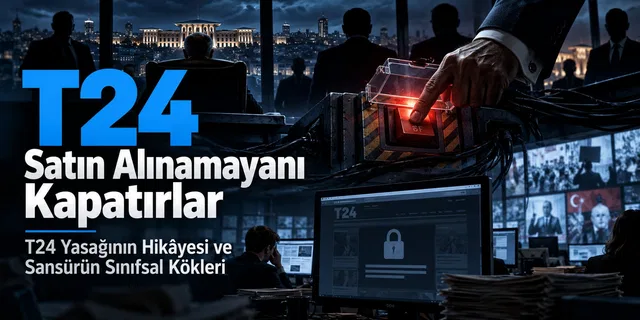
The last link — 29 September: T24. 1 October: EngelliWeb. The whole of a national news site was shut down; two days later, the account that kept the list of those shut down. We told T24's story in the piece They Shut Down What They Cannot Buy.
Do not be taken in by the variety of grounds. Morality, money and security look like three separate files; but the common denominator of the three is in whose hands knowledge will remain. We will see this in a moment through the rulings.
2. Who is on the list?
The names İFÖD counts among the accounts made invisible from Turkey are these. It matters to read them one by one, because the class map of censorship is hidden in the names:
| Section | Some of the blocked accounts |
|---|---|
| Journalists | Erk Acarer, Naz Yavuzarslan, Canan Kaya, Meral Danyıldız, Özlem Akarsu Çelik, Fırat Fıstık, İrem Afşin |
| News organisations | Kısa Dalga, soL Haber, Mezopotamya Ajansı, JinNews, Velvele, Kaos GL Haber, T24 |
| Economists | Prof. Dr Veysel Ulusoy, İnan Mutlu, Emre Şirin |
| Rights defenders and law | Amnesty International Turkey, the Media and Law Studies Association (MLSA), the Ali İsmail Korkmaz Foundation (ALİKEV), Yaman Akdeniz, one of İFÖD's founders |
| Women's organisations | We Will Stop Femicide Platform, the Federation of Turkish Women's Associations, the Women's Coalition |
| LGBTI+ organisations | the Kaos GL Association, the TİP LGBTI+ Bureau, and a great number of associations, collectives, pride-week accounts |
| The academy and the professions | Academics for Peace, the Psychiatric Association of Turkey |
| Labour | Umut-Sen, Başaran Aksu, Levent Pişkin |
| Literature | the writer Haluk Hepkon |
I want to draw your attention to three rows of this table.
The labour row. Umut-Sen is a union occupied with the organising of couriers, warehouse, supermarket and construction workers, that is, of the most precarious sections of the gig economy. Başaran Aksu is, for years, the name working in the field of workers' organising and of the record of workplace killings. What is a union and a workers' organiser doing inside a "morality" operation or a "national security" ruling? We will look for the answer below, in the language of the rulings.
The economists' row. When the fund crisis burst, from whom did the people learn of the crisis? Not from official statements; from the independent economists who explained the crisis's mechanism. Their silencing is the taking, from the hands of those who pay the crisis's price, of the right to learn how the crisis is.
The record row. Amnesty counts the detained, MLSA follows the hearings, the We Will Stop Femicide Platform keeps the list of the women who were killed, Academics for Peace has for ten years documented the price of a signature, EngelliWeb writes down those who are blocked. The greater part of the list is made up of the institutions that keep the records the state does not keep, or prefers to hide.
3. The rulings: without grounds, wholesale, and invisible
The nine rulings and one letter of request that could reach İFÖD's hands are the small corner that can be lit of a picture in which the remaining 1,155 accounts stay in the dark. Even what is seen in that corner is instructive enough:
| Court and ruling | Whom it targeted | The language of the ground |
|---|---|---|
| Istanbul 7th Criminal Court of Peace, 12.09.2026, 2026/9559 D.İş | Kaos GL, SPoD, Pembe Hayat, Lambdaistanbul, pride weeks, university collectives, 73 institutions and persons including these, 179 addresses in all | The text of the law and a formulaic sentence; not "a single line of reasoning" |
| Bakırköy 4th Criminal Court of Peace, 13.09.2026, 2026/9112 D.İş (a second request on 16 September) | Kaos GL Haber; then the Psychiatric Association of Turkey and the Kaos GL Association | TCK 226/2, "obscenity" |
| Mersin 3rd Criminal Court of Peace, 14.09.2026, 2026/9999 D.İş | Evrensel, the TİP LGBTI+ Bureau, Academics for Peace, Amnesty Turkey, Umut-Sen, ALİKEV | A direct application by the Provincial Directorate of Security; a block on "the whole of the pages" |
| Ankara 1st Criminal Court of Peace, 19–20.09.2026, 2026/13243 and 2026/13244 D.İş | Accounts including Prof. Dr Veysel Ulusoy | "Insulting a public official," "publicly disseminating misleading information" |
| Adana 4th Criminal Court of Peace, 25.09.2026, 2026/10114 D.İş | 47 accounts, including Başaran Aksu and İnan Mutlu | "National security"; the basis only an "open-source research report" and screenshots |
| Istanbul 1st Criminal Court of Peace, 29.09.2026, 2026/8894 D.İş | The whole of T24's site and its X account | "118 so-called news items in about a year"; "aimed at weakening the Turkish family structure" |
| 8/A, through the Cybersecurity Presidency, 1.10.2026 | EngelliWeb (@engelliweb) | Unknown; the ruling was not shared |
Four lessons come out of this table.
The first: reasoning has turned into an ornament. In the ruling of Istanbul's 7th Criminal Court of Peace that shut 179 addresses, there is no reasoning apart from the text of the law and a formulaic sentence. Reasoning is what makes a ruling open to oversight. A ruling without reasoning is a ruling that cannot be objected to. A ruling that cannot be objected to is no longer law; it is an administrative order.
The second: the police sat directly at the judge's table. The Mersin ruling was given on the direct application of the provincial directorate of security. The Adana ruling rests on an "open-source research report" and on screenshots. That is, a police unit scans social media, writes a report, and the court turns that report into a ruling. This is the judicial leg of the digital panopticon we mentioned in the KVKK piece.
The third: it is not the URL that is shut, it is the voice. In law there are two principles, "blocking on the basis of the URL" and "proportionality": if there is a content seen as problematic, that content is removed, not the whole of the site. The T24 ruling shut the whole of a news site for 118 items of content. The Mersin ruling shut "the whole of the pages" of the accounts. The target here is not a post; it is the subject who makes that post. When a union's account is shut, what is blocked is not an idea but that union's channel of speaking with its members; we wrote this in the first piece too: what is blocked is the infrastructure of communication, that is, the capacity to organise.
The fourth: the 9 percent we know, the 91 percent we do not. The basis of 115 of the 1,270 accounts is known. That means about 9 percent of the accounts. For the remaining 91 percent there is neither a judge's name, nor a ruling number, nor a ground. The account holder learns that they have been blocked from a notification X sends, and never learns why they were blocked. A ruling is needed in order to object, and the ruling is not given. This is not a legal order; it is an invisible legal order.
4. Why EngelliWeb? The class meaning of the record
Now let us come to the real question: why does an apparatus that shut one thousand two hundred accounts in a month reach also for the single account that documents this?
The answer is that the record itself is a power.
In the preface to the first volume of Capital, Marx tells, as one of the reasons he chose England as his example, the reports of the factory inspectors. The inspectors of the factory laws, the health reports, the parliamentary commissions of inquiry: if these documents, which put capitalism's own working on record, had not existed, the mechanism of exploitation could not have been shown empirically. The record is the raw material of criticism.
In Turkey today the state does not keep this record. On the contrary, it hides the record. The İSİG Assembly counts how many workers were killed in workplace killings; the We Will Stop Femicide Platform counts how many women were killed; EngelliWeb counts how many sites were shut; the human-rights organisations count how many people are in prison. The state gives the ruling, civil society does the counting, a private company carries out the sentence.
In this threefold structure the weakest link is the link of counting, because there is neither a law, nor a budget, nor a company that protects it. To silence the one who does the counting is the cheapest way of making the censorship itself invisible. When EngelliWeb's account is shut, the public will learn later, less, and more scatteredly that the next account has been shut. Censorship has begun to erase its own trace.
Let us also note an irony. According to the Stockholm Center for Freedom's account the jurist Kerem Altıparmak, on the shutting of Yaman Akdeniz's account, recalled that Akdeniz had contributed, with a case he opened at the Constitutional Court in 2014, to Twitter's remaining accessible in Turkey. The jurist who defended the platform's existence in Turkey is now being made invisible from the same platform. Akdeniz's comment is plain: he said he knew his account had long been at risk, but that he "had not expected it today"; he announced that he would not open a new account, and that he would question the ruling in law.
5. The two blades of the shears: the state and the monopoly
Let us not skip the most striking rate in the figures: 90 percent of the blocked accounts were made invisible from Turkey by X.
There are two subjects in this sentence. The state gives the ruling; a platform monopoly, owned by the world's richest man, carries it out. The company of a capitalist who bought a company with the discourse of "absolute freedom of expression" is working in Turkey as the fastest clerk of enforcement of rulings without grounds. According to The Next Web's note X had earlier announced that it objected to some of Turkey's demands, but in the end it complied again.
There is nothing surprising here. The principle of the platform monopoly is not freedom of expression; it is access to the market. Protecting advertising revenue in a market of eighty-five million is more valuable than the voice of a few thousand accounts. Let us widen here what we said in They Shut Down What They Cannot Buy: the state shuts down what it cannot buy, and the monopoly quietly carries out what has been shut down. One blade of the shears is political power, the other blade is digital capital. What is cut is society's voice.
For this reason the matter for us is not only "censorship in Turkey"; it is the matter of the infrastructure of communication being in private property. If the square of public debate is on a company's server, the door of that square is also in the company's key. The name of Knowledge Commons exists for exactly this reason: so long as the infrastructure of communication is not common property, freedom of expression always remains a permission, not a right.
6. A class reading: morality, money, security — a single question of property
When we set the three waves side by side, the picture that emerges is this:
| The official ground | Its class function |
|---|---|
| "Protecting the family," "obscenity" | To charge the bill of the social crisis not to impoverishment but to "moral dissolution"; to turn anger downward, onto the most defenceless groups |
| "Frightening the investor," "misleading the public" | To protect the asymmetry of knowledge in the fund crisis: those who decide know beforehand, the small saver learns at the last moment |
| "National security," "disinformation" | To put the workers' organiser, the economist, the journalist into the same bag and take them into a category that cannot be objected to |
| A ruling without grounds, without notification | To push everyone into self-censorship by making the law unforeseeable; to turn fear itself into an instrument of government |
| The silencing of the one who keeps the record | To erase the trace of censorship, to abolish accountability altogether |
The fund crisis is the key of this picture. The crisis was the bursting of the speculative accumulation of a fraction of capital interlocked with the state; hundreds of thousands of small savers are paying its price. The silencing of those who tell the crisis is the protection not of the ignorance of those responsible for the crisis, but of the ignorance of the crisis's victims. The investor in the ground "frightening the investor" is not the small saver; it is the big capital that fears the coming into the open of the truth that would frighten it.
The "Ailem Güvende" wave is the cultural face of the same mechanism. While the economic crisis deepens, while the pensioner Ali Şekeroğlu lost his life walking for honour in front of the Constitutional Court, the agenda is being built through "the family" and "morality." Moral panic is the lightning rod of class anger. For this reason a union's, a women's platform's, a newspaper's entering inside the morality operation is not an accident; the operation's real target is organised society itself.
The conclusion that comes out of this is this: censorship falls short when it is read as a "culture war" or a "deficit of democracy." Censorship is the ruling class's attempt, in times of crisis, to rebuild its property over knowledge. Who will know what, when will they know it, from whom will they learn it? The answer to these questions depends on in whose hands the means of producing knowledge are, in a society.
7. The solidarity that came from the world
Through September, voices rose to this picture in Turkey from different places in the world. Recording them matters, both in order to make the solidarity visible and in order to know that our own struggle is not alone.
Amnesty International
In the statement Amnesty International made on 15 September it described the operation, through the mouth of the Deputy Regional Director for Europe Esther Major, as "an all-out attack on LGBTI rights and on those who defend them." The statement recorded that Amnesty Turkey's X account (@aforgutu) was blocked on 14 September by an 8/A ruling through the Cybersecurity Presidency, that the organisation could not reach the text of the ruling, and that more than 180 accounts were blocked. The organisation opened a new account (@amnestyTR) and went on publishing.
In the assessment published on 22 September Amnesty's Europe campaigner Milena Buyum reported that in 15 provinces at least 116 people were taken into custody, at least 83 were detained, and an investigation was opened against more than 160 people; and that the Ministry of Justice sent a circular on "general morality" to 175 chief public prosecutor's offices in 81 provinces. Buyum's finding matters for us too: while families in Turkey are crushed under poverty, precarity and pressure, this operation has nothing to do with protecting the family. The same piece notes that people came into the street against the repression in more than 50 cities of the world.
Human Rights Watch (HRW)
On 18 September HRW, with the statement of the Deputy Director for Europe and Central Asia Benjamin Ward, defined the repression as "an open attempt to criminalise and marginalise LGBT individuals." HRW recorded that between 12 and 16 September dozens of accounts and sites were blocked, and that the accounts of Amnesty Turkey, Evrensel, MLSA and the HAK Initiative were among them.
The United Nations and the European countries
The UN High Commissioner for Human Rights, Volker Türk, called on Turkey to protect everyone's human rights without discrimination and asked that those arbitrarily taken into custody be released. The human-rights representatives of Germany, France, the Netherlands, Sweden, Finland and Iceland, expressing their deep concern, called on Turkey to comply with the European Convention on Human Rights, to which it is a party. More than 450 civil-society organisations from more than 65 countries demanded an end to the criminalisation of the LGBTI+ movement and the release of those in custody.
The Parliamentary Assembly of the Council of Europe
In the resolution it adopted, the Parliamentary Assembly of the Council of Europe (PACE) described what was lived as "a coordinated and escalating campaign against LGBT individuals and rights defenders"; it called on Turkey to release those in custody and to refrain from anti-LGBT legal arrangements.
Journalism organisations: for T24
After T24 was shut down, the Journalists' Union of Turkey (TGS), the Media and Law Studies Association (MLSA) and the International Press Institute (IPI), in a joint statement, described the ruling as "a heavy attack on our profession"; stating that the ruling violates freedom of the press and the public's right to receive news, they asked that it be withdrawn at once.
The president of the European Federation of Journalists (EFJ), Maja Sever, said that together with their members in Turkey, the TGS and the Journalists' Association of Turkey (TGC), they condemned the ruling, and that in Turkey sweeping court rulings are being used more and more to silence journalists and to restrict citizens' access to independent information.
The Committee to Protect Journalists (CPJ) stressed that the journalist Tuğba Tekerek, taken into custody in the operation, was taken into custody "only for doing her job", and criticised the government for using the "disinformation" law more and more to silence the press.
The words of T24's editor-in-chief Candan Yıldız match, one to one, the concept İFÖD used for last year: "We are truly living through a digital state of emergency." Yıldız Tar, editor-in-chief of Kaos GL, whose news was declared "propaganda," made a plain sentence: "This is not propaganda, it is basic journalism."
What do the indexes say?
In the 2026 World Press Freedom Index of Reporters Without Borders (RSF), Turkey is 163rd among 180 countries. RSF's Turkey representative Erol Önderoğlu, in a joint statement they made in March 2026 with eight organisations, IPI and CPJ among them, had counted political control over the judiciary and internet censorship among the instruments of weakening the critical media. Freedom House, in its 2025 "Freedom on the Net" report, classified Turkey as "Not Free" with 31 points out of 100; this score is the lowest among the European countries assessed.
How should we read this solidarity?
All of these voices are valuable. They tell the person behind a blocked account that they are not alone, they raise the cost of censorship in the international field, they go on record. But dear young comrades, solidarity too has a class map, and we have to read it correctly.
| The kind of solidarity | Its strength and its limit |
|---|---|
| The "deep concern" of governments and diplomats | It goes on record, but the same capitals go on sitting at the table of trade, migration and arms with Turkey; "concern" does not get ahead of interest. The concern of a Germany that prosecutes Palestine solidarity under §129 is conjunctural, not a matter of principle |
| International institutions such as the UN and PACE | They set a legal standard, they produce a text of resolution; but, as we saw in the Osman Kavala example, when even binding rulings are not applied their power of sanction is limited |
| Rights organisations such as Amnesty and HRW | They do systematic documentation, they form a public; but they themselves are also in the target, and Amnesty Turkey's account is the proof of this |
| Journalists' unions and professional organisations such as the EFJ, the TGS, the TGC | This is solidarity that comes from labour's own organisations. It rests on the common interest of those who work in a profession; it is lasting, organised and mutual |
| The street actions in more than 50 cities of the world | This is internationalism that comes from below, not institutional; it does not recognise diplomatic courtesy |
We are not exaggerating this distinction; each is of use in its own field. But the lasting guarantee is not in the concern of other states; it is in the organised solidarity of labour and of society. When a journalist's account is shut, the voice of their colleagues' union in Europe is a less visible but a firmer bond than an embassy's statement. The bond we have to grow is this one.
8. What does İFÖD want?
The demands in İFÖD's bulletin are plain and concrete. They also have a legal frame: the Constitutional Court, in the Artı Media GmbH ruling (General Assembly, B. No: 2019/40078, 14 September 2023), had found that Article 8/A does not contain a safeguard against arbitrary interventions and that the violation stems directly from the law. In İFÖD's words, September showed that "this structural problem has turned into a mass regime of censorship."
İFÖD's demands:
- That the criminal courts of peace, in their examination of objections, take Article 8/A to the Constitutional Court under Article 152 of the Constitution.
- That the blocks placed, within the scope of "Ailem Güvende," on LGBTI+ organisations, on rights defenders, on professional organisations and on T24 be lifted at once.
- That an end be put to the practice of wholesale blocking aimed at the whole of accounts and sites.
- That all rulings be notified to those concerned, together with their reasoning, and announced to the public.
- That the ruling aimed at the EngelliWeb account be announced at once, and the block lifted.
İFÖD announced that when it reaches the ruling it will object, and that it will demand that 8/A be taken to the Constitutional Court. To stand behind each of these demands is today the minimum common ground of everyone who defends freedom of expression.
9. Concrete tasks
Against censorship, anger alone is not enough; the record has to be kept alive, the channels multiplied, and organised solidarity grown. Our proposals for the young comrades:
- Keep the record alive. EngelliWeb itself goes on publishing at ifade.org.tr/engelliweb. Report to İFÖD every block you meet. They silenced the one who keeps the ledger; multiplying the ledger is our work.
- Archive. Save important news, statements, account contents to your personal archive and to the open internet archives. Deleted content is content that has no copy.
- Multiply the channels. Do not entrust the whole voice of your organisation, your union, your association to a single company's platform. Email newsletters, RSS, one's own websites, decentralised social networks run by the community: these are not a luxury, they are organisational security.
- See the infrastructure of communication as a common problem. So long as the square of public debate remains in private property, the state and the monopoly lock that square's door together. Write into your programmes the demand for an infrastructure of communication under public and community control.
- Support the legal processes. The objections and the Constitutional Court applications of İFÖD, MLSA and similar institutions mean a lasting case law. Follow these processes, make them known, support them.
- Set your union and your professional organisation in motion. Journalist, academic, jurist, computing worker: whatever profession you are in, carry the knowledge to the world by using your organisation's international ties. The EFJ's statement on T24 is the example of how this works.
- Do not surrender to self-censorship, but be careful. The aim of rulings without grounds is to make everyone live the feeling "I may be next." Go on sharing correct knowledge, with its source, in a calm and documented way.
The ledger does not close
In September one thousand two hundred and seventy accounts were blacked out. On the first day of October the account that kept the list of these was blacked out too. Censorship has begun to erase its own trace.
But history also teaches this: what is forbidden to record is not forgotten; it only begins to be kept somewhere else. No one learned the torture-houses of 12 September from the official archive; they learned them from testimonies, from the magazines in exile, from photocopies that passed from hand to hand. It will be so today too.
Dear young comrades, when a ledger is closed the work to be done is clear: to open a thousand ledgers. Knowledge belongs to everyone; keeping it, circulating it and defending it is everyone's work too.
They can silence the one who keeps the ledger. They cannot silence all of those who keep the ledger.
Update
2 October 2026, 15.15 — The piece was written on the September balance sheet İFÖD published today. The text of the ruling aimed at the EngelliWeb account has not yet been announced; İFÖD announced that it will object when it reaches the ruling. This section will be updated as developments come.
From this series, and related pieces
- From Obscenity to National Security: The Anatomy of a Forty-Eight-Hour Wave of Censorship (14 September 2026)
- Whose Family Is Safe? (15 September 2026)
- They Shut Down What They Cannot Buy (30 September 2026)
- Control for Capital, the Blast for Us (30 September 2026)
- KVKK's "80s Trend" Warning and Privacy in the Digital Age
- 12 September: The History, Balance Sheet, and Present of a Class Coup
- Gig Economy Dossier
Sources
Primary source
- Freedom of Expression Association — "The Wave of Censorship Turned into a Tsunami in September: At Least 1,270 X Accounts Were Blocked in a Month, and EngelliWeb's Turn Came," 2 October 2026
- İFÖD — EngelliWeb
International statements
- Amnesty International — "Türkiye: Authorities must end escalating crackdown on LGBTI rights groups and immediately release detained activists," 15 September 2026
- Amnesty International, Milena Buyum — "Türkiye's crackdown on LGBTI groups and activists is part of an escalating rights crisis," 22 September 2026
- Human Rights Watch — "Turquie : La répression des droits LGBT bafoue les principes de l'État de droit," 18 September 2026
- European Federation of Journalists — "Turkey: Istanbul court shuts down independent news site T24," 1 October 2026
- RSF and seven organisations — a call to end the pressure on the press in Turkey, 10 March 2026
News and compilations
- Al-Monitor — "Journalists decry crackdown after Turkey blocks news site over 'LGBT propaganda,'" October 2026
- Stockholm Center for Freedom — "Turkish court shuts down independent news site T24 over alleged 'LGBT propaganda'"
- Stockholm Center for Freedom — "Turkey blocks X account of prominent digital rights advocate Yaman Akdeniz"
- Turkish Minute — "Turkey blocks EngelliWeb X account that documents internet censorship," 1 October 2026
- bianet — "Turkey bans online censorship monitor's X account"
- The Next Web — "X withheld nearly 500 accounts in Turkey in a week, censorship monitor says," 29 September 2026
- dnyuz, relaying the New York Times — "Turkey's LGBT crackdown draws international condemnation, protests," 19 September 2026