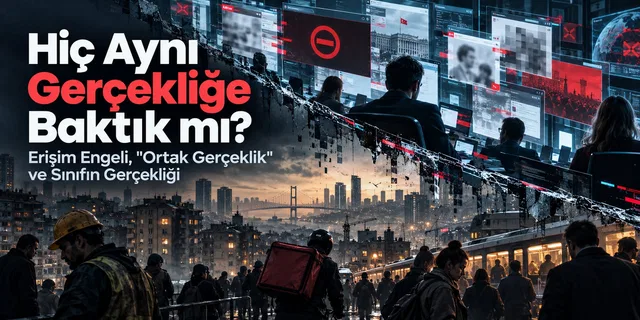
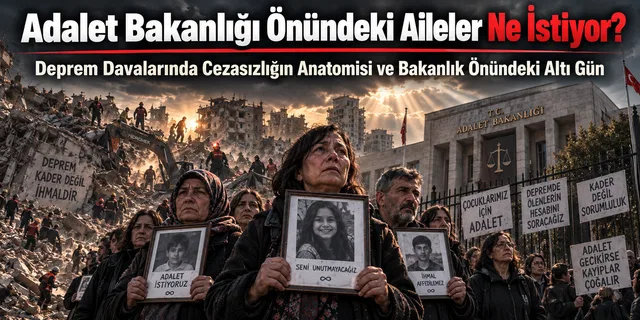
They Shut Down What They Cannot Buy
The Story of the T24 Ban and the Class Roots of Censorship

They Shut Down What They Cannot Buy
The story of the T24 ban and the class roots of censorship
In brief: What happened?
- The ruling: Istanbul's 1st Criminal Court of Peace, in decision 2026/8894 D.İş dated 29 September, ordered the shutdown of T24's website and all of its social-media accounts. The ruling was first announced on 30 September in the Justice Ministry's press WhatsApp groups; the Cybersecurity Presidency emailed T24 at 17.00 and demanded that it be carried out within four hours. The site went offline that evening.
- The pretext: the claim, under the "Ailem Güvende" ("My Family Is Safe") investigation, that T24 had published "118 items of LGBT propaganda" "in the past year". According to the list published by Evrensel, the items go back to 2012; among them are September pieces criticising the operation, a piece criticising the attack on LeMan, a censorship cartoon, and pieces with no LGBTI+ content at all.
- What came before: from 26 September, accounts close to the government targeted T24 over "the enormous flow of funds behind it".
- The same day: at least 147 further X accounts that had commented on the fund crisis were blocked on "national security" grounds. This was the third wave in a week.
- The responses: thirteen press organisations called for the ruling to be "withdrawn at once". The European Parliament's Turkey rapporteur, Nacho Sánchez Amor, called it "an open attack on freedom of expression". Writers at Evrensel and BirGün are reading the wave of censorship together with the fund plunder, the "Family and Population Decade" and the "economic security state".
- Our thesis: it is no coincidence that, on the same day, a newspaper was shut down in the name of the "family" and hundreds of accounts in the name of "national security". The moral front and the economic front are the same front. Independent publications that cannot be silenced through property are now being silenced through law. This is a regime whose consent has worn thin leaning on force.
The detail is below.
Dear Young Comrades,
This evening, 30 September 2026, a shutdown order was announced for T24, one of Turkey's most widely read independent news sites. The website and all of its social-media accounts. The pretext: 118 items published in a year were supposedly "LGBT propaganda".
The same day, at the same hours, at least 147 further X accounts writing about the fund crisis were blocked. These were not LGBTI+ associations. They were economists, academics, technical analysts, lawyers, small investors.
One day, two pretexts: one morality, the other national security. Sixteen days ago, in From Obscenity to National Security: The Anatomy of a Forty-Eight-Hour Wave of Censorship, we showed the same pairing and identified a tendency: once the instrument is normalised, the category expands. That day the list held a union, a newspaper, human-rights organisations. Today it holds the country's largest independent news site and hundreds of people commenting on a financial crisis.
This piece has two parts. First we will tell the story of the T24 ban, day by day. Then we will step back and ask: from whose need, of which class, of which crisis, does the recent wave of censorship arise? After that we will gather the comments of writers at Evrensel and BirGün, and at the end the voices of solidarity coming from the world and from Turkey.
Our questions, as always: In whose hands? Under whose control? For whose benefit?
Part One: The Story of the T24 Ban
What is T24?
T24 is an online newspaper that began publishing on 1 September 2009. Its founding team came from Tempo24; Doğan Akın has been editor-in-chief since the start. Over the years journalists such as Hasan Cemal, Yavuz Baydar, Yasemin Çongar, Andrew Finkel, Hazal Özvarış and Murat Sabuncu have written under this roof. Its owner is not a holding company but a small publishing firm (Wikipedia).
Its X account has 1.9 million followers, its Instagram account 238,000 (bianet English). T24 is not an LGBTI+ publication; it is a general news site. Politics, the economy, the world, culture, columns.
This detail matters, because the whole strangeness of the story sits here: a general news site is being shut down in its entirety because of 118 of the thousands of items it has published.
T24 is not on the target board for the first time. Editor-in-chief Doğan Akın was tried on a charge of "aiding a terrorist organisation" over reports based on an anonymous source, and was acquitted on 2 July 2020. On 5 July 2026, in the wave of detentions before the NATO summit, T24 reporter Buse Söğütlü was among those detained (EFJ).
Chronology: from targeting to the ruling
| Date | Event |
|---|---|
| 12–14 September | "Ailem Güvende" operation: raids on LGBTI+ associations and venues in fifteen provinces; access blocks on hundreds of social-media accounts; on 14 September the block reaches Evrensel, Amnesty International, Academics for Peace, MLSA and UMUT-SEN |
| 15 September | Journalist Tuğba Tekerek and seven Kaos GL directors are arrested in Ankara |
| 16 September | Blocks on the X accounts of journalists Şirin Payzın and İrfan Değirmenci, soL Haber, the Women's Coalition and TKDF |
| 17 September | The Capital Markets Board puts 130 funds of seven portfolio companies into liquidation; the fund crisis begins |
| The third week of September | Blocks on economic accounts such as economist Uğur Gürses, ENAG founder Prof. Dr Veysel Ulusoy and Prof. Dr Bilge Yılmaz, on "national security" grounds |
| 24–26 September | A new wave against the fund crisis and opposition accounts: Kısa Dalga, journalists Hilmi Hacaloğlu, Alptekin Dursunoğlu, Razi Canikligil, economist İnan Mutlu, UMUT-SEN co-founder Başaran Aksu |
| 26 September | Video posts targeting T24 begin from accounts close to the government |
| 28 September | Blocks on at least 150 accounts, including Bizim TV and BirGün reporters Meral Danyıldız and Sarya Toprak; Deniz Göktaş is released at the first hearing |
| 29 September | Istanbul's 1st Criminal Court of Peace, in decision 2026/8894 D.İş, orders an access block on T24's site and social-media accounts |
| 30 September | The ruling is first announced in the Justice Ministry's press groups, emailed to T24 by the Cybersecurity Presidency at 17.00, and the site goes down in the evening; the same day at least 147 further X accounts writing about the fund crisis are blocked |
The dates of the blocking waves slip by a day or two depending on the source (Evrensel's compilation versus Diken and bianet); we built the table from Evrensel's chronology.
The ruling is dated 29 September; the public learned of it on 30 September. The gap is itself a finding: the ruling was given first, then announced in the ministry's message group, and last of all notified to the party concerned.
First the campaign, then the ruling
The story does not begin in a courtroom. It begins on social media.
On 26 September, accounts close to the government began sharing videos targeting T24. According to Medyascope, one of those posts asked: "The enormous flow of funds behind T24, hiding behind the cloak of press freedom."
Notice: the campaign did not begin as "LGBT propaganda". It began as "funds". The first accusation was not moral but monetary: whose is the money behind you? The court ruling three days later does not mention money at all; it mentions 118 items.
T24's statement: "T24 had for some time been subjected to a campaign of slander and lynching on its social-media accounts." Editorial coordinator Gökçer Tahincioğlu wrote: "So heavy a ruling can be issued as the result of a carefully run slander campaign against an institution where dozens of press workers, journalists, work. Whatever we say is too little!" (BirGün)
Let us underline the phrase "press worker". What is being shut down is not an idea; it is dozens of people's workplace.
T24's own headline summed it up: "T24, Turkey's largest independent news site, also cited as a reference in the world, has been shut down after a slander campaign launched on social media!" The site described the process behind the ruling as a "lynching campaign" (MediaCat).
First targeting, then prosecution, then the ruling. Keep that sequence in mind; we will return to it in part two.
The ruling: 118 items, an entire site
The official statement is short: under the "Ailem Güvende" investigation run by the Istanbul Chief Public Prosecutor's Office, T24 was found to have produced "118 items of LGBT propaganda" in the past year; Istanbul's 1st Criminal Court of Peace ordered the shutdown of the site and its social-media accounts; the ruling was sent to the Cybersecurity Presidency to be carried out (GZT, Notbir).
There are four details here, and each is a separate problem.
First: the ratio. One hundred and eighteen items, most of them columns (Diken). The court has also issued a separate removal order for each of these items (bianet). So while the items found objectionable can be taken down one by one, the entire site is being shut down as well. In the words of lawyer-journalist Kemal Göktaş: "Saying 'it published 118 LGBT news items' does not by itself meet the statutory conditions."
Second: the type of offence. There is no offence called "LGBT propaganda" in the Turkish Penal Code. The investigation's grounds list obscenity, organisation, prostitution, narcotics; but they do not say which of these a newspaper column falls under. The pretext is not a definition of an offence; it is a label.
Third: the path. According to Turkish Minute, the ruling rests on Article 8/A of Law 5651 and must be carried out within hours. We described 8/A in From Obscenity to National Security: The Anatomy of a Forty-Eight-Hour Wave of Censorship: the article on "cases in which delay would be prejudicial". Enforcement first, review later.
Fourth: notification. The ruling was first announced in a note shared in the Justice Ministry's press WhatsApp groups (MediaCat). According to T24's statement, notification reached them only at 17.00, in an email from the Cybersecurity Presidency. The language of the email is a summary of today's censorship regime:
"The Cybersecurity Presidency is the public authority competent in the regulation of internet content in Turkey. (...) Pursuant to Article 8/A of Law (...) 5651, a decision has been given for the removal of the content and/or the blocking of access in respect of the publication whose URL is stated below. We inform you that the requirements of the said decision must be fulfilled immediately and at the latest within four hours. Relevant URL: https://t24.com.tr"
The "relevant URL" is not a news item, not a piece: the site itself. That evening, those who went to t24.com.tr met this warning: "Access has been blocked by decision 2026/8894 D.İş of Istanbul's 1st Criminal Court of Peace, dated 29/09/2026" (BirGün).
Even past 20.00, T24 had still not seen the ruling itself. Ankara correspondent Gökçer Tahincioğlu told Evrensel: "We are trying to obtain the ruling. It is this late and we still have not reached it! As the party concerned we have not even seen the ruling yet."
A newspaper learns that it has been shut down first from the ministry's message group, then from a four-hour ultimatum from a security institution; it still does not know the grounds of the ruling. On 14 September we wrote that Evrensel learned its own account had been blocked from an American company's email. In two weeks the channel of notification has passed from the company to the ministry's WhatsApp group. Law has become an announcement.
One hundred and eighteen items: what is on the list?
The list of 118 items that is the ruling's pretext was sent to T24 as a file; Evrensel published the list in full. We read it item by item. Once you read it, the ruling is seen to contradict even its own pretext.
Not "the past year", fourteen years. The prosecutor's statement says "within the past year". The oldest item on the list is dated 22 April 2012 ("From the churches: homosexuals exist!"). There are many pieces from 2013, 2014, 2015. Former ECtHR judge Rıza Türmen's 2015 piece discussing the US Supreme Court's same-sex marriage decision in legal terms is on the list, as is his 2020 piece "Hate speech".
Criticising the operation has become the operation's pretext. Eleven of the newest items on the list are criticism pieces written between 15 and 22 September 2026, that is, in the week after the "Ailem Güvende" operation:
| Author | Title | Date |
|---|---|---|
| Umur Talu | Honestly, your "family really is safe!" | 15 September |
| Şengün Kılıç | Plenty of chatter, futile effort, plenty of bullying… | 17 September |
| Mine Söğüt | The family is safe, so where are you? | 17 September |
| Tuğrul Eryılmaz | "Ailem Güvende", the street is safe, for some reason I do not feel safe at all! | 18 September |
| Yusuf Nazım | What history could not burn (2): the road from the Pink Lists to the Pink Triangle | 18 September |
| Çağatay Anadol | "Ailem Güvende" | 19 September |
| Gökçer Tahincioğlu | The virtual patrol and the informing system | 19 September |
| Leyla Alp | Whose family, safe from whom? | 20 September |
| Faruk Bildirici | Is the influence-agent law in force? | 21 September |
| Mehmet Y. Yılmaz | The "Our Family Is Safe" they talk about is not your family, do not get excited | 22 September |
| Umur Talu | Mamdani and Zamdani! | 22 September |
So pieces criticising an operation have been placed in that operation's file as its pretext. Criticism has been made into the evidence of what is criticised. This one table shows what the ruling is aiming at more clearly than any legal argument.
Items with no relation to LGBTI+. The list also includes:
- Mehmet Y. Yılmaz's 2 July 2025 piece "'A rehearsal for strengthening the home front'!", criticising the Islamist attack on LeMan magazine and the police's "spectator" stance on the anniversary of the Sivas Massacre
- M. K. Perker's 4 January 2021 censorship cartoon on the ministry's declaration of the children's book "The Magical Rainbow" as "harmful publications"
- An interview with Prof. Dr Fuat Keyman on the "Century of Turkey" (19 June 2023)
- Nurcan Baysal's piece on migrants (17 April 2015)
- Erdem Yörük's piece "Are you still among those we have not been able to HDP-ise?" (1 November 2013)
- "İHD is thirty-nine and those who went to Süleymaniye" (18 July 2025)
- "An effort at a 'soft transition' to a religious state?" (24 August 2021)
- "Did Atatürk drink whisky too, here is the document that ends the debate" (12 June 2023)
There is also this: the title of one interview on the list is Onur Ünsal's sentence: "We understood that poverty, being a worker, LGBT problems, that heteronormative male violence, are the same everywhere in the world." An interview that names poverty and being a worker in the same sentence has been coded as "propaganda".
This list shows that the "LGBT propaganda" label is not a definition of an offence but a sorting tool: secularism, migration, the Kurdish question, human rights, criticism of censorship, criticism of the operation; all of them can be put in the same sack.
Why T24, why now?
T24 has reported the "Ailem Güvende" operation in detail from the start: the raids, the detentions, the account shutdowns (Turkish Minute). So the operation is shutting down those who report the operation.
This matches the logic of the 14 September list exactly. That day we wrote: the common feature of the list is not being LGBTI+; it is keeping a record. T24 is a record-keeper. It is one of the institutions that prevent the operation from remaining off the record.
But there is a second answer to "why now", and that answer sits in the other ruling of the same day.
The same day, the other list: fund-crisis accounts
On 30 September, the same day as the T24 ruling, at least 147 further X accounts posting about the fund crisis were blocked. Their combined followers are about 2.65 million; five have more than 100,000 followers, seventeen more than 50,000. The list includes fintech specialist İris Cibre, technical analyst İbrahim Babadağı, stock-market investor Gürdal Hançer, academic Rıdvan Özturgut, lawyer Tugay Bek (Diken, bianet).
The pretext: "the protection of national security and public order." Bianet notes that Article 107 of the Capital Markets Law, which regulates market fraud, may also come onto the agenda as a basis.
This was the third wave. The numbers vary by source, and we are not hiding that:
| Date | According to Diken | According to bianet |
|---|---|---|
| 24 September | at least 80 accounts | 194 accounts |
| 28 September | at least 150 accounts | — |
| 30 September | at least 147 accounts | at least 147 accounts |
Whichever number is right, in a week several hundred accounts were silenced for talking about a financial crisis. And again: the state does not say how many accounts were shut down; an association (İFÖD) keeps the count.
The sentence of İFÖD co-founder Yaman Akdeniz shows the ring that joins the two lists: "X, Meta and the other platforms have submitted; they are carrying out every ruling."
Now let us take a step back.
Part Two: The Class Roots of Recent Censorship
First the map: the line of expansion of censorship in three months
Looked at one by one, each event looks "isolated". Put them side by side and a line appears:
| Period | Target | Pretext |
|---|---|---|
| June–July | Kaos GL editor-in-chief Yıldız Tar (terrorism charge); journalists detained before the NATO summit (reporters from T24, OdaTV, Bianet) | Terrorism, national security |
| 3 July – 28 September | Comedian Deniz Göktaş: arrest, an indictment seeking up to twelve years, release after eighty-seven days | Humour |
| July | An omnibus law expands the powers of the Cybersecurity Presidency | "Cybersecurity" |
| 12–14 September | LGBTI+ associations; then a newspaper, a union, legal and human-rights organisations | Obscenity / national security |
| 15 September | Journalist Tuğba Tekerek is arrested | Organisation |
| 16 September | Journalists, soL Haber, women's organisations | — |
| The third week of September – 30 September | Economists, analysts and investors commenting on the fund crisis (including ENAG's founder) | National security, public order |
| 26–28 September | Kısa Dalga, Bizim TV, BirGün reporters, UMUT-SEN founder Başaran Aksu | National security, public order |
| 29–30 September | T24 in its entirety | "LGBT propaganda" |
As you read this table, remember the law of the target list in Two Towers, One World: Twenty-Five Years of September 11: once the apparatus is legitimised, it expands its own list. The expansion we see here is from cultural categories towards economic ones. The wave that began with morality has arrived at the fund crisis.
This is exactly where the class reading begins.
First root: the moral front and the economic front are the same front
Put the two rulings of 30 September side by side: in the morning a news site is shut down on the pretext of "protecting the family"; the same day hundreds of accounts are silenced for talking about a fund crisis that has swallowed the savings of half a million people.
These are not two separate policies. They are two faces of the same policy.
In Whose Family Is Safe? we described the function of moral panic as follows: to shift the source of insecurity from property to culture. A family's real insecurity is rent, school costs, the pension, workplace deaths; and this month, savings put into a fund and not returned. None of these insecurities comes from a column. All of them come from property relations.
The moral campaign points this anger at the wrong address. But even when the address is shown wrongly, the anger stays where it is and begins to flow towards its real address. The shutdown of the fund-crisis accounts is the name of the dam placed in front of that flow. The first ruling draws the crowd's attention to culture; the second cuts the voice of those who talk about the economy.
Second root: in a crisis, information is capital's most valuable commodity
To understand why the fund-crisis accounts were shut down, one must remember what a market works with: information.
The mechanism we showed in the stock-market file Circuit Breaker: The Bourgeoisie's Exchange Does Not Even Trust Itself was this: large positions exit at the peak from the share whose price has been inflated; the smallest investor, who entered last, is left at the bottom. The only thing that determines who exits first is the order of access to information. On crisis days information is price; those who receive it first win, those who receive it later lose.
Now look at the silenced list again: finance specialists, technical analysts, stock-market investors, lawyers. These are not capital itself; they are the small investor's source of information. They are the channels through which 514,000 people learned what was inside the funds, the liquidation timetable, which company transferred what to whom.
One name on the list draws particular attention: ENAG's founder, Prof. Dr Veysel Ulusoy. ENAG is the group that publishes an independent inflation calculation against TURKSTAT's inflation figure. So among those silenced is also the person who produces the alternative price information on which the worker can lean in wage bargaining. Who will count inflation, who will tell what is inside the funds: both are the same question.
The class result of shutting these channels is simple: information remains the monopoly of those inside. The portfolio company, the related party, the institutional player has its own information; it has the Public Disclosure Platform, the Capital Markets Board, the telephone. What is silenced is the outsider's information.
The official pretext may be "fighting manipulation"; real manipulation of course exists. But in a crisis, fighting manipulation should first target those who trade on inside information, those who inflate the price, those who looked away for eleven months. If instead those who comment on the crisis are silenced, what is being protected is not the honesty of the market but the monopoly over the narrative of the crisis.
Capital is not only the owner of the factory and the fund. In a crisis it also wants to be the owner of how the crisis will be told.
Third root: silencing through law what cannot be silenced through property
Why T24? Why so large, so well known a publication?
Look for the answer in the past twenty years of media ownership in Turkey.
Mainstream media in Turkey today is largely in the hands of capital groups dependent on public tenders, zoning decisions, licences in energy, construction, mining. For these groups a newspaper is not a profit line but a relationship instrument: the holding that wins the tender adjusts its editorial policy to the one that awards the tender. Silencing by this route does not require a court ruling. Property itself is censorship. The editor-in-chief is removed, the columnist "leaves", the story is not published. No one shuts anything down.
This model worked very well for twenty years. But it has a limit: it cannot silence what cannot be bought.
The condition of existence of publications such as T24 is exactly this. Their owners are not a holding; they do not need an energy tender, a mining licence, a zoning decision. There is no lever with which to silence them through property. One path remains: the administrative and penal path.
This, in class terms, is a fork in the road:
| Form of censorship | Instrument | To whom it is applied | Visibility |
|---|---|---|---|
| Through property | Purchase, advertising, tender relations | Media tied to holdings | Invisible; "editorial policy" |
| Through law | Peace-court ruling, 8/A, access block | Small and independent publications that cannot be bought | Visible; by ruling, by pretext |
| Through the platform | "Withheld in Turkey", account restriction | Individuals, associations, unions | Half-visible; company notification |
As long as the first row works, there is little need for the second. That the second row is used so often shows that the first has been saturated, that is, that everything that can be bought has already been bought. What remains are those that have no price.
That is why the targets of recent censorship share a common class feature: publications that stand on reader subscriptions, donations, voluntary labour; unions; associations; specialists who write alone. Producers of information not tied to capital's circuit of circulation.
Fourth root: a power that cannot produce consent leans on force
Remember Gramsci's distinction: a ruling class governs with two instruments. Consent and force. While consent works, force stays in the background; there is no need to silence anyone, because people have already adopted the regime's narrative as their own common sense.
Producing consent is material work. It requires that wages, pensions, social assistance, the expectation that "tomorrow will be better than today" be held at a certain level. This September's picture is this: at the opening of school a lycée student's costs exceed a minimum wage (The Bell Does Not Ring the Same for Everyone); at the pensioners' action in front of the Constitutional Court in Ankara a pensioner loses their life; the savings of half a million households freeze in the fund liquidation.
Once the material basis of consent is worn away, two paths remain: either rebuild the material basis (this means asking capital for a share) or complete the missing part of consent by force. The censorship map of the past three months shows that the second path has been chosen.
That is why it is misleading to read censorship as a "show of strength". The intensification of censorship is a sign of weakness: a sign that the narrative can no longer persuade on its own, and that where it cannot persuade it has begun to silence.
Being a sign of weakness does not mean it is harmless. On the contrary: a regime that is losing its consent is inclined to raise the dose of force.
Fifth root: authority to the security bureaucracy, enforcement to the platform monopoly
The T24 ruling was sent to the Cybersecurity Presidency to be carried out. The fund-crisis accounts were shut down on "national security" grounds.
With the July 2026 omnibus law, a substantial part of the power to take measures on the internet was moved from a technical market regulator (the Information and Communication Technologies Authority) to a security institution attached directly to the Presidency. In From Obscenity to National Security: The Anatomy of a Forty-Eight-Hour Wave of Censorship we described this as "not a change of place of authority but a change of its character". This week we saw the result of that character: a financial crisis is being treated as a security matter.
The management of an economic crisis in the language of "national security" tells a great deal in class terms. Because security language is the language that closes discussion. Asking why a fund sank is an economic question; but the moment that question is coded as "a threat to public order", the asker themselves becomes the problem. The crisis is managed not as capital's crisis but as a problem of the security of the narrative.
Enforcement, again, sits with the platform companies. As Yaman Akdeniz says, X and Meta are carrying out every ruling. For these companies Turkey is an advertising and data market; the price of staying in the market is compliance. In a market of eighty-five million, darkening an account is as cheap as changing a field in a database. This is the circulation-side face of what we called digital enclosure in The Revolt of Crystallized Labor: A Call to the 20th Karaburun Science Congress: so long as the communications infrastructure is in private property, every word on that infrastructure is a permission conditional on the property-owner's co-operation.
So today's censorship regime is a partnership of two class fractions: an executive that has monopolised the power of decision, and global platform capital that takes on enforcement. One protects the security of the narrative, the other the security of the market. What they have in common is that what is silenced is propertyless speech.
Sixth root: silencing the intermediate layers, preventing an alliance
One last point, perhaps the most important.
Look at the owners of the fund-crisis accounts: economists, analysts, lawyers, small investors. In the classical class schema these are not the organised core of the working class; they are intermediate layers. The victims of the fund crisis are largely these layers too: the wage-earner, the shopkeeper, the self-employed person who put their savings into a fund.
In crisis periods these layers stand at a fork. Either they turn their anger upwards, towards the structure of property, and take the same side as the labouring classes; or their anger is directed downwards, towards scapegoats such as "foreign funds", "those who corrupt the family", "manipulators".
The recent censorship map is an intervention in this fork. On the one hand, the intermediate layers are being prevented from hearing their own crisis from their own specialists. On the other, in the same days a cultural enemy is being produced. It is no coincidence that the campaign against T24 began as a "flow of funds": to the crowd that has lost its savings in the fund crisis, another "fund" is being shown as the culprit.
What is feared in class terms is that lost savings and lost wages, the pension and school costs, be seen together as the product of the same property relation. The moment this is seen, separate victims can turn into a class alliance. Censorship is cutting the channels through which that view would be built.
Comments in Evrensel and BirGün: What Does Labour's Press Say?
First a reminder: these two papers are parties to the event as well as commentators on it. Evrensel's X account was blocked on 14 September on "national security" grounds; BirGün reporters Meral Danyıldız and Sarya Toprak were among those blocked on 28 September. The comments below are the view of the list from those who are on it.
Reactions the same evening
BirGün compiled the reactions that followed the ruling:
- İlknur Başer (SOL Party spokesperson): "T24 cannot be shut down. It is not independent journalism that disturbs public order, but censorship and shutdown! Where there is no independent journalism, one cannot speak of democracy."
- Alper Taş (SOL Party Central Executive member): "This shutdown order against T24 is a continuation of the reactionary policies aimed at darkening Turkey."
- Timur Soykan (BirGün writer): "The political Islamists who once reacted because the General Staff applied accreditation know no limit in censorship and repression. A very dark period."
- Bahadır Özgür: "A media organisation that has published for years has been shut down by a single ruling. This is a situation far beyond censorship. Turkey is living under a digital state of emergency."
T24's Ankara correspondent Gökçer Tahincioğlu, speaking to Evrensel, said they were preparing an objection and added: "The decision to block access entirely to a site that has reported news openly to every kind of idea in Turkey for seventeen years is, even in this climate, shocking." And he described the new threshold of censorship: "Now even the expression of a view can be counted as a crime; we watch it every day." (Evrensel)
In Evrensel columns: family, population, funds, the security state
Because the ruling came in the evening, as of this hour there is no column devoted only to T24 in either paper; we will update as pieces arrive. But the writers of both papers have, over the past two weeks, written step by step the ground that made this ruling possible. Put side by side, almost all of the roots we listed in part two appear in these pieces.
Nuray Sancar, "If the family cannot be safe anyway!" (18 September). Sancar recalls that the official basis of the operation is the "2026–2035 Family and Population Decade" vision and Presidential Circular 2026/4, and looks at the economic content of the circular: encouraging the return of the urban population to the countryside, regional wage debates, the labour-power shortage, military population potential. In Sancar's sentence: "A call of go back to your village is being made to the masses who cannot pay rent, cannot get by and are crushed by inflation." And the general principle: "Internal security has in every period been seen as an operation of drawing a border among social groups." (Evrensel)
This is the concrete document of what we called the "first root": "family" policy is a labour-power policy as much as a moral policy. How many children will be born, who will work where, at which wage they will consent.
Pınar Öğünç, "Hidden agenda, open attack, a matter of dose" (19 September). Öğünç recalls that Turkey is at the top of Europe in child poverty and writes: "If the concern is the family, not seeing that what does this institution the most damage is the economic crisis is possible only by intent." In the same piece she reports Evrensel writer M. Sinan Birdal's reading of the operation as "the transformation of family policy from a discursive field of struggle into a security policy applied with the instruments of the judiciary, the police, digital surveillance and financial inspection" (Evrensel). We note that we do not share the concept of "techno-feudalism" that appears in Öğünç's piece; what is happening is not a return to feudalism, it is monopoly capitalism itself. But the diagnosis is in the right place: digital surveillance and financial inspection are the two legs of the T24 ruling.
Ümit Akçay, "The new statism and the economic security state" (27 September). Reading the new Medium-Term Programme, Akçay describes two dimensions of the new statism: "The state's more active direction of capital accumulation, and the increasing reorganisation of economic relations by a security logic." (Evrensel) Akçay tells this through foreign trade, the supply chain and industrial policy. But the same logic is at work inside: the shutdown of accounts commenting on a fund crisis on "national security" grounds is the digital face of the economic security state. This is what we meant in the fifth root by "a financial crisis is being managed as a problem of the security of the narrative".
Bülent Falakaoğlu, "The issue is not 500,000 'gamblers'" (24 September). Against the discourse that belittles fund victims as "greedy", Falakaoğlu gives figures: there are about 6.2 million people in the stock market, 4 million of them with investments of 100,000 lira or less. "These people are neither greedy nor jackals after a score." People trying to protect their three kuruş while the currency is suppressed, gold is falling, and interest is below the inflation the worker lives (Evrensel). This is the document of what we recalled in the sixth root: the intermediate layers and the labourers meeting inside the same loss.
Arif Koşar, "Is this not real capitalism?" (30 September). Koşar answers the mainstream economists who, faced with the fund scandal, say "this is not capitalism, it is a plunder regime": "The palace regime made the fund plunder easier. Not because it is not capitalist, but on the contrary because it is capitalist…" (Evrensel) The same can be said of the censorship debate: this censorship is not a "deviation from the rule of law"; it is this accumulation regime's own law.
Ceren Sözeri, "Catching the media by its capital" (19 July). This piece was written two and a half months before the T24 ruling, and read today it stands like a prophecy. After recalling the transfer of the Information and Communication Technologies Authority's powers to the Cybersecurity Presidency and Penal Code 217/A, Sözeri writes that access-block type measures are "functional up to a point", that they can be circumvented, and that they make the regime look "censorious". She also names the new method: "The most current and practical one is to catch the capital and money traffic." (Evrensel) That the campaign against T24 began not with morality but with the question of "the enormous flow of funds" is exactly the mark of this method.
In BirGün columns: funds, the media and "which side"
Hayri Kozanoğlu, "The social dimensions of the fund scandal" (29 September). Kozanoğlu shows that in one of the liquidated funds the average portfolio of 25,000 investors is under 100,000 lira, and adds: those who resorted to manipulation, obtained inside information, and exited at the peak "have, what a coincidence, always come from among the large players." He writes that "market professionals" knew the details of the Capital Markets Board guide published on 28 August in advance, and that "understanding that the sweet-life period was approaching its end, they took all their precautions accordingly" (BirGün). This is the very mechanism we described in the second root as "in a crisis, information is capital's most valuable commodity".
Faruk Bildirici, "The media's role in fund fraud" (28 September). BirGün's media ombudsman lists one by one the media that burnished the funds: mainstream channels that hosted the detained company executives, television presenters who were the face of advertising, "economy writers" who did not tell their readers they were executives at a portfolio company, an economy newspaper that had formed a partnership with one of the liquidated companies, Anadolu Agency which deleted advertising copy from its archive. Bildirici's diagnosis: economic journalism "looks to the mouth of the political power and of large companies and investors; it does not look to the public interest. It is now the voice of the strong, of those with money, not of the weak." (BirGün)
Now put this piece beside the T24 ruling. The channels that burnished the funds, that called the investor to "join in too", are still on air. The accounts of independent economists trying to tell what is inside the funds are closed. And the largest independent news site has been shut down. This is the third root in its most naked form: bought media continues to speak; what cannot be bought is silenced.
Selçuk Candansayar, "'Is my family safe?' Who will determine the abnormal?" (21 September). Psychiatrist Candansayar describes how the operation began with nightclubs and reached LGBTI+ associations, organisations defending the rights of people living with HIV, then the Sexual Education Treatment and Research Association (CETAD) which trains physicians and psychologists, and the Turkish Psychiatric Association representing more than 7,000 physicians. His sentence on the "foreign funds" accusation is also a summary of the campaign against T24: "So the issue is not who took funds from where, but on which side who stands." (BirGün)
Can Ertuna, "Journalism against the spiral of silence" (23 September). Ertuna had written that in authoritarian regimes journalism tries "to open a crack in the wall of disinformation and propaganda through a handful of (as yet) uncensored websites" (BirGün). A week later the largest site in that handful was shut down. The sentence of a jury chair that Ertuna reports is, for today, a definition of a task: journalism sometimes "puts a record in society's memory and afterwards prevents those who come to power from saying 'we did not know this'."
What comes out of these comments?
The writers of labour's press set out from different subjects and meet at the same point:
| Writer and subject | The link they show |
|---|---|
| Sancar: Family and Population Decade | Moral policy = labour-power and population policy |
| Öğünç and Birdal: the character of the operation | Family policy = a security policy that runs with digital surveillance and financial inspection |
| Akçay: the economic security state | The economy = a field managed by a security logic |
| Falakaoğlu and Kozanoğlu: fund victims | The loser is small savings, the winner is the large player inside |
| Koşar: "real capitalism" | The plunder is not a deviation of the regime, it is capitalism's own working |
| Bildirici: funds and the media | Bought media burnished the funds, the independent voice was silenced |
| Sözeri: catching the media by its capital | The new method of censorship: "money traffic" |
| Candansayar: "foreign funds" | The issue is not funds, it is on which side one stands |
This table confirms our thesis in part two in others' pens: the T24 ruling is not a by-product of a moral campaign; it is part of an operation to bring the narrative of an accumulation crisis under control.
The Official Narrative and the Class Reading
| Official narrative | Class reading |
|---|---|
| T24 made LGBT propaganda | A general news site became the target of the operation because it reported the operation |
| 118 items were identified | While the items could be taken down one by one, the entire site was shut down; the target is the publication, not the content |
| We are protecting the family and children | The family's real insecurity is rent, funds, school costs and workplace deaths; the campaign shifts anger from property to culture |
| We are preventing manipulation in the fund crisis | What is silenced is not those who trade on inside information, but the small outsider investor's source of information |
| National security, public order | A financial crisis is being managed as a problem of the security of the narrative |
| It is a judicial ruling | The ruling was first announced in the ministry's message group, then notified by a four-hour ultimatum from a security institution; T24 still has not seen the text of the ruling |
| 118 items of the past year | The list goes back to 2012; September pieces criticising the operation have been made into the operation's evidence |
| There are foreign funds behind it | The campaign shows those who lost their savings in the fund crisis another "fund" |
| Isolated rulings | A single line expanding in three months from terrorism to humour, from morality to the economy |
| The platforms are complying with the law | Platform capital is in an enforcement partnership in order to stay in the market |
Voices of Solidarity from the World and from Turkey
If the first defeat of censorship is becoming countable, the second is not remaining alone. As of the night of 30 September, the solidarity messages we have been able to gather are these.
International
The European Parliament's Turkey rapporteur, Nacho Sánchez Amor, called the ruling an "open attack" (Elips Haber):
"What started as a disgraceful anti-LGBTIQ campaign under the cynical #AilemGüvende heading has now turned into an open attack on freedom of expression in Turkey."
Amor recalled that hundreds of accounts had been blocked in a few days, that T24 was the latest target as "one of the very few independent media", and finished: "It is getting worse and worse."
The International Press Institute (IPI) and the European Federation of Journalists (EFJ) Turkey Representation were among the signatories of the joint statement of the thirteen organisations mentioned below.
The European Federation of Journalists (EFJ) and the International Federation of Journalists (IFJ), in early July, had declared that they "absolutely condemn" the detention of journalists including T24 reporter Buse Söğütlü before the NATO summit, and had demanded the immediate release of all imprisoned journalists (EFJ). The T24 ruling is the unansweredness of that call three months later.
The International Federation for Human Rights (FIDH), in a joint statement with İHD published on 18 September, documented that in the "Ailem Güvende" operation at least 116 people had been detained, at least 82 arrested, and at least 125 more detained in protests. Their demands: the immediate release of those in detention, the dropping of prosecutions based on discriminatory charges, an end to the criminalisation of LGBTI+ civil society, and a clear condemnation by EU, Council of Europe and UN mechanisms (FIDH).
Amnesty International, in two separate statements in September, announced that the operation was "part of an escalating rights crisis" and that activists in detention must be released at once (Amnesty). Let us not forget: Amnesty International Turkey's own X account was among those blocked on 14 September.
Reporters Without Borders (RSF) had placed Turkey 163rd among 180 countries in the 2026 Press Freedom Index; the year before it was 159th (Turkish Minute).
The ruling also reached the world press the same day through Reuters and AFP in outlets such as US News, France 24 and Cyprus Mail.
From Turkey
Thirteen press organisations issued a joint statement (T24, Halk TV):
"The unconstitutional shutdown order is a grave attack on our profession and must be withdrawn at once."
The organisations stressed that the "Ailem Güvende" investigation has targeted press and expression freedom from the start, that journalists have been arrested, that access blocks have been placed on news sites and accounts (Artı Gerçek).
The signatories: the European Federation of Journalists Turkey Representation, the Press Council, DİSK Basın-İş, the Contemporary Journalists Association, the Tigris-Euphrates Journalists Association, the Diplomatic Correspondents Association, the Economy Correspondents Association, the Journalists Association, the Izmir Journalists Association, KESK Haber-Sen, the Media and Law Studies Association (MLSA), the Journalists' Union of Turkey, the International Press Institute.
Look at the list: there are three unions. Structures that defend journalism not as a professional matter but as a labour matter. When a news site is shut down, the first people left without work are reporters, editors, technical staff.
The Human Rights Defenders Solidarity Network, on the first day of the operation, 13 September, wrote in the name of thirty-five member organisations: "Defending human rights and LGBTI+ rights is not a crime" (İHSDA).
Prominent words from journalists and politicians (Diken, Medyascope):
- Barış Terkoğlu: The cost of governing the country badly is being made journalists pay, in court rulings wrapped in a moral package.
- Faruk Bildirici: The real aim is to silence opposition voices and to block independent journalism outside state control.
- MP Ahmet Şık: The ruling is a "digital martial law" trying to hide the truth.
- RTÜK member Tuncay Keser: Press freedom is not only journalists' freedom, it is society's freedom.
- Şirin Payzın: "Shutting down in this way T24, a respected online newspaper that has published independently for years, is a heavy blow to press freedom."
Terkoğlu's sentence summarises the second part of this piece in a single line. Let us add only this: bad government is not a management error; it is a class choice. What is being made journalists pay is the same choice that makes labourers pay the cost of the crisis.
The class lesson of solidarity
Two things are missing from this picture, and we note both.
First: international press organisations are fast, the international trade-union movement is slow. Press-freedom organisations speak by reflex; but the voice of international union confederations saying that censorship is a labour matter, that every publication shut down is a workplace, is not yet heard. This is a gap that needs to be filled.
Second: solidarity is still divided by category. Separate statements for LGBTI+ organisations, for journalists, for fund-crisis victims. Yet the rulings are applied on the same day, in the same court system, by the same security institution. If censorship works as a whole, solidarity must also be a whole.
Concrete Tasks
Keep the record. İFÖD's EngelliWeb archive is an information commons. See the fund-crisis accounts and the T24 ruling in the same ledger; report what you find missing.
Ask for the text of the ruling. The grounds of decision 2026/8894 and the list of 118 items must be made public. If you are a law student, a lawyer, if you hold a post at the bar: turn this demand into an institutional demand.
Be a reader, be a subscriber. The only security of publications that cannot be bought is their readers. Follow T24, Evrensel, Kısa Dalga, bianet directly, even if the domain changes; subscribe to email bulletins, RSS feeds. A publication that goes dark on a platform continues to live in the inbox.
Keep talking about the fund crisis, talk with sources. The place of the silenced accounts must be taken by cool, documented pieces that put a Public Disclosure Platform notice and a Capital Markets Board ruling under every claim. The way to break the class monopoly of information is to make information public and verifiable.
Think of the victims not separately but together. Show that you are talking with your neighbour who is a fund victim, your pensioner relative, your family struggling with school costs, about different faces of the same problem. That is the bond censorship is trying to cut.
Put it on your union's agenda. The unions of press workers (TGS, DİSK Basın-İş, Haber-Sen) are signatories of the statement. Whatever branch your own union is in, propose an item of "solidarity with press workers" for the branch agenda. Every publication shut down is a workplace.
Force the international trade-union link. If you know someone in a union in Europe, in Germany, elsewhere in the world, pass on this piece and the statement of the thirteen organisations. The press organisations have spoken; it is the workers' organisations' turn.
Build the alternative channel today. If your organisation's, association's, union's only communications channel is on a company's server, that channel is a permission. Your own domain, email list, archive and mirror site: these are a backup strategy. As we described in The Computing Worker's Handbook, the computing worker taking on the technical load in this field is directly a class task.
Do not organise solidarity by category. On 12 September LGBTI+ associations, on 14 September a union and a newspaper, on 24 September economists, on 30 September T24. Not having come up on the list yet does not mean not being on the list.
Dear Young Comrades,
For twenty years in this country newspapers were silenced largely not by being shut down but by being bought. A holding bought a newspaper, the newspaper fell silent; no one saw a court ruling.
The shutdown of T24 shows that this path has reached its end. What could be bought has been bought. What remains are publications that stand with their readers, their volunteers, their unions, that have no price. And the only way to silence what has no price is to ban it.
This shows that censorship is not a sign of strength but of exhaustion: a regime whose consent is running out beginning to shut down where it cannot persuade. But the most dangerous period of a regime that is running out is exactly this period.
That on the same day a news site is shut down in the name of the "family" and hundreds of accounts in the name of "national security" tells us one thing: the moral front and the economic front are the same front. Those silenced in the name of culture and those silenced in the name of the fund crisis are being silenced because they are approaching the telling of the same property relation.
Our work is to keep telling that relation. To count, to write, to record, to multiply. And to do this without entrusting it to a single channel, a single company, a single domain.
They shut down what they cannot buy. What cannot be shut down are those who stand up for one another.
Comradely.
Knowledge belongs to everyone.
Update
30 September 2026, 23.10 — The ruling was emailed to T24 by the Cybersecurity Presidency at 17.00; t24.com.tr went offline in the evening. T24 stated that it had not yet obtained the text of the ruling and was preparing an objection. Evrensel published the full list of 118 items; this piece was expanded with an analysis of that list and with the comments of writers at Evrensel and BirGün. No T24-specific statement has yet come from international trade-union confederations or from Council of Europe mechanisms. This piece will be updated regularly with the objection process, new columns and solidarity messages.
Related Pieces
The censorship file
- From Obscenity to National Security: The Anatomy of a Forty-Eight-Hour Wave of Censorship — the 12–14 September wave, Law 5651 arts. 8 and 8/A, the Cybersecurity Presidency
- Whose Family Is Safe? — the class function of moral panic
- The Deniz Göktaş Case and the Class of Humor
The apparatus of repression and surveillance
- Two Towers, One World: Twenty-Five Years of September 11 — the expansion law of the target list
- 12 September: The History, Balance Sheet, and Present of a Class Coup — the founding example of class operations presented on moral grounds
- Anthropic's Activist Monitoring System — the function of declaring "critical infrastructure" as taking it out of oversight
- KVKK's "80s Trend" Warning and Privacy in the Digital Age
Crisis and labour
- The Bell Does Not Ring the Same for Everyone
- The Revolt of Crystallized Labor: A Call to the 20th Karaburun Science Congress — digital enclosure
- The Computing Worker's Handbook
- Circuit Breaker: The Bourgeoisie's Exchange Does Not Even Trust Itself
Sources
Primary record
- Freedom of Expression Association — EngelliWeb, "T24 access blocked"
- T24 — "T24, Turkey's largest independent news site, also cited as a reference in the world, has been shut down after a slander campaign launched on social media!"
- T24 — joint statement from thirteen press organisations
The T24 ruling
- Medyascope — "Ailem Güvende" operation: T24 shut down
- Euronews Turkish — 'Ailem Güvende' investigation: shutdown order for T24 news site
- MediaCat — Shutdown order for the T24 site
- GZT — Why is T24 not opening?
- Notbir — T24 shut down: pretext LGBT propaganda
- bianet English — Turkish independent news outlet's website, social media accounts blocked
- Turkish Minute — Turkish court shuts down independent news site T24
- Yetkin Report — Shutdown order for T24: shock in the media world
- Diken — Censorship of T24: 'They are making journalists pay the cost of governing the country badly'
Evrensel and BirGün
- Evrensel — "LGBTI propaganda" pretext put forward | Censorship wave grows: T24 shut down
- Evrensel — The 118 news items and pieces cited as grounds for shutting down T24 have been made public
- Evrensel — T24 Ankara correspondent Gökçer Tahincioğlu: "Being blocked entirely is shocking"
- Evrensel — Reaction from press organisations to the shutdown of T24
- BirGün — The censorship wave is growing: T24 access blocked!
- Nuray Sancar — If the family cannot be safe anyway! (Evrensel, 18 September 2026)
- Pınar Öğünç — Hidden agenda, open attack, a matter of dose (Evrensel, 19 September 2026)
- Bülent Falakaoğlu — The issue is not 500,000 'gamblers' (Evrensel, 24 September 2026)
- Ümit Akçay — The new statism and the economic security state (Evrensel, 27 September 2026)
- Arif Koşar — Is this not real capitalism? (Evrensel, 30 September 2026)
- Ceren Sözeri — Catching the media by its capital (Evrensel, 19 July 2026)
- Selçuk Candansayar — "Is my family safe?" Who will determine the abnormal? (BirGün, 21 September 2026)
- Can Ertuna — Journalism against the spiral of silence (BirGün, 23 September 2026)
- Faruk Bildirici — The media's role in fund fraud (BirGün, 28 September 2026)
- Hayri Kozanoğlu — The social dimensions of the fund scandal (BirGün, 29 September 2026)
Fund-crisis accounts
- Diken — Access block on at least 147 X accounts including İris Cibre
- bianet — 147 further X accounts blocked because of fund-crisis posts
Solidarity messages
- Elips Haber — EP Turkey rapporteur Amor's reaction to T24
- Halk TV — Harsh reaction from professional organisations to the shutdown of T24
- Artı Gerçek — Reaction from press organisations to the shutdown of T24
- FIDH — Turkey: Erdogan is leading a full on crackdown against the LGBTQI+ community (18 September 2026)
- Amnesty International — Türkiye: Authorities must end escalating crackdown on LGBTI rights groups
- Human Rights Defenders Solidarity Network — Stop criminalising LGBTI+ organisations and rights defenders (13 September 2026)
- EFJ — Turkey: Crackdown on press freedom intensifies ahead of NATO summit (7 July 2026)
- US News (Reuters), France 24 (AFP), Cyprus Mail
Context