Dossier: The Real China
From Before Mao to 2026, From Revolution to Restoration — A Marxist China Dossier for Young Comrades

Comrade, Is China Socialist?
You Will Not Find the Answer by Looking at the Flag
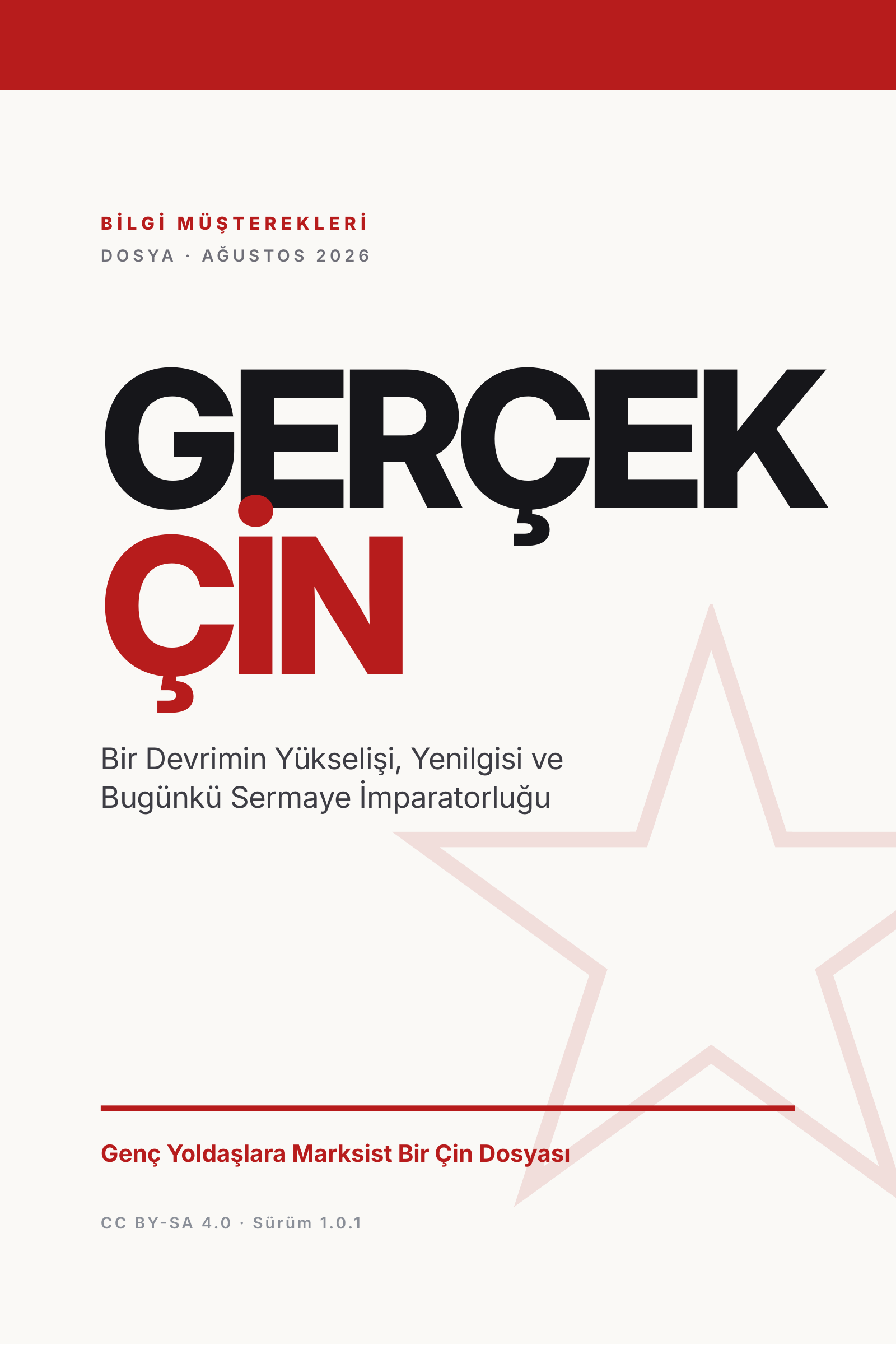
Our new dossier The Real China is out. 75 pages, 32 chapters; from the Opium Wars to the artificial-intelligence directives of 2026. Free and under a CC BY-SA 4.0 licence — as PDF, EPUB and Markdown on our Guides page.
Comrade, this dossier was written for you.
Because sooner or later you will fall into this debate. Perhaps in a reading group, perhaps in a social-media argument, perhaps at a family table. And in that moment, because your answer is not ready, you will either fall silent or repeat a sentence you once heard somewhere.
This dossier was written so that you would not have to repeat that sentence.
First, two easy traps
When China is discussed, people usually do one of two things.
First: defending China as a flag. The state’s name says “people’s republic,” the party’s name says “communist”; therefore what exists there is socialism. When factory conditions, the 996 work regime, or workers unpaid their wages are raised, the answer is ready: "You are making yourself a tool of imperialist propaganda."
Second: criticising China with the material Western press supplies. Citizen scores, cameras, dystopia. Even if the criticism touches real points, its frame is someone else’s frame — and that frame has a class interest.
Both say something. But neither does the same thing: class analysis.
And this is not a lack of information, comrade. It has a historical cause — and that cause is in us.
Why did this debate become so hard?
On the Turkish left, the China debate was never merely a debate about China. From the late 1960s on, China functioned in this country as a factional compass. Being for Beijing or for Moscow decided who was in which organisation, which journal one read, whom one spoke to and whom one did not.
That had a result, and we still live with it today: thought became identity.
When a thought becomes identity, its criticism is lived as an attack on identity. A factual finding about China turns at once into the question "who are you, which camp are you in."
If, fifty years on, a strike report from China still brings the factional score-settling of the 1970s onto the table — the problem is not in China; it is in us.
The first aim of this dossier is this: to free China from being hostage to camp allegiance and make it once again an object of inquiry.
The tool in your hand: four questions
How do we tell whether a country is socialist? Not by looking at its flag. Nor by looking at its anthem, the preamble of the party statute, or the headings of congress resolutions.
By looking at four questions. Put these in your pocket, comrade — they work for China, for Cuba, for Vietnam, and if need be for what we will build tomorrow:
1. In whose hands are the means of production? Not only in whose name they are legally registered: who in fact disposes of them, whose pocket the profit enters, who takes the investment decision.
2. Who appropriates the surplus-value? Where does the part of the value the worker produces that exceeds the wage go — to social need, or to capital accumulation?
3. Is labour-power a commodity? Must a human being sell labour-power on a market in order to live? Does unemployment operate as a disciplinary instrument?
4. Of which class is the state the apparatus? Is it liquidating capital, or organising the general conditions of its accumulation?
Marx said this long ago in The German Ideology: we cannot judge an epoch by what that epoch says about itself.
The whole method of the dossier is nothing but fidelity to these four questions. And all four give the same answer.
What is in the dossier?
Five parts, 32 chapters. Built to be read from beginning to end, yet each part also stands on its own.
Part I — Before the revolution. From the Opium Wars to 1949. An empire opened by narcotics, the “unequal treaties,” Taiping, May Fourth, the founding of the CPC and the 1927 Shanghai massacre. Why the Chinese Revolution was not an “import of communism” — and why its composition carried the seed of the defeat fifty years later.
Part II — Socialist construction and its inner contradictions (1949–1976). The credit column and the debit column side by side. Life expectancy rising from 35 to 65 is real; the famine of 1959–61 is real too. In the Sino-Soviet split, which criticism was right and which line was wrong. Why the Cultural Revolution produced the opposite of its aim. How the Three Worlds Theory placed China beside the apartheid regime in Angola. And Enver Hoxha’s critique in Imperialism and the Revolution — which part still stands, which part can be turned against him as well.
Part III — Restoration (1976–2012). How did capitalism return to China? The dismantling of the communes, the Special Economic Zones, guandao speculation, the liquidation of 30–60 million state workers, the WTO, and the admission of capitalists to party membership in 2002.
Part IV — China today (2012–2026). The class map: 300 million migrant workers, 200 million platform labourers, one of the world’s densest billionaire cadres. The surveillance regime. Xinjiang, Hong Kong, Tibet. Artificial intelligence and robotics — with the most current figures of 2026. Reading China with Gramsci: why did Confucius return? And the test by Lenin’s five criteria: Is China imperialist?
Part V — Debate. The China defence in its strongest form, then our reply. And a reckoning with the most comprehensive study produced on this subject in Turkish.
Appendices. A chronology 1839–2026, a glossary of concepts, a reading list, and a freely circulable debate card: eleven objections, eleven short replies.
Three things that will surprise you
One: There is no integrated “citizen score” system
Yes, you read that right. The picture told in the Western press and in Black Mirror — a single score for every citizen, dropping when you run a red light, keeping you off a plane because of what you think — does not exist in that form in China today. The Social Credit System is mainly institutional; individual scoring experiments stayed local and scattered; the relevant draft law has not been adopted since 2022.
Why do we write this? For three reasons. For honesty. For tactics — if you defend a false claim, your true claims sink with it. And because the real surveillance apparatus is more frightening than this myth: the camera network, identity-data integration, the health-code experiment, algorithmic monitoring at work. Quieter, more technical, more widespread.
Two: In the People’s Republic of China, students who read Marx were arrested
In 2018, workers at the Jasic factory in Shenzhen tried to form a union. University students who supported them — young people who defined themselves as Marxists, from the Marxism societies of Peking University and Renmin University — were detained across the country.
Comrade, it is hard to find clearer evidence of a state’s class character. If a state imprisons the young who take its official ideology seriously, that official ideology is no longer a programme; it is a cover.
Three: Capitalism did not arrive there by a counter-revolution
There was no invasion, no coup, no civil war. Capitalism returned to China through a Central Committee meeting — December 1978.
What made that possible we follow through the dossier: the means of production were legally “the people’s,” in fact in the hands of the party-state apparatus. When that apparatus one day decided to turn its de facto disposal into legal property, what could stop it?
Answer: an organised working class. In China it did not exist — because it had never been built.
That is the dossier’s most important lesson. And it is not really about China at all.
We also built the counter-theses in their strongest form
Comrade, you can tell whether a text respects you by this: does it refute the other side from its weakest form, or from its strongest?
We constructed the arguments of comrades who defend China in a separate chapter, as strongly as we could, and then answered them. There are seven objections:
- "800 million people left poverty — what other system did that?"
- "China is a counterweight to US hegemony; weakening it serves imperialism."
- "Strategic sectors are in the state’s hands. That is a qualitative difference from Western capitalism."
- "Socialism is a process; China is in its primary stage."
- "Every piece of information supplied by the Western press is suspect."
- "China is neither capitalist nor socialist; it is a transitional economy." (Michael Roberts’s thesis)
- "So what is your alternative — do you want China to collapse?"
None of these is a stupid argument. Several are seriously strong. And that is exactly why you must read them — because when you enter the debate, these are what will confront you; not a slogan you memorised.
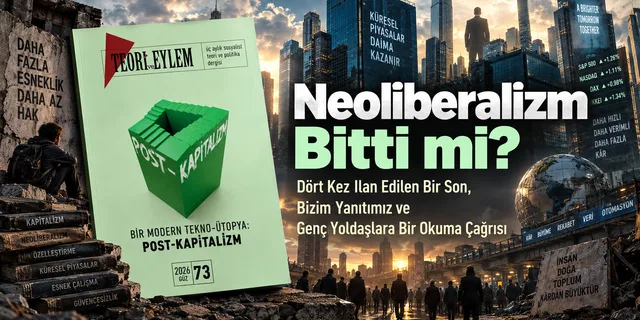
Chapter 30 of the dossier is also devoted entirely to another text: the cover dossier of issue 65 (Autumn 2024) of the journal Teori ve Eylem (Theory and Action), "Chinese Capitalism: From Where to Where?" It is the most coherent Marxist study produced on this subject in Turkish, and we recommend it directly to young comrades; we assessed its seven essays one by one. We wrote what we took from it, and where we diverge — because comradely criticism applies to the texts of our own tradition as well.
So what use is this knowledge to you?
Let us be honest, comrade: reading this dossier changes nothing in China. But it changes a few things in your political mind.
You gain a method. Four questions. You will never again judge any state by looking at its flag — including the state of your own country.
You escape a trap. The question “which of two evils?” is the working class’s oldest snare. When you are called to take sides in the US–China conflict, you will know that a third place exists. In 1914, when European social democracy voted for war credits, it fell into exactly this snare.
You will never forget one lesson. In the Great Leap Forward millions died — because no one dared report the real figure. In 1959 Peng Dehuai was purged for reporting the famine, and the message reached the whole apparatus: those who tell the truth are punished. After that no one reported the real figure.
A structure that treats criticism as a security threat cannot see its own error. An error it cannot see it cannot correct. An error it cannot correct accumulates and in the end blows the system apart.
In socialism democracy is not an ornament; it is an error-correction mechanism.
And read this not as a China problem but as a reflex in our own ranks today. Every attitude that tells the critic “who are you,” “who is behind you,” “you are harming the movement” is a small-scale rehearsal of the same mechanism.
And there is also a part about hope
This dossier may look like a narrative of defeat. It is not.
Because today in China there are 300 million migrant workers and 200 million platform labourers. Every year thousands of workers’ actions take place. In 2010 at the Nanhai Honda factory workers drew up a list of 108 demands; at its centre was the right to an independent union, and they won. In 2014 sixty thousand shoe workers struck over pension contributions. In 2018 workers, students and intellectuals stood side by side for the first time since 1989.
The future of socialism in China is to be sought not in the CPC’s documents, but in those factories and those university clubs.
Our comrades are not the Chinese state. The assembly worker in Shenzhen and the student arrested at Jasic for trying to form a union.
Internationalism is not a relation among states; it is a relation among classes. The costliest illusion of the twentieth century was to confuse the two.
Where will you get it?
The dossier is free and under a CC BY-SA 4.0 licence. In three forms:
- PDF — print-ready A4 layout, 75 pages. To reproduce, to bring to a reading group.
- EPUB — to read on a phone and an e-reader.
- Markdown — to carry onto your own site, wiki, or your organisation’s publication.
→ Download from our Guides page
Reproduce it, print it, work through it in your reading group, add your organisation’s name and republish it. You need no permission. The only condition is that the derived text circulate with the same freedom.
For a collective that writes against the enclosure of knowledge to enclose its own text with copyright would be the most visible contradiction.
Last word
Young comrade, if only one thing from this piece is to stay in your mind, let it be this:
What is written on a state’s flag does not change which class’s state that state is. That a party’s name says “communist” does not change which class’s party that party is.
These are not things to be learned and set aside — they are things to be looked at again every time.
And one thing more.
This dossier was written to be criticised. We gave contested figures as ranges: the Great Leap famine, Cultural Revolution death tolls, Xinjiang detentions, camera counts. Because we do not write what we do not know for certain as if we knew it for certain — and a single refuted figure carries away the credibility of a whole text.
Show the place you find wrong: with the source, with the reason. We will publish the criticisms that come, work those we find justified into the text, and name the contributor. Corrections are stated openly in the version notes; we do not change them in silence.
Because the common denominator of every disaster this dossier recounts was a single thing: the suppression of criticism.
Let us not fall into the same error with our own text.
In comradeship, Knowledge Commons
Publication note
The Real China — The Rise and Defeat of a Revolution and Today’s Empire of Capital A Marxist China Dossier for Young Comrades Knowledge Commons, August 2026 — Version 1.0.1
75 pages · 32 chapters · 4 appendices. Freely available as PDF, EPUB and Markdown: Guides
This dossier is a sibling text to the book "Criticizing as Comrades, Advancing Together" and the dossier "Labor in the Age of Artificial Intelligence — The Machine Is New, the Chain Is Old." It is linked directly to the former through a culture of criticism, and to the latter through technology and labour.
Version note. 1.0.1 (August 2026) — The dossier in Teori ve Eylem, Issue 65 (Autumn 2024), "Chinese Capitalism: From Where to Where?" was examined and worked into the text; Chapter 30 was added, and the labour-struggles chapter expanded with a strike chronology. 1.0.0 — First version.
For criticism, contribution and corrections: bilgimusterekleri.org
Licence: CC BY-SA 4.0 — you may reproduce, distribute and adapt provided you give attribution and share under the same licence.
This is a living document; it grows by criticism. bilgimusterekleri.org