A Class Balance Sheet of a Week in Washington
The Constitution in the Archive, Billionaires at the Table

The Constitution in the Archive, Billionaires at the Table: A Class Balance Sheet of a Week in Washington
The close of the US–China summit, "two states that want no rules" in artificial intelligence, a survey of the opposition press, America outside the table, and Erdoğan's week in New York
Dear Young Comrades,
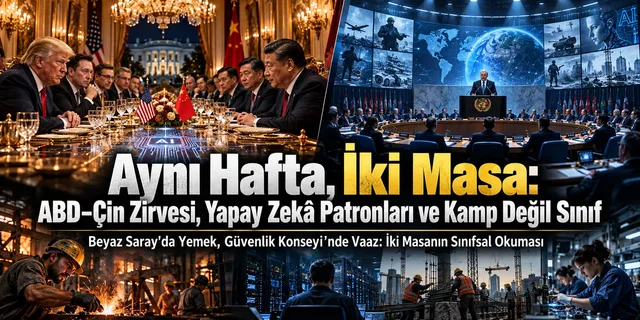
We closed The Same Week, Two Tables, published on Thursday night, with a promise: when Xi Jinping's visit ended on Friday, we would draw up a balance sheet of the talks and keep watching developments with a class eye. The visit is over. Xi drank tea with Trump at the White House, looked at the Declaration of Independence and the Constitution at the National Archives, and left Washington.
This piece keeps that promise. We will tell what happened in the United States last week from beginning to end. First we will complete the week's calendar and the summit's definite balance sheet: what was promised, what was taken, what was not taken? Then we will return to the heading of artificial intelligence, because the week's most instructive scene took place there. Then we will look at what was written this week in the opposition press, from the Guardian to taz, from Democracy Now to the World Socialist Web Site. Then we will move to the place the cameras did not turn: America outside the table. At the end we will take up Erdoğan's contacts in New York in the same week and say, from Turkey's standpoint, what we expect in class terms.
Our method has not changed: under every claim a fact, under every fact a source.
The week's calendar: from Sunday to Friday
Let us first complete the calendar. We told the first four days in detail in the previous piece. Here we recall them briefly and add the new developments.
- Sunday 21 September. Treasury Secretary Scott Bessent and Chinese Vice-Premier He Lifeng met at JPMorgan Chase's headquarters in New York. They agreed to set up a "notification mechanism" for artificial-intelligence incidents.
- Monday 22 September. Twenty countries and the EU published a statement for binding international oversight of artificial intelligence. Turkey signed; the United States and China did not.
- Tuesday–Wednesday 23 September. At the UN General Assembly Trump renamed artificial intelligence "Super Intelligence" and rejected "globalist oversight plans." Altman, Amodei, Delangue and Bengio briefed the Security Council. In the evening Trump greeted Xi beside the aircraft at Andrews Air Force Base.
- Thursday 24 September. In the morning a federal judge lifted the White House's press ban on CNN, MS NOW and Politico. Correspondents of the three organisations were able to return to the White House on the very day of Xi's visit. (NBC News) In the afternoon there was an official ceremony and talks at the White House. In the evening a state dinner was given, attended by technology billionaires.
- Friday 25 September. Tea at the White House, then a visit to the National Archives. Trump said he wanted to show Xi "some of the greatest treasures of that proud history." (WEAU) Xi left Washington in the afternoon.
Let us also add the next meetings to the calendar. Xi confirmed that the two leaders would meet twice more this year: at the APEC summit in China's city of Shenzhen in November, and at the G20 summit in Miami in December. The G20 will be held at Trump National Doral, a golf club owned by the US president's own company (WEAU). The leaders of the world's largest economies will be hosted on the private property of the host head of state. A scene in which the state and personal fortune are this tightly interwoven needs no commentary.
The summit's balance sheet: what was taken, what was not?
The mainstream press's three-day assessment met in the same place: much spectacle, little result. According to a press survey by Austria's public broadcaster ORF, CNN, the BBC, the New York Times and the Guardian described the visit in the same way. The actual meeting lasted about ninety minutes. As the Guardian noted, the ceremonies and the surrounding programme lasted longer than that meeting (ORF).
Now let us take the concrete results one by one.
What was taken
- A tariff ceasefire. The Busan ceasefire was extended by two months, to 10 January 2027. As Asia Times recalled, what was discussed was not six months, only two. (Asia Times)
- An artificial-intelligence dialogue. Both sides confirmed the establishment of a communications line for artificial-intelligence incidents and a regular dialogue. Bessent and He Lifeng will run the line (NTD).
- "Gestures" between peoples. Two giant pandas for a zoo in Atlanta. An invitation, over five years, of a hundred thousand young Americans to China on an exchange programme. An increase in direct flights between the two countries.
- A formula. According to Xi, the visit added "new content" to the Beijing meeting in May. The two sides agreed on "strategic stability on the basis of respect, justice and reciprocity" (The Daily Star). What the formula means was not defined.
- An instruction. The two leaders' economic teams were instructed to continue negotiations for a more comprehensive agreement. Bessent said fentanyl cooperation and new commercial aircraft purchases could be bargaining items.
What was not taken
- Chips. No new step was announced on export controls on advanced chips.
- Taiwan. Xi restated China's position against "Taiwan independence." The United States continues to hold back a 14-billion-dollar arms package. According to Asia Times the package is still on the table as a bargaining chip.
- Agriculture and rare earths. According to US officials China is meeting its soya purchase targets, but it is behind on other agricultural products and on deliveries of rare-earth elements.
- Iran. Xi called on the United States and Iran to return to dialogue and to the "Islamabad Accord." China is resisting pressure to use its influence over Tehran on Washington's behalf. Trump said he was optimistic about the reopening of the Strait of Hormuz but gave no details.
- Human rights. Peking's official summary mentioned neither detained American citizens nor other human-rights headings. In the observation of the Taiwanese commentator Chen Po-kung: "The Chinese people basically do not know what Trump said." (NTD) The two sides told the meeting to their own publics in different ways.
Balance-sheet table
| Put on the table | Taken off the table |
|---|---|
| Expectation of a "bigger deal" | A two-month ceasefire extension (10 January 2027) |
| Artificial-intelligence safety as "the centre of the summit" | An unverified notification line and a promise to "keep the dialogue going" |
| Chip export controls | No new step |
| A 14-billion-dollar arms package for Taiwan | The package is being held back, still on the table as a bargaining chip |
| Agriculture and rare-earth commitments | Soya on track; delays on the other items |
| Iran and Hormuz | A call for dialogue, optimism without detail |
| Human rights | None in Peking's summary |
| "Strategic stability" | An undefined formula, two pandas, Shenzhen in November, a golf club in December |
The conclusion from this table is this: the summit produced not an agreement but a postponement. The tariff war, the chip war and the Taiwan question were not frozen. Only their calendar was shifted forward. In class terms the meaning is simple: for the workers who pay the price of tariffs, supply-chain uncertainty and arms spending, nothing has changed. What has changed is a two-month window of predictability in which capital can plan the next quarter's profit.
Artificial intelligence: two states that want no rules
The summit's most discussed heading was artificial intelligence. The week's most instructive scene took place here too.
Trump. Before the meeting he took a clear position on artificial intelligence on Truth Social: "I want to leave it right where it is." He then added that China's position was the same (Spokesman-Review / Washington Post; Eastern Herald). In Bloomberg's headline: Trump said no move was made toward US–China artificial-intelligence guardrails at the summit. (Bloomberg)
Xi. According to China's official summary Xi said the two countries had "both the ability and the responsibility" to ensure that artificial intelligence "always remains under human oversight and serves the well-being of the people." He added that in artificial intelligence they could "compete but cooperate far more" (La Voce di New York).
The Washington Post gave this scene the headline "Xi acknowledges risks of AI even as Trump dismisses them." This headline is easily read as follows: Peking is the responsible party, Washington the reckless one. We need to be careful against that reading.
First the facts. There is no binding artificial-intelligence framework, no joint security agreement and no joint statement in the outcome texts (Eastern Herald). None of the demands Altman and Amodei had voiced at the Security Council two days earlier found a response. Two days earlier the two states had together rejected the call of twenty countries for binding oversight. In Eastern Herald's summary: "Neither of them wants anyone telling their own artificial-intelligence companies what to do."
So the difference in discourse does not change the partnership in practice. Trump speaks plainly: let the race go on without rules. Xi uses a more careful language: human oversight, the people's well-being, responsibility. But he too does not enter an international rule that would bind his own hands.
Let us read Xi's phrase "human oversight" in class terms. China's artificial-intelligence regulations really are tighter than those in the United States. But a large part of that tightness consists of content-control rules that require the content produced by generative artificial intelligence to conform to the political line set by the state. So when we say "human oversight," the overseeing human is not the worker in the factory but the party-state apparatus. As we showed in our dossier Dossier: The Real China, this is the same apparatus that in 2018 detained workers at the Jasic factory in Shenzhen who wanted to form a union. In China too, artificial intelligence is used for surveillance, algorithmic workplace control and the accumulation of technology monopolies.
That is why we can summarise the two positions as follows:
- Washington's model: the absolute freedom of private monopolies. Those who will oversee artificial intelligence are the market and the companies.
- Peking's model: accumulation by monopolies under state control. Those who will oversee artificial intelligence are the party-state.
In both models oversight is in the hands of capital or of its state, not of labour. In both models the owners of the data that trains the model, the workers the model is trying to replace, and the citizens the model watches are not at the table. What we said in The Same Week, Two Tables was confirmed on Friday evening: at this summit, artificial-intelligence safety was treated not as a safety question but as a stability question of a trade relationship. The only mechanism established is a Treasury channel. And a Treasury channel exists to protect the flow of profit.
One more note: according to survey figures relayed by Eastern Herald, 60 percent of Americans oppose the building of a data centre near their homes. US artificial-intelligence companies face serious electricity-grid bottlenecks. So the material cost of the race (electricity, water, land) is being charged to local communities, and those communities are objecting. For the artificial-intelligence race to remain "without rules" means that these objections too do not reach the table.
2.4 trillion dollars at the table
The state dinner given on Thursday evening was the week's clearest class photograph.
According to Democracy Now, drawing on Forbes, the combined wealth of the billionaires at the dinner exceeds 2.4 trillion dollars. (Democracy Now) According to Common Dreams, Senator Bernie Sanders recalled that the guests' wealth had "nearly doubled" since Trump's election. (Common Dreams) The guest list included Musk, Bezos, Altman, Pichai, Zuckerberg, Huang, Nadella and Cook. On the Chinese side, representatives of companies such as BYD, Xiaomi and CATL were also expected to attend.
Let us put this figure to a measure. 2.4 trillion dollars is more than Turkey's national income for a year. This wealth is in the hands of some ten people sitting at the table. Most of these people are the owners of the technology about which a warning of "risk to humanity" was issued at the Security Council two days earlier.
A question has to be asked here: how did this wealth nearly double in two years? Part of the answer is in the stock market, in the valuations of artificial-intelligence companies. But valuation does not come from the air. It rests on expected future profits, that is on the automation of work, the collection of data and products that will replace labour. As we have said since The Revolt of Crystallized Labor: A Call to the 20th Karaburun Science Congress, what crystallises in these models is humanity's common labour. The wealth at the table is the stock-market counterpart of the expropriation of that common labour.
A survey of the opposition press
Now let us read the week through the eyes of the opposition press. By opposition we mean two things here: the anti-administration mainstream in the United States (the Democrats and the liberal press) and the left press in Europe and the United States. The difference between what the two oppositions said is one of this piece's important lessons.
Guardian: "the ceremony lasted longer than the meeting"
According to a press survey by Austria's public broadcaster ORF, the Guardian held that the visit's framing programme lasted longer than the actual meeting of about an hour and a half. (ORF) The paper was among those who, together with CNN, the BBC and the New York Times, summarised the visit as "grand gestures, no concrete steps."
This observation is true and well placed. But with a gap: the criticism "much spectacle, little result" wants result instead of spectacle, that is a larger trade agreement and a clearer Taiwan position. It does not ask for whom the result would be.
taz: "not a wrestling match, a race"
In Germany's left-liberal paper taz, the Asia correspondent Fabian Kretschmer followed the summit in two pieces. In his first piece of 23 September he described China's "new self-confidence." He noted that five hundred American soldiers and military aircraft took part in the ceremony at Andrews. He relayed a remark by the former Meta executive George Chen: "Xi Jinping is now 73 years old, he wants to leave a legacy, and he wants to beat America in the new technology." Kretschmer also stressed China's internal weaknesses (low domestic consumption, high youth unemployment) and, despite these, its dominance of strategic supply chains in electric vehicles, robotics and chemicals. On artificial intelligence he wrote that the two powers would not agree on a set of rules, because each wants control over global standards.
In his second piece of 25 September he described the pomp of the ceremony (including a ninety-centimetre eagle statue) and the scarcity of results. He relayed Trump's words: "We have never understood each other this well." He gave Xi's phrase as follows: competition should be "a race, not a wrestling match" and should be "healthy competition." According to Kretschmer, Peking is using this staging strategically and gaining time in "system competition."
taz's pieces are rich in fact. Its mention of China's youth unemployment is also valuable. But its frame is "system competition": two systems, two states, two leaders stand face to face. The workers of the two countries appear in this frame only as an economic indicator (the unemployment rate), not as a subject.
IPG Journal: "not shared world domination, but Trump management"
In IPG Journal, the publication of Germany's social-democratic Friedrich Ebert Foundation, Sergio Grassi, Niels Hegewisch, Reinhard Krumm and Hannah Tyler published an assessment on 22 September, before the summit. Their thesis: "Trump needs a success, Xi is playing for stability." In their view a "G2" order will not be established. What should be expected is "not shared world domination, but Trump management." That is, step-by-step agreements through which the two leaders can present small victories to their domestic publics.
This forecast largely came true. But the phrase "shared world domination" itself is interesting. A social-democratic foundation uses the possibility of the two great powers sharing the world as a category of analysis, but it does not object to that possibility. It only says it will not happen.
Democracy Now and Common Dreams: oligarchs at the table
Two important publications of the independent left media in the United States, Democracy Now and Common Dreams, looked not at the summit's diplomatic face but at its dinner table. Both put on the headline the wealth of the technology billionaires at the dinner and how that wealth had grown in the Trump period. Common Dreams's headline used the phrase "Big Tech Oligarchs."
This was the attitude in the US press this week that showed class most clearly, and that has to be acknowledged. But it has a limit too: the criticism concentrates on "Trump's oligarchs." It does not bring the Chinese capitalists sitting at the same table, or the accumulation of technology monopolies in China, into the same frame. The oligarchy criticism stops at the national border.
World Socialist Web Site: "the Democrats are criticising from the right"
One of the week's most important observations was made by the World Socialist Web Site, in the line of the Fourth International. Andre Damon's piece of 25 September examines the Democratic Party's criticism of the summit. (WSWS)
The facts it relays are as follows:
- Twenty-one Democratic senators, including Chuck Schumer, said Trump needed finally to "show a little spine" toward China. They wanted arms sales to Taiwan expanded and the defence packages approved by Congress delivered. They demanded a stand against China's "renewed island-building" in the South China Sea.
- Representative Ro Khanna said Trump was "appeasing his 'friend' Xi." Minority Leader Hakeem Jeffries also voiced concern about Taiwan's sovereignty.
According to the WSWS these criticisms contradict reality. The Trump administration raised the average tariff on Chinese goods from 20.7 percent to 127.2 percent in the January–May period of 2025, carried out military seizures of tankers carrying Iranian and Venezuelan oil to China, and in December 2025 approved a record 11.1-billion-dollar arms package for Taiwan. According to the piece, the Democrats' opposition is not a peace opposition but an opposition that wants more war preparation.
This observation is very important for those looking at US politics from Turkey. To be against Trump does not automatically mean being against war or imperialism. The United States' main opposition party is criticising Trump for not being hard enough on China. "Anti-Trumpism" is not by itself a class position.
Morning Star and "Friends of Socialist China": the camp network
The Morning Star editorial we discussed in the previous piece ("Xi meets Trump: two visions collide") was republished on 25 September on the site "Friends of Socialist China." (Friends of Socialist China) The editorial describes China as "a harmonious society developing rapidly on almost every indicator of human well-being," and Trump's United States as a country "drowning in its own divisions, including racism." It sets China's diplomacy as "a peaceful and egalitarian vision of the world" against that of the United States as "the law of the jungle."
This republication shows that a network exists. Some left publications in the West work as carriers of a narrative that presents China as an "alternative to US imperialism." In this narrative China's 300 million migrant workers, the 996 working regime, the Jasic workers and the dollar billionaires do not appear. This week's scene (the red carpet, "let us not wrestle," "we have never got on this well," the pandas, the capitalists of both countries at the table) has once more given the lie to that narrative. The "anti-US front" was raising glasses at the White House.
Survey table
| Publication | Frame | What does it see? | What does it not see? |
|---|---|---|---|
| Guardian | Diplomacy | That the ceremony lasted longer than the meeting | For whom the result would be |
| taz (Kretschmer) | System competition | China's self-confidence, its internal weaknesses, the "race" | The workers of both countries as a subject |
| IPG Journal (FES) | Geopolitical management | Step-by-step agreements instead of "shared world domination" | An objection to the sharing itself |
| Democracy Now, Common Dreams | Oligarchy and inequality | The 2.4 trillion dollars at the table | Chinese capital at the same table |
| WSWS (Damon) | Imperialism and class | The Democrats' criticism from the right, from the side of war | (It asks the class question) |
| Democratic Party | "Appeasement" criticism | Trump's "softness" | Those who pay the price of war |
| Morning Star / Friends of Socialist China | Camp | The decay of US imperialism | Class relations in China |
America outside the table
Now let us look at the place the cameras did not turn. In the same week in the United States, far from the table at the White House, the following happened:
- Chicago hotel workers. Members of UNITE HERE Local 1 voted for strike authorisation on behalf of seven thousand workers at forty-six hotels. Contracts had expired in August. According to a survey by the union, nearly a third of members are struggling to pay rent or a housing loan. In the words of union president Karen Kent, workers need "better wages they can live on" (OnLabor).
- A first union at AutoZone. At an AutoZone store in White Plains, New York, eleven workers went to a vote to join the UAW and become the company's first unionised store. The company spent about two hundred thousand dollars on anti-union propaganda. In the words of one worker: "If we can do it, and I hope we win, then everyone can" (OnLabor).
- A judicial brake on ICE raids in Alabama. A federal judge issued an injunction preventing immigration police (ICE) from detaining construction workers without reasonable suspicion. At the centre of the case is Leonardo Garcia Venegas, a US-citizen construction worker detained twice even though he showed his identity. The judge held that unauthorised detentions based on ethnic origin were contrary to the Constitution (OnLabor).
- Public employees. The public-employees' union AFSCME filed a lawsuit against an administration rule that threatens employment services. The nurses' union National Nurses United continued organising work at Prime Healthcare hospitals over "chronic understaffing" and safety concerns (AFL-CIO).
- Press freedom. The White House's access ban on three news organisations was lifted by court order. Part of the press covering the summit could enter the room only by a court decision.
Let us set this list beside the table given on Thursday evening. The same week, the same country:
| At the White House | Outside the table |
|---|---|
| 2.4 trillion dollars of wealth at dinner | A third of Chicago hotel workers are struggling to pay rent |
| A two-month ceasefire and predictability for companies | A strike vote for seven thousand workers whose contracts ended in August |
| "Let us leave artificial intelligence where it is" | The two hundred thousand dollars AutoZone spent to stop the union |
| The Constitution is being looked at in the National Archives | In Alabama a US-citizen worker is detained twice in a manner contrary to the Constitution |
| To Xi: "we have never got on this well" | The press can enter the White House only by a court decision |
On the day the Constitution was shown to two heads of state at the National Archives, a construction worker's constitutional right could be protected only by a court decision. The distance between the Constitution's condition in the display case and its condition on the building site is the distance between the classes.
The week's class balance sheet
Let us gather the week's lessons in five points.
A ceasefire is capital's calendar. The summit's only concrete economic result was a two-month ceasefire extension. This gives capital the chance to plan the next quarter. For the workers who pay the price of tariffs, nothing changed. The real bargaining was postponed to Shenzhen in November and to the golf club in Miami in December.
Two states, one position on artificial intelligence. Trump said "let us leave it where it is"; Xi said "human oversight." But neither entered a binding rule. In Washington's model oversight is in the market; in Peking's, in the party-state. In neither is it in labour.
Anti-Trumpism is not a class position. The United States' main opposition is criticising Trump for not being hawkish enough toward China. The liberal press, saying "much spectacle, little result," wants a larger deal. Only a small left press asks about class, looks at the wealth at the table and at the worker's condition.
The camp narrative has collapsed, but its carriers are still at work. Xi, presented as the leader of an "anti-US front," agreed with Trump at the White House on "a race, not a wrestling match." Despite this, some left publications still present China as an alternative. We repeat what we said in The Same Week, Two Tables and in Dossier: The Real China: not camp but class.
The real movement is outside the table. The week's hopeful news did not come from the White House but from the hotels in Chicago, from an auto-parts store in White Plains, from a courtroom in Alabama. Those who pay the price of the artificial-intelligence race, the tariff war and the arms bargain are organising to refuse that price.
Seen from Turkey: Erdoğan's week in New York
There was another head of state in the United States the same week. President Erdoğan was in New York on 20–23 September for the UN General Assembly (Ekonomim). The delegation also included Foreign Minister Hakan Fidan, Energy Minister Alparslan Bayraktar and MIT director İbrahim Kalın (Al-Monitor). Xi's three days in Washington and Erdoğan's four days in New York fell on the same calendar. This overlap may be coincidence, but the content of the two visits leads to the same question: between the two great powers, where does Turkey's capitalist class want to stand, and who will pay the price?
What was said at the podium?
On 22 September Erdoğan criticised Israel from the General Assembly podium in harsh words. He said Israel had "a genocidal mindset" and described Gaza as "the most inhuman, most shameful concentration camp of our age." He said that despite the ceasefire more than 1,300 civilians had been killed in Gaza. He stated that the UN had "lost blood" and been rendered dysfunctional on Palestine, Lebanon and Sudan. He recalled that the United States had for the second time in two years refused a visa to Palestinian President Abbas. The Israeli delegation left the hall during the speech (Al Jazeera).
What was discussed at the table?
The calendar outside the podium, however, spoke another language.
There was no one-to-one meeting with Trump. The US ambassador to Ankara, Tom Barrack, had announced that the two leaders would meet in New York. According to the journalist Murat Yetkin, this one-to-one meeting did not take place. (Yetkin Report) On the agenda were the lifting of CAATSA sanctions, a solution to the S-400 question, a return to the F-35 programme and the resumed F-16 negotiations.
An Iran meeting instead. Erdoğan took part in the Iran meeting Trump organised on the sidelines of the UN General Assembly with the leaders of the Gulf Cooperation Council countries, Egypt, Syria, Iraq and Lebanon. There Trump said of Erdoğan: "He's a tough guy, don't mess with him. He's really a great guy." At the same meeting he stressed his support for the India–Middle East–Europe Economic Corridor and said that about one billion barrels of oil had passed through the Strait of Hormuz under US oversight. Erdoğan said work was continuing toward a solution to tensions in the Gulf (Oksijen). Erdoğan also attended the closed-press reception Trump gave for world leaders (A News).
Iran sanctions are in force. According to Yetkin, Turkey in this period took economic steps toward Iran: Bank Mellat's operations were halted, Mahan Air's flights and air links with Iran were cut. On 23 September new sanctions regulations aligned with UN decisions were published in the Official Gazette.
An investment summit. On 23 and 24 September Erdoğan took part in two business meetings in New York. At the first he addressed American–Turkish business circles and said the 100-billion-dollar trade-volume target with the United States would be reached "in the near future" (Sabah). The second was an investment summit. Participants included Mastercard, Boeing, Microsoft, Ford, JPMorgan, Lockheed Martin, Uber, Visa, Procter & Gamble, GE Aerospace, Citi, PepsiCo and FedEx. From the Turkish side Ahmet Ahlatcı, chair of Ahlatcı Holding, Murat Özyeğin of the DEİK Turkey–US Business Council, and Hamdi Ulukaya, founder of Chobani, took part. The delegation also included the ministers of foreign affairs, treasury and finance, trade, energy and industry, and Central Bank governor Fatih Karahan. The sectors discussed were energy (including LNG and nuclear), defence, aviation, technology, finance and automotive (Sabah).
At these meetings Erdoğan presented Turkey to American capital as follows: "an economy that has gained resilience against shocks." He said core-goods inflation had fallen to its lowest level since 2020, rent inflation to its lowest in four years, and that 2026 would close with a budget deficit of about 3.1 percent. He stressed green transition, artificial-intelligence infrastructure and semiconductor investment. He listed as Turkey's advantages the repositioning of supply chains that put "reliability over cost," energy and trade corridors (Baku–Tbilisi–Ceyhan, the Middle Corridor, the Development Road) and defence-production capacity at NATO standards (NTV). He added that the Turkish defence industry produces to NATO standards and can contribute to allies' supply-chain security.
Background. This week was the continuation of a process. At the White House meeting in September 2025 the two countries had signed a civil-nuclear cooperation memorandum, Turkish Airlines' Boeing purchase had been confirmed, and "progress" had been announced on F-35 and CAATSA (Türkiye Today). In July 2026 the two leaders had met at the NATO summit in Ankara. And in the same week, on 22 September, Turkey had signed the statement of twenty countries that wanted binding artificial-intelligence oversight.
A class reading: one language at the podium, another at the table
When we set these facts side by side, four observations follow.
First, the distance between discourse and practice. Erdoğan described Israel as "genocidal" from the podium. The next day Lockheed Martin was at the investment table. Lockheed Martin is the maker of the F-35, and the only country in the region that uses the F-35 is Israel. Turkey's demand is to return to the F-35 programme. The harsh language at the podium and the arms bargain at the table do not exclude each other. On the contrary, the harsh language works as a bargaining chip. This is the Turkish counterpart of the pattern we showed for China in the previous piece: opposition in discourse, integration in practice.
Second, a capital strategy between two blocs. One of the Chinese companies expected to attend the dinner in Xi's honour was BYD. BYD, under an agreement with Turkey in 2024, is building an electric-vehicle factory in Manisa of about one billion dollars. The same week Erdoğan was in New York telling JPMorgan, Ford, Boeing and Microsoft that Turkey was a "reliable supply chain." What Turkey calls a "balancing policy" is, in class terms, Turkish capital's strategy of taking a share from both blocs. Capital from both Washington and Peking comes to Turkey for the same reason: proximity to the European market and labour far cheaper than Europe's.
Third, to whom what is told. The sentence "rent inflation is at its lowest in four years" was said in New York to American investors. The same week in Ankara pensioners were demonstrating in front of the Constitutional Court with the slogan "Not for the money, for our honour," and in that action a pensioner, Ali Şekeroğlu, lost his life. The same week a new regulation on remote and hybrid work was published in the Official Gazette. An "economy resilient to shocks" is a success in the investor's eye. In the pensioner's and the wage-earner's eye it is another name for whose back the shock is loaded onto.
Fourth, the price of a regional role. The CAATSA, F-16, F-35 and Halkbank files are parts of a single bargain. What the United States wants in return became visible the same week: participation in sanctions on Iran, a "stability" role in the Gulf and Syria, more responsibility on NATO's southern flank. In this bargain Turkey has begun to cut its economic ties with Iran. The price of these steps will be paid not by the ministers in Ankara but by the small traders and labourers of the regions that live off trade and transport links with Iran.
What do we expect in class terms?
On the basis of this week's facts let us write plainly what we expect in Turkey in the coming months. These are not a prophecy. They are tendencies we will watch as the logical continuation of this week's facts.
A "100 billion dollars" grown by arms and energy imports. The import side of the trade target from the United States will consist largely of expensive items such as warplanes, Boeing aircraft, LNG and nuclear technology. Their cost will be paid from the budget and from foreign debt. The same budget is the budget that says "there are no resources" for pensions and public services. The winners will be the American monopolies sitting at the investment-summit table and the Turkish capital groups partnered with them.
The marketing of cheap labour. The slogan "reliability over cost" describes the expectation that part of the production shifted from China will come to Turkey. The condition of these investments is that labour in Turkey remain cheaper, more flexible and more unorganised than in Europe. That is why, alongside new investment incentives and free-zone regulations, we expect pressure on the minimum wage, the spread of flexible and remote work, and the continuation of obstacles to union organisation. US capital and Chinese capital (as in the BYD example) are looking for the same conditions.
Articulation to a war economy. The emphasis on a "defence industry at NATO standards" and "allies' supply-chain security" means that Turkey's industrial policy is increasingly tied to arms production and export. As the Iran war continues and armament in the region increases, this sector will grow. In return we expect the share of spending on education, health and social security to narrow.
A two-faced position on artificial intelligence. At the international podium Turkey defends binding artificial-intelligence oversight. At home it presents artificial-intelligence infrastructure and semiconductor investment to monopolies such as Microsoft as an investment opportunity. We expect energy and land incentives for data centres, the transfer of public data onto these companies' cloud infrastructure, and the spread of algorithmic control in workplaces. In this process the question of whose control the data of workers, public employees and citizens will be under will continue to go unanswered in national action plans.
A bargain tied to the calendar. As Yetkin recalled, ahead of us are the 27 October elections in Israel and the 3 November midterm elections in the United States. Trump said the Iran question could be resolved after the midterms. We expect the CAATSA, F-35 and Halkbank files to move according to this calendar, and Turkey's role in Iran and Syria to grow as the counterpart of this bargain.
Our position
The principle not camp but class holds for Turkey too. This principle tells us three things.
- Neither Washington, nor Peking, nor Ankara's "balancing" bargain. Turkey's bargaining between two blocs is not an independence in the interest of the Turkish working class. It is capital's effort to take a share from both doors. Independence is built through the working class's own organised position.
- Measure the word at the podium by the signature at the table. The seriousness of the harsh words spoken for Gaza should be assessed together with the bargain made with monopolies that produce arms for Israel. Solidarity with the Palestinian people is incompatible with articulation to the arms chain.
- Concrete demands. The content of international trade and arms agreements should be made public and discussed in parliament. Incentives given to foreign investment should be tied to the recognition of union rights. Resources allocated to arms purchases should be transferred to pensions, education and health. In artificial-intelligence investment, public data should be entrusted not to monopolies but to a commons infrastructure open to social oversight.
This week two great powers bargained in Washington, and Turkey's capitalist class bargained in New York. At all three tables the same people were missing: those who will pay the price.
The calendar ahead
We will go on watching developments with a class eye. The dates we have marked:
- October–November, Shenzhen: the second meeting of the artificial-intelligence notification mechanism. Will verification be added, will the scope widen, will there be an obligation of public disclosure?
- November, Shenzhen: the APEC summit and a Trump–Xi meeting. Shenzhen is the first Special Economic Zone of capitalist restoration in China and the city of the Jasic workers' union struggle in 2018.
- December, Miami (Trump National Doral): the G20 summit and the year's fourth Trump–Xi meeting.
- 10 January 2027: the end of the tariff ceasefire.
- Chicago: the hotel workers' strike decision and contract negotiations.
- 27 October, Israel: general election.
- 3 November, United States: midterm elections. Trump said the Iran question could be resolved after these elections. We expect the CAATSA, F-35, F-16 and Halkbank files to move according to this calendar as well.
Concrete tasks for young comrades
- Draw up a balance-sheet table yourselves. When a summit ends, make a "put on the table / taken off the table" table yourselves. Write the gap between expectations and results, and in whose favour that gap is.
- Ask the class of the opposition too. Look at what every voice that is "against Trump" or "against the government" is criticising: war, or that the war is not being waged hard enough? The wealth at the table, or the table's flag?
- Look at both sides of the table together. Do not stop the oligarchy criticism at the national border. The American billionaires at the White House and the Chinese capitalists at the same table are two branches of the same class.
- Follow the news outside the table. Follow sources that compile weekly news of the US labour movement (OnLabor, AFL-CIO bulletins, Labor Notes and the like). The struggle of the hotel workers in Chicago and of the eleven workers at AutoZone is no different from the struggle of supermarket and warehouse workers in Turkey.
- Ask about the 100 billion dollars item by item. Follow which items are inside the Turkey–US trade target (arms, aircraft, LNG, nuclear). Ask from which item of the budget the cost of each item is being cut to be paid.
- Look for labour in investment news. When you read a piece of foreign-investment news, ask: what will wages be in this factory, will there be a union, who is paying the incentive?
- Read and share the Real China dossier. When you meet the camp narrative in a discussion on China, have the facts in your hand.
Dear Young Comrades,
On Friday, before leaving Washington, Xi Jinping stood before the American Constitution at the National Archives. Trump showed him "the greatest treasures of that proud history." A construction worker whom the same Constitution is supposed to protect could obtain his right in Alabama only by a judge's decision. While 2.4 trillion dollars sat at that evening's table, seven thousand hotel workers in Chicago were voting to strike for a wage they can live on.
This week in Washington two powers decided to "leave where it is" the world's most powerful technology and to postpone the bargain to November. No one wanted a rule, no one wanted to stop, no one called the worker to the table.
But history is not written only in archives. It is also written in the hotels in Chicago, in a store in White Plains, in a factory in Shenzhen, on an assembly line in Manisa, among the pensioners waiting in front of the Constitutional Court in Ankara. As one worker said: if we can do it, everyone can.
Not camp but class. Not flag but labour.
Comradely.
Knowledge belongs to everyone.
Update
26 September 2026, 19.50 (Istanbul time): Xi Jinping's visit ended on Friday 25 September. This piece was prepared on the basis of assessments published after the visit ended. When the official records of the Security Council session are published they will be added to this piece. We will also update when the Chicago hotel workers' strike decision, the calendar of the artificial-intelligence meeting in Shenzhen, and the F-16, F-35 and CAATSA talks between Turkey and the United States become clearer. Regular updates will follow.
Sources
The close of the summit and the balance sheet
- NTD, Trump–Xi Summit Concludes With Limited Details on New Agreements (25 September 2026)
- Asia Times, Xi backs AI safety with Trump, draws Taiwan line, urges Iran talks (25 September 2026)
- The Daily Star, Trump, Xi end summit long on pomp, but short on progress
- WEAU, Trump Takes Xi to National Archives to Close Out State Visit (25 September 2026)
- ORF, Analysen von Medien: Viel Show, wenig Inhalt auf Gipfel Trump – Xi
Artificial intelligence
- Spokesman-Review / Washington Post, Xi acknowledges risks of AI even as Trump dismisses them (25 September 2026)
- Washington Post, Xi acknowledges risks of AI even as Trump dismisses them (25 September 2026)
- La Voce di New York, Trump, Xi Offer Little Beyond Conciliatory Words on AI (25 September 2026)
- Eastern Herald, No AI Deal From Trump and Xi's Summit — Because Neither Side Wants Rules (25 September 2026)
- Bloomberg, Trump Says No Moves Toward US, China AI Guardrails in Xi Summit (24 September 2026)
The state dinner
- Democracy Now!, Trump Hosts Xi Jinping for State Dinner, Joined by U.S. Billionaires Worth $2.4 Trillion (25 September 2026)
- Common Dreams, Jake Johnson, $2.2 Trillion: The Collective Net Worth of 'Big Tech Oligarchs' Invited to Trump-Xi Dinner (24 September 2026)
The opposition press
- taz, Fabian Kretschmer, Xi Jinping besucht Trump: Sein neues Selbstbewusstsein (23 September 2026)
- taz, Fabian Kretschmer, Trump und Xi in Washington: Schaumwein, ein Adler und Spartas Angst (25 September 2026)
- IPG Journal, Sergio Grassi, Niels Hegewisch, Reinhard Krumm, Hannah Tyler, Trump und Xi: Was beim Gipfel in Washington auf dem Spiel steht (22 September 2026)
- World Socialist Web Site, Andre Damon, Democrats accuse Trump of "appeasing" China in state visit by Xi (25 September 2026)
- Friends of Socialist China, Xi meets Trump – two visions collide (republication of the Morning Star editorial, 25 September 2026)
America outside the table
- OnLabor, News & Commentary: September 22, 2026
- AFL-CIO, Be Heard: What Working People Are Doing This Week (23 September 2026)
- NBC News, CNN, MS NOW and Politico allowed back at the White House after judge blocked Trump's ban (24 September 2026)
Turkey and Erdoğan's New York contacts
- Ekonomim, Cumhurbaşkanı Erdoğan'ın ABD programı belli oldu: Gözler Trump görüşmesinde
- Al Jazeera, Erdogan slams Israel's 'genocidal mindset' in blistering UN address (22 September 2026)
- Al-Monitor, Turkey, US resume F-16 talks ahead of expected Trump-Erdogan meeting
- Yetkin Report, Murat Yetkin, Erdoğan-Trump baş başa görüşmesi olmadı ama İran yaptırımları devrede (23 September 2026)
- Oksijen, Erdoğan da katıldı: Trump ve Körfez ülkelerinin liderleri İran gündemiyle toplandı
- A News, Turkish president attends Trump's reception for world leaders in New York (23 September 2026)
- Sabah, Başkan Erdoğan, New York'ta iş adamlarıyla bir araya geldi (23 September 2026)
- Sabah, Başkan Erdoğan'dan New York'ta yatırım zirvesi (24 September 2026)
- NTV, Erdoğan, New York'ta Türk iş insanları ile buluştu
- Türkiye Today, 'Historic' Trump–Erdogan meeting ends with nuclear deal, Boeing purchase, progress on F-35s and CAATSA (September 2025)
Knowledge Commons
- The Same Week, Two Tables: The US–China Summit, Artificial-Intelligence Bosses, and Not Camp but Class (24 September 2026)
- Dossier: The Real China (August 2026): PDF · EPUB · MD
- The Revolt of Crystallized Labor: A Call to the 20th Karaburun Science Congress (24 July 2026)