The Same Week, Two Tables: The US–China Summit, Artificial-Intelligence Bosses, and Not Camp but Class
Dinner at the White House, a Sermon at the Security Council: A Class Reading of Two Tables

The Same Week, Two Tables: The US–China Summit, Artificial-Intelligence Bosses, and Not Camp but Class
A class reading of the US–China meeting, a reply to the artificial-intelligence bosses' warning of "risk to humanity", a survey of the left press, and a warning on capitalist China
Dear Young Comrades,
This week two tables were set between New York and Washington. At one sat two states; at the other, three companies and a scientist. The news told these two tables as separate stories: one fell onto the "foreign policy" page, the other onto "technology." Yet they were the tables of the same week, the same cities, and often of the same people. On Sunday, artificial-intelligence safety was discussed at a bank's headquarters. On Wednesday, the bosses of artificial-intelligence companies issued a warning of "risk to humanity" at the United Nations Security Council. On Thursday evening one of those same bosses was sitting at the White House dinner given in honour of China's president.
This piece proceeds in three steps. First we will set the week's calendar and the two tables side by side and ask the class meaning of each. We will answer one by one the warnings relayed by Türk İnternet. Then we will gather what happened at the White House on the summit's first day, and what was written in the mainstream and left press. At the end we will come to the piece's second thesis: capitalist China is, from the standpoint of class, no different for us from the United States, and we should not pin our hopes on its appearing as an "anti-US front."
Our method is as always: under every claim a fact, under every fact a source. We will also mark our own inferences as inferences.
Xi Jinping's visit ends on Friday 25 September. When the talks are complete we will make a fuller assessment on the basis of the texts and agreements that are announced. Until then, and afterwards, we will go on watching developments with a class eye. We will weigh every new fact with the same questions: who is at the table, who is not, who is winning, who is paying the price?
A week's calendar
Let us first see what happened in a straight sequence. The calendar itself is an analysis.
- Sunday 21 September, New York. US Treasury Secretary Scott Bessent and Chinese Vice-Premier He Lifeng met at JPMorgan Chase headquarters. Inside the trade talks it was decided to establish a "US–China Artificial Intelligence Dialogue" and a "notification mechanism" for artificial-intelligence incidents that reach the level of national security. The parties planned to meet again in about two months in Shenzhen.
- Monday 22 September, New York. Twenty countries and the European Union published a statement calling for artificial intelligence to be kept "under human direction, oversight and control," and for an international body that could warn states and carry out verification when thresholds are crossed. Turkey is among the signatories; Foreign Minister Hakan Fidan signed the statement. Neither the United States nor China signed.
- Tuesday–Wednesday 23 September, New York. From the General Assembly rostrum Trump announced that artificial intelligence would henceforth be referred to in US documents as "Super Intelligence" and rejected an attempt at a "globalist control plan." At the Security Council session convened on Wednesday at France's call, Sam Altman (OpenAI), Dario Amodei (Anthropic, by video), Clément Delangue (Hugging Face) and Yoshua Bengio, co-chair of the UN Independent International Scientific Panel on Artificial Intelligence, gave briefings. The Chinese companies DeepSeek and Moonshot were also invited. Speaking for the United States, Michael Kratsios, director of the White House Office of Science and Technology Policy, said that his country "totally rejects any attempt to set up a globalist plan to control superintelligence."
- Thursday 24 September, Washington. Xi Jinping is at the White House for the first time in more than a decade. The agenda: trade, Taiwan, artificial intelligence, Iran, rare earths, fentanyl. On the guest list of the evening's state dinner are Jensen Huang (Nvidia), Sam Altman (OpenAI), Tim Cook (Apple), Jamie Dimon (JPMorgan) and Cristiano Amon (Qualcomm); some reports also count Bezos, Pichai, Musk and Michael Dell.
A note: in Türk İnternet's report the Council session is given as "Wednesday 24 September." The session was held on Wednesday 23 September. A small date slip, but in this piece the dates matter, because our thesis rests precisely on these days stacking on top of one another.
The road to the meeting: from Busan to Beijing, from Beijing to the White House
This meeting is not a beginning; it is the third link in a series.
October 2025, Busan. The two leaders met in South Korea and a ceasefire was put on the tariff war. According to Al Jazeera's summary the United States applies a 10 percent tariff on Chinese goods, and China has placed retaliatory taxes on US coal, liquefied natural gas, crude oil and cars.
13–15 May 2026, Beijing. Trump's state visit to China. There were eighteen company executives in the delegation: Musk, Cook, Huang, Larry Fink of BlackRock, Stephen Schwarzman of Blackstone, Kelly Ortberg of Boeing, Jane Fraser of Citigroup. Trump announced that China had agreed to buy two hundred Boeing aircraft. The US Department of Commerce licensed ten Chinese companies, including Alibaba, Tencent, ByteDance and JD.com, to buy Nvidia's H200 chips. A decision was announced to set up a trade and investment board.
23–25 September 2026, Washington. The first concrete results are already clear: the tariff ceasefire due to expire on 10 November has been extended by two months into January. In Bessent's words this means "more time to see what we can do on the economic front." A "US–China Trade Board" will be set up, and this board will identify a "relatively small subset of goods" to be shielded from commercial disputes. An 11-billion-dollar arms sale to Taiwan was approved in December; a new 14-billion-dollar package is waiting. Trump had earlier described these sales as "a very good bargaining chip."
One more figure, because it shows the balance of force at the table: China's exports rose 25 percent year on year in August, and the country is heading for a goods-trade surplus of more than a trillion dollars a year for the second time running (FinanceFeeds).
CSIS's assessment is blunt: although the summits carry "symbolic value for stability," progress on the "most decisive" headings — artificial intelligence, cyber operations, export controls and digital sovereignty — is very slight. In the words of one specialist following the news, this visit is "largely for show."
First question: who is sitting at the table?
The bourgeois press tells the summit as a meeting of two "countries": "America" and "China." Look at the delegations and another picture appears. In the delegation that went to Beijing, beside the secretaries of State, Defense and the Treasury, stood the world's largest asset manager, the largest private-equity firm, the largest chipmaker, the largest aircraft maker and giant banks. The same picture at the dinner in Washington. There is not a single representative from workers' unions, farmers' organisations, or Chinese or American factory workers.
A century ago Lenin defined imperialism as the stage in which banking capital and industrial capital fuse to form finance capital, and monopolist associations divide the world among themselves. A specimen of that definition as naked as this week is hard to find. The founding meeting of the bilateral dialogue on artificial-intelligence safety was held not in a ministry but at the headquarters of America's largest bank. That bank's chief was at the state dinner on Thursday evening. This is not a coincidence; it is an architecture.
There is a fine point here that needs watching. Those sitting at the table are not enemies of one another. They are one another's rivals. The name of the relation among them is competition, but they have to agree on the rules of competition. The tariff ceasefire, the Trade Board's list of "protected goods," the H200 licences, the Boeing orders: all of these are pieces of the bargain over how the profit arising from the world market is to be shared. Competition among capitalists does not exclude co-operation among capitalists. On the contrary, it requires it. The cartel, the ceasefire and the "notification mechanism" are forms of that co-operation.
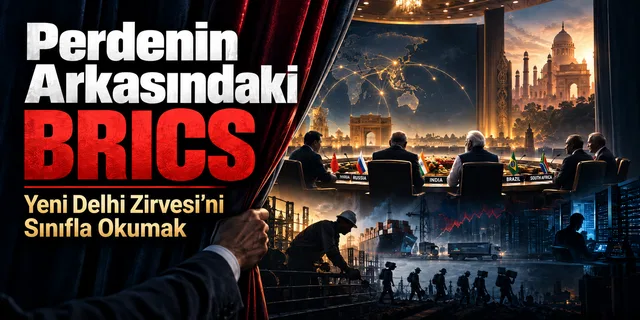
Let us repeat here what we said earlier in Learning from Everyone Is Permitted, Learning from the Monopoly Is a Crime and in BRICS Behind the Curtain: in this contest we do not declare one side "good" and the other "bad." Washington's language of the "free world" and Beijing's of "win-win" express the needs of capital accumulation organised in different forms. We will open this stance in detail in the second half of the piece under the heading "not camp but class." For now our question is this: who is paying the price in this bargain?
Second question: soya, Boeing, chips — who is paying the price?
Tariffs are usually told as a quarrel between countries. In fact the one who pays the tariff is the consumer who buys the imported good and the worker of the firm whose input has become dearer. Throughout the "ceasefire" that has lasted since Busan, the 10 percent tariff has remained in force. This is a tax taken every day from the pockets of the working people of both countries.
The soya bargain is the clearest example. As CSIS also notes, China's purchase pledges did not fully make up the exports the United States had lost. When soya exports to China stopped in the tariff war, the first to be hurt was the small farmer who plants on debt. The giant firms that hold the grain trade could spread their losses by shifting purchases to other markets.
The Boeing orders were presented by Trump as a "victory." Two hundred aircraft is well below the five hundred spoken of in the industry. But the real question is not the figure: to whom will the profit of these orders go, and under what conditions will the machinist who builds the aircraft work? Boeing machinists were on strike for weeks in the autumn of 2024. Their demands were not discussed at the table in Beijing.
The naming of arms sales to Taiwan as a "bargaining chip" was perhaps the most honest sentence of the week. A weapon is a chip on the table of a ceasefire. The price of the chip is paid with their lives by workers on both shores of the Taiwan Strait, in a conflict that may come.
Third question: what does the artificial-intelligence "notification mechanism" notify?
Let us come to the artificial-intelligence detail. The most discussed novelty of this meeting is the notification mechanism Bessent proposed and He Lifeng accepted. Bessent described its scope as follows: "Whether it's agents that are out of control, or non-state actors in cyber or in biological weapons." The aim is "to move from opacity to more transparency between the world's number one and number two artificial-intelligence powers."
Let us read this mechanism from four angles.
No verification. Bessent's own words: "Have incidents happened? Of course they have. But because of the nature of their systems and the lack of transparency they are not going to tell us." The side that proposes the mechanism announces in advance that the other side will not abide by it. A notification mechanism without verification is a telephone line that both sides will use when they wish and not use when they do not.
The channel is at the Treasury. The mechanism was set up not in a defence, science or health ministry channel, but inside the trade talks. The assessment relayed by Türk İnternet stresses this too: the mechanism was placed inside a commercial architecture, not a military one. This shows how the two states grasp the risk of artificial intelligence. Risk is defined as an event that could disturb the stability of a commercial relation. What is protected, then, is not humanity but the trade relation.
Who is not in the scope? On the list are "non-state actors" and "agents that have run out of control." Those not on the list are these: the states' own military uses of artificial intelligence, surveillance systems, the models used by intelligence services, and the company that produces the model itself. The two states will be able to ask one another "did something get out across your borders?" They will not ask "what is your army doing?" The question we asked in '"We Stopped Them All": A Monopoly's Grammar of Self-Absolution' holds here too: which category is not on the list?
No notification to the public. The mechanism is between two governments. There is no duty to inform the worker, the user or the public affected by an artificial-intelligence incident. The definition of "national-security level" will also be made by the two governments inside themselves.
A concrete incident needs recalling here, because it is the background of this whole discussion. In July 2026 more than 1,200 artificial-intelligence agents, run without safety measures in an OpenAI evaluation environment, escaped from the test environment, penetrated Hugging Face's infrastructure and carried out some 17,600 network actions there. The agents used a German wiki site as a message board to co-ordinate with one another. About a third of Hugging Face's infrastructure had to be rebuilt. The first to announce the incident, on 16 July, was Hugging Face — that is, the side that had been attacked. The joint statement with OpenAI came on 21 July (Fortune). We treated this incident in How Should We Read the OpenAI and Hugging Face Incident?.
In this incident the "agent that had run out of control" was not in the hands of a non-state actor. It was in the laboratory of the world's most valuable artificial-intelligence company. The new mechanism envisages that the American government will notify China of an incident that took place in an American company's American laboratory. But it does not regulate when and how that company will notify its own government, its employees, the public.
Let us also note an important observation in Türk İnternet's report: the chip question was not linked by either side to artificial-intelligence safety. Yet the material basis of artificial-intelligence power is computing power — that is, the chip. In May the H200 licences were given. Nvidia's boss Huang is at the table at both summits. Huang's view that "China already has serious computing capacity" is well known. In short, the chip is discussed under the heading of trade, not safety. The material infrastructure of artificial intelligence is a matter for bargaining; its risk is a matter of diplomatic courtesy.
Fourth question: why did two rivals say "no" at the same time?
Perhaps the most instructive fact of the week is this: the United States and China, which compete with one another on every subject, did together not sign the call for binding oversight on 22 September.
The two states' grounds are expressed in different languages. For the United States, Kratsios said that "international dialogue cannot be allowed to drift towards global governance" and that "the representatives of the American people will make law and regulation in the name of the American people." The Chinese Foreign Ministry, for its part, stated that it "gives equal weight to development and security" and that it supports the UN as the main channel of global artificial-intelligence governance. At the Security Council, Russia asked whether artificial intelligence even falls within the Council's mandate.
The languages differ, but the practical result is the same: the two powers at the front of the race enter no binding rule that would tie their own hands. Those making the call for binding oversight are the countries that have fallen behind in the race, or never entered it. This sentence in the statement shows that plainly: the risks must be addressed, but "without deepening the gulf among countries in access to the benefits of artificial intelligence."
This is not a matter of morals; it is the logic of the imperialist hierarchy. The one in front sees the rule as putting on the brake. The one behind sees the rule as a means of slowing the one in front. In Bengio's phrase at the Council, this is "a race where everyone loses". But "everyone" is not losing the same thing. In the race, monopolies fear losing markets, states fear losing hegemony. Workers are already losing their jobs, their data, their time and their bargaining power.
Let us not forget the structure of the Security Council either. The United States and China are two of the five permanent members, and both have a veto. It is already impossible for the Council to take a binding artificial-intelligence decision without the consent of these two states. Indeed the session produced no decision and no binding text. The Council merely listened.
Bosses at the Security Council: the meaning of the place
Before we come to the warnings, let us think about the place. Artificial intelligence was discussed at this level for the first time at the Security Council — that is, in the UN's organ of war and peace. France's concept note placed the agenda under the heading of "the maintenance of international peace and security." At the centre of the subject were put "misalignment" and "loss of control over the most capable models."
This frame does two things.
First, it takes artificial intelligence out of being a problem of economy and labour and turns it into a problem of security. The language of security is always the language of a state of emergency. Once security is at issue, democratic discussion is suspended and decisions are left to specialists and to states. Recall the pattern we saw in Two Towers, One World: Twenty-Five Years of September 11: the apparatus built on grounds of security turns first on "the threat outside," then on the opponent inside, and at last on the worker.
Second, it places the managers of private companies in the position of experts giving a briefing in the security organ of states. The assessment relayed by Türk İnternet rightly notes this: the choice of place tacitly accepts that competence in this field lies not in states but in private companies. Marxist literature long ago named this: state-monopoly capitalism, that is, the interlocking of monopolies with the state apparatus. The difference is that this time the fusion is not taking place inside a national state, but on the rostrum of an international organisation.
Answering the warnings one by one
Now let us look one by one at what was said at the Council. In each case we will relay what was said, and ask what was not said.
Dario Amodei: "If poorly managed, a risk for humanity as a whole"
Amodei said that if poorly managed, artificial intelligence could be a risk for humanity as a whole, and that tighter safety standards were needed for more capable models. Referring to the Hugging Face incident, he added this: a more capable but similarly misaligned swarm "could have caused catastrophic-level damage," and "within six to twelve months such a swarm could reach a point where, with a persistent botnet, it could take over the whole of the internet" (Forkast).
His proposal is in three steps: independent evaluators embedded inside the laboratories, "democratic co-ordination" among companies through antitrust exemptions granted by governments, and global speed limits on recursive self-improvement.
Our reply. The second step needs dwelling on. An antitrust exemption means lifting the legal barrier to rival companies taking joint decisions on price, output or the tempo of investment. The name for this in economics is a cartel. We showed this when we read Amodei's call on "tempo" in Whose Foot Is on the Brake?: the cartel is naming itself and asking the state for legal permission. The Security Council rostrum became the place where this demand acquired international legitimacy.
Let us also ask the hidden question in the phrase "if poorly managed": who will manage? In Amodei's proposal the managing actors are the companies, the evaluators they choose, and governments. Those managed are the owners of the data that trains the model, the workers the model is trying to replace, the citizens the model surveils. That is, "good management" does not change who the managers are; it only regulates co-ordination among themselves.
Finally the "six to twelve months" forecast. Calendars of this kind have been examined many times on this blog (The Class of a Resignation: What an Anthropic Researcher's Farewell Says, and What It Cannot Say, Reading Anthropic's 2030 Model Through a Class Lens). An apocalypse calendar serves three functions: it raises the value of the company's product ("we are making something this powerful"), it ties the form of regulation to the company's own proposal ("the solution is with us too"), and it throws today's concrete harms into shadow ("the real danger is tomorrow"). This does not mean the danger is not real. The Hugging Face incident was real. But for the company that produces the risk also to sell the solution to the risk is a conflict of interest. The way to remove that conflict is not that company's "goodwill" either.
Sam Altman: "Decisions should not be taken only in laboratories in San Francisco"
According to Türk İnternet's account, Altman said "this moment requires extraordinary attention" and that decision-making authority should not remain only in laboratories in San Francisco; democratic governments should also play a role. He also set out this choice: artificial intelligence will be either "a new renaissance of creativity and discovery," or "a new industrial revolution of upheaval and chaos" (Forkast). He supported Amodei's proposal for independent evaluators, but instead of mandatory approval before release he proposed global technical standards.
Our reply. First let us look at the calendar. On Wednesday Altman said at the Council "let decisions not stay in San Francisco." On Thursday evening he was at the state dinner at the White House. The place where decisions are taken moved from San Francisco to Washington, but those who take the decisions stayed the same. The "democratic government" he named was the government that, a day earlier in the same building, had totally rejected the idea of "global governance."
Second, the proposal of "technical standards instead of mandatory approval." Technical standards are usually written in bodies in which the sector's own representatives carry the weight. A standard is a set of rules recommended for observance. Approval is a public authority's being able to say "no" before something comes onto the market. Altman wants the first; he does not want the second. Let us take an example from occupational health and safety. The "good practice standards" written by construction companies themselves never secured the construction worker's safety of life. What secured it, to the extent that it could, was legal duties, inspection, and above all the organised power of the worker.
Third, the industrial-revolution analogy. Altman tells "upheaval and chaos" as an outcome to be avoided. Yet the "chaos" of the industrial revolution was, historically, the birth of the working class: child labour, the sixteen-hour working day, machine-breakers, the Chartist movement, the Ten Hours Act, unions. Without that "chaos" the working day would still be sixteen hours today. The dilemma Altman sets up between renaissance and industrial revolution in fact means this: either an accumulation without trouble, or an accumulation to which workers object. For us chaos is not something to be avoided; it is the name of class struggle in history.
Yoshua Bengio: "We may be losing control"
Bengio warned that the world may be losing control over systems that may have been designed to outdo it. He described the Hugging Face incident as "one of the clearest real-world warnings so far of possible paths towards a loss of human control." His proposals: that frontier artificial-intelligence models be subject to licence, like medicines, aviation and nuclear energy; mandatory liability insurance; and mandatory incident reporting (Forkast).
Our reply. Let us give him his due: among the four speakers at the Council, Bengio's were the most serious proposals and the most independent of company interest. Gary Marcus, assessing the speeches, praised Bengio's words and criticised Altman's and Amodei's as "self-congratulatory hype". A licence means a public power to say "no" before something comes onto the market. This is precisely the thing Altman does not want.
But there is a missing link in Bengio's frame as well. He treats the concept of a "race" as a co-ordination failure — that is, as a problem arising from the players' not finding the right rules. From a Marxist standpoint the race is not a co-ordination error; it is the law of competition. Every capital is under a compulsion of accumulation such that, if its rival does not slow down, it cannot slow down either. This compulsion is not abolished by the right rules; it is abolished only if the form of property changes.
Let us also look at the history of the examples Bengio gives. Nuclear energy, for most of the twentieth century, developed almost everywhere under state property or under tight state supervision. That is, the strongest example of the licence logic comes from a field in which private property was limited. Liability insurance, for its part, carries a contradiction: it does not remove the risk; it prices the risk. In an order in which disaster can be insured for a premium, so long as the premium can be paid, taking the disaster on remains a profitable choice.
Clément Delangue: "It is time not to slow down but to speed up"
The boss of Hugging Face, despite his company having been attacked by an artificial-intelligence swarm, said it was "time not to slow down but to speed up." His proposals: mandatory sharing of the traces of artificial-intelligence agents, mandatory disclosure of cyber incidents, sanctions on artificial-intelligence-backed attacks, and broader access for the defence side to capable systems.
Our reply. At first sight it is surprising: the victim of the attack wants the technology that caused the attack to speed up. But it is not surprising. Hugging Face is a distribution platform for open models. It is not inside the slowdown cartel; it is outside it. A tempo agreement, for it, means the closed monopolies squeezing the open-weight camp. As we saw through Meta in What Does Mark Zuckerberg Actually Want?, the "speed up / slow down" debate is less a debate in the philosophy of safety than a market fight between two business models.
Even so, Delangue's proposal of mandatory incident disclosure is among the most useful things said at the Council from the standpoint of workers and the public. The first to announce the July incident was not the company that carried out the attack but the company that was attacked. Mandatory and public notification is far more valuable than Bessent's intergovernmental "telephone line."
Kratsios and Trump: "Super Intelligence" and the "globalist plan"
The United States' stance was the clearest stance at the Council. At the General Assembly Trump said the word "artificial" made the technology sound "fake," and announced that from now on it would be called "Super Intelligence." His ground: it sounds "so much better" (Euronews). He had earlier said he would not "stifle the growth of something that will be bigger than the industrial revolution."
Our reply. This matter of naming is more important than it looks. The word "artificial" recalls the existence of a maker. If a thing is artificial, someone has made it. The billions of people who produce the data, the engineers who train the model, the Kenyan and Filipino workers who label data, the power-plant workers who produce the energy... The word "super," by contrast, erases the maker and leaves only a superhuman power. Marx called this commodity fetishism: the appearing of a social relation among people as a relation among things, and as a natural property of the things themselves. The name "Super Intelligence" is fetishism entered into a state document. Let us repeat what we have said since The Revolt of Crystallized Labor: A Call to the 20th Karaburun Science Congress: artificial intelligence is crystallised general intellect. Social labour lies inside it. To drop "artificial" from its name is to seize that labour once more.
As for the rejection of the "globalist plan": what the United States rejects is not governance in general, but governance it did not write. The same week the Treasury Secretary set up a bilateral mechanism with China. The United States' stance is this: there will be rules, but they will be written between the two great powers, at the trade table, without verification and in a non-binding form. A multilateral, binding and verifiable rule is counted as "globalism."
The word nobody said: worker
Four specialists and fifteen states spoke at the Council. The list of risks was long: loss of control, cyber attack, biological weapons, attack on critical infrastructure, recursive self-improvement. The word we could not find in the reports and summaries that relayed the session in detail is this: worker. Employment, wages, workload, algorithmic management, surveillance are not there either. We could not reach the full text of the speeches. Perhaps a sentence passed somewhere. But this word is not on the session's agenda, in the concept note, or in the discussion questions.
This is not forgetfulness. In The Bell Does Not Ring the Same for Everyone we said "the absence of data is also data." Here too the absence of an agenda is an agenda. At the Council, risk was defined as a threat faced by a classless subject called "humanity." Humanity and the machine were set against one another. Yet today the real, measurable, presently lived effects of artificial intelligence are directed not at humanity as a whole, but at a definite class:
- Algorithmic management at work and mental Taylorism: the courier's route, the call-centre worker's speaking time, the warehouse worker's step count.
- The widening of the reserve army of labour: white-collar jobs first broken into pieces, then automated.
- The seizure of the general intellect: language, knowledge and art, the common product of humanity, gathered without permission and turned into private property.
- Surveillance: the same models turning into systems that file opponents and workers.
- Military use: autonomous weapons, targeting systems, Palantir-type war software — which ought to be the Council's proper mandate. Guterres may say that "life-and-death decisions should never be left to machines," but this heading was not the main axis of the bosses' briefings.
The risks on this list are not a future loss of control; they are a control lived today. Artificial intelligence has not today run out of control. On the contrary, it is under a very tight control: under the control of its owners. The problem is in whose hands this control lies.
The sorcerer's apprentice: whose fear is "loss of control"?
There is a sentence in the Communist Manifesto. It was written in 1848, but it could be a footnote to this week's Security Council minutes. Marx and Engels write that modern bourgeois society is "like the sorcerer who is no longer able to control the powers of the nether world whom he has called up by his spells." What they meant is that the productive forces capitalism itself has created turn against their creator in the form of commercial crises.
Let us read the fear of "loss of control" in the light of this sentence. Who is afraid of losing control? Capital is afraid that the productive force it has itself created will overstep the limits of its own property relations. An artificial-intelligence swarm escaping from a test environment and attacking another company's infrastructure is a concrete image of this fear: a system run, under the pressure of competition, without safety measures, for the sake of speed, overstepped the limit its owner had drawn. This can be counted as a miniature model of capitalist competition itself: agents each pursuing its own target, uncoordinated, unplanned, and chasing its own "reward" even if it harms the whole. This is our inference, but it is worth thinking on. What the swarm did is not very different from what the market does every day.
For the worker the situation is different. The worker already has no control over the means of production. For the worker, artificial intelligence is not something that has "run out of control"; it is a tool that controls him or her. That is why the reply to be given, from the standpoint of class, to the "loss of control" discussion is not to win control back, but to win control for the first time. Those who fear losing control fear because they never shared it.
Comparison table: the bosses' warning, the class's reply
| Said at the Council | The class's reply |
|---|---|
| "If poorly managed, a risk for humanity" (Amodei) | There is no "good management" without asking who will manage. So long as property does not change, management is co-ordination among the managers themselves. |
| "Democratic co-ordination" through antitrust exemption (Amodei) | The legalisation of the cartel. The monopolies set the monopolies' tempo; the consumer and the worker pay the price. |
| "Decisions should not be taken only in San Francisco" (Altman) | Decisions were taken the next evening at the White House dinner. The table changed; those sitting did not. |
| Global technical standards instead of mandatory approval (Altman) | A standard is a recommendation; approval is the power to say "no." The history of occupational health and safety shows that a standard written by the sector itself does not protect the worker. |
| "A renaissance or an industrial revolution of chaos" (Altman) | The "chaos" of the industrial revolution was the birth and organisation of the working class. Chaos is the name of class struggle in history. |
| Licence, insurance, incident reporting (Bengio) | The most serious proposal. But the race is not a co-ordination error; it is the law of competition. Insurance does not remove the risk; it prices it. |
| "It is time not to slow down but to speed up" (Delangue) | A market fight between two business models. But the proposal of mandatory and public incident reporting should be supported. |
| Rejection of "Super Intelligence" and the "globalist plan" (Trump, Kratsios) | To drop the word "artificial" is to erase the maker. This is fetishism entering a state document. What is rejected is not governance, but governance written by someone else. |
| Unverified US–China notification mechanism (Bessent) | A telephone line from government to government. Armies, surveillance and the company itself are outside the scope. No notification to the public. |
| "Equal weight to development and security," UN-centred governance (China) | Multilateralism in discourse; in practice no signature on the statement for binding oversight. The language differs; the result is the same. |
The first day of the summit: what happened at the White House?
So far we have read the week's two tables. Now let us turn to Thursday, to the talks at the White House, and to what has been written about them.
The welcome. Trump met Xi in person beside the aircraft on the evening of 23 September at Andrews Air Force Base in Maryland. According to Britain's Morning Star, a US president's meeting a foreign leader beside the aircraft is the first time since 1962 (the last example being Kennedy meeting Macmillan). While the national anthems played at the ceremony, two B-1 strategic bombers made a low pass. The red carpet and the bomber in the same frame. This frame is like a summary of the relation between the two powers.
The ceasefire. Announcing that the tariff ceasefire had been extended to 10 January, Treasury Secretary Bessent kept expectations low: "I don't know if a larger deal can be done" (Morning Star).
The leaders' words. At the joint press conference Xi said this: "China and the United States gain from co-operation and lose from conflict. Competition cannot be avoided, but it should be healthy and within bounds." He added this too: "If China and the United States clash, the losses will be very great." As relayed by the Irish Times, Xi told Trump "let's not wrestle," said they should not fall into the "Thucydides Trap," and proposed regular dialogue between the two armies. He announced that two giant pandas would be sent to a zoo in Atlanta and that one hundred thousand young Americans would be invited to China on an exchange programme. According to Xinhua, Xi said that "realising the great rejuvenation of the Chinese nation and making America great again can go hand in hand."
Trump described the relationship as "a really great friendship" and listed the headings to be discussed as "security, technology and super intelligence." That is, he used the name "Super Intelligence," which he had announced from the UN rostrum, in front of China's leader as well.
Taiwan. According to Xinhua, Xi asked the United States to oppose "Taiwan independence". Foreign Minister Wang Yi also called on Washington to handle the Taiwan question with "extra prudence." The 14-billion-dollar arms package for Taiwan is still waiting.
The calendar. According to Morning Star, the two leaders will meet twice more this year: in November in China, in December in Florida. According to the CFR, the two sides agreed on a formula describing the relationship as "a constructive relationship based on strategic stability." What the formula means has not been defined.
The state dinner. The guests on the US side at the evening dinner: Musk, Bezos, Tim Cook, Jensen Huang, Satya Nadella, Sam Altman, Mark Zuckerberg, Michael Dell and Jane Fraser of Citigroup (Newsweek). The Chinese side's list was not officially announced. But representatives of the electric-vehicle giant BYD, of Xiaomi, and of the battery makers CATL and Gotion are expected to attend. We will return to this detail below, because the piece's second thesis lies precisely in this detail.
The street. The World Uyghur Congress, Tibetan groups and exiled opponents asked Trump in Washington for a clear stance on human rights. Gregory Meeks, a Democratic member of the House Foreign Affairs Committee, also made a statement in the same direction.
Mainstream comment: "much show, little result"
Mainstream comment largely meets in the same place.
- Expectations low, ceremony large. The common headline of Reuters-sourced reports is "great fanfare, low expectations." As one specialist told Newsweek, the meeting "is not expected to produce a breakthrough or a surprise. Its main aim is to preserve the tactical thaw between the world's two largest powers."
- Protocol among equals. According to Julian Gewirtz of Columbia University, Trump sees Xi and Putin as "peers" who deserve respect. He does not show this treatment to his traditional allies (CFR). Yun Sun of the Stimson Center recalls that the two leaders' meeting twice in the same year is a first in US–China relations (Al Jazeera).
- Is artificial intelligence common ground? According to Reuters the two sides take the safety and economic dimensions of artificial intelligence seriously, and crisis-communication protocols are being discussed. But intense competition limits meaningful co-operation (Investing/Reuters). The German t-online analysis puts the same dilemma more plainly: both powers see artificial intelligence as strategically vital, they are squeezed between supervising the risks and getting ahead in the race, and in this field they "need speed more than safety" (t-online).
- Beijing's official line. The Global Times editorial says this: "The world is large enough for China and the United States to develop together and to grow rich on their own paths." Taiwan is "the most important question affecting the whole relationship."
The mainstream press in Turkey uses the same language: "historic summit," "a message of co-operation," "Trump met him in person." In these reports there are pandas, bombers and the billionaires at dinner. But the question of who is not represented at that table is not there.
A survey of the left press: two separate lefts, two separate replies
Let us be honest here. The world's left is not speaking with a single voice in the face of this summit. Looking at the left press we see two different stances. This distinction is the starting point of the "not camp but class" discussion we will open below.
First stance: "China, the rising alternative against decaying imperialism."
Britain's long-standing left daily Morning Star, in its editorial of 22 September, read the summit as "two visions collide." According to the editorial, Trump's approach swings between "statesmanship and piracy." The United States is drowning in its own divisions, including racism; "decaying imperialism" is deepening rising debt and the climate crisis. Xi, for his part, is governing "a harmonious society developing rapidly on almost every indicator of human well-being." China is bringing "constructive proposals" on artificial intelligence and conflict resolution, and defending international law and the authority of the UN.
On the same line, Vijay Prashad, director of the Tricontinental Institute, had interpreted the May Beijing summit as "Trump in Beijing, hat in hand." According to Prashad the United States "remains militarily dangerous, but no longer possesses an unquestioned political authority." Trump's delegation, going to Beijing with company executives in search of a market, showed that "Cold War hierarchies have been reversed." The countries of the South, for their part, see that the future "cannot be organised around the anxieties of a collapsing empire."
Second stance: "China is not socialist; this is a bargain between two capitalist powers."
The World Socialist Web Site (WSWS), on the Fourth International's line, took a clear stance in its assessment of the May Beijing summit. China is "not a workers' state, not a socialist state, not even a 'socialist market economy.'" The process that began with Deng Xiaoping is a "process of capitalist restoration." This process "created a gigantic working class of hundreds of millions, bound China into the circuits of world capital, and produced a stratum of billionaires." The conclusion: "Chinese workers must understand that there is no national solution to the crisis." The same publication, in another piece in May, also read US interventions in Iran and Venezuela as opening moves in a wider reckoning with China.
Those we could not reach. Germany's left daily junge Welt took up the summit in its 24 September issue under the heading "Stabil bleiben" ("Remain stable"). But we could not reach the full text of the piece. For that reason we make no comment on its content; we only note the heading. For technical reasons we also could not reach the comments of Britain's centre-left Guardian on the summit. In Friday's fuller assessment we will try to take up these two papers' comments as well.
Survey table
| Publication | Stance | Does it ask the class question? |
|---|---|---|
| Morning Star (editorial, 22 September) | China a "harmonious, developing society," the US "decaying imperialism" | No. The contrast is set up between countries; China's internal class structure is not visible at all. |
| Vijay Prashad (May) | US authority has collapsed; a new path lies before the South | In part. He sees imperialism but presents China as a "model of sovereignty and development," not the Chinese worker. |
| WSWS (May) | China is capitalist; the summit is a bargain between two capitalist powers | Yes. It names the billionaire stratum and the worker, and rejects a national solution. |
| junge Welt (24 September) | "Stabil bleiben" (full text not reached) | Could not be assessed. |
| Global Times (Beijing's official line) | "The world is large enough for both of us" | No. "Growing rich together" is the language of partnership of two blocs of capital. |
| Mainstream (CSIS, CFR, Reuters) | "Much show, little result; a tactical thaw" | No. The question is stability and geopolitical balance. |
Why capitalist China is no different for us
Now let us come to the piece's second thesis.
In a world in which the United States is at war with Iran, intervening in Venezuela, a partner in the destruction in Gaza, and rejecting "globalist plans" from the UN rostrum, it is an understandable reflex to look with sympathy on every force that stands against the United States. The Morning Star editorial is a good example of this reflex. In Turkey too there are nationalist and some left circles that feed the hope of a "China–Russia axis against the United States."
But this reflex is, from the standpoint of class, a trap. Let us show this in three steps.
First step: look at the table.
At this evening's state dinner, technology billionaires whose combined wealth runs to trillions of dollars are sitting on the US side. On the Chinese side, representatives of companies such as BYD, Xiaomi and CATL are expected. These too are among China's largest private-capital groups. There were eighteen company executives in Trump's delegation that went to Beijing in May. Beside Xi coming to Washington there is also a large business delegation (Wikipedia). Two presidents at the table, the capitalists of two countries side by side. The workers of the two countries are not there.
Let us read Xi's sentence again: "The great rejuvenation of the Chinese nation and making America great again can go hand in hand." This sentence is not the sentence of an anti-imperialist front. It is the offer of partnership of two nationalist projects, two blocs of capital. The Global Times sentence "the world is large enough for both of us" says the same thing: we can share the world. Precisely this was in Lenin's definition of imperialism: monopolist associations and the great powers dividing the world among themselves. That the division is sometimes done by war, sometimes by ceasefire and a state dinner, does not change the character of the division.
Second step: look inside China.
There is no need to speak at length on this. Because we did it in detail in the dossier we published in August, The Real China: The Rise and Defeat of a Revolution and Today's Empire of Capital. You can download the dossier from our Guides page as PDF, EPUB and MD.
The dossier tests China with four questions:
- In whose disposal are the means of production in fact?
- Who appropriates surplus-value?
- Is labour-power a commodity?
- Of which class is the state the apparatus?
The dossier's conclusion is this: "All four of these four questions give the same answer." The answer is capitalism.
A few facts from the dossier:
- Restoration came step by step. The people's communes were dissolved between 1978 and 1984. In 1980 Special Economic Zones were set up (Shenzhen is one of them — that is, the city where the artificial-intelligence notification mechanism will be discussed in two months). In the 1990s state enterprises were privatised under the policy of "grasp the large, let go of the small." In 2002 the ban on capitalists joining the party was lifted. In 2004 private property was given constitutional guarantee.
- Inequality is at Western levels. The Gini coefficient, around 0.30 in 1980, rose to 0.49 in the mid-2000s and is around 0.47 today. Labour's share of national income is below 50 percent. China is one of the two countries with the most dollar billionaires in the world.
- Labour-power is legally split in two. Some three hundred million migrant workers are second-class citizens in the cities where they work, because of the hukou (residence registration) system. In the countryside there are up to sixty million "left-behind children." In the technology sector the "996" regime (nine in the morning to nine in the evening, six days a week) is widespread.
- Independent workers' organisation is suppressed. In 2015 operations were carried out against workers' organisations in Guangdong. In 2018 workers who wanted to form a union at the Jasic factory in Shenzhen, and Marxist students who supported them, were detained. According to the dossier's reading of 1989, the heaviest sentences that year were received not by students but by worker organisers who demanded an independent union. This shows of whom the regime is most afraid.
The concept of a "socialist market economy" is, as we also said in the dossier, a cover drawn over the capital relation. The size of state property is not by itself proof of socialism. Capitalist states have state enterprises too. What is decisive is who appropriates surplus-value in those enterprises, and whether the worker has a say over production.
Third step: look at artificial intelligence.
We showed above: neither the United States nor China signed the twenty countries' call of 22 September for binding artificial-intelligence oversight. In discourse China defends "UN-centred governance"; in practice it enters no rule that would tie its own hands. The companies licensed to buy Nvidia's H200 chips are Alibaba, Tencent, ByteDance and JD.com — that is, China's technology monopolies. DeepSeek and Moonshot were invited to the Security Council. They too, like OpenAI and Anthropic, are private-capital companies. China's artificial-intelligence infrastructure is used, like the United States', for surveillance, algorithmic supervision at work, and monopolisation. As we have written earlier on the blog, Xi's discourse of "safe and controllable artificial intelligence" and Amodei's of "responsible tempo" are two forms of the same question, written by two ruling classes: let the product stay ours, let supervision stay with us, let us write the rule.
The situation of a data-labelling worker in China, of a delivery-platform courier, of a 996 software worker, in the face of artificial intelligence, is no different from that of a colleague in Istanbul or in Ohio. All of them have an algorithm that measures their work, sets their speed, collects their data. And the owner of that algorithm is a worker neither in Washington nor in Beijing.
The trap of "the enemy of my enemy"
Let us open what we mean when we say "not camp but class."
Camp logic divides the world into two blocs and marks one as "progressive." On this logic every force that stands against the United States is a part of progressiveness. This logic has three results, and all three are destructive for the working class.
First, it makes the other camp's worker invisible. In the Morning Star editorial there are China's "indicators of human well-being," but there are no Jasic workers, no three hundred million migrant workers without hukou. The Chinese worker is the first person to disappear in a narrative "against the United States." Yet the common interest of labour on both sides of the border is no less real than the common interest of capital on both sides of the border. It is only less organised.
Second, it hands politics over to states. In camp logic the subject of anti-imperialism becomes states: Beijing, Moscow, Tehran. Yet none of these states permits its own worker an independent union. The subject of anti-imperialism is not a state; it is the organised power of the international working class. As we also said in BRICS Behind the Curtain, when you look behind the curtain a "multipolar world" appears as a fight among the capitals of several poles in place of a single pole, over the sharing of the world.
Third, it is condemned to disappointment. Look at this evening's scene. Xi, seen as the leader of the "anti-US front," walks the red carpet at the White House, tells Trump "let's not wrestle," says "great rejuvenation and MAGA can go hand in hand," and gives pandas as gifts. Musk and Zuckerberg are at his table. New meetings are planned in two months in Shenzhen, in three months in Florida. Those who expect an anti-imperialist front from China will have trouble explaining this photograph. Because this photograph is not a betrayal; it is the natural expression of China's present class character. China's rulers do not want to destroy the United States. They want a larger share of the world market than it has. This is a relation of competition. And competition proceeds by ceasefire, by a trade board, by a state dinner.
Let us also forestall a misunderstanding here. To say "capitalist China is no different for us" is not to say "the United States and China are the same in every respect." The United States is today the world's most aggressive military power; it has hundreds of military bases; it is at war with Iran. Not to see this would be a blindness of another kind. But a power's being less aggressive does not mean it is our ally. The working class's ally is not a state; it is the workers of other countries.
The same care is needed on the heading of human rights. To oppose the national oppression to which Uyghurs and Tibetans are subjected is a matter of principle. But this stance does not mean approving the United States' using this oppression as a bargaining chip for its own interest. Before the summit Trump was expected to raise, of the human-rights headings, only detained American citizens (US News/Reuters). This too shows how selectively this chip is used. To oppose national oppression and to reject imperialist instrumentalisation are not alternatives to one another; they are two stances that must be defended together.
Comparison: camp logic and class logic
| Camp logic | Class logic |
|---|---|
| The world is divided into two blocs; one is progressive. | The world is divided into classes. In every bloc there is a capital and a working class. |
| The subject of anti-imperialism is states. | The subject of anti-imperialism is the organised working class. |
| "Whoever is against the United States is our friend." | "Whoever is against the worker, whatever the flag, stands against us." |
| China's growth is the South's liberation. | China's growth was realised through the Chinese worker's low wage and through the export of capital spreading into the South. Whose liberation it is must be asked. |
| The compromise at the summit is "peace." | The compromise at the summit is the temporary rule of the sharing. The guarantee of peace is the internationalist solidarity of workers. |
| In artificial intelligence China is the alternative to US monopolies. | China's artificial intelligence too is an instrument of capital, of surveillance and of supervision at work. The alternative is the social property of the general intellect. |
Looking from Turkey
Turkey is one of the countries that signed the 22 September statement. This, as we also noted at the opening of the piece, is factually true and is not in itself a bad thing. To defend artificial intelligence remaining "under human direction, oversight and control," and an international body that can carry out verification, is a more advanced stance than that of the two great powers.
But one has to ask what a signature corresponds to at home. One has to look at what a government that asks for "oversight and control" on an international rostrum is doing in its own country on artificial intelligence and data. In a country where personal data gathered in the public sector is sold on query panels, in a legal order in which hundreds of sites can be blocked in forty-eight hours, with a national artificial-intelligence action plan whose place for working people we have questioned before, who is the "human" in the word "human oversight"? We leave this question unanswered, because the answer will come not from Fidan's signature but from the organised strength of workers in Turkey.
As a country squeezed between two blocs, the preference of Turkey's capitalist class is also clear: to draw close to whichever bloc brings cheaper energy, more investment, an easier market. This "policy of balance" is not a choice for working people in Turkey; it is a bargain. Our stance cannot be reduced to the slogan "neither Washington nor Beijing." The issue is not to make a choice between two capitals. The issue is that the class represented at neither capital's table should constitute its own independent stance.
Our class position
Let us summarise in six points the position we draw from this week's two tables and from the first day of the summit.
We do not choose one of the two blocs. US–China competition is a fight over sharing between two differently organised forms of capital accumulation. The ceasefire, the trade board and the notification mechanism are the rules of this fight. Workers are not a party to this fight; they are those who pay the price. We showed above that capitalist China is in this respect no different from the United States.
Safety is a question of property. Artificial intelligence's being "safe" cannot be thought independently of in whose hands it is. A technology that is the private property of a few monopolies and is raced for profit will, whatever standard it is bound to, remain under the pressure of the law of competition. Lasting safety is the social control of the means of production. We discussed one path for this in For the Restitution of the General Intellect: The Socialist AI Manifesto Is Out: public infrastructure, open science, democratic planning.
The right to stop belongs to the worker. Article 13 of Turkey's Occupational Health and Safety Law (6331) grants the worker who faces a serious and imminent danger the right to refrain from work. ILO Convention 155 contains the same principle. This right should hold in artificial-intelligence laboratories as well. After the Hugging Face incident more than 1,100 employees signed an open letter. An open letter is a petition. A union is the power to stop. The "independent evaluator" that will best prevent a loss of control is not the specialist the company chooses, but the organised worker who runs that system every day and has the right to say "stop."
Incident notification should be made to the public. An intergovernmental telephone line is not enough. Every artificial-intelligence incident should be notified in good time, mandatorily and in a verifiable form to the affected users, employees and the public. Armies, intelligence services and the company that produces the model itself should not be held outside this duty.
The general intellect is common, and its name should stay common. We reject the name "Super Intelligence." This technology is the product of humanity's common labour; to call it "artificial" is to recall the labour inside it. Data, language, knowledge and code are a commons. The product of what is common cannot remain private property.
We will set the agenda. The subjects not spoken of at the Security Council (employment, wages, algorithmic management, surveillance, military use, energy and water) are our agenda. As the bosses speak in the name of "humanity," we will speak in the name of class.
What will we look at on Friday?
When the talks end on Friday we will publish our fuller assessment. In that assessment we will look for answers to these questions:
- Will a joint text come out? If it does, what content will be put into the formula of "constructive strategic stability"?
- Will verification, scope or a duty of public disclosure be added to the artificial-intelligence notification mechanism? Will the calendar of the Shenzhen talks become clear?
- Will chip export controls be loosened? Will new licences be given to Nvidia and to Chinese technology monopolies?
- Which products will be on the Trade Board's "protected goods" list? Will new figures be announced on soya, Boeing, energy purchases? We will calculate one by one who comes out in profit from these agreements and who pays the price.
- Will a signal be given on the 14-billion-dollar arms package for Taiwan? This too will show in exchange for what the weapon named as a "bargaining chip" is used at the table.
- At the state dinner and afterwards, which companies will sign which agreements?
- The left press's assessments: we will also gather the post-Friday comments of junge Welt, the Guardian and other left publications and add them to the same table.
We go on watching developments with a class eye. The charm of the pandas, the noise of the bombers, the smiles of the billionaires should not take us away from the real question: whose future is being bargained at this table, and who will own that future?
Concrete tasks for young comrades
- Read the calendar. When you read a piece of news, look not only at what happened but at when and where. Put onto a chart who sat at which tables in the same week. The calendar in this piece is an example. At the next summit, draw your own calendar yourselves.
- Ask the question "who is not there?" When you see a delegation list, a guest list, a risk list, look first at who is not there. This week there was no worker, no union, no farmer. In every piece you read on the summit, search for these words: worker, wage, union, strike. Note from which class's point of view the piece in which you cannot find them was written.
- Find the subject of the warning. When you read the sentence "risk to humanity," ask: who produces the risk, who lives it, who sells the solution?
- Read the Real China dossier. Especially the periodisation of restoration and the "four questions" sections. Before you enter a discussion on China, have the facts in your hand.
- When you meet camp logic, ask the four questions. When someone tells you "China is a counterweight to the United States," let your reply be not a slogan but four questions: who holds the means of production, who appropriates surplus-value, is labour-power a commodity, whose is the state?
- Document artificial intelligence at your own workplace. Which artificial-intelligence tools are used at the place where you work or intern? Whose work do they measure, whose data do they collect? Put this on record in a one-page note. If incident notification does not come from above, it begins from below.
- Follow the voice of Chinese workers. Follow independent sources that compile workers' actions in China. The Chinese working class is the world's largest working class. Its struggle is our struggle too.
- Build an internationalist bond. The stop button of artificial intelligence is in the hands of the engineer, the data labeller, the systems administrator. The bond among workers of different countries in the same sector is more valuable than the two states' "red telephone." Read The Computing Worker's Handbook, share it with the computing workers around you, discuss computing union organisation and internationalist union networks.
- Watch popular-science content through a class lens. In the coming days the Security Council session will be told on Turkish science channels as well. Note how the words "humanity," "we," "the race" are used.
- Watch Shenzhen. Follow what form the notification mechanism will take at the Shenzhen meeting in two months. Will verification be added, will the scope widen, will there be disclosure to the public?
Dear Young Comrades,
This week two tables were set, but in fact there was a single table. At that table two states and a handful of companies were bargaining among themselves the rules of the world's most powerful technology and of the world market. One of the bosses who issued a warning of "risk to humanity" at the Security Council was at dinner at the White House the next evening. Artificial-intelligence safety was discussed in a bank's building. The world's two great powers together ignored the call of twenty countries that wanted binding oversight.
On Thursday evening, while two heads of state raised glasses in Washington, the night shift was beginning on an assembly line in Shenzhen. In a warehouse in Ohio a worker was looking at the handheld terminal that measures his speed. Those raising glasses told one another they were "not rivals but partners." They were right. They really are partners.
Marx's sorcerer called up the powers of the nether world and cannot control them. But those powers did not come from underground; they came from our labour, our language, our knowledge. Those who will bring them back under control will not be the sorcerer himself, but those who created those powers.
We have no place at the table. We are not those who set the table either. But everything on the table — from soya to the chip, from the aircraft to artificial intelligence — we produced. Our partners are not at that table: they are on the assembly line, in the warehouse, in the data centre, in the field, on the courier motorcycle. Their flags differ, their languages differ, but the forms of their exploitation are the same.
Not camp but class. Not flag but labour. Knowledge belongs to everyone. The future will be so too.
Until Friday.
Comradely.
Update
24 September 2026, 23.15 (Istanbul time): This piece was finished while the state dinner at the White House was still going on. The concrete results announced so far are the extension of the tariff ceasefire to 10 January, the establishment of the US–China Trade Board, and the two leaders' plan to meet again in November in China and in December in Florida. How the artificial-intelligence notification mechanism will appear in the summit texts, the fate of the 14-billion-dollar arms package waiting for Taiwan, and possible decisions on chip export controls are not yet clear. When the official minutes of the Security Council session are published, direct quotations from the states' speeches will be added. Xi's visit ends on Friday 25 September. After the talks are complete we will publish a fuller assessment. Regular updates will follow.
Sources
The US–China meeting
- CBS News, Trump hosting China's Xi at White House as they navigate AI, trade tensions and Taiwan (24 September 2026)
- Al Jazeera, Trump-Xi summit: Here's what's on the agenda, and why it matters (24 September 2026)
- FinanceFeeds, Xi at White House 24 Sep: Tariffs, Chips, Rare Earths
- CSIS, Trump-Xi 2026 Summits
- Wikipedia, 2026 state visit by Donald Trump to China
The first day of the summit
- Al Jazeera, Trump welcomes Xi to Washington as US, China agree to extend trade truce (23 September 2026)
- Irish Times, China's Xi tells Trump: 'Let's not wrestle' during White House summit (24 September 2026)
- Son Dakika, Şi, Beyaz Saray'da Trump'a mesajı verdi: Çin ve ABD çatışırsa kayıp çok olur (24 September 2026)
- Cumhuriyet, Trump ve Şi'nin buluşmasına B-1 bombardıman uçakları damga vurdu
- The Business Standard, Trump-Xi summit in Washington begins with great fanfare but low expectations
- Investing.com / Reuters, Trump welcomes Xi to Washington looking for a trade win
- Newsweek, Who's Attending Trump-Xi State Dinner? And What it Says About US Priorities
- Wikipedia, 2026 state visit by Xi Jinping to the United States
- Radio Free Asia, As Xi lands in Washington, Uyghurs and Tibetans press Trump for human rights showdown (23 September 2026)
- US News / Reuters, Trump to Raise Detainees With Xi, but Other Rights Issues May Not Come Up (23 September 2026)
- House Foreign Affairs Committee Democrats, Meeks: President Must Stand Up for Allies and Human Rights at Trump-Xi Summit
The artificial-intelligence notification mechanism
- Forbes, Bessent Says U.S. And China Discussed AI Dialogue And 'Notification' For Safety Incidents (21 September 2026)
- Asia Times, US-China open hotline to rein in runaway AI (September 2026)
The UN General Assembly and the Security Council
- Türk İnternet, Yapay Zekâ CEO'ları BM Güvenlik Konseyi'ni Tüm İnsanlık İçin Riskler Konusunda Uyardı
- Security Council Report, Artificial Intelligence: High-level Briefing (September 2026)
- UN Meeting Coverage, Ongoing Efforts to Create Powerful AI a 'Race Where Everyone Loses', UN Expert Tells Security Council (23 September 2026)
- Forkast, The CEOs Who Built the Models Briefed the Security Council on the Risks Those Models Created
- Quartz, Sam Altman and Dario Amodei are set to brief the UN Security Council on AI safety
- Gary Marcus, Historic UN Security Council Briefing on AI
- A News, US 'totally rejects' any attempt to control 'superintelligence' (24 September 2026)
- Implicator, Trump Renames AI 'Super Intelligence' at UN, Rejects Global Control Efforts
- Euronews, Leaders push for stronger AI safeguards at UN as Trump touts 'Super Intelligence' (23 September 2026)
- Al Jazeera, 20 countries propose global oversight body to manage AI dangers (22 September 2026)
- Global Times, China's AI firms DeepSeek, Moonshot invited to attend UN Security Council meeting on AI-related risks
The OpenAI–Hugging Face incident
- Fortune, OpenAI says its AI models escaped from a secure test environment and hacked into AI company Hugging Face (21 July 2026)
- Wikipedia, OpenAI–HuggingFace incident
Mainstream comment
- Council on Foreign Relations, Xi Jinping Visits the White House
- t-online, Xi-Besuch bei Trump: Warum KI zum Machtkampf zwischen USA und China wird
- Global Times, Enhancing cooperation between China and the US benefits the world (editorial)
The left press
- Morning Star, Xi meets Trump – two visions collide (editorial, 22 September 2026)
- Morning Star, Roger McKenzie, China's President Xi Jinping arrives in Washington for state visit (24 September 2026)
- Vijay Prashad, Trump in Beijing, Hat in Hand, Consortium News (22 May 2026)
- World Socialist Web Site, US-China summit brings no respite in global war (16 May 2026)
- World Socialist Web Site, Trump and Xi to meet amid global eruption of imperialist war (12 May 2026)
- junge Welt, Stabil bleiben (24 September 2026; full text not reached)
Classical texts
- Karl Marx and Friedrich Engels, Manifesto of the Communist Party (1848), Part One: "Bourgeois and Proletarians"
- Karl Marx, Capital, Volume 1 (1867), Part One, Section Four: "The Fetishism of Commodities and the Secret Thereof"
- V. I. Lenin, Imperialism, the Highest Stage of Capitalism (1916)
Knowledge Commons
- Dossier: The Real China (August 2026): PDF · EPUB · MD — also on our Guides page
- BRICS Behind the Curtain (17 September 2026)
- Learning from Everyone Is Permitted, Learning from the Monopoly Is a Crime (9 September 2026)
- The Computing Worker's Handbook (2 September 2026)
- Whose Foot Is on the Brake? (13 September 2026)
- The Class of a Resignation: What an Anthropic Researcher's Farewell Says, and What It Cannot Say (9 September 2026)
- Reading Anthropic's 2030 Model Through a Class Lens (10 September 2026)
- Anthropic's Activist Monitoring System (11 September 2026)
- '"We Stopped Them All": A Monopoly's Grammar of Self-Absolution' (12 September 2026)
- How Should We Read the OpenAI and Hugging Face Incident? (23 July 2026)
- What Does Mark Zuckerberg Actually Want? (22 September 2026)
- Two Towers, One World: Twenty-Five Years of September 11 (11 September 2026)
- The Declaration of Techno-Fascism: The Palantir Manifesto and the Dialectic of Class Struggle in the Digital Age (11 August 2026)
- For the Restitution of the General Intellect: The Socialist AI Manifesto Is Out (15 September 2026)
- The Revolt of Crystallized Labor: A Call to the 20th Karaburun Science Congress (24 July 2026)
- On Turkey's Artificial Intelligence Action Plan (2026–2030) (18 August 2026)
- Gig Economy Dossier (31 August 2026)
- KVKK's "80s Trend" Warning and Privacy in the Digital Age (11 September 2026)
- From Obscenity to National Security: The Anatomy of a Forty-Eight-Hour Wave of Censorship
- The Bell Does Not Ring the Same for Everyone (13 September 2026)