Our New Dossier Is Out: Joining Local Government
From the Kent Konseyi to the People's Assembly: How Does the Class Govern the Place It Lives?

Our New Dossier Is Out: Joining Local Government
From the kent konseyi to the people's assembly: how does the class govern the place it lives?
Dear Young Comrades,
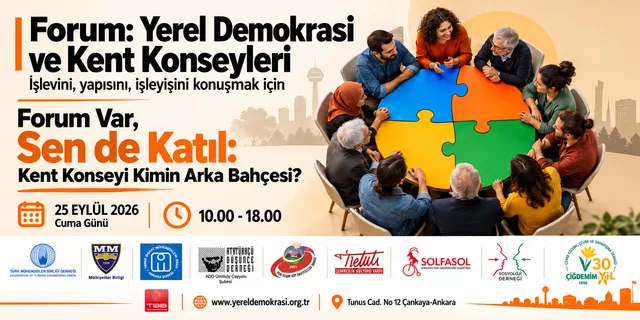
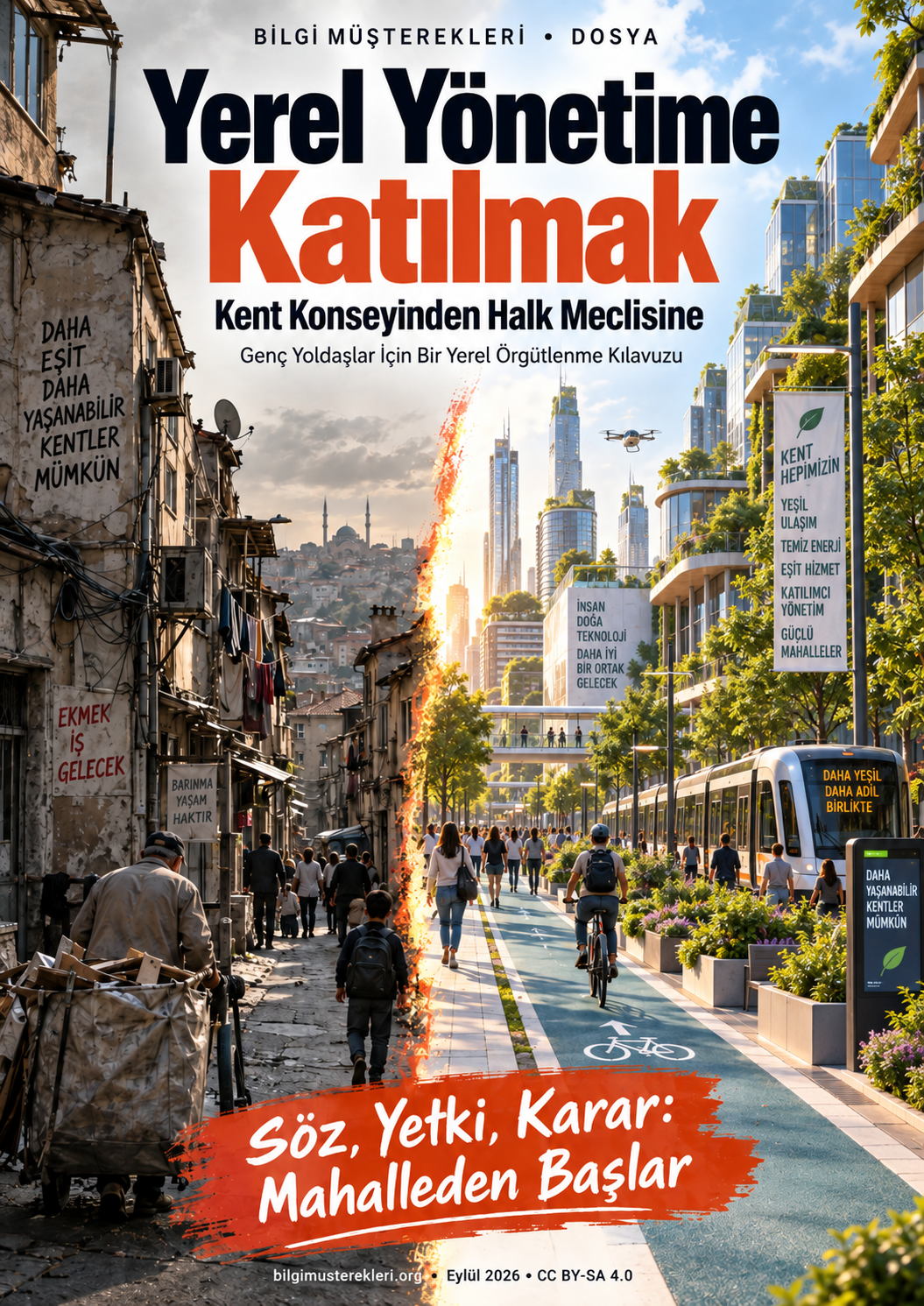
On Friday a forum titled "Local Democracy and City Councils" gathers in Ankara, in the Union of Municipalities of Turkey building on Tunus Caddesi. In our call to that forum we asked a question: whose back garden is the kent konseyi? That question would not fit in a blog post. We scoured the world, history and Turkey; out of it came a dossier of a hundred and seventy thousand words, twenty-one chapters in five books, with thirteen appendices (version 1.0.1). Its name is Joining Local Government, its subtitle From the Kent Konseyi to the People's Assembly — A Local Organisation Guide for Young Comrades. We wanted it in your hands before the forum.
You may download the dossier as PDF, ePub and Markdown, copy it, change it and share it; the licence is CC BY-SA 4.0. The dossier has been added on our Guides page beside "Event Organizing and Comradeship" Guide Is Out and The Computing Worker's Handbook.
What does the dossier ask?
We did not write a "kent konseyi handbook". We looked for an answer to a wider question that also includes the kent konseyi: How does the class govern the place it lives? Rent, water, transport, the crèche, the zoning plan, urban transformation, the municipal worker's collective agreement: a large part of the labourer's everyday life is decided in municipal councils, municipal companies and zoning commissions. If a class that is organised in the workplace remains unorganised in the city, it gives back in rent, in the bill, in the bus ticket what it has won.
The dossier's thesis can be summarised in five sentences:
- It is not the by-laws of participation mechanisms that decide their fate, but the class forces inside them; the kent konseyi can be both the ornament of capital's rule in the city and a school of organisation against that rule.
- In Turkey the kent konseyi was born of Rio 1992's language of "stakeholder governance"; it was designed as a body whose opinion is not binding, whose budget and secretariat come from the municipality; being a back garden is not a defect, it is the design.
- World experience shows one thing again and again: without budget power and without touching property, participation is ritual; without an organised base, participation ends with the election.
- Socialist experiences gave the principles of participation: the binding mandate, recall, a worker's wage, the unity of legislature and executive, the unity of factory and neighbourhood; but the same experiences also showed how these bodies were emptied by the party-state.
- The task today is to found one's own assembly in the neighbourhood and the workplace without waiting for the municipality to call; to use digital tools as the tools of these assemblies; to see local power as a school of the class's central struggle.
Five books, twenty-one chapters
Book One — Concepts. We tell of the municipality's class nature as a "local state", of urban rent, of zoning power and of the municipality's identity as an employer. We draw the genealogy of the concepts "governance", "stakeholder" and "common reason" from the World Bank to Rio, and we redraw Arnstein's ladder of participation with a class eye. From the Paris Commune to the soviets, from Gramsci's factory councils to Lefebvre's right to the city, we gather the class's adventure of discovering its own form of government in ten principles.
Book Two — The World. We weigh honestly the narrowing powers of the Soviet local soviets from 1918 to 1977, China's neighbourhood committees and the nineteen-day Shanghai Commune, Cuba's nomination and accountability meetings, Yugoslavia's thirteen thousand local communities: with their promises and with their emptying. Chile's supply committees and industrial belts of 1970–73; Porto Alegre's participatory budget melting from 17 percent to 0.17 percent; El Alto's forty-five-year neighbourhood federation; Red Vienna's 64 thousand municipal dwellings; the digital-participation lessons of Barcelona and Madrid; the expropriation referendum in Berlin; the transfer of more than a third of the plan fund to people's assemblies in Kerala; the rise and fade of vTaiwan in Taiwan.
Book Three — Turkey. We tell of the municipal socialism of 1973–77 and of how first the central government, then its own party, liquidated it; of Fatsa's eleven-district people's committees of 1979–80, within the legal frame and as an experience of municipalism; of the kent konseyi's road from Rio to Law 5393 and of the chain of tutelage in the regulation. In the "Back Garden" chapter we take up, in a language of critical dialogue, the 2024 and 2026 general assemblies of the Ankara Kent Konseyi, Kırşehir, the trustee practice and the bearing of municipalities with a left signboard towards labour. Then come the counter-examples (including the Gezi Park forums, the 6 February solidarity networks, right-to-the-city movements): Ovacık's people's assembly and cooperative, Dikili's water case, Fındıklı's People's Assembly and the meci tradition, Bağlar's participatory budget begun in 2025, Çankaya's neighbourhood assemblies. Two new chapters tell of the municipality's dark face and of dispossession: the rent machine, dummy plots, zoning amnesties and 6 February, dynasty municipalities, the left's candidate from the right, the cemevi and inequality, gangsterisation (Chapter 15); dispossession from the gecekondu to urban transformation, 1 Mayıs Mahallesi, Ayazma, Sulukule, Fikirtepe, the square-metre calculation, Turkuaz Mahallesi and Çiğdemim (Chapter 16). We measure every example with the same five questions: Was a resource transferred? Is the decision binding? Does the assembly live independently of the municipality? Are labourers inside it? What happened when the mayor left? The result is striking: in the "resource transfer" column there is not a single "yes".
In Book Two there is also a voice from Berlin: Elif Eralp's city vision in the 20 September 2026 election and its comparison with the dossier's criteria. Book Three also tells of those who carry the urban struggle of Ankara and Istanbul: from Solfasol's fifteen-year archive, the facts of İtfaiye Meydanı, Güven Hospital, İmrahor, Beşevler and the Ayrancı Neighbourhood Assembly; the case line of the Chamber of Architects Ankara Branch and of Tezcan Karakuş Candan, from the Atatürk Forest Farm to the METU road, directed at Gökçek and at Yavaş alike; the story of Mücella Yapıcı and Taksim Solidarity from before Gezi to the 2025 acquittal; Fuat Ercan's analysis that "TOKİ is the state taking part in the production process", and the reading of urban transformation not as a sharing-out of rent but as capital accumulation. The Maçoğlu experience is followed from Ovacık to Tunceli at provincial scale: building with the people, the seven-hour working day and the 85 percent collective agreement, the cooperative, the debt debate and the trustee of November 2024; afterwards the trustee's taking back of the same agreement. Municipalism in the Kurdish provinces is set out in a descriptive balance sheet: Sur's 2006 multilingual-service decision and the Council of State process, co-mayorship and women's institutions (DİKASUM, Zarokistan, Mardin's four-language crèche), those closed by trustee and reopened in 2024, Van's neighbourhood meetings, Diyarbakır's "The Floor Is Yours" gatherings and its People's Bread; against these, the dismissals in DEM municipalities in 2024–25 and the internal balance sheet "two of 62 municipalities opened a crèche". Our measure is not the signboard; it is the five questions.
Book Four — Proposal. A model of neighbourhood and workplace assembly to be founded without waiting for the municipality (a scale of 200–400 households, rotating and recallable delegates, a joint union–neighbourhood board, "ten steps to founding a neighbourhood assembly", the first three months and the first three campaigns), all within the legal forms Turkish law offers. An eleven-point draft programme for a socialist municipality: tying the manager's wage to the average wage of the municipal worker; leaving at least a fifth of the investment and service budget outside personnel and obligatory expenses (the target: 35 percent, at Kerala level) to the binding decision of neighbourhood assemblies; not selling municipal land; worker-supervised cooperatives in place of subcontracting; a public service under user oversight. And a concrete proposal for digital direct democracy: the Knowledge Commons Open Municipality Package — a Decidim-based, open-source, Turkish-localised participation infrastructure, joined to pol.is discussion mapping and open-budget visualisation, hosted on a public server, KVKK-compliant; with nine principles and a seven-layer architecture. Our rule is open: software is a tool, not a master; artificial intelligence summarises, it does not decide; a paper ballot is always there. In the same chapter we also read the 2030 National Smart Cities Strategy published in the Official Gazette on 19 September 2026: in a text that promises artificial intelligence, sensors and a digital twin to 81 provinces, the words "the people", "neighbourhood headman" and "kent konseyi" do not appear. Our answer is three clauses: data is a commons, code is public, the decision belongs to the assembly.
Book Five — Horizon. The dossier ends with a philosophy chapter: from Sumer's temple city to the Athenian polis, from More's Utopia to Fourier and Owen, from Engels's The Housing Question to the Soviet urbanist–disurbanist debate, from Lefebvre's thesis that "the city is a work" to Harvey's "accumulation by dispossession", from Castells's collective consumption to Marcuse's question "whose right, which right, which city", from the Situationists to feminist urban criticism — the class history of urban thought. The chapter tells how the "right to the city" was tamed from the cry of 1968 into UN-Habitat's language of governance, and argues that a communist city is not an architectural style: a social relation in which land has ceased to be an object of speculation, housing is a living space not an investment vehicle, care labour has become visible and collective, data and software are a commons, and the city-dweller is a decision-maker not a voter. We close with four distinctions: the public and the state, the common and the central, planning and bureaucracy are not the same thing; social property and the city-dweller's right to decide cannot be separated from each other. The matter is not to design the ideal city, but to socialise the power of continually redesigning the city.
The appendices put the dossier in your pocket: a glossary of concepts, a summary of the legislation, a thirty-row world comparison table, a 1973–2026 chronology of Turkey, a guide to founding a neighbourhood assembly, a handbook for preparing for a kent konseyi general assembly (becoming a delegate, watching the notice board, objection, application to the Ombudsman), a table for choosing digital tools, a poster of the ten principles, answers to thirteen objections (Appendix K), a first-year calendar for a neighbourhood assembly (Appendix L), twelve minimum demands for real democracy and a candidate-pledge text (Appendix M), and a unified bibliography of more than four hundred links.
Why now?
Because the ground on which to talk about city councils rarely opens, and this time it is opening. Because while the trustee closes municipalities one by one, and with them the city councils, we have also lived through a summer in which elected mayors changed party without asking the voter. Because in Ankara a candidate who defends participatory democracy was not even allowed onto the podium in 2024, and in 2026 took twelve votes against 1,071. And because, against all this, a municipality in Fındıklı puts the kent konseyi's advisory decisions as a standing item on the agenda of every meeting of its council. What explains the difference is not the by-laws; it is organisation.
Go to the forum with a question
Every chapter of the dossier ends with "Lessons from this chapter"; the chapters of the fourth book with concrete tasks. On the way to 25 September we propose one thing: try to find what your own district's kent konseyi has done in the last two years, the minutes of the general assembly, the delegate list and the opinions it sent to the municipal council. If you cannot find them, carry that finding to the forum. Ask the dossier's five questions of your own city.
This dossier is not a finished word; it is a call. In Appendix J we propose an oral-history commons: to put on record together the testimony of everyone who has lived an experience of local participation, from Fatsa to the neighbourhood assemblies, from Ovacık to Bağlar. Write what you have lived in your neighbourhood, your workplace, your kent konseyi; let later versions be written with the impressions of the forum and with you.
Word, authority, decision: it starts in the neighbourhood.
Comradely.
Knowledge belongs to everyone; so does the city.
Download
- PDF — Joining Local Government, version 1.0.1 (219 pages, 7.2 Mb)
- ePub — for e-readers (4.9 Mb)
- Markdown — source text, to change and copy (1.6 Mb)
- All our guides
The dossier was prepared to Knowledge Commons' typesetting standard (Poppins and Inter; red, black, grey); the graphics and production scripts are inside the Markdown package. You can send errors, gaps and suggestions for correction from our contact page; in the next version you will be named as you wish, with your name or without it.
Related pieces
- Forum: Local Democracy and City Councils — our call to the 25 September forum and the starting-point of the dossier
- A Class Soldier in Berlin: Elif Eralp and A Communist Traveler in Berlin: The Dialectic of Space and the Trail of Truth — our earlier pieces on Berlin's tenants' movement and the Left Party (background to Chapter 7)
- AfD's 43.8 Percent Is Not a Deviation: It Is the Bill of a Two-Hundred-Year Line and Thirty-Five Years of Dispossession — European reaction and local politics
- Whose Foot Is on the Brake? and KVKK's "80s Trend" Warning and Privacy in the Digital Age — the debate on digital infrastructure and data (Chapter 19)
- "Event Organizing and Comradeship" Guide Is Out and The Computing Worker's Handbook — the previous two members of our guides series
- Our Education Dossier Is Out: Whose School Is It? — another dossier prepared by the same method
Forum and sources
- The Local Democracy initiative · Forum: Friday 25 September 2026, 10.00–18.00, Union of Municipalities of Turkey, Tunus Cad. No: 12, Kavaklıdere/Çankaya — Google Maps
- Legislation: Municipal Law No. 5393, Art. 76 · City Council Regulation · 2030 National Smart Cities Strategy (Circular 2026/11)
- Ankara's urban memory: Gazete Solfasol and the series "New Politics from the Local" · Çayyolu Neighbourhood Assembly · Çiğdemim Association · TMMOB Chamber of Architects Ankara Branch · Local Democracy — Let Us Remember
- Experiences in Turkey: Fındıklı Municipality People's Assembly · Bağlar Municipality Participatory Budget · Union of City Councils of Turkey · Women's Coalition · People's Houses · Neighbourhood Disaster Volunteers
- World experiences: Decidim · Consul Democracy · Deutsche Wohnen & Co enteignen · Participatory Budgeting Project · Public Money? Public Code!
- Theory (Turkish editions): Henri Lefebvre, The Right to the City and The Production of Space (Sel) · David Harvey, Rebel Cities and Social Justice and the City (Metis) · Friedrich Engels, The Housing Question (Sol) · Manuel Castells, The City, Class, Power (Phoenix) · Mike Davis, Planet of Slums (Metis) · Tarık Şengül, Urban Contradiction and Politics (İmge) · Leslie Kern, Feminist City (Sel); the full bibliography is in the dossier's Appendix I, with more than four hundred links.