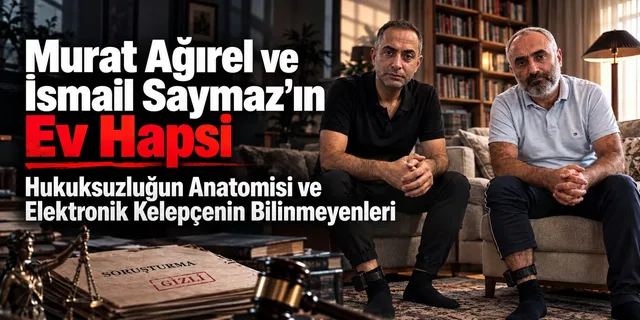
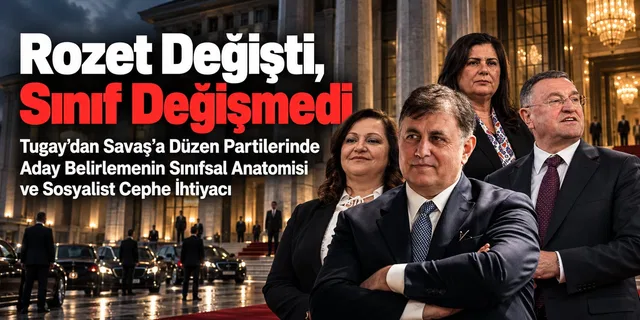
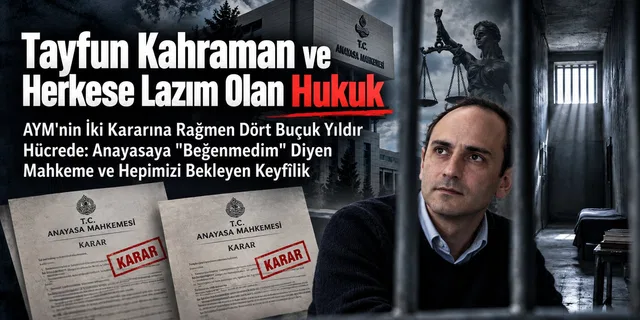
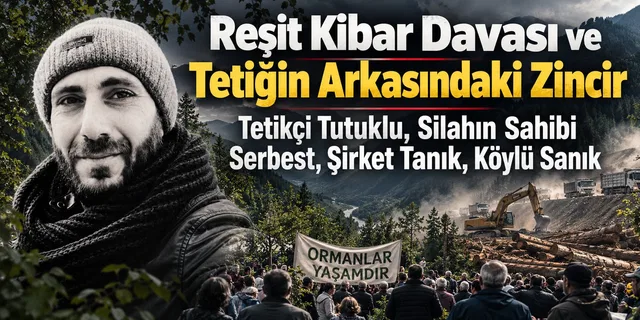
Whose Case Is Being Heard in Silivri?
For Young Comrades Who Know Nothing of the İBB and İmamoğlu Case

Whose Case Is Being Heard in Silivri?
For Young Comrades Who Know Nothing of the İBB and İmamoğlu Case
The City's Rent, the Clearing of Rivals, and the Class Character of the Law — a Living Piece, Updated as the Defence Continues
Updates
This piece is a living document. The defence of Ekrem İmamoğlu and of his lawyers will continue until Saturday 17 October; the court's interim ruling will be announced after the defences are finished. As a new development comes from the case, we will record it in this section with the newest at the top, and if necessary we will update the relevant part of the piece as well.
- 15 October 2026, 16:00 — The second day of the defence is continuing (the 99th day of the hearing). In the afternoon İmamoğlu described 19 March as "a coup conducted in the corridors of the courthouse". He said that an appointment he had obtained from Akın Gürlek, then Istanbul Chief Public Prosecutor, for 30 October 2024 was cancelled the day before, and that on the same morning an operation was carried out against Esenyurt Municipality. He said the signatory of the indictment is now both justice minister and president of the Council of Judges and Prosecutors, and that last week this minister called him "leader of a criminal organisation". He claimed that in prison he can look at the file for two hours a week on a computer. The details are below, under "Day Two". These are the defendant's statements; the court has not ruled yet.
- 15 October 2026 — Reactions compiled. We have gathered, in the section below, the statements of professional organisations, unions and human rights groups in Turkey, and of international bodies. If a new statement appears before the defence ends, we will update that section.
- 15 October 2026, 14:30 — The second day of the defence is continuing (the 99th day of the hearing). İmamoğlu described the indictment as "a political operation dressed in legal clothing"; he summed up how confessions are produced as "Detain them, take the family, put down the template, open the door", and said "A statement taken by threat cannot be evidence in law." In connection with the purchase of the CHP Istanbul provincial headquarters building, he asked that Kemal Kılıçdaroğlu be heard as a witness. He tied the flood disaster in Istanbul to building on stream beds and to unplanned urbanisation. The details are below, under "Day Two".
- 14 October 2026 — The first day of the defence (the 98th day of the hearing). Nineteen months after his arrest, İmamoğlu made his defence in this case for the first time. The same morning there was a police raid on Halk TV and a trustee was appointed. In the defence, the sentences "The Republic of Turkey has turned into a republic of operations", "The state is one thing, the government is another" and, on the fund crisis, "In this order the loss is shared out to the nation, the profit is not" stood out. The details are below, under "Day One".
- Coming up: Friday 16 October, the continuation of İmamoğlu's defence; Saturday 17 October, the lawyers' defence; then the court's interim ruling (including the question of detention).
Reactions: from Turkey and from the world
What follows is the organisations' own statements. Recording them does not make İmamoğlu our candidate. Their common point is what this piece has said from the start: detention has turned into punishment, the evidence has been gathered largely in secret witnesses, and the hearing has been made impossible to follow and impossible to defend. The solidarity of the European institutions is with a politician of the order. We take from them not the candidate, but the violation they have put on record. These statements do not enter the question of whose hands the city's rent is in; that question is ours.
From Turkey
- 19 March 2025 — KESK (the Confederation of Public Employees' Trade Unions). On the morning of the detention the confederation called the cancellation of the diploma "wholly devoid of law", and did not treat the trustees, the arrests and this operation as a coincidence. It read the "city consensus" offered as the grounds as a sign that dissent was to be silenced. (KESK statement, in Turkish) The same day in Samsun, KESK, DİSK and the TMMOB made a joint statement. (Samsunanaliz, in Turkish)
- 9 March 2026 — the Human Rights Association (İHD). At the first hearing it said that detention had ceased to be a measure and had become punishment, a practice that disregards the presumption of innocence. Recalling that this practice is applied especially to opposition politicians, journalists and human rights defenders, it called for the release of all politicians on trial in detention. (Cumhuriyet, in Turkish)
- 12 March 2026 — the Journalists' Association of Turkey (TGC), the Journalists' Union of Turkey (TGS) and DİSK Basın-İş. Journalists were to be moved from the press section to a blind spot that made the hearing hard to follow; when they did not leave their places, the court postponed the hearing to 16 March on the grounds that "order could not be maintained". The three organisations treated this as a violation of publicity and of the public's right to receive news. (bianet, TGC; both in Turkish)
- 13 March 2026 — the Istanbul Bar Association, first observation report. The delegation that had been watching the hearings since 9 March found serious problems in the first week for the right of defence, publicity, equality of arms, the presumption of innocence and communication between defendant and lawyer. It recorded that the later appointment as justice minister of the prosecutor who had conducted the investigation raised a debate about the court's independence and impartiality. The report is not a judgment on the merits. (BirGün, in Turkish)
- 9 April 2026 — the Chamber of Computer Engineers (TMMOB). For its member detained in the case, it recalled the presumption of innocence and that long detention must not turn into punishment, and it asked that the technical allegation be tested against concrete evidence and an independent expert. The file does not end with a mayor: a computing worker is inside the same template. (BMO, in Turkish)
- 13 April 2026 — the Istanbul Bar Association, second preliminary report. It wrote that, because the allegations had not been made concrete, defendants could not know what they were to defend themselves against, and that digital evidence could not be reached. The monthly review of detention had been crammed into three days, lawyers had been given 15 minutes per defendant, defendants had not been given the floor, and hearings had lasted about 12 hours. (Evrensel, in Turkish)
- 7 September 2026 — the Turkish Medical Association (TTB). It reported that hearings reaching 14–15 hours, and continuing on consecutive days, could damage the physical, mental and cognitive integrity of defendants, lawyers and the other subjects of the proceedings, and could reduce the capacity to make a defence. It wrote that these conditions should be considered in the light of the ban on exhaustion in Article 148 of the Criminal Procedure Code and of ill-treatment, and that they could be assessed, in the WHO classification, within "torture and other cruel, inhuman or degrading treatment". This is the medical organisation's assessment, not a court ruling. (T24, in Turkish)
- 9 September 2026 — the Istanbul Bar Association, overnight hearings. After watching the hearing in person, the bar applied to the court over sessions running past midnight. It argued that the practice removed sleep and rest, and that it touched Articles 13, 17 and 36 of the Constitution and Articles 3 and 6 of the European Convention on Human Rights. (BirGün, in Turkish)
- 14 October 2026 — the Istanbul Bar Association, the first morning of the defence. It declared the dawn operation against Halk TV and the appointment of a trustee contrary to the Constitution. It wrote that the timing mattered separately: taking the press under a police siege on the day the defence was expected to be heard is incompatible with a democratic state under the rule of law. It called on public officials, under Article 137 of the Constitution, not to carry out an unlawful order. (Evrensel, in Turkish)
From the world
- 19 June 2025 — UN special rapporteurs. Rapporteurs on torture, arbitrary detention, and freedom of expression and assembly conveyed to Turkey allegations of disproportionate force, ill-treatment and arbitrary deprivation of liberty during the March 2025 protests that followed İmamoğlu's detention. The letter is not about the indictment; it is about how the operation met the street. It became public in August 2025, after the government's reply. (Turkish Minute)
- 3 March 2026 — Human Rights Watch. In a statement before the hearing it described the case as a politically motivated mass corruption prosecution. It wrote that it was hard to avoid the conclusion that prosecutors were trying to remove İmamoğlu from politics and discredit his party; that secret witnesses, a lawyer jailed as a defendant and hundreds of defendants damaged the right to a fair trial; and that using a restriction for a purpose other than the one the Convention provides for could breach Article 18. (HRW)
- 6 March 2026 — Amnesty International. Dinushika Dissanayake, Deputy Director for Europe, called an indictment of nearly 4,000 pages, 142 charges and a prison demand of more than 2,300 years "ludicrous". She said the case rested almost entirely on secret-witness testimony, that an effective defence was practically impossible against hundreds of thousands of pages of evidence, and that this was the most extreme example of the justice system being turned into a weapon. (Amnesty International)
- 23 March 2026 — Human Rights Watch. It treated the arbitrary restrictions on lawyers, journalists and the public following the hearing as a breach of the duty to hold the trial in public. It wrote that pushing the press into a blind spot while the hall stood empty damaged confidence and the right to information. (HRW)
- 6 July 2026 — the European Committee of the Regions and European Parliament rapporteurs. Jelena Drenjanin, chair of the working group on Turkey, Nacho Sánchez Amor, the Parliament's standing rapporteur on Turkey, and MEP Magdalena Adamowicz found it a problem for a fair trial that the defence was put up in three separate cases on the same day. They called for the release of İmamoğlu and of the other mayors under arrest. The statement is openly one of political solidarity; it should be read as such. (European Committee of the Regions)
- 10 July 2026 — the Council of Europe Commissioner for Human Rights. Michael O'Flaherty wrote that there were "grave issues" for a fair trial, including equality of arms and the independence of the judiciary. He recorded that the defence's access to the file had been restricted, that some witness statements were reported to have been withdrawn after being taken under pressure, that on 6 July three cases were piled onto the same day, and that on 8 July İmamoğlu was not allowed to present his defence. He asked that allegations of ill-treatment be investigated under Article 3, that detention remain the exception, and that the right of defence in Article 6 be recognised. (The Commissioner's statement)
As of about 16:00 on 15 October we have not seen a new international statement on the defence now under way. If one appears, we will add it at the top of this section.
Summary: The Case in Five Minutes
Dear young comrades, we are writing this piece for friends who have never followed the İBB case, who have heard the name but do not know what is what. The short version is this:
What happened? Ekrem İmamoğlu, Mayor of the Istanbul Metropolitan Municipality, was detained on 19 March 2025, arrested on 23 March, and removed from office. The day before, Istanbul University had cancelled his diploma; a diploma was a condition of being a presidential candidate. In November 2025 the prosecution prepared an enormous indictment that defined İmamoğlu as the "leader of a criminal organisation for profit". The case began in Silivri on 9 March 2026, and today it is on its 99th day.
What do the numbers say? Today there are 436 defendants, 53 of them detained. In the first indictment the prosecution seeks for İmamoğlu from 849 years up to 2,430 years and 6 months in prison. A supplementary indictment on the Ağaç A.Ş. file names 29 people, and he is among them; in that file the demand runs from 62 years to 168. The first indictment counts 143 acts and a public loss of about 160 billion lira and 24 million dollars. In his defence İmamoğlu spoke of 155 acts; we do not treat the two figures as the same.
What happened these two days? İmamoğlu made his defence on 14 and 15 October. He described the case from beginning to end as a political operation, argued that the confessors' statements were taken under pressure, and, through the fund crisis, attacked the management of the economy. On the afternoon of the second day he described 19 March as a coup conducted in the corridors of the courthouse, tied a chief prosecutor's appointment and the Esenyurt operation to the same morning, and said that in prison he can look at a file of tens of thousands of pages for two hours a week on a computer.
Where do we stand? We repeat what we said in the piece on Tayfun Kahraman: we are not defending İmamoğlu, but the law is something everyone needs. İmamoğlu is a politician of the order; his municipalism, and his new party too, are an alternative inside the capitalist order. But the apparatus that tries to erase an elected administrator from politics with secret-witness statements, confessor templates and detention without end is the very apparatus that will tomorrow be turned on the trade unionist, the journalist and the worker on strike. Watching this case, we have to see two things at once: a power struggle between two wings of capital, and a liquidation of the law that the working class will also live through.
Why does it matter? Because this case puts three questions plainly: in whose hands is Istanbul's budget of 609 billion lira? Under whose control is the judiciary? And to whose benefit is the whole of the opposition's fight?
Now let us go into the detail.
First, Let Us Draw a Line
This case divides almost everyone in Turkey into two camps. According to one camp, İmamoğlu is the head of a corruption network and is getting what he deserves. According to the other, İmamoğlu is the last hope of democracy, and to defend him is to defend democracy.
A Marxist view says "no" to both; but this "no" is not a cheap escape that says "they are both the same". We have to do something harder:
- On the one hand, we go on criticising the politics İmamoğlu represents. "Managing better" without touching class relations in the municipality, "distributing the rent more fairly", working with capital "more transparently": all of these are a style of management inside capitalism. We discussed the limits of this politics in detail in The Badge Changed, the Class Did Not.
- On the other hand, we say that a politician's attempt to beat in the courtroom a rival he could not beat at the ballot box is a threat aimed at the whole of society, and most of all at unorganised and unprotected workers.
These two sentences do not cancel each other; they complete each other. Even the fragmentary rights of bourgeois democracy (assembly, organisation, defence, the presumption of innocence) were won by a hundred and fifty years of working-class struggle. Watching for whom, and how, those rights are pruned is our business.
One important note too: in this piece we report both the claims of the indictment and the claims in İmamoğlu's defence as statements of a party. The court has not yet ruled. We are not looking at who is guilty, but at what this prosecution shows.
For Those Who Know Nothing: Who Is İmamoğlu, What Is the İBB?
The İBB is the Istanbul Metropolitan Municipality. It is a huge institution that runs the water, the transport, the buses, the metro, the zoning plan, the parks and the rubbish of a city where about 16 million people live. Its 2026 budget was adopted as 609 billion lira (in Turkish). That is larger than the budget of many ministries in Turkey. It has dozens of companies (subsidiaries): Metro Istanbul, İETT, İSKİ, İGDAŞ, Kültür A.Ş., Ağaç A.Ş., Medya A.Ş. and many more. Tens of thousands of workers work in these institutions.
Under capitalism a metropolitan municipality is not an innocent service institution. It is a local knot of capital accumulation, where urban rent, construction capital, tenders, billboards, excavation spoil, land and zoning changes are distributed. Whoever holds the municipality largely decides which contractor will get the work, which land will be opened to development, and which neighbourhood will enter urban transformation. For that reason, losing Istanbul is not only a loss of prestige for a political party; it is the loss of a whole capitalist circle's channel of nourishment.
Ekrem İmamoğlu, for his part, came from a construction family. He was first mayor of Beylikdüzü, and was then elected Mayor of the Istanbul Metropolitan Municipality in 2019 (twice, with the election that was annulled and rerun) and in 2024: a politician of the CHP. At the beginning of 2025 he was coming to the fore as the CHP's presidential candidate. Today he is no longer in the CHP; after the "absolute nullity" ruling we describe below, he passed to the YENİ Party founded by Özgür Özel.
So this case is at once about the government of Turkey's largest city and about the strongest opposition candidate for the next presidential election. The two dimensions have to be read without being separated from each other.
Chronology: Nineteen Months, One Case
To understand the case, it helps to see the events in order.
- November 2024 — The investigation begins. (Medyascope, in Turkish)
- 18 March 2025 — Istanbul University cancels the diplomas of 28 people, including İmamoğlu, on the grounds of "a breach of the regulations" in the 1990 horizontal transfers. In Turkey a higher-education diploma is a condition of being a presidential candidate.
- 19 March 2025 — İmamoğlu is detained in the morning hours. Large protests begin across Turkey, led in particular by university youth.
- 23 March 2025 — İmamoğlu is arrested; the Ministry of the Interior removes him from office. Around the same days he is declared the presidential candidate in the CHP primary.
- 11 November 2025 — The indictment is prepared: 402 suspects, 105 detained, 143 acts, an alleged public loss of about 160 billion lira and 24 million dollars, and a demand of up to 2,430 years in prison for İmamoğlu. (Diken, in Turkish)
- 9 March 2026 — The case begins in Silivri, in the hall on the Marmara Prison campus.
- 21 May 2026 — The Ankara Regional Court of Appeal rules "absolute nullity" on the CHP's 2023 congress; it provides for the provisional removal of the Özgür Özel leadership and for the return to office of Kemal Kılıçdaroğlu and the old leadership. (NTV, in Turkish)
- 8 July 2026 — The last day of the first session (the 64th day of hearings). İmamoğlu wants to make his defence; he argues with the presiding judge about time and the calendar, is removed from the hall, and it is entered in the record that he "used his right to remain silent". The lawyers do not accept this.
- 24 July 2026 — Özgür Özel and 91 members of parliament resign from the CHP and found the YENİ Party. (Euronews, in Turkish)
- 12–13 August 2026 — İmamoğlu resigns from the CHP and calls for membership of the YENİ Party. (Euronews, in Turkish)
- 17 August 2026 — The second session of the case begins.
- September 2026 — The fund crisis breaks; sharp losses on the stock exchange, funds liquidated. (We told this process in Control for Capital, the Blast for Us.)
- 11 September 2026 — In a separate insult case (the Şadi Yazıcı case) İmamoğlu is sentenced to 2 years and 1 month in prison and a political ban; the lawyers appeal on 13 October.
- 13 October 2026 — The 97th day of the case. The court sets aside the four days between 14 and 17 October for the defence. (Diken, in Turkish)
- 14 October 2026 — In the morning a trustee is appointed to Halk TV; from the afternoon İmamoğlu begins his defence.
- 15 October 2026 — The second day of the defence. In the afternoon İmamoğlu described 19 March as a coup in the corridors of the courthouse; the detail is below.
What has to be noticed in this chronology is this: the legal calendar and the political calendar overlap almost perfectly. The cancellation of the diploma, one day before the detention; the detention, a few days before the primary; absolute nullity, in the period when the main opposition was gathering around a new leader and a new candidate; the trustee for Halk TV, on the first morning of the defence. A single coincidence is possible; this many coincidences are a method.
The Numbers of the Case
| What | Figure |
|---|---|
| Day of the hearing (as of 15 October) | 99 |
| Number of defendants | 436 |
| Defendants in detention | 53 |
| Number of acts in the indictment | 143 |
| Alleged public loss | ~160 billion TL + 24 million $ |
| Sentence sought for İmamoğlu (first indictment) | 849 years – 2,430 years and 6 months |
| Supplementary indictment, Ağaç A.Ş. | 29 defendants; 62–168 years for İmamoğlu |
| People charged as "organisation managers" | 7 (including İmamoğlu) |
| İBB 2026 budget | 609 billion TL |
| Time spent in detention | ~19 months |
Sources: Diken (13 October), Diken (the indictment), Diken live blog (15 October, 15:54), Cumhuriyet, Yeniçağ (all in Turkish). The November indictment counts 143 acts. In the defence of 15 October İmamoğlu spoke of 155. We do not treat the two figures as the same.
A demand for imprisonment of more than two thousand years is a political message much more than a legal measure. No human being can serve this sentence; the function of the demand is not to punish, but to frighten, and to say "this man, never again".
What Does the Indictment Say, What Does the Defence Say?
The indictment claims that İmamoğlu founded a "criminal organisation for profit" beginning in Beylikdüzü and reaching the İBB. Among the charges are founding and managing an organisation, bribery, extortion, bid rigging, money laundering, aggravated fraud and offences related to personal data. Counted as the organisation's "managers", alongside İmamoğlu, are Fatih Keleş, Murat Ongun, Adem Soytekin, Murat Gülibrahimoğlu, Ertan Yıldız and Hüseyin Gün.
The largest item of public loss (160 billion lira) is in fact about the dumping of excavation spoil on a mining site. According to Medyascope's account, MAPEG (the General Directorate of Mining and Petroleum Affairs) approved this dumping on the grounds of landslide risk, and it has been claimed that the Istanbul Governorate had a share in it too; but the indictment shows the İBB as the sole party responsible for the decision. Billboard tenders (Medya A.Ş.) and negotiated tenders under Article 21/B are also among the charges; critics recall that AKP municipalities and ministries use the same tender procedure. (Medyascope, in Turkish)
The structure of the evidence is contested too. According to the same report, the expression "I heard" appears 564 times in the indictment, and "as far as I remember" 969 times; the number of sentences based on hearsay is 691. The base-station records of telephones are offered as evidence, but most of these locations are people's workplaces. In the defence of 15 October İmamoğlu read out the indictment's sentence on the organisation chart, which counts statements under the effective-repentance rule before any document. From the minutes he reported that Adem Soytekin said he had seen, after giving his statement, the sentence about an organisation founded in Beylikdüzü to raise capital for a presidential bid, and that it had been put before him as a template. These are the defendant's statements.
| The language of the indictment | The language of the defence |
|---|---|
| "A criminal organisation for profit" and its leader | "A political operation dressed in legal clothing" |
| Statements of confessors and secret witnesses are evidence | "A statement taken by threat, pressure or promise cannot be evidence in law" |
| A public loss of 160 billion lira | The decisions are joint decisions among institutions; responsibility cannot be loaded onto the İBB alone |
| An organisational hierarchy | The "organisation chart" is a municipality's ordinary management structure |
| Detention prevents the destruction of evidence | "Trial in detention has been turned into a method of punishment" |
| The prosecution is a legal process | "Its aim is to eliminate me politically" |
| A statement under the effective-repentance rule comes first among the evidence | "The documents are on our side, the gossip is on theirs" |
This table does not say who is right; it shows how the two languages do not intersect at all. The prosecution is telling a criminal case, the defendant a political case. The court's job is to test these two narratives against the evidence. Our job is to make visible what neither narrative shows, namely class.
Day One: 14 October 2026
About 19 months after his arrest, İmamoğlu made his defence in this case for the first time. The day began, before the defence itself, with another event: in the morning there was a police raid on Halk TV and a trustee was appointed to the channel. İmamoğlu drew particular attention to this timing. (Cumhuriyet, in Turkish)
Medyascope published the full text of the defence (in Turkish). The headings that stood out were these:
The claim of a political case. "This is an entirely political case, and its aim is to eliminate me politically," he said. The day's most quoted sentence was in this frame too: "They looked in the mirror and wrote what they saw into the indictment in my name." And a harsher sentence still: "The Republic of Turkey has turned into a republic of operations."
The matter of the record. He rejected his removal from the hall on 8 July and the recording of a minute that said "he did not want to make a defence": "The record to the effect that I said I would not make a defence was entirely contrary to the truth."
Detention and families. He said that trial in detention "has been turned into a method of punishment" and that the presumption of innocence has been trampled; he described the pressure on lawyers and families, and thanked his wife Dilek İmamoğlu and the solidarity network founded by the relatives of the detained.
The book ban. He said that the banderoles for the book "The Nation Is My Witness" (Millet Şahidimdir), which contains a summary of his defence, had been obtained by legal means, but that the police nevertheless came to the printer, stopped the print run, and that the investigation shifted from the claim of "printing without a banderole" to the content of the book.
The press and Halk TV. "It is not the political power but the viewers, that is the nation, who decide whether a television channel lives or not," he said. He criticised the arrest of journalists and the access blocks.
The fund crisis and the economy. He drew a line from FX-protected deposits to the fund crisis and described the crisis as "the robbery of the century". Two of his sentences are especially important from our point of view: "The currency risk was taken off the balance sheet of the large deposit-holders and loaded onto the people's back" and "In this order the loss is shared out to the nation, the profit is not!" The figures he gave for the cost of the fund crisis (for example a loss exceeding 107 billion dollars) are his own calculation; they have not been independently verified.
State and government. "The state is one thing, the government is another," he said, and "The owner of the state is, plainly, the nation." He spoke of the allure of ruling without rivals and of the wrecking of the mechanisms of accountability, and compared today's practices with the political and trade-union legacy of 12 September.
The Kurdish question and the "city consensus". He described the investigation against him over the "city consensus" (Kent Uzlaşısı) as a political fiction; he said the "Terror-Free Turkey" process had to be conducted with the participation of the main opposition, that the Kurdish question has dimensions of democracy and freedom of expression, and he referred to the detention of Selahattin Demirtaş.
The day ended at about 17:30, with İmamoğlu saying he would continue the next day. Slogans were shouted in the hall for İmamoğlu and Özgür Özel. Özgür Özel was in Silivri too, and he read the appointment of a trustee to Halk TV as the government's helplessness.
Day Two: 15 October 2026
The 99th day of the hearing was the second day of İmamoğlu's defence. As this piece is being written the defence is continuing; what follows is what had been reported by about 16:00 on 15 October. (Diken live blog, Cumhuriyet, Medyascope; all in Turkish)
"A political operation dressed in legal clothing." İmamoğlu defined the indictment in these words and added: "and a savage operation at that." He claimed that he heard in May–June 2024, that is immediately after the local election results, that an operation against him in Istanbul was being prepared, and that a chief prosecutor was appointed to Istanbul for this purpose.
The confessor template. The most discussed sentence of the day was this: "Detain them, take the family, put down the template, open the door." According to İmamoğlu the method has four steps: mass detention, pressure through relatives, a statement template prepared in advance, and release in exchange for the statement. "A statement taken by threat, pressure or promise cannot be evidence in law," he said.
The organisation claim. He rejected the charge of a "criminal organisation"; he argued that he used the language not of a "system" but of an "organisation chart", and that a municipality's natural management structure was being read as an organisational hierarchy.
Conditions of detention and families. He said he was held for four days at the Vatan police headquarters, and that his lawyers had to walk long distances to reach him. He claimed that twenty detained mothers were separated from their children and sent to distant provinces, and that a department head was not given leave during his wife's labour.
Let Kılıçdaroğlu be a witness. On the charge concerning the purchase of the CHP Istanbul provincial headquarters building, he asked that Kemal Kılıçdaroğlu be heard as a witness, saying that Kılıçdaroğlu was "informed of everything about the purchase of the building". He argued that the indictment contains no concrete example of money or vehicle support being given to candidates for district mayor.
The flood disaster and Sazlıdere. He tied the latest flood in Istanbul not only to the rainfall, but to a population that was 6 million in 1986 exceeding 15 million in 2019, and to building on stream beds in areas such as Kâğıthane and Ayazağa. He said that around the Sazlıdere Dam a water basin of about 136 million square metres had been wiped out with a single signature, and that a population of nearly 2 million was being prepared for the site; he claimed it was not even clear which treatment plant the sewage of the places being built there would go to. He read the flood, the appointment of a trustee to Halk TV and the fund file as parts of a broader operation aimed at him. These figures for area and population are his own account.
"Three people", and Esenyurt. He said that it was not he who had to be cleared, but that three people, whose names he would not give, carry this responsibility. He said he had called Akın Gürlek, then Istanbul Chief Public Prosecutor and now Minister of Justice, that he was given an appointment for Wednesday 30 October 2024, that the appointment was cancelled the day before, and that on the same morning an operation was carried out against Esenyurt Municipality. "You are people who have betrayed the Turkish nation," he said. He said there was a record of the appointment; this account is his statement.
"A coup in the corridors of the courthouse." He described 19 March not as a coup by tank or by memorandum, but as a coup conducted in the corridors of the courthouse. He listed Yassıada, the executions of Deniz Gezmiş, Yusuf Aslan and Hüseyin İnan, 12 March, 12 September and 28 February, and he placed 19 March and the absolute-nullity ruling of 21 May among the same methods. He said the verdict had been written not against the defendants, but against the judges and the powers that judge.
The file, the audits, the offices. He spoke of an indictment of about 4,000 pages and an annex of 80,000, and said that in prison he has two hours a week on a computer, so that tens of thousands of pages cannot be read in that time. For the subsidiaries he counted Court of Accounts audits as 5 in the previous five years and 82 in his own term; prosecutorial investigations as 0 against 26; inspections by ministry inspectors as 0 against 378. On another table he claimed that the İBB was audited 147 times in 2014–2019 and 1,590 times in 2019–2025, and that no public loss was found. These figures have not been independently verified. He said the signatory of the indictment is now both justice minister and president of the Council of Judges and Prosecutors, and that last week, on Anadolu Agency, this minister called him "leader of a criminal organisation". He claimed that the prosecutor who questioned him is now Director General of Personnel at the Ministry of Justice, and that the spouse of the judge he faced in both cases has become a deputy justice minister. He argued that the organisation offence is a catalogue offence, and that once that word is written the door to detention opens.
Politics, inside the indictment. He reported reading the indictment's second aim as seizing the CHP with the proceeds of crime, and said that winning an election inside a party had been written down as the aim of an organisation. On the claim that delegates were bought at the congress of 4–5 November 2023, he said there was no delegate's name, no sum and no day, and that footage of the congress had been put in as evidence. He tied the sentence about a "fund of 2 billion" to hearsay heard from a man named Sarp Yalçınkaya, and said he did not know him. He claimed that Murat Gülibrahimoğlu had paid 42 million lira not into his own campaign but into the account of his rival, Murat Kurum. He said he did not know Hüseyin Gün, reduced the link to a photograph of five minutes, and said that a separate espionage file had been written onto that photograph too. He asked how an indictment for corruption comes to be tied to a notification to the Court of Cassation for the closure of a party.
As the rest of the defence comes in, we will update this section and the Updates part at the top.
A Class Reading: What Does This Case Tell Us?
Now let us come to our real business. What does the trial of a bourgeois politician, in a bourgeois court, say to the working class?
In Whose Hands Is the City's Rent?
In a capitalist country, large cities are where capital accumulation is at its most intense. Land, housing, infrastructure, transport and zoning are each a source of rent. The municipality is the table at which this rent is distributed: who will get the tender, which plot will be opened to development, which neighbourhood will be transformed, to whom the billboards will be given, where the excavation spoil will be dumped.
In Turkey since the 1980s, and especially in the 2000s, construction and urban transformation were made the locomotive of economic growth. Istanbul was the heart of this model. The political cadre that governed Istanbul from 1994 to 2019 grew, in that quarter-century, a construction, media and service capital around itself. When Istanbul changed hands in 2019, it was not only the office that changed hands; which circle of capital the municipality's resources would flow to was going to be decided anew.
The İmamoğlu administration did not change this relation at the root; it mostly rearranged the distribution of rent in favour of a different circle of capital, and in a language that looked more "institutional" and more "transparent". Social policies such as crèches, student grants, Halk Ekmek bread kiosks and transport discounts certainly touched workers' everyday lives; we do not belittle them. But these policies did not touch property relations, that is, who owns the city's land and infrastructure and to whose benefit they are run. Social municipalism is a carpet laid over the rent regime; the floor under the carpet stays the same.
That is why it is misleading to read this case as a fight between "clean management and dirty management". The real question is this: in which circle of capital's hands will control of Turkey's largest local budget lie?
Clearing Away Rivals: Beating in Court the Opponent You Cannot Beat at the Ballot Box
In his defence İmamoğlu spoke of "the allure of ruling without rivals". This expression describes a phenomenon with a long past in Marxist theory.
Examining Louis Bonaparte's coup in France in 1851, Marx described a type of regime in which executive power, becoming independent of parliament, of parties, even of the ruling class's own political representatives, places itself "above society". We call this Bonapartism. In the Bonapartist tendency the executive, in the name of protecting the general interest of the ruling class, also suppresses the competition inside the ruling class itself; it liquidates rival bourgeois wings from politics, renders parliament functionless, and turns the judiciary into its own apparatus.
This is what has been lived in Turkey over the last ten years. Parliament was rendered functionless by decree-laws (we told this in Parliament Is Opening, but What Is It For?); Constitutional Court rulings were not applied by the lower courts (Whose Contract Is the Constitution?); trustees were appointed in place of elected mayors. The İBB case and the absolute-nullity ruling against the CHP are the top step of this process: the target is no longer only the municipalities in the Kurdish provinces, but the main opposition itself and its strongest candidate.
This is not a "deviation" but the political form of a capitalism in crisis. In a period when economic growth can find no share to distribute, when inflation erodes wages, and when the fund crisis evaporates savings, the ruling wing becomes unable to tolerate political competition. A government that cannot bear the risk of losing an election begins to manage not the ballot box but the person who will enter it.
The Confessor Apparatus: In the Municipality Today, in the Factory Tomorrow
"Detain them, take the family, put down the template, open the door." İmamoğlu said this for his own case, but the sentence describes a method that is not at all new in Turkey.
Secret witnesses, statements based on hearsay, release in exchange for a confession, long detention: these methods were applied in this country for years to left organisations, Kurdish politicians, journalists, Gezi defendants and trade unionists. Those who did not raise their voices against these methods then are today seeing the same method applied to themselves. This is what happened in the files of Tayfun Kahraman, Can Atalay and Osman Kavala.
What matters here from a Marxist point of view is this: bourgeois law is a class law, but its formal guarantees are positions the working class won by struggle. The presumption of innocence, detention as the exception, evidence being concrete, the right of defence: these are not the bourgeoisie's favour to us, but limits imposed by the workers' movement and the democratic struggle. When these limits are lifted for one wing of capital, they have long since been lifted for the working class. The same template is enough to write a strike as "organisational activity", a union meeting as a "crime plan", a WhatsApp group as a "cell".
This is why we say "we are not defending İmamoğlu, but the law is something everyone needs". This sentence is not a tactic; it is a class calculation.
What the Defence Said, and What It Did Not Say
İmamoğlu's defence was a strong political text. But a Marxist has to look at a text not only by what it said, but also by what it did not say.
The true things it said. The sentence "In this order the loss is shared out to the nation, the profit is not" is a correct observation that catches the class essence of the fund crisis and of FX-protected deposits. In the FX-protected deposit scheme, the currency risk of the large deposit-holders was loaded onto the treasury, that is onto the workers who pay tax. In the fund crisis the money of the small investor, the pensioner and the wage-earner trying to protect their savings melted away. Saying this out loud matters. The reference to the political and trade-union legacy of 12 September matters too.
The things it did not say. But the subject the defence constructs is not "class"; it is "the nation". The sentence "The owner of the state is the nation" is the most basic illusion of liberal democracy. From a Marxist point of view the state is not a neutral referee standing above the classes, but an apparatus that organises the general interests of the ruling class. The distinction "the state is one thing, the government is another" opens to debate not the class character of the state, but only which party manages it. The solution İmamoğlu proposes is not to change the class character of the apparatus, but to run the apparatus "in the right hands" and "in accordance with the rules".
Criticising 12 September matters, but the question of who keeps up 12 September's union laws, its subcontracting regime and its strike bans cannot be asked of the government alone. In opposition municipalities too there has been subcontracting, low pay and harsh attitudes towards workers on strike; the debate over the strike and the strike-breaking at İzmir Metropolitan Municipality (in Turkish) is a recent example. When, in a defence, the working class is dissolved into "the nation", the relation the municipality has built with its own workers becomes invisible too.
We should also note that a politician who says "the loss to the nation" in the fund crisis did not say "then let the banks, the funds and big capital be nationalised, and let the savings be taken under a public guarantee". The criticism is aimed at a badly managed market, not at the market itself.
Two Wings, One Order
The splitting of the CHP by the absolute-nullity ruling, and the founding of the YENİ Party, are the most important political development in the background of this case. What is happening here is a rearrangement inside bourgeois politics itself: on one side an official opposition "tamed" by the hand of the judiciary, on the other an opposition gathering under the roof of a new party against this intervention.
It is understandable that young people bind their hopes, in this process, to the YENİ Party and to İmamoğlu; the courage of the young people who took to the streets on 19 March 2025, risking their school, their exam, their job, was real and deserves respect. But channelling that courage into the election campaign of a party of the order would be that energy's greatest loss. The badge may change; the class does not. The question is not only who will govern Istanbul, but for whom Istanbul will be governed.
Concept Boxes
Rent. Income obtained, without a direct contribution to production, from a monopolisable resource such as land, location or privileged access. In the city a zoning change can multiply the value of a plot overnight; this increase in value comes about not by whose labour, but by whose decision.
Fraction of capital. The concept that says the ruling class is not a single piece. There are conflicts of interest among construction capital, finance capital, industrial capital, exporting and importing sections, those close to the state and those who are not. Political parties often behave as the spokespeople of these fractions.
Bonapartism. A regime tendency in which executive power, becoming independent of parliament and of parties, also suppresses the competition inside the ruling class and presents itself as "the nation's sole representative". This phenomenon, which Marx examined in The Eighteenth Brumaire of Louis Bonaparte, is still very fertile for understanding today's authoritarianism.
Bourgeois law. Law that is equal for everyone in form, and that protects property relations in content. But the formal guarantees inside it (the right of defence, the presumption of innocence) are also a foothold of the workers' movement; defending them does not mean sanctifying bourgeois law.
The confessor system. A detained person's giving a statement about others in exchange for lightening their own situation. Combined with long detention and pressure through the family, it turns into a tool not of producing evidence but of producing statements.
Objections Often Heard, and Our Replies
"If there is corruption, let him be tried; what is wrong with that?" If there is corruption, let him of course be tried; but before an independent judiciary, with concrete evidence, in a process where detention is not turned into punishment, and by the same measure for everyone. A prosecution that turns only on the opposition, while the same tender procedures are used in municipalities close to the government, fights not corruption but a rival. The real remedy for corruption is not the courtroom either, but municipal budgets coming under people's assemblies and workers' control.
"This is the bourgeoisie's own fight; what is it to us?" The fight may be the bourgeoisie's own fight, but the weapons of the fight are aimed at everyone. The template applied to a mayor today was applied to a trade unionist yesterday, and will be applied again tomorrow. Remaining indifferent to lawlessness means the working class surrendering its own positions of defence. The result of this fight also directly affects the working class's conditions of organisation.
"Then we should support İmamoğlu." No. Opposing lawlessness does not mean supporting a politician's programme. İmamoğlu's programme is the "more proper" management of the capitalist order. While we defend legal guarantees, we have to keep our independent class stance; otherwise the anger of the youth turns once again into the vote bank of a party of the order.
"But if İmamoğlu wins, at least we will be able to breathe." Perhaps a somewhat wider political space can open; we do not belittle that. But what will fill that space is not a spontaneous "breath", but an organised workers' movement. For an unorganised people, a change of government is only a change of managers.
Concrete Tasks for Young Comrades
- Follow the case from the primary source. Read the full texts of the defence and the summaries of the indictment; do not make do with one-sentence posts on social media. Distinguish the parties' claims as claims, and court rulings as rulings.
- Defend legal guarantees as a principle. Stand, by the same principle whoever the defendant is, against trial in detention being turned into punishment, against the use of secret witnesses and evidence based on hearsay, and against pressure on lawyers and families.
- Take ownership of press freedom. The trustee for Halk TV, the shutdown of T24 (They Shut Down What They Cannot Buy) and the arrests of journalists are links of the same chain. Follow and support outlets that are independent and on the side of labour.
- Ask about your own municipality's budget. Whichever party governs, follow municipal council meetings, and look at tender announcements, zoning changes and the conditions of municipal workers. Take the floor in city councils and neighbourhood assemblies.
- Build a bond with municipal workers. Follow the union struggles of the workers in the İBB, in the subsidiaries and in the district municipalities. Whoever the municipality belongs to, the worker's wage, post and job security are our agenda.
- Turn anger into organisation. Unless the courage that took to the streets on 19 March stops being the material of an election campaign and turns into lasting organisations (unions, student societies, neighbourhood solidarities), every wave breaks on the shore and recedes.
The Law for Everyone, the City for the Worker
Dear young comrades, today a mayor is on trial in the hall in Silivri. But in that hall this country's law, its press, its right to vote and its right to oppose are on trial too. Our stance is clear: in this case we stand against the trampling of legal guarantees; but we do not hand that stance over to a party of the order.
This case showed us once again: so long as the city's resources stay in capital's hands, the fight over who will be mayor will go on between wings of capital; the losing wing will sit in prison, the winning wing at the tender table. The way to break this cycle is to open the city to the control of the workers who reproduce it every day: with its budget, its land, its transport, its water.
In whose hands is the city's rent? Under whose control is the judiciary? To whose benefit is this fight? We will go on asking these questions. As the defence continues, and as the interim ruling arrives, we will return to the Updates section at the start of this piece.
The law is something everyone needs; the city belongs to the worker.
The Days Ahead
- Friday 16 October — The continuation of İmamoğlu's defence.
- Saturday 17 October — The lawyers' defence.
- After the defences are completed — The court's interim ruling (including the review of detention).
- Parallel files — The diploma case (successive forgery of an official document, a demand of up to 8 years and 9 months), the "political espionage" case, the appeal in the Şadi Yazıcı case, the criminal case over the CHP congress, and the Court of Cassation stage of the absolute-nullity ruling.
The Pieces This One Is Built On
- Tayfun Kahraman, and the Law That Everyone Needs (7 October 2026)
- The Badge Changed, the Class Did Not (7 October 2026)
- Control for Capital, the Blast for Us (30 September 2026)
- They Shut Down What They Cannot Buy (1 October 2026)
- Parliament Is Opening, but What Is It For? (1 October 2026)
- Whose Contract Is the Constitution? (4 October 2026)
Sources
- Medyascope, İmamoğlu will make his defence in the İBB case: here is what you need to know, 13 October 2026 (in Turkish)
- Medyascope, The full text of Ekrem İmamoğlu's defence (14 October 2026), 14 October 2026 (in Turkish)
- Medyascope, The historic case is beginning: here is what you need to know about the İBB case, 6 March 2026 (in Turkish)
- Cumhuriyet, The 98th day of the İBB case ended: a historic defence from İmamoğlu after 19 months, 14 October 2026 (in Turkish)
- Diken, The İBB case: four days for İmamoğlu and his lawyers to make their defence, 13 October 2026 (in Turkish)
- Diken, Live blog: İmamoğlu in his defence, 15 October 2026, 15:54 (in Turkish)
- Cumhuriyet, The İBB case on its 99th day: Ekrem İmamoğlu continues his defence, 15 October 2026 (in Turkish)
- Medyascope, Day 2 of İmamoğlu's defence, 15 October 2026 (in Turkish)
- Diken, İmamoğlu in his defence: I heard in June 2024 that an operation would begin in Istanbul, 15 October 2026 (in Turkish)
- Diken, The İBB indictment: public loss of 160 billion lira and 24 million dollars, 11 November 2025 (in Turkish)
- Yeniçağ, The 99th day of the İBB case: let Kılıçdaroğlu be heard as a witness, 15 October 2026 (in Turkish)
- NTV, The absolute-nullity ruling in the CHP: how did the process work?, 21 May 2026 (in Turkish)
- Euronews, Özgür Özel and 91 members of parliament resigned from the CHP: a new party is being founded, 24 July 2026 (in Turkish)
- Euronews, Ekrem İmamoğlu resigned from the CHP, 13 August 2026 (in Turkish)
- Haber7, The İBB's 2026 budget is 609 billion lira (in Turkish)
- soL Haber, 23,000 workers on strike in İzmir: strike-breaking and a veiled threat from İzBB (in Turkish)
- Karl Marx, The Eighteenth Brumaire of Louis Bonaparte (1852)
This piece was published by Knowledge Commons under a CC BY-SA 4.0 licence. It is a living document; it will be updated as the case continues.