Parliament Is Opening, but What Is It For?
The Empty Seat, the Seized Will: A Parliament's Balance Sheet from Can Atalay to the Decree-Laws

Parliament Is Opening, but What Is It For?
The parliament that is opening is not the counterpart of the people's will: from Can Atalay's seized seat to a legislature emptied by decree-laws, from the fund plunder to the class agenda
In brief
Today's agenda. After a 51-day recess, the Grand National Assembly of Turkey (TBMM) opens today, 1 October 2026, the 5th legislative year of the 28th term. There is a ceremony at Anıtkabir at 13.00, President Erdoğan's opening speech in the General Assembly at 14.00, and in the evening a reception given by the Speaker, Numan Kurtulmuş. Ordinary business begins on 6 October. The headings the press lists: the fund investigation and a possible parliamentary inquiry, Central Bank Governor Karahan's presentation to the Plan and Budget Committee on 6 October, the 2027 budget coming to Parliament on 16–17 October, the "Terror-Free Turkey" process, the 13th Judicial Package, the talk of a new constitution, a regulation on foreign accommodation platforms (Booking), a tobacco law.
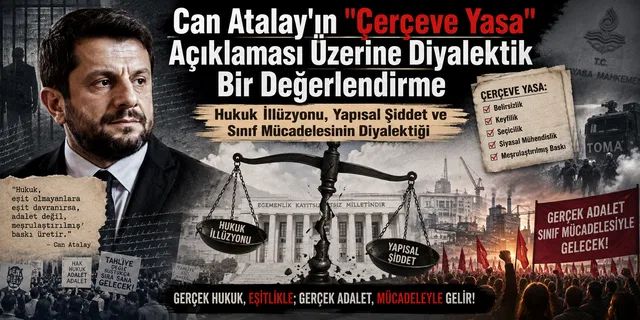
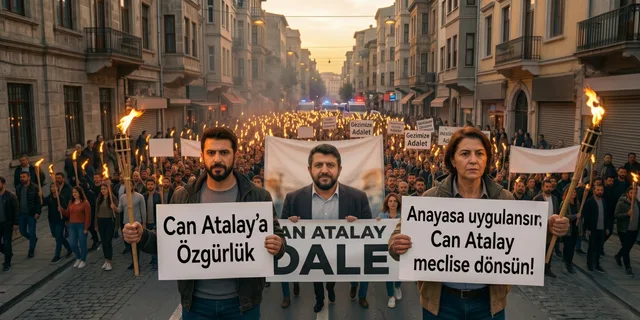
The same morning in Silivri. Can Atalay, the elected MP for Hatay, began a 24-hour hunger strike on the day Parliament opens. His demand is one sentence: that, as the Constitutional Court (AYM) ruled, his name be written again on the parliamentary roll, that he be released, and that he take the oath and begin his duty. His words: "The knife has now reached the bone."
This lawlessness in figures. Atalay has been in prison for 1,620 days. 1,236 days have passed since he was elected. 1,072 days have passed since the Constitutional Court's first violation ruling, and 791 days since the ruling that held the stripping of his seat "null and void". And through all of this time Hatay, a city that had only just come out of the earthquake, was left without a representative it had elected.
What does this piece tell? That the parliament opening today is not the counterpart of the people's will. The simplest, the barest proof is Can Atalay: a judgment that is not carried out despite so many court rulings, the seized will of Hatay's voters. The piece moves in four steps:
- How was the law broken? We tell the Can Atalay file day by day, article by article: Articles 83, 84, 85 and 153 of the Constitution, the Constitutional Court's three rulings, the Court of Cassation twice refusing to recognise the ruling, a criminal complaint against the Constitutional Court judges, a decision read in the General Assembly as "final" when it was not, and the "single signature" that was never entered on the roll. We ask why the same parliament did in a few months, for Berberoğlu and for Gergerlioğlu, what it has not done for Atalay in three years.
- How was Parliament made functionless? Atalay is not an exception; he is the summary of a ten-year process. From the wholesale lifting of immunities in 2016 to the "laws" issued by state-of-emergency decree-laws that bypassed Parliament, from the 2017 referendum's transfer of legislative power to presidential decrees to unanswered written questions, to opposition bills that are not even put on the agenda, and to trustees, we tell how Parliament was turned, step by step, into an office of approval.
- Atalay is not alone. We set side by side the lawlessness of the last two weeks: a fund plunder of 800 billion lira, T24 shut down one morning, the pensioner Ali Şekeroğlu who lost his life in front of the Constitutional Court, humour put on trial. Looked at one by one they are "events"; set side by side they are the picture of a class law.
- What is Parliament for? We compare the Palace's parliamentary agenda and the class's parliamentary agenda in two columns, leave questions for the opening day, and propose concrete tasks.
Our main thesis is this: The parliament opening today is not the counterpart of the people's will. A parliament that cannot enter on the roll the member the people elected, despite court rulings, is not representing the will; it is registering the will's seizure. A parliament that cannot enter its own member on the roll cannot protect the savings of hundreds of thousands of workers, the worker's life, or the pensioner's honour either. As long as Atalay's seat stays empty, the voice of everyone that seat represents stays empty too.
Dear Young Comrades,
Today the schools tell of a ceremony called "the opening of Parliament": a red carpet, protocol, applause. I want to tell you about another opening. In Marmara Prison in Silivri, a lawyer and an elected MP decided this morning not to eat. While a red carpet is laid in Ankara, a plate is turned away in Silivri.
We cannot understand today without putting these two images in the same frame. Because we understand what Parliament is for by looking at whom it lets in through the door and whom it leaves outside.
Schoolbooks define Parliament as "the place where the national will manifests": the place where the people's will appears. Looking at the parliament that opens today with this definition, a problem appears. Hatay's voters went to the ballot on 14 May 2023, declared their will, the election board registered that will with a certificate of election, and the Constitutional Court said in three separate rulings that this will is legally valid. And the bearer of this will is today not in the General Assembly but in Silivri. This gap between the people's will and Parliament's composition is the simplest answer to the question of what today's parliament is for.
Let us first set the facts down calmly. Then let us ask the questions.
Who is Can Atalay?
Can Atalay is a lawyer born in Hatay. He spent most of his profession on workplace deaths, the right to the city, and social cases: he was the families' lawyer in the Soma mine massacre case; he took part in the urban-renewal and green-space struggles in Istanbul, inside Taksim Solidarity. In 2013 he was among the defenders of Gezi Park.
So what stands before us is not "a politician" but a jurist who practised his profession on the side of the class. This detail matters: the apparatus that tried Atalay is the same apparatus he faced, at Soma, across from the bosses' lawyers.
On 25 April 2022, in the Gezi case, he was sentenced to 18 years in prison on a charge of "aiding an attempt to overthrow the government", and he was arrested the same day. The case had not yet become final; the file was at the regional court and at the Court of Cassation.
A year later, on 14 May 2023, while he was in prison, he was elected MP for Hatay on the list of the Workers' Party of Turkey (TİP). Three months had passed since the earthquake. A city that had come out from under the rubble entrusted its voice to a lawyer in prison. The election board gave him his certificate. That is, Atalay's election is an undisputed, legally registered fact.
What follows is the record of how a state under the rule of law was suspended, step by step.
The law, step by step: a chronology
| Date | What happened? |
|---|---|
| 25 April 2022 | Istanbul's 13th Heavy Penal Court gave Atalay 18 years in prison in the Gezi case; he was arrested. The ruling was not final. |
| 14 May 2023 | He was elected MP for Hatay on the TİP list; his certificate of election was issued. |
| 13 and 17 July 2023 | The 3rd and 4th Criminal Chambers of the Court of Cassation rejected the requests for release. |
| 21 July 2023 | His lawyers made an individual application to the Constitutional Court. |
| 28 September 2023 | The 3rd Criminal Chamber of the Court of Cassation upheld the 18-year sentence. That is, the judgment was "made final" after he had been elected. |
| 25 October 2023 | The Constitutional Court: the "right to be elected and to engage in political activity" and the "right to liberty and security" were violated. The file was sent to the first-instance court for a retrial, release, and a stay of the proceedings. |
| 8 November 2023 | The 3rd Criminal Chamber of the Court of Cassation did not comply with the Constitutional Court ruling; it claimed the Court had exceeded its authority and filed a criminal complaint against the Court's members. |
| 21 December 2023 | The Constitutional Court ruled a violation for the second time; it said that the failure to carry out the first ruling was itself a violation. |
| 3 January 2024 | The Court of Cassation announced that the Constitutional Court ruling "had no legal value" and sent the judgment to Parliament. |
| 30 January 2024 | The judgment, treated as final, was read in the General Assembly; Atalay's seat was stripped. A brawl broke out in the chamber. |
| 2 February 2024 | His lawyers and the Republican People's Party (CHP), under Article 85 of the Constitution, applied to the Constitutional Court for annulment. |
| 1 August 2024 | The Constitutional Court: there is no final judgment; the decision read in the General Assembly produces no legal result; the stripping of the seat is null and void. |
| 16 August 2024 | At the extraordinary General Assembly convened for Atalay, opposition MPs were attacked from the AKP benches; TİP MP Ahmet Şık was punched, blood was shed. The roll was not updated. |
| 2024–2026 | An application to the European Court of Human Rights (ECtHR); the ECtHR asked Turkey for its defence. Atalay petitioned the Speaker's office in March and April 2026, and on 23 April 2026 made the call "One signature is enough"; no reply came. |
| 1 October 2026 | On the first day of the new legislative year, a 24-hour hunger strike: "By the Constitutional Court's ruling, my name will be written back onto the roll." |
Read the table once more. The two highest organs of the law stand against each other; one says "a right was violated", the other says "your ruling is null, and I am sending you to the prosecutor too". The executive stands openly with the Court of Cassation. The legislature, that is Parliament, steps aside and watches at the very place where it should decide about its own member.
How the law was broken: five breaking points
Legal texts often look dull to the young. But in this file the texts are very clear; the breaking is just as clear. Let us gather it at five points.
The first break: immunity was never put to work
Article 83 of the Constitution says: "A deputy who is alleged to have committed an offence before or after the election cannot be detained, interrogated, arrested or tried unless the Assembly so decides."
There is an exception: the case of being caught in the act of an offence requiring a heavy penalty, and offences falling under Article 14 of the Constitution "provided that an investigation was opened before the election". The Court of Cassation rested its whole stance on this exception: the Gezi case falls under Article 14, therefore there is no immunity.
The Constitutional Court said this: the moment Atalay was elected, legislative immunity came into force. Because the exception is a provision that limits fundamental rights, it must be interpreted narrowly; in this file, neither statute nor settled case-law regulates, in a foreseeable way, where the exception is to be applied. Therefore the proceedings must stop and he must be released. What Atalay says today is the same: "On the day I was elected, the proceedings should have stopped, I should have been released, and I should have taken the oath and begun my duty."
That is, the argument began as an argument about legal interpretation. But in a state under the rule of law it is clear who ends an argument about interpretation. This takes us to the second break.
The second break: the Constitutional Court ruling was treated as "nothing"
Article 153 of the Constitution: "Constitutional Court rulings are published at once in the Official Gazette and bind the legislative, executive and judicial organs, the administrative authorities, and natural and legal persons." Articles 50 and 66 of Law 6216, which regulates the individual application, also order the courts to do what a violation ruling requires.
There is no rider in these provisions saying "if the Court of Cassation sees fit". The 3rd Criminal Chamber of the Court of Cassation twice, on 8 November 2023 and on 3 January 2024, refused to carry out the Constitutional Court ruling. And the first time, it sent the Court's members to the prosecutor with a criminal complaint.
It is worth stopping here. In a place where a lower court can treat as "nothing" a ruling the Constitution says "binds everyone", the Constitution is no longer a legal text; it is a letter of recommendation. Whoever is strong decides whether to follow that recommendation.
The third break: a judgment that was not final was read as "final"
Under Article 84 of the Constitution, the fall of a seat in the case of "a final conviction" "occurs when the final court decision on the matter is notified to the General Assembly."
The key word is "final". The Constitutional Court's violation ruling had removed the process on which the judgment's becoming final rested; a retrial had been ordered. That is, what was read in the General Assembly on 30 January 2024 was not, in the Constitutional Court's words, "a final judgment", but the announcement of a de facto situation. The Speaker's office stripped its own member's membership by relying on a finality that did not legally exist.
The fourth break: the "null and void" ruling went unanswered in Parliament
Article 85 of the Constitution gives a deputy whose seat is stripped, and their party, the right to apply to the Constitutional Court within a week. The application was made. On 1 August 2024 the Constitutional Court spoke plainly: there is no final judgment, the stripping is null and void, and for that reason there is not even a need to give an annulment ruling.
What does "null and void" mean? In legal language, an act is so gravely defective that it is deemed never to have been born. That is, according to the Constitutional Court, Atalay has never lost his seat since 30 January 2024. Legally he is still the MP for Hatay today.
What this ruling requires is a single administrative act: that the Speaker's office enter Atalay again on the roll of deputies. Neither a new law nor a vote is needed. The name of Atalay's call in April 2026 comes from here: "One signature is enough."
That signature has not been put for 791 days.
The fifth break: the legislature suspended its own reason for existing
The heaviest result of this file is not Atalay's personal situation but the decision Parliament gave about itself. On 16 August 2024, in the extraordinary General Assembly convened for Atalay, the argument ended in punches; TİP MP Ahmet Şık's face was left covered in blood. That day Parliament announced this: under this roof, to defend a constitutional right means accepting that one may be physically attacked.
Speaker Kurtulmuş is the person who, in work under his own speakership, had it written that "administrative obstacles must be removed". But when the matter comes to a member of his own institution, the administrative obstacle sits precisely on his own desk.
A parliament's first duty is not to hand to anyone the power to decide who those who elected it are. This power was won in England in 1689, in France in 1789, and in Ankara in 1920, always with the same question: Who can keep inside the one the people elected? Today the Assembly has accepted the Court of Cassation's answer, and the Palace's, to this question.
There is a precedent: the same parliament did this twice
The strongest evidence against the defence that "there is nothing the Speaker's office can do, this is a judicial decision" is Parliament's own past.
- Enis Berberoğlu (CHP): His seat was stripped on 4 June 2020. The Constitutional Court ruled a violation in September 2020; the first-instance court resisted; the Constitutional Court said violation a second time. In February 2021 Istanbul's 14th Heavy Penal Court complied with the Constitutional Court ruling and Berberoğlu became an MP again.
- Ömer Faruk Gergerlioğlu (HDP): His seat was stripped on 17 March 2021. The Constitutional Court ruled a violation on 1 July 2021; two weeks later Gergerlioğlu was an MP again. In his own words, the Speaker's office had said to him, "Sorry, you may come."
So the path is known, the procedure is known, the precedent is known. A few months were enough for Berberoğlu, two weeks for Gergerlioğlu. 1,072 days were not enough for Can Atalay. The difference is not in the law; it is in a political decision. Atalay's not being entered on the roll is not a legal gap; it is a conscious choice: to disregard the will of Hatay's voters.
Atalay is not an exception, he is the summary of a system: how was Parliament made functionless?
It is easy to look at Can Atalay's seat and say "this is a deviation". But, young comrades, this seat is a miniature of what has happened to Parliament in the last ten years. The people's will finding no counterpart in Parliament did not happen in a day; it was built by moves that followed one another, each set upon the one before. Let us look in order.
2016: immunity was lifted wholesale
On 20 May 2016 Parliament, by adding a provisional article to the Constitution, lifted immunities at a single stroke for all the summaries of proceedings prepared up to that day. The ordinary procedure is a separate file for each deputy, examination by a joint committee, and a General Assembly vote; that is, the deputy has the right to defend themselves. The provisional article suspended this procedure. Its direct result was the arrest, in November of the same year, of a large number of deputies, including the co-chairs of the HDP. Selahattin Demirtaş was kept in prison for years despite the release ruling the ECtHR Grand Chamber gave in 2020.
The first lesson was this: Parliament can lift, with its own hand, the guarantee of its own members. The legal ground of what Can Atalay is living today was laid that day.
2016–2018: a "law" without Parliament, through the state of emergency and decree-laws
The state of emergency declared on 20 July, after the 15 July 2016 coup attempt, was extended seven times and lasted until 18 July 2018. The more than thirty state-of-emergency decree-laws issued in these two years are one of the greatest breaks in Turkey's legislative history.
Let me say simply what a decree-law is. Normally a law is made like this: a bill is prepared, it is debated in committee, the articles are discussed one by one in the General Assembly, the opposition moves amendments, it is voted, the President approves, the Constitutional Court reviews. A state-of-emergency decree-law, by contrast, is issued by the Council of Ministers and enters into force on the day it is published in the Official Gazette. Parliament's approval comes afterwards, often months later; in the meantime the decree has already been applied, and people have already been dismissed from their jobs.
What was done with the decree-laws? According to figures compiled by the OMCT:
- About 130 thousand public employees were dismissed; more than 4 thousand judges and prosecutors were removed from the profession.
- The work permits of more than 22 thousand teachers were cancelled.
- Hundreds of associations and foundations, and more than 160 media outlets, were shut down.
- Of the more than 126 thousand applications made to the Inquiry Commission on the State of Emergency Measures, only 16 thousand were accepted.
Among these dismissals were thousands of trade unionists, academics and teachers who had nothing to do with the coup. The Academics for Peace, workers who were members of KESK, municipal employees working in the Kurdish provinces were written on the same lists. From the point of view of the working class, the state of emergency worked less as an instrument of "fighting a coup" than as an instrument for liquidating union and opposition organisation. The postponement of strikes also became ordinary in this period.
The real danger of the decree-laws was this: the state of emergency ended, but the emergency powers did not. Law 7145, issued in July 2018, carried many of the state-of-emergency powers (dismissal from the public service, detention periods, powers given to governors) into ordinary law. That is, the exception was made permanent. And the Constitutional Court refused to review the decree-laws during the state of emergency; Parliament's being bypassed was completed by constitutional review's being bypassed.
The result: decisions that changed the lives of millions of people entered into force without being debated for a single minute at Parliament's rostrum. The organ that should represent the people's will left the work of making law, in practice, to the executive.
2017–2018: the decree-law went, the presidential decree came
The referendum of 16 April 2017 was accepted, under state-of-emergency conditions, in the shadow of the Supreme Election Council's decision at the ballot box to "count unstamped ballots as valid", by 51.4 percent. The Presidential Government System, which entered into force in July 2018, turned the practice of the state of emergency into the constitutional order:
- Legislative power was divided. The decree-law was abolished and the presidential decree put in its place. The executive can now set rules directly, "on matters relating to the executive", without taking authority from Parliament. A wide field, from the establishment of ministries and public institutions to senior appointments, from the structure of regulatory agencies to some economic regulations, left Parliament's hands.
- The instruments of oversight were dismantled. The motion of censure and the oral question were abolished. Ministers bear no political responsibility to Parliament; Parliament has no way to bring them down. What remains is the written question; we will see its fate below.
- Even the power of the purse was pierced. A parliament's historical reason for existing is the power of the purse: "No taxation without representation." In the new order, if Parliament does not adopt the budget, the previous year's budget is applied, increased by the revaluation rate. That is, a budget procedure in which even Parliament's saying "no" produces no result.
- A single office in place of an elected organ. When Parliament's will and the Presidency's will conflict, it is no longer even a matter of debate to whom the last word legally and in practice belongs.
Let us say this in the language of class: in bourgeois democracy Parliament is a field where the conflicts of interest among fractions of the ruling class are bargained, and where the labouring classes can, even if to a limited extent, add their voice to this bargain. Authority piled onto the executive narrows this bargaining table; decisions are now taken at the table of a few people, in a direct relation with the strongest sections of capital. Parliament's becoming functionless also means the muting of that narrow voice of the workers.
Today's Parliament, in figures
Formally, Parliament is working. According to the Assembly's own activity report, in the last legislative year the General Assembly held 125 sittings, 36 laws were adopted, 50,276 written questions were submitted, and it was announced that 69 percent of them were answered. But looking inside the figures, another picture comes out. According to Kısa Dalga's December 2025 compilation, in the 28th term:
| Indicator | Situation |
|---|---|
| The rate at which written questions are answered within the time the Constitution provides | Around 14 percent; the rest were either never answered or answered after the time had passed |
| Bills submitted by the opposition | 2,957 bills; none was put on the General Assembly agenda |
| Bills of the ruling party | All of 100 bills became law |
| The time from a bill's arrival at the Speaker's office to the General Assembly's approval | 27 days on average |
| The number of "omnibus laws" in the 27th term | 87 omnibus laws amending 378 separate statutes |
The difference between "69 percent were answered" and "14 percent were answered on time" is functionlessness itself: the question is asked, but when the answer arrives the subject has long since closed. Remember the questions Ahmet Şık submitted in the fund crisis; what use, to anyone, is an answer that will arrive months after the door has closed, to a question that asked who got out before the door closed?
The omnibus laws are a separate story. A tax restructuring and an energy and mining regulation, a social-security article and an incentive for capital, are put into different articles of the same law. To say "yes" to one article, the deputy is forced to say "yes" to the other as well. While the public debates one heading, a regulation in capital's favour passes through another article. Those who follow Akbelen, the mining sites, the coasts, know this method very well.
Appointees in place of the elected: the trustee
The seizure of the people's will did not happen only in Parliament. Since 2016, most of the elected mayors in the Kurdish provinces have been removed and trustees appointed in their place; in recent years this practice has reached the municipalities of other parties as well. As we said when we wrote on Selçuk Mızraklı's release, a trustee is not a technique of administration; it is the removal of the budget and of the urban commons from oversight. The voter who goes to the ballot elects a mayor; Ankara appoints someone else. Hatay's empty seat in Parliament and the empty mayoral chair of a municipality to which a trustee was appointed are products of the same logic.
Let us gather it: what was taken from Parliament's hands
| Parliament's power in the constitutional order | Its situation in practice today |
|---|---|
| To make law | An important part passed to the executive through state-of-emergency decree-laws and presidential decrees; the rest was turned into rapid approval through omnibus laws |
| To oversee the government | The motion of censure and the oral question were abolished; most written questions are not answered on time |
| The power of the purse | In place of a budget that is not adopted, the previous year's budget is applied, increased |
| To protect its members | In 2016 immunities were lifted wholesale; elected people were arrested |
| Stripping and restoring a seat | In Atalay's case a judgment that was not final was read; despite the Constitutional Court's "null and void" ruling, the roll has not been updated for 791 days |
| The opposition's right to propose laws | Thousands of bills are not even put on the agenda |
| To represent the people's will | An elected MP is in prison, a trustee sits in an elected mayor's place |
A young comrade looking at this table rightly asks: then what is opening today? What is opening is a building and a ceremony. But a parliament in the sense of the place where the people's will appears is not exactly opening today. Can Atalay's seat is the place that makes this fact impossible to hide.
Why does bourgeois law behave like this?
As a Marxist, we also have to break an illusion here. To say "the rule of law is being broken" is true, but incomplete. Because this breaking has a direction.
Marx says that law is not a referee above classes, that it is the expression of particular relations of production. The great promise of bourgeois law is equality: everyone is equal before the law. This promise is a real gain, and we defend it. But the same law shows one more thing in moments of crisis: the rule bends where it touches the interest of the ruling class.
This is what happens in the Atalay file. Constitutional Court rulings are applied in a tax dispute of Türk Telekom, or of a holding. They are applied in a planning case of an energy company. But when what is in question is Soma's lawyer, Gezi's defender, an MP from a workers' party, the provision "the Constitution is binding" turns at once into "a matter of interpretation".
In short: law is a material that hardens or softens according to class. Let us not say this in the abstract. Let us look at the last two weeks.
Atalay is not alone: the law of the last two weeks
A fund plunder of 800 billion lira: "effective remorse" for whom, "wait" for whom?
The fund crisis we told step by step in our stock-exchange file is presented today as Parliament's "first item". Let us recall the figures: the more than 130 funds of seven portfolio companies were put into liquidation on 17 September. The size of the funds is over 800 billion lira, and the number of investors affected is between 455 thousand and 514 thousand. According to Medyascope's compilation, Finance Minister Şimşek had accepted the manipulation on 4 November 2025; from that date until the intervention, the size of the funds went from 297 billion lira to 800 billion.
That is, the mechanism worked for eleven months in front of the state's eyes. We discussed this through Ahmet Şık's written questions in Who Got Out Before the Door Closed?, and through the claim of a "controlled demolition" in Control for Capital, the Blast for Us.
The latest developments show the two faces of class law in the same week:
- Above: Fatma Betül Sayan Kaya, AKP Deputy Chair and former Minister of Family, resigned her posts on 26 September, without answering the allegation directly, after YENİ Party spokesperson Zeynel Emre's allegation that she and her husband had invested about 163 million lira and withdrawn more than 2.1 billion. The prosecutor's office asked for measures against the family members' assets. An allegation is an allegation; the presumption of innocence holds for everyone. But the question that has to be asked is this: knowing who got out before the door closed requires access to which information?
- Below: On the night of 30 September the Capital Markets Board (SPK) decided that, in the funds under liquidation, investors whose net investment is under 1 million lira may be paid an interim amount up to that sum. Minister of Justice Akın Gürlek announced that there are 217 suspects and 56 people in detention, that the villas and vehicles seized will be transferred to a pool at the Savings Deposit Insurance Fund, and that "the first priority is the small investor". This is a gain of public pressure, and priority for the small investor was a demand we too defended from the first day. But note: the interim payment is presented like a favour; when it will be paid, at what price, and onto whose back the remaining loss will be loaded, is still unclear.
Two laws side by side: on one side "effective remorse", resignation, and the calm of "let the process run"; on the other, "wait your turn", said to hundreds of thousands of people who put a retirement bonus, a child's school fees, into the fund.
And the tie to Can Atalay is here: those who had been raising the fund plunder in Parliament for years were the MPs of Atalay's party. The seats from which Parliament can ask questions in the name of the class worked one short.
A newspaper shut down one morning: T24
On 29 September, by a ruling of Istanbul's 1st Criminal Court of Peace, access to T24 was shut down. We told it in detail in They Shut Down What They Cannot Buy: the pretext is "morality", but in the same days the accounts of economists discussing the fund crisis were being shut down too. Censorship on the pretext of morality and censorship on the pretext of "economic stability" serve the same interest: let there remain no one who asks who got out before the door closed.
Here too the court is a criminal court of peace; that is, an institution the Constitutional Court has criticised again and again for "violating freedom of expression", and which the European Court of Human Rights has also found problematic. A judiciary that can shut down a news site with a single signature refuses to have an MP written onto the roll with a single signature.
A pensioner in front of the Constitutional Court: Ali Şekeroğlu
On 25 September in Ankara, Ali Şekeroğlu lost his life at the pensioners' organisations' action in front of the Constitutional Court. On the banner in his hand was written "Not for money, for our honour". The pensioners were at the Constitutional Court's door with a claim of unconstitutionality about the pension regulation.
Think: the pensioners trust the law and go to the Constitutional Court's door. Can Atalay trusts the law, applies to the Constitutional Court, and wins. But the ruling he won is not carried out. The lesson for the class is clear: a Constitutional Court ruling means something only if there is a social force that will impose its being carried out.
Handcuffs on humour: Deniz Göktaş
On 28 September the comedian Deniz Göktaş's first hearing was held, and he was released the same day. As we saw in the Göktaş file, a laugh can be counted a "crime"; but a mechanism of 800 billion lira working for eleven months can be described as a "temporary and manageable" problem.
And those who are not counted
In his statement Atalay recalled them all in one sentence: "Hundreds of elected people, politicians, journalists, artists are being held in prisons, unjustly and unlawfully, only because of their political stance." Mayors removed and replaced by trustees, journalists detained for years, bosses who go unpunished in workplace deaths, workers put out of the door because they joined a union. All of them are lines of the same list.
Two agendas: the Palace's parliament, the class's parliament
In today's opening speech we will most likely hear the stress on a "new and civilian constitution", "Terror-Free Turkey", "the fight against inflation", and, in the fund crisis, "there will be a reckoning". Behind each of these headings there is a class choice. Let us compare them in two columns:
| The Palace's parliamentary agenda | The class's parliamentary agenda |
|---|---|
| The talk of a "new and civilian constitution" | First, the application of the existing Constitution: Can Atalay's entry on the roll and his release, as the Constitutional Court rulings require |
| "A strong executive, a fast decision" | The return of Parliament's powers of legislation, oversight and the budget; the return of the motion of censure, a sanction for written questions not answered on time |
| The narrative that the state-of-emergency period "has closed" | The reinstatement and compensation of the trade unionists, teachers and academics dismissed by decree-law; the lifting of the emergency powers made permanent by Law 7145 |
| In the fund crisis, "those responsible will give an account" | A public investigation of who had access to the information in advance; a full breakdown of the fund transactions of politicians and their relatives; in the liquidation, the loss to be met from the assets of the founders and the related companies |
| An "interim payment" to the small investor | The timetable and the price of the payment secured by law; labour organisations and investor representatives sitting in the SPK's administration |
| The 2027 budget: interest payments and "fiscal discipline" | The pension and the minimum wage drawn to the poverty line; the tax burden shifted from the wage-earner to capital |
| The 13th Judicial Package: "speeding up trials" | The abolition of the criminal courts of peace; the end of impunity in workplace deaths; a sanction for the public official who does not comply with Constitutional Court rulings |
| A Booking law, a tobacco law | Judicial review of internet access bans; the reopening of T24 and of the accounts that were shut down |
| The "Terror-Free Turkey" commission | Peace arriving together with democracy: the end of the trustee practice, the reinstatement of the elected |
| A call to the opposition for "responsibility" | The impartiality of the Speaker's office, and a sanction for deputies who use violence in the General Assembly |
The left column is the agenda of the apparatus rearranging itself. The right column is the agenda of the worker demanding what they are owed from this apparatus. At the top of both columns stands the same question: Will the Constitution be applied?
Parliament is opening, but what is it for? Open questions
In the last part of this piece I choose to ask questions rather than give answers. Because the questions that should be asked in the General Assembly today will show, of themselves, what Parliament is for.
On the Constitution:
- Why does a parliament that wants to make a "new constitution" not apply Article 153 of the existing Constitution? Who, and why, should believe that an article not applied today will be applied in a new constitution to be written tomorrow?
- On what authority does the Speaker's office rely, continuing for 791 days an act the Constitutional Court called "null and void"?
- Is the decision of a chamber that filed a criminal complaint against the members of the Constitutional Court above the Constitution?
On Parliament itself:
- A parliament that has left an important part of its laws to decrees, its oversight to unanswered questions, and the power of the purse to automatic increases: when it opens, what has it opened?
- While the files of the tens of thousands of workers dismissed by decree-law are still not closed, why is the repeal of the laws that carried emergency powers into ordinary law not on this legislative year's agenda?
- If not a single one of the thousands of bills the opposition submitted comes to the General Assembly, where is the will of the millions who voted for those deputies?
- Why can the act done in a few months for Berberoğlu, and in two weeks for Gergerlioğlu, not be done for Atalay in three years? Is the difference the law, or the class Atalay represents?
On representation:
- After the earthquake, in the middle of the rubble, the container cities and the reconstruction tenders, Hatay has for more than three years been without the voice of an MP it elected. How many seats were missing for asking in Parliament who took the housing tenders in Hatay?
- In a system where an elected MP can be kept in prison, what is the ballot a guarantee of?
On the fund:
- If the Finance Minister accepted the manipulation in November 2025, what information was given to Parliament in the eleven months in between?
- Among those who got out before the door closed, are there politicians, bureaucrats, or their relatives? When will this list be opened to the public?
- Will the inquiry commission, if it is set up, hear the fund founders and the banks that fed them; or will it look only for "a few people of bad intent"?
- In the interim payment, onto whom will the remaining loss above 1 million lira be written?
On the law:
- If a criminal court of peace can shut down a newspaper in a day, why can the Speaker not make an entry on the roll in three years?
- Pensioners are waiting at the Constitutional Court's door, Atalay with the Constitutional Court's ruling in his hand, journalists with the Constitutional Court's case-law in their hands. When will the turn come of those who wait, trusting the law?
And the most basic question:
- Is this parliament the parliament of 85 million, or of those who got out before the door closed?
What do we learn, from the point of view of class?
This file teaches us three things.
First, law is a relation of force. On paper the Constitutional Court ruling is on Atalay's side. But a right on paper remains a wish unless there is an organised force that will have it carried out. No one but the working-class movement that had these gains written down defends the gains of bourgeois democracy, that is, the right to elect and be elected, the independence of the judiciary, the freedom of the press.
Second, Parliament's value is measured by which class those inside it represent. Lenin sees parliament as a "rostrum for speaking"; he does not reject it; but he knows that the real power is in the street, in the workplace, in the organisation. This is why Can Atalay's seat matters: that seat shows that Parliament's rostrum can, for a moment, be the rostrum of Soma, of Hatay, of the fund victim, of the pensioner. This is also why the rulers keep that seat empty with such obstinacy.
Third, "No one but ourselves will save us." This sentence of Atalay's is today's counterpart of the Internationale's principle, "There is no liberation on one's own." Neither the Constitutional Court, nor the ECtHR, nor the Speaker's conscience will open this door alone. The crowd gathered in front of the door opens the door.
Concrete tasks
Dear young comrades, what can be done today and in the weeks ahead:
Today:
- Make Can Atalay's hunger strike visible. In what you share, write not only solidarity but the demand: "Let the Constitutional Court ruling be carried out, let Can Atalay be entered on the roll."
- Listen to the opening speech and note how many times the word "Constitution" is spoken, and whether the name "Can Atalay" is spoken even once. What is not said tells more than what is said.
This week:
- Write to the deputies of your own province. The contact details of every deputy are on the Assembly's website. Ask one question: "What did you do for the Constitutional Court's ruling of 1 August 2024 to be carried out?" Record the replies, and the silences.
- Talk with people you know who were harmed by the fund. Help them learn how to apply for the interim payment; but also tell them that they have to move together. There is a great difference between 500 thousand scattered people and an organised platform of investors and workers.
In the months ahead:
- Follow the Central Bank's presentation on 6 October and the budget that will come to Parliament on 16–17 October. Compare, in the budget, the share of interest payments with the share of pension and health spending; this ratio is the most concrete document of whom Parliament works for.
- If a fund inquiry commission is set up, follow its meetings: who is heard, who is not heard? Keep a table.
- At your school, at your workplace, in your neighbourhood, organise a reading or a talk under the heading "Let the Constitution be complied with." You can use the chronology in this piece, and the five breaking points.
For good:
- Acquire a literacy in the law. Read Articles 14, 83, 84, 85 and 153 of the Constitution once, from beginning to end. Whoever does not know their right does not notice that their right has been broken either.
- Join a union, a professional organisation, a democratic mass organisation. This is the main lesson of this piece: a right is the right of the one who is organised.
Close: the empty seat
Today there are 600 seats in the General Assembly chamber. One of them is empty, though legally it ought to be full. Those who walk the red carpet, those who applaud, those who enter the ceremony photograph, will pass by that empty seat.
That seat is not only Can Atalay's. It is the seat of the teacher who lost their savings in the fund plunder, of the pensioner who died at the Constitutional Court's door, of the reporter of the newspaper that was shut down, of the person from Hatay who lost their home in the earthquake and lives in a container. As long as the seat stays empty, Parliament is saying something to us: This is not your place.
To understand whether a parliament is the counterpart of the people's will, there is no need for complicated constitutional theories. It is enough to look at a single question: is the person the people elected, the person the courts said "has been elected, must begin their duty", in that chamber today? As long as the answer is "no", what opens today is not the people's parliament but a chamber in which the people's will is seized.
Our answer is this: Parliament is a building paid for with our labour, the Constitution is the record of rights written by our struggle, and that seat is ours. We will go on asking until we take it back:
Parliament is opening. But what is it for?
Salute to Can Atalay. His hunger is this country's hunger for the law.
Update
1 October 2026, 09.45 — This piece is published before the opening speech. President Erdoğan's speech at 14.00, the reactions in the General Assembly, and developments concerning Can Atalay's hunger strike will be added to the piece. A regular update will follow.
Sources
Can Atalay and the hunger strike
- ANKA News Agency, "A 24-hour hunger strike from Can Atalay and a call to Parliament: by the Constitutional Court's ruling my name will be written back onto the roll", 1 October 2026
- Medyascope, "Can Atalay on a 24-hour hunger strike: 'The knife has now reached the bone'", 1 October 2026
- Başka Gazete, "Can Atalay began a 24-hour hunger strike", 1 October 2026
- Yeni Ankara, "Can Atalay announced that he was beginning a 24-hour hunger strike on 1 October", 1 October 2026
- Medyascope, "From Can Atalay to Kurtulmuş on the 106th anniversary of the Assembly: 'One Signature Is Enough'", 23 April 2026
The legal process
- The Constitution of the Republic of Turkey (Constitutional Court website)
- Constitutional Court decisions database, Şerafettin Can Atalay (2)
- Constitutional Court decisions database, Şerafettin Can Atalay (3)
- bianet, "The course of Can Atalay's case"
- Medyascope, "The Court of Cassation once again did not comply with the Constitutional Court's Can Atalay ruling", 3 January 2024
- Medyascope, "Constitutional Court ruling on Can Atalay: the fall of the seat is null and void", 1 August 2024
- Serbestiyet, "What does the Constitutional Court ruling on the stripping of Can Atalay's seat say?"
- Yetkin Report, "The Can Atalay session in Parliament: a fight with punches, blood was shed", 16 August 2024
- BirGün, "A 'Can Atalay' call from Erkan Baş: Parliament should convene before 15 August"
- Gazete Duvar, "The Can Atalay crisis was taken to the ECtHR"
Precedents and Parliament's becoming functionless
- Medyascope, "Istanbul's 14th Heavy Penal Court decided that the Constitutional Court ruling on Enis Berberoğlu be complied with", 8 February 2021
- Medyascope, "The Constitutional Court ruled a rights violation concerning Gergerlioğlu, whose seat had been stripped", 1 July 2021
- bianet, "Gergerlioğlu in Parliament after four months: the people's will won", July 2021
- OMCT, "Briefing note on the legacy of the decree-laws in Turkey"
- Kısa Dalga, "A so-called 'Parliament': the Assembly becoming functionless, in figures", 13 December 2025
- Yeni Şafak, "50 thousand questions from Parliament", 27 September 2026
- Constitutional Court, Yavuz Atar, "The Legal Regime of Presidential Decrees and the Review of Their Constitutionality"
Parliament's new legislative year
- Yeni Birlik, "A new legislative term in Parliament: the first items are the fund investigations and Terror-Free Turkey"
- Habertürk, "Parliament is ready for the new legislative term! It begins with the fund investigation"
- Yeni Şafak, "Heavy work in the new term"
- Hürriyet, Abdulkadir Selvi, "A parliamentary inquiry into the fund scandal is coming"
The fund crisis
- Medyascope, "The fund plunder of 800 billion lira: how it began, how it happened, what could have been done", 30 September 2026
- Euronews, "SPK decision on an interim payment in the funds under liquidation: a payment to the investor of up to 1 million lira", 1 October 2026
- A Haber, "A new period for payment to those harmed by the funds! Minister Gürlek announced it", 1 October 2026
- Euronews, "The fund allegations: AKP Deputy Chair Betül Sayan Kaya resigned", 26 September 2026
Related pieces from Knowledge Commons
- Who Got Out Before the Door Closed? (23 September 2026)
- Control for Capital, the Blast for Us (30 September 2026)
- They Shut Down What They Cannot Buy (30 September 2026)
- The Deniz Göktaş Case and the Class of Humor (28 September 2026)
- 12 September: The History, Balance Sheet, and Present of a Class Coup (11 September 2026)
- Who Is Selçuk Mızraklı and Why Was He Kept Inside for Seven Years? (9 September 2026)
- Not for Money, for Our Honour (25 September 2026)