Daron's Challenge, Elon's Test: Technocapitalism's Fake Duel
Digital Feudalism and Fake Conflicts: Notes for Young Comrades on Technology and Class Struggle

Dear Young Comrades,
These days you are witnessing the staging of a glittering "future" debate in your social media feeds, on digital news platforms, and in channels of popular culture. This debate, presented by the mainstream bourgeois media with enormous headlines, was served up as a "showdown" that flared between technology billionaire Elon Musk and Nobel Prize–winning economist Daron Acemoğlu.
So how exactly did this fake theater unfold?
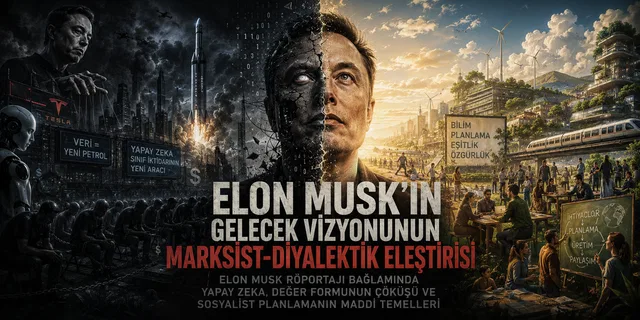
The fuse was lit by the bombastic statements Elon Musk made on a program he joined. Musk claimed that artificial intelligence and robotic technologies would push productive capacity to an unprecedented point, and asserted that within the next 10–20 years the world would pass into an "economy of abundance." According to Musk, by 2036 money's present function would have completely disappeared. Calling on youth and workers, he said, "Don't worry about setting money aside for retirement in the coming years; that won't matter anymore," and painted a utopia in which a "universal high income" would be bestowed on everyone thanks to the overproduction robots would create.
The response to these statements came from the institutionalist wing of bourgeois economics: Prof. Dr. Daron Acemoğlu of the Massachusetts Institute of Technology (MIT). Challenging Musk on his social media account, Acemoğlu—as detailed in the related report in Cumhuriyet—issued this challenge:
"If by 2036 money will no longer matter, commit to donating your roughly $1 trillion fortune to independent charities by 2036 at the latest. That will powerfully demonstrate your faith in technology. It will also calm a public worried about the political influence of billionaires."
From the outside, this dialogue looks like an implacable clash of ideas between two great minds thinking about humanity's future. Yet when we strip away the glittering illusions of the modern world of science and technology and look through a dialectical-materialist lens, what remains is a system-internal fight over power and image. In this article we will smash and present the background of this fake opposition polished by the bourgeois media, and set out our own dialectical-materialist view along the axes of relations of production, property structure, and class struggle.
Thesis: Techno-Messianism and the Illusion of "Abundance"
When you look at the discourses of Silicon Valley capital that Elon Musk represents, you see a new secularized "religion": Techno-Messianism. This ideological approach tears humanity's historical and social problems out of the fields of class struggle, property relations, and political organization, and flings them into the arms of "technological development"—presented as fully objectified and as if it were neutral.
Musk's discourse—"By 2036, thanks to AI and robotics, money will no longer matter; we will pass into a vast economy of abundance"—harbors three fundamental illusions that must be smashed from the standpoint of historical materialism:
Techno-Determinism as an Ideological Curtain
Techno-messianism presents technology as a mysterious power (a kind of modern miracle) independent of society and class relations, advancing on its own and saving everything it touches. Yet Karl Marx, in A Contribution to the Critique of Political Economy and Capital, clearly established the dialectical bond between the productive forces and the relations of production.
Technology is part of society's productive forces; yet these forces never operate in a vacuum. They always exist within a determinate relation of production (that is, a property structure). Today AI models, data centers, and automation lines are the private property of a handful of giant technology monopolies. While ownership of the means of production remains in the hands of the bourgeoisie, a magnificent acceleration in the development of the productive forces does not emancipate humanity of its own accord; on the contrary, it increases capital's domination over living labor, deepens alienation, and widens the social abyss.
The Organic Composition of Capital and the Deepening of Contradiction
The "abundance" Musk speaks of is a shallow illusion that ignores capitalism's own internal contradictions. From the standpoint of Marxist economics, the AI and automation drive is a change in the organic composition of capital. That is: capital reduces the share it invests in living labor (variable capital) and vastly increases the share it invests in machines, software, and robotics (constant capital).
This situation dialectically triggers two great crises:
-
The Surplus-Value Crisis: Under capitalism, the sole source of value is living human labor. Machines and algorithms do not create new value; they only transfer their own value into the product. When the working class is completely liquidated from production, the source of surplus-value that capital can absorb also dries up.
-
Overproduction and the Retirement Lie: Musk says, "Don't save for retirement; everything will get cheap and there will be plenty." But when there is no working class left with purchasing power, who will buy these "abundant" products? In a system where the products produced cannot be sold (realized) on the market, what emerges is not "a paradise in which everyone is prosperous," but a vast crisis of overproduction in which the masses are crushed by poverty while warehouses overflow with unsold goods.
Not "Abundance," but Digital Feudalism and a Regime of Alms
The "society of abundance in which money becomes meaningless" that Musk heralds must not be confused with communism's classless and stateless world. The order in Musk's mind is a model of Digital Feudalism in which capital has completely broken the working class's bargaining power.
In this model the masses, because they no longer have a role in the production process, are stripped of being a social force. The "universal high income" or "basic income" Musk speaks of is not emancipation; it is a digital regime of alms that technology lords would bestow to protect their own survival and to prevent possible revolutionary uprisings by the masses. The meaninglessness of money does not mean the socialization of property; on the contrary, it is the final stage of the masses' dispossession and of their absolute dependence on technology monopolies.
| Techno-Messianic Discourse (Elon Musk) | Material Reality (Dialectical Materialism) |
|---|---|
| "Technology will cut costs; everyone will easily reach everything." | As long as the means of production remain in private ownership, falling costs raise profit margins and bring the people not cheapness but the absence of purchasing power. |
| "In the future there will be no need to work; abundance will reign." | As living labor is withdrawn from production, the reserve industrial army (the mass of the unemployed) will grow and the masses will be marginalized. |
| "Money will no longer matter; retirement will become unnecessary." | What is at issue is not the abolition of money, but the destruction of purchasing power. Precarity is to be made permanent. |
| "With Universal Basic Income everyone will be prosperous." | A control mechanism designed to dampen class struggle and make the masses dependent on the alms of digital feudalism. |
Antithesis: Liberal Reformism and the Trap of "Moral Donation"
Against the crude techno-determinism Elon Musk represents and its illusion of an "economy of abundance," the challenge rising from the world of bourgeois academia—Daron Acemoğlu's "Commit to donating your $1 trillion fortune to independent charities"—was launched in the mainstream media as a radical "critique of the system."
Yet the method of dialectical-materialist thought is obliged to expose the class essence behind glittering headlines. The line Acemoğlu represents is a typical manifestation of liberal reformism and of capitalism's reflex of self-preservation.
The Illusion of Reducing a Structural Crisis to Individual Morality
Liberal economics tears the magnificent inequalities and contradictions capitalism creates from the system's objective laws and reduces them to matters of individual morality, personal intentions, or "bad management." Acemoğlu's approach is exactly this: he seeks the problem not in private ownership of the means of production, but in how the billionaires who hold that ownership use their wealth.
Yet Karl Marx, in Capital, does not accuse the capitalist as an individual; he defines them as capital personified. Even if Elon Musk or another billionaire were personally a "moral" human being, they could not change the objective laws of capital accumulation. Capital, by its nature, is compelled to expand and to raise profit rates. By consigning the historical blockage created by the capitalist mode of production to a capitalist's "conscience" and "donation pledge," Acemoğlu diverts the masses' eyes from the essential contradiction—that is, from property relations.
The Myth of "Philanthropy" and the "Independent Institution"
The greatest methodological illusion in Acemoğlu's challenge is the idea of transferring a trillion-dollar fortune to "independent charities." One must ask: In a capitalist social formation, can there be an institution independent of capital relations?
Historical reality shows us that in bourgeois society "philanthropy" is not the antidote to capitalist exploitation, but its most refined instrument of legitimization and hegemony:
-
Tax Exemption and Wealth Protection: Billionaire foundations are shields that prevent the socialization of wealth and offer opportunities for tax avoidance.
-
Ideological Will: With the funds they transfer, these foundations shape academia, research, and art in line with their own class interests, and domesticate radical ideas through funding mechanisms.
-
Invisible Power: Transferring wealth not to the public but to foundations means that decisions are taken by appointed technocrats. Acemoğlu advocates not the socialization of wealth, but only its transfer within the bourgeois structure to a different elite group.
Restoring the Order: The Function of Dampening Working-Class Anger
This sentence in Acemoğlu's statement confesses the real historical function of liberal reformism: "...This move will calm many people around the world who are worried about the political and social influence of billionaires."
The primary task of liberal reformism is not to transform the system, but to calm the masses who grow angry and tend toward radicalization in the face of the devastation the system creates.
Capital's overaccumulation and the wave of dispossession created by artificial intelligence are accumulating a revolutionary potential among the masses. Acemoğlu takes the stage with the air of a "guardian of the system" and whispers to the bourgeoisie: "If you do not distribute a little of these vast fortunes under the mask of 'philanthropy,' the masses will take your property from you entirely. To calm the masses, throw them a small symbolic portion of your capital as bait."
| Issue / Analysis | Liberal Reformism (Daron Acemoğlu) | Dialectical Materialism (Marxist View) |
|---|---|---|
| Definition of the Problem | Unjust distribution of wealth, institutional inadequacy, and the unchecked power of billionaires. | Private ownership of the means of production and the objective contradictions of capital accumulation. |
| Search for a Solution | The rich donating their fortunes to "charities," better regulations. | Ending the capital class's ownership; socializing the means of production. |
| Construction of "Philanthropy" | A moral and acceptable mechanism that reduces social inequality. | A system valve that consolidates bourgeois hegemony, avoids tax, and anesthetizes the masses. |
| Political Aim | To protect the system from crises, calm popular anger, and restore the order. | To raise class consciousness, expose fake reforms, and turn disorder into revolution. |
Synthesis and Process Analysis: Where Is the Real Contradiction?
The greatest skill of bourgeois thought is to smash the dialectical whole, create two fake poles, and force the masses to choose one of them. The Techno-Messianism (Thesis) Elon Musk represents and the Liberal Reformism (Antithesis) Daron Acemoğlu represents are precisely the two faces of this same coin. One tells you to seek the paradise of the future in capital's technological leaps; the other promises that you can tame the hell that paradise will create with "moral donations."
When we carry out a dialectical-materialist process analysis, we see that both lines are ideological curtains that conceal the essence of the event. So what does the dialectical synthesis tell us? Where is the real contradiction?
Collective Labor and the Seizure of "General Intellect"
In his work Grundrisse, Karl Marx makes an extraordinary forecast and speaks of the concept of "General Intellect." According to Marx, the level reached by social knowledge, science, and technology will become the main motor of production.
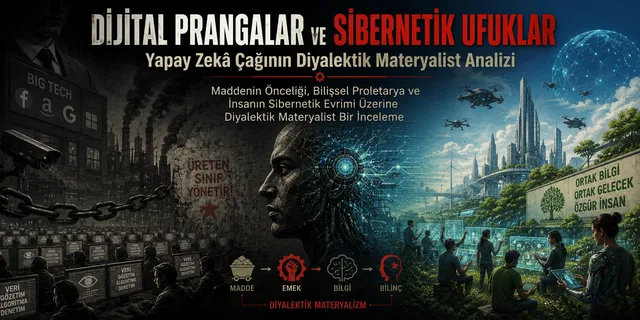
Today artificial intelligence is precisely this: a processed summary of all the written texts, codes, works of art, and scientific discoveries humanity has produced throughout history—that is, of collective social labor. The dataset that trains artificial intelligence is the common heritage of the human species.
The contradiction knots precisely here:
-
The Socialization of Production: The technology and data that feed the means of production are more collective and social than ever in history.
-
The Individuality of Property: This magnificent collective product has been imprisoned in the private property of a handful of technocapitalist companies (OpenAI, Microsoft, Google, Meta, Tesla).
The real contradiction is not between Musk and Acemoğlu; it is between the productive forces created by humanity's common intelligence and the capitalist property relations that seize those forces.
The Jamming of the Law of Value and Capital's Historical Limit
Dialectical process analysis reveals how a system prepares the conditions of its own destruction in the course of its own development. Capitalism, in order to raise profit rates, is constantly compelled to drive living labor (the worker) out of production and put dead labor (automation, artificial intelligence) in its place. Yet this process is pregnant with a dialectical explosion.
The capitalist mode of production takes its foundation from the Law of Value. The sole source of surplus-value is living human labor. To the degree that artificial intelligence and robotics completely liquidate living labor from production, the production of surplus-value also dries up. Where there is no living labor, there is no surplus-value; where there is no surplus-value, profit becomes impossible. Where the masses have no purchasing power, the abundance of commodities produced cannot be sold on the market.
This situation does not evolve of its own accord into the seamless "society of abundance" Musk promises. On the contrary, it is capitalism striking its own historical limit. Under conditions of full automation, capital destroys the reason for its own existence. That is why Musk tries to anesthetize the masses with the lie of "universal basic income," while Acemoğlu tries to delay the system's collapse with the "donation" of trillions of dollars.
The New Class Composition and Revolutionary Potential
The rising wave of automation and artificial intelligence is redrawing the front lines of class struggle. Developers, engineers, designers, academics, and content creators who once saw themselves as separate from the working class are rapidly being dispossessed and precarized.
As artificial intelligence becomes able to substitute even for skilled mental labor, society divides ever more clearly into two poles:
-
On one side, a small technocratic bourgeoisie that monopolizes the means of production, algorithms, and data centers.
-
On the other, a mass of the dispossessed (the modern proletariat) from whom both manual and mental labor have been taken, left without a future.
This situation creates the revolutionary potential that liberal reformists fear and that we Marxists must historically organize.
| Dimension of Analysis | Thesis (Elon Musk) | Antithesis (Daron Acemoğlu) | Dialectical Synthesis (Marxist Analysis) |
|---|---|---|---|
| Fundamental Contradiction | The technical difference between human power and machine efficiency. | Capital's overaccumulation and the lack of institutional regulation. | The social character of production versus the private/capitalist character of property. |
| Owner of Technology | The "visionary" capitalist who carries out the technological leap. | The capital group steered through institutions and foundations. | All of society, which produces historical collective labor and "General Intellect." |
| Systemic Blockage | There is none; technology will solve everything of its own accord. | There is; if unchecked it damages democracy and income justice. | It is inevitable; the Law of Value collapses; overproduction and the fall in the rate of profit deepen the crisis. |
| Locomotive of the Solution | Innovation, robotics, and technology bosses. | State regulations, tax reforms, and bourgeois philanthropy. | Organized class struggle that will seize the socialized productive forces. |
A Comradely Call: Demolishing Illusions and Organizing the Future
Dear young comrades,
Now that we have completed the dialectical analysis of this "trillion-dollar" clash of conceptions and show of challenge between Elon Musk and Daron Acemoğlu, we face the most decisive question: What should we do?
Let us recall that historical principle Karl Marx immortalized in the Eleventh Thesis on Feuerbach: "The philosophers have only interpreted the world, in various ways; the point, however, is to change it."
To analyze, to part the ideological curtains, and to expose the fake heroes of the bourgeois class is the first step; yet it can never be the last. Against the glittering illusions of the modern world of science and technology, the utopian fairy tales of Silicon Valley, and the narcotic sermons of liberal academia, we must come to consciousness of our own historical tasks.
Rejecting Fake Dilemmas and the Illusion of "Two Bourgeois Camps"
To cover up its own crises, the capital order always places two fake options before the masses: on one side, the digital feudalism and techno-dictatorship symbolized in the person of Elon Musk; on the other, the social-democratic reformism and moral philanthropy that Daron Acemoğlu represents.
As young comrades we absolutely refuse to be one side of this constructed stage!
-
We will not be digital slaves who accept dispossession and passivity in exchange for the alms ("universal basic income") a handful of billionaires would bestow, as Musk promises.
-
Nor will we be naïve spectators who, as Acemoğlu proposes, leave capital's right to exploit intact and wait for a few billionaires to grow a conscience in order to calm the masses' anger.
The Emancipation of Technology: From Alienation to Human Potential
Modern Marxism is not hostility to technology. We are not against artificial intelligence, automation, or robotics; we are against the class interests these tools serve.
Under capitalism, artificial intelligence is a threat that alienates the human from their own labor and holds them captive with the fear of unemployment. Yet in a social order freed from capital's yoke (socialism), automation and artificial intelligence become, on the contrary, the greatest material force of human emancipation. They cut necessary social labor time in half. They lift the burden of drudgery from humanity; they create for youth a vast free time in which to engage with science, art, and philosophy.
Our Historical Tasks and Axes of Struggle
For youth sectors that are to be squeezed in the grip of futurelessness, the housing crisis, unemployment, and degraded education, a dialectical-materialist stance today requires clinging in practice to these principles:
-
The Struggle for Socialization: The dataset on which AI models are trained is humanity's common heritage. Against the closing off of algorithms and data centers behind the armor of commercial secrecy, we must raise the demand for public ownership and social oversight.
-
Updating Class Consciousness: Do not see yourselves only as a "student," a "developer," or a "service-sector employee." With the AI wave, mental labor too is being deskilled. The fate of the manual worker and the mental worker is shared.
-
An Organized Materialist Line: Stay away from the superficial debates of social media and from individual recipes for salvation. Take your place in organized structures that unite the theoretical depth of scientific materialism with the practice of mass struggles.
| Issue / Stance | Bourgeois Illusions (Musk & Acemoğlu Front) | Revolutionary Dialectical Stance (Young Comrades) |
|---|---|---|
| Conception of the Future | The digital paradise technology will bring of its own accord, or reformist domestication. | A classless society in which property relations are changed through class struggle. |
| Perception of AI | The patent of a handful of technocrats and an instrument of capital accumulation. | A public value produced by humanity's collective intelligence (General Intellect). |
| Our Social Role | Consumers waiting for alms within the system, or a passive mass begging for philanthropy. | The subject of class struggle—the motor of history—and the builder of the future. |
| Line of Action | Watching the debates of iconized names on social media and choosing a side. | Theoretical deepening, organization, and the struggle to socialize the means of production. |
Turn your eyes away from the fake messiahs the media polishes, from billionaires' donation shows, and from the sterile verbiage of academic salons!
Neither the digital feudalism Musk draws nor the bourgeois reformism Acemoğlu takes refuge in can save your future. The future will be written not in the laboratories of a handful of elites, but by the collective will organized in factories, campuses, offices, at code screens, and in the streets.
Smash the illusions, arm yourselves with the dialectical method, and organize to build that revolutionary future in which the means of production will be transferred to where they belong—to society!
The future belongs to the proletarian youth who create and organize it with their hands!