From the Fields of Kırşehir to the Streets of Bağbaşı
The Dialectic of Identity and Rent in Kırşehir

Dear fellow townsfolk of Kırşehir,
At the gathering we held in recent days with valued members of the Yağmurlu tribe—our dear spouses, friends, and relatives—we took great joy in standing side by side and feeling our historical and human bonds. In the modern capitalist world, where alienation has reached its highest stage, it is entirely understandable that people seek to come together, remember their roots, and look for solidarity. We thank from the heart all the friends who put in the labor, laid the foundations, and brought us together at the same table for this precious gathering.
Yet the scientific method requires bringing to light the essence behind appearance. When we look, stripped of idealist and modern ideological illusions, our people's sincere desire to be together is being instrumentalized by the ruling classes and local rent interests, and is being reconstructed through a chauvinist illusion.
We are obliged to examine, through a rational process analysis, the socio-economic destruction stretching from Kırşehir's fields to the neighborhoods of Bağbaşı and Çukurçayır, the dispossession, and the ideological mechanisms that cover it over.
Historical Contradiction and Spatial/Political Punishment
We must reject the bourgeois-idealist conception of history that reads history merely as a chronology of kings, sultans, and palace intrigues. Anatolian history is a process of surplus-value expropriation and domination by the center (palace bureaucracy) over the productive forces on the periphery (Turkmen peasantry and Abdal communities).
-
Foundation and Exclusion: In the thirteenth and fourteenth centuries, the "Abdalan-ı Rum" and Turkmen dervishes—among the founding elements of the state—were excluded from the means of production and from governance as the state centralized and the conscript Kapıkulu bureaucracy became dominant.
-
The Discourse of "Etrak-ı Bi-İdrak": The palace circles' contempt for Turkmen and Alevi-Bektashi people as "Etrak-ı bi-idrak" (witless Turks) is proof of the ruling class's view of the oppressed people. In the Kalender Çelebi and Celali uprisings, the poor people of this geography were bloodily suppressed.
-
The Dialectic of Political Punishment: This history of exclusion continued in changed form in the republican period as well. From the Adnan Menderes era to the present, Kırşehir has been subjected to a deliberate "spatial punishment" because it did not offer unconditional submission to the ruling political powers and preserved its own political preferences. State aid was blocked; the city's development was halted; even the railway network was knowingly and deliberately routed around Kırşehir. The people were to be disciplined through economic deprivation.
Collapse in the Base: Agriculture, Animal Husbandry, and Youth Migration
The ultimate factor determining the social superstructure is material relations of production. The stage reached by peasantry and production in Kırşehir clearly shows the devastation wrought by agrarian capital:
-
Liquidation of Middle Peasantry: The Kırşehir peasant who once sowed sugar beet, barley, and wheat and made a living from animal husbandry is today crushed under the costs of diesel, fertilizer, and feed. The middle peasant forced to empty their barn, unable even to maintain the tractor bought on bank credit, has been turned—even if they still hold land—into the cheap laborer of monopoly companies in practice.
-
Deindustrialization and Migration: Apart from Petlas and Çemaş, no industrial investment or field of employment has been left in Kırşehir. Unable to find work, unable to hold onto their land, Yağmurlu and Kırşehir youth have been condemned to migrate to the big cities and become the metropolises' "reserve army of industry" (cheap labor power).
The Ideology of Rent: Mining Monopolies, Mehter, and Political Opportunism
While Kırşehir's base is being collapsed, our city this time, with its underground riches, whets the appetite of international mining monopolies and local rent groups. Mines opened without restraint are auctioning off water sources and agricultural land.
It is precisely at this point that the function of the Mehter March and chauvinist discourse imposed at festivals and social gatherings comes to light:
Ideological Illusion: Mehter marches and "Homeland, Nation, Tribe" speeches are an ideological cover used to hide international mining monopolies' plundering of Kırşehir's nature, the farmer's debt vise, and youth unemployment.
This opportunistic mentality—unable even within its own associations to operate the most basic internal democracy, defending narrow group interests—attacks the local government chosen by the people of Kırşehir and the Mayor by imposing chauvinist symbols. The arrogance of provincial chairs and bureaucrats who brazenly scold the citizen who seeks their rights and asks questions in the street and the square is the ruling class's desire to sustain its order of exploitation without being questioned.
Anatomy of Hypocrisy: The Abdal Tradition and Commodification
Capitalism conceals the social labor relation behind a commodity. The Abdal tradition in Kırşehir lives precisely this contradiction:
-
Exclusion in Everyday Life: Dispossessed of land, the Abdals have been squeezed into ghettos such as Bağbaşı and Çukurçayır and subjected in everyday life to racist-class discrimination under the label "çıngan."
-
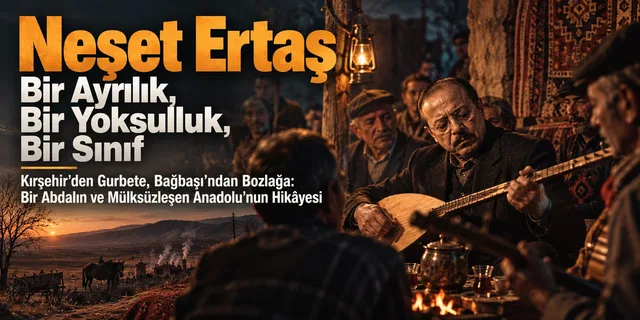
Being Made into Showcase Material: The cry and bozlak produced by the Abdal have been commodified by the ruling culture industry and the state apparatus. While Neşet Ertaş lived in poverty in exile, at his funeral he was made into show material for the state elite.
Comparison of Illusion and Materialist Reality
The table below exhibits the irreconcilable contradiction between the fictional appearance the ruling ideology offers the people and Kırşehir's concrete materialist reality:
| Category of Analysis | Illusion Constructed by the Ruling Class (Appearance) | Historical Reality (Essence) |
|---|---|---|
| Cultural Symbols | The Mehter March and Ottoman palace aesthetics. | Bozlak, deyiş, and bağlama that resist the center's oppression and narrate pain and exploitation. |
| Nature and Homeland | "Abstract patriotism" and praises of the tribe. | The auctioning of underground resources and waters to international mining monopolies. |
| Economic Structure | The discourse of a "developing and growing Kırşehir." | The end of beet/wheat; no work outside Petlas/Çemaş; youth migration into exile. |
| Political Approach | Culture of submission; anti-democratic structure in associations. | Political punishment ongoing since Menderes (absence of rail) and arrogant scolding of the questioning citizen. |
| Abdal Tradition | A "color of national culture" on TV and in protocol. | Dispossession in everyday life, "çıngan" discrimination, and ghettoization in Bağbaşı/Çukurçayır. |
From Dissolution to Class Consciousness
Social transformation in the geography of Kırşehir is unfolding in three fundamental stages:
-
Thesis (Traditional Productive Rural Structure): The historical ground on which agriculture and animal husbandry were self-sufficient, and on which the collective production ethic of Ahilik and Alevi/Abdal/Turkmen culture established horizontal and sharing relations.
-
Antithesis (Neoliberal Dispossession and Ideological Alienation): The collapse of agriculture, unemployment, youth migration, and mining plunder. To hide this great collapse, the masses are injected with the Mehter March, tribal clannishness, and chauvinist nationalism, alienating the people from their own reality.
-
Synthesis (Revolutionary Unity of Labor and Land): The breaking of false consciousness. The Sunni peasant who cannot run their tractor, the Abdal worker in Bağbaşı, the poor in Çukurçayır, and migrant youth grasping their common fate of dispossession and uniting on the ground of class and ecological solidarity.
Drawing the Line and a Call
To the working people stretching from Kırşehir's Yağmurlu village to the neighborhoods of Bağbaşı and Çukurçayır;
We are not, and cannot be, together with the rentiers who sell the homeland's soil and underground riches to international mining monopolies and profit from it!
We cannot stand in the same line with those who do not operate democracy in their own association and opportunistically attack the mayor chosen by the people; with those who arrogantly scold the citizen who asks questions in the square; with the ideological merchants who have the Mehter played so the people will not see the plunder.
What unites us is real love of homeland:
-
Love of homeland is protecting Kırşehir's soil and water against the cyanide of mining companies.
-
Love of homeland is defending the rights of the peasant who cannot sow their beet, of the youth who go into exile for lack of factories, of the precarious Abdal laborer.
-
Love of homeland is standing not with divisive tribal clannishness but with the common class solidarity of those who produce.
Come, let us defend our bread, our soil, and our children's future together. Against the arrogant marches and lies imposed on us, let us transform our pains into consciousness, into resistance, and into a common future with the cry of the bozlak on the string of our bağlama!
Salute to those who resist for their bread, who defend their soil, who live by the sweat of their brow!