Forum: Local Democracy and City Councils
There Is a Forum, Come Along: Whose Back Garden Is the Kent Konseyi?

Forum: Local Democracy and City Councils
There is a forum, come along: whose back garden is the kent konseyi?

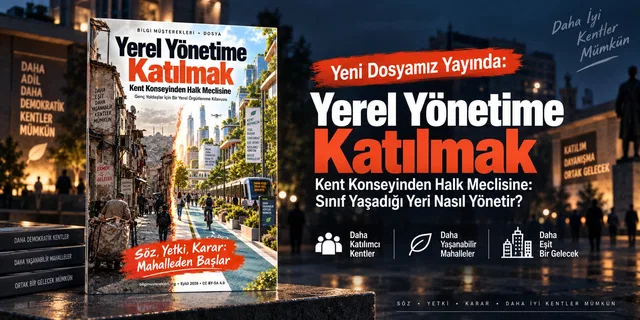
Local Democracy and City Councils — to discuss its function, structure and working Friday 25 September 2026, 10.00–18.00 Union of Municipalities of Turkey Service Building, Kavaklıdere Mah. Tunus Cad. No: 12, Çankaya/Ankara · Google Maps Information: yereldemokrasi.org.tr · iletisim@yereldemokrasi.org.tr Attendance is open and free; use the contact channels on the site to register. Travel details are at the end of the piece.
Dear Young Comrades,
This Friday there is a forum in Ankara. The title is long, the matter short: what is this thing called a kent konseyi good for, whom does it work for, how should it work? From ten in the morning to six in the evening a set of institutions — from professional chambers to associations, from foundations to Ankara's unofficial newspaper — will sit at the same table and talk this over. This piece was written to introduce that forum and to call you there. But not only to call you. We want to think together about the questions with which you should go to the forum, why city councils in most places today have turned into the municipality's back garden, and why this is true of municipalities with a "left" signboard as well. Because if you read participation mechanisms without a class eye you go to the forum as a "spectator"; when you read them with a class eye you become a "participant".
First the facts: what is a kent konseyi?
The kent konseyi is a body established by Article 76 of Municipal Law No. 5393 of 2005. The law makes it obligatory for municipalities to found a kent konseyi and describes it as follows: a platform on which public institutions, professional chambers, unions, universities, neighbourhood headmen and civil-society organisations come together to secure the participation of those who live in the city in its government, to develop the law of the fellow city-dweller, and to discuss the city's priorities and problems. The details are set by the City Council Regulation published in the Official Gazette on 8 October 2006; a 2009 amendment imposed on municipalities the duty to set aside an appropriation from the budget for the council and to give it secretariat support.
The council has three basic organs: the general assembly, the executive board and the council chair. Beneath these, assemblies such as women, youth and disabled people, and working groups formed by subject, operate. The council's decisions are not binding; the regulation says only this: the council's views are to be taken onto the agenda of the municipal council's first meeting and evaluated. The kent konseyi produces opinion; the municipal council takes the decision. The knot of the matter is right there.
The kent konseyi experience in Turkey, together with the Local Agenda 21 process before 2005, now exceeds thirty years. The study "City Councils in Turkey: Thirty Years of Experience and the Future of the Councils", published this year by the Marmara Municipalities Union, rests on surveys with 120 municipalities and 24 city councils, and its finding is familiar: there is an accumulation, but institutional capacity, level of effect and continuity vary from council to council like a chasm. In one city the council discusses the municipality's budget; in another it convenes a general assembly once a year and has a photograph taken.
Who is organising the forum, and what will be discussed?
On the forum's call poster stand the Association of Turkish Engineers, the Mülkiyeliler Union, the Ankara Branch of the Chamber of Civil Engineers of TMMOB, the Ümitköy-Çayyolu Branch of the Atatürkist Thought Association, the New Generation Village Institutes Association, the İlhan Tekeli Urbanism Culture Foundation, Solfasol, the Sociology Association and Çiğdemim Association, celebrating its thirtieth year (the institutions' links are at the end of the piece). The forum is being held at the Union of Municipalities of Turkey's centre on Tunus Caddesi; TBB is not the host, only the venue provider. The Local Democracy initiative behind the forum defines itself as a community working "to strengthen local participation, to support city councils and to spread democratic processes at the local level".
The "Let Us Remember" text on the initiative's site summarises the forum's frame: city councils cannot be bound directly to decision mechanisms, their power of effect is low, participation in most places remains formal, and the council faces the danger of being reduced to a "consultation vitrine". The proposal is that the council cease to be a structure "standing beside the municipality" and become "a shared field of government living inside the city". On the "What We Are Curious About" page the axes of discussion are listed under six headings: citizenship and a culture of participation, awareness of the kent konseyi, the council's working and institutional democracy, communication and trust, the right to the budget and the right to the city, deliberation and spatial justice. That the headings "right to the budget" and "spatial justice" stand openly on a forum agenda is a rare thing; whether the forum really talks these two headings will be the measure of its quality.
The poster debate: why are the city councils absent?
An honest introduction cannot skip this. As soon as the forum was announced a criticism circulated in the local press: on the poster of a forum whose subject is city councils there is neither a kent konseyi nor an umbrella body such as the Union of City Councils of Turkey or the City Councils Platform; in their place organisations whose "direct working relation with city councils is disputed" have come to the fore.
The criticism has a just side; to talk about the councils without the councils' own experience remains incomplete. But pay attention to its construction. The institutions on the poster are professional chambers, an urbanism foundation, a sociology association, a thirty-year neighbourhood association and an independent city newspaper; that is, precisely the organisations the law counts as components of the kent konseyi. To push these aside as "relation disputed" is to identify the kent konseyi with the council's managing cadre. The councils are not the property of their chairs and executive boards; by law they are the platform of everyone organised in the city. The real lesson of this debate is this: every discussion of participation mechanisms is at the same time a contest over who will represent that mechanism. And this contest has a story in Ankara. Do not go to the forum without telling it.
A story: the candidate who was not given the floor
Mehmet C. Peker, born in 1960, is a civil engineer, a METU graduate; one of the convenors of the Çayyolu and Ayrancı neighbourhood assemblies, a volunteer of the Ankara Kent Konseyi's Neighbourhood Culture Working Group. In his own words, since 2011 he is someone who "ended professional working life on office hours and has been practising active citizenship". In 2024 he stood for the chair of the Ankara Kent Konseyi, in his own naming its "spokespersonship", with a petition of a single signature. He has told in detail what he lived through on his own site and social-media accounts; we are passing it on from that account.
For the elective general assembly of 7 July 2024 the delegate list, according to the by-law, should have been posted at least fifteen days before the election; according to Peker the list was put not on the noticeboard but "on the table" only three days before the election. As a candidate he was prevented from reaching the delegates' institutional contact addresses, from sending an e-mail; the other candidate, with the support of youth-assembly volunteers, reached every delegate by telephone. When he went three days before the election to check the delegate list, he reports as they were spoken the words of an executive-board member: "Why are you standing, Mehmet Bey, you will not win. We know 2,600 of the 2,700 delegates; I alone had 150 of them put down." Two days before the election, when he went to the council building to submit a petition containing the solution proposals he had prepared for the general assembly, he was not even admitted to the garden; according to what the person at the door passed on, it was the chair's instruction.
He also wrote in November 2024 what happened on the day of the general assembly. On the podium sat both the vice-chairs of the previous term and those standing for the executive board for the new term; an objection of irregularity of procedure was not taken into account. The chair of the podium read the candidacy petition but refused the request to speak from the floor. The time from the formation of the podium to the announcement "the general assembly is completed" was about thirty minutes; in those thirty minutes a chair, 77 executive-board members, 69 advisory-board members, 75 high consultative-board members and 6 honour-board members were "elected". At this general assembly, at which 2,717 institutional bodies were said to have applied to take part and 2,450 signatures to have been put on the attendance list, Solfasol's request to send a delegate was refused on the grounds that "its institutional structure does not conform to the by-law". Peker applied to the Ombudsman Institution for the general assembly held on the invitation of the metropolitan mayor to be cancelled and renewed on the council's own invitation. In the same piece he also tells of the Çankaya Kent Konseyi's general assembly of 15 September 2024: the chair of the podium and one podium member were executive-board members of the last term; the executive board was determined by a block list and open voting instead of a sheet list and a ballot box; no candidate introduced themselves; to those in the hall who said "we want to know the candidates" the chair of the podium said the candidates could introduce themselves after the election.
This year's story too is complete. In April 2026 Peker announced a forum on "the twenty-year balance sheet of the city councils", prepared by volunteers of Gazi University, the Sociology Association, the İlhan Tekeli Urbanism Culture Foundation, the Ankara Bar City and Environment Centre, the Union of City Councils of Turkey and the Ankara Neighbourhood Culture Initiative, meeting every week for eighteen months; some of the names on the 25 September forum poster come from this work. At the seventh general assembly of 12 September 2026, in an election with 1,083 delegates, the sitting chair received 1,071 votes, Peker 12. At the same general assembly it was announced that since 2019 1.3 million people of Ankara had taken part in the processes. The number of recommendation decisions produced between 2019 and 2026 is 433; what is said is that all 433 of them were accepted unanimously. The figure 311 is the number of recommendation decisions accepted at the general assembly of 29 March 2026; it is not the portion of the 433 that passed the municipal council. The figures are impressive; but whether a decision accepted unanimously is implemented is a separate question, and if behind a result of twelve votes there stands a candidate not allowed onto the floor two years earlier, a delegate list that was not posted, and the sentence "we know 2,600 of them", one must ask to whom those figures belong.
As for Peker himself: he is not someone who practises class politics; he is a CHP member, a city-dweller who sees the council as a "school of democracy" and speaks the language of "sensitive and active citizenship". The reason we tell him is not that we share his politics; it is that the floor has been closed even to the mildest, most rule-bound, most "inside-the-system" critic of the participation mechanism. If the floor is closed to him, you have understood to whom the floor is open.
The back garden: why does the municipality love the council, and why does it fear it?
The story in Ankara is not a matter of personality; it is the working of a structure. The kent konseyi is of use to a municipal administration for two things. First, legitimacy: the sentence "1.3 million fellow city-dwellers took part in the processes" seals with the stamp of "common reason" the decisions of an administration that has a majority in the municipal council. Second, cadre: an administration that can determine who the delegates will be turns the council into a front office in which it organises its own voter and volunteer network. For these two functions the council must be visible, crowded and prize-winning; but it need not take decisions. When the council begins to produce opinion — still more, when it begins to produce opinion on the municipality's budget, the zoning plan, the wages of workers in the subsidiary companies — it ceases to be a back garden and becomes dangerous. Then the doors close, the lists are not posted, the podium finishes its work in thirty minutes.
One of the plainest examples of this is Kırşehir. At the general assembly of July 2024 Tahsin Üçgül, who had held the council chair for thirteen years, handed the post to Müfit Göçen; the administration was determined by open voting, and the municipality's own news item writes it openly: first among the full members of the new administration stands the mayor, Selahattin Ekicioğlu. That the mayor sits on the board of the organ that is supposed to give opinion to the municipality is the back garden written into the statute. At the general assembly of August 2026 Göçen was re-elected; it was announced that 318 events had been held in two years. Meanwhile, on the mining projects ringing Kırşehir, the council chair told the press "we are not against the mine, we are against the method; we have no tie to politics". That on a matter on which the mayor himself said "the threat of mining" the council speaks more cautiously than the municipality shows the council's function: to stand not in front of the municipality but behind it. We are not commemorating Kırşehir as a bad example; in a small city the effort of well-intentioned people to found a "platform of togetherness above politics" is intelligible. But looked at from a class frame, "above politics" means without class; a classless council is a council that meets on the common ground of the property-owners in the city.
There are counter-examples too, so do not fall into the easy "the kent konseyi is useless anyway". The Çanakkale Kent Konseyi defines itself as "administratively attached to the municipality but autonomous in its working"; the mayor has a single vote equal to the other members in the general assembly; under a 72-person executive board 11 working groups and neighbourhood assemblies operate. In Bursa, Mustafa Bozbey, as soon as he was elected in 2024, announced that he would change the council's structure: the council chair would no longer be a council member or the mayor; the administration would be elected by delegations coming from the seventeen districts. In July 2026 a new chair was elected and steps such as joint meetings with nine district councils and field work for seasonal agricultural workers were announced. We shall see how much of this remains discourse; but the mayor's leaving the council administration already shows the difference from Kırşehir.
The most advanced example is Fındıklı, a small district of Rize. Ercüment Şahin Çervatoğlu, who has governed the municipality since 2019, turned the Laz-culture tradition of "meci" (imece, collective work) into a principle of government. According to an assessment published in February 2026, in Fındıklı there is, beside the kent konseyi, a People's Assembly with a direct right of voice and oversight, an environment assembly independent of the municipality (VİÇEM), 23 working commissions and neighbourhood assemblies; the water tariff was set by the people, all spending is published monthly, the chair's office door and appointment system were abolished, a recall mechanism working with the resignation letters of the elected was established. In the interview he gave Bianet Çervatoğlu tells how, in a municipality they took over with 18.5 million lira of debt against an annual budget of 16 million lira, they founded production units such as a concrete plant, a recycling facility and a carpentry shop and employed 102 young people in the municipal subsidiaries. And remember the sentence Peker tried to say at the Ankara general assembly: on the agenda of every monthly meeting of the Fındıklı municipal council there is a fixed item, "Kent Konseyi recommendation decisions". Council representatives sit in that meeting; the decisions are discussed there. While in Ankara no general assembly was held for seventeen months, in Fındıklı this happens every month.
Do not forget that Fındıklı too is a CHP municipality. This shows that the matter is not in the party signboard but in class orientation and organisation. In Fındıklı the municipality accepts the people's assembly as an organ of oversight; in Ankara the kent konseyi is turned into a vitrine. The signboard is the same, the content different.
Left signboard, right practice: Karabağlar, Karaburun and İzmir
At this point we come to the most vital place in the matter. If we had said the sentence "municipalities see the council as a back garden" only of municipalities of the governing party, this would have been an opposition piece. For the piece to be a class piece, the stance of left-looking municipalities toward labour must also be named by name. İzmir is the laboratory of this.
In Karabağlar, DİSK Genel-İş, organised in the municipality's subsidiary KARBEL, posted a strike decision in December 2024; the municipality's offer, in a setting of 44 percent inflation and a 30 percent rise in the minimum wage, was a 12 percent increase. The union's call to the mayor was instructive: the workers had supported this administration in the election. In August 2026 Murat Mengirkaon, who had worked in the same municipality as a sociologist for fifteen years, was sent to cleaning work under the name of "rotation" for objecting to a collective agreement that left the established workers without the six-month inflation difference; he began a sit-in in front of the municipality, declared a hunger strike, and upon support stretching from KESK to the People's Houses, from TİP to EMEP suspended the action and continued his demand. At metropolitan scale in May 2025 the strike of 23,000 workers at İzenerji and İzelman began; two weeks after the strike ended the municipality ended the jobs of about 1,030 workers. The mayor's ground was that the monthly employer cost per worker would rise from 143,000 lira to 180,000 lira. Where a worker is turned into a cost item, the strike into a budget deficit, exile into "rotation", the business logic of capital is working under a left signboard.
There is also the political earthquake of the summer. After the CHP congress was ruled invalid by a court decision, Özgür Özel on 24 July 2026 founded the YENİ Party with 91 deputies. Five days later in Karaburun the mayor and all the CHP council members resigned from the party in a body; the next day fourteen district mayors of İzmir, among them Helil Kınay, the mayor of Karabağlar, announced that they were passing to the YENİ Party. In the Karabağlar council seventeen members changed party together with the mayor. In none of these passages was the voter asked; the municipal council was not asked; the kent konseyi was not asked at all. A party founded with the slogan "the will of the voter cannot be trampled" accepted in a single night that transferring the vote the voter had given to one party to another party was a mayor's decision. Pay attention to Karaburun: in this district, which every year hosts a science congress themed "labour/labourers", the municipality changed its signboard without asking its people a single question. That the kent konseyi is mentioned nowhere in this passage says where the council stands: a decoration informed after the decision has been taken.
The reason we tell these things is not to put the CHP or the YENİ Party on the same scale as the government's municipalities; we know that in kayyım municipalities the council does not exist at all, that even the elected administration has been abolished. The Van Kent Konseyi in December 2024 declared that it did not recognise the kayyım; the Fethiye Kent Konseyi this May described judicial decisions against elected party organs as "cannot be normalised". A kayyım means the budget leaving local oversight and the liquidation of the commons; the councils' opposition to this is of value. But the government's ignoring the council and the opposition's making the council a back garden are two faces of the same structure. The first seizes the local state from the centre; the second, while governing the local state, does not change its class character. This is the historical function of social democracy: to manage capitalism, to see the worker as a cost item, and to use participation as the production of legitimacy. Local democracy cannot be discussed without criticising this function.
A class look: consultation vitrine, or school of counter-power?
The Marxist tradition refuses to look at participation mechanisms from two extremes. The first extreme says "these are ornaments of the bourgeois state, keep away". The second says "here is participatory democracy, salvation is here". Both are wrong; because both see an institution such as the kent konseyi not as a field of class struggle but as a fixed object. The kent konseyi can work as a part of capital's domination in the city, and it can work as a school of organisation against that domination. Which it will be is determined not in the council's statute but in the balance of forces inside it. To see this, let us turn the forum's axes into class questions one by one.
| The forum's question | The class's question |
|---|---|
| Do citizens take part in decision processes? | Which citizens? Does a worker who works from seven in the morning to eight in the evening have the possibility of joining a working group that meets in office hours? Is the class composition of participation measured? |
| Is the kent konseyi known in public? | Who are those who know the council? The professional, organised sections that have time; or the fellow city-dweller working a second job? |
| Are the council's decisions implemented? | Which decisions are implemented? At the Ankara Kent Konseyi, 433 recommendation decisions were produced between 2019 and 2026; what is said is that all 433 were accepted unanimously. 311 is the number accepted at the general assembly of 29 March 2026. The real question is not acceptance but implementation: were wages in the subsidiary companies or zoning rent among these decisions, and which of them were put into practice? |
| Are council elections democratic? | Is the delegate list posted? Can a candidate take the floor? Of whom is the podium composed? Does the mayor sit on the council's executive? |
| How is the right to the budget used? | Is the municipal budget negotiated with the council before it comes to the municipal council? If under the name of a participatory budget one percent of the budget is distributed to the neighbourhood and the rest goes to the contractor, that is not called a right to the budget. |
| How is spatial justice secured? | Who determines for whom the city is produced? In urban-transformation decisions is there a voice of the council, or is the council called to "give an opinion" after the decision has been taken? |
| How is trust among citizens built? | Trust is built by the organisation of a common interest. Does the municipal worker's strike enter the agenda of the kent konseyi? Is a tie established between tenant organisation, workplace representation and the council? |
To ask the questions in the right-hand column of this table at the forum is a service to the forum itself. Advocates of local democracy already make the "consultation vitrine" criticism; our contribution should be to say why the vitrine is a vitrine. That the council's views are not binding is not a technical lack; it is the legal form of the municipal-council majority's — that is, of the property-owners in the city, through elected parties — not letting the monopoly of decision out of its hands. The law has recognised participation as a right but has not transferred power. Neither the text of the law nor a well-intentioned mayor solves this contradiction; what will solve it is an organised base of city labourers who see the council as their own matter. That is what Fındıklı teaches us: if the council works there, it is because behind the people's assembly there is a neighbourhood society organised in the meci tradition.
How does one go to the forum, and what does one do there?
Let us repeat what we said in our piece "Event Organizing and Comradeship" Guide Is Out: to take care is not the opposite of amateurishness, it is its condition. To go to the forum prepared is to take the forum seriously.
Look at what your district's kent konseyi has done in the last two years; try to find the general-assembly minutes, the delegate list, the working-group list and the views sent to the municipal council. If you cannot find them, carry this finding to the forum; the lack of transparency is the most concrete datum. Look at whether the mayor sits on the council's executive board; if they do, ask this. Go with a friend from your neighbourhood, your workplace or your school; from a forum attended alone a one-person impression remains, from one attended by two a discussion comes out. When you take the floor in working-group sessions, choose a question from the right-hand column of the table above and ask it with an example from your own city. Bring onto the agenda the exile in Karabağlar, the one thousand and thirty workers in İzmir, the candidate not allowed onto the floor in Ankara; these are subjects that stand not outside the local-democracy forum but at its very centre. Follow whether at the end of the forum a concluding statement or a monitoring committee is established; if not, propose it.
The unions should be at this forum too. The law counts unions as a component of the kent konseyi; but in practice the unions are either absent from the councils or present at a representative level. Yet all the living conditions of the city labourer, from transport to housing, from the crèche to the water bill, are determined by the municipality's decisions, and the municipality itself is one of the city's largest employers. That the class organised in the workplace remain unorganised in the city is an unacceptable gap. A union that carries the municipal worker's collective agreement onto the kent konseyi's agenda will have taken the first step that takes the council out of being a back garden.
Come along, but come with a question
The forum's slogan is "There is a forum, come along." Let us add one thing to this: come with a question. Go not to learn what the kent konseyi is, but to determine together what it can be. Do not content yourself with listening to the consultation-vitrine criticism; name by name the property relation behind the vitrine. In a session that talks of the right to the budget, ask who made the budget. In the spatial-justice session, ask whose justice urban transformation is. In the session that talks of council elections, recall the candidate not allowed onto the floor. Bring onto the agenda the stance of left-signboard municipalities toward the worker; because local democracy cannot be built with an administration that sees the municipal worker's strike as a "budget deficit".
City councils do not have to be a back garden. Fındıklı shows that a people's assembly can oversee the municipality; Çanakkale shows that a mayor can content themselves with a single vote; Bursa shows that they can at least withdraw from the executive. None of these happened of itself; behind each there is an organised demand. Those who will organise that demand in Ankara are meeting this Friday on Tunus Caddesi.
Friday 25 September, at ten in the morning. Come, let us be together.
Comradely.
Knowledge belongs to everyone. The city too.
Event details and travel
What: Forum "Local Democracy and City Councils: To Discuss Its Function, Structure and Working" — There is a forum, come along.
When: Friday 25 September 2026, 10.00–18.00 (full day; a lunch break is expected; the programme will be announced on the site).
Where: Union of Municipalities of Turkey Service Building, Kavaklıdere Mahallesi, Tunus Caddesi No: 12, 06680 Çankaya/Ankara. Building telephone: (0312) 419 21 00. Open in Google Maps.
Travel: Tunus Caddesi is the street running from Kızılay to Kuğulu Park; number 12 is at the Kızılay end of the street. For those coming by metro the nearest stations are Kızılay (M1/M2 and Ankaray interchange; about a ten-to-fifteen-minute walk via Karanfil and Meşrutiyet streets) and the Ankaray Kolej station (about a ten-minute walk from Ziya Gökalp Caddesi). Those coming by bus or dolmuş can get off at the Kızılay–Kolej stops on Atatürk Boulevard or Ziya Gökalp Caddesi. For those coming by private car, street parking in Kavaklıdere is limited; the multi-storey car parks in Kızılay or the car parks around Kuğulu Park are more suitable. For accessibility and wheelchair entry it is useful to telephone the building in advance.
Organising and supporting institutions (in the order on the poster):
- Association of Turkish Engineers — an engineers' association founded in 1948; Mehmet C. Peker attended the 2024 general assembly as this association's delegate.
- Mülkiyeliler Union — since 1924 the union of graduates of the Faculty of Political Sciences.
- Ankara Branch of the Chamber of Civil Engineers of TMMOB
- Atatürkist Thought Association Ümitköy-Çayyolu Branch (branch page)
- New Generation Village Institutes Association (2001) — Ankara Branch
- İlhan Tekeli Urbanism Culture Foundation — on the poster with its stylised logo; also a partner of the April 2026 forum on "the twenty-year balance sheet of the city councils".
- Solfasol — Ankara's Unofficial Newspaper — the publication whose request to send a delegate to the Ankara Kent Konseyi was refused in 2024.
- Sociology Association
- Çiğdem Education, Environment and Solidarity Association (Çiğdemim) — a neighbourhood association founded in 1996, in its 30th year.
- Venue provider: Union of Municipalities of Turkey
Contact: yereldemokrasi.org.tr · iletisim@yereldemokrasi.org.tr · Local Democracy's YouTube, Instagram, Facebook, WhatsApp, X and LinkedIn accounts are linked on the site.
Sources
- Local Democracy — Home · About us · Let Us Remember · What We Are Curious About · Legislation
- City Council Regulation — mevzuat.gov.tr
- City Councils in Turkey: Thirty Years of Experience and the Future of the Councils — Marmara Municipalities Union Culture Publications
- "What kind of forum is this? No city councils at the TBB-backed 'City Councils' forum!" — Ankara Kent Haber, 14 September 2026
- Mehmet C. Peker — "The Speech I Was Not Allowed to Give at the AKK General Assembly That Could Not Be Held", 7 August 2024 · "Continuing on the Road with Hope Despite Disappointments", 18 November 2024 · "The Epigenetic Existence of City Councils", 3 April 2026
- "Election completed at the Ankara Kent Konseyi: here is the result" — Manşet Haber, 12 September 2026 · "A call for common reason at the Ankara Kent Konseyi's 7th General Assembly" — Manşet Ankara, 12 September 2026
- Municipality of Kırşehir — "Our Mayor Selahattin Ekicioğlu Attended the Ordinary General Assembly of the Kırşehir Kent Konseyi", July 2024 · "Müfit Göçen Re-elected at a Broadly Attended General Assembly" — Kırşehir Haber Türk, August 2026 · "Göçen: We are not against the mine, we are against the method" — İHA, 2025
- Çanakkale Kent Konseyi — "What does the city's, the city-dweller's council do"
- Namık Göz, "An important step from Bozbey; will the Kent Konseyi's structure change?" — Bursa Hakimiyet, April 2024 · "A New Period at the Bursa Kent Konseyi" — Bayrak Haber, 21 August 2026
- İnan İzci, "A Source of Inspiration in Popular Municipalism: The Fındıklı Experience" — Sosyal Demokrat Dergi, 27 February 2026 · "Çervatoğlu: In Fındıklı we will increase participation and transparency with neighbourhood committees" — Bianet · Municipality of Fındıklı — Participatory Budget Conference
- "Strike decision posted in Karabağlar" — İz Gazete, December 2024 · "'Exile' for Objection to the Collective Agreement at Karabağlar Municipality" — El Yazmaları, 23 August 2026 · "Support from Organisations and Intellectuals for the Karabağlar Municipality Worker" — El Yazmaları, 7 September 2026 · "Resistance in front of the municipality against exile" — BirGün
- İzmir Metropolitan Municipality — Public Announcement, 28 May 2025 · "Mass dismissal decision taken in İzmir after the strike" — Memurlar.net, June 2025
- "Özgür Özel and 91 deputies resign from the CHP: a New Party is being founded" — Euronews, 24 July 2026 · "The political course changed in Karaburun: wholesale passage to the YENİ Party" — Ege'de Son Söz, 29 July 2026 · "Which municipalities in İzmir passed to the YENİ Party?" — Milliyet, 30 July 2026 · "Political balances changed in Karabağlar: Helil Kınay passed to the New Party" — Dokuz Eylül
- Van Kent Konseyi: "We do not accept the kayyım attempt!" — 5 December 2024 · Fethiye Kent Konseyi — Public Announcement, 25 May 2026
- Bilgi Müşterekleri — "Event Organizing and Comradeship" Guide Is Out, 6 September 2026