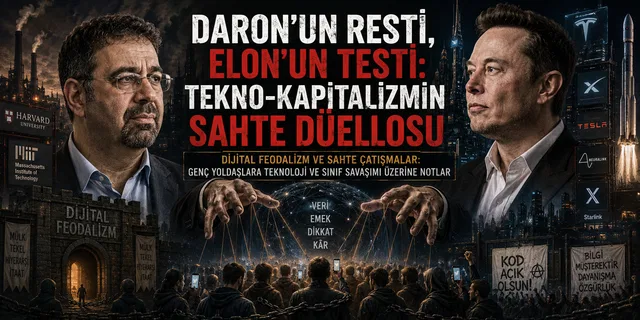
The Acemoğlu–Economist Dispute and Its Class Meaning
For Young Comrades: What Is to Be Learned from a Quarrel Between a Nobel Laureate and a Magazine?

Comrades, last week an unusual quarrel broke out in the economics pages. Unusual, because the combatants are not two sides that look like enemies of each other; they are two sides of the same world.
17 August. Britain’s most prestigious capital magazine, The Economist, published an unsigned article. The title was: "The world’s most influential economist is oddly unconvincing." The target was Daron Acemoğlu, winner of the 2024 Nobel Prize in Economics and a professor at MIT.
The magazine struck at three points:
One: The 2001 paper that opened Acemoğlu’s road to the Nobel—the study that explains whether countries are rich or poor by the “institutions” founded in the colonial period, and that has drawn more than 23,000 citations—did not rest on solid data. Another economist, David Albouy, had already shown in 2012 that some countries’ data had been borrowed from other countries; once corrected, the results did not stand. Even the Nobel Committee, in its 2024 report, conceded that the data were “occasionally incomplete.”
Two: Acemoğlu’s entire theory was built on a single word—“institution.” So what exactly was an institution? Laws? Customs? Courts? Culture? All of them? The magazine asked: "Countries prosper if their institutions are good and stagnate if they are bad. Fair enough. But what exactly is an institution?"
Three: And the real issue: Acemoğlu was “pessimistic” about artificial intelligence. He put AI’s contribution to productivity over the next decade well below one percentage point. For the magazine, that was a forecast “so gloomy as to strain credibility.”
19 August. Acemoğlu replied on social media. He said he found the piece “like a hit piece,” spoke of a “character assassination,” and demanded a right of reply from the magazine. He also uttered an enigmatic sentence: "There is a much more troubling situation in the background."
21 August. The magazine published the letter. Acemoğlu said: You declare me “unconvincing,” but your basis is anonymous economists’ corridor talk. Your only concrete source is a blog post. Your objection to my fertility work you take not from the study itself but from a social-media post—yet that caveat is already written at the end of our paper. And the closing sentence was this:
If this is the best you can do against a 33-year body of work, it is you who are unconvincing.
That is the affair. Now let us turn to the real question.
Clarification: Why does this quarrel concern us?
Comrades, when we see such news our first reflex is usually one of two.
First reflex: “The man is of Turkish origin, he has a Nobel, the British capital press has piled onto him. We stand with the victim.”
Second reflex: “Acemoğlu is a bourgeois economist. If The Economist is exposing him, so much the better.”
Both are wrong. And understanding why they are wrong is the first lesson we draw from this debate.
Because here two different classes are not fighting. Two wings of the same class are fighting. One is capital’s wing that says “the market does its own job, do not interfere.” The other says “if this goes on the order will explode; we need to repair it a little.” Both are for the continuation of capitalism. They only disagree on how it is to continue.
So if neither is ours, why give them our time?
For three reasons.
First: Where the enemy debates inside itself is the enemy’s weak point. If a class has begun debating a matter inside itself, it means it is not sure of itself on that matter. Capital today is pouring trillions of dollars into artificial intelligence and is not sure it will get its money’s worth. Acemoğlu’s saying “the return is overhyped” touches exactly that point of uncertainty. That is why he is being silenced.
Second: Even a Nobel laureate is disciplined when he crosses the line. Acemoğlu is not against the order. He is not a socialist at all. He says only two things: “AI’s profit falls short of its advertising” and “the direction of technology cannot be left to the market; it is a political choice.” For those two sentences, a man who carries all the system’s decorations is being discredited by an unsigned article. Do we need any other proof of how narrow the bounds of debate have become? We speak far beyond that bound. From this we can infer what will be done to us—and it is already being done: no article is written for us, no platform is given to us.
Third, and most important: What Acemoğlu says finds an echo inside the working class. The man talks about class. He says “elites abandoned the working class.” He says “technology is not fate; it is a choice.” His new book is titled What Happened to Liberal Democracy?, and what he proposes is called "working-class liberalism."
These are not empty words; they are attractive words. They find an echo in unions, universities, progressive circles. That is why our job is not to brush him off as a “bourgeois economist”; it is to show, one by one, where he is right, where he remains half-finished, and where he blocks the road. To defeat an idea is not to curse it; it is to carry it to the end and mark the place where it stops.
Let us do that under four headings.
Lesson 1: “Institutions,” or relations of production?
The Economist says Acemoğlu’s concept of “institution” falls into a vicious circle. It is right. But it cannot say why it falls—because if it did, it would cut off its own foot as well.
Think of it this way. Acemoğlu says: In some countries there are “inclusive institutions”—everyone’s property is safe, courts work, enterprise is free. In others there are “extractive institutions”—a minority plunders everything. The former grow rich; the latter grow poor.
It sounds logical. Then what happens? You ask, “Why are there bad institutions in this country?” The answer: “Because there were bad institutions in the past as well.” The circle closes. There is no way out.
Marx broke that circle a hundred and fifty years ago.
In the preface to A Contribution to the Critique of Political Economy he writes: In the process of production people enter into definite relations independent of their will. The sum of these relations of production constitutes the economic structure of society—the real foundation on which a legal and political superstructure rises.
Let us make it concrete. In a factory there are two people: the one who owns the machines, and the one who has nothing to sell but labour-power. That relation is the base. Property law, the labour court, the trade-union statute, the ban on strikes—these are the superstructure built upon that relation. Institutions are the child of property relations; not the mother, the offspring.
Acemoğlu turns this relation upside down. He declares the child the mother. That is why he cannot get out of the circle.
But there is something more critical. Notice: In Acemoğlu’s schema, exploitation appears inside the definition of “extractive institutions” as an institutional defect. That is, exploitation is not the normal working of capitalism; it is an accident that befalls some unfortunate countries. Britain is “inclusive,” Congo “extractive.” So what financed Britain’s inclusiveness? That question stays outside the model.
The colonial question explodes exactly here. Acemoğlu’s 2001 paper frames colonialism as a vehicle for transporting institutions: where Europeans could settle they carried good institutions; where they could not, plunder institutions. In this framing indigenous peoples are not subjects of their own history but blank pages on which institutions are written. And most important of all: where the surplus flows is never asked.
Yet open the primitive-accumulation chapter of Capital:
The discovery of gold and silver in America, the extirpation, enslavement and entombment in mines of the aboriginal population, the beginning of the conquest and looting of the East Indies, the turning of Africa into a warren for the commercial hunting of black-skins, signalised the rosy dawn of the era of capitalist production.
That is, the poverty of colonised geographies and the wealth of the metropolises are not the result of two separate institutional paths, but two faces of the same process.
All the elegance of econometrics serves precisely to cut that link. The moment you find an exogenous variable like “settler mortality,” you turn colonialism from a system into a generator of chance.
Let us keep this in mind: Albouy’s objection is a measurement error inside the construct. Our objection is to the construct itself. Even if you correct the data the problem remains: what is wrong is not the coefficient but the question.
Lesson 2: In whose hands is the machine?
Now we come to where Acemoğlu is strongest. And here we must be honest: The Economist attacks him most unjustly here.
Acemoğlu’s thesis is this: The path technology follows is not fate; it is a moral and political choice. The same technical base can be used to shut labour out the door or to widen the worker’s capacities. Which is chosen is decided not by productivity but by power relations.
This is a serious blow to mainstream economics. For they say: “Technology descends from the sky, raises productivity; we talk about distribution later.” Acemoğlu says: No, the direction of technology is itself a matter of struggle.
The Economist’s calling this “pessimism” is in fact this confession: To open the class character of technology to debate is a crime in itself.
But Acemoğlu stops on the very threshold of his victory. Why?
Because Marx had long since solved this question in the machinery chapter of Capital: Machinery, by itself, lightens labour. Used as capital, it lengthens the working day, intensifies labour, and turns the worker into an appendage of his own product. The problem is not in the machine but in the social relation in which the machine is placed.
So “the direction of technology is a choice” is true—but incomplete. Who makes that choice, under what compulsion?
A capitalist does not develop technology for fun. He develops it under the pressure of competition. He must produce more cheaply than his rival; for that he must produce more value in the same time—we call this relative surplus-value. He does not “choose” the machine that replaces labour; he is driven to it. For a boss to choose “labour-friendly” technology means accepting falling behind in competition. The system does not reward that choice; it punishes it.
That is why the call for “labour-friendly AI,” while the property relation stands as it is, can only be imposed by a force from outside: by law, by union compulsion, by political mobilisation. Acemoğlu knows this and says so. What he does not say is where that force is to come from. He has a prescription, but he does not produce the subject that will apply it.
And now the finest part of the matter
Acemoğlu’s own latest work tests his own thesis.
The June 2026 study "Baby Busts and Growth Booms", published with David Autor and colleagues, finds this: A fall in the birth rate does not slow growth; it accelerates it. In countries whose fertility is one point lower, income per worker is about 22 percent higher forty years later. The mechanism is written plainly: as labour grows scarce, capital turns toward labour-saving technology. The countries whose fertility falls most are those that shift most into high tech; in the United States, regions where the birth rate falls are those that see a boom in automation patents.
Comrades, this finding is no surprise to a Marxist. It is written in Capital: when labour-power grows scarce and dear, capital clutches at machinery and reproduces the army of the unemployed—in Marx’s phrase, the industrial reserve army. Labour scarcity is capital’s limit; capital crosses that limit by automation.
But the same finding unsettles Acemoğlu’s own thesis. Because here what determines the direction of technology is not a moral choice but an economic compulsion.
Acemoğlu’s system runs at two different speeds: when he discusses technology he is voluntarist (“we can choose”); when he works empirically he is determinist (“scarcity compels technology”). The concept that would resolve this contradiction—the idea that capital is a social relation that moves by its own laws, independent of persons’ wills—is not in his vocabulary. If it were, the conclusion he reached would not be “let us repair liberalism”; it would be the question of property.
Let us keep this in mind: Technology is not fate—that is true. But changing the direction of technology is not possible without touching the property relation that governs it.
Lesson 3: Why “working-class liberalism” is an oxymoron
In the background of the debate sits Acemoğlu’s new book: What Happened to Liberal Democracy?
The thesis is this: Liberal democracy succeeded in the twentieth century because it put working people’s welfare at the centre. Then elites abandoned the working class’s troubles, drifted into technocracy and identity politics, and the base dissolved. The remedy is to rebuild liberalism as "working-class liberalism."
There are two separate things here; let us not mix them up.
The diagnosis is strong. Acemoğlu accepts that the liberal centre has lost the working class and puts the bill on the elites, not on the “ignorant voter.” Saying that inside his own camp is not easy. The return of class to political analysis is a defeat for forty years of neoliberal discourse.
The solution is impossible. And the historical narrative it rests on is wrong.
Comrades, let us set the history straight. Liberalism was not born against power; it was born as the philosophy of a bargain with power. In 1688 it was the name of the compromise between aristocracy and bourgeoisie. Locke declared property sacred while he was a shareholder in a company that traded slaves. Mill wrote the classic of representative government while he was an official of the East India Company. Liberalism rejected universal suffrage for a hundred years on the ground that “the majority of the propertyless threatens property.” When Paris workers went to the barricades in June 1848, the liberal republic passed without a moment’s hesitation to the side of order and turned its guns on the workers.
Now look at the gains Acemoğlu writes into liberalism’s account: universal suffrage, the eight-hour day, the right to organise, social insurance, free education.
Not one of these is a gift of liberalism. All of them are gains torn from liberalism by force. The Chartists took them, the unions took them, socialists and communists took them. By strike, by barricade, by prison, by blood.
And what of that class compromise we call the twentieth century’s “golden age”? It too was the product of two special conditions:
- The pressure of the October Revolution. The bourgeoisie preferred concession to revolution. There was a concrete alternative opposite it.
- Imperialist rent. A portion of the surplus drawn from exploitation could be transferred to a section of the metropolitan working class.
Today the pressure of the first is gone; the margin of the second is narrowing. To call back the compromise itself as a choice when the conditions that produced it have disappeared is to try to replant the tree by looking at its shadow.
Watch the conceptual trap
The book’s most critical move is this: to put in place of class the pair "credentialed elite" and "ordinary person."
At first glance this looks class-like. It is not. Because class is not income level or diploma; it is position in relation to the means of production.
When you divide society along the diploma axis, what happens? The relation between the owner of the means of production and the one who must sell labour-power becomes invisible. “Exclusion” takes the place of exploitation. “Unjust sharing” takes the place of surplus-value. “Equality of opportunity” takes the place of property.
What remains is a demand for better distribution within capitalism’s limits. That demand is legitimate, and we fight for it too—but let us name it correctly: its name is not socialism; it is social reform.
Let us keep this in mind—memorise this distinction: Struggle for reforms is one thing; reformism is another. Marxist-Leninists fight in the front rank for every wage rise, every union right, every job guarantee. But they refuse to confine that struggle within the system’s limits, to hitch the class’s independent political organisation to the tail of the “sensible centre.” “Working-class liberalism” is precisely the call to hitch to that tail: a proposal to channel the class’s energy into repairing the order that exploits it.
Lesson 4: What is missing from the map — Imperialism
Comrades, the most striking side of this debate is what the two sides jointly leave unspoken.
Neither The Economist nor Acemoğlu describes the world economy as a system of monopolies. The export of capital, the domination of finance capital, the division and redivision of the world into spheres of influence—the map Lenin drew a hundred years ago is absent from both.
For Acemoğlu, differences among countries are a matter of institutional quality. For The Economist, a matter of market freedom. Both assume the same thing: if dependent countries apply the right prescription they can climb the ladder.
Yet dependence is not the sum of wrong choices; it is a structural product of the system: monopoly of technology, debt mechanisms, unequal exchange, control of world money.
What this means in Turkey
And now we come to the place that concerns us directly.
Acemoğlu’s institutionalism has for years performed a definite political function in Turkey. The programme of bourgeois opposition is reduced to this equation: "If the rule of law comes, foreign capital will come; if foreign capital comes, welfare will come." In this equation the role that falls to the working class is to wait patiently for the day when good institutions arrive.
Yet what is capital accumulation in Turkey based on? Cheap labour, de-unionisation, workplace deaths, informality, the liquidation of agriculture. And this form of accumulation produces the political regime over it not by chance but by necessity.
Let us keep this in mind: Authoritarianism is not a result that comes after the decay of institutions; it is a class choice the accumulation regime needs. Every analysis that treats institutions as an independent variable hits the same wall in Turkey every time, because it reads this relation backwards.
What comes out of the breach?
In this debate the working class has no side. On one side stands finance capital’s 183-year-old mouthpiece; on the other, an honest reformer who wants to save capitalism from itself. Our job is not to take one of them; it is to read the breach the quarrel opens.
The breach is real. Look at the letter affair: Acemoğlu got a right of reply in two days, the letter was published in the magazine, the file was closed. This is proof that the quarrel is inside the family—those who belong to the family are given a platform. The magazine both landed its blow and completed the show of “we are a forum of free debate.” Bourgeois public opinion absorbs disagreements inside itself this way: by turning the quarrel into a gentlemen’s exchange and making the conflict of interest beneath it invisible.
Notice that Acemoğlu too defended himself in the letter on the ground of guild rules: citation practice, context, selectivity, a thirty-three-year body of work. He did not ask “why now?” At one point he cracked the door by saying “there is a much more troubling situation in the background”; in the letter he closed that door with his own hand.
But let us not forget this: Acemoğlu taught us something. He put the concept of class back on the table of bourgeois economics. He said technology is not neutral. He accepted that elites have broken from working people. And for saying these things he was beaten.
His diagnosis brings us to the door. But he refuses to open the door. Because when he opens it the question that will confront him is not a question of economic policy but a question of power:
In whose hands will the means of production be?
An economist who asks that question does not get a Nobel, and his letter is not printed either. There is no need even to tell him “you are unconvincing”—because he is never given a platform at all.
Those who will ask that question are not those who wait for a platform; they are those who decide to build one.
A Short Glossary
Relations of production: The relations people enter in the process of production, independent of their wills. The basic question: whose are the means of production?
Base and superstructure: The base is the sum of the relations of production. Law, politics, institutions are built upon it and react back upon it—but they do not determine it.
Surplus-value: The portion of the value the worker produces that remains above the part corresponding to the wage and is appropriated by the capitalist.
Relative surplus-value: Surplus-value obtained without lengthening the working day, by raising productivity (that is, by machinery, by new technology). The real motor behind technological innovation.
Industrial reserve army: The mass of unemployed whom capital hires and dismisses according to its need. Its existence also presses down the wages of those in work.
Primitive accumulation: The process of forcible dispossession that made the birth of capitalism possible—enclosure, colonisation, the slave trade, plunder.
Reformism: Not to be confused with the struggle for reforms. Reformism is to make not crossing the system’s limits a principle; to substitute reforms for the class’s independent political aim.
Sources
- Daron Acemoğlu ve The Economist arasında sert tartışma: Taraflar ne diyor? — Euronews Türkçe, 19 August 2026
- The Economist’ten Daron Acemoğlu’na eleştiri — Medyascope, 18 August 2026
- Daron Acemoğlu, The Economist’ten cevap hakkı istedi — Medyascope, 19 August 2026
- The Economist, Acemoğlu’nun mektubunu yayımladı — T24, 21 August 2026
- Nobel laureate Acemoğlu blasts The Economist over 'hit piece' article — Türkiye Today, 19 August 2026
- What Happened to Liberal Democracy? — MIT Stone Center
- Baby busts and GDP booms: Demographic change and the macroeconomy — CEPR/VoxEU
- Baby Busts and Growth Booms — NBER Working Paper 35401
- Working-Class Liberalism: Anatomy of an Oxymoron — Özcan Buze
- The Economist on Daron Acemoğlu: Old Wine in a New Bottle? — Birol Başkan
Note: The Economist’s unsigned article of 17 August 2026 sits behind a paywall; accounts of its content rest on the secondary sources above.