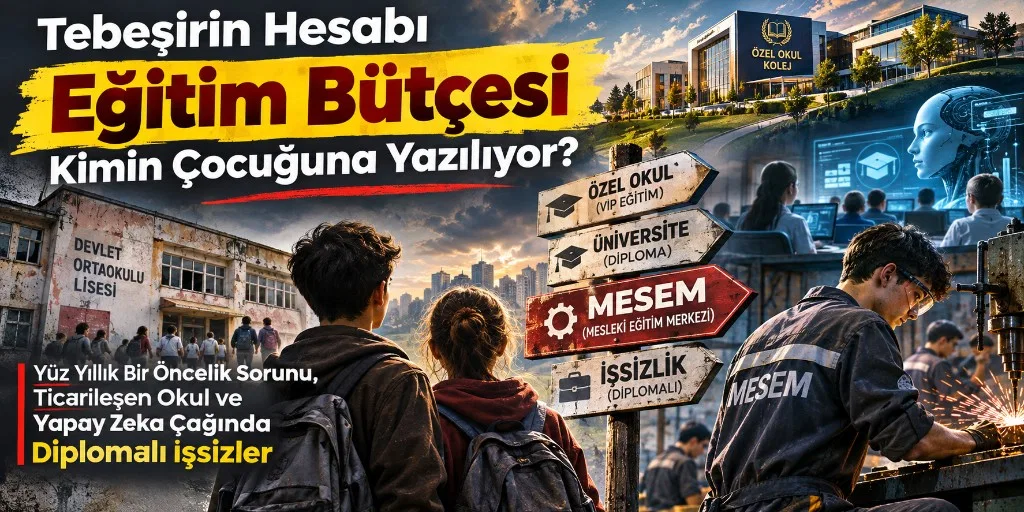
The Account of the Chalk: Whose Child Is the Education Budget Written For?
A Hundred-Year Problem of Priorities, the Commercialised School and Graduates Without Work in the Age of Artificial Intelligence
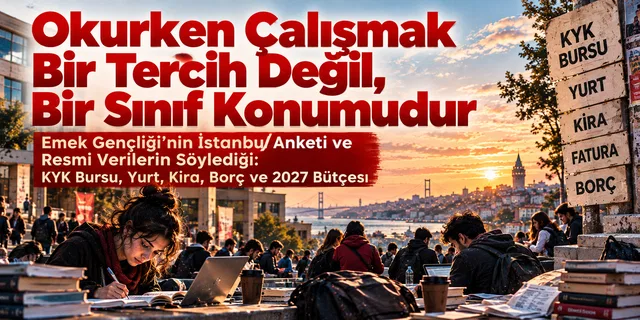
Today the 2027 budget of the Ministry of National Education (MEB) is being debated in the Plan and Budget Committee of the Grand National Assembly of Turkey. The figure on the table is 2 trillion 458 billion lira. It sounds large; in nominal terms it is a rise of 26.5 per cent. But the same figure also tells us that education's share of total public spending has fallen from 9.5 per cent to 8.3 per cent. As the budget grows, the place of education within it shrinks.
This essay is a continuation of our Democratic Education Dossier. In that dossier we discussed the class data of education, the axis of technology and artificial intelligence, and a programme of polytechnic education. Now we ask the same question in the language of money: How has money been set aside for education from the first budgets of the Republic to today? According to the needs of which class has this money been shaped? Why is commercialised education both expensive and poor in quality? And why, in the age of artificial intelligence, is a university diploma turning more and more into a door that opens onto unemployment? First a short summary, then the details.
Summary: The Education Budget in Twelve Theses
- A budget is not an accounting document; it is a class document. Where the state spends the taxes it collects shows for the benefit of which class the social surplus is redistributed.
- Spending on education is the cost of reproducing labour power. Capital needs workers who can read and write, who are disciplined and skilled; but it wants to keep the cost of this as low as possible and to spread it across society as a whole.
- In the first quarter-century of the Republic, education was never the priority of the budget. Between 1924 and 1938 the share of the Ministry of Education (Maarif) in the general budget stayed at an average of 3.7 per cent; in the same period roughly seven times as much went to defence.
- The share of education rose only when capital's need for skilled labour grew and when working people were organised. The language of "investment in manpower" in the period of planned development was the expression of this.
- After 1980, education began to be turned from a public service into a market good. The "donations" of school-parent associations, extra taxes and the cram-school economy were the tools of this transformation.
- Under the AKP, the share of investment in education collapsed. In 2002, 17.18 per cent of the MEB budget went to investment; in the 2027 proposal this ratio is 7.75 per cent.
- While the public school shrinks, public money flows to private schools, foundations and religious education. Purchases of private education services rise by 62 per cent in one year, to 90.1 billion lira; the share set aside for religious education is 108.9 billion lira.
- 82 per cent of the budget goes to personnel, yet there are still no teachers. A shortfall of 80,449 posts in the staffing norm is being covered with 71,757 hourly-paid teachers.
- The real bill for education is sent to households. Registration "donations", cleaning, stationery, school buses, private lessons: the working family fills from its own pocket every gap the state leaves behind.
- Commercialised education is expensive, but it is not good. The market school sells a diploma, not knowledge; an exam score, not understanding. It shapes the student not to understand the world but according to customer satisfaction. It does not speak to the real world, that is, to production, to society and to nature.
- In the age of artificial intelligence, the new component of the reserve army of labour is young people with diplomas. The registered employment rate of bachelor's graduates is falling, and one in five graduates cannot get a registered job; as entry-level mental work is opened up to automation, university graduates will join the army of the unemployed in greater numbers.
- What emerges is an education order split in two. The market for the children of the well-off; a minimal public school and charity for the children of working people. Our demand is a public education that ends this split: free of charge, scientific, connected to production, with its budget under democratic control.
Now let us open up these theses in detail.
Why Is the Budget a Class Document?
Every year the budget is presented in the Assembly as "the nation's budget". Yet in a society the "nation" is not made up of equal partners in a common treasury. Who pays the taxes and who benefits from the spending is a direct mirror of the class relations in society. As we stressed when we wrote about inflation earlier, in Turkey the greater part of tax revenue is collected from indirect taxes such as VAT and the special consumption tax, that is, above all from the consumption of working people. In that case the education budget is in fact the account of how much of the money that comes out of working people's own pockets returns to their own children.
In 1875, criticising the Gotha Programme of the German workers' party, Marx draws an interesting distinction. He objects to the programme's demand for "elementary education by the state". He accepts that the expenses of the schools, the qualifications of the teachers and the subjects of instruction should be fixed by a general law, and that the state should meet this expense, but he does not accept that the state should be made "the educator of the people". He says that government and church alike should be kept away from any influence on the school. Marx's position, then, is clear: The financing of education should be public; its content should be independent of the ideological control of power and of religion. What is happening in Turkey today is the exact opposite: While financing is being privatised more and more, political and religious control over content is growing.
To understand the place of spending on education in the economy we need one more concept: the reproduction of labour power. For a worker to be able to go to work every day, they need to eat, to be housed, to rest. For the next generation of workers to be raised, children need to be brought up and educated. Under capitalism, part of these costs is met by the wage, and part is taken on by the state. From the point of view of capital, the ideal is to find labour of the qualities it needs at the lowest cost. This is why the level of the education budget is never set according to "the needs of society", but according to capital's need for labour in that period and to the balance of forces between the classes.
The American economists Samuel Bowles and Herbert Gintis called this the "correspondence principle": The internal order of the school reflects the internal order of the workplace. Some children learn to obey, some learn to decide; which of the two they learn is determined largely by the class of their family. Pierre Bourdieu showed how the "cultural capital" that families pass on to their children is rewarded by the school as "talent" and "success". Budget cuts speed up this mechanism: The weaker the public school becomes, the more decisive the family's resources become.
The Founding Years: Nation-Building, a Scarce Budget
There is a widespread story about the first years of the Republic: the education mobilisation, the alphabet revolution, the Nation's Schools (Millet Mektepleri). Each of these was a real and progressive step. But the figures also show clearly that in this period education was not the priority of the budget.
Academic compilations of the share of the Ministry of Education (Maarif Vekaleti) in the general budget draw this picture:
| Year | Share of Maarif in the General Budget | Share of Defence |
|---|---|---|
| 1924 | 4.4% | 27.1% |
| 1928 | 2.6% (initial appropriation) | 30.1% |
| 1932 | 3.0% | 21.3% |
| 1938 | 4.7% | 28.0% |
| 1941 | 4.8% | 48.8% |
| 1946 | 7.8% | 31.1% |
| 1949 | 9.4% | 27.4% |
Source: the compilation of the 1924–1950 budgets published in the International Journal of Human Sciences.
Between 1924 and 1938 the average share was 3.7 per cent; between 1938 and 1950, 5.8 per cent. The average for defence was 31.6 per cent. The conditions of a young republic that had come out of war, and the shadow of the world war, explain part of this picture. But the real explanation is a class one: The ruling bloc of the founding period was made up of the bureaucracy and a commercial and industrial bourgeoisie that was only just beginning to grow fat. What this bloc needed was a cadre of civil servants and teachers to run its own state apparatus, not the mass education of the peasantry, which made up eighty per cent of the population.
The Village Institutes (1940) are the most striking example of this contradiction. The institutes are perhaps the most progressive experience in the history of education in Turkey: a model that joined education to production and turned the peasant child into a subject who transforms their own surroundings. But the buildings, the fields and the workshops were built largely with the labour of the students and the villagers themselves. What the budget did not give, the villagers' collective work (imece) made up. And under the pressure of the landlords and of reactionary circles, the institutes were dismantled from 1946 onwards and closed in 1954. The awakening of the peasant child was found to be "too much" the moment it began to touch the order of the land. The lesson still holds today: The ruling class allows education only to the extent that it does not shake its own order.
The Planned Period: When Education Became "Investment in Manpower"
After 1960 the State Planning Organisation was founded, and from 1963 onwards five-year development plans began to be prepared. Import-substituting industrialisation required technicians, engineers and skilled workers for the factories, and civil servants for a growing public sector. For the first time education was planned openly as an "investment in manpower". Vocational high schools, technical schools and new universities spread in this period.
The point to note here is this: Spending on education rose because that stage of capital accumulation required it. The workers' movement that grew stronger at the end of the 1960s, the organising of teachers (TÖS, the Teachers' Union of Turkey) and the student movement also gave this rise a social basis by defending education as a public right. The budget figures and the rise of class struggle coincide in the same period. This is no accident.
After 1980: From Public Service to Market Good
The decisions of 24 January 1980, and the 12 September coup that made them possible to implement, turned the model of capital accumulation in Turkey into one based on exports and cheap labour. As we described in detail in our 12 September dossier, this came together with the silencing of the unions, the teachers' organisations and the universities. In education, too, a new language settled in: "lack of resources", "society's contribution", "efficiency".
We can gather the education policies of this period under three headings:
- Handing school costs over to families. School-parent associations began to collect payments that were in practice compulsory, under the name of "voluntary donations", at registration time. The cleaning, heating and stationery of the public school gradually became the parent's problem.
- The growth of the cram-school economy. The inability of the public school to prepare students for exams created an enormous private cram-school (dershane) market. The central exams worked as a mechanism that turned family income directly into "success".
- Creating resources with extra taxes. When eight years of uninterrupted compulsory education was introduced in 1997, the resources needed were raised largely through extra taxes (on banking transactions, telephones, fees and the like) brought in by Law No. 4306. So the bill for the new burden was once again sent through consumption, once again to working people.
The essence of this period is this: Education began to stop being a service the state owes the citizen and to turn into a good in which the family "invests". Once this logic settles in, how much education whose child receives is tied to the family's ability to pay.
The AKP Period: The Collapse of Investment, the Rise of the Market and of the Religious Communities
From 2002 to today, education policy can be described as a transformation on two legs: on one side marketisation, on the other an ideological transformation through networks of foundations and religious communities (cemaat). The budget figures carry the traces of both legs.
The collapse of the share of investment. According to the budget analyses of Eğitim Sen, the education and science workers' union, 17.18 per cent of the MEB budget went to investment in 2002. This ratio fell as low as 4.57 per cent in 2009 and rose to 9.73 per cent in 2025. In the 2027 proposal it falls to 7.75 per cent, that is, to 190.6 billion lira. What is more, even the investment appropriation that is set aside is not spent: In the first six months of 2026, only 18.3 per cent of the 160.5 billion lira investment appropriation was used. What this means is concrete: overcrowded classrooms, double-shift schooling, prefabricated classrooms, buildings that will not withstand an earthquake. Yıldırım Kaya, from an estimate based on official data, says that about 1,400 schools carry a safety risk. In a country of earthquakes, not investing in school buildings means putting the lives of working people's children at risk.
The decline of the budget share. Because different sources use different denominators the ratios vary, but the direction is the same in every calculation:
- According to a report in Sözcü based on the Medium-Term Programme (OVP) of the Presidency of Strategy and Budget, ten years ago MEB's share of the central budget was 13.1 per cent; in 2026 it falls to 11.2 per cent, and in 2027 to 9.8 per cent. MEB is getting its lowest share of the last ten years.
- According to BirGün's compilation, the share was around 13 per cent in 2014; a level of 12 per cent is cited as the international benchmark.
- In the calculation Yıldırım Kaya made on the appropriations of all public administrations, the share falls from 9.5 per cent to 8.3 per cent.
A note: While in the OVP the 2027 MEB budget appears as 2 trillion 248 billion lira, in the proposal that came to the Assembly the figure rose to 2 trillion 458 billion lira. Even with the higher figure, because the general budget grows faster, the share of education still falls.
The composition of the budget. In the 2027 proposal, personnel spending and social security contributions together make up 82.1 per cent of the budget; purchases of goods and services 8.1 per cent, investment 7.75 per cent. This picture is often defended with "the education budget goes on salaries anyway". But the problem is not that salaries are too high; it is that everything else is squeezed. Teachers' salaries are melting away against inflation; despite this, the rest of the budget is so small that four-fifths of the total looks as if it went to personnel. The share left to cover the school's electricity, its cleaning, the student's meal and the laboratory's materials is around 8 per cent. This is why the Mersin Branch of Eğitim Sen says that no savings can be made on children's nutrition, and that the loading of cleaning and stationery costs onto parents must end.
The flow of public money to private schools. With the closure of the cram schools in 2014, most of the cram-school capital was converted into "basic high schools" (temel lise) and private schools; and the state began to pay an incentive, called "education and teaching support", for each student who went to a private school. Demand for private schools was created with public resources. Where we have arrived today:
- The appropriation for service purchases of the General Directorate of Private Education Institutions rises from 55.6 billion lira in 2026 to 90.1 billion lira in 2027; an increase of about 62 per cent. The general rise of the Ministry's budget is 26.5 per cent.
- According to MEB's 2025–2026 statistics, about 1.49 million of 17.7 million students, that is, 8.4 per cent, attend a private school. 15,000 of the 75,000 schools are private.
- According to TÜİK's 2024 education expenditure statistics, of every 100 lira spent on education, about 18 lira goes to private institutions.
So the budget gives to the private school the growth it withholds from the public school. This is not a matter of "freedom of choice"; it is the transfer of public resources to capital.
Foundations, associations, religious education and new academies. In the 2027 proposal the amount transferred to foundations and associations is 9.43 billion lira. These transfers are the financial basis on which the foundations and associations that the Ministry brings into schools through protocols become an ideological network funded from the public budget. The 285 per cent increase in one year in 2022 in the budget of the Türkiye Maarif Foundation was an early sign of this direction. The appropriation of the newly founded National Education Academy rises from 2.49 billion lira in 2025 to 15.7 billion lira in 2027; the projection for 2029 is about 42 billion lira. This despite the fact that only 16 per cent of the appropriation set aside in 2025 was spent. Taking teacher training away from the universities and handing it over directly to a structure under the control of those in power is the very situation Marx warned of: "the state as the educator of the people".
The Records of Evrensel and BirGün
Throughout the budget debates, while the official statements were given under the headline "the largest share goes to education", the press on the side of labour drew another picture. When we bring together what was written in Evrensel and BirGün, three shared findings stand out.
First, the "lion's share" rhetoric contradicts the figures. On 7 September BirGün was one of the first to announce the OVP figures: MEB's share of the central budget, 13 per cent in 2014, falls to 11 per cent in 2026 and 9.8 per cent in 2027. The government's promise that "we set aside the lion's share for education" has, in BirGün's words, "shrunk to a bird's share". A 2023 interview that Evrensel conducted with the Eğitim Sen expert Erkan Aydoğanoğlu had already answered the same rhetoric with the headline "the lion's share is on the parent's back": Schools meet their basic needs with registration donations and regular payments collected from parents; as the state's share in financing education falls, the families' share grows. When the investment series given in that interview (17.18 per cent in 2002, 4.57 per cent in 2009, 9.16 per cent in 2024) is read together with today's ratio of 7.75 per cent, it can be seen that the twenty years have been an uninterrupted retreat.
Second, the ideological composition of the budget. BirGün's report of 18 October, "An ideological budget in education", set out the programme breakdown of the 2027 proposal: 276.1 billion lira for general secondary education (including Anatolian, science and social sciences high schools), 108.9 billion lira for religious education, 285.8 billion lira for vocational and technical education. The sum of religious education and vocational education reaches about one and a half times general secondary education. This distribution is no accident: obedient labour on one side, cheap labour on the other. When we consider that most vocational education transfers child labour directly to the workplace through "learn while working" models such as MESEM, the vocational education centres, and that these children lose their lives in workplace killings, it becomes clear what type of person the budget aims to raise.
Third, education deepening class division. The Evrensel columnist Adnan Gümüş's piece of 21 August, "The great divide in the YKS", starting from the data of ÖSYM, the measurement, selection and placement centre, draws this picture: The average base score of those placed in state universities is 349; that of foundation (private) universities is 305. Boğaziçi is at the top with 488, Ardahan at the bottom with 253. Gümüş's emphasis is important: The school and the university, which once served to reduce inequality, today reproduce and deepen it; those who have money can enter the programme they want with a far lower score.
These three findings show that the budget figures are not a matter of accounting; they are a design of society.
No Teachers, but Hourly-Paid Teachers
If more than three-quarters of the budget goes to personnel, there should be no shortage of teachers, should there? Yet according to official data there is a shortfall of 80,449 posts in the staffing norm, and this gap is being covered with 71,757 hourly-paid teachers.
Hourly-paid teaching is the barest form of precarity in education. A way of working paid by the class hour, with wages that can fall below the minimum wage, without a permanent post, without job security. It is the public-sector counterpart of the "flexible labour" model we see in the gig economy. The state runs its own school on the logic of subcontracting.
There is one more contradiction here: While there are hundreds of thousands of teacher candidates who cannot be appointed, the gap is covered with hourly-paid teachers. According to TÜİK data, about a quarter of graduates of faculties of education cannot work in a registered job. This is the form the reserve army of labour takes in education. The mass of unemployed teachers both makes hourly-paid teaching "acceptable" and suppresses the wage and rights demands of teachers in permanent posts.
Who Pays the Bill? The Invisible Budget of Households
In debates on the education budget there is usually one more budget that goes unseen: the budget of families. According to TÜİK data, total spending on education as a share of national income was 5.8 per cent in 2019 and 4.9 per cent in 2024; the state's spending on education as a share of national income is 4 per cent. According to the OECD data compiled by Eğitim Sen, spending per student in primary education is 4,036 dollars in Turkey against an OECD average of 9,923 dollars; in secondary education, 4,793 against 11,400 dollars.
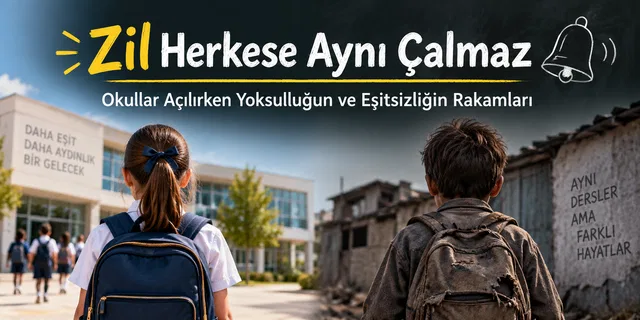
Who closes this gap? The working family. A "donation" at registration time, money for cleaning and stationery every month, the school-bus fee, study sessions and private lessons at exam time. As we write every September when the schools open, the bell does not ring the same for everyone.
The debate on free school meals must be read in this frame too. A meal is not "social assistance" or a "favour"; it is the material condition for a child to be able to learn. To expect success from a hungry child and then to label their failure as "lack of talent" is to present class inequality as if it were a personal flaw.
Commercialised Education: Expensive, but Not Good
The opening of education to the market was always defended with the same promise: "Competition raises quality; the family chooses the best." The experience of twenty years shows the opposite of this promise.
Price is not quality. Private school fees this year range from 500 thousand lira to 3 million lira. But as can be seen in the data compiled by Sözcü, the great majority of students who get full marks in the LGS, the high school entrance exam, prefer not the most expensive private schools but long-established public high schools, science high schools and a few old foreign-language schools. The closure of more than 2,000 private schools in the last five years also shows that the market moves not by "quality" but by the calculation of profit: When the crisis grows, the school closes and the student is left stranded. It is telling that even TÖZOK, the organisation of private school owners, says that "a school is only as good as its teachers". But in the private sector the teacher is a working person on a low wage, without a union, who does not know each year whether their contract will be renewed. A system that employs its teachers without security cannot be expected to be good.
The foundation university: entry by money, not by score. In the 2026 YKS, the university entrance exam, about 79 per cent of the 45,000 places left empty in the first placement were in foundation universities; about one-fifth of the places in foundation universities could not be filled. In state universities the occupancy rate is 99.5 per cent. The average base score of foundation universities is about 45 points lower than that of state universities. We are not blaming the individual student here; the problem is that part of the entry into higher education has been tied to the ability to pay. The more a diploma turns into a good that can be acquired with money rather than with knowledge, the more its value falls.
What does the market school sell? The real problem of commercialised education is not only that it is expensive or unequal; it is the knowledge it produces. The market school has three products:
- The exam score. The marketing value of the school is tied to its rankings in the LGS and the YKS. Teaching is shaped by question type; what is rewarded is not understanding but finding the right option quickly.
- Customer satisfaction. The parent is the customer; the student is the customer's child. An education that unsettles the student, makes them question their habits or demands effort is counted as a "service defect".
- The mark of prestige. The name of the school, the foreign language, the look of the campus turn into a certificate of class belonging. In Bourdieu's language, what is bought is not knowledge but the symbolic capital of the class.
None of these three speaks to the real world. The real world is how a factory works, why a building collapses, how a medicine is produced, how an ecosystem collapses, how wages are set, how society changes. Marx and Engels's idea of polytechnic education was an answer to exactly this rupture: to join education to productive labour, and the basic principles of science to the practical knowledge of production. This is why we put a programme of polytechnic education at the centre of our Democratic Education Dossier.
Today education in Turkey is caught between two extremes: on one side a market education focused on exams and prestige, cut off from production and from society; on the other the MESEM model, whose only connection to production is cheap child labour. The first does not show the real world; the second shows the real world only as exploitation. Polytechnic education is the third way: an education that makes labour the subject of learning but does not sell the child to the labour market.
TÜİK's Higher Education Employment Indicators 2025 show the results of this rupture clearly: Only 56.7 per cent of bachelor's graduates work in a job that matches their field. Among graduates of the social sciences, journalism and information, this ratio falls to around 20 per cent; according to eleman.net's compilation, about four-fifths of those who graduate in this field work outside it. So the education system is shaped not by the needs of society and production but by the logic of the market in places and the demand for diplomas.
The Army of Unemployed Graduates in the Age of Artificial Intelligence
People used to say "oku da adam ol", study and make something of yourself. For working families, the university diploma was seen as the way for the child to escape manual labour and find a secure job, the way to climb out of their class. Today this way is closing more and more, and artificial intelligence is speeding up the closure.
What do the figures say? According to TÜİK's Higher Education Employment Indicators, the registered employment rate of bachelor's graduates fell from 75.6 per cent in 2023 to 73.9 per cent in 2025; for associate degrees, from 67.7 per cent to 65.7 per cent. At least one in five of those who graduated between 2015 and 2024 is not in a registered job as of 2025. A young bachelor's graduate enters their first job after 14.2 months on average; a graduate in business, administration and law after 18.3 months. The employment rate of women graduates in the arts and humanities stays at 52.6 per cent. According to the calculations of DİSK-AR, the research centre of the Confederation of Progressive Trade Unions, idle labour and broadly defined unemployment are above 28 per cent; according to OECD data, about 30 per cent of young people in Turkey are neither in education nor in employment, and among young women this ratio exceeds 40 per cent (Karar). In our piece on TÜİK's labour force data we discussed the ideological function of this gap between the narrow and the broad definition.
Those who can leave are leaving. According to Evrensel's report of 23 October, the brain-drain rate among higher education graduates rose to 2.2 per cent in 2025; among graduates in information and communication technologies, this rate is 7 per cent. Computer engineers trained with public resources go above all to Germany, the United Kingdom and the Netherlands. So skilled labour educated with the taxes of working people is transferred free of charge to the capital of the core countries.
Why does artificial intelligence hit the university graduate? Earlier waves of automation targeted mainly manual labour and repetitive physical work. Large language models, by contrast, target entry-level mental work directly: writing reports, compiling data, writing simple code, translating, answering customer correspondence, scanning legal texts, preparing presentations. These are exactly the jobs new graduates do as they enter working life, the jobs that make up the first rungs of the ladder of learning.
In The Poverty of the White Collar we described the fall in white-collar hiring, and in Forty Percent of the Code, a Quarter of the Staff how, in software companies, staff are shrinking while artificial intelligence produces a growing part of the code. In The Human in the Loop we discussed how this changes the composition of labour: The senior employee remains as a "human in the loop" who checks what the artificial intelligence produces, while the entry-level jobs that are the way to reach that seniority disappear. The bottom rung of the ladder is being pulled away, but those on the upper rungs still defend the existence of the ladder.
The class meaning of this is clear. Marx shows that capital accumulation creates a relative surplus population, that is, a reserve army of labour, in excess of its own needs. This army is the tool for suppressing the wages and demands of those in work. In the 19th century the ranks of this army were filled by peasants driven off the land, in the 20th century by workers thrown out of the factory. In the 21st century, young people with diplomas are joining the ranks. The university graduate no longer has the privilege of the "intellectual" or the "expert"; the proletarianisation of mental labour is being completed. The existence of this new reserve army makes it easier to make even the graduates who do find work accept the minimum wage, to make them do unpaid internships on the excuse of "experience", and to make overtime normal.
There is a critical point here: The problem is not artificial intelligence itself, but in whose hands it is. The same technology could be used to shorten working hours, to offer everyone a better education, to free people from repetitive work and direct them towards creative work. But in the hands of capital a rise in productivity is realised not as shorter working hours but as dismissals. And the cost of this unemployment is once again charged to the public, once again to the working family. This is why in the Socialist AI Manifesto we argued for the socialisation of the means of production, of data and of models.
The education budget is directly related to this picture. For years the state expanded the number of places in higher education instead of quality; now, having cut the total number of places by about 246,000 between 2023 and 2025, it presents the problem as one of "too many graduates". But the problem is not a surplus of graduates; it is the lack of organisation of labour and the lack of planning of production. A society does not have a surplus of engineers, teachers, physicians or sociologists; what may be missing is the public planning and the will to invest that would employ them. That a quarter of the graduates of faculties of education are unemployed while there is a shortage of 80,000 teachers is the clearest proof of this.
The question we asked in Whom Is the University For? is even more burning today: In the age of artificial intelligence, will the university raise young people as a flexible workforce to be "reskilled" according to the changing needs of capital, or as free individuals who understand and transform the world? The first is the market university. The second is possible only with a public, free, scientific and democratic university.
Two Schools, Two Countries
When all these figures are put together, what emerges is not one education system but two separate worlds of education:
| What Is Said | What the Figures Show |
|---|---|
| "We set aside the lion's share of the budget for education." | MEB's share of the budget is at its lowest level in ten years; in 2027 it falls once again. |
| "We have raised investment in education as never before." | The share of investment in the MEB budget fell from 17.18 per cent in 2002 to 7.75 per cent; most of the appropriation set aside is not even spent. |
| "We offer families freedom of choice." | Public resources transferred to private education rise by 62 per cent in one year; while the public school shrinks, the private school grows on public money. |
| "Private schools raise quality." | More than 2,000 private schools have closed in the last five years; the average base score of foundation universities is 45 points lower than that of state universities. |
| "We are meeting the need for teachers." | A staffing shortfall of more than 80,000 is covered with more than 71,000 precarious hourly-paid teachers; a quarter of the graduates of faculties of education are unemployed. |
| "Education is free." | From the registration donation to cleaning, from the school bus to private lessons, the bill for education is sent to households. |
| "We are raising a generation with values education." | 108.9 billion lira goes to religious education and 9.43 billion lira to foundations and associations; teacher training is tied to an academy under the control of those in power. |
| "Our young people are being prepared for the professions of the future." | The registered employment of bachelor's graduates is falling; one in five is not in a registered job, nearly half work outside their field; IT graduates are going abroad. |
These two worlds correspond to the two classes of the country. For the children of well-off families: a well-equipped private school, a foreign language, private lessons, study abroad. For the children of working people: an overcrowded classroom, an hourly-paid teacher, a laboratory without materials, cleaning paid from the parent's pocket, a curriculum filled with ideological content and, in the end, unemployment with a diploma. Education stops being a means of climbing out of one's class and becomes a means of reproducing class.
To read this only as "bad management" or "wrong priorities" would be incomplete. A model of accumulation based on cheap labour does not need a highly skilled education on a mass scale; it recruits the small skilled cadre it needs from the private school and the elite public schools, and passes the rest directly into cheap labour as "apprentices", "interns" and "MESEM students". The budget is this model of accumulation written in figures.
What Do We Want for Public Education?
The unions of education workers, parents and student organisations have been voicing similar demands for years. We can gather them into a programme as follows:
- The public resources set aside for education should be raised to at least 6 per cent of national income, and MEB's share of the budget should not be allowed to fall below international benchmarks.
- The share of investment should be raised at least to its 2002 level, above 17 per cent; priority should go to strengthening schools at risk in an earthquake and to ending double-shift schooling and overcrowded classrooms.
- Incentives and service purchases for private schools should be stopped; these resources should be transferred to the public school. Foundation universities should be placed under public control.
- Transfers to foundations, associations and religious communities, and the protocols signed with them for schools, should be abolished; the content of education should be scientific and secular.
- Hourly-paid teaching should be ended, and the staffing shortfall should be closed with permanent, secure appointments.
- Every student, from pre-school to high school, should be given at least one free and nutritious meal a day.
- The cleaning, heating, stationery and staff costs of schools should be met entirely from the public budget; collecting money from parents under the name of "donations" should be banned.
- Models based on child labour, such as MESEM, should be abolished; in their place a polytechnic education should be built that joins production and science, and that prepares the child not for the labour market but for understanding the world.
- Public employment planning should be carried out against graduate unemployment: Public posts should be opened in every field where there is a shortage of teachers, physicians, engineers or social workers; the rise in productivity brought by artificial intelligence should be directed not towards dismissals but towards shorter working hours without loss of pay.
- School budgets should be transparent and open to democratic control; school councils made up of representatives of teachers, parents, students and staff should be able to monitor how the budget is spent.
Concrete Tasks
These demands will not come true by themselves. The budget is written anew every year, and every year it can become an object of struggle again. What can be done starting today:
- Ask about your school's budget. Find out the appropriation of the school where you are a parent, a student or an employee, and the money the school-parent association collects and spends. Use your right to information.
- Collect the "donation" receipts. Document the payments demanded at registration time and the requests for cleaning and stationery, and pass them on to the unions and parents' organisations. Making the invisible budget visible is the first step.
- Organise solidarity with hourly-paid teachers. Hourly-paid teachers are the section of education workers whose voice is most easily silenced. Open the way for them to join union organising.
- Grow the organising of graduates and students. Unemployment with a diploma is not an individual failure but a shared class problem. The union organising of graduates, interns and white-collar employees is one of the most urgent tasks of the age of artificial intelligence.
- Follow the budget debates and write about them. Follow the minutes of the Plan and Budget Committee and the parliamentary questions of deputies; pass the figures on to the people around you in plain language.
- Build joint platforms locally. Education unions, parents' associations, student collectives and neighbourhood organisations can come together and run joint campaigns on concrete demands such as free meals and safe school buildings. The network model of organising we described in Organising 2.0 can be a starting point for local alliances of this kind.
- Create a knowledge commons. Compile budget data by year, school-by-school lists of needs, and maps of teacher shortages and graduate employment as open data, and offer them for everyone's use. When knowledge is monopolised, the budget is monopolised too.
Dear Young Comrades
At first sight budget figures look cold and distant. Trillions, percentages, appropriations. But behind every figure there is a class, a child, a teacher. An investment share of 7.75 per cent is a child taught in a building that will not withstand an earthquake. A transfer of 90 billion lira to private education is a laboratory left incomplete in a public school. 71,000 hourly-paid teachers are 71,000 working people preparing for a precarious future. And every one in five graduates who cannot get a registered job is proof that the promise made by the order that tells you "if you work hard you will succeed" has not been kept.
You were told that the diploma was a ticket to salvation. Yet the diploma is not an individual ticket; it can become a power only in the hands of an organised class. In the age of artificial intelligence, everyone who works with knowledge, the coder and the teacher, the translator and the lawyer alike, faces the same question: In whose hands is the wealth that is produced, under whose control, for whose benefit?
The Village Institutes, raised in the first years of the Republic by the collective labour of the villagers, taught us two things: First, working people have the creativity to build their own education. Second, the ruling class does not hesitate to close down this creativity once it begins to shake its own order. This is why the struggle for education is not only a struggle for a bigger budget; it is a struggle over under whose control, for whose benefit and in whose hands the budget will be.
Education is not a good but a right. Knowledge is not a commodity but the common accumulation of humanity. The school should not be a sorting machine that reproduces classes, but a commons where every child can freely develop their own abilities and learn to understand and transform the world. And this is possible only through the joint struggle of organised working people, teachers, parents and students.
To ask for the account of the chalk is to ask for the account of the future.
Sources
Budget data and statements
- ANKA Haber, "CHP'li Yıldırım Kaya: MEB bütçesi büyüyor ama kamu bütçesindeki ağırlığı küçülüyor" (CHP's Yıldırım Kaya: The MEB budget is growing, but its weight in the public budget is shrinking), November 2026. ankahaber.net
- Haberler.com, "Yıldırım Kaya, MEB'in 2027 bütçesinde kamu payının yüzde 8,3'e düştüğünü söyledi" (Yıldırım Kaya said the public share fell to 8.3 per cent in MEB's 2027 budget). haberler.com
- Sultan Uçar, "Eğitimden kıstılar!" (They cut from education!), Sözcü, 19 September 2026. sozcu.com.tr
- Eğitim Sen, MEB Budget Brochure, November 2024. egitimsen.org.tr
- Yeni Anamur Gazetesi, "Eğitim Sen 2027 MEB bütçesine karşı çıktı" (Eğitim Sen opposed the 2027 MEB budget), 8 November 2026. yenianamur.com.tr
- MEB, "2025-2026 Örgün Eğitim İstatistikleri Açıklandı" (2025–2026 Formal Education Statistics Announced), 1 October 2026. meb.gov.tr
- Bloomberg HT, "Eğitimde geçen yıl yapılan 100 liralık harcamanın 18 lirası özele" (18 lira of every 100 lira spent on education last year went to the private sector) (TÜİK Education Expenditure Statistics, 2024), 5 December 2025. bloomberght.com
- Memurlar.net, "Öğretmen açığı kartopu gibi büyüyor: Norm kadro açığı 55 ilde 80 bin 449" (The teacher shortage is snowballing: a staffing shortfall of 80,449 in 55 provinces). memurlar.net
- Diken, "Eğitimde 'aslan payı' Maarif'in: MEB'in bütçesi yüzde 20, vakfınsa yüzde 285 arttı" (The 'lion's share' in education goes to Maarif: MEB's budget rose 20 per cent, the foundation's 285 per cent), November 2021. diken.com.tr
- Medyascope, "Eğitim Sen Genel Başkanı Nejla Kurul: Bütçede eğitim yatırımlarına ayrılan pay 20 yıl öncesinin yarısına bile yaklaşamadı" (Eğitim Sen President Nejla Kurul: The budget share for education investment does not come close even to half of what it was 20 years ago), 2 November 2021. medyascope.tv
- International Journal of Human Sciences, compilation of the Maarif and defence budgets for 1924–1950. j-humansciences.com
Evrensel and BirGün
- BirGün, "Eğitim bütçesinden tasarruf: 'Aslan payı' kuşa döndü" (Savings from the education budget: The 'lion's share' has shrunk to a bird's share), 7 September 2026. birgun.net
- BirGün, "Eğitimde 'ideolojik' bütçe: Dini ve mesleki eğitime 385 milyar TL" (An 'ideological' budget in education: 385 billion TL for religious and vocational education), 18 October 2026. birgun.net
- Adnan Gümüş, "YKS'de büyük ayrışma: Boğaziçi 488, Ardahan 253, devlet 349, vakıf 305" (The great divide in the YKS: Boğaziçi 488, Ardahan 253, state 349, foundation 305), Evrensel, 21 August 2026. evrensel.net
- Eylem Nazlier, "Eğitim bütçesi temel ihtiyaçları karşılamaktan uzak, aslan payı velinin sırtında" (The education budget is far from meeting basic needs; the lion's share is on the parent's back), Evrensel, 21 October 2023. evrensel.net
- Evrensel (DHA), "Yükseköğretim mezunlarında beyin göçü oranı arttı" (The brain-drain rate among higher education graduates has risen), 23 October 2026. evrensel.net
Commercialisation, graduate employment and unemployment
- Sultan Uçar, "Çok pahalı okul kaliteli okul anlamına gelmez!" (A very expensive school does not mean a good school!), Sözcü, 5 June 2026. sozcu.com.tr
- Euronews Türkçe, "Boş kalan kontenjanların çoğu vakıf üniversitelerinde" (Most of the empty places are in foundation universities), 19 August 2026. tr.euronews.com
- Alomaliye, "Yükseköğretim İstihdam Göstergeleri, 2025" (Higher Education Employment Indicators, 2025) (TÜİK), 23 July 2026. alomaliye.com
- Dünya, "Üniversite mezununda yeni tablo: İstihdam düştü, işe giriş süresi uzadı" (A new picture for university graduates: Employment fell, the time to the first job grew longer). dunya.com
- Eleman.net, "TÜİK Verileri Ortaya Koydu: Üniversite Mezunlarının Beşte Biri İş Bulamıyor" (TÜİK Data Reveal: One in Five University Graduates Cannot Find a Job), 5 August 2026. eleman.net
- Karar, "TÜİK işsizlik oranı gerçeği yansıtıyor mu? Üniversite mezunları neden iş bulamıyor?" (Does TÜİK's unemployment rate reflect reality? Why can't university graduates find work?), 3 September 2026. karar.com
Theoretical sources
- Karl Marx, Critique of the Gotha Programme, 1875.
- Karl Marx, Capital, Volume I, Chapter 25: "The General Law of Capitalist Accumulation".
- Samuel Bowles and Herbert Gintis, Schooling in Capitalist America, 1976.
- Pierre Bourdieu and Jean-Claude Passeron, Reproduction in Education, Society and Culture.
Related pieces from Bilgi Müşterekleri: Democratic Education Dossier · The Bell Does Not Ring the Same for Everyone · Whom Is the University For? · The Poverty of the White Collar · Forty Percent of the Code, a Quarter of the Staff · The Human in the Loop · TÜİK Labour Force Data · The Socialist AI Manifesto · Two Thermometers · 12 September Dossier · Organising 2.0 · Gig Economy Dossier
This essay is published under the CC BY-SA 4.0 licence. It may be shared, reproduced and developed, with the source credited.