The Class of the Budget: In 2027, from Whom Is It Taken, and to Whom Is It Given?
Interest, Guarantees, Incentives and the Partisan Social State: A Line-by-Line Class Reading of a Budget

Today the 2027 budget of the Ministry of Treasury and Finance is being debated in the Plan and Budget Commission of the Grand National Assembly. On the screens the words will turn: "fiscal discipline", "the fight against inflation", "broadening the tax base". Each of these words is the technical name for taking from one class and giving to another. In this piece we try to turn that technical language into plain language, to open the 2027 budget line by line, and to show how, through history, the budget has worked as an instrument of class.
Summary: The 2027 Budget in Ten Theses
- The budget is not an accounts table. It is a relation of power. In Rudolf Goldscheid's phrase, the budget is "the skeleton of the state, stripped of every ornament". How much is taken from whom, and how much is given to whom, says in figures which class rules in that country.
- The 2027 budget projects 27 trillion 276 billion lira of expenditure, 23 trillion 408 billion lira of revenue, and a deficit of 3 trillion 868 billion lira (Karar).
- 3 trillion 975 billion lira is set aside for interest. That is larger than the budget deficit. About 10.9 billion lira a day. About 15 lira of every 100 lira of spending goes to the rentier (Tele3).
- About 60 per cent of taxes are indirect taxes. VAT and the special consumption tax alone approach 9 trillion lira. The tax buried in bread, in the bill and in fuel is paid by the poorest as well as by the richest. Set against income, the poor pay far more (Endeks24).
- Capital's tax is cancelled in advance. Tax expenditure for 2027, the tax "forgone" through exemptions, immunities and deductions, is 4 trillion 879 billion lira. The amount forgone in corporate tax alone (1 trillion 79 billion) is almost half the corporate tax expected to be collected (2 trillion 223 billion) (Yeniçağ, TEZ-KOOP-İŞ).
- 296.8 billion lira in 2027 for guaranteed contractors. 160.7 billion for city hospitals, 134.1 billion for bridge and motorway guarantees and contribution payments. 813 million lira a day (TR724).
- Armament is the fastest-growing line. The ceiling of the Ministry of National Defence rises by 86 per cent, to 1 trillion 533 billion lira. The rise for the Ministry of National Education is 26.5 per cent (N24).
- Social assistance is a third of the interest. 1 trillion 341 billion lira is set aside for social assistance, and three times that for interest. Social assistance has also been taken out of the form of a right and turned into a network of dependence and loyalty.
- The budget of the AKP period is a three-legged machine of accumulation: collect from the worker through indirect tax, transfer to capital through interest, guarantees and incentives, and produce consent for this order through the network of social assistance and foundations.
- What changes the budget is not the parliamentary rostrum. It is the organised class. The criticisms of the EMEP and TİP deputies, who make the voice of the class heard from that rostrum, are still valuable for drawing the map of this struggle. At the end of the piece we list those points one by one. In the same section we have also added the budget words of the DEM Party, the New Party and SOL Parti, each in its own frame.
Now let us go into the detail.
What Is the Budget, and in Whose Hands Is It?
School textbooks define the budget as "the law that estimates the state's revenue and expenditure for one year and permits them to be carried out". The definition is right, and it is incomplete. What is missing is this: revenue from where, expenditure to where?
In Marxist state theory the budget has two functions. As James O'Connor shows in The Fiscal Crisis of the State (1973), the state must on the one hand secure the accumulation of capital (infrastructure, incentives, interest on debt, cheap credit) and on the other hand protect the social legitimacy of this order (education, health, social assistance, security). The budget is where these two functions collide. As accumulation spending grows, legitimacy spending is cut. As legitimacy weakens, the share that goes to the apparatus of repression and to the ideological apparatuses grows.
In the chapter of Capital on primitive accumulation, Marx names the public debt "one of the most powerful levers of primitive accumulation". The state borrows, and pays the debt with tax. The worker pays the tax. The rentier takes the interest. Today the name of this mechanism is "rolling over the debt" or "primary surplus". The substance has not changed.
In this piece we will read every line with three questions: In whose hands? Under whose control? To whose benefit?
Budget and Class through History: A Short Fiscal History of Turkey
The Ottoman Public Debt Administration: the budget pledged abroad
In 1875 the Ottoman state became unable to pay its debts. The Ottoman Public Debt Administration, set up by the Muharrem Decree of 1881, began to collect the most productive revenues, tobacco, salt, silk, stamps and alcohol, directly in the name of European creditors. A second treasury was built inside the state, in the service of creditor capital. The peasant's tithe and the labour of the tobacco worker were transferred straight to the bondholders in Paris and London. This was the first naked example of what is today called "the confidence of the markets".
The early years of the Republic: making a bourgeoisie by the hand of the state
In the first decades of the Republic the budget was the instrument for creating a national bourgeoisie. The 1927 Law for the Encouragement of Industry gave the industrialist land, tax exemption and customs facilities. The peasant carried the load through the livestock tax, road labour service and indirect taxes. The 1942 Wealth Tax was a fiscal operation that, in wartime, transferred the wealth of non-Muslim merchants to a Muslim-Turkish bourgeoisie, joining ethnic discrimination to a class redistribution. We took this process up in detail in Why Is the Republic a Bourgeois Revolution?.
The 1960s and the planned period: class struggle reflected in the budget
The 1961 Constitution brought in the principle of the "social state". This was not a favour. It was the result of the rising workers' movement and of the union organising of the 1960s. The share set aside for social security, public health and education grew in the years when DİSK was founded and the 15–16 June actions took place. The budget reflected, one to one, the balance of power between the classes.
24 January and 12 September: the budget rewritten in favour of capital
The decisions of 24 January 1980 brought an export-led model of accumulation. 12 September removed the organised workers' obstacle in front of that model. Real wages fell sharply in the years after the coup. In the 1980s extra-budgetary funds multiplied: the Mass Housing Fund, the Support and Price Stability Fund, and dozens more. An important part of public resources was taken outside parliamentary control. In our 12 September dossier we drew the class balance sheet of this turn.
The 1990s: a rentier's paradise
In the 1990s the state transferred resources to the banks and to the big groups of capital through interest on domestic debt. The holding banks placed deposits in government bonds and earned high real interest. By the time of the 2001 crisis, interest payments were swallowing almost the whole of tax revenue. The public cost of saving the banking system after the crisis was reckoned at roughly 50 billion dollars. Profit was privatised. The loss was nationalised.
The AKP period: a three-legged machine of accumulation
The AKP took over the fiscal frame that the IMF programme after 2001 had built. In the first years the interest burden fell, because there was globally cheap money and the revenue of large-scale privatisation. New channels of transfer took the place of the interest that had fallen:
- Privatisation. Telekom, Tekel, SEKA, Tüpraş, Petkim, the ports, the bridges and motorways, and electricity distribution were sold. Public property was turned into a field of accumulation for capital.
- Public-private partnership (KÖİ). Bridges, motorways, airports, tunnels and city hospitals were built with demand and revenue guarantees denominated in foreign currency.
- Tax expenditures and incentives. The corporate tax rate was pulled down from the 30 per cent of 2003, and countless exemptions were brought in.
- FX-protected deposits. With the KKM scheme brought in after the exchange-rate shock at the end of 2021, the currency loss of deposit holders, and above all of the large deposit holders, was made the public pay through the Treasury and the Central Bank.
- The return of interest. With the tightening after 2023, interest expenditure again became one of the largest lines of the budget. In 2027 it is pressing on 4 trillion lira. On the Medium-Term Programme it rises to 5.2 trillion lira in 2029.
What did the worker gain in this process? The minimum wage approached the average wage. Wages were equalised at the minimum wage. Home ownership became harder. The young were condemned to live with their families. The great majority of university students had to work while they studied. We measured this impoverishment in One Wage in Ten Months and in September Inflation, the TÜİK-ENAG Gap.
The Main Frame of the 2027 Budget
| Line | Amount (billion TL) | Note |
|---|---|---|
| Total expenditure | 27,276 | |
| Total revenue | 23,408 | |
| Budget deficit | 3,868 | 3.5% of GDP |
| Interest expenditure | 3,975 | Larger than the deficit, 14.6% of expenditure |
| Tax revenue | 19,906 | |
| Personnel expenditure | 6,318 | |
| Transfer to the SGK | 3,450 | |
| Shares of local administrations | 2,316 | |
| Purchase of goods and services | 2,184 | |
| Capital expenditure | 1,855 | |
| Tax expenditure (tax forgone) | 4,879 | Larger than interest |
| KÖİ guarantee and rent payments | 297 | 813 million TL a day |
Sources: Karar, the TEZ-KOOP-İŞ economic analysis, Yeniçağ, TR724.
The most striking relation in this table is this: when the amount the state forgoes in tax (4.88 trillion) is added to the amount it pays in interest (3.98 trillion), the sum is more than twice the budget deficit. The deficit exists not "because the people spent too much", but because of the tax not taken from capital and the interest paid to the rentier.
The Revenue Side: From Whom Is It Taken?
Indirect taxes: the silent levy on the poor
| Tax | 2027 estimate (billion TL) | Share of tax |
|---|---|---|
| VAT | 5,681 | 28.5% |
| Income tax | 5,533 | 27.8% |
| Special consumption tax | 3,284 | 16.5% |
| Corporate tax | 2,223 | 11.2% |
| Banking and insurance transactions tax | 990 | 5.0% |
| Fees | 748 | 3.8% |
| Customs duty | 531 | 2.7% |
| Stamp tax | 467 | 2.3% |
| Motor vehicle tax | 175 | 0.9% |
VAT, the special consumption tax, the banking and insurance transactions tax, fees, stamp duty and customs duty together make up about 60 per cent of tax revenue. An indirect tax is buried in the price of the good or service that is bought. It does not look at who buys. A worker on the minimum wage spends almost the whole of their income on consumption, so a large part of that income is subject to VAT and the special consumption tax. A high-income person sets an important part of income aside as saving, shares and property. That part never enters the indirect tax. The result: set against income, the indirect tax falls from the poor toward the rich. It is a regressive tax.
In The Class of a Litre of Diesel we showed that a serious part of the price of a litre of fuel is tax. We took up the tax and fund load on the electricity bill in The Class of Three Thousand Kilowatt-Hours. These lines are the everyday face of the indirect tax.
Income tax: the tax cut from the wage-earner's payslip
A large part of income tax is collected from wage-earners by withholding at source. The worker has paid the tax before receiving the wage. They cannot escape it, postpone it, or lobby for an exemption. When the tax brackets are not updated by as much as inflation, the worker moves into a higher bracket in the middle of the year and the net wage falls. This, called "the melting of the payslip", is a hidden extra tax that inflation takes from wage-earners.
Corporate tax: it exists in the law, and it is half in the till
Corporate tax in 2027 is estimated at 2 trillion 223 billion lira. In the same year the amount forgone within corporate tax is 1 trillion 79 billion lira. For every two lira they pay, companies almost fail to pay one. Investment allowances, incentive certificates, free-zone and technopark exemptions, research and development deductions, and export exemptions are the sources of this sum. Some of these incentives may turn into real investment. To which capital, on what condition, and with what requirement of employment and wages, is not open to the public.
Wealth and property: almost none
In Turkey the taxation of wealth, of property rent, and of the gains of big capital is next to nothing. The property tax is left to the municipalities and is calculated on low values. The gain on shares is largely exempt from tax. On the figure Erkan Baş reported in the commission, the richest 1 per cent owns 40 per cent of total wealth (Cumhuriyet). Not taxing this wealth is not a neglect. It is a choice.
The Expenditure Side: The Class Character, Line by Line
Here we read each main line of the budget with the three questions.
Interest expenditure: 3 trillion 975 billion lira
In whose hands? The greater part of government domestic borrowing securities is in the hands of the banks, the big funds and foreign portfolio investors. The neighbourhood shopkeeper and the worker on the minimum wage have no bond.
Under whose control? The interest rate, the maturity of borrowing and the currency composition are set between the Treasury, the Central Bank and market actors. Parliament approves only the total figure.
To whose benefit? The rentier's. About 10.9 billion lira of interest is paid a day. This sum is three times the resource set aside for social assistance (the EMEP Keşan statement, Keşan Postası). Interest is the most direct transfer collected from the worker by tax and paid to capital.
The government says the ratio of interest to GDP has fallen from 14.3 per cent in 2002 to 3.6 per cent in 2027. A correct ratio, and a wrong conclusion. What matters is not the ratio. It is the relation of the resource that goes to interest with social spending. On the Medium-Term Programme, interest rises to 4.7 trillion lira in 2028 and to 5.2 trillion in 2029. The load is growing.
Personnel expenditure: 6 trillion 318 billion lira
The salaries of teachers, nurses, civil servants, police and soldiers are in this line. Because it is the largest line of the budget, it is often targeted with the talk of a "bloated public sector". The overwhelming majority of personnel expenditure is the wage of public workers, and these wages are constantly melting against inflation. In the same line there are also the multiple salaries of the senior bureaucracy, board fees, and the privileges of appointed managers. Because the two are gathered in the same line, the wage of the public worker and the privilege of the bureaucratic elite disappear inside the same figure.
For public workers the real problem is that the collective agreement is left to the discretion of the Arbitration Board, without the right to strike. The budget turns the disorganisation of the public worker into a figure.
Social security transfers: 3 trillion 450 billion lira
The transfer to the Social Security Institution is used, in the government's speech, to mean "pensioners are a burden on the state". The sources of this deficit are in fact of class: widespread unregistered employment, premium incentives and discounts given to employers, premium amnesties and restructurings, and premiums paid on a low wage. The state takes on, by incentive, the premium the employer should pay, then closes the Institution's deficit with tax, and presents this as "support given to the pensioner". The pensioner, on the lowest pension, is condemned to work at a second job.
Purchases of goods and services: 2 trillion 184 billion lira
This line covers everything the public sector buys from outside: cleaning and security services, food, software, consultancy, rent. This is where subcontracting, tender bargaining, and tenders made by invitation under the 21/b negotiated procedure are concentrated. The Public Procurement Law has been changed more than a hundred times since it came into force in 2003. Each change widened the field of exception and of negotiation.
Capital expenditure: 1 trillion 855 billion lira
Public investment is, in principle, where social property grows: the school, the hospital, the railway, water and sewerage. In the AKP period public investment was emptied in two ways. First, investment was handed to private capital through the KÖİ model. The state began to pay rent instead of building its own school and its own hospital. Second, investment itself became the channel for distributing contractors' rent. On EMEP's account, the share of education investment in the budget of the Ministry of National Education falls from 17.18 per cent in 2002 to 7.75 per cent in 2027 (Keşan Postası).
National education: 2 trillion 459 billion lira
In absolute terms the largest ministerial budget. About 83 per cent of the budget goes to personnel. Very little is left for lines such as building and repairing schools, and a free meal for the student. The demand for one free meal in schools has not entered the budget for years. Meanwhile the content and the financing of education are opened, through foundations, associations and protocols, to the networks of religious communities. This is what we meant in The Bell Does Not Ring the Same for Everyone when we said the bell does not ring the same for everyone.
Health: the public hospital is the tenant, the city hospital is the landlord
In the 2027 budget of the Ministry of Health, the usage fee of the city hospitals is 82.3 billion lira and the purchase of services is 78.4 billion, 160.7 billion in all. That is about 10 per cent of the ministry's budget. Even in the first nine months of 2026 the amount paid reached 108 billion lira (TR724). On EMEP's reckoning, about 69 per cent of health-service appropriations goes to curative care and only 27 per cent to preventive health. Preventive health prevents illness. Curative health makes a profit from illness. The budget's choice is to hand health over to a "treatment industry".
National defence: 1 trillion 533 billion lira, an 86 per cent rise
The fastest-growing line of 2027. The ceiling of the Ministry of National Defence rises from 823 billion lira to 1 trillion 533 billion (N24). The Defence Industry Support Fund and the budgets of the Gendarmerie, the police and the National Intelligence Organisation are not added to this. In recent years the defence industry has become one of the most profitable and most sheltered fields of accumulation for capital in Turkey: a buyer guaranteed by the state, a long-term contract, secrecy and incentives. An armament budget means, on the one hand, a safe market for capital and, on the other, a resource for the apparatus of repression at home and abroad.
The Directorate of Religious Affairs: 229 billion lira
The budget of the Directorate of Religious Affairs rises by 31 per cent, to 229 billion lira. This figure is larger than the budget of many ministries. The class function of the Directorate is ideological. It is the institutional bearer of a language that presents poverty as fate, patience as virtue, and obedience as worship. The way Friday sermons look at economic crises, at the deaths of workers and at strikes is the open example of this function. In Whose Family Is Safe? we discussed how the ideological apparatus redefines the family.
Social assistance: 1 trillion 341 billion lira
We take this line up under a separate heading, together with the question of partisanship.
Direct supports to capital: 1 trillion 9 billion lira
On EMEP's reckoning, direct supports from the budget to employers (incentives, premium support, support for the interest on credit, export and investment supports) rise from 561 billion in 2025 and 713 billion in 2026 to 1 trillion 9 billion lira in 2027 (Keşan Postası). When tax expenditures are added to this figure, the resource transferred to capital in one year, directly and indirectly, reaches about 5.9 trillion lira. That is one and a half times the interest expenditure.
Guaranteed Wealth: How Is the Payment above Value Guaranteed in KÖİ Projects?
The group of capital known in public as the "Gang of Five", and in the language of the main opposition as Cengiz, Limak, Kolin, Kalyon and Makyol, took on an important part of the large infrastructure tenders of the AKP period. In the World Bank's database of private participation in infrastructure, these companies stood near the top of the lists of companies that take the most public tenders in the world. The question here is not the companies one by one. It is the mechanism itself. The mechanism is a contract architecture that zeroes capital's risk and guarantees its profit.
How does this mechanism work?
Demand guarantee. A daily number of vehicles is guaranteed for a bridge, a motorway or a tunnel. On the contract information that has reached the public, guarantee thresholds such as 40,000 vehicles a day for the Osmangazi Bridge and 68,500 a day for the Eurasia Tunnel were set. If that many vehicles do not pass, the Treasury pays for the vehicle that did not pass. The public pays a toll for a car that never crosses. The guarantee numbers are set according to the optimistic traffic forecasts of the consultants the company retains. The more the forecast is inflated, the larger the guarantee.
Currency guarantee. Guarantee fees were mostly defined in dollars or euros. As the lira loses value, the lira amount the Treasury pays multiplies. It is not the investor who should carry the currency risk. It is the public, which pays the bill of every fall in the lira. The 2027 figures rest on the assumption in the Medium-Term Programme of a dollar at 56 lira. If the rate passes that assumption, the bill will grow (Başkent Postası).
Indexed rent. In the city hospitals the state is not the owner of the hospital. It is the tenant. Rent and service fees are tied to foreign exchange and to price indexes. The hospital is rented for twenty-five or thirty years. When the contract ends the building passes to the state, but in most cases the construction cost of that building has already been paid several times over as rent.
Burying the service package in the contract. In the city hospitals, services such as cleaning, food, the car park, imaging and the laboratory are also given to the company. Every revenue-yielding field outside the "core" health service of the hospital is opened to private capital.
Debt assumption. The credits the project company takes from the banks are secured by the Treasury's undertaking to assume the debt. If the project fails, the state pays the credit. The bank's risk falls to zero, the cost of credit falls, and the profit stays with the company.
Tax exemptions. In KÖİ projects, exemptions from VAT, stamp tax and fees are part of the contract. The state pays the guarantee on the one hand and forgoes the tax on the other.
Secrecy. An important part of the contracts is not opened to the public, on the ground of "commercial secrecy". The audit of the Court of Accounts is limited. Parliamentary questions often go unanswered. The public is the debtor of a contract it did not sign and cannot see.
The figures
| Period | KÖİ payment |
|---|---|
| 2017–2026 (realised) | 816 billion TL (about $31.5 billion) |
| 2027 (projection) | 296.8 billion TL |
| 2028 (projection) | 354.7 billion TL |
| 2029 (projection) | 381.8 billion TL |
| 2017–2029 total | about 1.85–1.9 trillion TL |
Source: the reckoning of Ulaş Karasu, New Party deputy, based on the budget and Medium-Term Programme figures (Başkent Postası); the 2027 lines from TR724. The similar contracts of state economic enterprises and of institutions outside the central administration are not included in these amounts.
When these projects were begun it was said that "not five kuruş will come out of our pocket". The figures are there. Profit is private, risk is public. This is not called a "public-private partnership". It is called the public paying tribute to private capital.
The kinship between build-operate-transfer and the fund plunder
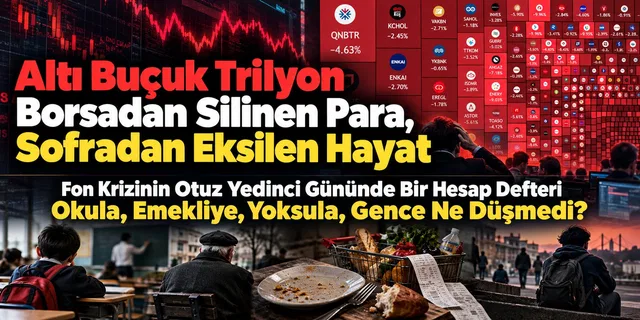
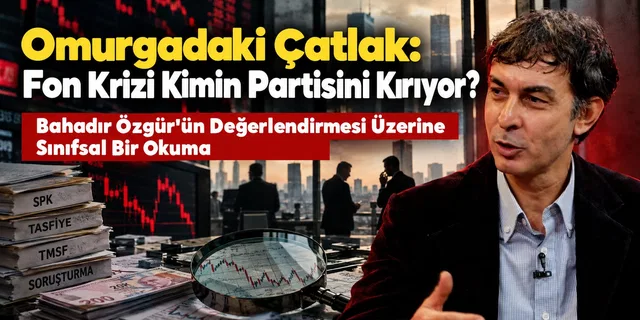
KÖİ and the fund investigation of recent weeks rest on the same logic: the transfer of a public resource to private accumulation by a network of capital and bureaucracy close to the government, slipped past audit and hidden behind a "technical" language. We discussed this network in Six and a Half Trillion and Whose Party Is the Fund Crisis Breaking?. The budget and the exchange, the guarantee and the fund, are different channels of the same class relation.
The Partisanisation of the Social State
A right, or a favour?
In the Constitutions of 1961 and 1982 the "social state" is a principle. The social state is the citizen's possession, as a right, of a certain level of life: unemployment insurance, free health, free education, decent housing. A right is taken without being indebted to anyone.
In the AKP period this principle gave way to an assistance regime. In the assistance regime the citizen is not the holder of a right. They are the needy. Assistance is given or not given. Its amount, its time and its form are at the discretion of the administration. Where there is discretion, there is an expectation of loyalty.
The organisational network of assistance
The main channel for distributing social assistance is the Social Assistance and Solidarity Foundations in every province and district. At the head of these foundations stands the governor or the district governor. On the board of trustees, beside public officials, there are neighbourhood headmen and local people chosen as "benefactors". Who is "needy" of assistance is decided by home visits and local knowledge. This structure is extremely open to interlocking with the local political networks of the central government.
The increase, in election periods, of the distribution of coal, food and white goods; the widening of assistance cards and of schemes such as the "Family Support Programme" in step with the election calendar; the blocking of the social-assistance campaigns of municipalities run by the opposition, or the freezing of their accounts: these are the examples of this regime that have reached the public over the years.
The network of foundations, associations and communities
Public resources were transferred to foundations and associations close to the government not only through the budget, but also through protocols, allocations of land, municipal donations and "cooperation" agreements with public institutions. Dormitories, courses, scholarships and youth work were carried on through this network. The social function of the state was partly subcontracted to a political-religious network of organisation. The student who takes a scholarship from this network, the family that finds a dormitory, the young person who finds a job, feels indebted not to the state but to the network.
The class meaning
The class function of this order has two sides:
- To manage poverty, not to abolish it. The assistance regime supports the poor not enough to lift them a little above the poverty line, but enough that they do not turn away from the order. Wages stay low, because assistance subsidises a part of the wage. This is an indirect wage support to employers.
- To put gratitude and loyalty in the place of class consciousness. The citizen who demands a right organises. The needy person who waits for assistance stands alone in the queue. The assistance regime builds a vertical relation of patronage in the place of class solidarity.
Our principle here should be clear. We are not against social assistance itself. We stand by the poor family's coal, the student's scholarship, the old person's support. What we are against is this support being taken out of the form of a right and turned into an instrument of partisan dependence. Our demand is not that assistance be cut. It is universal social rights, with a clear rule, cleared of political discretion.
Two Budget Logics Side by Side
| Today's budget logic | A budget logic on the side of labour |
|---|---|
| 60% of tax revenue is indirect tax | Indirect taxes removed from basic consumption; wealth and the gains of big capital taxed |
| 4.88 trillion TL of tax expenditure, its reason and its result closed | Every exemption tied to a condition of employment, wages and union; disclosed to the public company by company |
| 3.98 trillion TL to interest | The debt audited, debt that is not legitimate questioned, interest not put ahead of social spending |
| KÖİ guarantees in foreign currency, contracts secret | Contracts disclosed in full, guarantee payments stopped, the projects nationalised |
| In health, city-hospital rent and a treatment industry | The public hospital, preventive health, a free health service |
| In education, an investment share of 7.75% | Building schools, one free meal for every student, free and secular education |
| An 86% rise for defence | Housing, earthquake safety and climate adaptation instead of armament |
| Social assistance at discretion, distributed through a foundation network | Universal social rights: an unemployment guarantee, a basic income guarantee, free transport and energy |
| The budget prepared with the organisations of capital and debated in Parliament "for the sake of form" | A participatory budget: unions, professional chambers and neighbourhood councils have a say in preparing the budget |
From the rostrum and outside it: EMEP, TİP, the DEM Party, the New Party, SOL Parti
In the debates of the Plan and Budget Commission, the deputies of EMEP and of TİP were among the few voices that stated the class character of the budget directly. The DEM Party, in the same commission, reads the budget along the axes of peace, the mother tongue and poverty. The New Party speaks in another language: "the nation's treasury", "resilience", a leap in growth. Interest, KÖİ, the wage-earner's tax and the fund are still on their agenda too. Outside Parliament, the SOL Parti word on this budget that we found is at the level of a provincial organisation. In this pass we did not come across a separate TKP text that opens the lines of the 2027 budget. Below we gather each party's own words, in its own frame. The list can be updated as the debates go on.
The Labour Party (EMEP)
İskender Bayhan (Istanbul), the budget of the Ministry of Labour and Social Security, 3 November (Habererk/ANKA, Cumhuriyet):
- In a 22-page ministerial presentation the concept of "labour" appears only once. There are no figures on workplace deaths, union rights or poverty.
- About 1 million of some 2.5 million workplaces are in the dangerous or very dangerous class. The number of labour inspectors has been cut to 875.
- A penalty was imposed in 1,549 of the 5,573 inspections reported. In about one of every three workplaces inspected there is a violation.
- The unionisation rate fell in three years from 15.2 per cent to 13.8 per cent. The way the official rate is calculated hides the real situation ("94 out of 100 are without a union").
- Lawsuits objecting to union authorisation are not in the reports. The big holdings and the monopolies are not inspected enough.
- The ministry does not go to the sites of strikes. Workers dismissed for being union members, and families who have lost someone in a workplace death, are not dealt with.
- "Leave the sermons of social dialogue." "Stop blowing the horn of the capital that sucks the blood of labour."
İskender Bayhan, the budget of the Ministry of Industry and Technology, 3 November (EMEP, Sondakika):
- About 7 million workers work in industry, but the presentation does not speak "even in a single sentence" of their wages, their working conditions or the violations of their rights.
- The fall in industrial production in the TÜİK figures is not reflected in the presentation.
- Incentives transfer a public resource to holdings and to the owners of capital: "Minister, whose money are you distributing?"
- Groups that announce high profits dismiss metal workers and cut wages. In large factories, cake and chocolate are given to the worker instead of a bonus.
- At Smart Solar, 85 workers were dismissed for unionising, and the resistance continues.
- At Astor Enerji, workers are tracked with chipped cards (The Card Around Our Necks).
- The effects of the solar-energy investments in Diyarbakır on the peasants of Kervanpınar.
EMEP's general criticisms of the 2027 budget (the statement of the EMEP Keşan district organisation, 31 October; Keşan Postası):
- The budget is "a reverse mechanism of redistribution", working from the workers toward capital.
- Interest expenditure is about 15 per cent of the budget, and three times social assistance.
- Direct support to employers rises from 561 billion in 2025 and 713 billion in 2026 to 1 trillion 9 billion lira in 2027.
- KÖİ payments swallow budget resources like a "black hole".
- 83 per cent of the education ministry's budget goes to personnel. The share of education investment fell from 17.18 per cent (2002) to 7.75 per cent (2027).
- The rent and service fee of the city hospitals exceeds 10 per cent of the budget of the Ministry of Health. Health is left to the mercy of the "treatment industry".
- As the share set aside for public services and investment falls, the tax load and out-of-pocket spending rise.
EMEP's standing budget demands (the line Sevda Karaca raised in earlier budget periods, and which the party continues this year; EMEP):
- Wages below the poverty line to be exempt from tax.
- Indirect taxes such as VAT and the special consumption tax to be removed from basic consumption.
- A wealth tax to be brought in.
- Electricity, water, transport and heating to be free for poor workers.
- Free and decent public health and education; one free meal in schools.
- The criticism that the budget is prepared with organisations of capital such as TÜSİAD, MÜSİAD, TOBB and TİSK and debated in Parliament "for the sake of form".
- "Struggle changes the budget."
The Workers' Party of Turkey (TİP)
Erkan Baş, the budget of the Ministry of Labour and Social Security, 3 November (Cumhuriyet):
- In the period of AKP government, 38,216 workers lost their lives in workplace deaths. There is "not a single line" of this in the minister's presentation.
- The richest 1 per cent owns 40 per cent of total wealth. The budget does not take up this inequality at all.
- The employment figure fell from 32.5 million to 32.4 million. The talk of an "employment record" does not reflect the reality.
Erkan Baş, press conference at the Grand National Assembly, 4 November (ANKA, Habererk):
- "There is an immense gulf between the priorities of the government and the priorities of the people." The real problems of the people are not discussed in the budget.
- Workers, the unemployed, and those who die in workplace deaths are "only a figure" for the government. Naming the deaths "accidents" should be refused.
- The Justice Minister's statement in the fund investigation was left half finished. An administrative investigation should be opened at once. The allegations of bribery in the financial bureaucracy, and the political connections, should be brought to light.
- The decisions of the Constitutional Court and of the European Court of Human Rights are not complied with. Can Atalay's seat in Parliament has still not been restored. The state of law is not independent of the budget.
Note: Because TİP has no group in Parliament, its chances of taking the floor in the Plan and Budget Commission are limited. For that reason the party's budget criticisms will be concentrated in press conferences and in the debates of the General Assembly, as well as in commission speeches. The General Assembly debates will be held in December.
The DEM Party
The DEM Party does not set the budget up, as EMEP and TİP do, as a demand for a class budget. Its axis is peace, public services in the mother tongue, poverty and communal participation. The figures and demands below are their words.
Sevtap Akdağ Karahalı, the opening of the field campaign, 16 October (Evrensel). This speech is from before the commission debates. Karahalı said they would look more closely once the draft was in their hands:
- "We think the logic of the budget deepens poverty." She said that outside personnel spending she saw no notable line in national education, that there was no resource for health or for agricultural investment, that the rise in armament and the war industry came first, and that the transfer of resources to capital, and the incentives, continue.
- She asked for farmers' credit and debt to be cancelled, a basic income for those over 18 who cannot be employed, women's social-security and pension rights secured with state support, and support with bills and basic expenses for households under the hunger and poverty lines.
- Revenue taken from wealth and from large rent, transferred to the low-paid; indirect tax on the poor table cut. One free and hygienic meal in schools; transport, housing and school costs free throughout education.
- She said the budget period joins the fixing of the minimum wage, the public workers' rise and the collective-agreement talks. The demand will be organised not in Parliament but in the province, the district, the village, the neighbourhood and the house. Bread, justice and peace cannot be separated.
Yılmaz Yıldırımcı, the Ankara provincial organisation, "A Budget for Bread, Peace and Justice", 24 October (Mezopotamya Agency):
- He said this is the first budget after the framework law. He named, as a basic expectation, "the use for peaceful purposes of the 40 billion dollars set aside in the budget for war". That 40 billion dollars is their reckoning.
- He said the defence budget stands first, with a rise of 60 per cent on the previous year. "It is not possible to accept that, under the name of defence, a huge budget is set aside for the barons of war and the arms monopolies."
- He asked why, while the tax debt of the holdings is cancelled, resources are transferred to capital under the name of interest and rent. The slogans at the rally: "A budget for the peoples, not for war", "A budget for the worker, not for the fund men".
- He said the budget must be communal. The people are not the object of the budget. They are its partner and its subject.
- Demands: the minimum wage and the lowest pension indexed above the hunger line, to the poverty line, and exempt from tax. Pensioners to receive a bonus of one minimum wage four times a year. Wages raised to the decent living standard of a family of four. Health and education free, of quality, and in the mother tongue. Customer-guaranteed rent projects cancelled. A free nursery and care home, open around the clock, in every neighbourhood.
Meral Danış Beştaş and Hakkı Saruhan Oluç, the budget as a whole, 27 October (Yeni Özgür Politika):
- The two said the budget is drawn up not for peace but for the privileged, and proposed a separate final-accounts commission.
- Beştaş: in the 86-page presentation booklet the word poverty never appears. Democracy has evaporated, the social state is forgotten, law appears twice. She said 3 trillion 454 billion lira is set aside for defence and internal security, and that this is larger than the education ministry's budget of 2 trillion 459 billion lira. She also placed the health share beneath it. The paper printed that amount as "2 trillion 134 million". The health appropriation announced by Cevdet Yılmaz is 2 trillion 134 billion.
- She said social assistance rises by 46 per cent and that this is boasted of. "That 18 million citizens are in need is not a boast. It is the number of those who cannot sit at the table, and it is a document of shame."
- "The basic priority of the 2027 budget should have been peace. Peace should find its answer not only at the negotiating table but in the budget."
Ayşegül Doğan, 27 October (Yeni Özgür Politika):
- She said she saw no line for peace, democracy and justice. She cited an AKP official's sentence, "2 trillion dollars were wasted in 50 years". That is a sentence Doğan reported.
- "The 2027 budget touches no area of social life." "Peace cannot be separated from bread, nor justice and democracy from poverty."
Adalet Kaya (Diyarbakır) and Kamuran Tanhan (Mardin), the budget as a whole, 27 October (Mezopotamya Agency):
- Kaya said this is the 25th budget planned in the AKP period. "Because you see your political existence as bound to the support of national and international capital, you want to go on with budgets that put their interest first." She added that access to public services has ceased to be a right of equal citizenship and is offered as a favour.
- She said the helplessness of a woman who does not speak Turkish, in the hospital, the courthouse and the social services, and the equal service an Alevi citizen is due, have no line in the budget. She named the barriers LGBTİ+ people and migrants meet in housing and health. "The budget of this system, which ignores the fragile sections of society, cannot be the budget of the peoples."
- She said that as the DEM Party they reject this budget. Against it she set a budget right that secures women's economic independence, makes care labour public, is cleared of violence, and looks after all the oppressed.
- Tanhan: "To keep alive in this country on 23 to 25 thousand lira really does ask for resilience." "There is no welfare in the budget, and there is no claim about welfare either." He said a household's paying for food, rent and bills is not the same thing as a decent life.
- Drawing on figures of the Ministry of Family and Social Services, he reported that more than 18 million citizens are left in need of social assistance, and that 4.5 million households cannot pass the winter without support for electricity and heating. "In the social state, success must not be to increase the number of citizens in need of assistance and to boast of it."
- "The more you earn, the less you pay, or the more you benefit from the exemptions."
Mehmet Kamaç (Diyarbakır), the budget of the Ministry of Trade, 4 November (Haberler):
- He asked for secured finance for the small business, transparent support, collection on time, fair competition, and a settlement of debt according to the ability to pay.
- "The justice of a budget appears together with how much resource it offers the strongest firm, and with what possibility it gives the most fragile firm of staying open. The small shopkeeper is not asking for a privilege."
The New Party
The New Party does not set the budget up as a class relation. The points below are their own sentences. The figure, the claim or the demand is their word. We are not writing it as a court judgment.
Cavit Arı (Antalya), the budget as a whole, 27 October (the Grand National Assembly, Cumhuriyet):
- The group brought to the commission a banner reading "Political Responsible of the Presidential Organisation's Fund Plunder".
- Revenue 23 trillion 408 billion, deficit 3 trillion 868 billion. Arı said interest expenditure was 3 trillion 976 billion. "At the very start, a third of the budget is made up of the budget deficit and interest expenditure."
- In 2019 interest expenditure was 100 billion lira. In seven years it rose to 3 trillion 976 billion. Arı called this "almost 38 times".
- The excuses he listed for inflation: Covid, the Ukraine-Russia war, the earthquake, and this year the war in the Middle East. His objection to Cevdet Yılmaz's line that "the reason inflation rose by 7 points is this war" was this: "What has to be said now is that you can no longer govern the country properly."
Cavit Arı, the budget of the Ministry of Labour and Social Security, 3 November (the Assembly record, Vekilpedia):
- He said the cost of the fund loss to the small investor was about 800 billion lira. He added that, with the loss on the exchange, the cost passes into the trillions.
- The lowest pension is 23,552 TL, the minimum wage 28,075 TL. He reckoned the cost of raising the pension of the 5 million pensioners on the lowest pension to the minimum wage at about 23 billion a month and 270 billion a year. In the same speech he also called this difference 277 billion. His demand: the lowest pension, and the holiday bonus, should be one minimum wage.
- The gross income of a public engineer was 5.73 times the minimum wage in 1994 and has fallen to 3.05 times in 2026. Arı called this "a loss of about 47 per cent". TÜRK-İŞ's October poverty line is 123,000 TL. An engineer's salary, at 92,000 TL, is below it.
- The wage to be paid to a foreign engineer and architect must be at least four times the gross minimum wage. Today that amount is 132,000 TL gross. "We are in a position of giving to the foreign engineer what we withhold from our own."
- In 2026 the first tax bracket is 190,000 TL. The 2027 projection is 240,000 TL. A wage-earner on a payslip enters the higher bracket in the third or fourth month. If revaluation had been applied since 2002, the first bracket should have been 660,000 TL. For the second bracket he proposed the range from 660,000 to 1 million 400 thousand.
- Gradual retirement and the grievance of internships, and a restructuring of social-security debt for shopkeepers and farmers, are also among the demands.
Özgür Karabat (Istanbul), the budget as a whole, 27 October (the Grand National Assembly, Antep Manşet):
- "In this budget we see that the choices are wrong, that the budget works for interest, that the targets slip every year, that the tax load is piled onto the wage-earner and the consumer, that almost no measure is taken to tax wealth, and that Parliament's right over the budget narrows every day."
- In the chart they prepared for the fund investigation there are 21 names, 11 institutions and a single power of appointment. "Those arrested are not only company bosses. They are also the economic cadre of the state." He defined the chart not as a criminal complaint but as "a document of political responsibility".
- In the 2025 final accounts, income tax withheld from wage-earners came in 33.5 per cent above the target, and corporate-tax collection 22.8 per cent below it.
- The 2026 inflation target is 28 per cent. The target for the rise in income-tax collection from wage-earners is 52 per cent. Karabat questioned this gap.
- The richest 20 per cent takes 48 per cent of income. The poorest 20 per cent takes 6.4 per cent.
- The findings of the Court of Accounts rose from 1,049 to 1,052. Thirty-eight findings have been repeated unchanged for five years.
- In the same speech he called the solution "a great leap, a great revolutionary development drive". This is a programme separate from the class-budget demand of EMEP and TİP. Karabat's measure is the league table of growth.
Özgür Karabat, the labour budget, 3 November (ANKA, the Assembly record, Vekilpedia):
- On TÜİK, unemployment is 8.4 per cent and the idle labour force is 31.2 per cent. "A full eight million people work unregistered." "Unregistered work is a subject that poisons the whole of Turkey's economy."
- In 2025, 2,105 workers died while working. Ninety-four of them were children. He asked why not a single kuruş had been set aside for four years for the programme to protect children.
- He argued that 2 trillion 229 billion lira of the Social Security Institution's premium receivables were not correctly reflected in the financial statements, and that 340 billion lira sent to enforcement was not entered in the accounts.
- He said pensions do not suffice, and that gradual retirement is waiting. He asked for the criterion of the "national security" ground for postponing strikes, and whether this power would be given up.
Ümit Özlale (Izmir), the budget as a whole, 27 October (Antep Manşet):
- He found the theme of "resilience" right, and the budget in front of it wrong.
- He called the joining, in one person, of an advisory post at the Presidency and a seat on the board of a portfolio company "the most savage crony capitalism".
- He accused the management of Türkiye Sigorta, on his own reckoning, of a fraud of more than 50 billion TL. This is a claim. It is not a court judgment. Özlale's question was why no resignation came out of this appointment.
Ulaş Karasu (Sivas), on KÖİ. The figures are above, in the section on guarantee payments. His sentence is this: "The government's guarantee is to the company, the bill is to the nation." He said that the citizen who does not cross the bridge and does not go to the hospital also pays for this guarantee with tax. In the same sentence he named the 21/b negotiated tenders (Sivas İrade, CUMHA).
SOL Parti
In this pass we did not come across a central SOL Parti statement that opens the 2027 budget line by line. The word we found is at the level of a provincial organisation.
Elyesa Uygun, Artvin provincial official, 31 October (Toplumsal). A reply to the President's statement that the 2027 budget sets resources aside for pensioners' living conditions:
- He said pensions are moving away from meeting basic needs. "Who finds these bad living conditions fit for pensioners?"
- He said that after wage rises, steeper rises come on the goods people have to buy, and that "a rise of a few kuruş" will melt in the cost of living. He added that the announced inflation does not reflect the real cost of living.
- "A decent life is the right not only of pensioners but of the worker, the civil servant, the shopkeeper, the farmer, the young, and the whole of society. A rise for the pensioner is of course necessary. But the real success is to build a country that does not leave people waiting for a rise."
In early November, SOL Parti joined the statement read by the Sivas Halkevi in Republic Square against the 2027 budget debates, together with EMEP, the New Party and the KESK branch platform. The text in the square is the Halkevi's. We are not writing it as SOL Parti's word (Sendika.Org).
The Communist Party of Turkey
In this pass we did not come across a TKP text that opens the 2027 budget proposal line by line. The statement of 27 October, "We Have to Take Back the Stolen Republic", is a Republic Day text. It does not open the budget lines. If a text appears, it will be added to this section.
The common line that comes out of the parties' criticisms
- In the budget presentations the working class, workplace deaths and de-unionisation are made invisible.
- Public resources are transferred to capital through interest, KÖİ guarantees and incentives.
- The tax load is on the worker's back, through indirect taxes and wage withholding.
- The apparatus of inspection (labour inspectors, the Court of Accounts, Parliament) is made functionless.
- The budget, lawlessness, the fund plunder and corruption are parts of the same network of power.
This common line offers a concrete ground for the common action among left parties that we defend in Liberation Is in Our Hands, Unity Is in the Hands of the Class and in Organising 2.0. The budget period is a good opportunity to set factionalism aside and to build common figures, common demands and a common calendar of action.
The DEM Party reads some of these lines through the demand for peace, the mother tongue and a communal budget. The New Party counts interest, KÖİ, wage withholding and the fund; its programme is a leap in growth and "the nation's treasury". The SOL Parti word we found is that the pension melts in the cost of living, and that a decent life is the right of the whole of society. EMEP and TİP draw from the same figures a wealth tax, the removal of indirect tax from basic consumption, and the conclusion that struggle changes the budget.
Concrete Tasks
- Read your own budget. Work out how much of a month's wage returns to the state as VAT, special consumption tax and income tax. Look at the VAT line on the shop receipt, at the fuel receipt, and at the tax and fund lines on the electricity bill.
- Hold a budget workshop at work and at school. Using the tables in this piece, prepare a fifteen-minute account: interest and social assistance, tax expenditure and corporate tax, city-hospital rent and health investment.
- Follow the local KÖİ. If there is a city hospital, a guaranteed motorway or a bridge in your city, follow their annual payments through a freedom-of-information request and through the parliamentary questions of opposition deputies.
- Build the language of right in social assistance. Stand beside the neighbour who receives assistance. Explain that assistance is not a favour but a right, and that its amount and its conditions must be ruled. Document examples of partisan distribution.
- Join a union, and bring others in. The power that changes the budget is the organised worker who can bargain over the wage and strike. If the unionisation rate is under 14 per cent, the budget too is capital's budget.
- Signatures and action for common budget demands. Join, or organise, local budget forums that will bring the common points of EMEP and TİP together with unions, professional chambers and youth organisations.
- Follow the General Assembly debates, and share them. In the December debates, cut and share the speeches that raise the voice of the class. Meet the government's language of "fiscal discipline" with figures.
Dear Young Comrades
The budget looks like a game played every year in Parliament as a marathon. Ministers present, the opposition criticises, the government majority votes, the budget passes. This ceremony hides the place where the budget is actually written. The budget is written at the table of the organisations of capital, in the reports of the credit-rating agencies, in the contractors' contracts, in the interest market. What comes to Parliament is the approval of what has already been written.
But history also teaches us this. The entry of the social-state principle into the budget in the 1960s came through the organised struggle of the workers. The Spring Actions of 1989 forced the wages of public workers onto the budget table. Everything that has changed the budget was organised power built outside Parliament. The voice at the rostrum was the echo of the power in the street.
Today every tax cut from a worker's payslip mixes, somewhere, into the guarantee fee paid to a contractor, the interest paid to a rentier, the order given to an arms company. Knowing this is the first step. Turning this knowledge into an organised demand is the second step, and the real one.
Whose the budget is, the answer is clear today: capital's. What it will be tomorrow depends on how organised we are. Struggle changes the budget.
Sources
Figures of the 2027 budget
- Karar: the details of the 2027 budget
- Tele3: the money set aside for interest passed the budget deficit
- Endeks24: in the 2027 budget, indirect taxes are 60 per cent of tax
- TEZ-KOOP-İŞ: Economic Analysis of the 2027 Central Government Budget
- Yeniçağ: a tax exemption of 4.9 trillion lira in the budget
- N24: how much is there in the 2027 budget for education, defence and the Directorate of Religious Affairs?
KÖİ and guarantee payments
- TR724: the contractors' money is guaranteed; 296.8 billion TL to KÖİ in 2027
- Başkent Postası: Ulaş Karasu, "they said not five kuruş would come out, they will pay 1.9 trillion lira"
Criticisms of EMEP and TİP
- Cumhuriyet: the Plan and Budget Commission, the Labour Ministry debates
- Habererk/ANKA: Bayhan to Işıkhan
- EMEP: Bayhan, in the industry and technology budget the workers are not even named
- Keşan Postası: EMEP's budget statement
- EMEP: Sevda Karaca, "struggle changes the budget"
- ANKA: Erkan Baş, a gulf between the priorities of the government and the priorities of the people
- Habererk: Erkan Baş, the people's priorities are not in the budget
The DEM Party's budget speech
- Evrensel: the DEM Party will take the 2027 budget into the field, 16 October 2026
- Mezopotamya Agency: a budget for the peoples, not for war, 24 October 2026
- Yeni Özgür Politika: what has been prepared is not the budget of peace, 27 October 2026
- Mezopotamya Agency: Adalet Kaya and Kamuran Tanhan, 27 October 2026
- Haberler: the Trade Ministry budget, Mehmet Kamaç, 4 November 2026
SOL Parti and the TKP
- Toplumsal: SOL Parti Artvin, the pension, 31 October 2026
- Sendika.Org: the Sivas Halkevi's budget statement; SOL Parti took part
- TKP: We Have to Take Back the Stolen Republic, 27 October 2026
The New Party's budget speech
- The Grand National Assembly: the 2027 budget in the Plan and Budget Commission, 27 October 2026
- Cumhuriyet: the budget debates opened with the fund reckoning
- Cavit Arı, the labour budget, 3 November 2026, the Assembly record
- Antep Manşet: Karabat, "those arrested are not only company bosses"
- ANKA: Karabat on unregistered work
- Özgür Karabat, 3 November 2026, the Assembly record
- Sivas İrade: Ulaş Karasu's objection to KÖİ
- CUMHA: Ulaş Karasu, "they said not five kuruş would come out"
Theoretical sources
- Karl Marx, Capital, Volume I, Chapter 24 ("So-Called Primitive Accumulation")
- James O'Connor, The Fiscal Crisis of the State (1973)
- Rudolf Goldscheid, Staatssozialismus oder Staatskapitalismus (1917)
Related pieces from Knowledge Commons
- One Wage in Ten Months
- September Inflation, the TÜİK-ENAG Gap
- The Class of Three Thousand Kilowatt-Hours
- Six and a Half Trillion: The Money Wiped Off the Exchange, the Life Missing from the Table
- Whose Party Is the Fund Crisis Breaking?
- Whose Family Is Safe?
- The Bell Does Not Ring the Same for Everyone
- The Card Around Our Necks
- 12 September: The History, Balance Sheet, and Present of a Class Coup
- Why Is the Republic a Bourgeois Revolution?
- Liberation Is in Our Hands, Unity Is in the Hands of the Class
- Organising 2.0: An Idea for a Justified Revolt
This piece is one of the living documents of Knowledge Commons. It is shared under the CC BY-SA 4.0 licence. You may copy, change and share it if you credit the source. It will be updated as the debates of the Plan and Budget Commission and of the General Assembly go on.