Time Saved, Share Shrinking
Artificial Intelligence, Productivity and the Struggle over Distribution in the ILO's New Term

Dear Young Comrades,
Within a week, warnings came from two different institutions of the capitalist world.
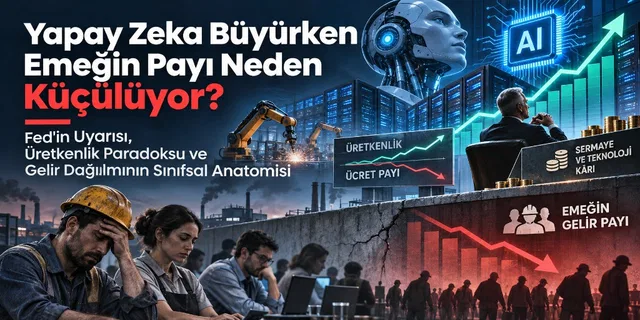
On 12 November, Michael Barr, a member of the Board of Governors of the US Federal Reserve, said in a speech at Yale that artificial intelligence could cause serious short-term disruptions, that its gains could flow to capital and that labour's share of income could fall. In Why Does Labour's Share Shrink as Artificial Intelligence Grows?, published two days ago, we examined that warning and the figures behind it in detail.
Today, 16 November, the Governing Body of the International Labour Organization (ILO) in Geneva elected Gilbert F. Houngbo to a second term as Director-General. Houngbo identified the transformation of the labour market by AI as a central issue for his new term. The public debate came down to one question: Will rising productivity shorten our working time, or will it put pressure on employment and wages?
This article brings the two warnings and the two essays together. We are looking at two sides of the same question. Productivity gains can return to workers in two forms: higher wages or shorter working hours. One is our share, the other our time. Today's figures show that both are being taken from us.
Let us state our answer at the outset: technology cannot answer this question by itself. The answer depends on who owns the time saved and the wealth produced. This is not an engineering question but a class question.
Summary First: Twelve Theses
- The news: Houngbo was re-elected on 16 November 2026 with 51 of 56 votes and five abstentions. His rivals Yolanda Díaz and Javier González-Olaechea withdrew before the vote. His new term runs from 1 October 2027 to 2032.
- Two warnings in one week: Both the Fed and the ILO say AI's gains may flow to capital. Both propose solutions without asking about ownership: training, job matching, competition policy and appeals for a "fair distribution".
- Productivity has two currencies: wages and time. Gains can return to workers as a share of income or as hours. At present, neither is adequately returning to them.
- The share is shrinking: In the United States, labour's share fell to 53.0 per cent in the third quarter of 2026, the lowest since the series began in 1947. Globally, the labour income share was 52.6 per cent in 2025. In Turkey, labour payments accounted for 38.1 per cent of value added.
- Hours are not shortening; work is intensifying: Some workers at AI companies report working 70–90 hours a week. Hours saved through AI are filled with new meetings and tasks.
- The break is old, the speed new: The gap between productivity and wages has widened since 1979. AI did not create this trend; it inherits it and may accelerate it.
- The mechanism is Marx's relative surplus value: Under capitalism, productivity can shorten necessary labour time and increase surplus labour time. It does not automatically raise wages or shorten the working day.
- Productivity gains leave through three doors: job cuts, intensification and wage pressure. The fourth door — shorter hours and a larger share — has historically been opened through organised struggle.
- Share and time were won together and are being lost together: From 1886 and 1917 to the ILO of 1919 and the years 1945–1975, working time fell as labour's share grew. The same forces won both: an organised working class and capital's fear of it.
- The ILO's limit is structural: Its tripartite structure reflects the balance of power; it does not change it. Today the organisation faces financial strain, divisions and dependence on the payment schedule of its largest contributor.
- Turkey is a severe test: Europe's longest actual working week, one of its lowest labour shares and collective bargaining coverage of around 10 per cent. AI arrives on top of this picture.
- Our demand has two legs: a move towards a 32-hour week without loss of pay, and a wage formula of "inflation plus productivity". Both require the same foundation: raising the question of ownership and organising.
Now let us unpack these theses.
What Happened in Geneva?
Founded in 1919, the ILO is the oldest specialised agency of the United Nations. It makes decisions through a tripartite structure of government, employer and worker representatives; its Governing Body also elects the Director-General.
The election on 16 November produced an interesting picture. Two rival candidates withdrew before the vote; Houngbo stood alone and received 51 votes, with five abstentions. One of those who withdrew, Spanish Labour Minister Yolanda Díaz, spoke sharply on her departure: she said the current administration had led the organisation into the worst crisis in its history and that, without change, the ILO would continue to decline. The concrete face of the crisis is money: the United States, traditionally the organisation's largest contributor, has delayed payments, and the ILO has said it may have to reduce staff.
In his acceptance speech Houngbo identified AI's transformation of the labour market as a central challenge and said technological progress must remain at the service of people. His priorities for the second term include strengthening labour standards and supervision, a greater presence in the field, the effects of AI and financial sustainability. The concept he emphasised most was the tripartite structure, or "tripartism".
This gives us our first clue: the world's foremost international labour organisation is entering the AI age financially strained, divided and dependent on the decisions of its most powerful member.
Two Warnings in One Week: The Fed and the ILO
It is no coincidence that a central banker and the head of a labour organisation spoke about the same subject in the same week.
Barr's warning: As we explained in Labour's Share, Fed governor Barr said AI's gains could flow to capital and a handful of giant companies could gain an "unprecedented" advantage. We read this as an official admission of monopoly capitalism. Barr's proposed solutions were training, job matching and competition policy.
Houngbo's warning: Houngbo presented a report titled A Moment of Choice: Harnessing Artificial Intelligence for Decent Work to the 114th International Labour Conference in June 2026. At the opening, he said workers everywhere must share in the productivity gains generated by AI, and that those gains should be fairly distributed through better wages, stronger protections and more inclusive growth. He also made an important point: technology alone will not determine the future of work.
The warnings share a feature: they correctly identify the problem but seek solutions without asking about ownership. One proposes the market, the other dialogue. Yet the question neither institution asks is the one that matters: Who receives the gains, and why are they able to take them?
A small but meaningful detail: the publication information for Houngbo's report says OpenAI's ChatGPT Enterprise was used to improve its readability. The world's labour organisation polished its main report on AI's impact on labour using a commercial product of the monopoly it was discussing. This is not an accusation of hypocrisy; it is a small snapshot of how dependent everyone has become on the same infrastructure.
Productivity's Two Currencies: Wages and Time
Let us use a simple framework to clarify the debate.
Suppose a worker can now do in six hours, with AI, what previously took eight. Two hours have been saved. Where can those two hours go?
- To the worker as wages: The worker still works eight hours, but part of the additional output is added to their pay. This means preserving or increasing labour's share.
- To the worker as time: The worker works six hours without a reduction in pay. This means shorter working hours.
- To capital: The worker still works eight hours for the same pay, and all the additional output is recorded as profit. Or the same work is done with fewer workers and redundancies follow.
The first two paths are gains for workers; the third is a gain for capital. The ILO's question — whether working time will fall or wages will come under pressure — is really a question about choosing among these paths. The figures suggest that the third path is operating today.
The Figures: The Share Is Shrinking, Hours Are Not
The First Currency: Share
In the United States: According to the figures collected in Labour's Share, labour's share in the US nonfarm business sector fell to 53.0 per cent in the third quarter of 2026, the lowest in a series beginning in 1947. In the same quarter, productivity grew at an annualised rate of 3.6 per cent from the previous quarter, while unit labour costs fell at an annualised rate of 0.7 per cent. Inflation-adjusted hourly compensation rose only 1.0 per cent over the previous four quarters. Corporate profit margins reached 14.9 per cent of national income. Over a longer period the picture is even more striking: between 1979 and 2025, net productivity rose by 90.2 per cent, while typical workers' pay rose by 33.0 per cent.
Worldwide: According to the ILO's statistical arm, ILOSTAT, the global labour income share fell from 53.0 per cent in 2015 to 52.6 per cent in 2025 — equivalent to around $196 less per person per year at purchasing power parity. As the ILO puts it, when productivity gains flow disproportionately to capital rather than wages, growth is distributed more unequally. The ILO's 2024 report estimated that the 1.6-percentage-point fall in labour's share since 2004 represented an annual shortfall of $2.4 trillion in 2024 compared with what workers would have received had the share remained stable. The same report says technological progress, including automation, has increased productivity and output, but workers have not received an equitable share of the gains.
In Turkey: The picture is harsher still. The economy grew by 2.3 per cent in the second quarter of 2026, but labour payments as a share of value added fell to 38.1 per cent. According to DİSK-AR, the minimum wage fell from 80.6 per cent of national income per person in 1974 to 43.6 per cent in 2025. The total income loss experienced by insured workers in the first eight months of the year was 1 trillion 863 billion lira. Collective bargaining coverage is approximately 10 per cent. Details and sources are in our Labour's Share article.
The Second Currency: Time
For several years technology bosses have promised a four-day working week. Zoom founder Eric Yuan, Bill Gates and Jamie Dimon have all said AI will free us from working five days. This year even OpenAI called on companies to try a four-day week without reducing pay.
What do employees at these companies experience? According to the BBC, workers at OpenAI, Anthropic and Meta report weeks of 70 to 90 hours; some also work Saturdays and Sundays to get everything done.
The picture is not much different among office workers more broadly. According to Boston Consulting Group's 2026 survey, a significant proportion of regular AI users save up to eight hours a week, but the time freed up fills with new meetings, more emails and never-ending operational tasks. A column in Ekonomi Gazetesi sums it up well: AI saves time, but organisations give that time back to work rather than to workers.
According to Eurostat's figures for actual weekly hours in 2025, Turkey has Europe's longest average working week at 42.4 hours. The figure is 33.9 hours in Germany and 35.6 in France. Under Labour Law No. 4857, Turkey's statutory working week is still 45 hours.
Put the two together: workers in Turkey work Europe's longest week and receive only around 38 per cent of value added. We are losing both time and share. AI arrives on top of these two losses.
Job Loss: Neither Apocalypse nor Complacency
According to a joint ILO–World Bank study from March 2026, 30–32 per cent of employment in high-income countries is exposed to generative AI. For developing countries it identifies a subtler danger: disruption may arrive before productivity gains. The study also suggests a "white-collar bypass": clerical jobs that provided a path to upward mobility and women's participation in the workforce in advanced economies may disappear in developing countries before they have fully emerged. In The Misery of the White-Collar Worker we described how young white-collar workers in Turkey are being pushed off the first rung of the ladder.
The ILO also offers an honest warning: exposure indicators alone should not be read as job-loss forecasts. Its Southeast Asia research reports around 80 million exposed workers but, for now, no evidence of large-scale job losses.
This warning protects us from two easy narratives: neither the apocalypse of "robots will take all our jobs" nor the complacency of "there is nothing to fear" is right. The reality is subtler: before a job disappears, its content, pace, pay and bargaining power change. This is where share and time are lost.
The Mechanism: Why Do Productivity Gains Not Return to Workers?
Relative Surplus Value
In Labour's Share we explained the paradox through Marx's concept of relative surplus value. Briefly: the working day has two parts. In one, workers produce the equivalent of their wages — necessary labour time. In the other, they produce surplus value for the capitalist — surplus labour time. When productivity rises, workers produce the equivalent of their wages in less time. If the working day remains the same, the time saved is added to surplus labour time.
That is why the "natural" tendency of rising productivity under capitalism is to reduce labour's share without shortening the working day. Both are consequences of the same mechanism.
Who Has the Machine Worked For Each Time?
The chapter on machinery in the first volume of Capital is almost a map of today's debate. Marx showed that, under capitalist use, machinery is deployed not to ease labour but to increase surplus value. In the early period it became one of the most powerful means of lengthening the working day. When the law limited the working day, intensification came into play: more work, attention and nervous energy were packed into the same hour.
The logic is simple. For the capitalist, giving an hour's gain back to workers as an hour of freedom or an hour's pay is a loss. If a competitor fills that same hour with new work, the employer who gives it back falls behind in the market. The law of competition is stronger than the goodwill of an individual boss. That is why a call to "share the gains fairly", however sincere, is crushed between the gears of competition.
Under capitalism, productivity gains leave through three doors:
- The first door, layoffs: The same work is done by fewer people, and those left out join the reserve army of labour. As the reserve army grows, the bargaining power and share of those still employed fall.
- The second door, intensification: Nobody is dismissed, but everyone does more work in the same time. Ninety-hour weeks at AI companies and the hours filled again in the BCG survey are examples of this door.
- The third door, wage pressure: Because part of a job is handed to a machine, human labour is declared "less valuable". Junior positions close, experienced staff become "supervisors" and pay scales are pushed down. In The Human in the Loop and Forty Per Cent of the Code, a Quarter of the Workforce we described the form this takes in software.
The fourth door has two leaves: a larger share and shorter hours. Historically it has never opened by itself.
Dead Labour, Living Labour and Monopoly
What distinguishes AI from earlier machines is that it brings the replacement of living labour by dead labour — models, data centres and computing infrastructure — into mental work on a mass scale. Moreover, this dead labour is distilled from the common knowledge of millions: books, code, encyclopaedias and forums. The social knowledge Marx called the "general intellect" is enclosed as the private property of a handful of companies.
Barr's warning about an "unprecedented advantage" takes on meaning here. Monopoly means both price-setting power in product markets and monopsony — buyer's monopoly — power in labour markets. Together they prevent productivity gains from spreading to society through lower prices and to workers through wages or time.
Why Are Keynes's Grandchildren Not Working Fifteen Hours?
In 1930 Keynes wrote that by his grandchildren's generation productivity would have risen so much that people could make a living working fifteen hours a week. His forecast of productivity was roughly right; his forecast of working time was not.
Keynes's error was not technical but class-based. He estimated productivity but failed to account for who controlled it. The time saved remained the property not of wage workers but of the owners of the means of production. In Pearls from Gates we put it in one sentence: who gets the time saved is a question of ownership. Today we add: so is who gets the growing wealth.
What Does History Teach? Share and Time Were Won Together
Neither shorter working time nor a larger share for labour was a gift of technology. Both were products of the same struggles.
- 1800–1840, England: In the early decades of the industrial revolution, productivity rose while wages stagnated. Economic historians call this "Engels' pause". Wages rose with unions, the Chartist movement and factory legislation; the Ten Hours Act followed in 1847.
- 1886, Chicago: Strikes for the eight-hour day and Haymarket: the origins of May Day.
- 1917, Petrograd: A decree issued four days after the October Revolution established the eight-hour day as a general right in Soviet Russia. Other countries, including Uruguay and Mexico, had already adopted eight-hour laws. As we discussed in What the October Revolution Brought, the history of the eight-hour day also runs through 1917.
- 1919, Washington: The first convention adopted at the ILO's first International Labour Conference limited industrial work to eight hours a day and 48 a week. Note the date: two years after October. The ILO was, in part, an institutional response to the Western bourgeoisie's fear of October.
- 1935: The ILO adopted a convention envisaging a 40-hour week under pressure from the Great Depression and the army of unemployed workers.
- 1936, France: Factory occupations under the Popular Front won the 40-hour week and paid holidays.
- 1945–1975: Labour's share remained high in the West and the working week shortened. This was not due to capital's generosity but to an organised working class, the existence of the socialist bloc and pressure on capital.
- 1979 onwards: The Volcker shock, de-unionisation, subcontracting and financialisation. The gap between productivity and wages widened and the shortening of working time stalled. Turkey's Spring Actions of 1989 showed how quickly organised labour could increase its share.
The pattern in this list is clear: when time shortened and labour's share grew, workers were organised and capital felt pressure. As organisation weakened, both gains came under pressure.
The ILO's present crisis is also an institutional reflection of this reversal. Born in the shadow of October, the organisation has become financially strained and weakened as that shadow receded.
Two Narratives Side by Side
| The narrative of capital and "mainstream politics" | Labour's narrative |
|---|---|
| AI will make everyone more productive and the gains will spread automatically. | Productivity has risen for forty years while labour's share has eroded and hours have not shortened. Gains do not spread by themselves; organisation wins them. |
| The answer is education and skills: a retrained worker keeps their job. | Skills offer an individual promise of escape; they do not change the size of the reserve army. Bargaining power is built through collective agreements. |
| Competition policy balances the power of monopolies. | Competition penalises giving workers back the time saved. The question is not too little competition but who owns the means of production. |
| A four-day week can be a "perk" offered by forward-looking companies. | A shorter working week should be a legal and universal right, not a perk, and should come without loss of pay. |
| Cheaper AI benefits everyone. | Lower prices alone do not increase labour's share; cheap goods are of little use to an unemployed worker. |
| Tripartite dialogue can deliver a fair transition. | Dialogue reflects the balance of power. Those not strong enough to sit at the table leave it empty-handed. |
| AI is a neutral tool; it depends on how it is used. | A tool may be neutral; its ownership is not. Whoever holds the model, data and infrastructure determines its use. |
Let Us Be Honest: Points of Dispute
The objections discussed in Labour's Share also apply here. Briefly:
- "AI is not the cause of the falling share." Partly true. The decline has continued since 1979. Our argument is not that AI created the trend, but that it inherits it and may accelerate it.
- "There is no decline if measured correctly." Objections concerning measurement deserve attention, but the long-term divergence between productivity and wages is visible across measures.
- "Exposure does not mean job loss." Correct, as the ILO also says. But share and time can be lost before a job disappears.
- "Wages have recovered in recent years." Where recovery has occurred, organised bargaining power has stood behind it, as in the US strike wave of 2023. This objection strengthens rather than weakens our argument.
Turkey: The Longest Week, the Smallest Share
Turkey is one of the harshest tests of this debate.
Europe's longest actual working week, a labour share of 38 per cent of value added, a minimum wage that has nearly halved relative to national income, and collective bargaining coverage of around 10 per cent. In our article on TÜİK labour force data we saw the gap between narrow unemployment and labour underutilisation approach 30 per cent; in Two Thermometers we examined how wages fall behind inflation year after year.
In Turkey, inflation, the tax burden and lack of organisation have been the principal mechanisms shrinking labour's share. AI will add another layer. In a country dominated by a culture of long hours and low unionisation, there is no automatic mechanism to ensure productivity gains go through the "fourth door". On the contrary, the first three doors are wide open: staff are being cut in call centres, banking, accounting and software; those who remain do more work; and overtime is normalised under the name of "flexible work". The algorithmic management of platform capitalism, as we described in the Gig Economy Dossier, is already a daily reality for couriers and warehouse workers.
If we remain unorganised, the result is clear: fewer staff, a more intense pace, tighter surveillance and a smaller share.
The ILO's Limits and Value
It is easy to dismiss the ILO, but it would be wrong. Its conventions recorded a century of gains by workers worldwide: freedom of association, the prohibition of child labour and forced labour, and occupational health and safety standards. In Turkey, unions can invoke these texts when doors close in domestic law.
But we must also see its limits clearly:
- It has no direct coercive power. The ILO recommends, proposes conventions, supervises and reports. It has no instrument to stop a non-compliant government or company directly.
- The tripartite structure reflects the balance of power; it does not change it. The weight of worker representatives at the table depends on their organisation on the ground.
- Financial dependence. The organisation today depends on the payment schedule of its largest contributor.
- A problem of language. Saying "let the gains be fairly shared" does not say who will distribute them or how; it remains a moral appeal. Like Barr's proposals on training and competition, it goes around the question of ownership.
We therefore see the ILO neither as a saviour nor as something to discard. We see it as a position to defend: a place that records the gains of struggle and gives international solidarity a basis. The value of that position is measured by the size of the force behind it.
The Philosophical Ground: Where Does the Realm of Freedom Begin?
In the third volume of Capital, Marx distinguishes the realm of necessity from the realm of freedom. The realm of necessity is the labour we must perform to sustain life. The realm of freedom is the time in which people develop their abilities as an end in themselves. For Marx, the realm of freedom begins only beyond the realm of necessity, and its basic condition is shortening the working day.
In the "Fragment on Machines" in the Grundrisse, he makes a bolder argument: as science and technology develop, the real measure of wealth ceases to be labour time and becomes free time. Capitalism carries this contradiction: it uses technology to minimise necessary labour time while continuing to insist on labour time as the measure of value. It must therefore turn the time saved not into free time but into surplus labour time.
This is why share and time are two sides of the same question. Share is the part of social wealth that goes to workers; time is the life workers have left for themselves. Capitalism compresses both in favour of surplus labour.
AI is today's sharpest form of this contradiction. On one side stands a vast accumulation of general intellect distilled from humanity's common knowledge. On the other, each hour and each lira generated by that accumulation is entered on the balance sheets of a handful of companies. Writing about Anthropic's survey of 81,000 people, we called this the "treadmill paradox": we run faster but remain in the same place because we do not set the speed of the belt.
Paul Lafargue was mocked when he wrote The Right to Be Lazy in 1880. Today the book reads like a prediction: in the age of the machine, people's right is not to drown in the abundance it produces, but to put the machine at the service of their free time and common welfare.
Three Questions
Let us ask the three questions we pose in every article:
- In whose hands? Models, data and computing infrastructure are in the hands of a few monopolies. The time saved and growing wealth are entered on their side of the ledger.
- Under whose control? Employers decide alone how AI enters the workplace, whose work is transformed and how saved time is used. Workers are neither the subjects nor the controllers of these decisions.
- For whose benefit? The figures are plain: profit margins are at records, labour's share is at a historic low and working hours are not shortening.
Concrete Tasks
If theory is not turned into a roadmap, it becomes a text of complaint. Let us set out ways to fight for share and time together on three levels.
The Trade Union Level
- An AI clause: Every collective agreement should make the introduction of AI and algorithmic tools subject to union approval and joint assessment. Replacement, workload and surveillance should be its three headings.
- A formula for share: Link wage demands to "inflation plus productivity growth". Productivity growth must be measured and brought to the bargaining table.
- A formula for time: A specified share of AI-related productivity gains should be reflected in shorter working time without loss of pay. The long-term goal is 32 hours a week.
- Job security: Prohibit AI-related dismissals during the collective agreement period; make training and redeployment an employer obligation when work changes.
- Oversight of algorithmic management: Systems that measure performance, schedule shifts and allocate tasks should be open to worker representatives; workers should have the right to contest algorithmic decisions.
- The right to disconnect: Prohibit out-of-hours emails, messages and requests for "a quick look". Work should end when the screen closes.
- Organise white-collar workers: Computing, finance, call centres and media. Those first affected by AI are among the least organised; this is no coincidence.
The Political Level
- From 45 hours to 40, and from 40 to 32: Gradually reduce the statutory working week without loss of pay. The 40 hours proposed by the ILO in 1935 should not still be a distant goal in Turkey in 2026.
- Limits on overtime: Reduce the annual overtime limit and strengthen enforcement.
- Link the minimum wage to national income: As DİSK proposes, set the minimum wage at 60 per cent of national income per person.
- Tax AI rents: Direct a tax on monopoly profits towards financing shorter working time and social security.
- Public AI infrastructure: Open, accountable public models and computing infrastructure.
- Data and model commons: Open data, open models and cooperative structures. Treat worker data collected at work as belonging to workers.
The Intellectual Level
- Challenge the claim that "technology is destiny". Neither apocalypse nor paradise: technology is a field of power relations.
- Stand up for the data and translate it into the language of unions. Labour-share and working-time figures should be on every collective bargaining table.
- Bring common knowledge together with common ownership. If AI's raw material is social knowledge, the productivity it produces is social too.
- Build a chain of alliances: Tech workers, call-centre staff, couriers and warehouse workers are at different ends of the same algorithm. We proposed Organising 2.0 precisely to unite this fragmented structure.
In Place of a Conclusion: The Real Question
Both the Fed governor and the ILO Director-General are right: AI's effect on labour is a central issue. But the question, as posed, is incomplete.
"Will productivity growth shorten working time or put pressure on employment and wages?" is asked as though we were waiting for the outcome of a neutral natural event. But this is not a weather forecast. The result will be determined by who owns the time saved and the wealth produced, who controls the machine and who is organised at the table.
The lesson of history is this: technology alone has freed nobody. The steam engine brought sixteen-hour working days; it was strikes, not machinery, that brought eight hours. The high labour share after 1945 was won not by technology but by an organised class and capital's fear. AI will not automatically bring either a four-day week or a growing share.
Share and time go to those strong enough to sit at the table. The machine is new, the chain is old. What can break the chain is the same as ever: organised labour.
Dear Comrades,
Every hour saved and every lira produced is entered on someone's ledger. Until now that ledger has always been opened in the same place. The age of AI offers both a threat and an opportunity: knowledge has never been produced so collectively, and the contradiction of keeping collectively produced knowledge as private property has never been so clear. Our task is to make this contradiction visible and to say in workplaces, unions, parliament and the streets: "The time saved and the growing share are ours."
For working less, living better and thinking together. For better days, all together.
Sources
The basis of this article
- Oğuz Demirkapı, Why Does Labour's Share Shrink as Artificial Intelligence Grows?, Knowledge Commons, 14 November 2026. Sources for US, Turkish and global labour-share figures, including BLS, EPI, DİSK-AR and TÜİK, are linked there.
The news
- ILO: Gilbert F. Houngbo re-elected Director-General of the International Labour Organization, 16 November 2026
- BusinessDay / Reuters: UN labour agency chief Houngbo wins second term, 16 November 2026
- France 24 / AFP: Former Togo PM re-elected as UN labour agency chief, 16 November 2026
- LPSK: Houngbo's re-election and second-term priorities, 16 November 2026
ILO reports and data
- ILO, A Moment of Choice: Harnessing Artificial Intelligence for Decent Work, Director-General's report, 114th International Labour Conference, 2026.
- Dawn / AFP: Gains generated by AI must benefit workers, says UN, 2 June 2026
- ILOSTAT: The world of work and the 2030 Agenda: A ten-year review
- ILO, World Employment and Social Outlook: September 2024 Update, via Dawn
- ILO: Employment and Social Trends 2026
- ILO–World Bank: Uneven global impact of generative AI on jobs, 27 March 2026
- ILO: AI exposure indicators and their limitations, 17 April 2026
- ILO: Generative AI and labour markets in ASEAN, July 2026
Working time
- Chip Online: AI was supposed to reduce workload; some are working 90 hours a week, via BBC
- Ekonomi Gazetesi: Who gets the time saved by AI? (BCG, AI at Work 2026)
- Euronews: Working hours in Europe, 10 June 2026 (Eurostat data)
- ILO: The history of the eight-hour day and Convention No. 1
- Parliament of Uruguay: The 1915 eight-hour working day law
- Konya Chamber of Commerce: Global Working Hours and Productivity
Classics
- Karl Marx, Capital, Volume I, chapters on relative surplus value and machinery and large-scale industry; Volume III, Chapter 48, "The Trinity Formula".
- Karl Marx, Grundrisse, "Fragment on Machines".
- Friedrich Engels, The Condition of the Working Class in England, 1845.
- John Maynard Keynes, "Economic Possibilities for Our Grandchildren", 1930.
- Paul Lafargue, The Right to Be Lazy, 1880.
Related articles from Knowledge Commons
- Why Does Labour's Share Shrink as Artificial Intelligence Grows?
- Pearls from Gates
- Anthropic's Survey of 81,000 People
- What the October Revolution Brought
- The Misery of the White-Collar Worker
- The Human in the Loop
- Forty Per Cent of the Code, a Quarter of the Workforce
- TÜİK Labour Force Data
- Two Thermometers
- Gig Economy Dossier
- Organising 2.0