An Invitation to Odak 2026 and Our Submission
The People's Data, the People's Model

The People's Data, the People's Model: An Invitation to Odak 2026 and Our Submission
The data that trains the models belongs to all of us. The real question is who the models will belong to.
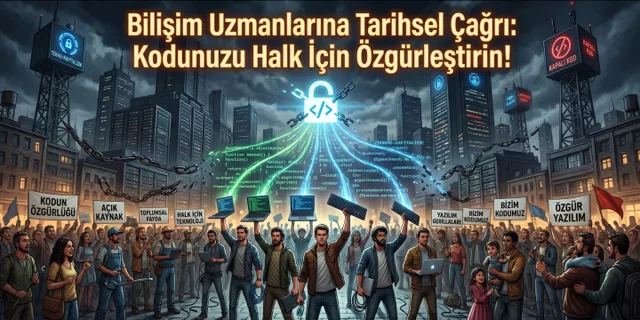
In brief. The Free Software Association (Özgür Yazılım Derneği) and Hackerspace Istanbul are holding the Odak 2026 conference on Sunday 13 December 2026 at the Barış Manço Cultural Centre in Kadıköy. This year's theme is "Free Artificial Intelligence", and its slogan is "The People's Data, the People's Model!" Admission is free; the conference will be held in Turkish and English. The TMMOB Chamber of Computer Engineers and the Union of Informatics Labourers (Bilişim Emekçileri Sendikası) are among the supporters. The call for participation is open: proposals for talks, panels, workshops and short talks can be submitted until 22 November 2026, 23:59. We at Knowledge Commons have applied with a talk titled "What Is the Knowledge Commons? From the People's Data to the People's Model". In the first part of this piece we introduce the conference; in the second we share our submission and what we want to say.
Dear Young Comrades,
For months on this blog we have been reading artificial intelligence through the same questions: In whose hands? Under whose control? To whose benefit? In our Karaburun paper we wrote about how large language models expropriate society's common knowledge. In the Socialist AI Manifesto we set out what we defend against that. In our piece on distillation we took up the contradiction that "learning from everyone is permitted, learning from the monopoly is a crime."
That is why a conference choosing "The People's Data, the People's Model" as its theme is not ordinary news for us. This slogan turns the question we have been asking in our writing into an open demand. In this piece we first introduce the conference, then say what we want to take there.
Part one: getting to know Odak 2026
What is Odak?
Odak is an international free-software conference organised by the Free Software Association. According to its Frequently Asked Questions, its aim is to show why free software is fundamental to individual freedom, and to stress that this struggle belongs not only to technical people but to everyone.
That the conference carries a Turkish name is a deliberate choice. The organisers say that not everyone knows English, and that the free-software struggle needs to be visible in other languages and cultures too. In a world where computing speaks almost entirely in English, this choice is the linguistic counterpart of the idea that knowledge belongs to everyone.
Odak is built on the accumulation of the ÖzgürKon conferences the association has held before: the 2020 and 2021 conferences, and the 2026 conference held this April.
We were at ÖzgürKon in April
In telling you about Odak, we also want to speak from our own experience. On 25–26 April 2026, Knowledge Commons took part in ÖzgürKon 2026, again at the Barış Manço Cultural Centre in Kadıköy. On 26 April at 10:00, in the Theatre Hall, we gave the talk Knowledge Commons in the Algorithmic Age: The Transformation of Labour and the Liberation of Science (in Turkish).
ÖzgürKon 2026 ran for two days, in three halls, with 44 sessions in which 44 speakers took part. Alongside the talks there were short talks, workshops, meetups, a panel and a class. The conference described itself as "the place where software freedom meets other struggles for freedom": it treated software freedom together with hardware freedom, internet freedom, press freedom and hacktivism.
The most important thing that stayed with us from those two days was this: free software was discussed not as the technical hobby of a few enthusiasts, but as a question spoken of at the same table as other struggles for freedom. The halls did not hold only programmers; there were students, journalists and rights defenders too. This showed that the tradition we describe through Mustafa Akgül's legacy in The Computing Worker's Handbook is still alive today: in this country, thousands of people learned computing in the halls of free-software days, in sessions given by volunteers. ÖzgürKon is one of the links of that tradition in the new generation.
Eight months after ÖzgürKon, Odak is rebuilding this gathering in the same halls, this time through artificial intelligence. In April we had already taken the floor with that talk; in December we want to carry the same argument forward, from the people's data to the people's model.
Theme: "Free Artificial Intelligence – The People's Data, the People's Model"
The call for participation lists the conference's subheadings as follows:
- The definition of free artificial intelligence
- The production, development and reproducibility of language models and other artificial-intelligence systems
- The vital, ecological and social effects of artificial intelligence
- Labour–capital and relations of production
- The effects of artificial intelligence on art
- The use of artificial intelligence for the benefit of humanity
- Professional and social consequences
Look at the list carefully: it contains an explicit heading, "labour–capital and relations of production." It is an important step that a free-software conference treats artificial intelligence not only as a matter of licences or technical architecture, but also as a matter of relations of production. For years the free-software movement asked, "Is the code free?" With artificial intelligence the question grew: Whose data, whose model, whose computing power?
Who is at the table?
| Role | Organisations |
|---|---|
| Organisers | Free Software Association, Hackerspace Istanbul |
| Supporters | TMMOB Chamber of Computer Engineers, Union of Informatics Labourers, Kadıköy Municipality, Barış Manço Cultural Centre |
This table is a small example of the solidarity we defend in The Computing Worker's Handbook: the free-software community, the professional chamber and the union at the same table. The organisations of those who produce knowledge coming together is the first condition of the idea of "the people's model."
Session types
Odak does not have a single kind of speaking format. The session types on the call page are as follows:
| Type | Length | What for? |
|---|---|---|
| Talk / Panel | 1 session (50 minutes, including questions) | To treat a subject in depth |
| Lightning talk | 10 minutes at most | To introduce an idea or a project quickly |
| Lightning² talk | 256 seconds at most | To share an experience or a view; for the first time this year |
| Workshop / Lab / Forum / Class / Meetup | 1 session or longer | Practical and participatory work |
| Unconference | At least 4 sessions in one hall | Sessions whose agenda the participants set |
The 256-second "Lightning²" format deserves a separate note. This format says that to be a speaker you do not need to be an expert, or to prepare a long presentation. A student, a courier, a translator or a teacher can, in about four minutes, describe an experience they have had with artificial intelligence. This is a concrete example of what we call "opening the floor to everyone" in our guide Event Organizing and Comradeship.
Practical information
| Date | 13 December 2026, Sunday |
| Place | Barış Manço Cultural Centre, Kadıköy, Istanbul (see on the map) |
| Language | Turkish and English (work on simultaneous interpretation and subtitles is continuing) |
| Admission | Free; free registration is open |
| Solidarity ticket | Optional, by a donation of 200 ₺ or more |
| Livestream | Sessions will be watchable on the Sonsuz Düğüm YouTube channel |
| Proposal deadline | 22 November 2026, 23:59 (call system) |
| Code of conduct | Racon |
| Contact | bilgi@oyd.org.tr |
How can you contribute?
- Be a speaker. If you have an idea, a project or an experience, send a proposal through the call system. The 256-second format is well suited to people taking the stage for the first time.
- Be a participant. Register for free and come with your friends.
- Volunteer. Write to bilgi@oyd.org.tr to join the organising team.
- Show solidarity. The conference is made with voluntary labour and donations. Taking a solidarity ticket means helping an event continue in which knowledge is not turned into a commodity for sale.
- Spread the word. Take the call to your department, your workplace, and your union and chamber representative.
Part two: what are we taking to Odak?
Our submission
As Knowledge Commons, we applied to Odak 2026 with a talk proposal. Our proposal is now under review. The programme will be announced after the proposal period closes.
| Title | What Is the Knowledge Commons? From the People's Data to the People's Model |
| Type | Talk (50 minutes, including questions) |
| Language | Turkish |
| Speaker | Oğuz Demirkapı |
The abstract in the submission is as follows:
Large language models are trained on knowledge produced in common by millions of people; yet this accumulation is turned into private property inside the closed models of a few monopolies. In this talk I discuss the knowledge commons through the questions "In whose hands, under whose control, to whose benefit?"; I set out its vision, its technical layers (licensing, data governance, the fully open model, federated infrastructure) and examples of practice from the world and from Turkey. The aim is to turn the goal of "The People's Data, the People's Model" into an applicable roadmap.
Why this talk?
The conference's slogan places a comma between "the people's data" and "the people's model." Inside that comma sits a very large question. The people's data already exists: it sits on Wikipedia, on forums, in open code repositories, in translations, in lecture notes. The people's model does not yet exist. What will close the distance in between?
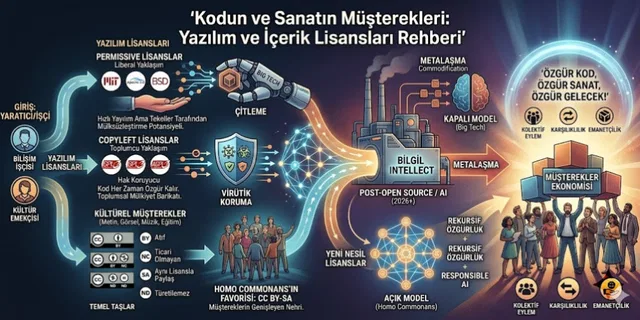
Our answer is this: openness alone does not close this distance; the commons does. Large companies, too, can freely collect open data and turn it into their own closed products. The commons, by contrast, covers not only the resource but the community that produces it, the community's rules, and the conditions under which the resource is reproduced. Our talk aims to make this distinction clear, and to make the road to "the people's model" concrete.
What will we say?
We have planned the talk in three parts.
Conceptual ground. We will begin with Marx's concept of the "general intellect" in the Grundrisse. Marx says that the knowledge a society has accumulated at a certain point turns directly into productive power and is embodied in machines. Today we see a striking counterpart of this foresight in large language models. We will then follow the history of enclosure from the fencing of common lands to intellectual property, and from there to data and to models. Through the work of Elinor Ostrom, Yochai Benkler, James Boyle and David Harvey we will discuss the theoretical roots of the concept of the commons; through GNU, the GPL, Wikipedia, Creative Commons and OpenStreetMap, its roots in practice.
Technical layers. We will treat how a commons is built in five layers: law, data, model, infrastructure and governance. In this part we will share a short checklist with which we can ask, "Is this model really open?" The difference between a model that only shares its weights and a model that is fully open, together with its training data, its code and its reproducibility, stands at the very centre of the "free artificial intelligence" debate.
Examples of practice. We will discuss examples from different fields, from Wikipedia to volunteer mapping after the earthquake, from Pardus to Common Voice, from models opened together with their data, such as BLOOM and OLMo, to computing cooperatives. In each example we will ask two questions: What did it achieve, and where was labour used without return?
We plan to close the talk with three concrete proposals for Turkey:
- Build a community-governed data commons for Turkish
- Ensure that data and software produced with public funds are published under a commons licence
- Discuss together the role of computing workers in building this infrastructure
More than a talk
We see this talk not as a one-way presentation but as the start of a discussion. If the programme allows, we also want to propose a meetup session the same day titled "How is a data commons for Turkish built?" In that way we can make concrete, together with the participants, the proposals we put forward in the talk.
The presentation file and the source list will be published on this site under a CC BY-SA 4.0 licence after the talk. If our proposal is accepted, we will announce its place and time in the programme here.
To young comrades
Events like Odak exist not only for listening, but for taking the floor. We cannot leave the debate on artificial intelligence to the press releases of a few companies and the television commentary of a few "experts." If we produced the knowledge that trains the models, the right to speak about the future of those models is ours too.
If you have a proposal, send it by 22 November. If not, come to Kadıköy on 13 December, take your place in the hall, ask questions, argue. The people's model begins with the people's debate.
In comradeship, Knowledge Commons
Sources
Odak 2026
- Odak 2026 homepage
- Odak 2026 call for participation
- Odak 2026 Frequently Asked Questions
- Odak 2026 free registration
- Odak 2026 code of conduct (Racon)
- Free Software Association donation page
- ÖzgürKon 2026, ÖzgürKon 2021, ÖzgürKon 2020
Organisers
Theoretical sources for our talk
- Karl Marx, Grundrisse (1857–58), "Fragment on Machines"
- Elinor Ostrom, Governing the Commons (1990)
- Yochai Benkler, The Wealth of Networks (2006)
- James Boyle, "The Second Enclosure Movement and the Construction of the Public Domain" (2003)
- David Harvey, The New Imperialism (2003)
Related pieces from Knowledge Commons
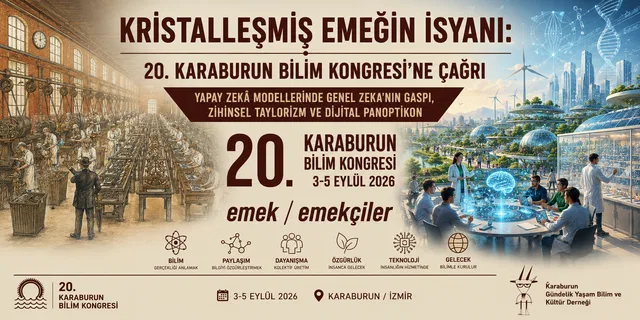
- The Revolt of Crystallized Labor: A Call to the 20th Karaburun Science Congress
- For the Restitution of the General Intellect: The Socialist AI Manifesto Is Out
- Learning from Everyone Is Permitted, Learning from the Monopoly Is a Crime
- Reading and Developing the TMMOB's Artificial Intelligence Report: Who Holds the Ruler?
- The Computing Worker's Handbook
- Event Organizing and Comradeship
Licence: CC BY-SA 4.0. You may copy, distribute and adapt it provided that you credit the source and share it under the same licence.
This is a living document; it will be updated when the result of our talk proposal and the conference programme are announced. bilgimusterekleri.org