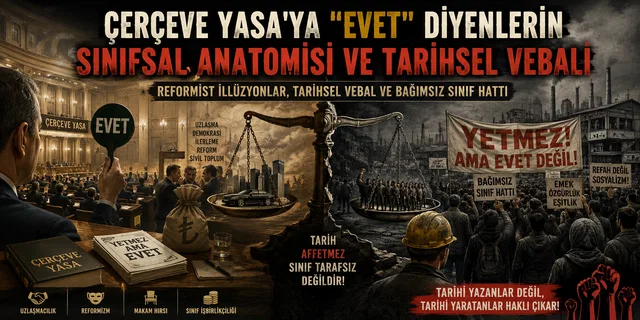
A Dialectical Assessment of Can Atalay’s Statement on the "Framework Law"
The Illusion of Law, Structural Violence, and the Dialectics of Class Struggle

Dear Young Comrades,
From behind the cold walls of Marmara (Silivri) Prison, Hatay MP Can Atalay issued a statement on the 12-article "Framework Law" bill that passed the TBMM Justice Committee, and took a stance that sits at the very center of the discourses of "non-conflict," "politicization," and "democratization" periodically polished in Turkish politics. With the voice he raises from prison, Atalay emphasizes the ground of "nonviolent politics" and calls for "surrounding the peace fire" that power and opposition blocs are trying to kindle between them.
Can Atalay’s personal courage, the stand he has shown since the Gezi Resistance, and his defiance of the seizure of his will are beyond dispute. Yet dialectical materialism proceeds not from persons’ intentions or moral postures, but from the class ground and objective function of discourses.
Our task as modern Marxists is to tear apart the illusions of "discursive peace" produced by bourgeois ideology, to show the limits of the reformist line crystallized in Can Atalay’s statement, and to set out with a dialectical grasp why, on class grounds, we must say "NO" to this "Framework Law" daydream.
Bourgeois Law and Legal Fetishism
When Karl Marx, in Volume One of Capital, analyzes commodity fetishism, he exposes how social relations of production among people appear as a mystical relation among things ("reification"). The Soviet legal theorist Evgeny Pashukanis carried this analysis into the field of law and drew out the anatomy of the legal form:
Bourgeois law is the legal husk of the relation of "commodity exchange" on the market. Just as the property owner and the propertyless worker are abstractly accepted on the market as "free and equal buyers and sellers," bourgeois law constructs the boss and the worker, the oppressing state and the oppressed citizen, on paper as "equal legal subjects."
The fundamental approach that stands out in Can Atalay’s statements is a reflection of a "rights-defending lawyer" conception. Atalay grasps the field of bourgeois law as a way of "opening a breach" against the state, and laws as a "ground" on which social peace can be built.
Yet dialectical materialism reminds us of these truths:
-
The Class Origin of Texts: The "Framework Law" or similar packages are not a manifestation of law’s universal reason. Laws are the temporary balance sheet of the balance of class forces at a concrete moment. If a law comes before parliament, this stems not from the enlightenment of the ruling class, but from the blockage the capital-accumulation regime is living through and from its need to restore its hegemony.
-
Legal Fetishism: Legal fetishism is the illusion that laws bring rights into being from nothing. The constitutive role Atalay attributes to the "Framework Law" falls into the error of treating law as a classless referee. Yet rights are not won by statutes; they are torn away through class struggle waged in workplaces, factories, and streets.
-
The Constitutional Paradox: That a revolutionary held in Silivri despite the decisions of the Constitutional Court (AYM) themselves should hope for relief from a "Framework Law" issued by the same state apparatus is a deep dialectical contradiction. If the bourgeois state turns even its own constitution into scrap paper when class interests require it, to think that a new article of law will provide laborers with security is to surrender to legal fetishism.
"Nonviolent Politics" and the Illusion of Structural Violence
The concept most prominently highlighted in Can Atalay’s message has been "nonviolent politics." Liberal-democratic theory paints the political field as a sterile and neutral "arena of negotiation." On this shallow view, when actors lay down their weapons, violence ends and "civilized politics" begins.
Marxist philosophy turns to the dialectical structure of violence conceptualized by Slavoj Žižek and to Walter Benjamin’s text Critique of Violence in order to smash this liberal myth.
With the voice he raises from prison, Atalay defends the cessation of subjective violence (physical conflicts) and the drawing of politics onto legal ground. Although the stopping of conflicts has tactical value in allowing the masses to breathe, to absolutize a concept by severing it from its class content harms revolutionary politics:
-
Making Structural Violence Invisible: The silencing of weapons does not mean violence has ended. The structural violence produced by the smooth functioning of the capitalist system itself (workplace deaths, precarious employment, the housing crisis, wages below the poverty line) continues without interruption. Atalay’s discourse of "nonviolent politics," while cursing visible violence, makes invisible the cold and silent structural violence that capital applies every day to the working class.
-
Whitewashing the State’s Monopoly of Violence: As Walter Benjamin noted, when the bourgeois state demands "nonviolence" from citizens, it in fact wants to reserve the privilege of using violence solely for its own monopoly. While the state tells opponents "Lay down your weapons and hard political methods," it does not dismantle its own police, prisons, and judicial instruments of repression.
-
Pacification (Taming): Capital-accumulation regimes, in periods of crisis, do not like the risks that physical conflicts bring. The promise of "nonviolent politics" is an ideological instrument for the ruling classes to pacify social opposition and secure market stability.
Discourse Politics and Material Reality
The dominant tendency today in bourgeois academia and in the liberal political world is to reduce reality to a linguistic game or to "narrative construction." On this approach, fed by postmodern philosophies, social problems can be solved if the right words are chosen and an "inclusive legal language" is used.
Karl Marx and Friedrich Engels shattered this daydream at its root in The German Ideology: "It is not consciousness that determines life, but life that determines consciousness."
Can Atalay’s poetic discourse, which finds expression in the phrase "surrounding the peace fire," must, from the standpoint of dialectical materialism, be tested against the material class interests behind it.
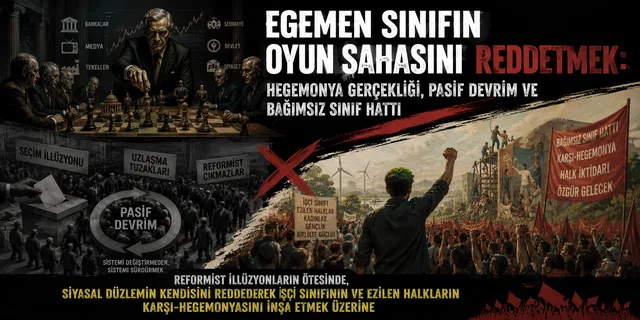
Gramsci and Passive Revolution: Antonio Gramsci defines the tactic to which the ruling classes resort when they enter a crisis of hegemony as Passive Revolution. Ruling power absorbs from above the radical demands of the lower classes. By confining them inside a parliamentary package (the "Framework Law"), it tames them. At the level of discourse "peace" is constructed, while at the material level the rule of capital is restored.
Althusser and Ideological Apparatuses: As Louis Althusser noted, law functions in the last analysis as an Ideological State Apparatus. It interpellates individuals as "free citizens"; yet when the system’s limits are pressed, the Repressive Apparatuses (police, prison) enter the scene at once.
Comparative Class Analysis
| Axis of Analysis | Liberal / Reformist Approach (Can Atalay et al.) | Dialectical-Materialist Class Approach |
|---|---|---|
| Social Reality | A "public sphere" in which political actors dialogue. | A "field of class conflict" directed by the capital-accumulation regime. |
| Meaning of the "Framework Law" | A legal "opportunity" that will dampen violence and institutionalize peace. | An apparatus for taming the opposition when the ruling bloc is in crisis. |
| Subject of the Political | Lawmakers, parliamentarians, and legal experts. | The organized working class that uses its power from production, and the oppressed masses. |
| Character of "Peace" | The silencing of weapons and the opening of the road for parliamentary politics. | The root-and-branch abolition of capital’s exploitation and of structural violence. |
| View of Law | A neutral institution that must be restored when violated. | A form that legitimizes the ruling class’s property and its power based on force. |
Why Must We Say "NO"? (Class and Dialectical Grounds)
From a revolutionary standpoint we must say "NO" to the "Framework Law" ground to which Can Atalay’s call is addressed, and to the reformist line this stance represents. This "NO" is not directed against peace or democratic rights; it is a class objection to the traps of the bourgeois state and to the makeup of the order of exploitation.
Our grounds are these:
To Refuse to Grant the Bourgeois State the Legitimacy of "Architect of Peace"
To say yes to a "Framework Law" prepared by the ruling class, or to accept it as a reference point, confers on the state that every day murders workers in factories, plunders nature, and fills prisons with social opposition the character of "the legitimate referee of peace and society." Every step that bestows legitimacy on the state is a blow struck against class consciousness.
Not to Create New Illusions Under a Regime of "Deconstitutionalization"
Can Atalay himself is in prison despite an AYM decision. To assume that a regime which tramples its own constitution and high-court decisions will abide by a 12-article text it issues is to deceive the masses. To believe that existing unlawfulness can be solved with a new legal text drags the masses into passive expectantism.
Not to Confine Struggle Within Parliamentary Limits
The Framework Law discourse shifts the center of political struggle from the streets, factories, and campuses to Assembly committees and the bargains of lawyerly elites. We say "NO" to this logic that takes the subject of politics from the hands of the masses and surrenders it to parliamentary actors.
Not to Cover Up Capital’s Structural Violence
A peace discourse built solely on the "silencing of weapons" legitimizes capital’s savage exploitation of the working class and its structural violence. The "non-conflict" secured in a milieu where workplace deaths, minimum-wage slavery, and dispossession continue serves only the quieter exploitation of the bosses.
Not to Become an Instrument of Passive Revolution
The power bloc is playing the reform card in order to overcome the hegemony crisis in which it is squeezed and to consolidate the home front. We refuse to be subordinated to any "framework" regulation that would help the rulers manage their crisis and take the wind out of the opposition.
Process Analysis and the Task of Revolutionary Politics
Rosa Luxemburg, in Reform or Revolution?, establishes the dialectical bond between reform and revolution as follows:
"The struggle for reform is the means; social transformation and revolution are the end. Rights struggles waged within bourgeois institutions have value to the extent that they develop the working class’s self-organization and class consciousness."
When we take up the current debate through a dialectical process analysis:
Stage of Accumulation: Revolutionary politics does not refuse to stand against Can Atalay’s captivity or to defend democratic rights. Yet this struggle is waged not with a daydream of improvement within the system, but so that the masses may accumulate experience.
Stage of Blockage: As the masses press the legal channels, they collide with the walls of the bourgeois state. Atalay’s continued detention becomes, before the masses, a qualitative lesson that smashes the fairy tale of the "rule of law."
Revolutionary Leap: By saying "NO" to "Framework Law" dreams, revolutionary politics directs the anger and fighting spirit of the masses not into system-internal reformist channels, but toward independent class organization.
It Is Organized Class Power That Will Build the Future
Dear Young Comrades,
Can Atalay’s message from prison is valuable as an expression of individual resistance; yet as a political and class program it is a reformist illusion.
No "Framework Accord" with the bourgeois state or its Justice Committees provides security if there is no organized class power behind it. Just as a boss tears up a collective agreement at the first crisis if a union has no de facto power, the bourgeois state will shelve the law it itself enacted at the first opportunity if there is no organized social pressure.
Our task is:
-
To say "NO" to the legal fetishism that binds the masses to the corridors of the Assembly and to the twists of articles of law.
-
To expose capital’s structural violence of exploitation hidden under the discourse of "nonviolence."
-
Without leaning on reformist dreams, to invite the masses to build their self-organization in factories, on campuses, and in neighborhoods.
Genuine and lasting peace will take shape not in the cold texts of the Assembly Justice Committee, but in the revolutionary will of the organized working class that will stop the wheels of exploitation.