A Class Assessment of Mustafa Yalçıner’s "Framework Law and Positions"
A Revolutionary Critique and a Comradely Contribution

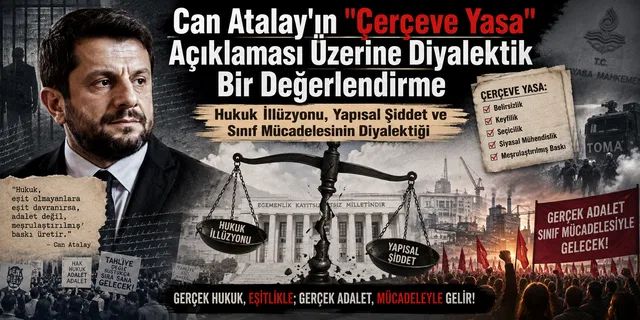
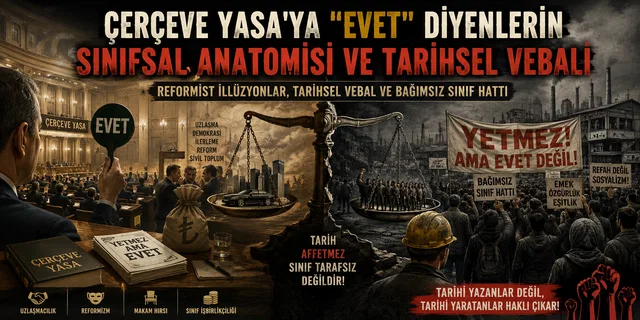
The Framework Law that came onto the agenda of the Turkish Grand National Assembly and entered into force (the Law on Strengthening National Solidarity and Social Integration) is not merely a technical legislative act or a formal legal norm. Viewed through the dialectical-materialist method Karl Marx set out in the preface to A Contribution to the Critique of Political Economy and through Nicos Poulantzas’s theory of the state, this law is a passive-revolution apparatus constructed to overcome the blockages of the capital-accumulation regime, to expand the field of executive power, and to postpone social contradictions in favor of the ruling class.
Mustafa Yalçıner’s article titled “Framework Law and Positions”, published in the newspaper Evrensel, is extremely valuable for opening a debate on the stance the socialist movement and the working class ought to take in this historical interval. The aim of this assessment is to pass comrade Yalçıner’s article through a dialectical filter; to salute the strong contributions it makes to a revolutionary class stance; and to deepen its class-theoretical limits by offering a comradely critique and a constructive contribution.
The Valuable and Strong Sides of the Article: Revolutionary Class Reflex
Mustafa Yalçıner’s article has succeeded, in an environment where the bourgeois media and liberal circles present the law through the illusion of an abstract "democratization," "social consensus," or "civilianization," in turning the compass back toward the concrete interests of the working class.
-
Exposure of Capital Accumulation: Comrade Yalçıner correctly diagnoses the real motive behind the law; he sets out in clear language that behind the discourse of "social integration" lie the bosses’ hunger for profit, flexible and precarious labor regimes, and privileges granted to capital.
-
Objection to Bourgeois Parliamentarism and Legal Fetishism: By criticizing an understanding of opposition confined to parliamentary corridors and formal constitutionalist debates, the article recalls a revolutionary stance that seeks the source of legitimacy not in parliamentary procedures but in class struggle in the street and in the spheres of production.
-
Class-Centered Agitation: Its exposure, from the workplace ground, of the threats the law poses to the working class’s concrete rights, to severance pay, and to the rights to strike and organize offers a concrete contribution to communists’ arsenal of agitation and propaganda.
Comradely and Critical Openings: Theoretical and Political Limits
While the revolutionary stance in comrade Yalçıner’s article is valuable, from the standpoint of the dialectical-materialist method and of Marxist state sociology the article is seen to harbor some serious theoretical weaknesses and limitations. These limitations are not those of a singular opinion column alone; they are a reflection of structural theoretical deficiencies that afflict a significant section of Turkey’s traditional left.
The Weakness of Economism (Narrow Workerism) and the Exclusion of a Political Power Program
Economism (or spontaneism / narrow trade-unionism), which Lenin subjected to a root critique in What Is to Be Done?, is the tendency to reduce political struggle and the exposure of the state directly to economic rights losses, wage expropriations, and conditions of work in the factory.
In comrade Yalçıner’s article the Framework Law is treated predominantly within the parenthesis of "working life, trade-union rights loss, flexible employment, and exploitation." Yet the Framework Law is not a singular amendment to labor law or a flexibility regulation. The law is the political and ideological restructuring of the state apparatus through the executive (the regime of decrees).
To reduce the matter only to the worker’s economic losses at the factory level risks pushing into the background the revolutionary class party’s task of offering the masses a comprehensive alternative of political power and an alternative organization of the state. The vanguard detachment of the working class must be not merely a "trade-union agitator" who exposes the bosses’ profit, but a Tribune of the People that deciphers all the maneuvers of the bourgeois state, its steps of passive revolution, and the transformation of the political regime.
Fetishism of Bourgeois Law and the Absence of a Pashukanisian Critique
In debates within the left and in comrade Yalçıner’s text, theoretical clarity concerning the class character of law at times becomes blurred. As Evgeny Pashukanis set out in The General Theory of Law and Marxism, bourgeois law is not a supra-class scale of justice but the legal form taken by relations of commodity exchange.
The liberal-constitutionalist discourse that formations inside parliament such as TİP frequently fall into—and that also seeps into left public opinion—of the kind "Let the Constitution be obeyed," "The rule of law is not being applied," "Constitutional Court decisions are binding," attributes a fetishistic sanctity to bourgeois law. In a regime where the Constitution and court decisions are brazenly abolished by the executive, confining the struggle to calls for "loyalty to constitutional principles" feeds among the masses the daydream of "seeking rights" through bourgeois courts and state institutions. This weakens the theoretical ground of the de facto–legitimate street struggle that the revolutionary class movement needs.
Neglect of Gramscian Passive Revolution and the Construction of Consent
Passive revolution, as Antonio Gramsci indicated, is the resort by the ruling classes to reform moves from above in order to absorb unrest accumulating at the base among the masses and to restore the regime. Gramsci stresses that the power of the capitalist state springs not only from crude apparatuses of force such as the police and the army (coercion / constraint), but from the mechanism of Social Consent it constructs through civil society and ideological apparatuses.
In comrade Yalçıner’s analysis the state is portrayed almost entirely as capital’s immediate and crude "apparatus of repression." This approach misses the ideological dimension of the state and the construction of consent it conducts at the molecular level. Leaving the interior of the law ambiguous and transferring it to regulations serves not only to accelerate matters for the bosses, but to pacify social opposition by creating among the oppressed masses the illusion that "a solution within the system is possible; consensus is being reached in parliament."
The Shallowness of Moralist "Crime State" Discourse
The moralist (moralizing) language of agitation frequently resorted to both in parliamentary speeches and in left publications—"the state has become a mafia," "gang state," "criminal-organization regime"—harbors a serious theoretical problem.
The state does not take on a form that attacks working people "because it has fallen into the hands of bad, immoral, or unqualified administrators." By its nature and by the historical reason for its existence, the state is the collective repressive apparatus of capital. To define the power and the state as a "criminal organization" inoculates the masses, in covert form, with the illusion that "if honest, moral, and upright politicians come, the state will be put right." This serves the dream of cleaning and restoring the bourgeois state rather than a radical anti-capitalist rupture.
Absence of Synthetic Unity between the Regional–National Contradiction and the Class Contradiction
From the standpoint of the Kurdish question and regional dynamics, the Framework Law is a wide-ranging move of hegemony and consent production conducted by the ruling class. In comrade Yalçıner’s article this dimension has been pushed behind class politics or passed over relatively superficially.
Yet a revolutionary class politics must bring the Kurdish people’s demand for freedom and equality and Turkey’s working class’s anti-capitalist struggle into a synthetic unity. The trustee regime in the Region, dispossession, the creation of a cheap labor basin, and projects of ecological plunder are direct extensions of the capital-accumulation regime. To abstract the national question from class politics, and class politics from the reality of national oppression, is contrary to dialectics.
Class Analysis Comparison Table
The table below summarizes the relation and complementary elements among the line that comes to the fore in comrade Yalçıner’s article, Integral Marxist Class Analysis, and the revolutionary class line we defend in the Bilgi Müşterekleri Assessment text:
| Axis of Analysis | Yalçıner’s "Framework Law and Positions" Article | Integral Marxist / Sociological Class Analysis | Our Stance (Bilgi Müşterekleri Line) |
|---|---|---|---|
| Conception of State and Law | Sees the state as capital’s direct crude instrument of repression; law as a text of rights expropriation. | Sees the state as the institutionalization of class power relations (Poulantzas); law as an instrument of consent production (Gramsci). | Rejects bourgeois law and constitutional fetishism; conceptualizes the Framework Law as the class dictatorship of the executive. |
| Focus | Economic & Trade-Union: Rights losses at factory level, flexible work, and exploitation. | Integral & Political: Executive domination, authoritarian restoration, dispossession, and regime transformation. | Grasps the passive-revolution move, the flexible labor regime, ecological plunder, and regional dispossession on a united anti-capitalist line. |
| Stance toward the Law | Agitation through the working class’s rights losses and a workplace-centered rejection. | Categorical exposure of the regime’s passive-revolution strategy; de facto struggle through street, factory, and campus assemblies. | Rejects pragmatist concessions, the daydream of "small rights," and system-internal restoration; puts independent class politics to the fore. |
| Political Horizon | To weave lines of economic/trade-union resistance in factories and workplaces. | An anti-capitalist program of power encompassing all oppressed sections (youth, the Kurdish people, ecology) under working-class leadership. | Organizes revolutionary organs of power rising from below through worker–student committees and street and workplace assemblies. |
Revolutionary Perspective: Tearing the Framework Together
Comrade Mustafa Yalçıner’s article is an extremely valuable revolutionary intervention for recalling the independent position of the working class against bourgeois illusions. Yet what the socialist movement needs is to complete this just workplace opposition with a hegemonic political line that deciphers the integral transformation of the state and the moves of passive revolution.
As young comrades our task is:
-
Theoretical Deepening: While owning revolutionary accumulations that stand on class ground like comrade Yalçıner’s, to sharpen our theory with the state and politics theories of Lenin, Gramsci, and Poulantzas.
-
Street and Factory Unity: To build solidarity assemblies among young workers, students, and precarious masses who will be most exposed to the precarity the Framework Law will bring.
-
Class Independence: Neither to expect democracy from the ruling bloc nor to articulate ourselves to the liberal opposition’s formal procedural debates.
We do not accept the limits drawn by capital and the bourgeois state. With the resolve to organize the historical truth of a classless and exploitation-free world, we will continue to grow the revolutionary struggle!