What Does the 2026 "Framework Law" Conceal?
A Class-Based Analysis Against the State’s Authoritarian Restoration and the Bourgeois Regime of Non-Conflict

Dear young comrades,
We are putting the "Framework Law" regulation that has densely occupied the country’s agenda in recent days—and that has been widely debated in parliament and in public opinion—through a dialectical filter, stripping it of the packaging polished in visuals and in the bourgeois media.
We are passing through a historical conjuncture in which social struggles have sharpened, the capitalist system is shaken by multi-sided crises, and the ruling classes embark on new legal-political moves to fortify their own power. The most basic requirement Marxist theory offers us is to tear off the packaging of bourgeois politics and of its legal apparatuses, and to bring to light the objective and class material reality behind what appears.
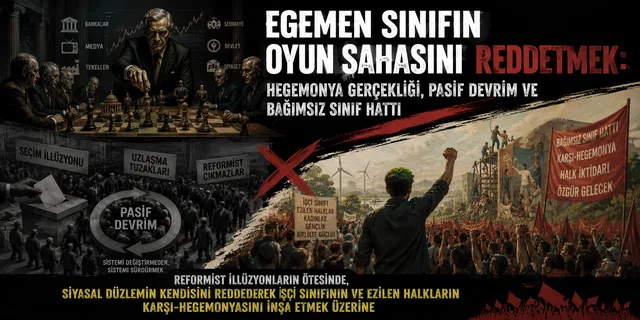
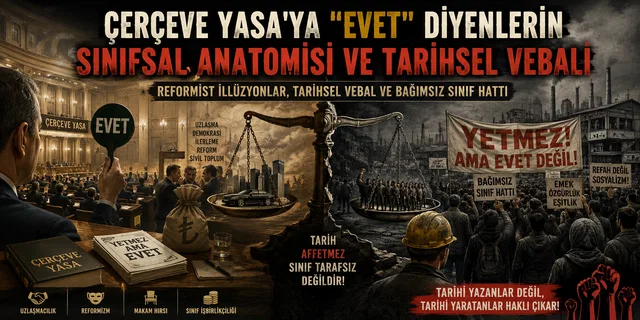
The bourgeoisie seats the table of the law in a gilt frame and presents it to the masses by ticking the boxes "Flexibility, Efficiency, Political Stability, and Social Consensus." Yet when we look behind this ornate frame and the black curtain, what is concealed are authoritarian mechanisms that strike directly at the gains of the working class: union restriction, strike bans, the expansion of detention powers, the narrowing of freedom of expression, and the erosion of judicial independence.
The bill that has settled onto Turkey’s agenda, passed through the Justice Committee of the Assembly, and been brought to the General Assembly—officially titled the "Bill on Strengthening National Solidarity and Social Integration," known in public as the Framework Law—must be put through precisely this class filter. When we analyze this text, which the dominant media and bourgeois politicians present with discourses of a "historic accord" or "social integration," in the light of dialectical materialism, we can grasp its real character.
Legislative Technique in Bourgeois Law: Code Law versus Framework Law
Looking at politics and law with a materialist eye, we must first correctly define the conceptual tools bourgeois legal technique employs. In the technique of norm-setting, laws are categorized according to their functions and the relations they establish with existing legislation:
-
Code Law (Main / Basic Law): Laws that systematically regulate a particular legal or social field from beginning to end on their own, without amending an already existing statute. The Turkish Penal Code or the Turkish Civil Code, for example, are code laws.
-
Framework Law (Carrier / Amendment Law): Laws that, by referring to one or more existing code laws, amend certain of their articles, add new supplementary or transitional provisions, or draw the general principle boundaries of implementation.
That is why the 12-article bill adopted by the TBMM Justice Committee in August 2026 is called a "Framework Law." The law does not establish a new constitutional status or penal regime from scratch. On the contrary, remaining within the bounds of existing criminal, labor, and enforcement legislation, it draws the frame of a special regime of prosecution and deferred enforcement aimed at certain organizational offenses.
The Class Character of Law: A Materialist Critique of Bourgeois Law
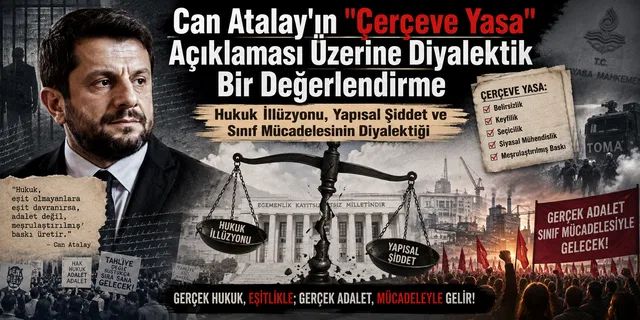
Dear young comrades, one of the greatest lies of bourgeois ideology is the claim that law is a classless and impartial "scale of justice." As Marx and Engels stated, bourgeois law is the will of the ruling class converted into statute.
Law is a superstructural institution rising upon relations of production and class contradictions. No statute issued by the capitalist state can be treated independently of the survival of the ruling class (the bourgeoisie) and of the state apparatus that is its executive organ. As Nicos Poulantzas emphasized, the capitalist state and its legal regulations take shape in order to preserve balances within the dominant bloc, bring the opposition of the oppressed classes under control, and fortify the organs of the state in moments of crisis.
The Concrete Content and Anatomy of the 2026 Framework Law Bill
The Law’s Name and Official Purpose
The official title of the bill submitted to the TBMM is the "Bill on Strengthening National Solidarity and Social Integration." Its official purpose, stated in Article 1, is to regulate the procedures for deferring the enforcement of ongoing investigations, prosecutions, and convictions following a determination by the security institutions that PKK/KCK and affiliated structures have ended their de facto existence and surrendered all weapons and munitions in their possession, and following the publication in the Official Gazette of a National Security Council (MGK) decision confirming that determination.
The regulation does not contain a constitutional democratization package; its scope is drawn directly by organizational offenses and securitarian boundaries.
The Mechanism of Tutelage and Conditionality: MGK and Executive Monopoly
The implementation of the law and individuals’ ability to benefit from the regulation are tied directly to the military-bureaucratic state mechanism:
-
MGK Decision Requirement: For the deferral provisions to be applied, a determination by the security institutions and MGK confirmation published in the Official Gazette are mandatory.
-
Application Period: Rights beneficiaries must file a written application with the Chief Public Prosecutors’ Offices or competent institutions within six months of the MGK decision’s publication.
-
Tutelage of the Executive Board: Monitoring and implementation of the process will be carried out by a "Board" chaired by the Vice President and composed of the Ministers of Justice, Foreign Affairs, Interior, and National Defense, the Secretary-General of the Presidency, the Head of MİT, and the Secretary-General of the MGK. The establishment of a Monitoring Commission within the TBMM is also foreseen.
The Regime of Deferred Investigation, Prosecution, and Enforcement
The bill provides a graduated mechanism of judicial and enforcement deferral according to the upper limit of the penalty for the offenses:
-
Offenses Requiring Imprisonment of 15 Years or Less: Ongoing investigations, prosecutions, and enforcement of sentences are deferred for 5 years.
-
Offenses Requiring Imprisonment of More Than 15 Years or Life Imprisonment: Ongoing investigations, prosecutions, and enforcement of sentences are deferred for 10 years.
-
Supervision Period and Reoffending: During the deferral period, statutes of limitation for prosecution and punishment do not run. If no new terrorism offense is committed within the stated period, a decision of no grounds for prosecution / dismissal is issued, or the sentence is deemed enforced. If a new terrorism offense is committed within that period, the deferral decision is lifted and prosecution and enforcement continue from where they left off.
-
Political Ban (Deprivations of Rights): The lifting of political-rights deprivations for persons whose sentences are deferred may be decided by a court or enforcement judge upon the Board’s request after at least 2 years have passed in 5-year deferrals, and after at least 3 years in 10-year deferrals.
Boundaries of Inclusion and Exclusion
The class character of the law becomes clear in whom it includes and whom it leaves outside:
-
Offenses Within Scope: Offenses of founding, directing, membership in, aiding, and propaganda for PKK/KCK; offenses under the Law on the Prevention of the Financing of Terrorism (No. 6415); certain local officials prosecuted or sentenced in "urban consensus" cases.
-
Intentional Homicide and Pre-2005 Aggravated Life Convicts: Intentional homicide offenses committed within the framework of organizational activity, and offenses committed before 1 June 2005 that require life / aggravated life imprisonment, are outside the scope. With this exception, Abdullah Öcalan’s and the organization’s top cadre’s benefiting from legal deferral has been directly blocked.
-
Gezi Trial Prisoners: Detainees in the Gezi trial such as Osman Kavala, Can Atalay, and Tayfun Kahraman are entirely outside the scope because their charges fall under TPC 312 ("attempt to overthrow the government") and are not tied to PKK/KCK.
-
KESK Decree-Law Victims and the Academics for Peace: Public employees dismissed and prosecuted for union activity, peace actions, or the work stoppage of 29 December 2015, together with the Academics for Peace, have been left entirely outside the regulation.
The Impunity Shield and Absolute State Authority (Article 10)
One of the Framework Law’s most critical articles is Article 10. According to the article: > "No legal, administrative, or criminal liability shall arise for persons who perform duties within the scope of the purposes and activities of this Law by reason of those duties."
This provision offers public officials and law-enforcement cadres who will implement the law an absolute impunity shield and abolishes accountability.
Authoritarian Conflict Resolution and the Regime’s Class Logic
The Reduction of the Political to Criminal Law
It is clear that the Kurdish question is, in its essence, a historical and political problem with dimensions of constitutional equal citizenship and democratic rights. Yet the Framework Law strips this issue of all its political and democratic dimensions and reduces it to a mere "procedure of deferred penalty and enforcement."
As SAMER Coordinator Yüksel Genç has noted, this approach is not a search for social consensus or a democratic solution, but a strategy of authoritarian conflict resolution or "managing the conflict." The basic aim is not to solve the great structural problem at the root, but to minimize the conflict dynamic and make the state of non-resolution sustainable in favor of the ruling class. Assoc. Prof. Yücel Demirer likewise states that with a flexible 12-article legal structure the executive’s discretionary field has been expanded and the goal of democratization has evaporated.
"Hostage Politics" and Biopolitical Control
The disciplinary control mechanisms Michel Foucault defined with the concept of "biopolitics" are concretized in this law’s 5- and 10-year deferral periods.
Persons’ convictions are not entirely eliminated; they are recorded in a special system for 5 to 10 years. The conviction threat that hangs throughout the process serves the aim of keeping oppositional political subjects under control. This regulation produces a "hostage politics" that, instead of opening the way for politics, binds the fate of the masses to the decisions of the Palace regime. The 2-to-3-year political ban freezes persons’ participation in democratic politics.
Authoritarian Statism, Detention Powers, and the Erosion of Judicial Independence
Nicos Poulantzas’s concept of "Authoritarian Statism" expresses the centralization of power in the executive and the security bureaucracy through the narrowing of parliamentary and judicial fields of oversight. Together with the Framework Law:
-
Erosion of Judicial Independence: Prosecutors and enforcement judges are made subordinate to Board and MGK decisions rather than to independent legal discretion; the judiciary is turned entirely into the political power’s administrative executive bureau.
-
Expansion of Detention and Policing Powers: On the pretext of "process security," security forces and intelligence mechanisms are granted broad detention powers, search privileges, and supervision rights; these steps are turned directly into instruments for suppressing social opposition.
Consolidation of Union Restrictions and Strike Bans
While developing a discourse of "social consensus" on the one hand, the capital order prunes the working class’s most basic constitutional rights in the sphere of production on the other:
-
Strike Bans and Updates: Taking shelter behind the pretexts of "national security," "national solidarity," or "economic stability," the right to strike is in effect restricted; work stoppages in fields declared strategic sectors are declared unlawful and blocked.
-
Union Squeeze and Restriction: Workers’ freedoms of union organization, collective bargaining rights, and rights of action are held under the threat of the security bureaucracy and employer tutelage; union activities are put in a vise with accusations of "affiliation with terror."
The Bourgeoisie’s Political-Economic Motivations and Geopolitical Squeeze
The Regional Equation and the "Home Front" Strategy
The Framework Law move is not independent of regional developments along the Syria–Iraq–Iran–Eastern Mediterranean axis and of imperialist struggles over redistribution.
In the face of new political-military balances in Syria and Iraq and steps toward the SDF’s integration, the law’s emphasis on "all formations affiliated with PKK/KCK" seeks to extend its field of effect toward Iraq and Syria. The dominant regime aims to strengthen its position in regional bargains in the Middle East and to secure its backyard by ensuring "public order" in the domestic market (fortifying the home front).
Capital Accumulation, Economic Crisis, and "Non-Conflict, Stability, Investment Climate"
Turkey in 2026 is characterized by high inflation, budget deficits, and the collapse of working people’s purchasing power. A continuous conflict environment creates a colossal burden of military expenditure. The bourgeoisie’s economic motivations are these:
-
Limiting War Expenditures: Constraining conflict costs so as to open resources to the service of the capital-accumulation regime.
-
Foreign Capital and the Search for "Stability": Creating a predictable domestic market and a "conflict-free, stable investment climate" in order to attract international capital.
-
Imposing Flexibility and Efficiency: Diffusing flexible and precarious models of work in the labor market to raise capital groups’ global competitiveness, and legitimizing the exploitation of labor under the name of "efficiency" by imposing de-unionization.
A Dialectical Comparison of Ideological Presentation and Material Reality
Dialectical materialism, when examining social and legal phenomena, enables us to separate the shell produced by the bourgeoisie (ideological form) from the essence lying beneath it (material reality). In moments of crisis, the capitalist state fortifies its own class interests and coercive apparatus while always wrapping this in abstract ideological concepts presented as universal and "for everyone’s benefit."
The "Framework Law" bill brought onto the TBMM agenda in August 2026 exhibits, in this respect, the dialectical contradictions of ruling-class ideology in all their nakedness. The basic oppositions between the discourses produced by the dominant media and the political power and the law’s objective-class counterpart deepen under the following headings:
The Discourse of "National Solidarity and Social Integration" vs. the Covering of Class Contradictions
-
Ideological Presentation: Starting from its name, the law is presented to society as a project of "social consent," "national brotherhood," and "integration." It is promised that with the end of conflict the whole society will unite around a common national interest.
-
Material Reality: In a conjuncture in which the working class, the oppressed, and youth in Turkey are crushed under deepening poverty, high inflation, heavy exploitation, and precariousness, the discourse of "National Solidarity" is an instrument of the bourgeoisie for covering over class contradictions. The ruling class seeks to align the masses ideologically around the state’s securitarian agenda in order to prevent working people from forming a common class line against economic crisis and exploitation.
"Flexibility, Efficiency, and Investment Climate" vs. Strike Bans and Union Restrictions
-
Ideological Presentation: The bourgeoisie depicts the law as a reform move that, through flexibility, efficiency, political stability, and a climate of non-conflict, directly opens the way for foreign investment.
-
Material Reality: The bitter truth these ornate concepts curtain off is the effective blocking of the working class’s right to strike, the narrowing of union organization, the deepening of the wheels of exploitation by stretching working hours, and the unconditional suppression of rights claims in factories and streets through expanding police/detention powers.
The Discourse of "State Reason, MGK Confirmation, and Guarantee" vs. Authoritarian Statism and the Erosion of Judicial Independence
-
Ideological Presentation: Tying the process to MGK confirmation and to the upper board chaired by the Vice President is marketed as "state seriousness," "resolve," and "legal assurance."
-
Material Reality: It is the transfer of the solution, torn from a civil, mass, and democratic ground of dialogue, entirely to the monopoly of the military-bureaucratic state. As in Nicos Poulantzas’s conceptualization of "Authoritarian Statism," the executive and the security bureaucracy are placed entirely above the legislative and judicial organs; decision-making processes are hidden from the people and from social opposition. Judicial independence is destroyed; members of the judiciary are turned into mere clerks of the administrative bureaucracy.
The Discourse of "Legal Deferral and Reintegration into Society" vs. Biopolitical Control and "Hostage Politics"
-
Ideological Presentation: The 5- and 10-year deferrals of investigation, prosecution, and enforcement are characterized as a legal opportunity offered for persons’ "participation in social life" and for "opening a new page."
-
Material Reality: Persons’ penalties are not erased; the threat of conviction is held over them for 5 to 10 years like the Sword of Damocles. This mechanism is the construction of biopolitics and a society of control in the sense Foucault defined. Individuals are domesticated under a permanent legal threat and a special registration system; oppositional subjects are pacified with the threat that deferral will be lifted at the slightest political activity. The 2-to-3-year political ban empties the discourse of putting politics in the place of arms.
The Discourse of "Inclusiveness and Normalization" vs. Selective Purge and Those Left Outside Scope
-
Ideological Presentation: The law’s claim to "bury the terror problem in the darkness of history" and to bring a general climate of peace to the country is put forward.
-
Material Reality: Because a real social reckoning and democratization are not aimed at, the law rests degree by degree on a selective limitation. Gezi trial prisoners (Osman Kavala, Can Atalay, Tayfun Kahraman, and others) have been left outside the scope on the ground that they are prosecuted under TPC Article 312. KESK Decree-Law victims and Academics for Peace dismissed for union actions, peace statements, or the work stoppage of 29 December 2015 have deliberately not been defined in the text of the law, and their grievances have been continued.
The Discourse of "Requirements of Duty and Public Interest" vs. the Impunity Shield and Unaccountability (Article 10)
-
Ideological Presentation: It is stated that public personnel performing duties under the law are protected in the name of "uninterrupted public service" and a "security shield."
-
Material Reality: The arrangement of legal, administrative, and criminal non-liability in Article 10 is an absolute impunity shield the state bestows on its own security and administrative apparatuses. Even "accountability," one of the most basic principles of bourgeois law, is suspended; the public bureaucracy is placed in a position entirely above the law.
Comparative Summary Table
| Bourgeois / State Discourse (Visible Shell) | Marxist-Sociological Analysis (Material Essence) |
|---|---|
| "National Solidarity and Social Integration" | An effort to cover the proletariat’s class contradictions with nationalist ideology under conditions of deepening exploitation. |
| "Flexibility, Efficiency, and Investment Climate" | A search to create a paradise of strike bans, union restrictions, flexible work, and cheap labor. |
| "MGK Confirmation and Registration" | The authoritarianization of the solution by tearing it from the civil sphere into the monopoly of the military-bureaucratic state. |
| "5- and 10-Year Judicial/Enforcement Deferral" | Hostage politics that holds opponents under a conviction threat spread over 10 years instead of lasting rights. |
| "Detention and Security Measures" | Destroying judicial independence; pacifying social opposition with broad detention powers. |
| "Non-Liability for Officials (Article 10)" | Fortification of authoritarian statism; granting absolute impunity to security and bureaucracy. |
| "A New Page for Everyone" | A selective purge policy that keeps KESK Decree-Law victims, Academics for Peace, and Gezi prisoners outside. |
The Line of Struggle: How Are Genuine Peace and Democratization Won?
Not Bourgeois Charity, but Class Struggle
Dear young comrades; "A genuine solution comes not by the grace of power, but only through the united struggle of the oppressed."
Social emancipation does not emerge from regulations the ruling classes offer in order to manage their own crises and secure capital accumulation. The control regime the bourgeoisie builds takes as its basis the preservation of exploitation and of the authoritarian structure. The revolutionary stance is neither to fall for the ruling class’s securitarian illusions nor to trail after chauvinist hysteria.
A Class-Based United Line of Struggle
Political and social emancipation will be won not by taking shelter in statutory articles the bourgeoisie grants, but through the common anti-capitalist and anti-imperialist struggle of the Kurdish and Turkish peoples, the working class, youth, and all oppressed sections. Against the ruling classes’ efforts to attach the working class to their own statist agenda with discourses of "fortifying the home front," the Class-Based United Line of Struggle that revolutionary youth must raise takes shape around the following basic slogans and principles:
Internationalist Unity on the Ground of "Equality, Freedom, Labor"
-
The Common Logic of Exploitation: The capital order and its securitarian apparatuses condemn the Turkish worker to hunger in the vice of the minimum wage while stripping the Kurdish worker and youth of identity and driving them into precariousness. The escalation of the conflict environment and of nationalist chauvinism is the strongest ideological curtain concealing the ruling class’s wheels of exploitation.
-
Internationalist Unity of Forces: The democratic solution of the Kurdish question and the emancipation struggle of the Turkish proletariat form a dialectical whole. The class-based line is the sole antidote that renders the poison of chauvinism ineffective in neighborhoods, factories, and campuses.
"Democracy for the People": A Concrete Program of Democracy and Freedom
-
Complete Democratization: The mere silencing of arms or the postponement of investigations is not enough. All political prisoners—above all Selahattin Demirtaş, Figen Yüksekdağ, Can Atalay, Osman Kavala, and the Gezi trial prisoners—must be released at once.
-
Abolition of Strike Bans and Union Restrictions: Administrative/political bans on the right to strike in all branches and sectors must be lifted; barriers and police threats before union organization must end.
-
Ending the Trustee Regime: All mayors removed from office and replaced by trustees on grounds of "urban consensus" or political claims must be restored to their posts; the trustee regime that usurps the will of the electorate must be abolished.
-
An End to Decree-Law Lawlessness and Purges: KESK public employees and Academics for Peace dismissed by decree-law for defending union rights and the demand for peace, and all employees purged on the pretext of affiliation-association, must be reinstated unconditionally.
-
Constitutional Equal Citizenship and Education in the Mother Tongue: The solution of the Kurdish question cannot be handed over to the rulers’ conjunctural tactics and MGK tutelage. The Kurdish people’s national, cultural, and democratic rights, together with the right to education in the mother tongue, must be placed under constitutional guarantee.
"The Rights Are Ours, the Future Is Ours": Struggle for Labor and Education Against War Budgets
-
Budget for the Future, Not for Armament: The trillions of liras transferred to arms, the defense industry, and conflict budgets in line with NATO decisions and militarist policies are morsels cut from the throats of workers and working people.
-
The Demand of Revolutionary Youth: All resources allocated to conflict and the security bureaucracy must be spent on providing free, qualified, scientific, autonomous education in the mother tongue; on increasing student dormitories and scholarships; and on eliminating youth’s anxieties about the future.
Practical Tasks of Revolutionary Youth
-
Ideological Struggle: To expose, patiently and boldly on campuses and among youth masses, the ideological manipulation the bourgeoisie presents under the names "National Solidarity," "Flexibility," and "Efficiency."
-
Weaving a United Front: To create anti-fascist, anti-capitalist grounds of united action around the common demands of Turkish and Kurdish youth in every field—from campuses to neighborhoods, from young workers’ assemblies to student representative bodies.
-
An Independent Class Line: Without being confined within the limits of ruling-class cliques (the Palace regime, bourgeois opposition, or intra-system alliances), to place the proletariat’s independent revolutionary line at the center of processes of accumulation and crisis.
History writes not passive spectators, but those who grasp objective conditions and act to change them. Facing the 2026 Framework Law, our task is to expose the capital and state reason behind the text, and—without being confined within the limits of bourgeois law—to weave united action around the equality of peoples and the proletariat’s independent class line.
The future belongs not to capital and the security bureaucracy, but to the working class and revolutionary youth who raise united action and class consciousness, saying "The Rights Are Ours, the Future Is Ours"!
Basic Legal Problems That May Arise on the Axis of the Text and the Bill
In light of the August 2026 "Bill on Strengthening National Solidarity and Social Integration" (Framework Law) and the analyses conducted in this text, we can gather under the following headings the basic legal problems and constitutional contradictions likely to emerge if the regulation enters into force:
1. Violation of the Constitution’s Equality Principle and Discriminatory Scope (Constitution Art. 10)
The bill’s most basic field of legal crisis is the categorical and selective distinction it establishes among beneficiaries:
-
Selective Exclusion from Scope: While granting deferral for certain organizational offenses, the bill deliberately leaves outside its scope Gezi trial prisoners under TPC 312, KESK Decree-Law victims subjected to dismissal/prosecution for union actions, and Academics for Peace.
-
Risk of Annulment by the Constitutional Court: These typical distinctions drawn on the basis of offense type and date constitute a contradiction with the principle of "Equality Before the Law" regulated in Article 10 of the Constitution. If the regulation becomes law, its being taken to the Constitutional Court (AYM) and becoming the subject of annulment actions on equality grounds is inevitable.
2. Separation of Powers and the Transfer of Judicial Authority to the Executive (Constitution Arts. 9 and 138)
According to Article 9 of the Constitution, judicial power is exercised by independent and impartial courts in the name of the Turkish Nation. The bill, however, places judicial processes under the tutelage of administrative organs:
-
MGK and Administrative Board Approval: Deferral of investigations, prosecutions, and enforcement is tied not to the independent discretion of judicial organs but to determinations by security institutions, an MGK decision, and the permission/assessment of the administrative Board chaired by the Vice President.
-
Tying New Investigations to Permission: Under Article 3/3 of the law, subjecting investigations to be opened after the MGK decision to Board permission restricts prosecutors’ power to open investigations ex officio and creates administrative tutelage.
3. The Impunity Shield and Violation of the Rule of Law (Constitution Arts. 2 and 125)
The provision in paragraph 2 of Article 10 of the bill—"No legal, administrative, or criminal liability shall arise for persons who perform duties within the scope of the purposes and activities of this Law by reason of those duties"—opens a very grave legal hole:
-
Absolute Impunity: Public personnel, law-enforcement forces, and administrative cadres tasked under the law are given a complete shield of non-liability.
-
Breach of the Principle of Administrative Responsibility: Article 125 of the Constitution lays down the rule that "Recourse to judicial review shall be available against all acts and actions of the administration." The impunity shield granted to officials contradicts directly the "Rule of Law" principle in Article 2 of the Constitution and the principles of judicial review of the administration in Article 125.
4. Violation of the Principles of Legal Certainty and Foreseeability
One of the most basic elements of the rule of law is that norms be abstract, clear, foreseeable, and determinate:
-
Ambiguity of Intentional Homicide and Attempt: Leaving "intentional homicide" offenses outside the scope in Articles 2 and 3 of the bill is pregnant with serious case-law crises in practice. It is unclear whether acts that do not in fact result in death, or that remain at the stage of attempt, in cases opened under referral articles such as TPC 302 (disrupting the unity of the state) will be brought within this scope.
-
Deferral as a Sword of Damocles: That deferral will be lifted if "a new terrorism offense is committed" during the 5- and 10-year deferral periods creates legal insecurity when combined with Turkey’s broad and flexible conceptualization of "terror."
5. Bypassing ECtHR and AYM Judgments and Deprivations of Rights
-
Disregarding Acquired Rights: Judgments of violation and release issued by the ECtHR and the AYM concerning Selahattin Demirtaş and similarly situated detained politicians are already binding. By tying the non-implementation of these judgments to a new statutory condition of deferral, the bill renders international and constitutional case law obsolete and draws politicians into a circle of 10-year deferral and 2–3-year political bans.
-
Blocking Political Participation: Deprivations of rights imposed on persons who benefit from the law during the deferral period or in certain transitional years (barriers to voting and standing for election and to participation in political-party activity) are a disproportionate interference with the legality of crime and punishment and with the constitutional right to engage in political activity (Constitution Art. 67).
6. Violation of the Right to Property and Confiscation Without a Final Conviction (Article 3/1)
The arrangement in paragraph 1 of Article 3 of the bill—"With regard to property and assets subject to confiscation, a liquidation decision shall be issued together with the deferral decision and they shall be recorded as revenue to the Treasury"—is a grave violation of the right to property:
- Contradiction with the Presumption of Innocence: Liquidating persons’ assets and transferring them to the Treasury on the ground of a deferral decision while there is not yet a finalized conviction directly contradicts the Right to Property in Article 35 of the Constitution and the Presumption of Innocence in Article 38.