Class Analysis of the Framework Law and Socialist Strategy
Law, the State, and the Class Nature of the "Framework"

Young comrades,
As Karl Marx stated in the preface to A Contribution to the Critique of Political Economy, legal relations and forms of the state cannot be understood on their own; their roots lie within "the material conditions of life" and the relations of production. When we approach the matter through the state theories of Nicos Poulantzas and Louis Althusser, the bourgeois state and law are not a supra-class, neutral arbiter; they are an ideological and repressive apparatus that institutionalizes the ruling class's relations of exploitation under the mask of "general social benefit."
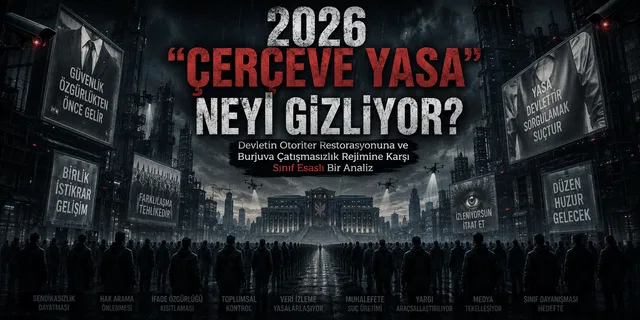
The Framework Law adopted in the Turkish Grand National Assembly (the Law on Strengthening National Solidarity and Social Integration) is the product of a deep regime of lawlessness in which constitutional guarantees have been de facto suspended, decisions of the Constitutional Court and the ECtHR are not recognized, and fundamental rights and freedoms are restricted by decrees. In this interval, when even the most basic universal principles of law are trampled, this law that passed the Assembly is legally groundless, devoid of legitimacy, and arbitrary both in form and in content.
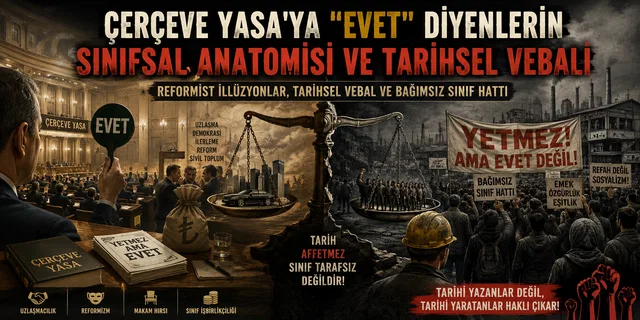
This is not a phenomenon we are encountering for the first time in Turkey's political history. Whenever the bourgeoisie lives through a crisis of governance, it uses law as a lever of legitimation and restoration. The most concrete historical threshold of this is the 2010 "Not Enough But Yes" referendum process. Constitutional amendments packaged then, too, as "settling accounts with tutelage," "civilianization," and "democratization" fed liberal and reformist dreams, yet in the end made possible the monopolization of the judiciary and the resewing of the authoritarian regime's seams in capital's favor.
When the political documents compiled in the archives and analyses we have examined are passed through a dialectical filter, the Framework Law is seen to be a continuation of the same historical line:
-
Illusion of Legitimacy: Just as in 2010, the resistance of the masses and of the opposition is to be broken with abstract promises such as "social peace" or a "new process."
-
Absolute Domination of the Executive: In a milieu where the binding force of the Constitution and of laws has vanished, an empty "framework" is drawn so that implementation may be transferred entirely to presidential decrees, regulations, and administrative boards.
In the final analysis, the Framework Law is nothing but a legal baton in the hands of the bourgeoisie in this period when the capital-accumulation regime is blocked, the bill for the crisis is charged to working people, and the regime is trying to secure its own survival.
The Political Economy of the Law and the Strategy of Passive Revolution
When the bourgeois state cannot solve the blockages in the capital-accumulation model and social contradictions directly, it suspends or postpones them through formal, flexible, and ambiguous legal norms. At this point the "Framework Law" technique is a special ideological and administrative apparatus to which the capitalist state mechanism resorts in moments of crisis.
Gramscian Passive Revolution and Molecular Restoration
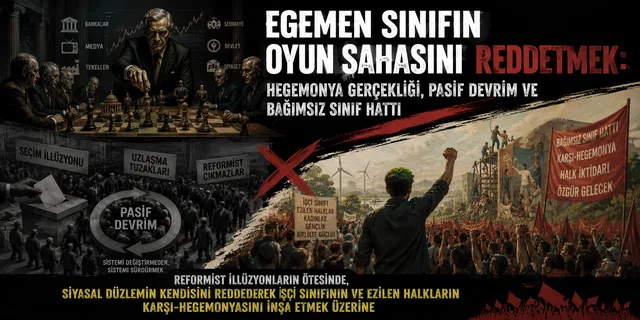
Passive revolution (rivoluzione passiva), as Antonio Gramsci conceptualized it in the Prison Notebooks, is the strategy of "reform from above" to which the ruling classes resort in order to absorb the unrest of the masses, ward off the risks of social explosion, and sustain relations of domination.
The Framework Law is in the full sense an instrument of passive revolution:
-
Absorbing Social Demands by Emptying Them Out: The people's demands for democratization and peace are transformed to fit the security needs of capital and the state; instead of a root democratization, an administrative "framework" is offered.
-
Molecular Transformation: While the state domesticates radical dynamics that may come from below and draws them into the system, it constructs at the molecular level a new ground of "social consent" that will secure the uninterrupted operation of capital.
Poulantzasian "Relative Autonomy" and the Concentration of Executive Power
Nicos Poulantzas notes that the capitalist state possesses "relative autonomy" (autonomie relative). This autonomy enables the state to go beyond the short-term interests of individual bourgeois and to protect the collective and long-term interest of the capital class.
In the Framework Law technique, parliament is turned into a formal office that approves the general mass and authority of the law. Details and implementation are left to administrative decisions. Thus, while legislative oversight is taken offline, the executive can rapidly implement the decisions capital accumulation needs without being caught on parliamentary delays. The impression is given that legality is formally preserved, while in fact the regime of decrees is consolidated.
Flexible Labor, Precarity, and the Organization of Rent Fields
The political economy of the law directly affects relations of production and the restructuring of the region:
-
Cheap Labor Reservoir and Flexibility: By creating an image of political stability and reduced uncertainties, flexible and precarious labor regimes are legitimized across the whole country, the Region foremost, and an uninterrupted environment of exploitation is prepared for capital.
-
Capital Transfer and Dispossession: Administrative regulations under the Framework Law make possible the plunder of nature, mining and energy investments, and the opening of rent fields under the pretext of regional development, infrastructure, and security.
The Left's Test: Parties' Positions and Class Politics
The Framework Law's arrival on the parliamentary and public agenda has been a historical litmus paper testing the ideological clarity of Turkey's left, its relation to parliamentarism, and its approach to class politics. The process harbors serious ruptures across left formations inside and outside parliament.
The Parliamentary Left Line: In-Depth Analysis of TİP and EMEP
In formations that use the parliamentary ground, the contradiction between the narrow field bourgeois parliamentarism offers and revolutionary class politics has come to the surface in its sharpest form.
Workers' Party of Turkey (TİP): Constitutional Fetishism and the Trap of Moralist Discourse
TİP's agitation in the Framework Law process and its general political line in parliament present a picture of "moralist opposition" with high agitational power but limited theoretical/class depth.
-
Ahmet Şık's Speech and Critique of Moralist Discourse: Ahmet Şık's speeches from the parliamentary podium directed at the regime and the Framework Law find a response among the masses with their hard rhetoric and agitational tone. Yet when this agitation is passed through a dialectical filter, it is seen that the fundamental ground of the critique is formed not by the capital-accumulation regime so much as by the discourse of a "crime/mafia state" or "moral collapse." Instead of exposing the state as the collective repressive apparatus of the capitalist class, Ahmet Şık tends to define the power as "a criminal organization that has seized the state." This approach reduces the Framework Law to the level of "dark bargains" of power cliques rather than reading it as capital's need for passive revolution. In the end the perspective offered to the masses is not an anti-capitalist class struggle but the idea of "cleaning the state with honest and moral administrators"—that is, the search to restore the bourgeois state.
-
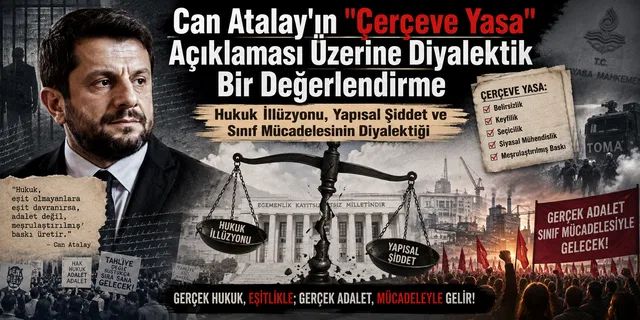
Can Atalay's Situation, Statements, and the Jurist's Bottleneck: The stripping of Can Atalay's parliamentary seat and his being held hostage in prison despite Constitutional Court decisions is concrete proof that bourgeois law has been entirely abolished. Yet Can Atalay's statements from prison and the defense line woven around him are predominantly confined to the axes of "loyalty to the constitutional order," "defending republican law," and "implementation of Constitutional Court decisions." For a Marxist, defending the scraps of the 1982 Constitution or the decisions of bourgeois courts cannot by itself be a revolutionary strategy. The situation Can Atalay lives through is not a singular "legal violation" but the result of the state's drive to protect an authoritarianizing capital-accumulation regime. Confining the struggle only to courtrooms and constitutional procedures feeds among the masses the illusion of "seeking rights through law" and pushes into the background the real force—the class movement in the street and the factory.
Labour Party (EMEP): The Limit of Workerism (Economism) and Critique of the Political Apparatus
Compared with TİP, EMEP is more insistent on using parliament as a podium from which to voice loudly the concrete problems of the working class. Yet EMEP's stance toward the Framework Law also carries serious limits from the standpoint of class vision.
-
İskender Bayhan and Sevda Karaca's Statements and Critique of Class Vision: İskender Bayhan and Sevda Karaca use the parliamentary podium effectively to make heard the voices of child workers victimized by MESEM, of striking textile and metal workers, and of precarious women. In the Framework Law process as well they have drawn attention to the rights losses and the dimension of exploitation the law will bring upon the working class. Yet this stance is not exempt from the weakness of "economism / narrow workerism" that Lenin condemned in What Is to Be Done?
-
Bayhan and Karaca's agitation reduces the problem directly to factory limits, wage expropriation, and conditions of work. Facing a comprehensive political move such as the Framework Law—which targets the character of the state, the passive-revolution gambit on the Kurdish question, and restructuring within the ruling bloc—EMEP's language remains inadequate to go beyond critique of workers' concrete rights losses and to offer the masses a hegemonic, alternative perspective of political power. The tactical hesitation in the parliamentary vote on the law has also shown that merely emphasizing workerism is not enough to meet the great political maneuvers of the bourgeois state.
The Extra-Parliamentary Socialist Left: TKP and SOL Party
Formations representing the revolutionary focus outside parliament, by contrast, have read the process directly on the axes of regime restoration and class struggle:
-
Communist Party of Turkey (TKP): It took a clear stance by rejecting the law at the level of principle. TKP evaluated the process as a move by the "Neo-Ottomanist" regime to fortify itself; it defended that neither Turkey's Kurdish question nor its democratization problem can be solved through ethnic/sectarian bargains or intra-capital compromises, and that the sole solution is an anti-capitalist line on class ground.
-
SOL Party: It stressed that no "democratic solution" will come from a power that tramples the Constitution and fundamental rights and whose very existence is anti-democratic. Emphasizing that bargains behind closed doors must not be confused with the people's demand for peace, it wove a radical and categorical objection to the regime from outside.
Comparison of the Class Positions of Left Formations
| Party / Formation | Political Line and Discourse | Approach to the Process | Class / Theoretical Critique |
|---|---|---|---|
| TİP (Ahmet Şık & Can Atalay) | Constitutional Rights, Moralist Exposure of Crime & Institutional Defense | Hard rhetoric in parliament; flexible/system-internal stance in the vote | Critique confined to bourgeois legal norms; the shallowness of seeing the state not as capital's instrument but as a "criminal organization." |
| EMEP (İ. Bayhan & S. Karaca) | Working-Class-Centered Opposition & Factory Agitation | Factory-focused agitation; class-accented stance in parliament | Weakness of economism; the limit of failing to see the integral hegemonic and political state restoration the Framework Law carries. |
| TKP | Anti-Capitalist & Anti-Imperialist Rejection | Categorical rejection of the law; putting class politics to the fore | The risk of homogenizing regional specificities and identity dynamics while treating the process on a "national/class" ground. |
| SOL Party | Anti-Regime United Front Line | Radical objection from outside against the power's legitimation | The limitedness of instruments for turning the demand for social peace into a mass alternative program in the street. |
YENİ Party's Stance and a Socialist Analysis
The stance displayed by YENİ Party, representing the main focus of opposition in the Framework Law voting process, has brought to light with dialectical clarity the structural dead ends of center-left, social-democratic, and liberal bourgeois politics. YENİ Party's position is not an individual MP's preference or a simple lack of group discipline; it is directly bound up with the historical role "system-internal opposition" undertakes in the ruling class's moments of crisis.
Political Split and the Dilemma of Bourgeois Opposition
YENİ Party's split in the vote (35 for, 54 against, and MPs who did not take part) is a natural result of the class contradictions the party carries:
-
"State Reason" and the Restoration Wing (Yes Votes): The wing aligned with the party leadership and state bureaucracy has articulated itself to discourses of "the survival of the state," "geopolitical stability," and "holding the domestic front." This stance shows that bourgeois opposition lacks the capacity to resist the orientations of the ruling bloc in moments of crisis and that, in the final instance, it places the continuity of the capitalist state above everything.
-
Liberal-Democratic Jurist Wing (No Votes): The MPs who voted no grounded their objections in the grounds that "the process was not conducted transparently," that "the one-man regime's powers are increasing," that "trustee practices continue," and that "the will of parliament is being bypassed."
Liberal Constitutionalism and the Trap of "Procedure"
When the stance of the no-voting wing is examined from the standpoint of Marxist sociology, this objection is seen not to go beyond a search for system-internal restoration. YENİ Party's grounds for rejection are directed not at substance but at procedure:
-
Numerical and Legal Formalist Objection: YENİ Party opposition has not targeted the field of flexibility the law opens to capital, the precarious labor regime, or the risk of opening the region to the plunder of international finance capital. The objection has remained limited to formal norms such as how the law was discussed in committee, the appointment procedures of boards, and the technical inadequacies of the text.
-
Illusion of Bourgeois Law: YENİ Party pumps to the masses the fetishism of seeing law as a supra-class and neutral mechanism of justice. In a regime where the Constitution and court decisions are not de facto implemented, calls for a "return to the rule of law" consign the revolutionary energy of the masses to the ballot box and to parliamentary procedures.
System-Internal Lightning-Rod Function and Role in Passive Revolution
In the Gramscian sense, YENİ Party is the safety valve and lightning rod of the passive-revolution process the ruling class conducts. It absorbs the anger accumulating among the masses against the power and against lawlessness and keeps it within the limits of system-internal reasonable opposition. With the discourse "We are not against peace but we object to procedure," it both pacifies the secular-democratic sensitivities in its base and cuts off the path of a radical street opposition that would entirely narrow the power's field of legitimacy.
| Axis of Analysis | YENİ Party's Liberal / Bourgeois Opposition | Socialists' Class Struggle Line |
|---|---|---|
| Conception of Law and State | Sees law as supra-class; the state as a neutral organ. Says "Let us return to the rule of law." | Sees law as the will of the ruling class; the state as a class apparatus of repression. Takes as essential the exposure of bourgeois law. |
| Focus of Objection | Procedure and Form: Lack of transparency, transfer of Assembly powers, structure of boards. | Substance and Class: Capital's need for flexibility, exploitation of labor, rent and dispossession. |
| Stance toward the Law | Compromise aligned with "state reason," or formal rejection (split at the ballot). | Categorical exposure and rejection of the law as an integral regime restoration and capital move. |
| Field of Solution and Struggle | Parliamentary committees, election processes, parliamentary bargains. | Factories, campuses, streets; de facto–legitimate workers' and people's assemblies. |
Socialist Line and Strategic Vision for DEM Party: The Trap of Pragmatism and Historical Lessons
For DEM Party, standing at the intersection of the mass power of the Kurdish freedom movement and Turkey's revolutionary accumulation, the adoption of the Framework Law carries the meaning of a strategic and ideological fork in the road. The stance DEM Party displayed in the process of the law's passage through the Assembly has once again brought to the surface the historical tension between revolutionary politics and pragmatic parliamentarism.
The Class Roots of Pragmatism: The Illusion of "Small Rights"
The pragmatist tendencies that at times become marked in DEM Party politics and that have also been observed in the Framework Law process are not without cause. Behind this pragmatism lies the masses' search for breathing room and desire to obtain concrete, small gains—masses held for years under heavy repression, prison policies, and the trustee regime:
-
Concrete Partial Rights: The anxiety of "obtaining a right, however small"—in fields such as the removal of trustees, the release of prisoners, and the provision of formal legal guarantees in language and culture—pushes the party to sit at the table with the "framework" the power offers.
-
The Conversion of Tactical Consideration into Strategy: Yet when these just and concrete demands of the masses are not united with a socialist strategic vision, tactical moves turn into a strategic line and pragmatism becomes dominant.
The Trap of Trusting the Existing System and Forgotten Lessons
The greatest weakness of the pragmatist approach is that it misanalyzes the character of the bourgeois state and of the existing regime and fails to draw conclusions from historical lessons. Turkey's recent history is full of the transience of the "democratization" steps the bourgeoisie and those in power take to overcome their own crises:
-
The 2010 Referendum and the "Resolution Process" Experience: In the 2010 referendum and the subsequent "Resolution Process," trust placed in the legal frameworks drawn by the state and in the favors of the power has carried heavy costs. The ruling class overturns the table in moments when it is cornered; it takes back overnight by decrees all the "small rights" thought to have been placed under legal guarantee.
-
Surrender to the Ambiguity of Law: To cast a "yes" vote for a text such as the Framework Law, whose interior is to be filled by the executive, or to pin hope on it, means trusting the "goodwill" of a power that does not recognize the Constitution and ECtHR decisions. For a Marxist, to assume that a power that tramples even the Constitution will remain loyal to an indefinite "Framework Law" of its own making is historical naïveté.
Essentials of the Socialist Vision: Where Is the Solution?
The socialist vision DEM Party needs in order to break free from articulation to bourgeois restoration projects and to weave a real social peace must rest on these essentials:
-
Synthetic Unity of the National Question and Anti-Capitalist Struggle: The Kurdish question is not independent of the ruling class's policies of exploitation and of regional rent calculations. Precarious employment in the Region, dispossession conducted through trustees, and ecological plunder are the direct result of the capitalist accumulation regime. Therefore emancipation is possible not through the passive-revolution rods the bourgeois power extends, but through the united anti-capitalist struggle of Turkey's working class.
-
Break from Illusions and Street–Workplace-Centered Politics: Parliament must be used as a field of struggle and exposure, yet the political horizon must not be confined to parliamentary corridors. Rights are won and protected not by the "framework" laws of the bourgeois parliament, but by de facto–legitimate lines of struggle built in the factory, the street, and the neighborhood.
-
Building a United Labor Front: Together with TİP, EMEP, TKP, SOL Party, unions, and mass organizations, DEM Party must be a founding element of an independent United Labor Front that says "No to the Framework of Capital and the Regime" against the restorations of those who rule.
Expected Class Effects in the Days Ahead and Deepening Contradictions
With the Framework Law's entry into force, concrete transformations will unfold in the days ahead in the field of social and class relations—beyond an abstract legal debate—that will directly raise rates of exploitation and accelerate capital accumulation. These transformations will not remain limited to singular fields; they will deepen the domination the capitalist state mechanism establishes over the masses through the executive.
Flexibilization of the Labor Regime and Raising the Rate of Exploitation
The regulatory authority the law transfers to administrative decisions and decrees will restructure working life directly in capital's favor:
-
Institutionalization of Precarity: On the ground of uncertainty the law creates, historical workers' gains such as severance pay, working hours, and job security will be stretched by administrative regulations. Flexible, remote, piece-rate, and subcontracted forms of employment will be seated on a legal "framework."
-
Formalization of Trade-Union Struggle: Strike rights will be rendered de facto unusable under the cover of "public order" and "national security/integration"; legitimate strikes will be blocked by administrative decisions.
Dispossession, Rent Transfer, and Ecological Plunder
The legal ambiguity the law provides will accelerate the transfer of cities and nature to international and domestic capital groups:
-
Regional Capital Flow and Dispossession: Under the Framework Law's discourse of "development" and "social integration," urban rent fields, mining sites, and water basins—East and Southeast foremost—will be allocated to mining and construction companies by emergency expropriation and administrative decisions.
-
Commodification of the Natural Commons: Lands on which local people practice agriculture and animal husbandry will be dispossessed, and the people will be forced to join the cheap labor army (the reserve army of industry) on the peripheries of cities.
Turning Youth into a Cheap Labor Army
Youth stands among the sections that will take the heaviest share of the class destruction the Framework Law will bring:
-
Internship and Apprenticeship Exploitation: Under the name of vocational education and integration projects, university and high-school youth will be included in production processes for a bare living under the name "intern" or "apprentice." Thus youth will be used as a cheap and docile labor reservoir that lowers capital's costs.
-
Futurelessness and Brain Drain: Precarity's becoming the rule will create a deep despair among young masses; this situation will feed escape from organized struggle or a relentless search for individual salvation.
Executive Domination and De Facto Political Outlawry
The crossing even of the formal limits of the rule of law will make repression in the political field permanent:
-
Criminalizing Street Opposition: Thanks to the law's flexible provisions, every kind of rights-seeking action, de facto demonstration, and strike may be brought within the scope of crime on the administration's ground of "violating the framework."
-
Regime of Administrative Oversight: Parliament will be rendered entirely dysfunctional, and the country's economic and social life will be governed through the executive's subordinate administrative boards.
Class-Destruction Balance Sheet and the Axis of Socialist Struggle
| Social / Class Field | Probable Class Effects of the Law | Line of Socialist Struggle and Organization |
|---|---|---|
| Working Class & Working Life | Flexible work, de facto expropriation of severance pay, strike bans, de-unionization. | Build factory and workplace assemblies; weave de facto–legitimate strike and resistance lines that cross legal limits. |
| Youth & Education | Cheap labor exploitation under the name of internship and apprenticeship; futurelessness; destruction of academic freedoms. | Build youth committees on campuses and in high schools with the demand for "free, quality education and a secure future." |
| City, Nature, and Dispossession | Emergency expropriations, rent projects, dispossession of peasants and city-dwellers through mining and energy plunder. | Articulate local ecology resistances to an anti-capital class movement and the struggle for urban rights. |
| Political Rights & Freedoms | Restriction of the rights of assembly, march, and organization by administrative decisions; trustee regime and de facto repression. | Keep street opposition and united defense and solidarity networks alive with a de facto–legitimate conception of struggle. |
A Call to Young Comrades: What Is to Be Done? Historical Revolutionary Tasks
Young comrades!
We are not obliged to accept the legal, political, and administrative "frameworks" the bourgeoisie draws, or to take refuge in the licensed fields of opposition those frameworks delimit. That shattering truth Karl Marx stated in the Theses on Feuerbach stands before us today: "The philosophers have only interpreted the world, in various ways; the point, however, is to change it."
Facing the destruction the Framework Law brings, the task of revolutionary youth is not to be a passive spectator or a reserve of bourgeois restoration projects, but to take historical and class initiative. In this direction the youth movement must rise on the following four strategic pillars:
Theoretical Equipment: Ideological Clarity and Struggle against Fetishism
The dialectical-materialist method is our strongest weapon for tearing away the curtains of "social integration," "reform," and "legal framework" that capital and the bourgeois state weave with ornate concepts.
-
Smash the Fetishism of Bourgeois Law: Explain to the masses and to young comrades that law is not a neutral organ of justice but, on the contrary, an ideological device that institutionalizes the ruling class's relations of exploitation. Apply to current politics the logic in Lenin's The State and Revolution and in the state theories of Poulantzas and Gramsci.
-
Keep Historical Consciousness Alive: Transmit to young generations, through theoretical and historical workshops, how liberal pipe dreams paralyzed the left movement in the "Not Enough But Yes" process and in past "resolution" illusions.
-
Be an Organic Intellectual: With the responsibility of the "organic intellectual" Antonio Gramsci indicated, carry theory out of library shelves into lecture halls, construction sites, high-school desks, and workers' basins.
Overcome Class Laziness: Cells of Organization from Campuses to Factories
Youth opposition must surpass narrow lecture-hall debates closed in on themselves and unite directly with the living spaces of the working class and of the precarious.
-
Young Worker and Student Solidarity Networks: Build independent struggle committees for high-school and university youth exploited under the name of internships, MESEM/ÇEKAP-like projects, and cheap-labor practices through the powers the Framework Law transfers to the executive.
-
Workplace and Campus Assemblies: Commonize the anger woven against appointed trustee rectors and against inadequate housing and food conditions in universities with resistances against low wages and flexible work in factories. Organize political struggle through an assembly model rising from below.
Agitation and Counter-Hegemony: Wage the Ideological Struggle in the Street
To break the ground of false consent that capital and the media produce, we must reproduce revolutionary agitation-propaganda instruments.
-
Catch a Plain and Class Language: Tear apart the complex texts of bourgeois law! Make the masses grasp in a plain way—through agitation leaflets, digital media, street theater, and agitation podiums—what the law steals from a worker's severance pay, a student's future, a peasant's land.
-
De Facto–Legitimate Struggle Line: In a milieu where laws have lost their legitimacy and even the Constitution is not recognized, do not confine the line of struggle within the limits of bourgeois legality. Defend the rights of demonstration, march, strike, and boycott in the street through de facto and legitimate action.
Class Independence against System-Internal Pragmatism and Reformism
Youth must be the most dynamic insurance of a stance against reformist dreams and pragmatic concessions.
- Stand Firm against Bourgeois Compromises: Neither expect "democracy" from the ruling bloc nor be reserved as backup for the liberal opposition's procedural debates. Unite the Kurdish people's freedom struggle with Turkey's working class's fight for emancipation on an independent anti-capitalist line against the capital order.
Axis of Revolutionary Youth's Struggle and Practical Tasks
| Field of Struggle | Present Class / Political Threat | Young Comrades' Concrete Revolutionary Task |
|---|---|---|
| Ideology and Theory | Reformist illusions, bourgeois legal fetishism, liberal restoration projects. | Build dialectical-materialist reading groups; turn the theory of "passive revolution" and of the "state" into agitation. |
| Universities and High Schools | Accredited education, cheap labor exploitation under the name of internship, academic and political repression. | Build Student–Worker Solidarity Committees with the demand for an autonomous-democratic university and free education. |
| Workers' Basins and Industry | Flexible work, precarity, de-unionization, expropriation of young labor through MESEM and similar practices. | Weave de facto workers' assemblies and cells of organization in young workers' dormitories and in OSBs (organized industrial zones). |
| Culture and Propaganda | Disinformation created by bourgeois media and pacification of the masses. | Build counter-hegemony through street publishing, digital agitation lines, and independent media instruments. |
It Is the Revolutionary Will of the Class That Will Tear the Frameworks Away!
Young comrades!
To manage its own crisis, pacify the masses, and grant a lifespan to the order of exploitation, the bourgeoisie may draw the "framework" of whichever law it likes; it may suspend the Constitution; it may disregard universal legal norms. Just as it did in the 2010 "Not Enough But Yes" process and in subsequent constitutional engineering, the ruling class once again imposes its own limits on society.
Yet history is not the work of the powerful who write the laws; it is the work of the masses who break the wheels of exploitation on which those laws rest. Our task is to refuse to fit into the narrow frameworks the bourgeoisie offers, to give no credit to pragmatist daydreams or promises of formal reform, and to shake from its foundations the capitalist order that produces that framework.
We do not accept capital's framework! With the resolve to organize the historical truth of a classless, exploitation-free, free world:
Workers of All Countries and Oppressed Peoples, Unite!