Wages Unpaid, Detentions Without End: The Truth the Miners Tell in Ankara
176 People Working in the Mine Have Gone a Year and a Half Without Pay. In Ten Days They Were Detained Five Times

Comrade, Why Are the Miners Still in Ankara?
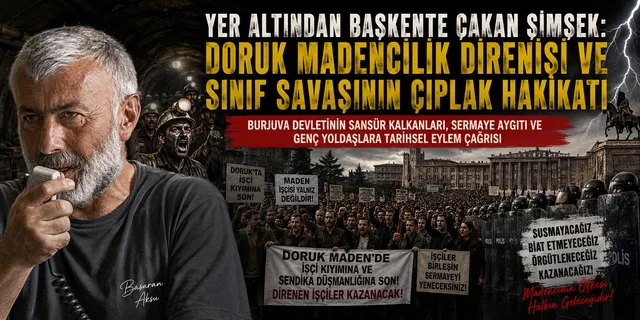
Today, 20 August 2026, roughly a hundred miners were again taken into custody in front of the Ministry of Energy and Natural Resources. According to the union’s statement, miners and press workers covering the scene were beaten; Bağımsız Maden-İş Organizing Specialist Başaran Aksu was put in a separate vehicle from the others. The fifth wave of detentions in ten days.
Comrade, this piece was written for you.
Maybe you saw the news on your phone today, looked for a few seconds, and scrolled on. There is nothing to be ashamed of in that — we all do it. But now I am asking for ten minutes of your time. Because what you saw in that frame is not an "incident." It is the clearest, barest, most instructive form of how labor stands in this country as a relation.
Come, let us look together.
First, two easy traps
When you saw this news, you probably felt one of two things.
Either you said "how sad, what a pity." Or you said "the same things every day, nothing changes" and grew tired.
Both are human. And both leave you where you are.
Pity reduces the matter to a misfortune: wretched people who happened upon a bad boss. Yet those people are not wretched; they are creditors. And what stands opposite them is not a bad person, but a working mechanism.
Fatigue is more dangerous, because it looks justified. To say "the same thing keeps happening" is in fact a correct observation. But if from there you draw the conclusion "so it cannot change," you have mistaken the repetition itself for a law of nature. Yet what repeats has a mechanism. If there is a mechanism, it can be analyzed. If it can be analyzed, it can be intervened in.
Our method is the third: to understand. And to ask every event the same three questions.
In whose hands? Under whose control? For whose benefit?
Now let us start from the beginning.
Who are these people?
Those waiting in front of the Ministry in Ankara are workers of two enterprises:
- Eti Gümüş — a silver mine in Elazığ.
- Doruk Madencilik / Yunus Emre Thermal Power Plant — a coal and energy facility in Eskişehir.
Both sit under the same roof: Yıldızlar SSS Holding.
And the reason they are there is the simplest reason you could guess:
They are not being paid their wages.
The figure the union gives is this: at Eti Gümüş, 176 miners have not received their accumulated wages for roughly a year and a half. Added to that are severance payments, notice pay, and compensation for periods of "unpaid leave" imposed without their consent.
Comrade, pause here for a second. Because if you read this sentence quickly, you will miss it.
There is no wage-bargaining dispute here. No collective-agreement deadlock. No strike.
Work already done is not being paid for.
The worker went down the shaft. Extracted the ore. Ran the plant. The product was sold, money turned over, invoices were cut, electricity flowed into the grid.
The wage was not paid.
Now look at the chronology — and count something
| Date | What happened |
|---|---|
| 18 July 2026 | Eti Gümüş workers began action for their claims |
| 24 July | The company accepted, gave a written commitment. The workers ended the action |
| 6 August | The day payment was promised. No payment |
| 10 August | Workers arrived in Ankara. At a metro exit, before they even reached the Ministry, more than 80 people were taken into custody |
| 11 August | The Ankara Governorship declared a 15-day ban on protests and events in the city |
| 13–15 August | A new wave: 82 workers, then their spouses and families. Detention periods were extended |
| 17 August | The company said "payments have been made." Workers opened their accounts and showed: no money |
| 18 August | Intervention against those who had been waiting in front of the Ministry for eight days. President Gökay Çakır and Başaran Aksu in custody again |
| 20 August (today) | Roughly 100 miners taken into custody. Miners and press workers beaten |
Meanwhile, house arrest was sought for two unionists. Başaran Aksu was once questioned on an allegation like "inciting the public to hatred and enmity" and released under judicial control. Some workers were detained three times in four days.
Now, comrade, here is what I want you to count:
How many kuruş appear as paid in this table?
Zero.
And how many waves of detention?
Five. Plus a governorship ban, one judicial control, one house-arrest demand.
If in a country the price of asking for your wage is detention, then "claim" is no longer a legal concept. It is a political one.
Carve that into your mind. The rest of this piece explains how that becomes possible.
First lesson: What is an unpaid wage?
Young comrade, most people take unpaid wages for a delay. Or for rudeness, for a lack of conscience.
It is not. An unpaid wage is a movement of capital. Come, let us see this with a thought experiment.
Suppose a boss needs money. He has two options.
He goes to the bank. He pays interest. He posts collateral. He must meet the term. If he does not pay, foreclosure comes.
Or he does not pay the wage. What happens?
- He keeps the same money in hand.
- He pays no interest.
- He posts no collateral.
- He sets the term himself.
- His creditor cannot call the credit back — because the next morning that worker must go down the same shaft again.
Now add inflation to this. Money to be paid a year and a half later is no longer the same money. While the worker’s claim erodes, the cash the boss holds does work.
The union said it in a single sentence:
"The holding has turned the workers’ unpaid rights into its own financing instrument."
Comrade, that sentence is not journalism; it is economics. And it says something very important.
In capitalism’s "normal" operation the boss pays the wage and takes his profit from surplus value — that is, from the value the worker produces but is not paid for. That is already exploitation, and it is the real question we must debate.
But what is happening here is a step beyond that: the wage itself has been turned into a source of profit. The value of labor-power is not merely underpaid; a portion of it is not paid at all, and that money is put to work as capital.
That is why this is not a "bad boss" story. It is a method of accumulation.
And never forget this: a method, so long as it is not punished, is repeated.
Second lesson: How did this holding grow?
If you are asking "But how did this man grow so large?," you have asked the right question. Because the answer opens the part of the matter that concerns the state.
The holding’s owner is Sebahattin Yıldız. And the growth story is not an entrepreneurship story; it is a story of transfer.
Privatization. Eti Gümüş was sold through privatization in 2004: roughly 40 million dollars. According to the Chamber of Mining Engineers’ assessment at the time, the enterprise’s value was around 450 million dollars.
Comrade, look at the gap. That is not a bargaining margin. It is the passage of value in public hands into private capital.
TMSF transfer. The Yunus Emre Thermal Power Plant in Eskişehir had passed to the TMSF from Naksan Holding, which was placed under trusteeship after 2016. In 2022 it was sold to Doruk Madencilik. According to union reports, 1.1 million TL in cash was paid in the sale; against that, a debt offset of 3.15 billion TL was accepted.
In other words, almost no money entered the till. And no resource that could be set aside for workers’ claims was formed either.
Licenses. The holding is reported to hold 2,364 mining licenses.
Public payment. Between 2022 and 2024 it received 131.2 million TL from TEİAŞ’s capacity mechanism; in the same period the company in question paid no corporate tax, according to the records.
Record. In 2021 the waste dam of Nesko Madencilik, affiliated with the holding, collapsed in Giresun; 4,500 tons of waste spread onto farmland. The fine was 12 million TL. Operations continued shortly afterward. Kütahya, Çankırı, Amasya, Bilecik, Çorum, Giresun, Eskişehir — unpaid wages, mass dismissals, and occupational-safety violations since 2011 are on the record.
Now let us read the table together:
| What was given | Who gave it | What came in return |
|---|---|---|
| A mining enterprise far below its value | Privatization Administration | Unpaid wages |
| A thermal plant via debt offset | TMSF | Unpaid indemnities |
| 2,364 mining licenses | Public authority | Workplace murders, environmental destruction |
| Capacity-mechanism payments | TEİAŞ | Tax-free profit |
| Impunity | Administration and judiciary | Repeated violation |
Comrade, this is not a "company that succeeded in the market." It is a structure grown through the transfer of public assets, through public payments, and through impunity. Those being loaded into police vans in Ankara today are the ones paying the bill for that transfer.
Third lesson: Why is the state there?
At school they taught you this: the state is not a party in the market. It sets the rule, ensures compliance, and is the arbiter in disputes. If your wage is unpaid, you go to court and you get it.
Now test that narrative in Ankara.
The miners are going not to court but to the Ministry. Why, do you ask?
Because this holding took its assets from the state. It took its licenses from the state. It receives its payments from the state. So in this relation the state is not arbiter — it is a founding partner.
The workers did not learn this from a book. They know it from experience. And that is the kind of knowledge our theory must respect most.
So how did the state respond?
- It did not make payment happen.
- It did not enforce sanctions announced earlier. (The parliamentary question submitted by DEM Party deputy Cengiz Çiçek asks exactly this.)
- But it banned the protest: a 15-day protest ban in Ankara on 11 August.
- And it produced detentions: five waves, extending to families.
Comrade, here I will give you a tool. Carry it in your pocket; take it out in every dispute:
In a conflict, you learn which side the state is on not from what it says, but from whom it turns the coercive apparatus against.
Apply that measure. Here the coercive apparatus was turned not against those who do not pay the wage, but against those who ask for their wage.
In the Marxist tradition there is a classical formulation of this: the executive of the modern state is a committee for managing the common affairs of the whole bourgeoisie. But do not memorize that as a slogan. Use it as a testable proposition. That it is testable is what separates it from a slogan.
Fourth lesson: Why were families detained too?
You ought to have asked this question. Because it cannot be explained as an ordinary policing operation.
If you want to disperse an action, you take the protesters. Taking spouses, children, families standing there is not dispersal.
It is deterrence.
The aim is not to spread the crowd out, but to carry the cost of resistance into the worker’s home. The message is this: "If you take this on, it is not only you who will pay — your household will too."
Comrade, understand this well. Because when capital and the state cannot defeat the worker at the workplace, they try to defeat them in the household. Rent, debt, the child’s school, the spouse’s anxiety — these are the boss’s invisible allies.
And precisely for that reason, that families in this resistance joined the process instead of pulling back in fear is news far more important than the detention counts.
Fifth lesson: What are the miners teaching us?
Now we come to the finest part.
Unpaid wages have a trap: at the first moment they turn the worker into an individual creditor. Everyone has a separate figure, a separate file, a separate court.
The form capital prefers is exactly that. Because 176 separate lawsuits mean 176 separate and powerless parties. Everyone waits alone; some accept, some give up, some settle for installments.
The miners reversed this.
- They turned the claim into a common demand.
- They turned the file into a collective action.
- They turned individual grievance into a class position.
And they did one more thing — the most instructive, in my view: they chose their addressees correctly.
Instead of waiting at the factory gate, they went in front of the Ministry. Because they see that the source of the problem is not a single boss, but the web of relations that brings that boss into being.
Comrade, this consciousness does not come from theory. It comes from experience. Our job is not to blur that consciousness, but to name it.
I leave the union’s reply of 18 August as it is, because none of my analysis can improve on it:
"You cannot frighten those who come from underground with detention. If we are detained a thousand times, we will return a thousand times. We are not afraid. We will win."
Read today’s union statement in its own voice as well: → Bağımsız Maden-İş’s 20 August statement
Watch for this: three narrative traps
In the coming days this news will reach you in three forms. Recognize all three, comrade.
1. Reduction to public order. The news is framed not as "miners were detained because they could not get their wages," but as "an unauthorized demonstration was intervened against." Thus a year and a half of unpaid wages drops out of the sentence; what remains is "the law was not obeyed." Look at what drops out of the sentence in a news story.
2. Singularization. "One company could not make payment; sad." Yet the same holding has done the same thing in eight provinces for fifteen years; it is on the record. The singular-incident narrative renders the pattern invisible. If the pattern is invisible, responsibility becomes invisible too.
3. Technicalization. "There is a cash-flow problem; restructuring talks continue." This language turns the unpaid wage into a balance-sheet line. Yet what corresponds to that line in a household is an uneaten meal.
Against all three, the tool in your hand is the same: In whose hands? Under whose control? For whose benefit?
So what is to be done?
Comrade, I will be honest with you: none of what follows changes the system. All of it increases bargaining power today. These are separate tasks, and both are necessary. To be revolutionary does not mean to belittle today’s position.
1. Let the payment schedule be made public. How much is owed to which worker, when it will be paid — let the Ministry announce it. Saying "payment was made" is not an announcement if it cannot be tested against a bank slip.
2. Tie licenses to workers’ claims. Suspend the mining licenses and incentives of enterprises that do not pay wages. A license is not a property right; it is a privilege granted by the public — and a privilege can be conditioned.
3. Halt public payments. Cut public-sourced payments such as the capacity mechanism until the wage debt is closed; even offset them directly against workers’ claims.
4. Put workers’ claims first. In foreclosure and bankruptcy ranking, workers’ claims should come before bank and public claims. Today the worker is the creditor waiting at the very end of the line.
5. Lift protest bans. The right of those who ask for their wage to make that known to the public cannot be suspended by a "public order" exception. The ban is not a neutral measure; it works in favor of those who do not pay.
And one is addressed directly to you, comrade:
This resistance cannot be sustained without visibility. Sharing the news, circulating the union’s statements, putting this on the agenda in your own workplace and organization — I know it feels "insufficient." But know this: how many people a detention story reaches affects whether the next detention will be carried out.
And do not belittle yourself. Most of those workers waiting in Ankara today once said "what can I do anyway." Then they stood side by side.
Closing word
Young comrade, if only one thing from this piece stays in your mind, let it be this:
What is happening in Ankara is not a public-order incident. It is the most visible moment of a process in which public assets were transferred to a holding, that holding used workers’ wages as its own capital, and those who asked for their wages met the state’s coercive apparatus.
The non-payment of wages begins as a legal problem; with the prohibition of making payment happen, it turns into a political problem.
And I leave you this as well.
176 people who have not received wages for a year and a half are still going to that door despite being detained five times. Their families were detained; they went again. A ban came; they went again. They were told "it was paid" and deceived; they opened their accounts and showed, and went again.
This is not patience, comrade. This is being organized.
The miners come from underground. They are used to working in the dark; they are more durable than we are against being made invisible and against being frightened. What falls to us is not to pity them — to stand beside them and to learn from them.
In comradeship!