2026: The Police Are Maiming School Students
In France, Children Defending Their Schools Are Paying for the Austerity Budget with Their Bodies

2026: The Police Are Maiming School Students
In France, from one lycée blockade to a half-million-strong revolt against austerity
Summary: What Happened in a Month?
Maimed children. Since mid-September, school students in France defending their schools have been met by the police with grenades, rubber bullets and grenade-launcher rounds. In Lens, a 15-year-old student's hand was blown off. In Tours, a 16-year-old student lost his right eye. In Saint-Ouen-l'Aumône, a 14-year-old's jaw was broken in two places. On 17 October in Saint-Étienne, another protester lost a hand. 215 students and 85 school staff have been injured.
Children in custody. As of 6 October, 5,060 people had been taken into custody, and 87 per cent of them are minors. The Interior Minister instructed the police to use "all intermediate weapons". The Prime Minister called the injuries "accidents".
What the children are asking for. None of the demands is extraordinary: teachers for the classes left empty, smaller classes instead of classes of 36, repairs to crumbling buildings with an average age of 61, more humane timetables, and an end to class-based sorting in university admissions.
The growth of the movement. A teachers' strike that began on 17 September in Créteil, in the Paris suburbs, spread through student solidarity to more than a thousand lycées and over thirty universities. The government's 54-billion-euro austerity budget, and the freezing of public-sector workers' pay for the fourth year in a row, carried the anger to the unions, the yellow vests and broad sections of working people. On 17 October more than half a million people were on the streets.
Those standing with the students. The children were not left alone. The yellow vests returned to the streets, saying "Our paths may be different, but our concerns can meet." The Confédération paysanne, the union of small farmers, joined lycée blockades with their tractors; in Bordeaux, Reims and Annonay they brought students breakfast, hot soup and vegetables. Teachers, nurses, firefighters, parents, pensioners, fishers who had closed ports against fuel price rises, a judges' union and human rights lawyers also took their place on the same side.
The class meaning. The issue is not France's schools but to whom capitalism is sending its debt bill. A state that gives tax cuts to capital and sets aside budgets for armament is closing the gap by cutting from the school's ceiling, the teacher's post and the pensioner's pension. And the children who object to this are being maimed.
A fork in the road. The movement is strong but scattered. The streets are crowded, the strike is weak. Looting and arson give the state legitimacy and win votes for the far right; Marine Le Pen leads the polls ahead of the 2027 elections. In the coming weeks the decisive question is whether the students' anger can unite with the organised strikes of the working class in a single programme.
Below we open up each of these headings in detail.
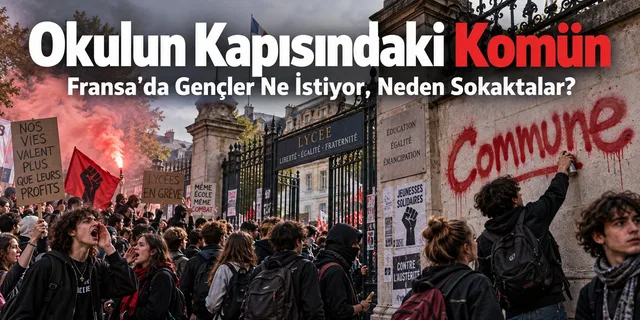
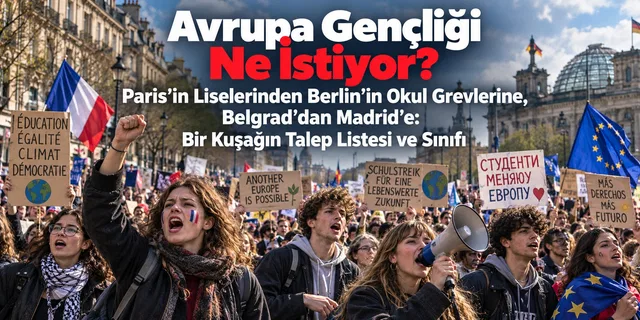
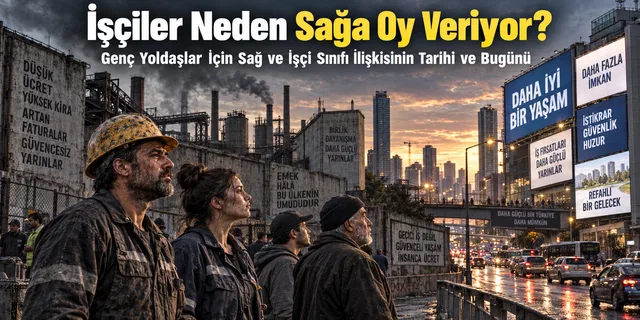
This piece is part of a series. We have been following the movement in France since its first days: What Does Europe's Youth Want? (2 October) told the story of the movement's birth together with youth actions across Europe; The Commune at the School Gate (7 October) read the list of demands through a class lens; French School Students' Struggle Against Parcoursup (12 October) analysed the class character of the admissions algorithm. This piece continues the series after 17 October, placing state violence at its centre.
Dear Young Comrades,
The title of this piece is not an exaggeration but a record. Lens, Tours, Saint-Ouen-l'Aumône, Saint-Étienne... The crime of these children was to want teachers in their schools, desks in their classrooms and a sound ceiling over their buildings. The year is 2026. The country is France, which tells its own story as the cradle of "human rights".
Yesterday, Saturday 17 October, more than half a million people were on the streets in France: 550 thousand according to the Interior Ministry, 800 thousand according to the CGT. 110 thousand in Paris. Most of the crowd were your age: lycée students and university students, and alongside them teachers, nurses, firefighters, parents, and what remains of the yellow vests of 2018.
Most of the news will show you burning cars, looted shops, and the flames engulfing the roof of Limoges's historic town hall. These things happened, and we will not hide them. But in this piece we will ask two questions: Why is the state prepared to maim its own children? And how do you get from the collapsing ceiling of one school to a march of half a million? The answer to both questions is the answer not of France but of how capitalism works today. That is why it concerns us too.
What Happened? A Short Chronology
The movement's beginning was utterly ordinary. On 17 September, in Créteil, one of the working-class suburbs of Paris, teachers went on strike against the shortage of teachers and resources. In the days that followed, the students of the Lycée Antoine-de-Saint-Exupéry blockaded their school in solidarity with their teachers. Their demands read less like a union leaflet than like the minutes of a parent-teacher association: teachers for classes that have none, smaller classes instead of classes of thirty-six, repairs to run-down buildings where people swelter for lack of air in the summer heat. We described the first two weeks of the movement, and the 29–30 September when school students and public servants took to the streets on the same day, in detail in our piece What Does Europe's Youth Want?
What followed moved at the speed of social media and of anger:
| Date | Development |
|---|---|
| 17–18 September | Teachers' strike in Créteil, followed by the blockade of the Saint-Exupéry lycée |
| 24–25 September | More than 10 lycées blockaded in Seine-Saint-Denis and Val-de-Marne |
| 29 September | The school students' union USL calls a national day of action; ~400 lycées affected; on the same day eight major unions hold a public-sector strike |
| 30 September | Public-sector strike ahead of the budget: 300 thousand people according to the unions; 625 arrests |
| 1–2 October | 1,207 lycées affected; prefectures close ~400 lycées and ban gatherings in front of schools |
| 5 October | In Lens a 15-year-old lycée student loses his hand to a police grenade |
| 6 October | Third national day of action; the CGT, FSU and Solidaires join; 250–450 thousand people |
| 17 October | More than half a million people; in Saint-Étienne another protester loses a hand; ~400 arrests |
So that you can feel the weight of the figures: according to the Ministry of Justice's data of 6 October, from the start of the movement to that day 5,060 people had been taken into custody, 87 per cent of them minors. Proceedings had been opened against more than 1,800 people, 1,483 of them children. 215 students and 85 school staff had been injured. Even in a poll commissioned by Le Figaro (a right-leaning newspaper), 62 per cent of the French consider the movement justified (Wikipedia summary).
The Police's Weapons, the Children's Bodies
Let us start with the bodies, because the government's language is built to make them invisible.
| Place | Injured | What happened? |
|---|---|---|
| Saint-Ouen-l'Aumône | A 14-year-old student | Jaw broken in two places by a grenade-launcher round |
| Tours | A 16-year-old student | Lost his right eye |
| Lens, 5 October | A 15-year-old first-year lycée student | Hand blown off by a police grenade |
| Saint-Étienne, 17 October | A protester | Lost a hand to a police grenade |
| Nationwide | 215 students, 85 school staff (40 of them head teachers) | Injured |
These are not the work of individual "over-zealous police officers"; they are the result of a chain of command. Interior Minister Laurent Nuñez instructed the security forces to use "all intermediate weapons". What are called "intermediate weapons" are an arsenal designed not to kill but to maim: rifles that fire rubber bullets, hand grenades containing explosives, grenade launchers. Prime Minister Lecornu, for his part, described the injuries as "accidents" (Socialist Alternative).
France is a country familiar with these weapons. During the yellow vest movement of 2018–2019, more than twenty people lost an eye and five lost a hand. The most controversial grenade of that period was withdrawn from use in 2020 under public pressure, but a similar one was brought in to replace it. In other words, the weapon changed and the policy of maiming remained. Today these weapons are being turned on children on this scale for the first time. We also looked at this double stance, in which the state sets up a "consultation platform" with one hand while firing rubber bullets with the other, in the "The Two Hands of the State" section of our Parcoursup piece.
The state's response is not limited to bodies; it extends to the law as well:
- Mass arrests: 5,060 arrests by 6 October, 87 per cent of them children. Proceedings against more than 1,800 people, 1,483 of them minors. In the same period 790 cases were dropped; in other words, the purpose of the arrests is less to prosecute than to intimidate (Wikipedia summary).
- Threats against families: Justice Minister Gérald Darmanin asked prosecutors to invoke parents' legal responsibility. A state that cannot frighten the child frightens the family.
- Closing schools: Prefectures closed around 400 lycées and banned gatherings in front of schools. Children defending the right to education were answered by suspending education (Al Jazeera).
- Prosecution of politicians: Bally Bagayoko, a mayor in Seine-Saint-Denis who supported the students, was reported to prosecutors on suspicion of "incitement"; the right wing raised the prospect of banning La France Insoumise.
The police inspectorate (IGPN) opened ten investigations. Amnesty International's warning was plain: the students "must not be repressed, but listened to." The government, meanwhile, puts its own figures forward: it says more than 700 police officers have been injured. This figure should be taken seriously too; but on one side there is a professional apparatus equipped with helmets, shields and weapons, and on the other there are 14-year-old children. The scales of violence are set not by adding up figures but by the relationship of power.
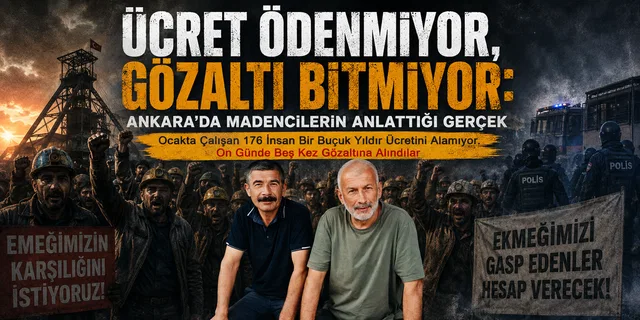
This picture is not unfamiliar to us. We recorded the banning of the streets in Ankara before the NATO summit, and the presentation of arrests as "preventive", in our pieces Pre-NATO 'Fear' Barricades in Ankara and A Chronicle of Ankara's 'Preventive' Siege and Arrests; and the class distribution of state violence in Reading the İHD 2025 Report Through a Class Lens. The difference between Paris and Ankara lies not in the essence of the apparatus but in its make-up.
So why is the state so harsh? Because the issue is not the school but the budget. If the government makes concessions to the students, it will have to make concessions too to the teacher, the nurse and the pensioner who object to the same budget. Protecting the austerity programme requires the first objection to be crushed in a way that deters the rest. The hand blown off in Lens is a footnote to a 54-billion-euro table of cuts. To understand this, let us now look at the school and the budget.
Why the School? The School Is the Workshop of Labour Power
Liberal commentators tend to read this movement as "generational anger" or as "a reaction to Macron's top-down style". Even Nicholas Bequelin, writing in TIME, ties the matter to the need for "a new social contract" (TIME). These readings are not wrong, but they are incomplete. What is missing is this question: what is the school for under capitalism?
From a Marxist point of view, the school is where labour power is reproduced. Capital wants to find tomorrow's worker ready-made: a workforce that can read and write, is used to discipline, and has acquired certain skills. But it does not want to pay the cost of this itself; it makes the state, and through taxes largely working people themselves, pay it. When profit rates are squeezed and state debt grows, the first item to be cut is this "cost of reproduction": the school, the hospital, the nursery, public transport. Our Education Dossier: Whose School Is It? set out this framework in detail; we told the history of teachers' labour in Whose Hand Holds the Chalk?
The French Ministry of Education's own data make the picture plain (Socialist Alternative summary):
- The average age of school buildings is 61 years; only 15 per cent have been renovated since 2015.
- A third of schools are over capacity.
- In 2025, in 10 per cent of lycée teaching hours there was no teacher in the classroom.
- France has had its worst PISA results since 2000.
But this collapse is not evenly distributed across every school. It is no accident that the movement began in Créteil, Seine-Saint-Denis and Val-de-Marne. These are the areas where Paris's working-class families of immigrant origin live, and they were also the stage of the 2005 banlieue uprising. Here class and race are intertwined: France bans the collection of ethnic statistics, but the crumbling ceiling of a banlieue lycée makes statistics unnecessary.
Then there is Parcoursup: the post-lycée university admissions platform. On the surface a neutral algorithm; in reality a sorting machine that favours the children of "good" lycées and of university-educated families. As we showed in detail in French School Students' Struggle Against Parcoursup, the problem lies not in the code but in the management of scarcity: few places, many applications; this is not a natural phenomenon but a budget choice. Recall also what we wrote earlier about digital capitalism's myth of "goodness" and about algorithmic domination: the algorithm is a tool for making class selection look like a technical decision. What the French lycée student calls "Parcoursup stress" is in fact the stress of waiting for a piece of software to confirm their own class position.
In short, the students are objecting as much to the sorting of the future cut out for them as they are asking for "better schools". We discussed in The Commune at the School Gate why the sum of the demands points to an idea of the "commons" that goes beyond reform.
The School's Ceiling Collapsed in the Budget: 54 Billion Euros of Austerity
The student movement could not have grown this large on its own. What turned it into a movement of half a million was the 2027 budget put on the table in the same weeks.
Prime Minister Sébastien Lecornu's budget provides for roughly 54 billion euros of spending cuts (Carolina Political Review). The main items of these cuts:
- A freeze on the base pay of public-sector workers in 2027: the fourth in a row, and the eighth under Macron. According to the unions, these freezes have eroded purchasing power by double digits; their demand is a 6 per cent rise (Al Jazeera).
- A freeze on pensions, except for the lowest.
The justification is ready-made: public debt has passed 119 per cent of GDP, the cost of borrowing is at its highest level in 20 years, and the budget deficit is 5.4 per cent. The markets have begun to compare France with Greece in 2010.
Here we must stop and ask: Whose debt is this debt? When Macron came to power in 2017, one of his first acts was to abolish the wealth tax and introduce a flat tax on capital income. "Let the rich invest, and prosperity will trickle down," it was said. What trickled down was not prosperity but the debt bill. On top of this came fuel and energy prices driven up by the Iran war (we described the class burden of fuel in The Class of a Litre of Diesel), and armament budgets accelerating across Europe. The slogan of the young people in Germany who oppose compulsory military service with school strikes is like a summary of this equation: The Rich Want War, Students Want a Future. The result is a familiar equation: tax cuts for capital, budgets for weapons, freezes for working people, a collapsing ceiling for the school.
Nor is this only France's story. Last year, in September 2025, the "Bloquons tout" (Let's Block Everything) movement arose against the 44-billion-euro budget of cuts of the then prime minister François Bayrou, and between 500 thousand and a million people joined the unions' strike of 18 September. The Bayrou government fell. Macron has worn out five prime ministers in two years. What changed was the prime ministers; what did not change was the austerity prescription brought back to the table every year. We discussed why this prescription never ends in Has Neoliberalism Ended?, and how the same bill is presented in Europe as a housing crisis in Europe's Housing Crisis and the Class of the Home.
Today's movement was built on exactly this accumulation. In the words of the political scientist Bruno Cautrès, this is "the culmination of different mobilisations" (Al Jazeera).
The Children Are Not Alone: Support from the Fields, the Ports and the Hospitals
What the state feared most was that the anger at the school gate would spill over the school walls. That is exactly what happened. Social groups paying the bill of the same budget through different doors took their place, one after another, beside the students.
Tractors from the fields
On 5 October the Confédération paysanne, which organises small and medium-sized farmers, called on its members to "bring the angers together" and join the lycée blockades. The union found the young people's demands "just and legitimate", and condemned the dismantling of public services in education, health and transport, especially in rural areas, as well as the violent repression of social movements. Nor did it hide its own troubles: after "a disastrous summer", farmers had been abandoned in the midst of one of the worst economic crises in recent history. The next day at least ten departmental branches answered the call (Terre-net / AFP, in French).
On the morning of 6 October the scene was moving (Contre Attaque, in French):
- Bordeaux: Farmers brought breakfast to the students of the Lycée Montaigne. In one farmer's words: "As an agricultural movement, it is important for us to show our solidarity."
- Annonay (Ardèche): At dawn the tractors were in front of the Lycée Boissy d'Anglas; the trailers filled with young people.
- Reims: Farmers handed out hot soup and vegetables to the lycée students on the action.
- Deux-Sèvres: Supplies of local and organic produce were brought to the blockade of a rural lycée.
- Allier: Farmers accompanied a lycée march.
This is not a first. In 1968 the farmers of Nantes fed striking workers; in 2016 tractors supported a university blockade. In France the soil of worker–peasant–student solidarity runs deep.
The yellow vests are back
The yellow vests, born in 2018 against a fuel tax, joined the students' call this time with their own demands. The call of Jérôme Rodrigues, one of the movement's well-known figures, was simple: "Our paths may be different, but our concerns can meet." More than 1,750 action points were announced across the country for 17 October (Al Jazeera).
The name of the joint campaign described the meeting itself: "Yellow Vests and Youth, Our Struggles Meet." The call was addressed to students, workers, farmers, firefighters, teachers, health workers, climate activists and pensioners. Among the signatories were last year's "Bloquons tout" coordinations (Morocco World News).
What brought the yellow vests back onto the streets was diesel, which had passed 2.37 euros a litre with the Iran war and the blockade of the Strait of Hormuz. Since mid-September fishers had closed the ports of Nice and Sète, and farmers, construction and energy workers and health workers had joined the fuel protests (Wikipedia). The price at the pump and the teacher shortage at school were two faces of the same budget.
Unions, lawyers, families
- Trade unions: The CGT called for general assemblies in workplaces; its General Secretary Sophie Binet said the budget "sacrifices young people": "We cannot play Russian roulette with our children's future." Solidaires and the FSU joined the actions; the CGT branch at Toulouse University Hospital called out hospital workers. Even the video game workers' union STJV went on strike; for us, computing workers standing beside the students has a particular meaning.
- Teachers: The words of Clémence, a maths teacher in Paris, sum up the teachers' stance: "They want more resources, more teachers, better teaching conditions. We have been asking for these things for years" (Al Jazeera).
- Lawyers: The judges' union, the Syndicat de la magistrature, described the police intervention as "brutal". Human rights lawyers and the French Human Rights League (LDH) were on the marches; the French section of Amnesty International called for "unnecessary and excessive use of force" to be avoided.
- Families, health workers, firefighters, pensioners: In the 17 October marches, parents walking beside their children were together with nurses and firefighters.
- University students: University students, blockading more than thirty campuses, took to the streets in solidarity with the lycée students.
- Political parties: As well as La France Insoumise, Communist Party leader Fabien Roussel and Ecologist leader Marine Tondelier also declared their support for the movement.
The meeting in a table
| Group | How did they support? | Their own bill |
|---|---|---|
| Small farmers (Confédération paysanne) | Joining blockades with tractors, supplies, breakfast | "A disastrous summer", the dismantling of rural public services |
| Yellow vests | Actions at more than 1,750 points on 17 October | Fuel, purchasing power, unfair taxation |
| Fishers, construction and energy workers | Fuel protests, port blockades | Diesel at 2.37 euros |
| Public-sector workers (teachers, nurses, firefighters) | Strikes and marches | Pay frozen for the fourth time |
| Trade unions (CGT, Solidaires, FSU) | Strike calls, workplace general assemblies | Wages, pensions, public services |
| Lawyers (judges' union, LDH, lawyers) | Exposing police violence, legal support | The erosion of the rule of law |
| Families and pensioners | In the marches beside their children | Frozen pensions, their children's future |
The class meaning of this table is clear: austerity hits different sections of society through different doors, but it hits them all from the same budget. The small producer in the countryside, the public-sector worker in the city and the lycée student in the banlieue are different lines of the same bill. As Marx showed for the France of 1848, as long as the link between the peasantry and the working class remains broken, the bourgeoisie can use each against the other; when that link is made, the balance of the order is shaken.
Still, let us be honest: this support is not yet an alliance but a meeting. The tractor coming to the school gate is an important sign; but unless this meeting turns into a common programme, a common calendar of action and common bodies of representation, each group may go back to bargaining over its own demands. The experience of the yellow vests in 2018 shows this too: broad anger that cannot become an organised will disperses. It should not be forgotten that part of the yellow-vest base is also open to the right; the direction this meeting takes depends on how much programme and organisation the left can offer it.
The words of Théo, a 19-year-old student, state the common denominator of this meeting in a single sentence: "We are fed up with the government prioritising military spending. We want resources for schools and hospitals."
Two Narratives: What the Government Sees and What Class Sees
Let us set side by side how two separate countries emerge when the same events are looked at from two different places:
| The government's narrative | What class sees |
|---|---|
| "Far-left infiltrators are inciting young people" (Education Minister Geffray) | The movement was born from solidarity with a teachers' strike; 62 per cent consider it justified |
| "Police violence is nothing but accidents" (Lecornu) | Two people lost a hand and a young person lost an eye; the Interior Minister ordered the use of "all intermediate weapons" |
| "The budget deficit makes austerity unavoidable" | The deficit was swollen by the abolition of the wealth tax and cuts for capital; the bill is sent to wages |
| "We offered an emergency solution with 3,000 substitute teachers" | A patch against 3,700 lycées and a decade-long staffing gap; student and teacher unions rejected it |
| "Parents should be held legally responsible for their children's actions" (Darmanin) | The state holds no one responsible for leaving schools without teachers |
| "Public funds cannot cover the damage forever" (Lecornu) | Public funds did not cover 61-year-old school buildings either |
| "There is no place for violence in our Republic" (Macron) | 87 per cent of more than 5,000 arrests are children; the distribution of violence is also a class one |
What this table teaches us is that in every crisis the state makes the same three moves. First, it ties the movement to an outside force ("the far left", "an LFI operation", in Turkey "provocateurs" or "foreign powers"). Second, it presents violence as one-sided. Third, it papers over a structural problem with a patch. The mechanism is the same in France as in Turkey, because in both the state is a committee for managing the common affairs of capital.
The Question of Violence: Let Us Be Honest
Dear comrades, here we must be honest with ourselves too. Streets were wrecked in Paris, an Apple store was emptied in Lille, Limoges's historic town hall burned, and the town hall in Marseille was entered (Euronews).
This has to be thought about from two directions.
First: Let us not forget who gives birth to the violence. Facing a state that fires tear gas, rubber bullets and grenades at 14-year-old children defending their schools, it is not surprising that anger loses its form. Unorganised anger cannot choose its target. Looting is not class consciousness; it is a distorted mirror of consumer society that appears in the absence of class consciousness.
Second: Looting and arson do not strengthen the movement; on the contrary, they become an instrument of legitimacy in the state's hands for crushing it. Lecornu's talk of "extremely intense violence" is a way of making people talk the next day about the burned building rather than the budget. More dangerous still: today in France the demand for "order" is being credited to the right, to Marine Le Pen. In the polls ahead of the presidential election of April 2027, Le Pen is in the lead (TIME). As we described in AfD's 43.8 Percent, the force that harvests most of the despair created by the austerity of social democracy and the liberal centre is the far right. We also discussed why working people turn to the right, and how this is an expression of disorganisation, in Why Do Workers Vote for the Right? If the left cannot give this anger an organised direction, the bill for it may be presented at the next election as a racist government.
That is why our principle is clear: we expose state violence, but we see the movement's strength not in arson but in organisation and in stopping production.
1968? The Limits of a Comparison
Jean-Luc Mélenchon described this movement as "the strongest youth movement since 1968". At first glance the resemblance is striking: the students started it, the unions joined, the state responded harshly.
But what made 1968 into 1968 was not the barricades at the Sorbonne but the general strike of 10 million workers and the factory occupations that followed (you can find the experience of the French working class, from the June Days of 1848 to the Paris Commune and the anti-fascist front, in our History of the European Working Class dossier). The barricade shook the state; the strike stopped capital. Today the picture is different: only 11 per cent of teachers joined the public-sector strike of 30 September; among other public-sector workers the rate was below 10 per cent, and in hospitals lower still. One of the reasons is the difficulty of giving up a day's pay when wages are melting away.
So at the moment France has strong streets but a weak strike. The street creates visibility; the strike stops profit. What will force the austerity budget to be withdrawn is the union of the street and production. CGT General Secretary Sophie Binet's "red alert" warning, and the 48-hour deadline she gave the government, show an awareness of this threshold. The real question is whether the unions can move from a calendar of one-day actions to a sustained and widespread strike.
Let us recall what Lenin said about "spontaneity": the spontaneous movement is consciousness in embryonic form. The blockade in Créteil was spontaneous solidarity. The USL's national call turned it into an organised movement. The present threshold is for this movement to unite the student's demand with the worker's demand in a single programme: staff for the school, a pay rise for the public-sector worker, a decent pension for the pensioner, and a tax system that takes the money for all of these from capital. We also asked this question of the passage from spontaneous anger to a historical subject in our piece To Be a Historical Subject in the Age of Illusions: "Organize!"
Seen from Turkey: The Same Bell, Different Schools
In September, as the schools opened, we said "The Bell Does Not Ring the Same for Everyone". France has become the proof of that statement on a European scale.
In Turkey too, overcrowded classes, double-shift schooling, gaps closed with hourly-paid teachers and contract posts, buildings that are not earthquake-resistant, class-based sorting through an examination system presented as "merit", and education being loaded a little more onto the family's pocket every year are familiar realities. We live in a country where even a single school meal is begrudged (The Child-Protection Excuse of Those Who Begrudge Children a Single Meal). What Parcoursup is to the French student, the central examination system is to our young people. We also looked at the state's reflex of answering school problems with police, cameras and bans in The Rifle at the School Gate.
The difference lies here: in France there is a school students' union (USL), teachers' unions can respond to a student blockade with solidarity, and a workers' confederation can join the students' call. In Turkey, the lycée student's right to organise is in practice ignored; disciplinary regulations, the line that "politics must be kept out of school", and the family's fear divide young people into isolated individuals. On the teachers' front, though, there are hopeful examples: we described the struggle of private-sector teachers in Ankara in The Future Forged at the Ankara Barricades.
Another thing France shows us is that the tractor can come to the school gate. In Turkey too, the small producer crushed by diesel and fertiliser prices, the public-sector worker whose pay is melting away, and the student whose future is lined up in an examination queue are different lines of the same budget. We said in To Be a Historical Subject in the Age of Illusions: "Organize!" that the anger stretching in the Aegean from Akbelen to seasonal farm work becomes strength only when it is organised; France has shown the scale of this.
The lesson we will draw from France is not "let us set the streets on fire too". The lesson is this: no school's problem is the problem of a single school. The collapse of a classroom ceiling is the result of a budget choice. And that choice is a class choice.
Concrete Tasks
Young comrades, watching France is not enough; we must learn from it. Our proposals:
- Draw up an inventory of your own school. Class sizes, teaching hours with no teacher, the number of hourly-paid teachers, the building's earthquake report, canteen prices, school bus fees. Numbers turn anger into argument.
- Build ties of solidarity with teachers. The movement in France began with student support for a teachers' strike. The union struggle of education workers is your struggle.
- Connect the school problem to the budget problem. Set side by side the share of the central government budget allocated to education investment and the interest payments, defence spending and incentives given to capital.
- Distinguish organisation from a social media trend. A call can spread in a day and die out in a day. What lasts are structures that meet regularly, take their decisions together and elect their representatives.
- Record state violence, but do not make violence the movement's method. In France the state's biggest trump card was the burning buildings. Our strength lies in our numbers and in our capacity to stop production.
- Connect the school gate to the other gates. In France, farmers with their tractors, yellow vests with their marches and lawyers with their statements came to the students' side. Get to know the teachers' union, the health workers, the small producer and the neighbourhood association in your own city; start talking about a common list of demands and a common calendar.
- Be alert to the far right harvesting the anger. When the despair created by austerity is turned against the migrant and the "other", capital wins a second time.
- Keep the international information network alive. Translate and share the statements, demands and forms of organisation of the French student unions. Knowledge is a commons; so is the experience of struggle. We have begun collecting the lists of demands of youth movements across Europe in our piece What Does Europe's Youth Want?; let us grow this collection together.
The Bell Is Ringing
When the students of a lycée in Créteil closed their doors for their teachers, perhaps they did not know what they were doing. Four weeks later half a million people were marching not only for better schools but for "the rights they want to take back". As one student told Al Jazeera: "We are here because we want to take back our rights."
Capitalism is trying to make people pay its debt by cutting it from children's schools, the nurse's wage and the pensioner's pension. The young people in France are refusing to pay this bill. Whether this refusal remains a revolt or turns into a class programme will become clear in the coming weeks.
For us the lesson is clear: the bell does not ring the same for everyone; but when everyone stands up at the same time, who rings the bell changes too.
In solidarity,
Knowledge Commons
Sources
- Al Jazeera, "France to shutter up to 500 schools as more student protests called", 4 October 2026 — https://www.aljazeera.com/news/2026/10/4/france-to-shutter-up-to-500-schools-as-more-student-protests-called
- Al Jazeera, "Public workers in France strike over pay as student protests turn violent", 30 September 2026 — https://www.aljazeera.com/news/2026/9/30/french-public-workers-strike-over-pay-as-student-protests-turn-violent
- Al Jazeera, "Tear gas and unrest as hundreds of thousands protest for reforms in France", 17 October 2026 — https://www.aljazeera.com/news/2026/10/17/france-wave-of-nationwide-protests
- Euronews, "'No room for violence,' says Macron after rioters and looters hijack peaceful demonstrations across France", 17 October 2026 — https://www.euronews.com/2026/10/17/no-room-for-violence-says-macron-after-rioters-and-looters-hijack-peaceful-demonstrations-
- CBS / The National Desk, "Hundreds of thousands protest across France over schools, cost of living, and fuel prices", 17 October 2026 — https://cbs6albany.com/news/nation-world/hundreds-of-thousands-protest-across-france-over-schools-cost-of-living-and-fuel-prices
- CNN, "Half a million protesters sweep France in major show of youth unrest", 17 October 2026 — https://edition.cnn.com/2026/10/17/europe/half-million-protesters-sweep-france-in-youth-unrest-latam-intl
- Nicholas Bequelin, "Why is France Burning?", TIME, 16 October 2026 — https://time.com/article/2026/10/16/france-student-protests-macron/
- Carolina Political Review, "Strikes, Deficits, and Stalemate in Paris", 14 October 2026 — https://www.carolinapoliticalreview.org/cpr-daily/2026/10/14/strikes-deficits-and-stalemate-in-paris
- Socialist Alternative, "Giant Wave Of Youth & Student Protest Surges In France", 8 October 2026 — https://www.socialistalternative.org/2026/10/08/giant-wave-of-youth-student-protest-surges-in-france/
- Wikipedia, "2026 French lycée protests" — https://en.wikipedia.org/wiki/2026_French_lyc%C3%A9e_protests
- Wikipedia, "Bloquons tout" — https://en.wikipedia.org/wiki/Bloquons_tout
- Terre-net / AFP, "La Confédération paysanne appelle les agriculteurs à rejoindre les lycéens", 6 October 2026 (in French) — https://www.terre-net.fr/manifestations/article/904390/la-confederation-paysanne-appelle-les-agriculteurs-a-rejoindre-les-lyceens
- Contre Attaque, "Des paysans en renfort des lycéens", 7 October 2026 (in French; a pro-movement publication) — https://contre-attaque.net/2026/10/07/des-paysans-en-renfort-des-lyceens/
- Al Jazeera, "Protests spread across France as 'yellow vests' set to join", 17 October 2026 — https://www.aljazeera.com/news/2026/10/17/france-braces-for-nationwide-protests-with-yellow-vest-members-set-to-join
- Al Jazeera, "'We're short of resources': France's student protesters, in their own words", 7 October 2026 — https://www.aljazeera.com/news/2026/10/7/were-short-of-resources-frances-student-protesters-in-their-own-words
- Morocco World News, "France's October 17 Protests Seek to Unite Students, Unions and Yellow Vests", October 2026 — https://www.moroccoworldnews.com/2026/10/341724/frances-october-17-protests-seek-to-unite-students-unions-and-yellow-vests/
- Wikipedia, "2026 French fuel protests" — https://en.wikipedia.org/wiki/2026_French_fuel_protests
Related pieces from Knowledge Commons
The France and Europe's youth series
- "French School Students' Struggle Against Parcoursup", 12 October 2026 — https://bilgimusterekleri.org/en/blog/parcoursup/
- "The Commune at the School Gate", 7 October 2026 — https://bilgimusterekleri.org/en/blog/okulunkapisindakikomun/
- "What Does Europe's Youth Want?", 2 October 2026 — https://bilgimusterekleri.org/en/blog/avrupagencligineistiyor/
- "The Rich Want War, Students Want a Future", 26 September 2026 — https://bilgimusterekleri.org/en/blog/zenginlersavasogrencilergelecekistiyor/
Education and youth
- "The Bell Does Not Ring the Same for Everyone", 13 September 2026 — https://bilgimusterekleri.org/en/blog/okullaraciliyor/
- "Our Education Dossier Is Out: Whose School Is It?", 29 August 2026 — https://bilgimusterekleri.org/en/blog/egitimdosyasi/
- "Whose Hand Holds the Chalk?", 5 October 2026 — https://bilgimusterekleri.org/en/blog/ogretmenliginhikayesi/
- "The Rifle at the School Gate", 22 September 2026 — https://bilgimusterekleri.org/en/blog/okulkapisindakitufek/
- "The Child-Protection Excuse of Those Who Begrudge Children a Single Meal, and the Surveillance Gate on Social Media", 17 October 2026 — https://bilgimusterekleri.org/en/blog/cocugukorumak/
- "The Future Forged at the Ankara Barricades: The Class Struggle of Private-Sector Teachers", 18 June 2026 — https://bilgimusterekleri.org/en/blog/ogretmensendikalari/
State violence and repression
- "Reading the İHD 2025 Report Through a Class Lens", 5 September 2026 — https://bilgimusterekleri.org/en/blog/ihd2025raporu/
- "Pre-NATO 'Fear' Barricades in Ankara", 23 June 2026 — https://bilgimusterekleri.org/en/blog/natokorkusu/
- "As Capital's Global Guardians Arrive: A Chronicle of Ankara's 'Preventive' Siege and Arrests", 26 June 2026 — https://bilgimusterekleri.org/en/blog/ankaratutuklamalari/
Austerity, crisis and the far right
- "Has Neoliberalism Ended?", 19 September 2026 — https://bilgimusterekleri.org/en/blog/neoliberaalizmbittimi/
- "The Class of a Litre of Diesel", 17 September 2026 — https://bilgimusterekleri.org/en/blog/birlitremazotunsinifi/
- "Maricarmen's Stretcher, Elif's Key: Europe's Housing Crisis and the Class of the Home", 25 September 2026 — https://bilgimusterekleri.org/en/blog/evinsinifi/
- "AfD's 43.8 Percent Is Not a Deviation: It Is the Bill of a Two-Hundred-Year Line and Thirty-Five Years of Dispossession", 11 September 2026 — https://bilgimusterekleri.org/en/blog/afdnereye/
- "Why Do Workers Vote for the Right?", 19 September 2026 — https://bilgimusterekleri.org/en/blog/iscilernedensagaoyveriyor/
Algorithms, organisation and history
- "The Tearing of the Illusion: A Materialist Intervention Against Digital Capitalism's Myth of 'Goodness' and the Call to 'Pace the Frontier'", 29 July 2026 — https://bilgimusterekleri.org/en/blog/sinirinotesi/
- "Algorithmic Domination and the 'Echo Chamber' Politics of Digital Capital", 8 May 2026 — https://bilgimusterekleri.org/en/blog/algoritmik-tahakkum-ve-dijital-sermayenin-yanki-odasi-siyaseti/
- "Dossier: A History of the European Working Class Is Out", 27 September 2026 — https://bilgimusterekleri.org/en/blog/avrupaiscisinifitarihi/
- "To Be a Historical Subject in the Age of Illusions: 'Organize!'", 15 August 2026 — https://bilgimusterekleri.org/en/blog/egedeorgutlenin/