Why Is the Republic a Bourgeois Revolution?
A Respectful Class Answer to Emre Kongar's Thesis of the National Democratic Revolution

Dear Young Comrades
On 3 November, Emre Kongar published the fourth piece in his series in the newspaper Cumhuriyet, under the title "'Cumhuriyet', 'milli demokratik devrim'dir (4)", and the same day he shared this summary on X: "The Republic is not a 'bourgeois revolution'... The Republic is a 'national democratic revolution'."
His reasoning, in short, is this. A bourgeois revolution is a mature capitalist class destroying the feudal order and establishing its own power. No such class existed in the Ottoman Empire or in Turkey. The economy was tied to foreign capital and to comprador elements. The War of Liberation was carried out, with the people's support, by a military and civilian bureaucracy that came from the Unionist tradition. This was not a class reckoning. It was a national struggle for liberation.
In this piece we will explain why we do not agree with this thesis. As we do so, we will first open the concepts one by one, because much of the argument comes from a confusion about what the concepts mean. Then we will look at the Turkish case, with its dates and its laws.
But first, a debt of respect.
First, Respect
Emre Kongar is one of the few people in this country who took sociology out of the lecture hall and explained it to the people. With works such as Toplumsal Değişme Kuramları ve Türkiye Gerçeği and Türkiye'nin Toplumsal Yapısı, he taught generations to think of society as a structure. For years he defended secularism, science and the Enlightenment, without flinching from the cost, in the periods when reaction spoke at its loudest. That he still writes, still argues, and still engages with the young even on X, past the age of eighty, is in itself an example of citizenship.
This is exactly why we argue with him seriously. We would not answer the thesis of a writer we did not take seriously. Our criticism is not of the person. It is of the class vision on which the thesis rests. And we think this vision leads everyone who wants to defend the Republic today to the wrong place.
A Short Summary: Ten Theses
- A bourgeois revolution is not a revolution the bourgeoisie makes by hand. It is the revolution that opens the road to capitalism. The measure is not who led it, but which relations of production it opened the way for.
- The condition of a "mature bourgeoisie" is absent from almost every bourgeois revolution in history. Even in the France of 1789, the people on the stage were not industrialists, but lawyers, journalists and minor officials.
- In countries where the bourgeoisie is weak, the army and the bureaucracy make the bourgeois revolution "from above". Prussia (Bismarck), Japan (the Meiji Restoration of 1868) and Italy (the Risorgimento) are the classic examples. Turkey is a member of this family.
- The "national democratic revolution" is not the opposite of the bourgeois revolution. It is a kind of it. In the Marxist literature its content is bourgeois-democratic. The difference is which class takes the lead, and where the revolution is directed.
- Kongar's own evidence refutes his thesis. Lenin's saying "not Bolsheviks, but anti-imperialist nationalists" means, in Lenin's language, "a bourgeois-democratic movement of national liberation".
- In Turkey the bourgeoisie was not mature before the revolution, but the state created it deliberately. The project of a "national economy" and a "national bourgeoisie", running from 1908 to 1950, is the document of this.
- The darkest page of this creation is the transfer of property. The property of the Armenians in 1915, the property of the Rum through the 1923 population exchange, and non-Muslim capital through the Wealth Tax of 1942 were transferred to the Muslim-Turkish bourgeoisie.
- The revolution's approach to the worker and the peasant gives away its class character. The strike law of 1909, the closing of the workers' press in 1925, the ban on strikes in 1936, articles 141 and 142 in 1936, and the ban on class-based associations in 1938.
- The slogan of "a classless, unprivileged and fused mass" is not the ideology of the absence of classes. It is the ideology of the banning of the class struggle.
- Defending the gains of the Republic does not require presenting it as classless. On the contrary, the gains can be truly protected, and carried forward, only by seeing its limits.
Let us turn to the detail.
Let Us Open the Concepts
The source of the argument is, to a large extent, a confusion of concepts. We open the following concepts in order, and in plain language.
Revolution
In the Marxist sense, a revolution is not a change of government or of regime. It is the passing of state power from one class to another class (or to an alliance of classes), and, as a result, the opening or the changing of the road before the relations of production. Marx's famous formula, in the preface to A Contribution to the Critique of Political Economy, is this. At a certain stage of their development the productive forces come into conflict with the existing relations of production. These relations cease to be forms of development of the productive forces and become their fetters. "Then begins an era of social revolution."
So what defines a revolution is not the flag, the anthem or the leader. It is the question of which relation of property and labour will be dominant. The question Şevki Kılıç asked beneath Kongar's post is exactly this: "For you, what changes does the concept of revolution create over production?"
The Bourgeois Revolution
A bourgeois revolution is the revolution that removes the obstacles in front of the accumulation of capital, by destroying pre-capitalist relations of production (feudal, tributary, or, as in the Ottoman case, structures based on a state-land order) and their political superstructure (absolute monarchy, the sultanate, religious legitimacy, the privileges of estates).
Its typical tasks are these:
- The unification of the national market (the abolition of internal customs and of the privileges of estates; a common currency, measure and law)
- The securing of private property in land and in capital
- The creation of the citizen who is equal before the law and "free", that is, the legal ground of the free worker who can sell their labour
- The separation of religion from the affairs of the state, secular law and secular education
- The founding of the nation-state, and the securing of unity in language and culture
- The taking of political power from the sultanate and the dynasty, and its use in the name of "the nation", and in fact in the name of the propertied classes
Kongar's definition ("the process in which a mature capitalist class destroys the feudal order and establishes its own power") puts in the place of the concept only one special case of it, and a special case that is very rare in history.
As the historian Neil Davidson shows in detail in How Revolutionary Were the Bourgeois Revolutions? (2012), in the Marxist tradition the bourgeois revolution is defined by its results, not by the class origin of the cadre that leads it. Cromwell's army in the England of 1640, the Jacobin lawyers in the France of 1789, the samurai in the Japan of 1868, and the Prussian landed aristocracy (the Junkers) in the Germany of the 1860s made these revolutions. None of them was "a mature industrial bourgeoisie".
The Bourgeois Revolution from Below and from Above
In 1907, in The Agrarian Programme of Social-Democracy in the First Russian Revolution, Lenin distinguishes two roads of the transition to capitalism:
- The American road (from below): The old landlordism is liquidated by revolution, the land passes to the peasant, and capitalism develops from among free farmers. The democratic content is broad.
- The Prussian road (from above): The old landowners and the bureaucracy stay in place, and themselves slowly become capitalist. The peasant is dispossessed and turned into a worker. The democratic content is narrow, and the authoritarian state is strong.
Engels, too, described Bismarck's unification of Germany as a "revolution from above". Gramsci, for the Italian unification (the Risorgimento), uses the concept of the "passive revolution": a transformation carried out by the ruling cadres without the active participation of the popular masses, and even while their movement is blocked, which in the end establishes the bourgeois order.
This is the key concept for understanding Turkey. In a country whose bourgeoisie is weak, the military and civilian bureaucracy has taken on the tasks of the bourgeois revolution. This does not show that the revolution was not bourgeois. It shows that it was a bourgeois revolution of the Prussian-Meiji type.
The War of National Liberation
A war of national liberation is a nation's struggle for independence against imperialist occupation or colonial rule. This describes a task, not the class character of the revolution. Different classes can take on the same task in different directions:
- In Algeria the FLN, and in India the Congress Party, carried out national liberation under the leadership of the local bourgeoisie and the petty bourgeoisie, and the result was capitalist states.
- In Vietnam and in China the same task was carried out under the leadership of the worker-peasant alliance, and it opened onto a socialist transformation.
So the sentence "the War of Liberation was a national struggle" is true, but the conclusion "therefore it was not a bourgeois revolution" does not follow from it. The question is under which class's leadership, and toward which property order, the national liberation was carried out.
The National Democratic Revolution
Here is the real knot of the conceptual confusion. The "national democratic revolution" is not, as Kongar supposes, a concept that is an alternative to the bourgeois revolution. It is a concept of Marxist theory itself, and its origin is also the Soviet and Comintern literature:
- In Two Tactics of Social-Democracy in the Democratic Revolution (1905), Lenin openly defines the democratic revolution as "a bourgeois revolution in its content". The question is whether the bourgeoisie, or the worker-peasant alliance, will lead this revolution.
- The Second Congress of the Comintern, in 1920, treats the national movements in colonial and semi-colonial countries as "bourgeois-democratic" or "national-revolutionary" movements, and defends a temporary alliance with them on the condition that the independent workers' organisation is preserved.
- In On New Democracy (1940), Mao defines the new-democratic revolution as a revolution that is "bourgeois-democratic in character, but under the leadership of the proletariat".
- After the Moscow meeting of 1960, the concepts of "national democracy" and "the non-capitalist road" come to the fore in the Soviet literature.
- In Turkey, at the end of the 1960s, the National Democratic Revolution movement led by Mihri Belli used this concept, and saw the Kemalist revolution as "an unfinished national democratic revolution", a process that had to be completed. Doğan Avcıoğlu's Türkiye'nin Düzeni was close to this line.
The emphasis, at the end of Kongar's piece, that "the national democratic revolution must be completed" is a direct echo of this tradition. The irony is this. Kongar ties the "bourgeois revolution" reading to the official Soviet view, but the concept of the "national democratic revolution" that he himself proposes also comes from the Soviet and Comintern vocabulary.
More important: in the Marxist meaning of the concept, the distinguishing feature of a national democratic revolution is that the worker and peasant masses take part in the leadership, or at least stand as an organised and independent force. A radical solution of the land question, the freedom of the labourers to organise, and the limiting of domestic large property together with imperialism are the indispensable conditions of this revolution. None of these exists in Turkey's history from 1919 to 1938. On the contrary, the road in front of all of them was deliberately closed.
The National Bourgeoisie and the Comprador Bourgeoisie
The comprador bourgeoisie is the domestic capital that grows rich as the agent of foreign capital, and that runs its market and its trade. In the last century of the Ottoman Empire this section was made up largely of Rum, Armenian, Jewish and Levantine merchants.
The national bourgeoisie is the domestic capital that wants to protect its own national market and to build its own industry, and that for this reason comes into a certain contradiction with imperialism.
Kongar's observation that "a strong national bourgeoisie had not formed" is correct. But here the course of history is being read backwards. In Turkey the national bourgeoisie is not the subject of the revolution. It is the product of the revolution. The state built a bourgeois order that had no bourgeoisie, and then raised a bourgeoisie for this order. This is not the absence of a class. It is the birth of a class by the hand of the state.
Bonapartism and the Bureaucracy's Appearance of Standing "Above the Classes"
In The Eighteenth Brumaire of Louis Bonaparte, Marx describes how, when there is a balance or a weakness among the classes, the state and the bureaucracy appear as a power "above the classes". But this appearance is misleading. The Bonapartist state, too, in the end protects and develops bourgeois property.
The military and civilian bureaucracy in Turkey also appears "above the classes" in this way. The strength of Kongar's thesis comes from this appearance. Yet every institution this bureaucracy founded, and every law it passed, secured private property and the accumulation of domestic capital. For the bureaucracy to act in the name of a class, it does not have to come from that class. It is enough that it establishes that class's property order.
Let Us Compare the Concepts
| Measure | Classic bourgeois revolution (from below) | Bourgeois revolution from above (Prussia / Meiji / Turkey) | National democratic revolution in the Marxist sense | The "national democratic revolution" as Kongar uses it |
|---|---|---|---|---|
| Example | England 1640, France 1789 | Germany 1860-1871, Japan 1868, the Italian Risorgimento | The process in China before 1949, Vietnam | Turkey 1919-1938 |
| The force that leads | The bourgeoisie and its radical wing, with the active participation of the masses | The army, the bureaucracy, a section of the old landowners | The worker-peasant alliance, proletarian leadership | The military and civilian intellectual cadre |
| The role of the masses | Active in the street, on the barricade, in the village | Mobilised as soldiers, politically passive | Organised, and partners in power | Supportive, unorganised |
| The land question | Feudal property is liquidated | The large landowners are preserved, and slowly become capitalist | A radical land reform, the land to the peasant | The tithe was abolished, large property was not touched |
| The organisation of the labourers | Limited, but widened by struggle | Suppressed | A basic principle | Strikes and class-based organisation were banned |
| The property order | Private capitalist property | Private capitalist property, with the state's protection | Large capital is limited, open to a transition to socialism | Private property, domestic capital supported by statism |
| Class character | Bourgeois | Bourgeois | Bourgeois-democratic in content, socialist in direction | "Above the classes" according to Kongar, bourgeois according to us |
What the table shows is clear. Turkey's experience of 1919-1938, even if it carries the name Kongar gives it in the last column, sits by its qualities in the second column. The indispensable features of the third column (worker-peasant leadership, land reform, the organisation of the labourers) do not exist in this experience.
A second comparison is between the typical tasks of the bourgeois revolution and what was done in Turkey:
| The task of the bourgeois revolution | Its counterpart in Turkey |
|---|---|
| The abolition of dynastic and sultanate power | The abolition of the sultanate in 1922, and of the caliphate in 1924 |
| The nation-state and national sovereignty | The Grand National Assembly in 1920, the Republic in 1923, Lausanne |
| The unification and protection of the national market | The Cabotage Law of 1926, customs autonomy in 1929, the unification of measures in 1931 |
| The legal guarantee of private property | The Civil Code of 1926, the Constitution of 1924 |
| The encouragement of domestic capital | İş Bank in 1924, the Law for the Encouragement of Industry in 1927 |
| Secular law and secular education | The Law on the Unification of Education in 1924, the Civil Code of 1926, the entry of secularism into the constitution in 1937 |
| The equal citizen (and free labour-power) | Equality before the law, the right of women to vote and to stand for election in 1934 |
| State support for the accumulation of capital | The statism of the 1930s, Sümerbank (1933), Etibank (1935), the First Five-Year Industrial Plan (1934) |
Secular law, secular education, women's rights and the abolition of the sultanate, which Kongar counts as evidence of the "national democratic revolution", are, as this table shows, the textbook tasks of the bourgeois revolution. These gains are great, they are real, and they should be defended. But they do not change their class character.
The Turkish Case: How Was the Bourgeoisie Created?
The prehistory: the face of capital in the Ottoman Empire
In the nineteenth century the Ottoman Empire opened its doors to British capital with the 1838 Treaty of Balta Limanı. The Land Code of 1858 opened the road to private property in land. In 1881, with the Ottoman Public Debt Administration (Düyun-ı Umumiye), an important part of the finances passed under the control of foreign creditors. The capitulations granted privileges to the foreign merchant.
In this period the commercial and financial bourgeoisie was made up largely of non-Muslim and Levantine sections. Kongar's diagnosis that "the economy was dependent on foreign capital and on comprador elements" is therefore correct. But the story does not end here. It begins here.
1908: the first act of the bourgeois revolution, and the first strike law
The Constitutional Revolution of 1908 took place under the leadership of the Committee of Union and Progress. Immediately after the revolution a great wave of strikes spread from Istanbul to Salonica, and from the railways to the tobacco workshops. The new power's answer, in 1909, was the Tatil-i Eşgal Law: strikes in public services were banned, and unionisation was blocked.
This is the first class choice of the bureaucracy that is said to stand "above the classes". In its very first year it stands opposite the worker, and beside property.
The national economy: a deliberate programme for creating a bourgeoisie
As Zafer Toprak shows in detail in Türkiye'de Milli İktisat 1908-1918, the Unionists, especially after 1913, openly applied a programme of "creating a national bourgeoisie". The Law for the Encouragement of Industry was passed in 1913, the capitulations were unilaterally abolished in 1914, monopolies and privileges were granted to Muslim-Turkish merchants during the war years, and dozens of "national" joint-stock companies and banks were founded in Anatolia.
This programme is a class project. Its aim is to liquidate the non-Muslim bourgeoisie that held the economy, and to put a Muslim-Turkish class of capital in its place.
The dark page of the transfer of property
The heaviest, and the most silenced, face of this project is this. With the deportation and destruction of the Armenians in 1915, the property left behind changed hands through the regulations on "emval-i metruke" (abandoned properties). With the population exchange of 1923, the property of the Rum population was also redistributed by a similar road. As researchers such as Çağlar Keyder and Taner Akçam have shown, the accumulation of capital of a section of Anatolia's new Muslim merchant and notable class rests on this change of hands.
This process continued in the Republican period as well. The Wealth Tax of 1942 assessed a tax on non-Muslim merchants many times higher than on Muslims. The property of those who could not pay was sold, and they themselves were sent to labour camps at Aşkale. An important part of the property that was sold passed to Muslim-Turkish capitalists.
Kongar's sentence "there was no mature bourgeoisie" is, for this reason, half a sentence. Its full form is this. There was no mature Turkish bourgeoisie, and the state created it deliberately, also by changing the hands that held the property of other peoples. To say this is not to belittle the Republic. It is to face history.
The class composition of the War of Liberation
It is true that the War of Liberation was a national struggle. But the Societies for the Defence of Rights (Müdafaa-i Hukuk), which were the organisational spine of this struggle, were made up largely of local notables, merchants, landowners and clerics. The soldier was a peasant, but the word belonged to the notable.
It is reported that Mustafa Kemal pointed out the soldiers in the trench to Aralov and said "these are peasants, there can be no Bolshevism with them". Kongar uses this as evidence for his thesis. Yet this sentence tells us that the leadership saw the peasant not as a political subject, but as a mass to be mobilised. This is exactly the logic of the bourgeois revolution from above.
There is another fact of the same period. In January 1921 Mustafa Suphi and fourteen comrades were killed in the Black Sea. The experiment of the official "Communist Party of Turkey", founded in 1920, was an attempt to bring the independent communist movement under control. The People's Communist Party was closed, and its leaders were tried. Even while the War of Liberation was under way, no room was left for an independent worker-peasant politics.
What does Lenin's sentence prove?
Kongar reports that Lenin said to Aralov, "Mustafa Kemal and his friends are not Bolsheviks, they are anti-imperialist nationalists". This is true, and it is entirely compatible with Lenin's approach. But it says exactly the opposite of Kongar's thesis.
In the Theses on the National and Colonial Questions, which Lenin wrote in 1920 for the Second Congress of the Comintern, movements of this kind are defined as bourgeois-democratic movements of national liberation. Lenin wants support to be given to them to the extent that they are against imperialism, but he wants the independence of the workers' movement never, under any condition, to be sacrificed. So Lenin's sentence "they are not Bolsheviks, they are anti-imperialist nationalists" means "this is a bourgeois national movement, and we support it because it is against imperialism". The Soviet aid of gold and arms to Ankara is also the expression of this principled but conditional support.
The Izmir Economic Congress of 1923: where the classes sat at the table
The Izmir Economic Congress, which met from 17 February to 4 March 1923, set the economic direction of the new state. Delegates took part in the congress as groups of farmers, merchants, industrialists and workers. This is the state's own registration of the existence of classes.
The decisions of the congress pointed to private property, to the encouragement of domestic capital, and to an economy open to foreign capital, provided it was not contrary to national interests. The demands of the workers' group, such as the right to a union, the eight-hour day and social security, were largely shelved.
The following year, in 1924, İş Bank was founded with Mustafa Kemal's support and under Celal Bayar's management. The bank became the financial centre of the new bourgeoisie.
The tithe, the land and the peasant
The abolition of the tithe in 1925 was a real relief for the peasant. But landed property was not touched. The large landlordism of the East and the Southeast, and the large farm ownership of the Aegean and Çukurova, were preserved. The state's loss of revenue was made up with indirect taxes, that is, again from the backs of the broad sections of the people.
Kongar speaks of "attempts at land reform". The real attempt is the 1945 Law on Providing Land to Farmers. This law met the resistance of the large landowning deputies in the Assembly. The "Memorandum of the Four" of Adnan Menderes, Celal Bayar, Refik Koraltan and Fuat Köprülü, and then the founding of the Democrat Party, were born from inside this debate. In the end the law remained largely without effect, and in 1950 it was in practice shelved.
That a bourgeois revolution does not liquidate landlordism is, in Lenin's distinction, the clearest sign that it took the "Prussian road".
The doors closed to the worker
The calendar that shows the Republic's approach to the working class is the strongest answer to the claim of a "state above the classes":
- 1925: With the Takrir-i Sükun Law, and with the Sheikh Said rebellion given as the reason, workers' and left publications (Aydınlık, Orak Çekiç) were closed alongside the opposition press, and the leaders of the Communist Party of Turkey were tried.
- 1936: The Labour Law was passed, and strikes and lockouts were banned.
- 1936: Articles 141 and 142, taken from the Rocco Code of Mussolini's Italy, were added to the Turkish Penal Code. Organisation and propaganda aimed at "the establishment of the domination of one social class over the other social classes" were made crimes. These articles remained in force until 1991.
- 1938: With the Law on Associations, it was forbidden to found an association based on class.
If a state writes the existence of classes into the text of the law, and then bans the organisation of only one of those classes (the worker), there is little left to say about that state's class character.
Statism: socialism, or state capitalism?
The statism applied in the 1930s, after the Great Depression of 1929, is sometimes presented as an experience "close to socialism". The credit taken from the Soviet Union in 1932, and the influence of the Soviet planning experience, are real. But the aim of statism is clear in the Republican People's Party's own documents: that the state should invest in the areas where private enterprise falls short.
As Korkut Boratav shows in Türkiye İktisat Tarihi, statism stood not opposite private capital, but behind it. The factories founded by Sümerbank and Etibank provided cheap inputs, infrastructure and a trained workforce. After 1950 an important part of this accumulation was transferred to private capital. Statism became the incubator of the bourgeoisie in Turkey.
"A classless, unprivileged and fused mass"
The famous formula of the Republic's founding ideology was "a classless, unprivileged and fused mass". Kongar's thesis is, knowingly or not, an academic continuation of this formula.
But this formula does not describe the absence of classes. It declares that the class struggle is not legitimate. The "classless" discourse of a state that chose delegates at Izmir according to class, that founded a bourgeoisie with İş Bank, and that banned the strike and class-based organisation, is not a finding about reality. It is an instrument of hegemony. This discourse has throughout history presented the "national" interest of capital as everyone's interest, and has counted the worker's demand as "separatism" and "class provocation", and banned it.
The Class Weaknesses of Kongar's Thesis
We find Kongar's thesis weak, from the standpoint of class, on four points.
First, the definition is wrong. To define the bourgeois revolution as "the mature bourgeoisie taking power" leaves out the greater part of the bourgeois revolutions in history. By this definition Meiji Japan, Bismarck's Germany, and even Jacobin France do not count as bourgeois revolutions. If a definition leaves out most of the examples it is supposed to explain, the problem is not in the examples. It is in the definition.
Second, the subject and the result are confused. Kongar looks at who made the revolution (the military and civilian bureaucracy), and does not look at what it established (a capitalist nation-state based on private property). The Marxist method asks for the reverse. One looks first at the result, that is, at the relations of production.
Third, the bureaucracy is treated as above the classes. The bureaucracy is not a class, but it is not classless either. It establishes, protects and reproduces the dominant property relation in society. The elitist approach of the military and civilian bureaucracy in Turkey, and its approach of "for the people, in spite of the people", does not hide its bourgeois character. On the contrary, it is a typical feature of the bourgeois revolution from above.
Fourth, and perhaps the most important, the political results. The idea that "the Republic is above the classes" leads, today as well, to two things:
- To the labourers suspending their own class demands while they defend the Republic. The logic of "first the Republic, then class" places capital and labour in the same "national front".
- To the habit of waiting for a saviour from the military and civilian bureaucracy, or from "the intellectual cadres". From 27 May to 12 March and to 12 September, we have described in detail in our 12 September dossier what this expectation has cost on this soil.
Here we must grant Kongar one thing. He puts this thesis forward in order to defend the Republic against reaction. But to present the Republic as "above the classes" leaves off the stage the real force that would defend it, that is, the organised labourers. Those who are eroding the gains of the Republic today also profit from exactly this class blindness. If one section of the same bourgeoisie defended secularism yesterday, another section today uses reaction as an instrument of the accumulation of capital.
Why Does It Matter?
The debate over "a bourgeois revolution, or a national democratic revolution" can look like an academic quarrel over a name. It is not. It directly determines what we will do today.
| To count the Republic as a "national democratic revolution above the classes" | To see the Republic as a "bourgeois revolution from above" |
|---|---|
| The task: to "complete" the revolution, but with no clarity about who will complete it | The task: to defend the gains with the organised force of the labourers, and to go beyond them |
| The subject: the intellectual cadre, the progressive bureaucracy, "the nation" | The subject: the working class and the labouring people |
| Secularism and the Enlightenment as values independent of the class struggle | Secularism and the Enlightenment as gains that can be protected only by the class struggle |
| Reaction as a moral deviation of "the enemies of the Republic" | Reaction as an instrument of hegemony that suits one section of the bourgeoisie |
| An alliance with the "national" wing of capital is possible and necessary | No wing of capital is the labourer's lasting ally |
| The aim: a return to 1923, "the Republic again" | The aim: the labourers' republic, on the road to a classless society |
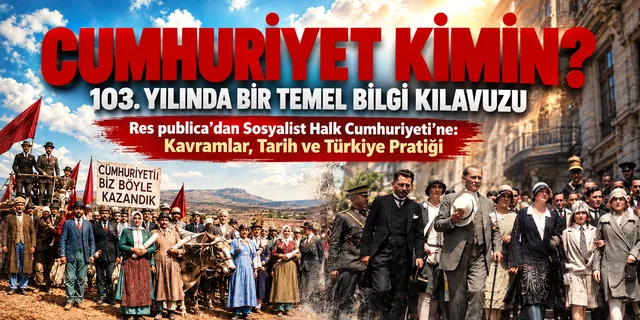
We have discussed this distinction before, in different pieces. In the basic guide Whose Republic? we explained the republic itself, the origin of the bourgeoisie in Turkey, and the relation between capitalism and the republic. In The Republic Again, But Whose Republic?, our answer to Ünsal Ünlü's Republic Day broadcast, we discussed the difference between the republic and democracy, and why a class explanation is needed rather than a moral one. We also took up the class side of the law in Whose Law Is the Republic's Law?. Kongar's thesis can be read as an academic formulation of the problems we took up in these three pieces.
We also described what the October Revolution gave, in the same years, to the world and to this soil, in What Did the October Revolution Give the World?. To understand correctly the Soviet support given to the War of Liberation, you can look at that piece as well.
What Is to Be Done? Concrete Tasks
- Let us learn to read with concepts. When we assess a political event, let us ask three questions: In whose hands? Under whose control? To whose benefit? Let us not hesitate to ask these questions of the Republic as well.
- Let us defend the gains, but not present them as classless. Secularism, secular education, equality between women and men, and scientific thought are our gains too. The way to protect them passes through an alliance with the labourers, not with capital.
- Let us face the history that has been silenced. To speak of the place of 1915, of the population exchange and of the Wealth Tax in the birth of the national bourgeoisie is not hostility to the Republic. It is the effort to set it on firmer ground.
- Let us go to the sources. Let us discuss together, in reading groups, Lenin's Two Tactics, Zafer Toprak's Milli İktisat, and Korkut Boratav's Türkiye İktisat Tarihi.
- Let us not wait for a saviour. Let us organise. Neither a progressive officer nor an intellectual cadre can take the place of the labourers' own organisation. Let us organise in the union, in the school, in the neighbourhood and in the workplace.
- Let us keep arguing with Kongar, and with those who think as he does. Not with insult, but with evidence and with concepts. Their stand against reaction is valuable. Our task is to give that stand a class ground.
Dear Comrades
The Republic is a bourgeois revolution. This sentence does not belittle it. Bourgeois revolutions are the great progressive leaps of history. The destruction of the sultanate, of the caliphate, of sharia law, and of the order that shut women in the house was a civilisational leap on this soil that is hard to take back.
But a bourgeois revolution, as the name says, establishes the order of the bourgeoisie. It brings freedom to the owner of property, and a ban to the worker. The share that falls to the labourer inside this order depends on how organised they are.
To Kongar's call that "the national democratic revolution must be completed", we answer as follows. Yes, the Republic has unfinished work. But there is no longer a cadre that will complete it from above, and perhaps there never was. Only the class that was once silenced by being called "a classless, unprivileged and fused mass" can complete that work, by coming onto the stage with its own organisation. And when that class completes it, what emerges will no longer be a bourgeois republic. It will be the labourers' republic.
With respect to Emre Kongar, for what he has contributed to thinking and to argument.
Sources
The texts under discussion
- Emre Kongar, "'Cumhuriyet', 'milli demokratik devrim'dir (4)", Cumhuriyet, 3 November 2026
- Emre Kongar, post on X, 3 November 2026
The classics
- K. Marx, A Contribution to the Critique of Political Economy, Preface (1859)
- K. Marx, The Eighteenth Brumaire of Louis Bonaparte (1852)
- V. I. Lenin, Two Tactics of Social-Democracy in the Democratic Revolution (1905)
- V. I. Lenin, The Agrarian Programme of Social-Democracy in the First Russian Revolution (1907)
- V. I. Lenin, Draft Theses on the National and Colonial Questions (1920)
- A. Gramsci, Prison Notebooks (notes on the Risorgimento and the passive revolution)
- Mao Zedong, On New Democracy (1940)
Turkish history and the debate
- Zafer Toprak, Türkiye'de Milli İktisat 1908-1918
- Korkut Boratav, Türkiye İktisat Tarihi 1908-2002
- Çağlar Keyder, Türkiye'de Devlet ve Sınıflar
- Taner Timur, Türk Devrimi ve Sonrası
- Taner Akçam, İnsan Hakları ve Ermeni Sorunu
- Rıdvan Akar, Aşkale Yolcuları: Varlık Vergisi ve Çalışma Kampları
- Doğan Avcıoğlu, Türkiye'nin Düzeni
- S. I. Aralov, Bir Sovyet Diplomatının Türkiye Hatıraları
- Neil Davidson, How Revolutionary Were the Bourgeois Revolutions? (2012)
From Knowledge Commons
- Whose Republic? A Basic Guide in Its 103rd Year
- The Republic Again, But Whose Republic?
- Whose Law Is the Republic's Law?
- What Did the October Revolution Give the World?
- 12 September: The History, Balance Sheet, and Present of a Class Coup
- The Bourgeoisie Is Buying Time with Technology, and We Will Bury Capitalism
This piece is a living document, and it can be updated with criticism and contributions. It is shared under the CC BY-SA 4.0 licence. You may copy, change and share it if you credit the source.