The Republic Again, But Whose Republic?
A Comradely Reply to Ünsal Ünlü's 29 October Speech, and a Roadmap

First, a Debt of Respect: A Journalist Without a Boss
We want to begin this piece not with a criticism but with a thank you.
Most of us in this country know Ünsal Ünlü in the mornings. A professional who graduated from the economics department of Mülkiye and has practised journalism for more than thirty years. When the doors of the mainstream media closed, one by one, on journalists who told the truth in the years when power and capital shook hands, he was one of those put out of doors. But instead of falling silent he chose another path: since 27 August 2015 he has been doing, in his own words, "journalism without a boss" on his own channel. For eleven years, every morning, without depending on a holding that buys advertising, a boss who imposes an editorial line, or an editor-in-chief who says "don't write that".
It is necessary to understand well what this means. The greater part of the media in Türkiye is in the hands of energy, construction, mining and finance capital. News is a card in these capital groups' bargaining with the state. In such a climate, journalism without a boss means, as he himself has said, both a great comfort and a great unprotectedness. There is no institution behind you, no army of lawyers, no wage security. There is only the trust of the viewer and your own professional honour. In an interview at Medyascope he summed this up in a plain sentence: whatever he does today, he was doing the same at the place from which he was sacked; that is called journalism.
A few things set him apart from many another "opposition" commentator:
- He counts standing with the people as the definition of the profession. In an interview he gave BirGün in April 2026 he said that journalism, by definition, must stand with the people, and that its clash with capital and with power is therefore inevitable. That is a sentence many defenders of "impartiality" do not dare to speak.
- He keeps memory alive. In the days when the Musa Anter case was allowed to fall under the statute of limitations he said, "We will be the memory of society; we will not let it be forgotten". Against a policy of forgetting, memory is one of journalism's most revolutionary functions.
- He sees imprisoned journalists not as individual victims but as part of a collective struggle for democracy. He says openly that unemployment, the absence of unions and insecurity have become the common fate of the profession; that is, he sees the journalist as a worker.
- He does not stop at speaking; he is at the front in the street as well. When journalists walked in ten provinces on 24 October 2026 saying "No to censorship, freedom for the news", those watching the walk in Ankara saw him right beside the banner, at the front from the beginning of the action to the end. That day we too wrote "If We Fall Silent". It is easy to say "organise" from a screen; Ünlü said it with his body as well.
- He carries pluralism not as an ornament but as a stance. Beginning the holiday broadcast with "good morning" in dozens of languages, from the Kurdish "Rojbaş" to Armenian, from Greek to Georgian, is a small but meaningful sign. He celebrates the republic not by waving a flag but by addressing all the peoples of this land.
- He defends the document against the cult of the person. For eleven years, every 29 October, he has called on his viewers to learn not "by turning someone into a hero" but by reading the primary source itself.
This is why Ünsal Ünlü deserves great respect. His good faith is not a communications strategy; it is a good faith whose price has been paid, tested by unemployment and by unprotectedness. And most important, it is a good faith that refuses to be a passive spectator, that tries to set society in motion, that carries the effort to be an agent. Ünlü is a professional who says journalism should not be confused with activism; but journalism that stands with the people is, in itself, a form of claiming the revolutionary inheritance of the republic.
It is precisely for this reason that we take his speech seriously and think it important to think it through with him. This piece is a comradely contribution made to someone standing in the same ranks.
The Speech and This Piece
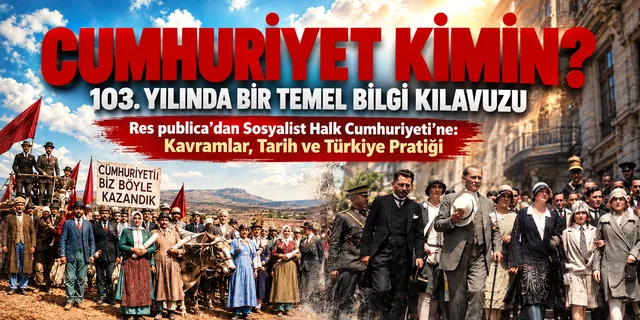
In the 103rd year of the Republic, Ünsal Ünlü made a sincere, warm and well-intentioned call in the speech he published on his channel under the title "What we need is not a new republic, but the republic again!". This piece is not an objection to that call; it is a proposal to develop it. It brings forward what was said that is true and valuable, opens the class window where the argument can be developed, and in the end proposes a concrete roadmap. We set out the conceptual frame of the republic at greater length in Whose Republic? A Basic Guide in Its 103rd Year, published yesterday; this piece stands beside that guide, as a comradely reply to a living speech.
First, the Summary: Ten Theses
- Ünlü's starting point is right: The republic is not an object of celebration; it is a way of life that has to be argued over again today. To say "to many more" requires struggling for many more.
- The stress on "ordinary life" is a strong intuition: The child who goes to school hungry, the young person who cannot pay the rent, the worker who fills the tank before the petrol rise... To build the meaning of the republic from everyday life is more sincere, and more true, than great words.
- But the republic and democracy are not the same thing. The republic is a form of state; in whose hands it is, under whose control it works, and for whose benefit it runs, are separate questions. Democracy has to do with the answer to those questions.
- The Republic of 1923 is a bourgeois republic. Turning the subject into a citizen is a great advance; but the same republic closed workers' organisations in 1925, banned the strike in 1936, and made class-based organising a crime in 1938. Seeing these two faces together develops the call for "the republic again".
- The observation about "the mentality that founded the Village Institutes and the mentality that closed them" is very valuable; only, behind these two mentalities there are two classes: the progressive intellectual who wants the peasant child taught, and the agha who does not want his land taken from him. Both were in the same party.
- The ruin being lived through is not the work of "degenerates", "scoundrels" or "the selfish". Moral anger is justified; it can be developed with a class explanation. Privatisation, the fund plunder, the selectivity of the courts, gangsterisation: these are the regular results of a certain stage of capital accumulation, of a certain class alliance.
- Reaction did not rise of itself; the bourgeoisie used it. From 1950 to 12 September, from the Turkish-Islamic synthesis to "not enough, but yes", religion and nationalism were an apparatus in the hands of capital for dividing the working people. When this link is made, the speech grows stronger.
- The housing crisis is not a "wreckage of values"; it is the financialisation of housing. The example Ünlü gives from the United States is proof that the problem is not moral but structural and global.
- Ünlü's understanding of "unity" also carries a right intuition: There is no unity with those who are trying to destroy the republic. But in drawing the line one must put, in place of "good people / bad people", the measure "those who live by their labour / those who grow rich on someone else's labour". On which side are the holdings that run Atatürk advertisements on the holiday?
- What we need is not "the republic again" but an "advanced republic": a republic that defends the gains of 1923 but does not stop there, that turns equal citizenship into an equal life, in which labour is organised. The road to this also runs through a class-based programme of democracy.
Dear Young Comrades,
On the morning of the holiday most of you shared the sentence "Gentlemen, tomorrow we shall proclaim the republic" on social media. Ünsal Ünlü begins his speech from exactly there, and says this: 103 years have passed since that sentence; we should now be talking about entirely different things.
We agree. In this piece we will try to take those "entirely different things" a little further. We listened carefully to Ünlü's speech: sincere, warm, with its heart in the right place, and sensitive to the ruin of today. This intuition can be developed through the window of class. Here we will try to carry the diagnosis further, together.
In doing so we keep one principle in view: Ünlü, and the millions of patriotic people who think as he does, are not on the other side; they are beside us. One speaks with them in order to win them. That is what a comradely contribution is.
What Does Ünlü Say? What Is True and Valuable
Let us first grant what must be granted. There are at least seven strong observations in the speech:
Learning without making heroes. Ünlü recalls that eleven years ago he began by saying "do not learn the thing you want to learn by turning someone into a hero", and he directs people straight to the primary source, to the Nutuk. This is a healthy attitude that puts reason and the document forward against the cult of the person.
Filling the celebration with content. The stress that the word "to many more" will not come true of itself, that one must dream and struggle, is right. A holiday should not be a ritual; it should be a moment of reckoning.
The political character of ordinary life. This is perhaps Ünlü's strongest intuition: what people miss most today is not great ideals but ordinary life. The child who does not go to school hungry, the young person who has hope, the student who can pay the rent, the citizen who is tried fairly. To define the republic through these everyday questions is very valuable.
The liquidation of institutions and of belief in the institution. Parliament existing but not working, the courts becoming "law for some people", public enterprises being sold off and scattered. Ünlü says that it is not only the institutions that have been liquidated, but belief in institutions as well. This is a very apt observation.
The exposure of the "new republic" discourse. He says openly that the liberal intellectuals who came forward twenty years ago with the promise of a "second republic", a "more freedom-loving republic", opened the road for today's power, and he warns that a "second wave" is being prepared. This warning is especially important today.
The Village Institutes formula. "The contradiction of this country is the struggle between the mentality that could think of founding the Village Institutes and the mentality that closed them." This is the deepest sentence in the speech. In a moment we will open this sentence together with its class content.
Confidence against fear, and "all of us together or none of us". The stress that liberation will not come alone, that society must speak without fearing one another, lays the moral ground of organisation.
We agree with all of these. Now let us look at the places that can be developed.
The Republic Is Not Democracy
The conceptual threshold where the speech can be developed begins here. When Ünlü says "republic" he often in fact means "democracy", even "the social state": equality, justice, a working parliament, a child who does not go hungry, the right to housing.
Yet the republic is a form of state. The Latin root of the word, res publica, means "the public thing", and in its plainest sense it tells of there not being, at the head of the state, a sovereign who passes from father to son. This definition leaves open the question of who governs, and for whose benefit.
History is full of examples of this:
- The Roman Republic was the republic of the slave-owners.
- The Venetian Republic was the republic of a merchant oligarchy.
- The United States was founded as a republic, and in that republic it took about ninety years and a civil war to abolish slavery.
- Pinochet's Chile, and the Türkiye of 12 September, were each a "republic".
So the question "is there a republic?" by itself says nothing. Ünlü sees this intuitively as well: "Thank God the country's name is still the Republic of Türkiye. But..." he says. It is with class that the inside of that "but" is filled.
Marx said this very clearly in 1843: Political emancipation is not human emancipation. For everyone to be an equal citizen before the state is a great advance; but so long as inequality continues inside society, in the factory, in the field, in the rent, this equality remains formal. Anatole France tells this with a bitter irony: the law, in its majestic equality, forbids the rich as well as the poor to sleep under bridges.
Ünlü's sentence "we passed in 24 hours from servitude, from being subjects, to equal citizenship" is for this reason both true and open to development. True, because the legal status really did change. Open to development, because the next morning the agha's land, the merchant's capital and the farmhand's poverty were still in their place.
| What does the republic provide? | What else does democracy require? |
|---|---|
| Elected government in place of a dynasty | Those elected being controlled by the labouring majority |
| Equal citizenship before the law | Real equality in property and in opportunity |
| Secular law | The right to organise, to strike, to bargain collectively |
| Woman being counted a citizen | The emancipation of woman's domestic and waged labour |
| Public education | Education not making a class distinction |
| National independence | The economy depending on society, not on capital |
The left-hand column is the gain of 1923, and it must be defended. The right-hand column is what has not yet been won, and it is necessary to struggle for it.
The Two Faces of the Republic of 1923
To defend the good sides of the republic one has to know it as a whole. A one-faced account of the republic makes defending it harder as well; because the other side always puts forward the other face that is passed over.
The revolutionary face: The abolition of the sultanate and of the caliphate, secular law, the alphabet reform, women's right to vote and to be elected in local elections in 1930 and in general elections in 1934, public education, étatist industrialisation, public establishments such as Sümerbank and Etibank, the People's Houses, the Village Institutes. These are civilisational leaps on this land that are hard to take back.
The class face: The same republic took as its task the creation of its own bourgeoisie.
- The İzmir Economic Congress of 1923: Demands of the workers' group such as the eight-hour day and the right to a union remained outside the programme; the demands of the merchant and industrialist groups were decisive.
- The Law for the Maintenance of Order, 1925 (Takrir-i Sükûn): The law issued on the pretext of the Sheikh Said revolt closed not only reactionaries but workers' associations and left publications as well.
- The Law for the Encouragement of Industry, 1927: Private industrialists were given land, tax exemption and customs facilities.
- The Labour Law of 1936: It banned the strike and the lock-out; its model had been influenced by the labour legislation of fascist Italy.
- The Law on Associations, 1938: It banned the founding of associations on a class basis.
- The Wealth Tax of 1942: It became the instrument for transferring non-Muslim capital to the Muslim-Turkish bourgeoisie.
This should be said not in order to belittle the republic, but in order to define it correctly: the Republic of 1923 was a bourgeois republic, progressive against the feudal-religious order, but limited against the working class. To defend its progressive sides is our task; to go beyond its limited sides is our task as well.
Making this distinction heads off two risks: the trap of the liberal and religious right that rejects the republic as a whole, and the nationalist stance that counts it a sacred trust exempt from criticism. Staying clear of both strengthens the struggle against today's ruin. You can also look at our 12 September dossier and What Did the October Revolution Give the World?, where we discussed this in more detail; many of the progressive steps of the Türkiye of 1923 cannot be thought apart from the wind that 1917 created in the world.
The Village Institutes: Not Two Mentalities, Two Classes
Let us return to Ünlü's deepest sentence: "the struggle between the mentality that could think of founding the Village Institutes and the mentality that closed them."
This sentence is very true; only one more step is needed: These mentalities were not flying in the air; they had their feet on the land.
When the Village Institutes Law came out in 1940, peasant children began to learn reading and writing, farming, a craft, music and their own rights. Under the lead of Hasan Âli Yücel and İsmail Hakkı Tonguç, the poor children of Anatolia were returning to their villages as teachers, but also as conscious citizens.
Whom did this disturb? The landlord. The peasant who has learned to read questions the agha's land, his interest, the sharecropping order. This tension broke open when the Law for Providing Land to Farmers came before parliament in 1945. The large landowning deputies who opposed the law, among them Adnan Menderes, were inside the same party, the CHP. That split gave birth to the Democrat Party. From 1946 onwards, before the DP had even come to power, the CHP government itself began to empty the institutes from within; in 1954 they were closed altogether.
So the "closing mentality" was not a stranger coming from outside the republic. It was one wing of the republic's founding class alliance, that is, of the alliance of the bureaucracy, the commercial bourgeoisie and the landlords. The progressive intellectual and the agha were under the same roof, and when the clash came, the agha won.
This lesson is vital for today: A progressive republic cannot last so long as it is open to the veto of the property-owning classes. The Village Institutes did not lose a fight of mentalities; they lost a fight over property.
"Degenerates" and "Scoundrels": Developing Moral Anger
Throughout the speech Ünlü often uses a moral language: degenerate, scoundrel, shameless, toady, crawler. We understand this anger and we share it. This anger can be developed with a class explanation.
According to Ünlü, the only concern of Bolsonaro, and of Vahdettin, is "to fill their own pockets, their families' coffers". Today's ruin, in a similar way, is the work of "those who make money out of thin air", "those who steal", "those who exploit state resources without limit".
This explanation can be developed in two places:
First, one can go beyond persons. Replacing people with well-intentioned ones is not enough on its own. Almost every government that has come to power since 1980 has moved in the same direction with different discourses: privatisation, subcontracting, de-unionisation, the opening of public services to the market. The sale of public assets from Sümerbank to Tüpraş, from Erdemir to Türk Telekom, from SEKA to Petkim, was not the work of a single party; it was a class programme.
Second, the durability of the order can also be taken into account. Ünlü says the order is a paper tiger that "could be brought down with a single explanation". That hope is valuable; it has to be met with organised power. The fund plunder, the trustee regime, selective justice, gangsterisation are not deviations of a structure; they are the way that structure works. The observation Ünlü himself reports proves this: the shares of companies that are making losses are still rising, "the fund fraud is ticking over nicely". We discussed this in detail in The Cost of the Fund Plunder: who pays the cost of the plunder, and to whom does the profit remain? The answers given to these questions show not a moral disorder but the financial accumulation phase of capital.
Gangsterisation should be read in the same way. Networks that have turned into a mafia inside the state, capital groups that feed on public tenders, cliques that use the courts as a tool... These are not passing human weaknesses like "selfishness"; they are the lasting products of an accumulation model in which capital is interwoven with the state, and competition is conducted not in the market but at the state's door.
| Moral explanation | Class explanation |
|---|---|
| "Degenerates sold the country" | The sale of public assets is capital's need for accumulation |
| "Thieves robbed the funds" | Financial plunder is the result of an order that has shifted investment from production to speculation |
| "The courts work for some people" | The judiciary is a tool in the conflicts of the ruling class alliance |
| "Selfishness has seized society" | Neoliberalism liquidated solidarity institutionally |
| "Ill-intentioned people are in charge" | Whichever party comes, the same class programme is applied |
| Solution: let good people come | Solution: let the relations of property and power change |
The Boss of Reaction: The Bourgeoisie and the Religious Apparatus
This is perhaps where the speech can be developed most. Ünlü tells the enemies of the republic as "toadies who will go on kissing the padishah's hem"; as if reaction were a residue left over from the Ottoman Empire. Yet the force that reproduces, feeds and uses reaction in Türkiye in every period is the capitalist class.
- 1950: While the Democrat Party was turning the call to prayer back into Arabic, it was on the other hand opening the country to US capital through the Marshall Plan and NATO. Religion was the new class alliance's means of winning the people.
- The 1960s–70s: The Associations for Struggle against Communism, religious and nationalist organisations, were supported systematically against the rising workers' movement and against DİSK.
- 12 September 1980: The coup was made in order to apply the decisions of 24 January. While the workers' movement was crushed, the Turkish-Islamic synthesis was declared the official ideology, compulsory religious instruction entered the constitution, and imam-hatip schools were multiplied. Halit Narin, then president of the employers' union confederation, said himself for whom the coup had been made: "until now the workers have laughed; now it is our turn to laugh."
- The 2000s: The "not enough, but yes" liberals, European capital and broad sections of the domestic bourgeoisie supported the AKP as a "conservative democratic" reform party. Because the AKP could apply privatisation, subcontracting and flexible work to an extent none of its predecessors had managed.
Ünlü speaks of "the bribe-taking system that has been put in place since the mid-1980s, stuffed in under the name of liberalism". This observation can be developed. One more step: that system was put in place with the bayonet of 12 September, and religion became the ideological cement of that system. The struggle against reaction cannot, for this reason, be separated from the struggle against capital.
Making this link makes a defence of secularism lasting: naming reaction is not enough; one also has to touch the class relation that feeds it.
The Nostalgia for Ordinary Life: Whose Ordinary Life?
Ünlü's words "we miss our old ordinary life" are very touching and, in large part, true. Today the life of the minimum-wage worker, the pensioner, the student is more insecure than it was twenty-five years ago.
But one has to look at nostalgia with a class eye. Ünlü's childhood in Anıttepe, his ceremonial duty at Anıtkabir, are truly fine memories. But in those same years:
- In the 1990s Kurdish villages were being emptied, unsolved murders were being committed.
- In the crisis of 2001 hundreds of thousands of people were left without work.
- The subcontracting system was set up in those years; de-unionisation gathered speed in those years.
- When the miners of Zonguldak walked to Ankara in 1990–91, "ordinary life" for them meant secure work and a living wage; that life too was being taken from their hands.
So the "old ordinary life" was not ordinary in the same way for everyone. The relatively secure life of a middle-class family was being lived in a period in which other sections were paying a heavy price. To say this is not to belittle the nostalgia; it is to turn it into a demand that covers everyone.
Ünlü's intuition here opens a very valuable door: if the republic means "ordinary life", then the content of the republic is concrete material demands: A free school lunch for every child. The right to housing for every young person. A minimum wage above the poverty line. Secure work. Free healthcare. These are not a "return to the old"; they are the demands of a future that was never fully possessed. We discussed these matters also in The Bell Does Not Ring the Same for Everyone and Whom Is the University For?.
The Housing Crisis: Not the Ruin of Values, the Ruin of Housing
Ünlü makes a very important observation: in the United States too people form the same sentences as in Türkiye; the house their fathers bought by working cannot today be bought by four children together. Then he explains this as follows: "There is a very serious wreckage in the chain of values in the world."
Here one has to stop and think. If the problem were a "rule of degenerates" peculiar to Türkiye, why would the same crisis be lived in the United States, in Britain, in Spain, in Germany? The answer is plain: because the problem is not moral; it is structural and global.
In the last forty years housing has ceased to be a place to live in and has become an investment vehicle, a financial asset. Large funds buy houses in bulk, rents are set according to interest and return expectations, and public housing production has been abandoned in almost every place. In Türkiye TOKİ has ceased to be an instrument of public housing and has become an institution transferring rent to construction capital.
We agree with Ünlü's words "we must regain the belief in equality". But this belief does not come back of itself. It comes back only through struggles that win equality in the concrete, through tenants' unions, through students organising for the right to housing, through the demand for public housing. Morality rises on a material foundation; not the other way round.
Brazil and Serbia: The Lessons Are Right, and the Reading Can Be Developed
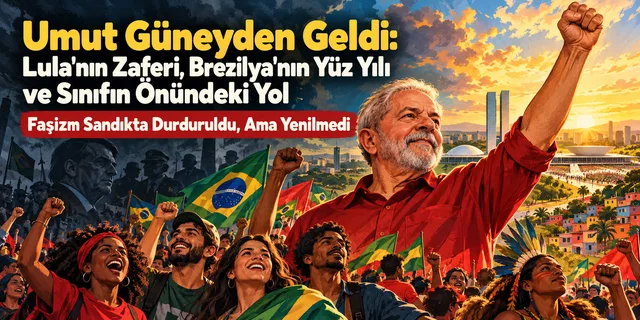
As examples from the world Ünlü mentions Serbia, Brazil and Hungary. Very apt. We have followed these countries closely: that is why our pieces on hope in Brazil and youth in Serbia were written.
Ünlü's reading of Brazil can also be developed. According to him the millions behind the right were there "because they were seized by the delusion of power", and when the leader fled they became "unable to make a sound". This reading can be carried further with a class explanation.
Yet those millions neither vanished nor fell silent. Behind the Brazilian right there is agro-export capital (agronegócio), evangelical church networks, the gun lobby and the big media. These do not scatter when a leader flees. Lula's victory is one round of a class struggle, not the end. What makes Brazil Brazil is the decades-long organisation of landless peasant movements such as the MST, union confederations such as the CUT, and youth and women's organisations.
There is a similar lesson in Serbia: before they won the ballot, students organised in plenums, in neighbourhoods, by walking to the villages. What won was not the charisma of a leader but organisation built from below.
The lesson is this: What defeats reaction is not moral superiority but organised power.
"Unity" — But on Which Line?
Towards the end of the speech Ünlü draws a very important boundary: "When we say unity it does not mean let us love everyone, let us embrace. No scoundrel who uses the possibilities of the republic to destroy the republic has a place in this togetherness."
We agree with this. The question is: where does this line run?
There is a clue to this in Ünlü's own speech. He opens a parenthesis and says this: the great big companies that do not remember Atatürk 364 days of the year, but on 29 October make tearful advertisements, "standing at the fingertip of power". A very sharp observation. On whose side are these companies? Is the holding that makes the advertisement celebrating the republic and the next day sacks the unionised worker, works with subcontractors, grows rich from public tenders, in the camp of the "republicans"?
Here the nationalist understanding of unity and the class-based understanding of unity part:
| Nationalist unity | Class-based unity |
|---|---|
| The measure: attachment to Atatürk and to republican values | The measure: living by one's labour, or growing rich on someone else's labour |
| The "patriotic" boss and the worker in the same ranks | Boss and worker have different interests |
| The enemy: the religious, the separatists, outside forces | The enemy: capital and the reactionary apparatuses it uses |
| Differences are called a "wealth" but national identity is taken as the basis | The common interest of the Turkish, Kurdish, Alevi, Sunni worker is taken as the basis |
| The method: standing up for values | The method: organising, demanding, winning |
Ünlü's words "the differences of this country are a wealth" are very valuable. To take this sentence seriously means counting the Kurdish worker, the Alevi citizen, the migrant worker as equal members of the same class front. The republic's being "the one who stands by those who have no one" is possible only in this way.
Not "Again", but an "Advanced" Republic
Ünlü's main thesis: "What we need is not a new republic, but the republic again." Against the destructiveness of the liberal "second republic" project this stance is understandable and justified. It can also be developed.
"The republic again" is a backward-looking call; it can be carried forward. It is not possible to go back to 1923: 1923 is the republic of the strike ban, of the ban on class organisation, of the land reform that could not be carried out.
Our proposal: an advanced republic. That is:
- one that defends the gains of 1923 in secularism, equal citizenship, public education, women's rights,
- but does not stop there, and adds economic democracy, the organisation of labour, public property,
- that founds the equality of peoples not as a formal but as a real equality,
- that rests not on the veto of capital but on the control of the labouring majority.
This is, in the full sense of the word, a democratic people's republic, and on its horizon a socialist republic. That fine sentence Ünlü loves, Atatürk speaking when he was elected president not of himself but of the nation, gains a real meaning only in such a republic: when the nation is thought of not as an abstract whole but as the millions who live by their labour.
A Roadmap: Concrete Tasks
The word is fine, but the work is finer. The "confidence" and "resolve" of which Ünlü speaks turn into a force only through concrete steps. The roadmap we propose is this:
Conceptual tasks
- Speak by distinguishing the republic from democracy. Instead of "the republic is slipping from our hands", say "the democratic content of the republic is being liquidated, and that content was never complete".
- Pass from a moral language to a class language. Place beside every word "degenerate" a question: "for whose benefit?"
- Tell the two faces of 1923 together. While defending the gains, speak also of the strike bans, of the closing of the Village Institutes, of the Wealth Tax. This does not weaken the republic; it empties the attacks made against it.
Tasks of demand
- A manifesto of "ordinary life". Turn Ünlü's intuition into concrete demands: a free and nourishing school lunch, the right to housing for the student, a minimum wage at the poverty line, a living pension, public housing production, control of rents.
- An account of the privatisations. Draw up a list of the public assets sold since 1980, and demand the return of strategic sectors to the public.
- A real investigation of the fund plunder. Let the plunders closed with payment plans pass through a judicial and public scrutiny, and let the savings of the small investor and of the worker be secured.
- The removal of the obstacles in front of the right to strike and to organise. The first measure of a democratic republic is that the worker is not sacked for joining a union.
Organisational tasks
- Tie republic rallies to class demands. At the 29 October celebrations, beside the flags, let there also be union banners, student housing demands, pensioners' demands.
- Neighbourhood and workplace organisation. Like the plenums in Serbia, the grassroots movements in Brazil: tenant solidarity networks, student housing initiatives, workplace committees.
- A labour front of peoples and of faiths. A class language in which the Turkish, Kurdish, Alevi, Sunni worker can meet on common demands, going beyond identity polarisation.
- Join the struggle for secularism to the critique of capital. Bring into the open from which companies, from which tenders, the tarikat and congregation networks are fed.
- Watchfulness against a second "not enough, but yes" wave. Ünlü's warning is apt: if a new constitution or a "new republic" package is being prepared, the first question should be this: where does this package put the strike, the union, public property, the equality of peoples?
Last Word: To Many More, But All of Us Together
Ünsal Ünlü ties his speech to Nâzım and to the words "all of us together or none of us". Let us finish from here as well.
If we take this sentence truly seriously, we have to say clearly whom "all of us together" covers: the child who goes to school hungry in the dark of the morning, the young person who cannot pay the rent, the worker trying to live on the minimum wage, the one who has retired and still has to work, the one whose savings were taken by plunder. And also whom this "all of us together" does not cover: the one who runs an Atatürk advertisement on the holiday and puts the unionised worker out of doors all year, the one who takes public property for a song and harvests rent, the one who uses religion and nationalism to divide the working people.
A hundred and three years ago the republic turned the subject into a citizen in a single night. The task before us now is to turn the citizen into a truly equal human being, a human being who is the owner of their labour and of their life. This will not happen in a single night. But as Ünlü says: since it was done, it can be done again. Let us add: this time further, more encompassing, and with the organised force of labour.
With a comradely greeting to Ünsal Ünlü and to all patriots who love this country sincerely, as he does.
To many more. All of us together. To the republic of labour.
Sources and Further Reading
The speech under discussion
- Ünsal Ünlü, "What we need is not a new republic, but the republic again!", YouTube, 29 October 2026.
On Ünsal Ünlü and journalism without a boss
- Medyascope, Mülkiyeliler Birliği Wednesday Talks: "We will be the memory of society; we will not let it be forgotten", 22 September 2022.
- Medyascope, Six years of journalism without a boss with Ünsal Ünlü, 26 August 2021.
- Medyascope, Ruşen Çakır's guest Ünsal Ünlü: leaving nine years of independent journalism behind, 23 August 2024.
- 24 Saat, Ünsal Ünlü's boss-less broadcast is ten years old.
- BirGün, Interview with Ünsal Ünlü: the solution is in journalism, 12 April 2026.
- Velev, Impression: who took part in the press action in Ankara, what happened?, October 2026.
- Medyascope, Journalists walked for press freedom, 24 October 2026.
Related pieces from Bilgi Müşterekleri
- Whose Republic? A Basic Guide in Its 103rd Year
- If We Fall Silent (on the journalists' action of 24 October)
- 12 September: The History, Balance Sheet, and Present of a Class Coup
- What Did the October Revolution Give the World?
- Six and a Half Trillion: The Money Wiped Off the Exchange, the Life Missing from the Table
- Hope Came from the South: Lula's Victory, Brazil's Hundred Years, and the Road Before the Class
- They Walked Past the Algorithm: How the Plenum Beat the Ballot in Serbia
- The Bell Does Not Ring the Same for Everyone
- Whom Is the University For?
- The Class's Answer to Evrim Ağacı's Question (one of our comradely criticism pieces on popular content)
Classical and historical sources
- Karl Marx, On the Jewish Question (1843): the distinction between political emancipation and human emancipation.
- Karl Marx, The Eighteenth Brumaire of Louis Bonaparte (1852): the class character of the bourgeois republic.
- V. I. Lenin, The State and Revolution (1917): on the democratic republic as the "best shell" for capital.
- Mustafa Kemal Atatürk, Nutuk (1927).
- Labour Law no. 3008 of 1936; Law on Associations no. 3512 of 1938; Village Institutes Law no. 3803 of 1940; Law for Providing Land to Farmers no. 4753 of 1945.
- Fay Kirby, Türkiye'de Köy Enstitüleri.
- Korkut Boratav, Türkiye İktisat Tarihi 1908–2009.
Bilgi Müşterekleri — Knowledge Belongs to Everyone. This piece is a living document. It will be updated with corrections and contributions. CC BY-SA 4.0.