The Bourgeoisie Is Buying Time with Technology, and We Will Bury Capitalism
A Comradely Reply to Fikret Başkaya: Palantir, the Useless Class, and the Dystopias of Disorganisation

The Bourgeoisie Is Buying Time with Technology, and We Will Bury Capitalism
A comradely reply to Fikret Başkaya: Palantir, the useless class, and the dystopias of disorganisation
Dear young comrades,
Fikret Başkaya gave a talk at the opening of the autumn term of the Free University (Özgür Üniversite) on 10 October 2026. Two days later the talk was published under the title "Why can Technical Science not save capitalism?..". Başkaya gives a correct answer to a correct question: technology cannot save capitalism, because capitalism's problem is not technical but social.
We add one step to this answer. Technology cannot save capitalism, but the bourgeoisie is using technology to lengthen capitalism's life. With artificial intelligence, platforms and surveillance software it makes up for the falling profit with monopoly rent, supervises labour more tightly, sends the bill for the crisis to the labourers, suppresses objection, and presents all of this as "inevitable progress". The price of every year the bourgeoisie gains by these means is paid by millions of people, in unemployment, insecurity, surveillance and war. Capitalism will die neither by the hand of technology nor of its own accord, by its own decay. Only organised labour can bury it.
The main points of the article:
- What Başkaya sees correctly: Technology is not neutral. The tool is in the service of humanity; the machine is in the service of capital. Living labour creates value. Trying to solve ecological destruction "with more technology" is like trying to put out a fire with petrol. Capitalism cannot be reformed.
- Where it can be developed: The count of industrial revolutions can be supported by a periodisation based on regimes of accumulation, rather than a framework that comes from Davos. The "376 years" in the text is probably a slip of the pen; 276 years have passed from 1750 to today. The slowdown in productivity is real, but the data show that this slowdown began in the 1970s. When the measured data of 2026 are used instead of the International Energy Agency's (IEA) forecast dated 2024, the argument grows stronger still.
- Carrying politics into the field of technology: The state, platforms, surveillance, data, Palantir and the technology worker found no place in the talk. Artificial intelligence is treated predominantly as "the machine that takes the worker's place". Yet today artificial intelligence is at the same time an apparatus of rent seizure, an apparatus of labour control, and an apparatus of repression and war. These are exactly the bourgeoisie's instruments for buying time.
- "Dementia", not the buying of time: Capitalism's promises have grown senile; its apparatus has not. In Lenin's words, for the bourgeoisie "there is no absolutely hopeless situation". If we do not close the exit, the system can go on living by declaring a large part of humanity "useless".
- The limits of looking from outside: In a criticism that does not know technology from the inside, technology can easily turn into a black box or a devil. While the sector's statistics are criticised, its exaggerations can be accepted, without intending it, as a premise. The technology worker can be missed as a subject of organisation. Building a bridge to the young generation that grows up inside technology becomes harder.
- The limits of looking from inside: The engineer without a class vision thinks the problem is technical, and becomes capital's most loyal interpreter. The solution is the organised meeting of these two kinds of knowledge: in Gramsci's language, the organic intellectual of technological labour.
- The name of the age: Not techno-feudalism, but the algorithmic phase of monopoly capitalism. The state and the technology monopoly do not take one another's place; they fuse. The state is customer, partner, shareholder and the one that applies discipline. The company is the state's eye, ear and trigger.
- The useless class: People are made useless not for society, but for the valorisation of capital. To manage this population the bourgeoisie has two hands: in one, payoffs for silence such as a fund dividend or a basic income; in the other, surveillance of the Palantir kind.
- The dystopia of disorganisation is not science fiction, but today's tendency: The citizen who is scored, the worker managed by algorithm, the migrant hunted with social-assistance data, war that automates, knowledge that is enclosed.
- The task: The unionisation of the technology worker, refusal from inside, demands for public data and algorithms, knowledge commons, an alliance with the ecology movement, and joint work with comrades who look from outside, such as Başkaya Hoca.
The occasion, and a road map
Başkaya's text is the text of a thinker who, since Paradigmanın İflası, has settled accounts with official history and the myth of developmentalism, and who has also paid the price of that. It deserves to be read with respect. It is also directly related to what we have been saying for years on these pages about artificial intelligence.
In the detailed section we will go forward in three steps. First we will assess the text: we will talk about its strong sides, and about the points at which it can be developed. Then we will draw a general lesson from these notes: the consequences of people who are not inside technology speaking about the world of technology, and the reverse of this, the blindness of those who are inside technology and do not see class. Finally we will read the age with our own class vision: where capitalism stands today, how the bourgeoisie buys time with technology, what the talk of a "useless class" conceals, the fusion between states and technology monopolies, companies of the Palantir kind, and the dystopias that await us if there is no organised resistance.
What does the text say?
Başkaya's talk moves, roughly, by the following steps:
Capitalism and "pure economics". Capitalism is an order based on profit and the accumulation of capital, which exploits labour and nature. "Pure economics" describes not real capitalism, but an imaginary capitalism. Politics and economics cannot be separated. Recalling that there is no economics prize in Nobel's will, a gesture is also made at the dressing-up of mainstream economics as science.
Tool and machine. Drawing on Leroi-Gourhan, it is stressed that the development of technique and the development of the human brain are simultaneous. Then comes perhaps the most beautiful sentence of the text: "The tool was in the service of all humanity; the machine, in the hands of the capitalist class, is in the service of making profit and expanding capital…"
Five industrial revolutions. Steam and coal (1750), the internal-combustion engine and oil (1880), nuclear energy (1950), information and communication technologies (1990), artificial intelligence (2015). At each stage living labour is replaced a little more by the machine. The intervals between the revolutions also grow shorter.
Value and automation. Only living labour creates value. As the machine and artificial intelligence take the place of living labour, relatively less surplus-value is produced. Trade, finance, the stock exchange, education, health, the police and the army do not create value; they take a share of the value that living labour creates. The question is also asked: to whom will the product of the robotised factory be sold?
Ecology. New technologies consume excessive electricity and rare metals. According to the IEA, if artificial intelligence develops "in the form in which it is proclaimed", electricity consumption will double, and an important part of this will be met by coal and gas. In a passage from Otto Ullrich, the attraction of technology comes from its being able to shift its costs to other times and places, and from its predatory character. The conclusion: "the so-called solution amounts to nothing but trying to put out a fire with petrol!"
Dementia. Productivity has been falling since the beginning of the twentieth century. The situation capitalism is in is "not a crisis but dementia", that is, an irreversible dissolution.
Not reform but revolution. There is no "better capitalism". A communist revolution is necessary, or else the collapse of the system will carry humanity with it. Workers, students, ecologists, women, anti-fascists are in the field, but they are not enough. Events set the masses in motion. The talk ends with this slogan: "Let us bring capitalism down before it collapses."
The strong sides of the text
Let us begin the assessment with what the text gives us. A comradely reading begins by granting what the other person has got right.
It recalls that technology is not neutral. In Turkey the debate on artificial intelligence moves, to a large extent, between two poles: either the developmentalism of "let us not miss the opportunity", or the apocalyptic literature of "artificial intelligence will destroy us". Başkaya falls into neither. He sees the problem not in technique itself, but in the social relation within which technique is used. The distinction between tool and machine tells this very plainly.
It puts the theory of value back on the table. In most places where artificial intelligence is discussed, the word "value" either does not appear at all, or appears in the sense of shareholder value. Başkaya recalls that living labour creates value, and that the machine does not create value, but only transfers its own value to the product. This overlaps with what we have said since The Expropriation of the General Intellect and the AGI Illusion: artificial-intelligence models are the crystallised labour of millions of people, turned into private property.
It puts the ecological contradiction at the centre. It is still necessary to say that the cloud is not a cloud, but concrete, copper, water and coal. We also discussed this in Reckoning with the 'Cloud' Myth in the Light of İlker Kalaycı's Text and the Cybernetic Repair of Metabolic Rift.
It stands clearly against reformism. Formulas such as "responsible artificial intelligence", "ethical principles", "human-centred technology" remain decoration so long as they do not ask the question of property. We discussed this in detail in The Poverty of Artificial Intelligence Ethics and Human Dignity.
It openly accepts the insufficiency of the organised subject. To say that the movements are in the field, but are not enough, is not to deceive oneself.
This core is sound. The proposals below are for strengthening this core still further, with current data and with knowledge that comes from inside technology.
Where it can be developed: data, concept, and politics
We would like you to read the notes in this section not as a list of corrections, but as proposals for enriching a common text together. In each of them we think there is a datum or a concept that supports, in a stronger form, what Başkaya chiefly means to say.
The calendar, and periodisation
The text says "In the 376 years that lie behind us, 5 industrial revolutions have been lived", and places the first revolution in 1750. Because 276 years have passed from 1750 to 2026, there is in all likelihood a slip of the pen here. It may look like a small detail, but when writing about technology such details gain importance, because the young generation that reads the text has often grown up inside that technology, and is careful with figures.
A more fruitful field of discussion is the periodisation itself. The habit of "numbering the industrial revolutions" comes mostly from the mainstream literature. Klaus Schwab, the founder of the World Economic Forum, popularised the concept of the "Fourth Industrial Revolution" at Davos in 2016. His aim was to present technological change as an inevitable natural event, and to call on states, unions and universities to "adapt". Başkaya uses this count for a critical purpose. But because the count itself comes from this framework, the argument can sit on firmer ground if it is supported by another periodisation in the Marxist tradition.
In Late Capitalism Ernest Mandel related technological revolutions to the long waves of the accumulation of capital: the steam engine produced by machinery after 1848, electricity and the internal-combustion engine after the 1890s, electronics and nuclear energy after the 1940s. What was decisive was not the date of the technical invention, but the conditions of the rate of profit, and the class relations, within which the invention was put into production on a mass scale. On this view nuclear energy can be read not as a separate industrial revolution, but as a part of the cluster of electronics, computers and automation that the war economy created. Its share in the world's energy supply has stayed limited ever since the 1950s. The passage between 1990 and 2015 also shows a continuity rather than a sharp break. Today's artificial intelligence cannot be thought of without the network infrastructure of the 1990s, the platform monopolies of the 2000s, and the heaps of data of the 2010s. It is possible to see this not as a separate "revolution", but as the deepening of the same regime of accumulation.
This distinction is not an academic detail. When we count technology as independent waves, it looks as if the subject of history is technology. When we read it through regimes of accumulation and class struggles, the subject of history becomes people again. This also fits Başkaya's own thesis better, the idea that the machine is in the hands of a class.
Since when has productivity been slowing?
The text says "since the beginning of the twentieth century, productivity has been continuously declining". Supporting this sentence with data, and shifting its period a little, can strengthen the argument still further. As Robert Gordon shows in The Rise and Fall of American Growth (2016), the period in which total factor productivity in the United States increased fastest was between 1920 and 1970. Electricity, the internal-combustion engine, chemistry and urban infrastructure gave their fruits in this period. According to the data of the US Bureau of Labor Statistics (BLS), labour productivity in non-farm businesses grew by an average of about 2.8 per cent a year between 1948 and 1973. Between 2007 and 2019 this rate fell to about 1.5 per cent.
The slowdown Başkaya points to, then, is real and very important. According to the data, this slowdown begins in the 1970s, and coincides with the fall in the rates of profit, the collapse of the Keynesian compromise, and the neoliberal offensive. In 1987 Robert Solow formed a famous sentence: "You can see the computer age everywhere but in the productivity statistics." This paradox supports very well what Başkaya chiefly means to say: digital technologies, inside capitalist relations, did not bring the leap in productivity they promised. New technology served less to increase productivity than the changing of hands of existing value, that is, the seizure of rent, the advertising market, financial speculation, and the control of labour.
Placing the break in the 1970s has one more gain: it makes visible the class character of neoliberalism, and why, from this period on, the bourgeoisie has used technology more and more as an instrument for buying time.
The IEA figure: the forecast of 2024, the measurement of 2026
The text says that if artificial intelligence develops "in the form in which it is proclaimed", electricity consumption will double in 2026. This figure seems to rest on a forecast in the Electricity 2024 report that the IEA published in January 2024. In that report it was calculated that the electricity consumption of data centres, artificial intelligence and cryptocurrency could rise, in the high scenario, from about 460 TWh in 2022 to over 1,000 TWh in 2026.
Today we have measurement instead of a forecast, and the measurement confirms Başkaya's concern. According to the IEA's current assessment dated April 2026, the consumption of data centres was about 485 TWh in 2025. In 2025 alone it rose by 17 per cent. The consumption of data centres focused on artificial intelligence grew by 50 per cent in one year. In the same year the increase in global electricity demand stayed at 3 per cent. The forecast is that total consumption will rise by 2030 to about 950 TWh, that is, to about 3 per cent of global electricity demand.
The "doubling in 2026" of the high scenario did not come about. But the tendency confirms what Başkaya says in a more striking form: while the world's electricity demand grows by 3 per cent, the demand of artificial-intelligence data centres grows by 50 per cent. Using the current measurement has two benefits. First, it disposes in advance of the objection of the sector's defenders that "that apocalypse did not come". Second, it leaves no need for the reservation "if it develops in the form in which it is proclaimed". That reservation, even without intending it, accepts the sector's own growth narrative as a premise. The narrative of the artificial-intelligence monopolies, "scale is everything, computing power will grow without limit", is less an engineering fact than a story told to the investor. When we speak with measured data, we also find the chance to question this story.
Making the subject of "rare metals" a little more concrete can also help to tie the ecological criticism to the criticism of imperialism. The matter is much wider than the rare-earth elements: copper, gallium, germanium, lithium, cobalt, high-purity silicon. Their mining sites draw a map of exploitation that runs from Congo to Chile, from Indonesia to China. The concentration of chip production largely in Taiwan, and the export restrictions between China and the United States, are also parts of this map.
The theory of value: adding the counter-tendencies and monopoly rent
Başkaya's reasoning, which rests on the theory of value, is this: living labour decreases, surplus-value decreases, the system decays. This logic rests on Marx's law of the tendency of the rate of profit to fall, and its core is correct. In the third volume of Capital Marx defines this law as a tendency, and immediately afterwards lists the counter-tendencies: the raising of the rate of exploitation, the pressing of wages below the value of labour-power, the cheapening of the elements of constant capital, the relative surplus population, and foreign trade. When we add these counter-tendencies to the table, how the bourgeoisie buys time with technology also becomes clear. Because today artificial intelligence sets almost all of these counter-tendencies to work at once:
- It raises the rate of exploitation: Algorithmic management measures and compresses the intensity of work second by second. The courier, the warehouse worker and the call-centre labourer live this every day. We call this mental Taylorism.
- It cheapens constant capital: It lowers the cost of work such as design, software and analysis.
- It creates a relative surplus population: The army of the unemployed and the insecure presses down the wages of those who are working.
- It transfers to the monopoly value created elsewhere: This is the point we most propose to add to the text.
An important part of the earnings of artificial-intelligence companies comes not from the surplus-value produced by their own workers, but from monopoly rent. They gather the common knowledge on the internet, that is, the unpaid labour of millions of people, turn it into a model, and then sell access to this model by subscription. Platforms take a share of every transaction. Cloud providers rent out computing power. In Marx's language this is the redistribution, by means of monopoly prices, of the total surplus-value in the economy. Başkaya correctly stresses that trade and finance do not create value. When we apply the same logic to the artificial-intelligence monopolies, we can see them not only as "the owner of the machine that takes the place of living labour", but also as the rentiers of social knowledge, the process we called "the expropriation of the general intellect" in the presentation The Revolt of Crystallized Labor: A Call to the 20th Karaburun Science Congress.
The important question the text asks, "to whom will the product of the robot factory be sold?", can also find an answer from here. A part of it is consumption kept on its feet by debt. A part is the luxury consumption of the richest. A part is the services that companies sell to one another. And a very important part, as we will see in detail below, is the state: the army, the police, the migration administration, intelligence. One of capitalism's historical answers to the problem of realisation has always been armament and the apparatus of repression. Today one of the best-known names of this answer is Palantir.
Separating the metaphor of "dementia" from the expectation of collapse
"Not a crisis but dementia" is a strong metaphor that stays in the mind. Still, we think it is open to two misreadings.
First, the metaphor can be understood as capitalism's inevitably coming to an end by its own internal dynamics. This opens the door to the impasse of the "theory of collapse", which has been debated inside Marxism for more than a century. In 1920, at the Second Congress of the Communist International, Lenin spoke very clearly on this: for the bourgeoisie "there is no absolutely hopeless situation". So long as a revolutionary force does not overthrow it, capitalism looks for a way out even of the deepest crisis, if necessary by war, by fascism, by writing off millions of people.
Second, the image of "dementia" can give the impression that the power facing us has weakened. Today's technology monopolies work in a way that is extremely rational, planned, organised, and intertwined with the state. Palantir's executives, OpenAI's strategists, the Pentagon's procurement officers know very well what they are doing. In our view what has grown senile is capitalism's promises: prosperity, progress, a job for everyone, democracy. The dementia of the promises does not mean that the apparatus has grown weak. On the contrary, a system that cannot keep its promises leans less on consent, and more on force and surveillance. What the bourgeoisie does with technology is exactly this: where it cannot buy consent, it buys time.
Başkaya's closing slogan, "Let us bring capitalism down before it collapses", already cuts off both of these readings. While the diagnosis of dementia on its own could lead to a passive expectation, the slogan calls to action. We too are on the side of the slogan. Completing the slogan with a concrete proposal of organisation and with current demands may be the addition the text needs most. In the last section of the article we try to contribute to this with our own proposals.
Carrying politics into the field of technology as well
At the beginning of the text Başkaya recalls a very correct principle: politics and economics cannot be separated. When we carry this principle into the field of technology as well, the following headings, which stand at the centre of the artificial-intelligence debate in 2026, become visible:
- The relation between the state and the technology monopolies
- Surveillance, data, filing
- Palantir and similar companies, military artificial intelligence
- Platform monopolies and algorithmic management
- The labourers of the technology sector, experiences of unionisation, objections from inside
In the text, technology is treated predominantly as a technique of production. We propose to add the reading of technology also as a technique of domination. It is plain that Başkaya cannot give a place to everything in a short talk. But this dimension is also related to a more general problem we will discuss in the next section, the limits of looking at technology from outside.
Summary table
| Başkaya's thesis | Our proposal |
|---|---|
| The tool in the service of humanity, the machine in the service of capital | A very plain and strong formula. It rests on Marx's distinction between the machine and the capitalist use of the machine. |
| Five industrial revolutions in 376 years | The span can be corrected as 276 years. A periodisation based on regimes of accumulation, instead of the count that comes from Davos, strengthens the argument. |
| Productivity has been falling since the beginning of the century | The slowdown is real. According to the data it begins in the 1970s, and can be read together with neoliberalism. |
| According to the IEA, electricity consumption will double in 2026 | The 2026 measurement can be used instead of the 2024 forecast. The current datum is more striking: the demand of artificial-intelligence data centres rose by 50 per cent in one year. |
| Automation reduces surplus-value, the system decays | The tendency is correct. When the counter-tendencies and monopoly rent are added, how the bourgeoisie buys time also becomes visible. |
| To whom will the product of the robot factory be sold? | A very well-placed question. One of its important answers is the state: military spending and spending on repression. |
| Not a crisis but dementia | The promises have grown senile; the apparatus is strong. Capitalism does not die of its own accord. |
| Not reform but revolution | We agree. We propose that it be completed with organisation, a programme, and current demands. |
Speaking about technology from outside technology
Let us now pass from these notes to a general lesson. This lesson holds not only for Fikret Başkaya, but for almost the whole generation of the Turkish left that speaks about technology. Let us say it openly: we are not exempt from this problem either.
A thinker who has given his life to political economy, to the writing of history, to the criticism of development, follows technology to a large extent from newspaper reports, from the reports of international institutions, and from popular books. This is not a fault. It is the natural result of the division of labour. But we need to see together the consequences this situation creates, because one of the most important fields for understanding the modern world is exactly here.
The black box and demonisation: fetishism turned upside down
A thing whose inside we do not know turns either into a black box or into a god. The technology sector itself deifies technology: "artificial general intelligence is coming", "the singularity is near", "it will solve everything". The criticism that looks from outside rejects this god, but from time to time can turn it into a devil: "Technical Science", "the Machine", "Artificial Intelligence", with a capital letter, like a single subject, against humanity. In both cases technology ceases to be a product of the relations between people, and turns into a thing that has a will of its own. What Marx called the fetishism of the commodity is exactly this: the social relation between people appearing like a relation between things.
In the chapter on machinery in Capital, Marx writes this of the Luddites: it took time and experience for the labourers to learn to distinguish the machine from its capitalist use, and to direct their attacks not at the material means of production, but at the social form of use of these means. Başkaya's distinction between tool and machine is in fact built on this lesson. When we carry this lesson to its end, this question also comes before us: on what technical basis will a socialist society be founded? "Technical Science cannot save capitalism" is correct. But if we leave technology wholly to capital, even asking this question becomes harder.
Accepting the sector's figures as a premise
The criticism that does not know technology from the inside takes its data, whether it wants to or not, from the sector itself or from institutions intertwined with the sector. Davos's count of revolutions, the companies' announcements that "artificial intelligence will destroy this many jobs", high-scenario energy forecasts, and the like. An important part of these figures is a piece of marketing directed at the investor, the government and the public. When an artificial-intelligence company says "our technology will eliminate millions of jobs", it is in fact making a promise of value to its shareholders.
When criticism reports these claims as they are, it has, without intending it, contributed to the thing the sector wants most: exaggerating the power of technology. We discussed this in What Does the "AI Tsunami" Conceal?. Exaggerated optimism and the expectation of apocalypse share the same premise: technology is as powerful as it is said to be. The class view first questions the premise: who is saying it, why are they saying it, has it been measured, or has it been sold?
The labour process can be missed
When you look at technology from outside, you see a machine. When you look from inside, you see people. Workers in Kenya, in the Philippines, in Venezuela, who label data for a few dollars an hour and sort out the heaviest content. Trainers, on contract and insecure, who train the models to give "humane" answers. Programmers in Turkey who deliver a "sprint" from nine in the morning until midnight, whose performance is measured every day on dashboards. Those who work in the cooling, the cabling, the security of the data centre. Artificial intelligence is less a machine than the form of organisation of this labour.
When the labour process is missed, the subject of organisation can be missed too. We propose to add the technology labourers to the movements Başkaya lists (workers, students, ecologists, women, anti-fascists). Today there are millions of people working in the most critical field of capital, in its brain and nervous system. When in the spring of 2026 the Pentagon declared Anthropic a "supply-chain risk" because it stood against domestic mass surveillance and against weapons that fire without a human, according to Axios hundreds of workers from Google and OpenAI signed a petition asking that their own companies also stand on the same line. This shows that the inside of technology is not homogeneous, and that a class struggle goes on there too. The inside is not a single-piece "system". It is a field of struggle.
Building a bridge to the young generation
There is a reason we open this article with "Dear young comrades". Today's young people were born inside technology. The telephone, the game, social media, the artificial-intelligence assistant, platform work are their everyday life. This generation is very angry at the world capitalism offers it, and more open than ever to class criticism. But when it sees, in a technical detail, something that does not fit its own experience, it can move away before reaching the correct core of the criticism. On one side the worry that "these young people have been captured by technology", on the other the distance of "our elders do not live technology as we do". Only capital comes out gaining from this distance. The bridge between generations can be built by the meeting of the masters' accumulation with the experience the young live with technology.
Building a bridge to concrete demands
When we treat technology as a whole "Technical Science", it becomes harder to formulate what we will demand from today to tomorrow. Revolution is necessary, but the road that leads to revolution passes through the positions won against the concrete injustices people live today. A right of objection to algorithmic dismissal, health data not being given to the police, the banning of no-bid surveillance contracts, a requirement of open source in public software… These are demands that can be formulated together with those who know how technology works. When the strong strategic horizon of the view from outside meets the concrete knowledge of the view from inside, the bridge between the revolution and today can be built.
The other face of the coin: the limits of the view from inside
Let us not be unfair here. The limits of those who speak from inside technology often produce more dangerous results. The engineer without a class vision can believe that every problem has a technical solution. They can name surveillance "data security", unemployment "reskilling", inequality "the digital divide", war "defence technology". This is why a part of the technology labourers of Silicon Valley has turned, under the flag of "effective accelerationism" (e/acc), into a new version of Marinetti. We told this in From Futurism to Techno-Fascism. The eye that knows technology but does not know history and political economy can be capital's most loyal and most talented interpreter.
The matter, then, is not "let those outside be quiet, let those inside speak". The matter is the organised meeting of these two kinds of knowledge. What Gramsci called the "organic intellectual" is the intellectual who comes from inside their own class and turns that class's experience into a conceptual consciousness. The organic intellectuals of technological labour should be people who know technology from the inside and who take over the class view from masters such as Başkaya Hoca. This is also the reason for the existence of Knowledge Commons.
| The view from outside (a strong class view, limited technical knowledge) | The view from inside (strong technical knowledge, a limited class view) |
|---|---|
| Apt to see technology as a single-piece "Technical Science" or "Machine" | Apt to see technology as a neutral tool, and the problem as bad use |
| While using the sector's figures in order to criticise, can approve the exaggeration without intending it | Uses the sector's figures in order to sell, and produces the exaggeration |
| Can miss the labour process and the technology labourer | Sees the labour process, but may not name it as exploitation |
| Can slide towards the expectation of collapse | Can slide towards the optimism that "every problem has a technical solution" |
| Offers a strong strategic horizon, and can have difficulty with concrete demands | Produces a concrete demand, but may not question property |
| The synthesis: organised technological labour, which knows technology from the inside and asks the question of property and power |
Reading the age with our class vision
Let us now say our own word, and try to widen the headings that were touched on briefly in Başkaya's talk, or that found no place there.
The age capitalism has reached: not techno-feudalism, but algorithmic monopoly capitalism
There is a thesis that has been fashionable in recent years: capitalism is over, and "techno-feudalism" has come in its place. According to this thesis, which Yanis Varoufakis has popularised, platforms now collect rent rather than profit, and for that reason the order is feudal. We have discussed and rejected this thesis many times on this site. The growth of rent is not the end of capitalism. It is an ordinary feature of its monopoly phase. Lenin told this more than a hundred years ago, when he spoke of the "parasitic and decaying" character of finance capital and the monopolies. Today's technology monopolies still exploit wage labour, still accumulate capital, still bargain with one another and with states for the rate of profit. What has changed is the instruments of accumulation.
We can list the features that define our age as follows:
The monopolisation of computing power, of data, and of models. The number of companies in the world that have the infrastructure to train large-scale artificial-intelligence models does not exceed the fingers of one hand. This is a centralisation much denser than the steel and oil trusts of the beginning of the twentieth century. Moreover the technical composition of capital has risen so far that the entry of a new rival into this field is almost impossible. It is possible only with the support of another state, or of another giant.
The expropriation of the general intellect. The common knowledge of society, that is, books, articles, code, forum correspondence, works of art, becomes the raw material of private models. The social accumulation of knowledge that Marx, in the Grundrisse, called the "general intellect" is turned directly into the property of capital. The enclosure of what is common is the digital repetition of the original accumulation of capital.
The algorithmic control of labour. Taylor measured the worker's hand with a chronometer. Today the algorithm measures the worker's attention, voice, keystroke, emotion. From the case in which an artificial-intelligence boss fired a human for the first time to the couriers in the gig economy, the function of management is increasingly handed over to the machine. Management handed over to the machine also becomes less visible, and harder to object to.
The digitalisation of the apparatus of repression and war. As capitalism's promises grow senile, the apparatus of force grows stronger. One of the fastest-growing and most profitable fields of use of artificial intelligence is, as we will see below, surveillance, migration control, and war.
How does the bourgeoisie buy time with technology?
The bourgeoisie uses technology for four functions. None of them solves capitalism's contradictions. Each of them buys the system time by transferring the bill of the contradiction from today to tomorrow, and from the top downwards. Seeing them separately makes clear what we are struggling against.
As an instrument of rent seizure. Enclosing common knowledge and renting it out. Taking a share of every transaction through the platform. Selling cloud and model access by subscription. The falling profitability in production is made up for by seizing value created elsewhere.
As an instrument of labour control. Breaking the work into pieces, measuring it, intensifying it. Watching the worker one by one and making their organisation harder. Evaporating responsibility by saying "the algorithm decided". By raising the rate of exploitation, the fall in the rate of profit is slowed.
As an instrument of repression and war. Scoring the citizen, hunting the migrant, filing the opponent, selecting the target automatically. Where consent has run out, the order is kept on its feet by force. Spending on armament and surveillance also provides capital with a reliable market.
As an ideological apparatus. "Technology is inevitable", "one does not stand against progress", "artificial intelligence will take your job, adapt". These discourses present the class relation like a law of nature. A part of the dismissals made "because of artificial intelligence" is in fact a cost-cutting dressed in a package that looks good to the investor. Anger is directed not at capital, but at the machine, or at fate.
Başkaya's talk focuses, in the main, on one dimension of the first and second functions, the machine's taking the place of living labour. Yet what is decisive today is the interlocking of the four functions. Technology does not offer the bourgeoisie a way out. It offers a postponement. But every crisis that is postponed comes back as a heavier bill to wider sections.
The "useless class": useless for whom?
In Homo Deus, published in 2016, Yuval Noah Harari put forward the concept of the "useless class": artificial intelligence and automation would advance so far that billions of people would become economically good for nothing, and these people would spend their time with drugs and virtual games. This concept has spread so far that today we hear a version of it from the mouths of technology bosses almost every week.
We discussed this concept on this site in The Bloody Steps of the Pyramid: The 2026 Global Dispossession War and the Birth of the 'Useless Class'. Let us repeat it briefly: in Harari's account, "uselessness" is the natural result of technology. In Marx's account, the "relative surplus population" is the law of the accumulation of capital itself. In chapter 25 of the first volume of Capital, Marx tells how, as the organic composition of capital rises, a section of the working population is made "surplus" relative to capital's need for valorisation, and he divides this population into its layers: the floating population that moves in and out of work, the latent population ready to flow from the country to the city, the stagnant population that works in irregular and the worst conditions, and, at the very bottom, pauperism.
The question that has to be asked here is this: Useless, for whom? People are not useless for society. Care work, education, health, ecological repair, culture, research… There is an immense amount of work that needs to be done, and is not done. People are useless only for the valorisation of capital. Labour that does not bring profit is not labour for capitalism. The discourse of the "useless class" presents this historically and socially specific relation like a natural fate of humanity.
This discourse also has concrete reflections today. According to the April 2026 data of Challenger, Gray & Christmas, of the 83,387 layoffs announced in the United States that month, 21,490, that is, more than a quarter, were tied directly to artificial intelligence. Artificial intelligence became, for the second month in a row, the number-one ground of layoffs (the KRQE/Nexstar report). A part of these figures is a real substitution, and a part is the ideological packaging we have just mentioned. But in both cases the person who loses their job is real. In Turkey, we showed with TÜİK's own data that broadly defined unemployment has passed 30 per cent. The "useless" have already been produced here, long before the technology arrived.
What is really dangerous is the answer capital has developed for how this population will be managed. This is a two-legged answer: on one side hush money, on the other surveillance and the police. The most interesting example of the hush money came this summer. According to Decrypt, drawing on the Financial Times, in July 2026 Sam Altman proposed to give the US government a 5 per cent share of OpenAI, worth about 42.6 billion dollars. The ground was that Americans should take a share of the earnings of artificial intelligence, and Alaska's oil fund was shown as the model. This is not a socialisation. It is an insurance premium that a monopoly, 95 per cent of which remains in private hands, pays in order to calm the rising political reaction and to make the state a partner in its own fate. Distributing a small part of the wealth at the top as a "basic income" or a "fund dividend", and protecting the rest: this is the polite face of managing the useless class. We will come to the rough face in a moment.
| The bourgeois account | The class's answer |
|---|---|
| Artificial intelligence will make most people useless | People are made useless not for society, but for the valorisation of capital |
| This is the natural and inevitable result of the technology | This is the result of property relations. The same technology can also be used to shorten the working day |
| The solution: reskill, adapt | The solution: sharing the productivity gain by shortening working hours, and by public service |
| A basic income or a company fund will put everyone at ease | A distribution that does not touch property is hush money, and it comes together with surveillance |
| The useless are kept busy with entertainment and the virtual world | If those declared useless organise, they become the gravedigger of this system |
The state and the technology monopoly: not a change of place, but a fusion
There is another approach we often meet: "Companies, not states, now govern." Or the reverse: "States should rein the companies in." Both views think of the state and capital as two separate powers facing one another. In the Manifesto, Marx and Engels defined the executive of the modern state as a committee for managing the common affairs of the bourgeoisie. During the First World War, Lenin gave the name "state monopoly capitalism" to the intertwining of the monopolies and the state. 2026 is a new and very open phase of this fusion.
Let us look at a few examples of the last year:
The state becomes a shareholder. The US government, by turning the 8.9 billion dollars of grants under the CHIPS Act into shares, took a 9.9 per cent stake in Intel. Nvidia and AMD agreed to turn over to the government 15 per cent of their chip sales to China. OpenAI proposed a 5 per cent share. These are not "nationalisation". They are the state's becoming a partner in the profit of private monopolies, and protecting them in return.
The state becomes a customer. The Pentagon, intelligence, the migration administration, the police… The most reliable, the least bargaining, the highest-paying customer of artificial-intelligence companies is the state. This is one answer to the question Başkaya asked, "to whom will it be sold?"
The state applies discipline. The most instructive event of this year was the clash between Anthropic and the Pentagon. According to Axios, the Pentagon asked Anthropic to lift all the safety limitations on military use. The company resisted on two matters: mass surveillance at home, and weapons that fire without human intervention. Upon this, on 27 February 2026, President Trump announced that he would put the company on a blacklist. The Department of Defense also stuck on Anthropic the "supply-chain risk" label usually applied to "enemy" companies such as Huawei. According to the same report, a compromise offer put on the table for the company at this time included the analysis of location, browsing and financial data bought from data brokers on Americans.
It is important to read this event correctly. Anthropic is not a workers' organisation. It is a group of capital. We had already criticised the system that monitors activists and the monopoly's language of self-absolution. But the event shows this: the state can discipline even the capital that hesitates to give full service to its own apparatus of repression. The fusion is not a partnership of equals. The needs of the apparatus of repression are decisive. The technology monopoly either serves these needs, or it is declared a "risk".
The fusion is not only in Washington. In China the same fusion works in another form, by the party-state's directly directing the technology giants. As we said in The Same Week, Two Tables: The US–China Summit, Artificial-Intelligence Bosses, and Not Camp but Class, we do not have to choose one of the two blocs of capital. In Turkey too, the integration of public data is on the agenda through Did You Know There Is a Directorate General of Public Artificial Intelligence? and On Turkey's Artificial Intelligence Action Plan (2026–2030). We have also discussed, in The Illusion of "Indigenous and National" Artificial Intelligence and the Dialectic of Imperialist Integration, that the label "indigenous and national" does not make this fusion more innocent.
Palantir: the state's eye, ear, and trigger
The purest example of this fusion is Palantir. The company was founded in 2003 under the lead of Peter Thiel and Alex Karp. Among its first investors was In-Q-Tel, the venture-capital arm of the CIA. Palantir, then, was designed from its birth as an extension of the intelligence apparatus. The business model is simple and very powerful: to build an "ontology" that connects the state's scattered databases, that is, tax, health, migration, police, social assistance, telephone and location data, and to sell the ability to search, match and produce targets on this integrated data. Palantir does not take the state's place. It fits the state with a new nervous system.
The picture of the last two years:
- The US Army: In the summer of 2025 the army signed a 10-year enterprise agreement, of up to 10 billion dollars, gathering its existing contracts with Palantir under a single roof. The budget ceiling of Maven, the Pentagon's artificial-intelligence targeting platform, was raised to about 1.3 billion dollars.
- No-bid contracts: According to Nextgov's report of August 2026, by a memorandum signed by Deputy Secretary of Defense Steve Feinberg, an additional payment of up to 243.9 million dollars was committed to Palantir until April 2027. The memorandum showed none of the grounds the regulations foresee for a no-bid purchase. The total of Palantir's federal contract obligations since 2024 is 3.2 billion dollars, and about half of this is no-bid.
- The migration administration (ICE): In April 2025 Palantir was given a contract modification of 30 million dollars to develop a platform called ImmigrationOS, for identifying people to be deported, monitoring "voluntary departures" almost in real time, and speeding up the logistics of deportation (Immigration Policy Tracking Project). In January 2026, 404 Media revealed a tool called ELITE, used by ICE and reported to have been developed by Palantir. According to Fortune, the tool produces a file and a "tip" about people, shows the targets on a map, and gives a "confidence score" for a person's current address. Medicaid is among the data sources. The data-sharing agreement between ICE and the related agency allows the transfer of the personal data of about 80 million Medicaid patients. Palantir and DHS did not comment on the report.
- Europe: In Germany the police of Bavaria, Hesse and North Rhine-Westphalia use Palantir software. In 2023 the Federal Constitutional Court found the automatic data-analysis regulations in Hesse and Hamburg partly unconstitutional. Despite this, spreading it at the federal level is being discussed, and the SPD, the Greens and the Left Party are against this step. In Britain the contract for the National Health Service's (NHS) Federated Data Platform was given in 2023 to the consortium led by Palantir.
- Israel: In January 2024, in the middle of the war in Gaza, Palantir announced a "strategic partnership" with the Israeli Ministry of Defense.
There is a class way of reading this picture. Look carefully at the ELITE example: data gathered for health is being used for a human hunt. The record system that the social state set up in order to serve its poorest citizens is turning into the instrument for finding them and deporting them. The turning of social-assistance data into police data is exactly this, the rough face of managing the useless class. If the basic income is the hush money, Palantir is its other hand.
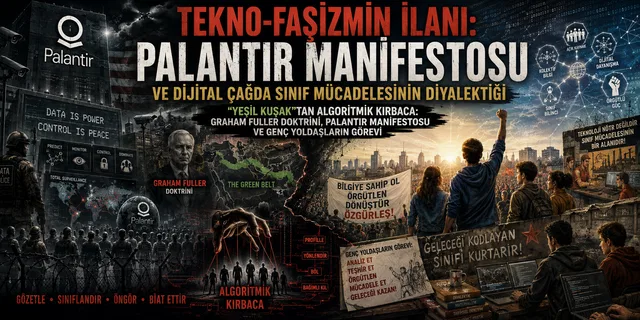
Alex Karp does not hide this. In The Technological Republic, the book he published in 2025, he called on Silicon Valley to serve "the national purpose", that is, the military superiority of the West. We examined this book, and the company's manifesto, in The Declaration of Techno-Fascism: The Palantir Manifesto and the Dialectic of Class Struggle in the Digital Age. We have also discussed Thiel's intellectual world in Thiel's Dialog Barricades - Technofeudalism Organizing in Digital Castles.
What does "of the Palantir kind" mean? Palantir is not alone. It is the most developed example of a kind. Inside the same kind there are Anduril, which produces autonomous weapons and border surveillance; Clearview AI, which sells facial recognition to the police with billions of face photographs gathered from the internet; Flock Safety, which sets up networks of licence-plate reading in cities; and spyware companies known for breaking into the telephones of journalists and opponents. The "Lavender" system, which +972 Magazine revealed in April 2024 and which was reported to be used by the Israeli army to produce target lists in Gaza, is this kind's last word in war. Their common features are these: choosing the state's apparatus of repression as the customer, processing public data with private software, hiding accountability behind the wall of commercial secrecy and national security. We also discussed this on the axis of robotics and armament in Against Whom Is 'Physical AI' Arming?.
Perhaps this is the dimension we most propose to add to Başkaya's talk: "Technical Science cannot save capitalism" is correct. But Technical Science serves very well the holding under control of the people whom capitalism cannot save.
If there is no organised resistance: drafts of the dystopia
The word dystopia calls up science fiction. But none of what follows is science fiction. All of them are where the tendencies that exist today will arrive, if they do not meet an organised counter-power.
The citizen who is scored. Today a "confidence score for an address" is calculated for a migrant. Tomorrow an application for social assistance, credit, a rental contract, a job application, an examination result and social-media movements can be joined in the same ontology. Your score determines who you are, and what you can reach. No law says "we are scoring you". But every door asks for a score.
The worker managed by algorithm. The decisions of hiring, the shift, the wage, performance and dismissal are handed over entirely to the algorithm. There is no human to object to. There is also no manager to sit across the table from the union representative. There is only "the system decided this way". For couriers this is already real today.
A two-storey humanity. On one side a small minority that has computing power, health, education and security. On the other a majority kept busy with a basic income, managed by surveillance, and counted "useless". Experiments in a "private city" such as Próspera in Honduras, supported by funds among whose investors Thiel also stands, and the fantasies of the "network state", are the drafts of these citadels where those at the top will live by their own laws. We took this up in detail in From Futurism to Techno-Fascism.
War that automates. A war in which the algorithm proposes the target, the time of approval falls to seconds, and the principle of "the human in the loop" turns into a formality. Anthropic's clash with the Pentagon showed that even this principle is a matter of bargaining for capital. Gaza became the laboratory of this war. What capital tries in the laboratory, it sooner or later spreads to the field.
Enclosed knowledge. A world in which people reach knowledge increasingly only through the models of a few companies, and in which these models also determine what is true. A world in which even scientific knowledge is produced in closed laboratories and is the property of the monopoly, as told in OpenAI's 722 Mathematics Papers and the Closed Laboratory of the General Intellect. The turning of reality itself into a subscription service.
A warming world, servers that are cooled. The giving of priority to data centres in regions suffering water scarcity, computing clusters that run on uninterrupted energy beside households whose electricity bills are rising. This is the counterpart, in everyday life, of what Başkaya called "putting out the fire with petrol".
And the most important: all of this looking legitimate. The darkest dystopia is the dystopia in which repression does not look like repression. It comes under the name of "security", "efficiency", "personalised service", "a measure against fraud". Nobody sees a shackle. Everybody only downloads an application.
This picture is not a fate. Each of them can be objected to, slowed, stopped today. The constitutional-court decision in Germany, the New York city comptroller's asking Palantir for a human-rights risk assessment, the petitions of technology labourers, show this. But none of them is enough on its own. As Başkaya said: the movements are in the field, but they are not enough. For them to be enough, organisation is needed.
What is to be done? Concrete tasks
Let us go on from where Başkaya's talk ends, carrying his call forward. In order to turn the slogan "Let us bring capitalism down before it collapses" into a programme with content, we propose the following tasks on the axis of technology:
The unionisation of the technology labourer. The programmer, the data labeller, the content moderator, the call-centre worker, the designer, the network administrator, the courier… Everyone whose hand touches a keyboard and a screen. In Turkey the struggle for the right of computing labourers to organise in a separate branch of industry is one of the most critical union struggles of this century. We drew the detailed road map in The Computing Worker's Handbook.
Refusal from inside. Refusing to work on projects of surveillance, filing and war, making these projects known to the public within legal limits, and building collective mechanisms of protection for this refusal. The petition of the Google and OpenAI workers is a small but meaningful beginning. One engineer's refusal on their own costs them their career. The refusal of a thousand engineers together stops a project.
Public demands. Positions that can be won from today to tomorrow:
- Banning the use, for the purposes of law enforcement and migration control, of health, education and social-assistance data
- Banning public institutions from making no-bid contracts for surveillance and data-analysis software, and the public disclosure of all these contracts
- A right to examination by a human, and a right of objection, against algorithmic decisions, especially in hiring, dismissal, credit and social assistance
- A requirement of open source in public software, and a ban on the transfer of public data to private companies
- Support for the campaign for an international ban on autonomous weapons
- The sharing of the productivity gain that artificial intelligence brings, by the shortening of working hours without a loss of wages
Knowledge commons. Defending and enlarging free software, open models, communities' own servers, public computing infrastructure. The answer to the expropriation of the general intellect is its being turned back into common property. We set out the principles of this in For the Restitution of the General Intellect: The Socialist AI Manifesto Is Out.
An alliance with the ecology movement. The water and energy consumption of data centres, the destruction of mining sites, and the climate crisis are parts of the same struggle. Building a bridge between technology labourers and the ecology movement is the way to turn Başkaya's ecological criticism into a concrete alliance.
The bridge between generations, and between kinds of knowledge. This is the article's real proposal. The accumulation of political economy of masters such as Fikret Başkaya, and the experience of the young labourers who work inside technology, should come together. Seminars in which technology labourers speak, in institutions such as the Free University, joint reading groups, joint articles… The comrade who looks from outside takes knowledge from inside. The comrade who looks from inside learns history and political economy. As Knowledge Commons we are always ready for such a joint work.
Continuous watching. Watching and interpreting the class developments in the world of technology week by week. For this you can follow the series we have begun, The Week's Class Struggle in Technology.
Technology can be ours too
Dear young comrades,
The title of Fikret Başkaya's talk asks a question: why can Technical Science not save capitalism? The answer is correct: because capitalism's problem is not technical, but social. But we want to add one more question: Whom can Technical Science save?
The same computing power is used today to find a migrant's address. The same power can also be used tomorrow to give warning of an epidemic in advance, to identify the buildings that will collapse in an earthquake, to plan a country's energy need, to shorten everyone's working day. This is not a dream. This is the twenty-first-century counterpart of the conclusion reached by the workers who first saw the difference between the machine itself and the capitalist use of the machine.
Başkaya Hoca is right: events set the masses in motion. But events set the masses in motion only in the direction that the organisation which is ready shows. If there is no organisation, anger either flows to the right or scatters. The task of those of us who work inside technology is to be ready when that event comes, and it will come. An organised labour that knows technology from the inside, that knows its class, and that stands shoulder to shoulder with the comrades outside.
Capitalism will not die of its own accord. The bourgeoisie will go on using technology to lengthen its life. Technology can lengthen this life, but it cannot save the system. What will bury the system is not technology either, but organised labour. We will bury it. Putting every tool in our hands back into the service of humanity.
For better futures, all together.
Sources
The text assessed
- Fikret Başkaya, "Why can Technical Science not save capitalism?..", Free University, 12 October 2026 (the opening talk of the autumn term, 10 October 2026)
Energy and productivity
- IEA, Electricity 2024, January 2024
- Enlit, "AI and data centre electricity use continue to surge, IEA finds", 17 April 2026
- U.S. Bureau of Labor Statistics, Productivity and Costs
- Robert J. Gordon, The Rise and Fall of American Growth, Princeton University Press, 2016
- Ernest Mandel, Late Capitalism (Der Spätkapitalismus, 1972)
The state, the technology monopolies, and Palantir
- Axios, "Pentagon blacklists Anthropic, labels AI company 'supply chain risk'", 4 March 2026
- Decrypt, "OpenAI Offers US Government a $42 Billion Slice of Itself", 2 July 2026
- Nextgov/FCW, "Palantir's no-bid pipeline just got bigger", 12 August 2026
- Immigration Policy Tracking Project, "Reported: Palantir awarded $30 million to build ImmigrationOS surveillance platform for ICE"
- Fortune, "ICE allegedly uses Palantir tool tracking Medicaid data", 26 January 2026
- Yahoo News, "Germany weighs nationwide use of Palantir's controversial software"
Layoffs
- KRQE/Nexstar, "Companies name AI as top reason for job cuts for second straight month" (Challenger, Gray & Christmas data for April 2026)
The classics
- Karl Marx, Capital, Volume I, Chapter 15 ("Machinery and Modern Industry") and Chapter 25 ("The General Law of Capitalist Accumulation"); Volume III, Chapters 13 and 14
- Karl Marx, Grundrisse, "Fragment on Machines"
- V. I. Lenin, Imperialism, the Highest Stage of Capitalism (1916); report on the international situation at the Second Congress of the Communist International (1920)
- Antonio Gramsci, Prison Notebooks
- Yuval Noah Harari, Homo Deus, 2016
Related articles from Knowledge Commons
- The Expropriation of the General Intellect and the AGI Illusion
- The Revolt of Crystallized Labor: A Call to the 20th Karaburun Science Congress
- The Bloody Steps of the Pyramid: The 2026 Global Dispossession War and the Birth of the 'Useless Class'
- The Declaration of Techno-Fascism: The Palantir Manifesto and the Dialectic of Class Struggle in the Digital Age
- Thiel's Dialog Barricades - Technofeudalism Organizing in Digital Castles
- From Futurism to Techno-Fascism
- Against Whom Is 'Physical AI' Arming?
- Anthropic's Activist Monitoring System
- "We Stopped Them All": A Monopoly's Grammar of Self-Absolution
- The Same Week, Two Tables: The US–China Summit, Artificial-Intelligence Bosses, and Not Camp but Class
- Did You Know There Is a Directorate General of Public Artificial Intelligence?
- On Turkey's Artificial Intelligence Action Plan (2026–2030)
- The Illusion of "Indigenous and National" Artificial Intelligence and the Dialectic of Imperialist Integration
- What Does the "AI Tsunami" Conceal?
- The Poverty of Artificial Intelligence Ethics and Human Dignity
- Reckoning with the 'Cloud' Myth in the Light of İlker Kalaycı's Text and the Cybernetic Repair of Metabolic Rift
- OpenAI's 722 Mathematics Papers and the Closed Laboratory of the General Intellect
- An AI Boss Fired a Human for the First Time
- Gig Economy Dossier
- TÜİK: Two Figures, One Country: 8.1% and 30.6%
- The Computing Worker's Handbook
- For the Restitution of the General Intellect: The Socialist AI Manifesto Is Out
- The Week's Class Struggle in Technology