Whose Republic? A Basic Guide in Its 103rd Year
From Res Publica to the Socialist People's Republic: Concepts, History and the Practice in Türkiye

Dear Young Comrades,
29 October has come. Flags will be hung, speeches will be made from the platforms, and the same documentary images will turn on the television. Some of you will celebrate the day sincerely, and some of you will keep your distance, saying "what is it to us". We think both attitudes fall short. It is not right either to worship the republic like an idol or to discard it like a shell. First we have to understand what it is: a form of state founded by which classes, under which conditions, and for which purposes? In whose hands does it work today, under whose control, and for whose benefit? And when we say "what do we want today", why do we still speak of a republic, but of an entirely different republic, a socialist people's republic?
This piece is a basic guide. A short summary first, then the detail.
Summary: The Republic in Ten Theses
-
The republic is a form of state, not a type of state. The Latin res publica means "the public thing, the people's business". It means that at the head of the state stand not a ruler who inherits the office by blood, but people who are elected and who serve for a set term. But so long as the questions "who elects, who is elected, and who owns the property" stay open, the republic can be the state of slave-owners, of merchants, of industrialists, and of workers.
-
The modern republic is the political form the bourgeoisie built against feudal absolutism. From the Netherlands to the United States, from France to Türkiye, republics replaced privilege based on blood with a new domination based on property and the market. This was a real advance for humanity; but its limit came from the same place.
-
The Republic of Türkiye is a project in which a weak bourgeoisie was strengthened by the hand of the state. In the last period of the Ottoman Empire, trade and industry were largely in the hands of non-Muslim and foreign capital. The "national economy" policy of the Committee of Union and Progress, the dispossessions of the war years, and the statism of the Republic are the stages of creating a "national bourgeoisie" from above.
-
Kemalism's discourse of a "classless, privilege-less, fused mass" is in fact the banning of class organisation. While the worker's union, strike and party were banned, the boss's chamber, bank and incentive law were set up. The state that denied classes was the state of one class.
-
The republic has real gains, and these must be defended. The abolition of the sultanate and the caliphate, secularisation, women's right to vote and to be elected, civil law, the alphabet and education reforms, and experiments such as the Village Institutes were civilisational leaps that cannot be taken back. Those who can defend them most consistently today are not those who founded them, but the working class.
-
The republic and democracy are not the same thing. The republic answers the question "who is at the head of the state", and democracy answers the question "who exercises sovereignty". There are republics without democracy (one party, a junta, a trustee), just as there are democracies that are not republics (constitutional monarchies such as Britain and Sweden).
-
Bourgeois democracy is built on formal equality and material inequality. Everyone has one vote; but the vote of the owner of the factory, the media, the bank and the platform has been counted before it enters the ballot box. In Lenin's words, the democratic republic is the best possible political shell for capitalism.
-
Socialism does not reject the republic; it completes it. The Paris Commune, the soviets, the people's republics: all of them tried to extend the principle of the republic (election, recall, the public interest) as far as the ownership of the means of production. "The people's business" finds its real meaning only when production too is the people's business.
-
In Türkiye today the republic is being emptied from the inside. The one-person rule set up in 2017, the trustees, the subordination of the judiciary, the erosion of secularism and the debate over a "new constitution" show that the bourgeois republic of 1923 cannot even carry its own gains.
-
What we want: a Socialist People's Republic. That is, a republic in which sovereignty really lies with the working people, the means of production pass into social ownership, representatives are elected and can be recalled at any moment, and which is secular, based on equal citizenship, and founded on the fraternity of peoples. This is what will complete what 1923 left half-finished.
What Is the Republic?
The root of the word: "the people's business"
The word "cumhuriyet" comes from the Arabic root cumhur (a crowd, a gathering of the people). Its counterpart in the Western languages (republic, république, Republik) comes from the Latin res publica: res is "thing, business", publica is "belonging to the people, public". The republic, in the meaning of the word, is "the people's business" or "a public matter".
The opposite of this definition is monarchy: the state being counted as the property of one person or of one dynasty. In the Ottoman Empire the state was the property of the House of Osman. The lands were the sultan's, and the subjects were the sultan's servants. The republic, in its plainest form, is the refusal of this claim of ownership: the state is nobody's private property.
Three basic features of the republic as a form of state
| Feature | Its meaning |
|---|---|
| Election | The person or body at the head of the state comes to office not by birth but by an election. |
| A limit of time | The office is limited to a set term; the post does not become the person's property. |
| Publicness | Decisions are taken, in principle, in the name of the interest of "the public", not of a family or a dynasty. |
But these three features always leave one question open: who is "the public"? In Rome, women, slaves and foreigners were not part of "the public". The United States Constitution of 1787 recognised slavery and counted enslaved people as "three-fifths of a person" in the reckoning of voters. In nineteenth-century France the right to vote was for a long time limited to property-owners. The history of the republic is the history of a class struggle over whom "the public" includes.
The form of the state and the class character of the state
The basic contribution of Marxism here is this distinction: the form of the state (monarchy, republic, parliamentary, presidential, and so on) and the class character of the state (the domination of which class it organises) are different things.
The domination of the same class can be organised in different forms: the bourgeoisie has maintained its domination by constitutional monarchy in Britain, by a republic in France, by Franco's dictatorship in Spain, and by Pinochet's junta in Chile. The other way round, the content of states that carry the label "republic" can be very different from one another: the Republic of Venice was the state of a merchant oligarchy, the Weimar Republic of the bourgeoisie, and the Soviet Socialist Republics of the workers and peasants.
The question "are you for the republic?" is therefore incomplete on its own. The real question is this: "which class's republic?"
A Short World History of the Republic
Ancient republics: the "people" of the slave-owners
- The Roman Republic (509–27 BCE): It was founded by the overthrow of the kingdom. There were consuls, a senate and popular assemblies. But real power lay with the land-owning patricians. The plebeians (small producers, artisans) won rights through struggles that lasted centuries (the tribunate of the people, written laws). The Gracchus brothers, who wanted land reform, were killed. The revolt of Spartacus (73–71 BCE) was the answer given to the republic by the slaves left outside "the public".
- Athens is an example of direct democracy more than of a republic; but there too those counted as citizens were free men, and slaves and women were outside.
The lesson: In a class society the principle of the republic has always been limited by the ruling class defining "the public" as itself.
Medieval and early modern merchant republics
- Venice (697–1797), Genoa, Florence: City-states of commercial capital. The doge came by election, but those who elected him were the rich merchant families.
- The United Provinces of the Netherlands (1581): The first great modern republic, founded by a commercial bourgeoisie that rose against the Spanish monarchy. The world's first joint-stock company (the Dutch East India Company, 1602) and its first modern stock exchange (Amsterdam) were born in this republic. This is the first open example of the bond between the republic and capital.
- The English Revolution (1649–1660): King Charles I was executed, and Cromwell's Commonwealth was set up. In this process the Levellers wanted the vote for everyone, and the Diggers wanted the land in common. Both were crushed by the bourgeois republic. The bourgeoisie later compromised with the monarchy.
The age of the bourgeois revolutions: the United States and France
- The United States (independence in 1776, the Constitution in 1787): A break from the kingdom, a written constitution, the separation of powers. But a significant part of the founding fathers were slave-owners. The text that said "all men are created equal" existed together with slavery and the destruction of the indigenous peoples. The abolition of slavery required a civil war (1861–1865).
- France (the Revolution of 1789, the First Republic in 1792): Feudal privileges were abolished, and the Declaration of the Rights of Man and of the Citizen was proclaimed. In the Jacobin period (1793) a constitution containing universal suffrage was written, but it was never applied. Afterwards France went back and forth for a century among republic, empire and kingdom. Today's Fifth Republic was founded in 1958.
The importance of the French example: The slogan "liberty, equality, fraternity" was a universal language the bourgeoisie used to take the whole people behind it against feudalism. But when the Paris workers demanded a "social republic" in June 1848, the same republic crushed them with cannon fire. Marx, in The Eighteenth Brumaire of Louis Bonaparte, reads this moment as the moment when the real face of the bourgeois republic was revealed: the bourgeois republic means the unlimited domination of one class over the other classes.
Alternative republican experiments: the search for a republic of the working people
Here we come to the subject that really concerns us: the attempts to carry the principle of the republic beyond the limits of the bourgeoisie.
The Paris Commune (March–May 1871): The first workers' power, lasting 72 days. The Commune:
- abolished the standing army and put the armed people in its place,
- brought all public officials to office by election and made them recallable at any moment,
- limited the salaries of public officials to a worker's wage,
- separated the church from the state and made education free and secular,
- turned the workshops abandoned by their owners over to workers' cooperatives,
- banned night work in the bakeries.
Marx, in The Civil War in France, defined the Commune as "the political form at last discovered under which to work out the economical emancipation of labour". The Commune was a "social republic" against the bourgeois republic.
The Soviet Republic (1917) and the USSR (1922): The October Revolution established the power of the councils of workers, soldiers and peasants (the soviets). Land was given to the peasants, the factory to workers' control, and the eight-hour day, full equality for women, and free health and education were proclaimed. The Union of Soviet Socialist Republics, founded in 1922, was a union of republics that made the right of nations a constitutional principle. We told these gains in detail in What Did the October Revolution Give the World?
The Mexican Constitution (1917): A few months before October, the constitution that came out of the Mexican Revolution was one of the first texts to write into a constitution that the land and the wealth under the ground belong to the nation (Article 27) and workers' rights such as the eight-hour day and the right to strike (Article 123). It shows what popular movements can seize even inside a bourgeois republic.
The Weimar Republic (1919–1933): It was the product of the German workers' November Revolution of 1918. But social democracy dispersed the workers' councils and collaborated with the reactionary units that killed Rosa Luxemburg and Karl Liebknecht. The bourgeois republic, the moment big capital wanted it, handed power to Hitler. The lesson: a republic that does not touch capital cannot defend itself against fascism.
The Second Spanish Republic (1931–1939): Land reform, secularism, women's rights, the autonomy of Catalonia and the Basque Country. The International Brigades, coming from all over the world, defended the republic against the fascist coup. The Western bourgeois democracies, meanwhile, stayed "neutral".
The people's republics (1924 and after 1945): In 1924 the Mongolian People's Republic was founded. After the national liberation struggles waged against fascism in the Second World War, "people's republics" were founded in Eastern and South-Eastern Europe (Albania, Bulgaria, Yugoslavia, Poland and others) and in Asia (the Democratic Republic of Vietnam in 1945, the Democratic People's Republic of Korea in 1948, the People's Republic of China in 1949). These states were defined as the power of broad popular fronts that had fought fascism (workers, peasants, progressive intellectuals) and were seen as a transitional form called "people's democracy". With its 1976 constitution Albania changed its name to the People's Socialist Republic of Albania, and declared that the transition period had been completed and that the foundations of a socialist society had been laid. (Our piece on Enver Hoxha)
The Republic of Cuba (after 1959): A sugar plantation in the back yard of the United States was turned by revolution into an independent and socialist republic. A literacy campaign (1961), free health and education, a people that stayed standing despite the embargo.
A comparison: the bourgeois republic and the republic of the working people
| The bourgeois republic | The republic of the working people (social / people's / socialist) |
|---|---|
| Sovereignty belongs to "the nation", but the means of production are private property | Sovereignty belongs to the working people, and the means of production are social property |
| The representative is elected and is untouchable for the term | The representative is elected and can be recalled at any moment |
| The bureaucracy and the army stand above the people, separate from them | The public official works for a worker's wage and is open to control |
| There is political equality, and economic inequality is counted as "natural" | Political equality is completed by economic equality |
| There is no democracy in the factory, the office or the platform | Democracy extends to the workplace, the neighbourhood and the school |
| The media and knowledge are in the hands of capital | Knowledge and communication are a public common |
| The national question is "solved" by suppression and assimilation | The equality of peoples and the right of self-determination are recognised |
Why and How Was the Republic Founded in Türkiye?
The background: a collapsing empire and a semi-colonial economy
In the nineteenth century the Ottoman Empire became a source of raw materials and a market for European capitalism. The 1838 Treaty of Balta Liman removed the customs walls and ruined local crafts. In 1875 the state went bankrupt; the Ottoman Public Debt Administration, founded in 1881, seized important tax revenues of the empire directly, in the name of European creditors. Railways, mines and banks were in the hands of foreign capital.
In this economy a large part of the local commercial bourgeoisie came from non-Muslim communities (Greek, Armenian, Jewish, Levantine). The Muslim-Turkish elements were predominantly landowners, bureaucrats, soldiers and small shopkeepers.
The origin of the bourgeoisie in Türkiye
The birth of the bourgeoisie in Türkiye is different from that in Europe. In Europe the bourgeoisie grew by its own strength over centuries, in the cities, in trade and in manufacture, and then took power. In Türkiye the process worked largely in reverse: first a military-bureaucratic cadre that seized political power, and then a bourgeoisie created by the hand of the state.
We can read this process in four stages:
a) The Second Constitutional Era and the "national economy" (1908–1918): The Committee of Union and Progress adopted, as an open programme, the creation of a Muslim-Turkish bourgeoisie. National companies and national banks were founded; state tenders, privileges and credits were transferred to this section. During the First World War a new layer of merchants grew rich on the black market and on profiteering (in the popular language of the period, "war profiteers").
b) The dispossessions of the war years (1915–1923): The Armenian deportation and massacre of 1915, the expulsions of the Greek population and the population exchange of 1923 meant the liquidation, to a large extent, of the non-Muslim bourgeoisie in Anatolia. The properties, workshops, shops and lands left behind ("emval-i metruke", abandoned properties) mostly changed hands among the local notables, the war profiteers and the new bureaucracy. This is one of the first sources of capital accumulation in Türkiye, a bloody one that is passed over in silence. It is the specific form, on this soil, of the violence Marx called "primitive accumulation".
c) The class alliance of the War of Independence (1919–1922): The national struggle was carried out by an alliance of the military and civilian bureaucracy, the Anatolian notables (landowners), local merchants and a part of the clergy. Peasants and a limited number of workers were the military force of the war, but they were not the leading element of the alliance. The arms and gold aid of Soviet Russia was of decisive importance. In the same years Mustafa Suphi, the founder of the Communist Party of Turkey, and fourteen comrades were killed on the Black Sea in January 1921. This murder was an early sign of which class the new regime saw as a partner and which class it saw as a danger.
d) The Izmir Economic Congress (February–March 1923): Merchants, industrialists, farmers and workers' representatives took part in this congress, which met before the republic was proclaimed. But the weight lay with the merchants and the landowners. The congress drew a road based on private property, a market economy open to foreign capital, and the support of the local entrepreneur by the state. The demands of the workers' representatives, such as the eight-hour day and the right to a union, stayed on paper.
The proclamation of the republic and the founding reforms
| Date | Development |
|---|---|
| 1 November 1922 | The sultanate was abolished |
| 29 October 1923 | The republic was proclaimed |
| 3 March 1924 | The caliphate was abolished, and the Law on the Unification of Education was adopted |
| 20 April 1924 | The 1924 Constitution was adopted |
| 1925 | The Law on the Maintenance of Order; the lodges and zawiyas were closed; the Hat Law |
| 1926 | The Turkish Civil Code (from Switzerland), the Penal Code (from Italy) |
| 1928 | The alphabet reform; the phrase "the religion of the state is Islam" was removed from the constitution |
| 1930 / 1934 | Women were given the right to vote and to be elected, first in local and then in general elections |
| 1937 | Secularism and the "six arrows" of the CHP entered the constitution |
| 1940 | The Village Institutes were founded (they were closed in 1954) |
The importance of these reforms cannot be belittled. The domination of a dynasty and of religious authority over the state was removed; women became subjects of the law; education was brought under a single and secular roof. In the world of the 1920s these were steps ahead of many European countries. We took up this line of enlightenment separately in our piece on Ahmet Taner Kışlalı.
But: "a classless, privilege-less, fused mass"
The official ideology of the republic claimed that there were no classes in Türkiye with interests opposed to one another, and that society was a harmonious whole made up of "professional groups". This was called populism. The source of this idea was the corporatism of the Europe of the period (especially Mussolini's Italy) and French solidarism.
In practice this meant the following:
- In the period of the 1925 Law on the Maintenance of Order, the journal Aydınlık was closed and communists were tried in the Independence Tribunals.
- The Labour Law of 1936 banned the strike and the lockout. The same year, Articles 141 and 142 of the Turkish Penal Code, taken from the Italian fascist penal code, made it a crime to defend "the domination of one social class over the others". These articles, known as the ban on communism, stayed in force until 1991.
- The Associations Law of 1938 banned the founding of associations "based on class".
While classes were denied, that is, only one class's organisation was banned. The worker had no union, no party and no strike; but the boss had the Chambers of Commerce and Industry, İşbank (1924) and the Law for the Encouragement of Industry (1927).
Statism: a bourgeoisie by the hand of the state
The Great Depression of 1929 collapsed an economy that rested on the export of agricultural products. Private capital was not strong enough to industrialise on its own. Statism was therefore adopted as policy in the 1930s:
- The First Five-Year Industrial Plan (1934) was prepared with the technical aid and credit of the Soviet Union. The Kayseri and Nazilli textile factories were built with Soviet specialists.
- Public enterprises such as Sümerbank (1933) and Etibank (1935) opened factories in textiles, sugar, iron and steel, and mining.
Statism was not socialism. Although some intellectuals of the Kadro movement tried to theorise it as a "third way", its aim was for the state to do what private capital could not, to build the infrastructure and then to open a field to private capital. The public factories provided cheap inputs, created a low-wage and strike-free working class, and state tenders and credits produced new rich people. The founding story of many of Türkiye's largest holdings today begins with the state tenders, monopoly dealerships and import permits of this period.
The Wealth Tax of 1942 was a tax imposed in wartime and applied to non-Muslims many times higher than to Muslims, and those who could not pay were sent to labour camps at Aşkale. This was one of the last great waves of the transfer of property from non-Muslim capital to the Muslim-Turkish bourgeoisie.
A summary of the Turkish model
We can summarise the relation between the republic and capitalism in Türkiye as follows:
- The political revolution came before the economic revolution. The bourgeoisie did not found the state; the state founded the bourgeoisie.
- The state became both the instrument and the guarantee of capital accumulation. Incentives, tenders, credit, confiscation and the suppression of labour were the instruments of this guarantee.
- The bourgeoisie stayed tied to the state at the navel. The bourgeoisie of Türkiye was therefore never, as in Europe, an independent class that defended democracy for its own interest. In every crisis it stood behind the army, the junta and the "strong leader".
- The working class was to be dissolved inside the "fused mass". From the first day, class politics was coded as separatism, a foreign ideology and a security problem.
- The national question was to be "solved" by denial. The imposition of one language and one identity; the Sheikh Said (1925), Ağrı (1930) and Dersim (1937–38) events; the official refusal, for a long time, to acknowledge the existence of the Kurdish people: this is the heaviest result of the republic's narrow definition of "the public".
The Later Course of the Republic: From 1946 to Today
Multi-party life and the binding to the United States (1946–1960)
Multi-party life began in 1946. The Democrat Party, which came to power in 1950, was the party of the large landowners and the commercial bourgeoisie. With the Marshall Plan (1948) and NATO membership (1952), Türkiye was made the forward post of the capitalist bloc led by the United States. Soldiers were sent to Korea. Anticommunism settled at the centre of the state ideology. The pogrom of 6–7 September 1955 struck another blow at the Greek bourgeoisie in Istanbul.
The 1961 Constitution: the ground the working people won
The 1961 Constitution, prepared after the coup of 27 May 1960, was the most freedom-loving constitution in Türkiye's history: the principle of the social state, the right to a union, to collective bargaining and to strike (made law in 1963), university autonomy, the Constitutional Court. These rights were not granted from above; they were the product of the pressure of a working class that had been growing since the 1950s. The great workers' rally at Saraçhane in 1961, the Kavel strike of 1963, the founding of DİSK in 1967 and the great workers' resistance of 15–16 June 1970 were the moments when, inside the republic, the working classes began to build their own "public". The entry of the Workers' Party of Turkey into parliament in 1965 with 15 deputies was the first time the working class was represented in parliament in its own name. (The TİP dossier)
12 March, 12 September and the 1982 Constitution
Capital could not tolerate the freedom-loving face of the republic in the face of an organising working class. The memorandum of 12 March 1971 came, then the decisions of 24 January 1980, and the coup of 12 September 1980 made to apply them. The coup was the application of the IMF prescription at bayonet-point. DİSK was closed, thousands of people were tortured, and executions were carried out.
The 1982 Constitution narrowed the republic's "public" again: the right to strike was restricted, the relation of political parties with unions was banned, the Higher Education Council was set up, the Turkish-Islamic synthesis became the official ideology, and religious instruction was made compulsory. The constitution in force today is still this junta constitution. For the detail you can look at the 12 September dossier and Whose Contract Is the Constitution?
The AKP period and one-person rule
The neoliberal policies applied from the 1980s were carried to a new stage under AKP rule after 2002. Privatisations, public-private partnership projects, the rent transferred to construction and energy capital, de-unionisation, subcontracting and precarisation are the mark of this period. Political Islam, advancing along the road opened by 12 September, settled into every apparatus of the state.
With the referendum of 16 April 2017 the "Presidential Government System" was set up. This system, in which executive power is gathered in one person and the power of parliament and of the judiciary to control that person is largely weakened, eroded in practice the most basic principle of the republic, the principle that the state is nobody's personal property. Trustees appointed in place of elected mayors, the cases opened against opposition municipalities and politicians (the Istanbul Metropolitan Municipality case), the detention of journalists, social-media access bans, and the erosion of secularism beginning with education are parts of the same process.
Today: the "new constitution" debate in the 103rd year
As the republic enters its 103rd year, the government is keeping the call for a "civilian and new constitution" on the agenda again. Jurists and bar circles warn that in this debate the amendment of the articles on secularism and fundamental rights (for example Article 42, which regulates the right to education, and Article 66, which defines citizenship) will be brought to the front (Cumhuriyet). The reaction voiced at the general assembly of the Izmir Bar Association, "the defenders of an outdated regime cannot make a new constitution" (Cumhuriyet), shows how sharp the debate is.
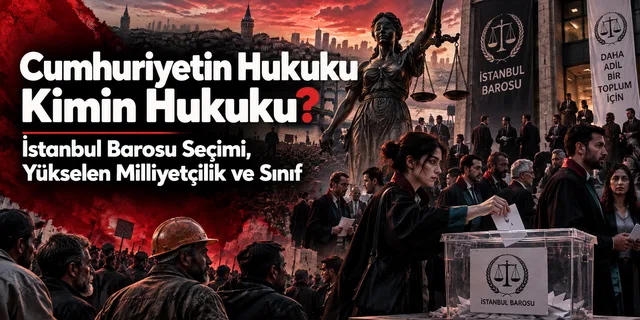
We ask this: in this debate, where are the worker's right to strike, the union thresholds, workplace killings, the minimum wage staying below the hunger line, women's labour, the equal citizenship of the Kurdish people, and digital surveillance? Both the government's "new constitution" and the opposition's discourse of a "return to 1923" leave these questions largely outside. We discussed this distinction through the bar election in Whose Law Is the Republic's Law?
Capitalism and the Republic: The Core of the Relation
Why the bourgeoisie loves the republic (and why not always)
For capitalism to work, the following are needed:
- Relations built by contract, not by blood,
- Individuals who are equal before the law (formally) and who can freely sell their labour-power,
- A predictable legal order and a guarantee of property,
- The removal of feudal privileges, internal customs and guild restrictions.
The republic is the form that meets these needs best. Lenin, in The State and Revolution, puts it this way: the democratic republic is the best possible political shell for capitalism. Because once capital has settled into this shell, its domination cannot be shaken no matter which person, which party or which change comes.
But the bourgeoisie is bound to the republic conditionally. When the working class organises by using the freedoms of the republic, the bourgeoisie does not hesitate to suspend the republic: France 1851, Italy 1922, Germany 1933, Spain 1936, Chile 1973, Türkiye 1971 and 1980. The answer to the question "who will defend the republic" has therefore always been the same, historically: the organised working class and the working people.
Property is the republic's unseen constitution
In the bourgeois republic there are two constitutions: one written, adopted by parliament; the other unseen, written by property relations. The first says "everyone is equal". The second determines who boards the service bus at four in the morning and who travels by company plane.
Today new articles are being added to this unseen constitution: the algorithms of the platform companies determine who sees what, who is hired and who is "switched off". Voter behaviour is collected as data, processed and sold. (Meta in Brazil, Access Bans in Turkey, The US Midterms and Algorithmic Politics) The republic's "public sphere" is being moved onto the private servers of a few monopolies. In the twenty-first century this is the greatest seizure of the res publica, that is, of the public thing.
Democracy and the Republic: Kindred, but Not the Same
Two separate questions
| The republic | Democracy |
|---|---|
| It is the answer to "who is at the head of the state, and how do they come there?" | It is the answer to "who exercises sovereignty, and how?" |
| Its opposite is monarchy | Its opposite is oligarchy, dictatorship, autocracy |
| It defines a form of state | It defines a relation of power, the degree of participation |
| It can exist without democracy (one party, a junta) | It can exist without a republic (a constitutional monarchy) |
The period 1923–1946 in Türkiye was a one-party republic. In the coups of 1960, 1971 and 1980 the name "republic" was kept, but democracy was suspended. The other way round, Sweden, Norway and Britain, although they are constitutional monarchies, operate the institutions of bourgeois democracy (universal suffrage, parliament, the right to a union) much more broadly than Türkiye.
Bourgeois democracy and people's democracy
Democracy itself is also a matter of class. Bourgeois democracy separates the political field from the economic field: you are equal at the ballot box, not in the factory. You vote once every four years, but you have no say in your workplace, your neighbourhood, your school or the platform you use. All the decisions are the boss's, within the scope of "the right of property".
People's democracy, or socialist democracy, aims to remove this separation. It extends democracy to the field of production, that is, to the workplace, the economy and knowledge. The recallable representatives of the Paris Commune, the workplace-based elections of the soviets, and the student plenums in Serbia today (They Walked Past the Algorithm) are different historical forms of this search.
The struggle for democracy in Türkiye, and the republic
In Türkiye the struggle for democracy has been waged most consistently by the working classes and the oppressed peoples. The right to strike, trade-union freedom, freedom of thought and of organisation, the right to education in the mother tongue, the equality of women and men: none of these is a right the bourgeoisie gave of its own wish. "Democratising the republic" and "making the republic a republic of the working people" are therefore, for us, two faces of the same aim.
Socialism and the Republic
Why do Marxists give weight to the republic?
Some young comrades may think, "it is a bourgeois state anyway, it makes no difference whether it is a republic or a monarchy". This is wrong. The classics of Marxism have seen the democratic republic as the most favourable ground for the struggle of the working class:
- Marx, in the Critique of the Gotha Programme (1875), stresses that the class struggle is in the last instance waged inside the democratic republic.
- Engels, criticising the draft of the German social-democratic programme in 1891, writes that the democratic republic is the specific form of the proletariat's power, as the Great French Revolution also showed.
- Lenin made the demand for a republic one of the first articles of the workers' programme in Russia.
Why? Because the republic makes class relations more naked. If there is no king, if there is no "shadow of God", what remains is property relations and class domination. The struggle takes its clearest form here.
But the bourgeois republic is not the last stop
Socialism takes the republic's promise of "the people's business" seriously and carries it to the end:
- The people's business is not only who the head of state will be, but what will be produced, how much, and for whom.
- "The public thing" is not only the parliament building, but the factory, the land, energy, data and knowledge.
- Sovereignty "belonging unconditionally to the nation" becomes real only when economic sovereignty also belongs to the nation, that is, to the working people who make up its overwhelming majority.
That is why we say: the most consistent defender of the principle of the republic is socialism. The bourgeois republic stops its own principle at the gate of property. The socialist republic opens that gate.
Learning from our past
The experiments of the socialist republic created the greatest gains in human history; but they also met heavy problems, external encirclement, internal bureaucratisation, and in the end the return of capitalism. We neither worship these experiments nor deny them. We will settle accounts with them with great maturity, learn, and build a better world. (The Real Russia)
What Do We Want Today? What Is a Socialist People's Republic?
The root of the concept
The concept of the "people's republic" was born, in the twentieth century, from inside the national and social liberation struggles waged against fascism and imperialism. It means a state founded, under the leadership of the working class, by a broad alliance of peasants, working shopkeepers, progressive intellectuals and oppressed peoples. The "socialist people's republic" names the stage at which the power of this alliance is bound to the aim of building a socialist society through the socialisation of the means of production.
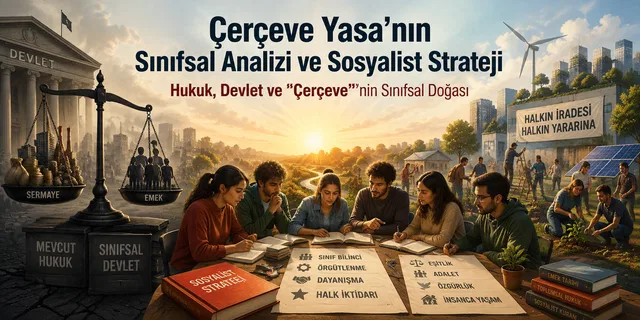
For Türkiye this concept rests on the thesis that the promises 1923 proclaimed but could not realise, that is, the promises of full independence, popular sovereignty, secularism and equal citizenship, can be completed only by the power of the working classes.
The basic principles of the Socialist People's Republic
1. Sovereignty really belongs to the working people. Decision-making is organised upwards, beginning from the workplace, the neighbourhood and the village. People's assemblies, workplace councils and local administrations are equipped with real authority.
2. Representatives are elected and can be recalled. No administrator is untouchable. Those who elect can recall those they elected before the term ends. The wages of public officials are limited to the wage of a skilled worker. The formation of a privileged bureaucracy is prevented.
3. The means of production are social property. Large industry, the banks, energy, the mines, transport, communications and digital infrastructure (data centres, platforms, artificial-intelligence models) pass into social ownership. Production is carried out not for profit but for social need, and by democratic planning.
4. Labour is the measure of everything. A job for everyone, a humane wage, a shortened working time, safety at work. Technological development is used not to create unemployment and surveillance, but to shorten working time and to free human creativity.
5. Full secularism. Religion is separated completely from the affairs of the state and from education. The state's religious institutions, such as the Directorate of Religious Affairs, are abolished. Freedom of belief and of unbelief is guaranteed.
6. The equality and fraternity of peoples. Equal citizenship, education in the mother tongue and cultural rights are recognised for all the peoples living in Türkiye (Kurdish, Turkish, Arab, Laz, Circassian, Armenian, Rum, Syriac, Alevi, and all the other communities). The right of peoples to self-determination is accepted as a principle. Citizenship is defined not by an ethnic identity but by equal rights.
7. The equality of women and men. The making-invisible of women's labour is ended. Domestic care labour is socialised (nurseries, care homes, collective canteens). Every institution of the state is mobilised against violence against women.
8. Free and good public services. Education, health, housing, transport and communication are rights offered to everyone free of charge and equally. The legacy of the Village Institutes, which joined production with education, is revived.
9. Knowledge is a common. Science, software, data and culture are accepted as a public common. Free software, open access and a public artificial-intelligence infrastructure are a basic policy of the state. The people's model is trained with the people's data; no monopoly can seize the product of collective labour.
10. Peace and internationalism. The country leaves the imperialist military blocs (NATO), and foreign bases are closed. Solidarity with neighbouring peoples and with all the working people of the world is the basic principle of foreign policy.
A comparison with 1923
| The bourgeois republic of 1923 | The Socialist People's Republic |
|---|---|
| "Sovereignty belongs unconditionally to the nation", but property belongs to the bourgeoisie | Sovereignty and property belong to the working people |
| Classes were treated as non-existent, and workers' organisation was banned | The abolition of class exploitation is the aim, and the working people are organised |
| Secularism was applied with a state-controlled religious institution (the Directorate of Religious Affairs) | Full secularism: religion and the state are completely separate |
| One language, one identity, assimilation | The equality and fraternity of peoples |
| Women were given political rights, and domestic labour stayed invisible | Political equality is completed by socialised care labour |
| A bourgeoisie was created by the hand of the state | Social property and democratic planning |
| Full independence was the aim, and after the 1950s the country was bound to NATO | A foreign policy independent of the imperialist blocs, and internationalist |
Does the Socialist People's Republic mean rejecting 1923?
No. The socialist people's republic takes over the advanced gains of 1923 and defends them against the reaction in power today. But it goes beyond the class limits of 1923. It wants to make the holiday of the republic the holiday of its real owners, that is, of the working people who work in the factories, the fields, the mines, the offices and the servers of this country.
Concepts Often Confused: A Small Glossary
| Concept | A short definition |
|---|---|
| Republic | The form of state in which the head of state is limited by election and by time |
| Monarchy | The form of state in which the head of state passes by descent |
| Constitutional monarchy | A monarchy in which the ruler remains symbolic and authority lies with parliament |
| Democracy | The exercise of sovereignty by the people, directly or through representatives |
| Bourgeois democracy | A democracy in which political equality is built on private property and economic inequality |
| People's democracy | A form of power, based on the alliance of the working classes under the leadership of the working class, that aims at the transition to socialism |
| Secularism | The separation of religion from the affairs of the state |
| Statism | The state's taking part in the economy directly as a producer and an investor; it should not be confused with socialism |
| Populism (Kemalist) | The corporatist view that sees society as classless, harmonious professional groups |
| Primitive accumulation | The accumulation made, at the birth of capital, through violence, seizure and dispossession |
| The social state | The bourgeois state's recognition of social rights under the pressure of the workers' struggle |
| Socialist People's Republic | A republic, secular and based on the equality of peoples, in which sovereignty and the means of production are in the hands of the working people |
Concrete Tasks: What Can We Do After 29 October?
- Let us read and discuss. Share this piece around your school, your workplace and your neighbourhood. Set up small reading groups by asking the question "whose republic?"
- Let us defend the gains. Let us raise our voice against the erosion of secularism beginning with education, against the taking back of women's rights, and against the appointment of trustees in place of those who were elected. Let us defend this not as a "return to the good old days" but as a step forward.
- Let us join the "new constitution" debate with a class agenda. Let us carry to the centre of the debate the demands for the right to strike, the removal of the union thresholds, safety at work, a humane wage, education in the mother tongue, data rights, and the limiting of digital surveillance.
- Let us organise. The only way to be the owner of the republic is to be organised. A union, a student organisation, a professional organisation, a neighbourhood assembly, a cooperative: begin from whichever is close to you.
- Let us write the history ourselves. Record the history of your family, your neighbourhood and your workplace through oral-history work. Take hold of the Armenian, Greek, Kurdish, Alevi and workers' memories that official history has left outside.
- Let us make knowledge a common. This piece is published under the CC BY-SA 4.0 licence. Copy it, change it, develop it, translate it, on condition of naming the source and sharing it with the same freedom.
Who Will Complete the Republic?
Dear Young Comrades,
The republic proclaimed 103 years ago ended, on this soil, the domination of a dynasty and of religious authority. This was a great step. But that republic stayed inside the limits of the classes that founded it: it became the republic of those who have property, not of those who live by their labour.
Today even the founding gains of that republic are in danger. The heirs of those who founded them either abandon these gains or use them as a bargaining chip in the deals they make with capital. The only force that can defend secularism, equal citizenship and popular sovereignty to the end is the working people, who have no capital to lose and a whole world to win.
That is why, on 29 October, we want to speak both with those who hang a flag and with those who do not. We want to say this to them: the republic is not something proclaimed once and then finished. Every generation founds it again, or loses it. The task of our generation is to make "the people's business" really the people's business.
Long live the fraternity of peoples, long live the republic of the working people!
Sources
The classics
- Karl Marx, The Eighteenth Brumaire of Louis Bonaparte (1852)
- Karl Marx, The Civil War in France (1871)
- Karl Marx, Critique of the Gotha Programme (1875)
- Friedrich Engels, The Origin of the Family, Private Property and the State (1884)
- Friedrich Engels, A Critique of the Draft Social-Democratic Programme of 1891 (1891)
- V. I. Lenin, The State and Revolution (1917)
- V. I. Lenin, The Proletarian Revolution and the Renegade Kautsky (1918)
On Türkiye
- Doğan Avcıoğlu, Türkiye'nin Düzeni (1968)
- Çağlar Keyder, Türkiye'de Devlet ve Sınıflar (İletişim Yayınları)
- Korkut Boratav, Türkiye İktisat Tarihi 1908–2009 (İmge Kitabevi)
- Zafer Toprak, Türkiye'de "Milli İktisat" 1908–1918 (Yurt Yayınları)
- Taner Akçam, İnsan Hakları ve Ermeni Sorunu: İttihat ve Terakki'den Kurtuluş Savaşı'na
- Rıdvan Akar, Aşkale Yolcuları: Varlık Vergisi ve Çalışma Kampları
- Mete Tunçay, Türkiye Cumhuriyeti'nde Tek-Parti Yönetimi'nin Kurulması (1923–1931)
- Kemal Sülker, Türkiye'de Sendikacılık Tarihi
Current news
- Jurists: the imposition Türkiye will face is clear, and amending Articles 42 and 66 enters the first four — Cumhuriyet
- Izmir Bar Association general assembly: "the defenders of an outdated regime cannot make a new constitution" — Cumhuriyet
Related pieces from Bilgi Müşterekleri
- Whose Contract Is the Constitution?
- Whose Law Is the Republic's Law?
- What Did the October Revolution Give the World?
- The History of the Struggle for Enlightenment in Turkey, in Memory of Ahmet Taner Kışlalı
- 12 September: The History, Balance Sheet, and Present of a Class Coup
- Mass or Class? A Dossier on the Workers' Party of Turkey
- The Bourgeoisie Is Buying Time with Technology, and We Will Bury Capitalism
- A Genealogy of Patience: A Moral History from the Celali to the Harami
- Red Scare Again
- On Enver Hoxha's Birthday
- Whose Case Is Being Heard in Silivri?
- They Walked Past the Algorithm
- Meta in Brazil, Access Bans in Turkey
Bilgi Müşterekleri — Knowledge Belongs to Everyone. This piece is a living document. It will be updated with corrections and contributions. CC BY-SA 4.0.