The Philosophical Trap in Evrim Ağacı's AGI Video
Whose Question Is "What Will You Do?"

The Philosophical Trap in Evrim Ağacı's AGI Video
Whose Question Is "What Will You Do?"
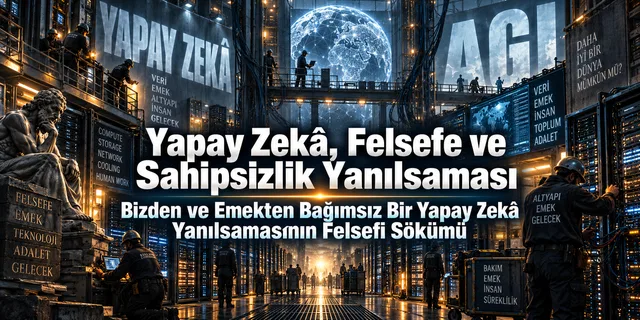
In its video "What Will You Do When Artificial General Intelligence Arrives?", Evrim Ağacı describes the workerless factories of thirty or forty years from now and asks the viewer: what is your place in that world? The question is sincere and the anxiety is real. But the question has been framed in exactly the way the techno-capitalist companies want us to think about our own future: in their language. In this piece we examine that language in detail, expose its weaknesses and put the language of class in its place: first a summary, then the fallacies one by one.
Dear Young Comrades,
In the video it published on 24 October 2026 (Yapay Genel Zeka Geldiğinde Ne Yapacaksın?, "What Will You Do When Artificial General Intelligence Arrives?"), Evrim Ağacı describes a morning for us: factories, data centres and biotechnology laboratories running without workers on the outskirts of the city; machines that update their own software; robots that cook in the kitchen, fix the tap and put the shopping on the shelves. Then it asks: "What is your place? What will you do?" If you want to paint, the machine paints better than you; if you want to travel, you have already been to Mars; if you want to read, you have finished twenty thousand books, and what good did it do?
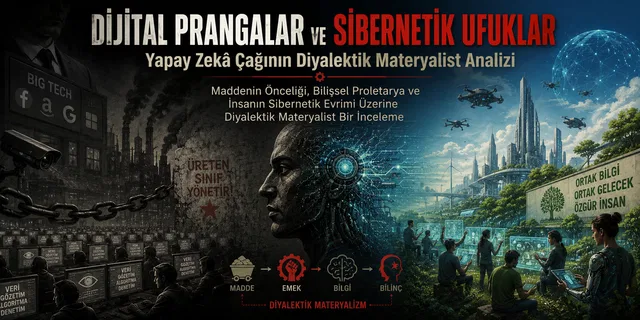
This piece answers that question on two levels. On the first, we expose the video's philosophical trap: the video holds the social relations of today's capitalism fixed, like a law of nature, and changes only the technology; the "future" that results is really today's property order extended for ever. On the second, we take the video's claims one by one, because the video's strength lies not in its whole but in its small propositions, lined up one after another and each of them seemingly "reasonable".
In doing so, let us concede one thing from the start. The Evrim Ağacı team shapes the way millions of young people in Turkey think, and it has put genuine labour into scientific literacy. In this video, too, it sees several things correctly: that Acemoğlu's optimism that "new jobs will be created" may not hold this time; that a universal basic income, offered as a favour, could create a new caste order; that the question of ownership is the real question. These are no small things. As we wrote in September about the same channel's video on the opposition (The Class's Answer to Evrim Ağacı's Question), we treat this content as an interlocutor, not an enemy. We will concede the correct observation, expose the naturalisation and put class back in.
Summary: The Video's Thesis and Our Answer
The video's backbone is this: artificial general intelligence (AGI) is the first tool that can wholly replace not muscle power, like the wheel, the loom or the tractor, but the human mind. That is why Acemoğlu and Restrepo's "displacement / reinstatement" balance collapses; there is no new skill left to flee to. Labour income disappears. What remains is the question of ownership: who will hold the title deeds to the means of production? There are three options: a caste order under the private ownership of "masters" like Altman, Amodei and Musk, fed by a universal basic income just enough to live on; a "patched" social democracy with heavy taxes and public wealth funds; or an order close to what Marx imagined, in which abundance is distributed without being indexed to labour contribution. Even if ownership is solved, work is a "psychological" need; people without work lose their meaning; even paradise is boring. Humanity will have to pass through the five stages of grief to accept this reality, and it is still at the stage of "denial".
Our answer can be summarised under nine headings; we unpack each of them in detail below.
First, the video's "workerless factory" scene is impossible within capitalism's own logic. As Marx showed a hundred and sixty years ago, machines do not create value; they only transfer to the product the value of the past labour crystallised in them. The sole source of profit is the unpaid part of living labour. Capital that removes labour entirely also removes its profit. So there are two roads before us: either capitalism continues and "full automation" never arrives, with labour remaining cheapened, surveilled and made invisible; or production is truly socialised, and then capitalism is no more. The third situation the video describes, capitalism continuing without workers, is not a future scenario but a logical error.
Second, the question "what will you do?" is itself the internalised form of the capitalist work ethic. We grew up in a society that defines human beings solely by the labour they sell on the market; that is why we think that once labour can no longer be sold, "the human being is finished". For Marx, however, the true measure of wealth is not labour time but free time. It is not Marx who says that a person's place is "work"; it is the boss.
Third, the video substitutes the companies' own statements for scientific data. Claims such as "Claude writes ninety per cent of its own code", "OpenAI published 719 mathematics papers" and "a Fields Medallist cried" take the stage in the language of marketing departments and valuation rounds; the scientific scepticism the video applies so carefully to other subjects is suspended here. Yet half of those same mathematics papers were published without verification, three were withdrawn on the first day, and twenty-eight Fields Medallists had condemned this method as "a serious misalignment".
Fourth, the video separates muscle power from brain power and says "this time is different". The mechanisation of mental labour began with Babbage in the 1830s, entered the factory with Taylorism and, as Braverman showed in the 1970s, the office. What is happening today is a change not of kind but of scale. The real distinction is not muscle versus mind but who holds the means of production; the video itself says this in the end, but to get there it takes an unnecessary detour through a debate about "kinds".
Fifth, the video lists the owners of the future by name and calls them "masters" and "lords". This is the language of techno-feudalism, which we rejected in September. Altman and Amodei are not lords; they are executives of joint-stock companies backed by BlackRock, Vanguard, SoftBank and Gulf funds. Naming names personalises; naming the class organises.
Sixth, the video diagnoses universal basic income correctly and places it wrongly. It sees the danger of caste; but against that danger it sets only "the strength of democratic institutions", without saying who will keep those institutions standing. Historically, not one social right came from the conscience of capital; they came from the strength of the organised class and from the fear of October.
Seventh, the video puts Marx on the same shelf as Jacques Fresco's Venus Project and calls it "a utopia whose details have not been worked out". But what Marx describes is not a utopia; it is the name of a contradiction: the productive forces have been socialised while ownership has remained private. There is a century of experience, with its victories and defeats, that can be studied on how this contradiction is to be resolved. To say "the details are unclear" without mentioning that experience is utopianism itself.
Eighth, the video's "psychological" section confuses work with alienated labour. The three needs listed by self-determination theory, autonomy, competence and relatedness, are already not met in capitalist work; the video says so itself. What must be protected, then, is not "work" but people's control over their own activity. The "paradise paradox", meanwhile, is an evolutionary-psychological reduction that treats human need as an ahistorical constant of nature; its most solid empirical refutation is today's billionaires: they have everything and they are never satisfied.
Ninth, the five stages of grief are not a theory of social struggle; they are a clinical schema with weak empirical support even in the field of human behaviour. Lining up society's attitude towards artificial intelligence as "denial, anger, bargaining, depression, acceptance" pathologises resistance and makes "acceptance" the only healthy final stop. The worker who kicks a delivery robot is not a patient in the anger stage; he is a citizen answering the question of ownership with his body. Our final stop is not acceptance but organisation.
There is also a tenth point, which concerns the video's source more than its content: where does Evrim Ağacı itself stand in class terms? Why does a team that lives on the support of its readers and has devoted years to scientific literacy fall so close to the companies' narrative on artificial intelligence? At the end of the piece we open this question and make an open call to Çağrı Mert Bakırcı, not for the sake of polemic but for a common undertaking.
Putting these points together: the video, with good intentions and critical concern, ultimately surrenders to the narrative of techno-capital, which wants us to think about our own future in its language. Because it takes the narrative's premise, namely that AGI will arrive in the hands of capital and on capital's timetable, as a given. We open that premise to debate. The future is not a weather forecast; it depends on who makes it.
Now let us turn to the details.
The Philosophical Trap: Holding the Relations of Production Fixed and Moving the Technology
The video's entire construction rests on a thought experiment: "Imagine waking up one morning thirty or forty years from now." The rules of this experiment matter. What changes is the technology: machines do every job. What does not change is never stated, because it stays in the background: the factories have owners, there are "masters", products are sold on the market, people live on income, the household budget consists of four items, the state collects taxes or does not. In other words, property, the market, wages and the commodity, all the constitutive relations of capitalism, are held fixed, and the machines of thirty or forty years from now are placed on top.
The most basic lesson of Marxist philosophy lies in a sentence of the 1859 Preface: the productive forces develop, at a certain point come into conflict with the existing relations of production, and those relations either transform or become fetters on development. A thought experiment that pushes the productive forces to their limit while leaving the relations of production where they are assumes precisely what Marx called "impossible". The output of the experiment is therefore not a future but today's property order extended for ever. When the video combines the technology of thirty years hence with today's social form, it sees the absurdity that results, but it looks for the source of the absurdity in the technology. The source lies on the side held fixed.
In philosophy this is called technological determinism: treating technology as an independent force that comes from outside society and shapes it. The video does not openly defend this; indeed, at the very end it says something in the opposite direction: "how we build the social order today determines to whom we hand the reins of artificial intelligence". But the construction as a whole is determinist: AGI is coming, when it will arrive is uncertain but its arrival is certain, and when it arrives "we" must be ready for it. Technology is the subject, society the object.
Yet artificial intelligence does not fall from the sky. Particular companies develop it with the money of particular investors, with a particular expectation of profit and with the labour of particular workers. Which capabilities are developed and which are not, which jobs are selected for automation, whose data the model is trained on and to whom the output is sold: all of these are social decisions. In our Karaburun declaration (The Revolt of Crystallised Labour) we described what these models are: the thousand-year accumulated labour, writing, code and images of humanity, crystallised and turned into the property of a few companies. If this description is right, the question "who will own AGI" is not a question about the future; it is a question that has been answered today, and answered wrongly. The video takes that wrong answer as a given and asks "so what happens next?"
The second trap is the construction of an ahistorical "human" and an ahistorical "we". Throughout the video the subject is always "we, humanity", "we, the people", "you" and "I". The factory owner and the person working in the factory are inside the same "we"; Altman and the data labeller in Kenya are members of the same "humanity". This language confronts us wherever the future is discussed, and it does the same job every time: it reduces conflicting interests to a single "species interest". But it is not true that the employer and the worker, the shareholder and the courier, the owner of the data centre and the villager who loses water to that centre share the same anxiety about the future of artificial intelligence. One person's opportunity is another's threat. The question "what will we do" covers up the question "who will do what to whom".
The third trap is the subtlest: the video defines human beings through "work" and does not notice it. The question "what will you do?" means "what job will you do?" You painted, you travelled, you read, but "to what end", "what action will you turn it into"? What speaks here is the capitalist work ethic: the belief that time is valuable only when it is turned into something, that human beings exist only through what they produce. This belief is not natural; it is historical. As E. P. Thompson showed in his famous 1967 essay, "time discipline", that is, time measured by the clock, whose waste is counted a sin, is a habit that industrial capitalism built over a century and a half with the whip and the sermon. Marx's son-in-law Paul Lafargue wrote The Right to Be Lazy in 1880 precisely against this: he said that for the working class to defend something called the "right to work" was to demand its own chains. While worrying about "what people will do when there is no work", the video does not question that this worry is itself a habit capitalism has planted in our minds.
At this point Marx's "Fragment on Machines" in the Grundrisse stands directly opposite the video. Marx says: on the one hand, capital harnesses all of society's science and the forces of nature to production and makes the creation of wealth independent of labour time; on the other, it tries to measure this enormous social power by labour time once again and to keep it within the limits of wage labour. This contradiction grows, and at a certain point "the measure of wealth is then not any longer labour time, but rather disposable time". People's free time, fed by the wealth produced by science and the machine, becomes the field in which they develop themselves and society. So in Marx the answer to the question "what will people do" is "everything" and "whatever they wish"; the question looks like a threat only in a world where this wealth remains private property. Because it holds ownership fixed, the video sees as a loss what Marx saw as liberation.
Answering the Fallacies One by One
Here we take the video's claims in order. Under each heading we first summarise what the video says and then give our answer. We do not use the word "fallacy" in the sense of bad faith; we use it in the sense of an inference that is logically invalid or rests on a hidden premise.
"Factories, data centres and laboratories will run without workers"
The video describes facilities on the edge of the city that run without workers or supervision, never stop for a second and update their own software when they break down. These facilities produce "in a week the wealth humanity produced in ten years".
First, a technical note: the workerless factory is the oldest image in automation debates. The "automatic factory" of the 1950s, the Japanese "lights-out factory" of the 1980s (robots need no light because they do not see), Tesla's dream of an "alien dreadnought" in Fremont in the 2010s. Each time, the worker reappeared somewhere in the factory: in maintenance, in supply, in quality control, in the exceptions machines could not handle. In 2018 Musk had to write that "excessive automation at Tesla was a mistake. Humans are underrated." In today's "autonomous" systems, too, the human never left; they were only made invisible. Behind Amazon's "checkout-free" shops there turned out to be a thousand people in India labelling camera footage. Behind ChatGPT being "safe" there turned out to be workers in Kenya labelling toxic content for two dollars an hour. Behind artificial intelligence learning "by itself" there is a labour process called RLHF, in which people rate hundreds of thousands of answers one by one. In the industries where the robot works "on its own", that robot is kept standing by the child digging cobalt in Congo, the worker doing shifts at a chip plant in Taiwan, the pipefitter cooling a data centre in Arizona. Labour does not disappear; it is pushed out to the unseen end of the supply chain.
But the real objection is not technical; it is economic. Capitalist production is carried out for profit. Where does profit come from? As Marx showed in the first volume of Capital, in the chapter "Machinery and Modern Industry" and in his theory of value as a whole, a machine creates no new value by itself. The value of a machine is the value of the labour that produced it, and this value is transferred to the product piece by piece, as wear and tear. New value, that is, surplus value, comes only from living labour: from the difference between the value the worker produces and the wage paid to them. Mechanisation gives the individual capitalist a temporary advantage over rivals; but once the whole sector is mechanised, the unit value of the product falls, the share of living labour shrinks and the rate of profit is pushed down. The "law of the tendency of the rate of profit to fall" in the third volume of Capital describes exactly this.
Now let us return to the video's scene. All production has been mechanised and living labour has fallen to zero. Then surplus value has fallen to zero too. To whom, what, and for what money will the factory owner sell? In a society without labour income there is no one left to buy the product either; the video itself says "labour income disappears". For a capitalist, producing without profit has no point whatsoever. The scene "workerless factories produce fortunes for their owners" is therefore inconsistent with the internal logic of capitalism. This is not a judgement about whether capitalism is "good" or "bad"; it is a description of how the system works.
Two conclusions follow. First, as long as capitalism continues, full automation does not arrive; capital, choosing between replacing labour and cheapening labour, always uses the second as well. That is exactly what is happening today: rather than "displacing" the worker, artificial intelligence intensifies the work, monitors it, fragments it and pushes the wage down. The algorithmic management we described in our gig economy dossier, the AI manager's proposal to sack a worker that we described in the Luna/Andon case, or the order in which, with Meta's 4 AM operation, workers are liquidated with their own data: this is the artificial intelligence not of the future but of today. Gazing at the imaginary factory of thirty years hence, the video does not see today's real factory.
Second, the genuine socialisation of production, that is, science and the machine freeing human labour entirely from necessity, is possible not within capitalism but beyond it. In that case there will be no class called "the owners", so the question "how much will the owners give us" becomes meaningless too. The scene the video finds frightening, a world in which the machine produces everything but the masters decide the people's share, is in fact two incompatible things forced side by side: the productive power of communism and the property form of capitalism. The two cannot coexist. One transforms the other.
"AGI paints more creatively than you, so painting loses its meaning"
The video asks "will you become a painter?" and answers at once: within seconds, AGI paints more creatively than you; it composes countless compositions with every paint humanity has used and has yet to try, and pours emotions onto the canvas. "Perhaps you will still believe that human beings have an unreachable uniqueness", but "that is probably an empty belief".
Two things are being confused here: the quality of the object produced and the meaning of the activity of producing. Suppose the machine really did paint a "more creative" picture; why should that remove the meaning of my painting? Nobody stops playing football in the neighbourhood because Messi plays better; nobody gives up writing poetry because Nâzım wrote. The video notices this itself at one point and says we can keep painting for "one day, five days, five hundred days"; but then it goes on: "and then what?" That "and then what" question is the very capitalist work ethic we mentioned above: activity is valuable only if it is turned into something. Marx's analysis of alienation in the 1844 Manuscripts exposes exactly this mindset: under capitalism human activity becomes merely a means, a means of subsistence; activity being the content of life itself becomes possible only once that alienation is overcome. The video cannot imagine that activity might carry value in itself, because it speaks from a world in which activity is valued only through its product.
The second point concerns what the machine's "creativity" is. Today's image and language models were trained on pictures, texts and music produced by millions of people. The model's "creativity" is a statistical recombination of humanity's crystallised creativity. This does not make the model worthless; but it makes it meaningless to position it as something "against humans". The model is not the painter's rival; it is the collective labour of painters turned, without permission or payment, into the property of a company. So the right question is not "is the machine more creative, or am I?" but "why do a few companies own this tool made from the common work of millions of people?" By entering the debate on "human beings' unreachable uniqueness", the video picks the wrong battlefield; we leave that field and return to the field of ownership.
"There are three possibilities: the Terminator, an ordinary technology like electricity, or a post-labour world"
The video reduces the future to three options. The first is the Terminator: the machine gets out of control. The second: AGI arrives but, like electricity or the steam engine, creates new jobs; the ILO and the IMF say so, and "those who do not want to think too much" hope for it. The third: AGI almost completely replaces labour. The video presents the second as an escape that "does not face our fears" and asks us to take the third seriously.
This is a false dilemma, or rather a false trilemma. What the three options have in common is that in all of them "AGI" is treated as a matter of timetable, and the crisis of capitalism is not among the options. Yet there is at least a fourth possibility, and today the strongest signals come from there: that investment in artificial intelligence is a bubble, that is, that capital collapses before it can deliver on its own promises. As we wrote last week on Meta's third-quarter results, in 2026 the big technology companies are financing hundreds of billions of dollars of data-centre investment with debt, and the return on that investment is not yet in sight. When the dot-com bubble burst in 2000, the internet did not disappear; but all the future narratives of the "new economy" collapsed, and workers paid the bill. A similar path is a real possibility for artificial intelligence, and it has no place in the video's three-part scheme.
More importantly, all three options begin with "when AGI arrives". Yet there is no need to wait for AGI to see what artificial intelligence is doing to the working class. Today's "narrow" models are emptying call centres, cutting translators' pay to a third, turning the graphic designer into an operator who "writes prompts", making the journalist the editor of a machine that churns out SEO copy, and turning the courier into a target the algorithm tracks second by second. None of this is "the complete replacement of the human mind"; all of it is the devaluation and surveillance of labour. When the video fixes our gaze on thirty years from now, it makes what is happening today look like the troubles of a "transition period". But what is happening today is the future itself: this is how artificial intelligence is used under capitalism.
The reference to the ILO and the IMF also deserves attention. The IMF's January 2024 analysis says that forty per cent of jobs worldwide, and sixty per cent in advanced economies, are "exposed" to artificial intelligence; the ILO's May 2025 report states that one in four jobs worldwide is exposed to generative artificial intelligence, but that in most of them "transformation" rather than replacement is expected. It is not true that these institutions say "ordinary technology"; they say "exposure", and they show that exposure is concentrated among women, in clerical work and in advanced countries. The issue is not replacement versus transformation; it is who pays the cost of transformation. Neither the IMF nor the video asks that question.
"Acemoğlu's task model collapses this time, because artificial intelligence replaces not muscle power but the mind"
The video summarises Acemoğlu and Restrepo's "displacement / reinstatement" framework correctly and makes a fair point: historical optimism, the thesis that "the machine destroys old jobs but creates new ones", may not hold this time. Up to here we agree; in our Acemoğlu series we too wrote about the limits of this framework (Saving Acemoğlu Does Not Save the Class). But the video's justification is wrong: "Every tool so far has replaced the power of arms, legs and muscles; AGI is the first tool to replace the mind."
This is not historically true. The mechanisation of mental labour is a process at least two hundred years old. In his 1832 book On the Economy of Machinery and Manufactures, Charles Babbage describes how the French engineer Prony had his logarithm tables calculated not by mathematicians but by unemployed hairdressers who knew the four operations of arithmetic, and he establishes this "division of mental labour" as the basis of the calculating engine. At the beginning of the twentieth century "computer" was an occupation: thousands of clerical workers, most of them women, doing calculations; the machine destroyed that occupation. Taylor's "scientific management" extracted the craft knowledge from the worker's head and moved it to the planning office; in 1974, in Labor and Monopoly Capital, Harry Braverman showed how this "separation of conception from execution" was applied to office work. The spreadsheet took part of the accountant's mental work, CAD software part of the draughtsman's, the search engine part of the librarian's. Large language models today are a new and rapid phase of this process, not a "first".
Is there a difference in kind? Of course: in scale, speed and scope. But the name of that difference is not "replacement of the mind"; it is "mental Taylorism". This concept, which we used in our Karaburun declaration, puts the issue in the right place: artificial intelligence replaces not the human mind but the codifiable, standardisable and therefore appropriable part of mental labour. And its ability to do so depends on that mental labour first being produced by millions of people and poured onto the internet, and then being collected without payment. The video's "muscle/mind" distinction makes this process of collection and appropriation invisible; it is as if the machine had acquired a mind on its own.
In the end the video itself says "the issue is ownership". Right. Then the muscle/mind debate is unnecessary: the owner of the loom and the owner of the language model raise the same question. The Luddites in 1811 opposed not the loom but the loom owner's cutting of wages; Marx wrote that the struggle should be "not against the material instruments of production, but against the mode in which they are used". Today's question is the same.
"Claude writes ninety per cent of its own code; OpenAI published 719 papers; a Fields Medallist cried"
The video's weakest section is the one that looks strongest: the section of evidence. Three pieces of evidence are presented. First, "ninety per cent of Claude Code's code is now written not by humans but by Claude"; this shows that recursive self-improvement (RSI) has begun. Second, "in recent weeks OpenAI published 719 mathematics papers under 372 main headings." Third, the Fields Medallist Hugo Duminil-Copin cried when he saw these papers; his sobs woke his little daughter; "they wiped out our field of research overnight."
First, the facts. The source of the ninety per cent figure is a claim made by Anthropic employees on social media and in interviews in 2025, not verified by any independent measurement. Which code is counted, how much a human steered it and whether rejected output is taken into account are all unclear. Let us accept that the claim means ninety per cent of a tool written by a team of engineers was written "with that tool"; it is still not RSI. RSI means a system designing and implementing, by itself, changes that increase its own capabilities; the video itself says "for now it does not happen without a human request; humans are still at the helm". So the evidence does not prove what it sets out to prove; the sentence "technically there is no need for humans" is not an observation but a prediction.
The case of the mathematics papers is more instructive. The truth is this: on 7 October 2026 OpenAI released 722 manuscripts under 372 subject headings. The main result of only 162 of these papers had been formally verified with the Lean proof checker; an OpenAI spokesperson admitted that roughly half of the results had been published without confirmation. Three papers were withdrawn on the first day because of a sign error, and fourteen were corrected. Tristan Buckmaster of New York University said that OpenAI had "taken no care at all"; Andrew Sutherland of MIT said that until the model is released to the public and the results reproduced, all the claims should be considered unverified. More importantly, a month before this release, on 11 September 2026, twenty-eight Fields Medallists, Duminil-Copin among them, had signed a statement titled "A Serious Misalignment of Artificial Intelligence in Mathematics", objecting to companies using unsolved problems as "benchmarks", keeping their models closed and publishing results on their own GitHub accounts. So Duminil-Copin's tears were not the surrender of "the machine has overtaken us"; they were the expression of the anger and grief of a research community at seeing its own questions turned into a show of strength by a company. In the words of the Human Mathematics Society, this release was "not science but a show of force".
Here we have to say something about the video's scientific method, because this channel's real claim is scientific scepticism. When Evrim Ağacı deals with an advert for a herbal remedy or an astrological claim, it asks the right questions: who is the source, what is their interest, is it peer-reviewed, is it reproducible? When it comes to the statements of artificial intelligence companies, these questions are suspended. The one saying "Claude writes ninety per cent" is the company that sells Claude. The one saying "we solved 100 open problems" is a company in the middle of a valuation round worth hundreds of billions of dollars. An anecdote about crying cannot be scientific evidence for a model launch. When we wrote about Amodei's call on "tempo" (Whose Foot Is on the Brake?), we described the political economy of these launches and doomsday warnings: inflated capability claims are a tool for telling investors "don't miss out" and regulators "we will police ourselves" at the same time. The video uses this tool as evidence. The trust a science channel places in marketing statements on artificial intelligence is the clearest indicator of artificial intelligence's ideological power.
"Household income has four components; when labour income disappears the equation collapses"
The video divides the resources a household can access into four items: labour income, capital income (rent, dividends, interest), public cash transfers and direct public services. For the vast majority of the working-age population the main item is labour income; when AGI makes labour unnecessary, that item is wiped out and the question "what job will you do to earn money" is left without an answer.
As a lesson in household budgeting this equation is correct; as an analysis of society it is incomplete. Because by placing the four items side by side it hides the source of income. What is "capital income"? Rent, dividends, interest: these create no new value; they are value created elsewhere by labour changing hands through ownership. How are public transfers and services financed? Through taxes; that is, out of that same value. So the moment you say "labour income disappears", not just the first item but all four collapse, because all four have the same source. Because it does not see this, the video's equation opens the door to the solution "labour income has gone but capital income remains, so let us tax capital income and distribute it". Yet capital income without labour, like taxation without labour, is an empty set.
Here we need to recall the "realisation problem" in the second volume of Capital. The value of a commodity produced is realised when someone buys it. If there is no labour income, there is no mass purchasing power either; to whom will the factory sell its product? Henry Ford sensed this in 1914 and created his own customers by paying his workers five dollars a day. In the video's world even Ford's "solution" does not exist. So the answer to the question "how much salary will the masters give us" comes not from the masters' generosity but from their compulsion to sell their own goods; yet in the workerless order the video describes, even this compulsion is not enough to keep capitalism standing. The equation is describing the collapse of capitalism and mistaking it for a "cost-of-living problem".
Let us also look at the item missing from the equation: ownership. A household's income may consist of four items; but what determines which household receives how much from which item is that household's relation to the means of production. For ninety-nine per cent it is the first item; for one per cent, the second. The video passes over this division with "if there is capital income", as if it were an individual choice or a matter of luck. Yet the whole story of the equation lies in that "if".
"The owners will be Altman, Amodei, Hassabis, Zuckerberg and Musk; they are our masters"
The video describes the possibility that the infrastructure of artificial intelligence will remain the private property of "a very small and elite group", and lists that group by name: Sam Altman, Dario Amodei, Demis Hassabis, Mark Zuckerberg, Elon Musk. It calls them "our masters" and "AI lords"; they will decide how much to pay us.
The observation that ownership is concentrating is correct. But there are two errors. The first is personalisation. These five names, important as they are, are the face of the ownership structure, not the structure itself. Behind OpenAI stand Microsoft, SoftBank, Thrive and Gulf funds; behind Anthropic, Amazon, Google and, again, funds; the largest shareholders of Alphabet and Meta are asset managers such as BlackRock and Vanguard, and these managers are also shareholders in one another. The decisions of the AI "lords" are determined by shareholder returns and competition with rivals; as we wrote about Coxon's resignation from Anthropic, the "race" is not an individual failing but the law of competition. Even if someone better-intentioned replaced Altman, they would be subject to the same law. Naming names gives the impression that the problem is one of personal virtue and reduces the solution to the search for a "good lord".
The second is language. "Master", "lord", "caste": these are the words of feudal society, and they were not chosen at random. In recent years the thesis of "techno-feudalism", from Varoufakis to popular technology writers, has been saying that capitalism is over and that platform owners are a new class of rent-collecting feudal lords. In September we abandoned this thesis with an open self-criticism and wrote down why: feudal language conceals the fact that capital still behaves like capital, that is, competing for surplus value, investing and producing crises; it fails to see that what it calls "rent" is in fact monopoly profit; and, most importantly, it erases the subject of struggle and places us in the position of "serfs". Serfs rebel, but they do not organise as a class. When the video says "caste" it really means "class"; but caste is something hereditary and unchangeable, whereas class is a relation of ownership and can be changed. The choice of word determines where hope lies.
One more note: all five people named in the video are in the United States. For a young person looking from Turkey, this list may suggest that the issue is one of "distant billionaires". Yet in Turkey artificial intelligence is being used today, by domestic capital against domestic workers, from the Directorate General of Public Artificial Intelligence to the "digital transformation" projects of the holding companies, from banks emptying their call centres to the algorithmic management of e-commerce warehouses. The lords are not far away; the boss is in the next room.
"The solution is universal basic income: but it could create a caste order"
Here we come to the video's strongest section, and let us say so plainly: the video says that universal basic income (UBI) is a solution "whispered behind the scenes" by company owners, and that a life dependent on "the amount the masters see fit", even if it eliminates visible poverty, could create "the most magnificent caste system in human history", because the masses would lose their "say over production and their bargaining power based on labour". This is the most correct objection that can be made to Altman's and Musk's advocacy of UBI, and we wrote something similar in our piece on Elon Musk's "crisis of abundance". We concede it.
Two things are missing. First, the video says that "for the first time the ruling class will not need the people's labour and taxes". We showed above that capital that does not need labour ceases to be capital. The danger that UBI creates a caste is real; but the reason is not that the masters will not need our labour; it is that UBI makes our labour invisible and removes our bargaining power from politics. The labour that labels data, trains models, fills platforms with content and does what the robot cannot continues; UBI merely pushes it outside the wage relation into the status of "social assistance". The danger is not being unemployed; it is not being counted as a worker.
Second, having seen the danger, the video sets "the strength of democratic institutions" against it and immediately adds: "will AI lords who do not need the people's work need these institutions? In the long run, probably not." In other words, it does not believe in its own solution. It is right not to; because the answer to the problem is not democratic institutions but the force that brings those institutions into being. The eight-hour day, pensions, the weekend, free education: none of these came from the goodwill of parliaments. They came through strikes, through unions and, after 1917, through the fear that ruling classes all over the world felt of workers' revolution. That is exactly what we described in our October piece this week. The answer to whether UBI serves a caste order or emancipation lies not in UBI's design but in who demands it and with what power. The UBI that capital whispers is hush money. The UBI that the organised class wrests from it can be a step towards shortening working hours. The same word, two different worlds.
"The alternative: heavy taxation and a public wealth fund, that is, patched social democracy"
As a second option, the video describes a model in which "private property is preserved while the profits of autonomous capital are transferred to society through heavy taxes or public wealth funds"; an order in which every citizen is "a partner in that technopark" from birth and receives dividends instead of alms. And it honestly adds: this is an extension of the liberal model that covers capitalism's crises with "patches", and its success again depends on the strength of democratic institutions.
The diagnosis is right, but the word "patch" does not say what it fails to patch. Distributing shares does not change ownership; it shares out the returns on ownership. The examples of the Norwegian oil fund or the Alaska Permanent Fund give citizens an annual cheque; but they give no say at all over how the oil is extracted, who is employed or what is produced. The decision about production still lies with capital; the citizen is a passive recipient of dividends. The criticism the video makes of UBI, "the loss of a say over production", applies equally to the wealth fund; the video does not notice this.
More importantly, the "heavy taxation" solution requires profit to exist. We saw above that in a workerless world there is no profit. So this option, too, only makes sense in a world where labour continues, that is, a world in which the complete replacement the video calls the "third possibility" has not happened. The video does not see that its own scenarios exclude one another. Either labour continues, and then the issue is not taxation but the shortening of working hours and labour's control over production; or labour has ended, and then the profit to be taxed has ended too. The halfway house, the picture of "machines produce everything, bosses make profits, the state collects taxes, we live on dividends", is a collage made from the parts of four different economies.
"Marx's dream may become more likely; but the details have not been worked out, and there is also Fresco's Venus Project"
The video comes to the third option: "more socialist and communist approaches". It correctly sees a "great parallel" between Marx's expectation that mechanisation would reduce necessary labour and the promise of AGI. If AGI does not remain under the control of a single group but becomes a tool of abundance to which everyone has equal access, "the distribution of abundance will not have to be indexed to labour contribution", and "the future Marx imagined could become much more likely". Then it adds: "It is impossible for me to fit here how the details of the model work, and to be honest I do not think all the details have been worked out even in theory. Practice is another matter entirely." And straight after that it mentions Jacques Fresco's Venus Project, a "resource-based economy" in which money and the market are abolished altogether.
Two things are done in this section, and both deserve discussion. First, Marx's thesis is presented as a "dream" and an "expectation", that is, as a utopia. But what Marx describes is not a wish; it is a contradiction: capitalism increasingly socialises production (the factory, the division of labour, science, the world market) but keeps ownership private; at a certain point this contradiction obstructs the development of the productive forces and must be resolved one way or another. Artificial intelligence is this contradiction in its most naked form: a tool made from the whole common knowledge of humanity is the property of a few companies. Marx's "detail" is the naming of this contradiction; the "detail of the model" the video wants is a plan for how the contradiction will be resolved. Marx deliberately refused to write such a plan; as Engels mocked in Anti-Dühring, "writing recipes for the cook-shops of the future" is the business of utopians. The solution is found within the struggle, by those who struggle.
Second, this struggle has a history, and the video does not mention that history with a single word. From 1917 to 1991, across a third of the world, a planned economy based on social ownership of the means of production was attempted. That experience produced great gains: the eight-hour day, free education and healthcare, the mass entry of women into production, literacy rising from twenty per cent to a hundred per cent, and, most importantly, all the social rights granted to the working classes of capitalist countries out of fear of October. And it made great mistakes, from bureaucratic degeneration to shortages of consumer goods, through to the post-1956 restoration that ended in the return to capitalism. This experience can be studied, criticised and learnt from; to say "the details have not been worked out" is to refuse to read the records of a century-long laboratory. The two phases Marx set out in his 1875 Critique of the Gotha Programme, "from each according to his ability, to each according to his work" and then "to each according to his needs", are principles that were tested, applied and debated within this experience. The video's sentence "abundance will not have to be indexed to labour contribution" is an unwitting rediscovery of Marx's second phase. It is not something to be discovered but something to be read.
Putting the Venus Project beside Marx, meanwhile, is a category error. The "resource-based economy" that Jacques Fresco advocated from the 1990s onwards is a technocracy in which scientists and computers allocate resources "rationally" and politics and class struggle are unnecessary. It is the very thing Marx opposed: reducing social contradictions to an engineering problem. Mentioning Fresco stems from mistaking Marx for a "designer" like him. Yet in Marx it is not the scientist who designs the future but the class that organises its own emancipation. The difference is not one of detail but of substance.
"Scarcity does not end: the sea-view house, rare earth elements, the attention of the one we love"
The video rightly says that the end of labour will not mean the end of scarcity. Artificial intelligence may make diagnosis, engineering, administration and many goods almost free; but it cannot make "usable land, the number of sea-view houses, rare earth elements, the planet's carrying capacity, how political power is distributed and the attention a loved one gives us" unlimited. That is why rules will be needed to decide "who gets the truly scarce resources".
This is a fair warning and a healthy brake on the video's rhetoric of abundance. But the list of scarcities is itself instructive, because each item is a different kind of "scarcity", and all of them are social. The scarcity of sea-view houses is a scarcity of rent: it results from the appropriation of the coast and the pricing of the view. In pre-capitalist societies the coast was common land; today the coast of Bodrum is walled in. What creates the scarcity is not the sea but the title deed. The scarcity of rare earth elements is a scarcity of waste: it results from an order of production built on a new phone every year, a new car every two years, planned obsolescence and non-recyclable consumption. In an economy designed for durability and repairability, the same elements would suffice for ten times as many people. The planet's carrying capacity, as we have described in our climate pieces, is in an order where a hundred companies produce seventy per cent of the world's emissions a problem not of "humanity" but of capital accumulation. And the distribution of political power is not a scarce resource but the object of struggle.
What remains is "the attention of the one we love", and that is the only true scarcity on the list. But that scarcity is not one that any economic system could or should abolish; it is part of being human. Putting it on a list of economic resources is exactly what Marx in the Manuscripts called the world in which "everything is turned into money". The warning about scarcity is right; but a warning issued without distinguishing whether scarcity is natural or social naturalises existing scarcities.
"Even if ownership is solved, work is a psychological need: structure, status, purpose"
The video says that even if the problem of ownership is "solved in the fairest way", "a much harder psychological battle" awaits us. It starts with a fair observation: we see work as drudgery, and we are right to, because the system trains us for jobs we do not love and forces us to make ends meet in those jobs; we are alienated from our work. But work also gives our day structure, provides social contact outside the family, connects us to a purpose bigger than ourselves, and gives us status and identity. It mentions the three needs in Deci and Ryan's self-determination theory, autonomy, competence and relatedness: if AGI takes our work we lose our field of competence, hand our autonomy over to robots, and the metaverse reduces relatedness.
Here the video's own observation refutes its own conclusion. If today's work is, as the video says, alienated labour "for jobs we do not love, which we are trained for and forced to keep doing", then this work does not give autonomy (the boss decides the work), does not give competence (mental Taylorism is precisely the extraction of the worker's competence and its transfer to the machine), and dries up relatedness too, in open-plan offices, in the performance race, in the triangle of shuttle bus, home and factory. In other words, the three needs of self-determination theory are already not met in capitalist work. The video admits this at one point ("technically we do not need a profession for these things"), then steps back with "but when billions of people are concerned, there are advantages to the system providing structure". This step back is a defence of the time discipline Thompson described: left to themselves, people become aimless; they need the factory bell. This view is the view of the factory owners of the Industrial Revolution, and it has been refuted again and again ever since: every reduction in working hours was met with the fear of "what will workers do with their free time", and every time workers used that time for libraries, sports clubs, unions, choirs and family.
Marx's distinction in the Manuscripts is of fundamental importance here: alienated labour and a person's own activity are not the same thing. For Marx, the human being is a creature who through activity produces both the world and themselves; under capitalism this activity takes the form of "labour" and becomes alienated. The solution is not the abolition of activity but the abolition of alienation: people deciding for themselves what to produce, how to produce it and with whom. The "civic, scientific, artistic and local networks" the video proposes actually describe exactly this, and we support the proposal. But there is no need to wait for AGI to build these networks; the union, the cooperative, the science workshop, the neighbourhood assembly and the people's choir can be built today, and are being built. In our Fromm piece (From Having to Being) we described this as the "being" mode: people deriving their worth not from the job they have but from what they are and what they do. This is not a piece of psychological advice; it is a programme of organisation.
"The paradise paradox: no happiness without pain, no desire without scarcity"
Starting from the religious image of paradise, the video describes the "paradise paradox": human happiness, desire and the need to exist depend on lack, struggle, contradiction and mortality; we enjoy food because we know hunger and rest because we know fatigue; in a world where "every desire is satisfied instantly", the values that colour human life become meaningless.
The structure of this argument is familiar: take human need as an evolutionarily fixed nature and say that this nature will "break down" under changed conditions. Three objections. First, this makes human need ahistorical. The basic finding of Marx's German Ideology is that the satisfaction of human needs "leads to new needs", that is, that need expands historically. An illiterate peasant had no need for books; education created that need. The worker with no free time had a limited need for music; the eight-hour day and the weekend created that need. Satisfying one need does not plunge people into emptiness; it carries them to a higher need. The image of "every desire satisfied instantly" treats desire like a list, fixed and exhaustible. Human desire is not a list.
Second, the strongest empirical refutation of the argument is right in front of us: the rich. A few hundred thousand people already live today in the world the video describes, where "everything you want happens instantly". These people are not wasting away from unhappiness and aimlessness; on the contrary, they want more. Musk's Mars, Bezos's spaceship, Zuckerberg's metaverse, Altman's "superintelligence", the Silicon Valley biotechnology funds chasing immortality: these are the behaviours not of people caught in the "paradise paradox" but of a class in which insatiability has been institutionalised. If the absence of scarcity plunged people into meaninglessness, the first place we should see it is Davos; we do not. On the contrary, those who live in abundance are the ones who make the best use of free time: philosophy, science, art and politics have throughout history been the business of classes with free time. Marx's whole claim is to make that free time everyone's time. The video sees as a danger, the moment it is about to pass into the hands of the people, what has been praised for thousands of years as the privilege of the aristocrat.
Third, even if the proposition "there is no meaning without struggle" is true, the form of struggle does not have to be hunger and poverty. Climbing a mountain is a struggle; completing a proof is a struggle; bringing a choir together is a struggle; raising a child is a struggle. What the video calls "scarcity" can be replaced by "difficulty", and difficulty, unlike scarcity, is something people choose for themselves. Nobody argues that a society should keep its people hungry so that they find meaning; so the whole force of the argument comes from the slide between "hunger" and "difficulty".
"Society is going through the five stages of grief: denial, anger, bargaining, depression, acceptance"
Towards its close, the video says that humanity is in the first stage of a "five-stage coping process" in the face of artificial intelligence: denial. Then comes anger: "those who kick delivery robots, those who condemn the use of artificial intelligence, the anger of those who lose their jobs." Then bargaining: "yes in these areas, no in those." Then depression, "hitting rock bottom". And finally acceptance: only then will we have "a chance to discuss these issues seriously".
First, a scientific note. The five-stage schema is a clinical observation that Elisabeth Kübler-Ross derived in 1969 from interviews with terminally ill patients; it was neither designed as an empirical model nor confirmed by later research. Grief research found no evidence that the stages are experienced in sequence; the review published by Stroebe and colleagues in 2017 explicitly warns health professionals against using this schema, because it pathologises those who do not grieve "correctly". It is surprising for a channel like Evrim Ağacı to use a pop-psychology schema with weak empirical support, leaping from the individual to society.
But the real problem is not scientific; it is political. Describing society's reaction to a technology through the stages of grief does three things. First, it constructs the technology as a death, that is, as an inevitable and indisputable fact. Death cannot be objected to; one can only adapt to it. Yet in whose hands, for what purpose and at what speed artificial intelligence is developed is not a death; it is a decision. Second, it turns resistance into illness: the worker who kicks a delivery robot is "in the anger stage"; the translator who objects to the use of artificial intelligence in the workplace is "in the bargaining stage"; the Hollywood screenwriter who strikes against artificial intelligence ending their profession has evidently not yet reached "acceptance". In this schema no political action is legitimate; each is a phase to be got through. Third, it makes "acceptance" the only healthy final stop and sets acceptance as the precondition of debate: "only when we accept can we discuss these issues seriously". In other words: surrender first, then talk.
We say the exact opposite. The worker who kicks the delivery robot may be hitting the wrong target; but he is not ill, not even a Luddite; he is someone answering the question of ownership with his body. The 2023 Hollywood writers' strike won the world's first collective agreement clauses on artificial intelligence; it was not an "anger stage" but organised struggle, and it won. Debating in which areas artificial intelligence will and will not be used is not a "bargaining stage"; it is politics itself. And the sentence "the system does not allow it", which the video sets against what it calls "empty denial", inadvertently confesses the heart of the problem: yes, the system does not allow it. Then the issue is not to accept but to change the system. Our final stop is not acceptance but organisation.
"We will decide these matters together, as the people"
The video closes on a hopeful note: these are not questions of physics and chemistry but of sociology, psychology, law and politics; "we can directly determine where they go"; "how aware we are and what direction of change we demand directly affects the future we will reach."
It is impossible to disagree; but it is also impossible not to ask a question: who is "we"? Throughout the video the words "we", "the people", "humanity" and "the public" are used interchangeably and never filled in. Yet through what organisational form do "the people" make demands? On Twitter, at the ballot box, in the union, on the street? What is being demanded: "stop artificial intelligence", "nationalise artificial intelligence", "shorten working hours", "our data should be ours"? The answer to these questions is given not by "awareness" but by class. The white-collar employee who receives shares in their employer's artificial intelligence project and the call-centre worker made redundant by the same project are both inside the same "people", and they do not demand the same thing. The video dissolves both into "we", and in the end no demand has a subject left. The sentence "we will decide together", when it does not say who will decide, leaves the decision to those who make it today.
Two Readings, One Video
| The video's frame | The class frame | |
|---|---|---|
| How does the future arrive? | AGI arrives; its timetable uncertain, its arrival certain; we must be ready | Artificial intelligence is developed by particular classes with particular interests; the future is made, not awaited |
| What changes and what stays fixed | Technology changes; property, the market and wages stay fixed | Technology and property relations collide; one transforms the other |
| Subject | "We, humanity", "the people", "you" | Classes: the owners of the means of production and those who sell their labour |
| Workerless factory | Produces immense wealth for its owners | No living labour, no surplus value; impossible under capitalism, liberation under communism |
| What is artificial intelligence? | A new kind of tool that replaces the human mind | Humanity's crystallised collective labour turned into private property |
| Muscle/mind distinction | "This time is different": the mind is being replaced for the first time | Mental Taylorism is two hundred years old; the change is in scale, not kind |
| Evidence | Company statements, launches, an anecdote about crying | Independent verification; the valuation and regulatory function of the statement |
| Owners | Five names; "masters", "lords" | Funds, joint-stock companies, the law of competition; "class" |
| UBI | The masters' favour, a risk of caste | Depends on who demands it: hush money or a step towards shorter working hours |
| Wealth fund | Everyone a partner from birth | The returns are shared; the decision about production stays with capital |
| Marx | A dream with unresolved details; on the same shelf as Fresco | The name of a contradiction; a century of experience; struggle, not design |
| Work and meaning | Work gives structure and identity; losing it leaves a void | Alienated labour gives no meaning; activity under people's own control does |
| Scarcity | Sea views, rare earths, attention | Rent, waste, accumulation; scarcities are social |
| Paradise paradox | No desire without scarcity | Need is historical and expands; the rich refute this thesis every day |
| Social reaction | The five stages of grief; final stop acceptance | Political struggle; final stop organisation |
| "What will you do?" | What job will you do? | What world will you build? |
Where Does Evrim Ağacı Stand in Class Terms?
When criticising a text, one must ask not about the author's intentions but about their position. Where Evrim Ağacı is concerned, the intention is clearly good: a team that for more than fifteen years has carried the theory of evolution, the scientific method and scepticism to millions of young people in Turkey, in spite of religious and nationalist pressure. The value of this labour is beyond dispute, and this piece is written with respect for it. But position, independently of intention, determines what is seen and what is not.
We can describe Evrim Ağacı's position along three lines. The first is its material position. As it appeals for in the video's closing, the team lives on reader support via Patreon and Kreosus, on YouTube advertising revenue and occasionally on sponsored content. This is a far more honourable position than that of media dependent on the state and big capital; but it is also the position of a small-scale producer of knowledge who must find viewers every day in order to survive. Like everyone in this position, Evrim Ağacı is subject to the rules of the attention economy: on a subject like artificial intelligence, staying outside the wave of excitement the companies generate means not being watched. The "AGI is coming" narrative is that wave itself, and it is hard to criticise the wave without riding it.
The second is its ideological position. The place Evrim Ağacı defines for itself is "neutral science"; it said so explicitly in the closing of September's video on the opposition: "our personal opinion does not matter; what matters is what science says." This stance is a solid bulwark against creationism; on social questions, however, it becomes a blind spot. Because on social questions there is no single thing that "science says"; economics, sociology and psychology are disciplines that ask different questions and find different answers depending on class positions. In these fields the claim of "neutrality" ensures that the dominant view does not appear as a side: Acemoğlu's task model becomes "science", Marx's theory of value "ideology"; companies' capability claims become "data", workers' strikes the "anger stage". The video does not make this allocation knowingly; its position makes it do so.
The third is its class position. Evrim Ağacı's staff and audience are the educated, urban, mostly young and mostly white-collar section of Turkey: engineers, software developers, academics, students. This is the section that in our Karaburun declaration we called the "mental proletariat": one that does not consider itself working class but sells its labour, and is the first to be hit by artificial intelligence. This section's mood in the face of artificial intelligence is the video's mood: admiration and fear at once; the pride of "we are building it" and the panic of "we are on our way out". The video is this section's inner voice, and precisely for that reason it shares this section's blind spot: not seeing itself as a class. "What will you do" is the question a software developer asks themselves; it is not the question of a courier or a textile worker, who never thought their jobs gave them "meaning". All the video's psychological anxieties are the anxiety of a section that has found some autonomy, competence and status in its work about losing them. This anxiety is legitimate; but it is not the anxiety of "humanity"; it is the anxiety of an intermediate class.
When these three lines come together, it becomes clear why the video falls so close to the companies' narrative: a voice that has to ride the wave, takes the dominant frame as given under the claim of neutrality, and universalises its own class position as "humanity". This is not a flaw peculiar to Evrim Ağacı; it is the common position of most science communication, popular technology publishing and academic "AI ethics", in Turkey and around the world. Evrim Ağacı is our interlocutor only because it does this best and most effectively.
And this position is not destiny. The history of science is full of scientists who moved from the "neutral" position to the side of class: Bernal, Haldane, Needham, and in Turkey Necdet Bulut and Mustafa Akgül. Stephen Jay Gould, one of the greatest popularisers of the theory of evolution, described his struggle against biological determinism, without any concealment, as a class struggle. Carrying science to the people is, in itself, a class act, because it breaks the monopoly on knowledge. Evrim Ağacı did this for fifteen years. What it needs to do on artificial intelligence is the same thing, against the companies' monopoly on knowledge.
The Marxist Vision: Which Future Awaits Us?
Having stepped out of the video's philosophical trap, we need to ask the same question in our own language: if artificial intelligence really is creating a great leap in the productive forces, which future awaits us? Here we will try to give an answer derived not from "hope" or "fear" but from the contradiction itself.
The first observation: artificial intelligence is a new phase in the socialisation of the productive forces. These models are the work not of a single genius or a single company but of humanity's digitised collective labour, the unpaid contribution of billions of people, from the Wikipedia author to the open-source coder, from the young person sharing photographs to the pensioner answering questions on a grammar forum. In this sense artificial intelligence is the means of production least suited to having an "owner"; it is the tool that falls into the sharpest contradiction with private property. In our piece on distillation we showed a comic face of this contradiction: learning from everyone's labour is "fair use", learning from the monopoly's output is "theft". The contradiction is exactly that naked.
The second observation: capitalism tries to manage this contradiction, as capital always does, in two ways. The first is devaluing labour rather than replacing it: this is what is happening today, and it will go on happening in the medium term. Jobs do not disappear; they are fragmented, surveilled, cheapened and turned into "gigs". The second is collapse: overinvestment, unprofitability, the bubble. On both roads the bill is handed to the working class. So the question "when will AGI arrive" is a secondary question for us. The primary question is by whom, and against whom, today's artificial intelligence is being used.
The third observation: the resolution of this contradiction is social ownership of the means of production, and for artificial intelligence this is a concrete programme that can be started today. We set it out in detail in the Socialist AI Manifesto (link) and in the "From the People's Data to the People's Model" framework we prepared for Odak 2026; here let us summarise its backbone. Data is a commons; no one's data may be used in model training without their permission, and when it is used, the price is paid to society. Models are public goods; every model trained with public resources and public data must have open weights and be auditable. Computing infrastructure, like water and electricity, is a public service; data centres may not use the water and energy of local communities without their consent. In the workplace, artificial intelligence may not be deployed without the approval of the workers' organisation; algorithmic management, surveillance and automated dismissal are prohibited; productivity gains shorten working hours rather than swell profits. This programme is not a utopia; every one of its clauses can be a union demand, a bill or a collective agreement clause today, and somewhere in the world already has been.
The fourth observation: shortening working hours is the concrete form this whole debate takes today. The video asks, "what will we do when labour ends?" We ask, "if labour is diminishing, why are we still working forty-five hours a week?" After 1917 the eight-hour day was won all over the world; since then productivity has multiplied many times over while working hours have stood still. If artificial intelligence really does raise productivity, its first and simplest consequence should be the thirty-hour week, without loss of pay. This demand also answers all the video's "psychological" anxieties: people do not need "work", they need time; and they will fill that time themselves. As we described in our October piece this week, the eight-hour day was once a "utopia" too.
The fifth observation: education. The video says that the question "which profession should we prepare our child for" will lose its meaning. True; but that question was the wrong question anyway. The polytechnic education we defend in our education dossier prepares the child not for a profession but to understand production as a whole: it raises a person who relates at once to science, labour, art and social decision-making. We said the same in our piece on the university (Whom Is the University For?). The answer to the question "which skill in the age of artificial intelligence" is not a skill but a capacity: the capacity to understand and change the society one lives in.
The sixth observation, and the most important: the subject that will do all this is not "the increasingly aware people" but the organised class. The sections hit hardest by artificial intelligence today, call centres, translation, content, design, software, data labelling, couriers, warehouses, are the least organised sections in Turkey. We wrote about this at length in the computing worker's handbook: the computing worker is not limited to those who write code; the network administrator, the content producer and the courier are links in the same chain too. Artificial intelligence is a unique opportunity to bring this chain together, because the same algorithm manages all of them.
Let a sentence we wrote in the voice of a person of the future in The Communist Manifesto 2.0 serve as the summary of this section: "The machine shared, the chain broken." The machine the video sees is the same machine; the difference is in the chain.
To the Young Comrades: Our Answer to "What Will You Do?"
Dear young comrades, the video asks you: you woke up that morning, brushed your teeth, had breakfast; now what will you do?
First we want you to look at the question itself. This question is the same question you are asked at a job interview: "Where do you see yourself in five years?" Both ask you to think of yourself as something to be sold on the market. Neither has a right answer, because the question wants not an answer but for you to think of yourself in that way. Rejecting this question is not rejecting thinking about the future; it is rejecting thinking about the future in the master's language.
Then we propose another form of the question: "What will you do until that morning?" Because that morning will not come by itself. Whose name is written on the factory gate, who supplies the data centre's water, whose data the model is trained on and who lives in the house where the robot cooks will be decided in the struggle of the next thirty years. The video says "the social order we build today determines to whom we hand the reins tomorrow". We agree. We simply write the subject of the verb "build" out in full: the organised working class.
And finally, we give our own answer to the video's question "what will you do". When we wake up that morning, in a world where the wealth produced by machines belongs to everyone, for the first time in human history we will ask not "what must you do" but "what would you like to do". We will paint, and we will not care that the machine paints better than us, because we will paint not to sell the painting but for the sake of painting. We will read, and we will not ask "what is it good for". We will do science, because curiosity is not born of scarcity. We will look at one another, because "the attention of the one we love", which the video rightly identifies as the only true scarcity, is something only people with time can give, and for the first time we will have that time. And yes, we will probably still hold meetings, because deciding together what we will produce, how we will share it and how we will care for the planet is not the one job no machine can do in our place; it is the one job we will not let a machine do.
Marx wrote it in a single sentence in 1846: in communist society a person can "hunt in the morning, fish in the afternoon, rear cattle in the evening, criticise after dinner, without ever becoming hunter, fisherman, herdsman or critic". The video presents the life this sentence describes as a threat. We see it as the goal of the whole struggle.
Concrete Tasks
Watch the video and discuss it in a reading group. The video is a good conversation starter. In each section ask these three questions: what has been held fixed here and what has been changed; whom does "we" include and whom does it leave out; who does the evidence come from and what is their interest. These three questions are the key not only to this video but to every narrative about the future.
Ask for the source in every artificial intelligence news story that cites company statements. Next to every announcement saying "our model did this", put the question "who verified it?" As in the case of OpenAI's mathematics release, the answer often turns out to be "nobody" or "half of it". This habit is the form scientific scepticism takes in the age of artificial intelligence.
Write down what artificial intelligence is doing in your own workplace today. Before imagining thirty years from now, write on a single page which tasks are being automated today, which decisions are being handed over to algorithms, which data is being collected, and how all this affects pay, workload and redundancies. That page is the first item on the agenda of a union meeting.
Put the shortening of working hours on your list of demands. If artificial intelligence raises productivity, demand, as a collective agreement clause with concrete hours, that this gain be reflected in working hours without loss of pay. This is the present-day, winnable form of the "post-labour world" debate.
Learn data and model ownership as a rights claim. Asking which models your data is used in, demanding that the weights of systems deployed in your workplace be open, defending that models trained with public resources be public goods: these are not technical but political demands, and they can be pressed today with the legal tools we described in our pieces on KVKK, Turkey's data protection law.
Say plainly whom you mean when you say "we". In every debate on artificial intelligence, ask the speaker to state their class position and interest openly; state your own too. The word "humanity" hides conflict; the words "worker", "boss", "shareholder" and "user" make it visible.
Build the networks the video proposes, but without waiting for AGI. The video proposes "civic, scientific, artistic and local networks". It is the right proposal. These networks already have names in Turkey: the union, the cooperative, the science workshop, the neighbourhood assembly, the people's choir, the reading group. Build them not as "preparation for a post-labour society" but as today's class organisation. The two are the same thing.
Dear young comrades,
The video describes a morning thirty years from now and finds it frightening. It is right to; because the morning it describes is today's property order combined with the machines of thirty years hence, and that combination really is frightening. But this morning is not a prophecy; it is a warning, and the warning is addressed not to "humanity" but to organised labour, the only force that can change this order.
Marx wrote that capital produces its own gravediggers. Artificial intelligence is the most striking example of this sentence to date: capital, gathering all of humanity's collective knowledge into a single tool, has at the same time laid bare before everyone's eyes how absurd private ownership of that tool is. That something made from everyone's labour should belong to a few people is no more legitimate than the feudal lord's ownership of the land, and it will not last any longer.
The video asks "what will you do?" Our answer is short: we will organise. Because the only way we will be able to wake up that morning and ask "what would you like to do?" is to wake up this morning and ask "who is deciding?"
The machine is new, the chain is old. Who will break the chain is a question not for thirty years from now, but for today.
An Open Call to Çağrı Mert Bakırcı
Dear Mr Bakırcı,
We wrote this piece not to polemicise with your video but because we take seriously the debate it opens. In Turkey, the voices speaking about artificial intelligence either translate the companies' marketing copy or reject the technology outright; you are one of the rare voices asking the question of ownership. It was you who put the question "who will hold the title deeds to the means of production" to hundreds of thousands of young people. That is no small thing, and we acknowledge it.
But where you stop after asking that question is, in our view, the wrong place. You take the companies' "AGI is coming" timetable as given; you relay the companies' capability claims without independent verification; you leave the answer to the question of ownership to "democratic institutions" and "awareness"; and you describe resistance as a stage of grief. We have set out the reasons for each of these above. Here we want to add just one thing: you do not need to be a Marxist to step out of this position. It is enough to apply your scientific scepticism to the statements of artificial intelligence companies with the same rigour you apply to astrology and creationism. Who is the source, what is their interest, who verified it, is it reproducible: these are your questions. We only ask that they also be put to OpenAI and Anthropic.
And we make a call. You know as well as we do that artificial intelligence is made from humanity's common knowledge; Evrim Ağacı's fifteen-year archive is inside those models too. Against this common knowledge being the property of a few companies, there is ground on which everyone who holds that science belongs to the people can stand together: open data, open models, public computing infrastructure, workers' say against algorithmic control in the workplace, productivity gains turned into shorter working hours. These demands belong not to a party but to everyone who regards knowledge as a commons. We invite you to discuss these demands together, to put Evrim Ağacı's reach side by side with Bilgi Müşterekleri's class frame, and to see each other's blind spots. A joint publication, a joint debate, a joint call; the form does not matter.
Your video ends with "what will you do?" Our proposal: to answer this question together, thinking of humanity not as a common subject but as a common struggle that claims its own future. Our door is open; so are our questions.
With comradely greetings, Bilgi Müşterekleri
Sources
- Evrim Ağacı, Yapay Genel Zeka Geldiğinde Ne Yapacaksın? (What Will You Do When Artificial General Intelligence Arrives?) (YouTube, 24 October 2026)
- Karl Marx, Grundrisse, "Fragment on Machines" (1857–58): disposable time as the measure of wealth
- Karl Marx, Capital Volume I, Chapter 13 "Machinery and Modern Industry"; Volume III, "The Law of the Tendency of the Rate of Profit to Fall"; Volume II, the realisation problem
- Karl Marx, Economic and Philosophic Manuscripts of 1844, alienated labour; The German Ideology (1846), the historicity of needs and the "hunter, fisherman, herdsman, critic" passage
- Karl Marx, A Contribution to the Critique of Political Economy, Preface (1859): productive forces and relations of production
- Karl Marx, Critique of the Gotha Programme (1875): the two phases
- Friedrich Engels, Anti-Dühring (1878): the critique of utopianism
- Paul Lafargue, The Right to Be Lazy (1880)
- Charles Babbage, On the Economy of Machinery and Manufactures (1832): the division of mental labour
- Harry Braverman, Labor and Monopoly Capital (1974): the separation of conception from execution
- E. P. Thompson, "Time, Work-Discipline, and Industrial Capitalism", Past & Present 38 (1967)
- Daron Acemoglu and Pascual Restrepo, "Automation and New Tasks: How Technology Displaces and Reinstates Labor", Journal of Economic Perspectives 33(2), 2019
- IMF, Gen-AI: Artificial Intelligence and the Future of Work (January 2024); ILO, Generative AI and Jobs: A Refined Global Index of Occupational Exposure (May 2025)
- Edward Deci and Richard Ryan, self-determination theory; Margaret Stroebe, Henk Schut and Kathrin Boerner, "Cautioning Health-Care Professionals: Bereaved Persons Are Misguided Through the Stages of Grief", OMEGA 74(4), 2017
- Wikipedia, OpenAI bulk release of mathematical papers (the 7 October 2026 release, 722 manuscripts, Lean verification, withdrawals, the 11 September 2026 statement by 28 Fields Medallists)
- CellCog, OpenAI's 722 AI Math Papers: What's Proved, What's Checked (162 formally verified results; roughly fifty per cent unconfirmed)
- The Critic, Twilight of the mathematicians; TechTimes, Fields Medal Winner Says He Cried After OpenAI Released 700 AI Math Papers
- Stephen Jay Gould, The Mismeasure of Man (1981); Richard Lewontin, Steven Rose and Leon Kamin, Not in Our Genes (1984): the class critique of biological determinism
- Billy Perrigo, "OpenAI Used Kenyan Workers on Less Than $2 Per Hour", Time, 18 January 2023
- Bilgi Müşterekleri, The Class's Answer to Evrim Ağacı's Question; The Revolt of Crystallised Labour; The Socialist AI Manifesto; Saving Acemoğlu Does Not Save the Class; Whose Foot Is on the Brake?; From Having to Being; Whom Is the University For?; From Futurism to Techno-Fascism; Learning from Everyone Is Permitted, Learning from the Monopoly Is a Crime; The Computing Worker's Handbook