A Class Soldier in Berlin: Elif Eralp
The Child Exiled by 12 September Took On Rent and Racism in Germany's Capital

A Class Soldier in Berlin: Elif Eralp
The child exiled by 12 September took on rent and racism in the capital of Germany
Dear Young Comrades,
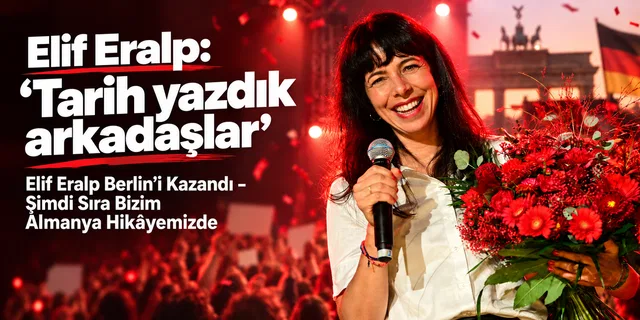
On 20 September 2026 Berlin goes to the polls. The Left Party's candidate stands first in the surveys, and that candidate's name is Elif Eralp.
Let us say this at the outset: this is not a "a Turk's success" story. This is the story of the daughter of a family driven out of Turkey by a military coup forty-six years ago, standing up to the housing monopolies and to racism in the capital of Europe's largest economy. That is, not a migration story, but a class story.
This piece tells what Elif Eralp is fighting against, what she has said in her own words on Gaza and on migrants, where the migrant worker stands in Germany today, how Germany went not forward but backward after the Wall came down, and from what class ground racism is fed. And at the end it has a single sentence:
We stand with you, Elif!
Who is this woman? A chronological introduction
Read item by item, Elif Eralp's biography looks like an individual rise. Read as a whole, it is a cross-section of the class history between Turkey and Germany.
September 1980 — Exile. After the 12 September military coup, her family flees Turkey for Germany under political repression. Her mother is pregnant on the journey. So the reason Eralp was born in Germany is directly the counterrevolution in Turkey. This is the shared fate of the greater part of migration from Turkey: labor migration and political exile are two faces of the same coin.
1981 — Born in Munich. The family moves to Dortmund, then to Hamburg; she spends her school years in Hamburg-Altona. That is, she grows up in a migrant neighbourhood.
2001–2007 — University of Hamburg Faculty of Law. She passes the First State Examination in Law.
2007–2009 — Legal clerkship. She works at the Hamburg Local Court, UNHCR, and the German Embassy in Ottawa; she passes the Second State Examination. Field of specialisation: residence and asylum law. She builds her profession at precisely the point where the migrant collides with the state. In her own words, the law is an instrument of the struggle for equal rights.
2010 — Legal-policy adviser to the Left Party group in the Bundestag.
2017 — Joins the Left Party.
2018 — Elected to the leadership of the Berlin state organisation.
2019 — A founder of Links*Kanax. A federal association aiming to make migrant-origin workers an autonomous focus inside the party. The political stance here matters: not waiting to be represented, but organising representation.
2021 — Member of the Berlin House of Representatives. Elected from Friedrichshain-Kreuzberg. The same year the Deutsche Wohnen & Co Enteignen referendum, providing for the socialisation of the big housing monopolies, is passed by popular vote — and is not implemented by the Senate. Eralp's political line hardens in exactly this gap.
2023 — Re-elected in the repeat election. As the group's spokesperson for migration, participation, and the fight against discrimination, she becomes one of the hardest names in the migration-policy debates.
2024 — Deputy leader of the parliamentary group.
May 2025 — Deputy chair of the Berlin state organisation.
9 October 2025 — The state executive nominates her unanimously.
15 November 2025 — The state congress confirms her candidacy for Governing Mayor (Regierende Bürgermeisterin) of Berlin.
20 September 2026 — The election. In the latest polls the Left Party is in the 20–22 percent band, first or neck-and-neck with the CDU; the AfD 17–18, the Greens 16, the SPD 12–13. Compared with 2023 the Left Party is up about 8–9 points. With some 18,000 members it has become Berlin's largest party by membership; it takes in an average of 20 new members a day, and its base is growing younger and more female.
The sentence in her campaign video compresses the whole chronology into a single line:
"People like me aren't actually supposed to become mayor in this country."
What is she fighting against? Elif Eralp's front line
Who a candidate is becomes clear in who she stands against. Eralp's parliamentary work and campaign programme are not a scattered "list of good intentions"; they are a connected front line.
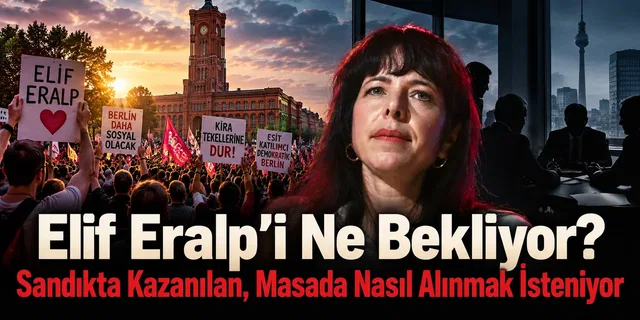
Against the housing monopolies. The heart of the campaign is here: socialisation of the big real-estate companies by purchase, and the letting of the housing at affordable rents. In her own constituency she is fighting the expiry of social-housing occupancy commitments that throw thousands of units onto the market; she defends the strengthening of municipalities' right of first refusal (Vorkaufsrecht); she demands that the 2021 referendum be implemented. Her sentence is plain: "I don't want big real-estate companies deciding which way our city will go."
Against racist police practice. Arbitrary identity checks, racial profiling, police operations that target migrant youth in neighbourhoods such as Görlitzer Park are standing items on her parliamentary agenda. She demands an independent investigation of racism inside the police and the introduction of a stop-receipt system.
Against deportations and the refugee regime. Closing the vast refugee camp at Tegel, abolishing the stigmatising payment-card (Bezahlkarte) that monitors refugees' spending, objecting to arbitrary return practices — all of it is a direct extension of her identity as a residence-law lawyer.
Against second-class citizenship. Speeding up the naturalisation procedure, defending dual citizenship, and the demand for the right to vote for everyone who lives in Berlin. This last is perhaps the most strategic heading for migrant communities.
Against institutional discrimination. A concrete action plan against anti-Muslim racism, a diversity quota in public institutions, amendment of the "Neutrality Act" (Neutralitätsgesetz) — which imposes a headscarf ban on teachers — in line with court rulings. That is, she treats discrimination not as a "feeling" but as an institutional mechanism to be dismantled by regulation.
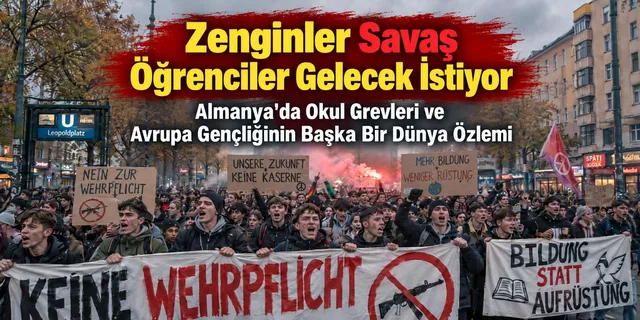
Against cuts and the war budget. The source of the cuts carried out in the name of "reform" in health, care, and pensions is in the open: military spending raised to record levels. Rearmament and social demolition are not two separate policies; they are two faces of the same budget line.
And Turkey. In the House of Representatives she also spoke against the arrest of Istanbul's metropolitan mayor; she carried the demand for democracy and freedom onto the ground of solidarity with the opposition in Turkey. For Berlin's worker from Turkey, this is where the false wall between "politics here" and "politics there" comes down.
Looked at heading by heading, "human rights" appears. Looked at together, what appears is this: the fight over who will appropriate the value produced in the city.
In her own words: Gaza
Elif Eralp's most comprehensive statement on Gaza is the call she made on 10 October 2024 as the parliamentary group's spokesperson for migration, participation, and the fight against discrimination. It is not a diplomatic wish-text; it is a concrete administrative demand:
"In the war that has continued since Hamas's brutal massacre of 7 October 2023, tens of thousands of people in Palestine, Lebanon, and Israel have been killed and wounded by the Israeli government's military. The humanitarian situation in Gaza is catastrophic and is worsening every day. The UN, human rights organisations, and even the Foreign Office report that the civilian population's basic provision has completely collapsed, and that they have been cut off from vital resources such as electricity, food, water, and medical care."
"The consequences are immediately life-threatening, especially for the war-wounded, pregnant women, the chronically ill, people with disabilities, and children. That is why organisations such as the Berlin Refugee Council are demanding these people's admission to Berlin. We take up this demand as our own. The Senate must meet its humanitarian responsibility; it must admit people from Gaza and Lebanon, especially the stateless Palestinians there, to Berlin, and it must open state admission programmes to that end."
"Berlin is home to Europe's largest Palestinian community. Many people have lost relatives in the war or are still fearing for them. They must be given the chance to bring their relatives to them. Berliners already have such a state arrangement for Syrian, Iraqi, and Afghan relatives; it needs to be extended."
"I also call on the Berlin Senate to take federal-level action to end the freeze on processing Palestinian applications imposed by the Federal Office for Migration and Refugees, which courts including the Berlin Administrative Court have found to be unlawful."
"Berlin prides itself on being a 'safe harbour city.' It must meet its humanitarian responsibility when it comes to the wars in Gaza and Lebanon and the victims of those wars as well."
The class importance of this text is here: in Germany, to speak about the Palestine question is an act that can end a career. The state apparatus has criminalised criticism under the name of "reason of state" (Staatsräson); demonstrations have been banned, associations closed, police violence increased in migrant neighbourhoods. In such a climate, for a member of parliament to put forward concrete, practicable, bureaucracy-binding demands such as the admission of Palestinians and the processing of asylum applications is a heavier stance than a symbolic gesture of solidarity.
To be honest: among the forces in the German parliament, the Left Party was the only party that accepted naming what is happening in Gaza as genocide, and it carries the message "against war and genocide" on its campaign posters. At the same time, that Eralp has used a more cautious language on this heading than some other candidates inside the party is also a matter discussed in the press. There is no need to hide this: a socialist's task is not to present the candidate as flawless, but to stand behind the demands. Our expectation is clear — the admission-programme pledge must remain on the table after the election as well, and the language against arms exports and the "reason of state" doctrine must harden.
In her own words: Migrants and institutional racism
20 March 2024, International Day for the Elimination of Racial Discrimination. Eralp's statement directly rejects the liberal frame that treats racism as individual prejudice:
"We demand that the fight against racism finally be understood by the Senate as a central task of government action. Above all, action must be taken against the structural and institutional racism that is rooted in public institutions, state structures, laws, and executive action."
She then lists, one by one, the work the government has left undone: none of the expert commissions' recommendations implemented; the plan to ban racial profiling and introduce a stop-receipt system abandoned; the ban that discriminates against teachers who wear the headscarf not lifted despite the highest court rulings; school regulations not rewritten with an anti-discrimination eye; no step taken against anti-Roma and anti-Sinti racism.
And the hardest sentence:
"As in the case of Görlitzer Park, racist debates are being whipped up by the Governing Mayor himself. On top of this come calls for a stigmatising payment card, more deportations, and more migration controls — these are grist to the mill of those drawing up deportation plans."
In this single sentence the whole argument of this piece is present: the establishment parties normalise the far right's language by implementing its demands in a "reasonable" form. The road opened to the far right is being paved not by the AfD, but by those who say they are against the AfD.
Eralp's other concrete demands concerning migrants sit in this same frame: extending the existing admission programmes for Syrian, Iraqi, and Afghan relatives; housing refugees not in central camps but in neighbourhoods, in decent housing; abolishing the payment card; speeding up naturalisation and dual citizenship; the right to vote for everyone who lives in Berlin.
Let us look at this contradiction again: hundreds of thousands of people who keep Berlin's transport, hospitals, construction sites, and kitchens standing cannot cast a single vote on how that city will be governed. This is not a deficit of democracy; it is its class boundary. The human being accepted as labor-power is rejected as a citizen. Eralp's demand for "the right to vote for everyone who lives in Berlin" strikes exactly this wall.
Being a migrant in Germany: A sixty-five-year status
To understand Elif Eralp's struggle, one must know the age of the structure she faces.
1961: The "guest worker" lie. When the labor agreement between Turkey and Germany was signed, German capital's need was clear: cheap, unorganised, temporary, and, when necessary, returnable labor-power. The concept "Gastarbeiter" is not a courtesy; it is a legal status: work, produce, but do not belong here. Equal sweat in the factory, unequal status in the law.
Permanence and denial. People stayed, their children were born here, their grandchildren went to school here. But for decades the state maintained the official lie that "Germany is not a country of immigration." This denial was not innocent: it legitimised the exclusion of the migrant population from political rights.
Today's concrete picture. The migrant-origin worker in Germany works, on average, in lower-paid, more precarious, more shift-based, more subcontracted jobs: logistics, cargo, construction, cleaning, gastronomy, care. They bear a disproportionate risk of workplace accidents and occupational disease. They live rental discrimination directly — on the same listing, with the same income, the applicant whose name is not German receives fewer invitations. Their child is steered into class-segregated schools. And on top of all this, if they are not a citizen they cannot vote in any election.
The migrant is not only a victim: DİDF and organised accumulation
The picture told so far can make the migrant worker look like only the party that is subjected. Yet migration from Turkey in Germany has for forty-five years also been an organised class experience.
Its most concrete expression is DİDF — the Federation of Democratic Workers' Associations (Föderation Demokratischer Arbeitervereine). Note the founding date: December 1980. That is, the same year as the 12 September coup that drove Elif Eralp's family from Turkey, inside the same wave of exile. The coup drove a generation from the country; that generation entered the factory in Germany, and one of its first acts was to found associations. This is the proof that the migration carried not a passive but a political character.
DİDF's line has been clear from the start: to organise workers of Turkey origin — Turkish and Kurdish — not on the axis of nationality, but on the axis of class. Today it operates with more than forty local associations in Germany, and in five further countries in Europe. Its fields of work are precisely the headings this piece is about:
- The trade-union ground: election of migrant workers as works-council representatives (Betriebsrat) in unions such as IG Metall and ver.di; rank-and-file organising; making the migrant worker visible in strike and collective-bargaining processes.
- Education: campaigns against the steering of migrant children into class-segregated schools.
- Citizenship rights: the demand for the vote, naturalisation, and equal political participation — the same line as Eralp's demand for "the right to vote for everyone who lives in Berlin."
- Antifascism: neighbourhood solidarity in the face of the attacks stretching from Mölln to Solingen, from the NSU to Hanau; DİDF Youth (1996) continues this line through antifascism, antiracism, and antimilitarism.
DİDF is not the only example. Berlin's present fabric of struggle is made of many structures that feed one another: the tenant committees of the Deutsche Wohnen & Co Enteignen campaign; neighbourhood-based anti-eviction initiatives; refugee-rights organisations such as the Berlin Refugee Council (Flüchtlingsrat Berlin) — from whose call Eralp's Gaza admission-programme demand was born by taking it up directly; migrant women's organisations; unions' migrant commissions; the Palestinian community's solidarity networks; and the circle of the Labour Party together with Evrensel's network of reader-correspondents in Germany.
The conclusion that follows is politically decisive: Elif Eralp's candidacy did not fall from the sky. It stands on an organised experience accumulated for forty-five years in association halls, factory canteens, union congresses, school parents' meetings, funerals and commemorations. It is not one person's rise; it is an accumulation breaking the surface.
And the reverse is also true: it is these structures that will hold that position after the election. A mayoralty, if there is no organised class behind it, is dissolved in short order inside the regulations and budget discipline. What will protect the result that comes out of the ballot box is the association, the union, and the tenant committee.
The Wall came down, Germany went backward
When the Berlin Wall fell in 1989, the story told to the world was "the victory of freedom." Thirty-seven years later, let us draw up the balance sheet from the worker's point of view. Because since the Wall came down, Germany has gone not forward but backward.
1990–1994: Treuhand and the liquidation of the East. The GDR's publicly owned industry was privatised at plunder speed by the Treuhandanstalt. Millions of jobs vanished, whole regions were deindustrialised, an entire generation was left with the feeling of having been "devalued." That the AfD's strongest fortresses today are precisely those regions is not a cultural coincidence; it is the political bill of a thirty-year dispossession.
1991–1993: Pogroms. Hoyerswerda (1991), Rostock-Lichtenhagen (1992) — arsons applauded by thousands, watched by the police. Mölln (1992) and Solingen (1993) — the burning of families from Turkey in their homes, women and children burned alive. These attacks coincide with the same years as mass unemployment in the East and the crisis atmosphere in the West. It is not a coincidence.
1993: the Asylkompromiss — the state's answer to the street. While migrants were being burned in the street, parliament passed the constitutional amendment that in practice abolished the right of asylum. That is, against racist violence the state protected not the migrant, but the demand of racist violence. This is the most instructive moment in Germany's own history: the far right can have its programme implemented without coming to power.
2003–2005: Agenda 2010 and Hartz IV. Under a social-democratic–Green government, unemployment benefit was slashed, the low-wage sector grew enormously, temporary and subcontracted employment was normalised. For the first time at this scale the working class was split into a layer of "working poor." The material source of the anger of the precarious worker who votes AfD today was laid here — and those who produced that anger today call people into a front of "democracy against fascism."
2000–2007: the NSU murders. A neo-Nazi cell killed ten people over years, nine of them of migrant origin. For years the state investigated not the perpetrators but the victims' families; it named the murders the "Döner murders"; intelligence files were destroyed. The issue here is not a few degenerates; it is institutional racism.
2019 Halle, 2020 Hanau. The synagogue attack in Halle; the murder of nine migrant-origin young people in a single night in Hanau. Hanau is a breaking point in the collective memory of Germany's migrant generation: the moment the sentence "we belong here" was answered with bullets.
2024: the "remigration" plan and the street's answer. When the secret meeting at which far-rightists discussed the deportation of millions of people of migrant origin was exposed, hundreds of thousands of people marched in the streets of Germany. This is the proof that the antifascist potential in this country is still alive.
2025: the crack in the wall. In January 2025 the CDU's motion on migration policy obtained a majority in the Bundestag with AfD votes. Postwar Germany's "firewall" (Brandmauer) doctrine was in practice breached. Today it is openly discussed that a name who "does not close the door outright" could be prepared in Merz's place.
2026: now. In Saxony-Anhalt the AfD is around 42 percent in the polls; on 6 September there is a chance of producing the first AfD state premier of the postwar period. The same month, on 21 September, IG Metall called factory actions against layoffs, and on 26 September rallies against social cuts in 14 cities. The plan to lay off tens of thousands of workers at Volkswagen is accumulating anger at the base.
So the ground covered in the thirty-seven years after the Wall came down is this: public property was liquidated, social rights were slashed, the right of asylum was in practice abolished, racist violence was institutionalised, and the far right settled at the centre of parliament. The Wall came down; in its place far higher walls were raised in front of the worker.
Why is racism rising? Not a moral question, a class question
The liberal intellectual likes to read the rise of racism as "ignorance," "lack of education," or a "crisis of values." This reading is comforting, because it requires changing nothing. Yet racism is not an error of ideas; it is a function. It is fed by these four mechanisms:
One: the splitting of labor-power. Capital always needs a layer of workers whose legal status is weak. The worker who carries the fear of deportation cannot strike, does not go to the union, cannot ask about overtime. Every regulation that cuts migrants' rights in fact cuts the bargaining power of the whole working class. Racism is a stick that drives wages down — and because the stick hits everyone, hostility to migrants is also to the native worker's harm.
Two: the horizontal diversion of anger. In periods of crisis, workers' anger flows either upward (toward capital) or sideways (toward the neighbour). Capital finances the second. To say "rents went up because there are too many migrants" makes the landlord and the real-estate fund invisible. To say "the hospital queue is long because there are refugees" acquits the minister who signed the health cuts. Racism is the turning of the class contradiction's vertical axis onto the horizontal axis.
Three: the false compensation of dispossession. The person who has lost everything is promised superiority, if nothing else, for being "native." This is a payment that yields no material gain but distributes a psychological rank. Because it is free, it is also, from capital's point of view, the cheapest form of loyalty.
Four: normalisation by the state. Racism does not grow only from the street upward; it is also legitimised from above downward. From the 1993 asylum settlement to today's payment-card and deportation packages, the establishment parties normalised the far right's language by implementing its demands in a "reasonable" form. In Eralp's words: these "are grist to the mill of those drawing up deportation plans."
The conclusion that follows is clear: the "firewall" strategy has structurally failed. A party that signs the same cuts package, passes the same deportation law, and looks the other way at the same layoffs cannot give the AfD a moral lesson. You cannot produce the disease and sell the medicine.
The real antidote to the far right is not a cordon but a class alternative. A concrete line of struggle against rent, against layoffs, against cuts, and the organised expression of that line. What is happening in Berlin today is exactly this: it is the Left Party that benefits most from the growth of social struggle. This is not a coincidence; it is the confirmation of this law.
Berlin: not a "Multikulti" shop window, but the composition of the working class
Last July, in the piece A Communist Traveler in Berlin: The Dialectic of Space and the Trail of Truth, I argued this: the city is not a geographical surface; it is the form of production relations carved into stone, asphalt, and the tenancy contract.
Berlin is the most concentrated example of this. The streets where the Spartacists were bloodily suppressed in 1919, the squares where fascism marched from the ballot box and with the consent of the elites in 1933, the line along which two modes of production stood face to face for twenty-eight years as a concrete stroke, the archives of Nazi terror and of Stasi bureaucracy, and the neighbourhoods where gentrification advances today — all are layers of the same city.
Berlin's structure called "multikulti" is also one of these layers. How it is read is decisive:
The liberal reading: Multikulti is a shop window. Kreuzberg's breakfast, Neukölln's nightlife, festivals, the slogan "diversity is richness." In this reading the migrant is a colour that contributes to the city's tourist appeal.
The materialist reading: Multikulti is the actual composition of Berlin's working class. Kreuzberg, Neukölln, and Wedding are not cultural mosaics; they are neighbourhoods in which labor-power is reproduced. The person here works in construction, cargo, the kitchen, cleaning, care, the hospital. Structural racism here is not an abstract prejudice; it is a material mechanism that suppresses wages, de-unionises, makes rent unpayable, sends the child to a segregated school, and makes police stops arbitrary.
Berlin is also home to Europe's largest Palestinian community — and over the past two years this community has been the direct target of demonstration bans, police violence, and collective-suspect treatment. So the Gaza question is not "foreign policy" for Berlin; it is an internal question lived in this city's migrant working-class neighbourhoods. Eralp's admission-programme demand must be read on this ground.
And gentrification is the spatial liquidation of this position. When a housing monopoly buys a neighbourhood, it does not tear out that neighbourhood's culture; it tears out the worker who is there. Rent is today, in Berlin, the second and most visible form of the appropriation of surplus-value: a portion of the value produced in the factory is transferred, at the start of the month, into the real-estate fund's account.
Two programmes, two answers
Two separate answers are being given to the same crisis. The difference is not moral; it is of class.
| Problem | The AfD's answer | Elif Eralp's / the class struggle's answer |
|---|---|---|
| Rents in an unpayable state | "Migrants are filling the housing" | Socialisation of the housing monopolies, a rent cap, right of first refusal, public housing |
| Layoffs, industrial crisis | "Foreign workers are driving wages down" | Trade-union organisation, joint action against layoffs (21 September) |
| Cuts in health and care | "Social benefits are going to the migrant" | A social budget against the rearmament budget, mass rallies against cuts (26 September) |
| Collapse in the schools | "There are too many foreign children in the classrooms" | Investment in public education, an end to class segregation |
| "Security" | Police pressure, deportation, racial profiling | An end to arbitrary stops, investigation of racism in the police, stop receipts |
| The migrant's status | Deportation, "remigration" | Fast naturalisation, dual citizenship, the vote for everyone who lives in Berlin |
| Gaza and war | A "clash of civilisations" language that feeds racism | A state admission programme, processing of asylum applications, a stance against war and genocide |
| The address of anger | The one below against the one below | From below upward: from the worker to capital |
| Form of organisation | A leader-party that turns the mass into spectators | Union, tenant committee, neighbourhood solidarity, a rank-and-file campaign |
In a single sentence: the AfD turns anger horizontal; class struggle sets it vertical.
We stand with you, Elif
Dear Elif,
Your candidacy is not, for us, an item of an election campaign. It is a line stretching from that September when your mother crossed a border in her womb to today.
12 September sent hundreds of thousands of people in this country to torture, prison, exile. The children of those exiles grew up in Germany's factories, mines, kitchens. For forty years they were told "you are guests." Their names were not pronounced, their diplomas were not recognised, their homes were burned, their murders were called "Döner murders," their killers were hidden in front of the state's eyes. And now that generation's daughter is a candidate for mayor in the capital of Europe's largest economy.
We greet this not as revenge, but as a settling of accounts.
We support you not because you are from Turkey, but because the programme you defend is the programme that stands closest to the programme of the working class. What being from Turkey means is that you carry this programme from the experience of those most oppressed. That you, as a lawyer, built your career in residence and asylum law — that is, that you took sides at the point where the state comes down hardest on the migrant — is for us a reference in itself. To be able to say that a baby left without water in Gaza has to do with an administrative decision in Berlin takes courage in this country today.
You say, "People like me aren't actually supposed to become mayor in this country." Correct. This order was built for exactly that. That is why your winning will be the order breaking its own rule.
We stand with you, Elif. Beside the tenants of Kreuzberg, Neukölln, Wedding. Beside the worker who comes off shift and picks up their child from school. Beside the migrant youth who cannot enter the polling station because they have no vote, but who will go door to door and speak for you. Beside our Palestinian neighbour who has lost a relative in Gaza and lives, in Berlin, mourning and ban at the same time. And beside those in Turkey who are still settling the account of 12 September.
Let us also drop a comradely note, because friendship is not flattery: Our support does not end with the ballot box; it begins with it. In 2021 the people of Berlin said "yes" to socialisation and the Senate did not implement it; so the question is not one of votes, but of relations of force. We have not forgotten that in past Senate coalitions the Left Party was a partner to privatisations and evictions. That is why our support will be conditional, alert, and from below: support at the ballot box, oversight in the street. Your winning is not an arrival; it is a position opened; what will hold that position are tenant committees, union rank-and-file organisations, and neighbourhood solidarities. For as long as you stand in that position, we stand behind you.
Channels of support: how to reach Elif Eralp, how to support her
Websites
- Parliamentary work and House of Representatives activity: elif-eralp.de
- Election campaign — volunteering, door-to-door work, leaflets, donations: elif-fuer-berlin.de
- Party-independent election initiative — signature campaign: elif-eralp-waehlen.de
- Parliamentary-group page (statements, speeches, questions): linksfraktion.berlin/abgeordnete/elif-eralp
- Die Linke Berlin: dielinke.berlin
Social media
- Instagram: @eliferalp
- TikTok: @eliferalpberlin
- X: @ElifEralpBerlin
- Bluesky: eliferalp.bsky.social
- Facebook: elif.eralp.77
Contact
- Constituency office: Zeughofstraße 22, 10997 Berlin — Tel: 030 695 079 25 — buero@elif-eralp.de
- Parliamentary office: Niederkirchnerstraße 5, 10117 Berlin — Tel: 030 232 525 27
Concrete tasks: what can be done until 20 September?
- Do a vote-right scan. In your family, at your workplace, in your association, how many people have the right to vote and are not thinking of going to the polls? Make the list, speak to them one by one. Do not miss the postal-vote (Briefwahl) deadline. Every unused vote is written into the racist side's column.
- If you have no vote, you still have the right to intervene. Working on the campaign, speaking door to door, persuading in association and neighbourhood networks, carrying the argument into the workplace is a more lasting intervention than a ballot paper. Register: elif-fuer-berlin.de
- Sign the independent support text: elif-eralp-waehlen.de
- Carry the campaign into Turkish. Tens of thousands of people who speak Turkish in Berlin have not yet heard this campaign in their own language. Carry Elif's posts into your own circle with short notes in Turkish; get them into neighbourhood groups and association lists.
- Make contact with organised structures. Go to the DİDF association or DİDF Youth unit in your city, to your union's migrant commission, to the tenant initiative in your neighbourhood. A vote cast alone disperses; a vote that comes out of an association turns into organised power.
- Keep the admission-programme demand on the agenda. The demand for a state admission programme for Gaza and Lebanon must not be forgotten as an election promise; our Palestinian neighbours' family reunification and asylum applications must be followed.
- Join the 21 September factory actions and the 26 September rallies. The election and the street are not alternatives to each other; what will protect the result at the ballot box is the force in the street.
- Bring the rent struggle down to the building level. Take the socialisation demand out of being an election slogan and turn it into tenant committees.
- Do not avoid arguing with the right-nationalist current inside migrant communities. The line "they don't touch us, the problem is the refugees" is a noose slipped around our own necks. None of those who died in Hanau were asked their identity.
- Stay organised on the morning of 21 September. To settle accounts if we win, to resist if we lose.
September is carrying two possibilities to Germany at once.
In Saxony-Anhalt the first AfD state premier of the postwar period may emerge. In Berlin, the daughter of a family exiled by the 12 September coup may become mayor of the capital of the continent's largest economy. These two possibilities are products of the same crisis; which of them is realised will be determined not by the crisis itself, but by the class's level of organisation.
In Berlin, history never advanced by itself. In 1919 the Spartacists were defeated, because the organised counterrevolution was ready. In 1933 fascism walked to power from the ballot box, because the workers' movement was split. In 1993 the right of asylum was abolished, because racist violence in the street received approval from parliament. The name of the lesson is clear: it is not by building walls that one wins, but by taking sides.
On 20 September a vote in Berlin is a position. On 21 September an action in the factory, on 26 September a step in the square, is that position's wall.
Let us deliver Berlin not to rent, but to labor.
We stand with you, Elif! We stand with you, Comrade!