The Rich Want War, Students Want a Future
School Strikes in Germany and European Youth's Longing for Another World

The Rich Want War, Students Want a Future
School Strikes in Germany, the Return of Conscription, and the Class of War: A European Reading for Young Comrades
Dear Young Comrades,
On the morning of Friday 25 September 2026, classrooms emptied in more than a hundred German cities. Berliner Zeitung described that morning as "the school building fell silent, the streets grew loud." (Berliner Zeitung) The organisers' figure was more than 45 thousand students. The numbers the police recorded are not small either: two thousand four hundred in Berlin-Wedding, about seven hundred in Munich, a few hundred in Hamburg, two hundred in Stuttgart, a hundred and eighty in Frankfurt, three hundred and fifty in Bielefeld (ms-aktuell). In eastern Germany, twenty-three cities were on the list in Brandenburg, Saxony, Saxony-Anhalt, Thuringia and Mecklenburg-Western Pomerania alone; students from small towns were brought by bus to the larger cities (Ostdeutsche Allgemeine).
In Berlin the students gathered in the district historically named "Red Wedding," at Leopoldplatz and the town-hall square; the march circled Humboldthain park and ended with a rally at Gesundbrunnen (Qiez, Berliner Zeitung). One stop on the route had been chosen with particular care: the Rheinmetall plant recently converted from a car-parts factory into an ammunition factory. Evrensel's report lists the banners of the Berlin march one by one: "The rich want war, students want a future," "Peace without weapons," "Students against conscription," "A generation of resistance instead of drone fodder," "Vocational training instead of military service." (Evrensel) On the march, which Palestine supporters also joined, the slogans included "Freedom for Palestine," "German weapons and money commit murder in the world," "Never again conscription," "Merz to the front" and "Today is not a school day, it is a strike day." Some students fed the survey letters from the Bundeswehr straight into a paper shredder.
In the same days, 24–26 September, the Bundeswehr was running an exercise in Hamburg named "Red Storm Charlie": five hundred soldiers, helicopters, and more than thirty civilian institutions from the fire service to the port company, from Airbus to aid organisations. The scenario was the eastward dispatch of allied troops from Hamburg port amid "tension on the Baltic borders" (Bundeswehr). So on one side the state was rearranging the city for war; on the other, that city's children were saying in the street "we are not in this."
The news reached Turkey as well. Accounts such as Conflict wrote this afternoon: "Germany sent eighteen-year-old males an order to undergo a compulsory medical examination for military service. After this decision, protests began in the country. More than 45 thousand students are in the streets at more than 100 points." (Conflict) The post was viewed more than 170 thousand times in a few hours.
The substance of the news is true, but it has to be read with two small corrections. First, the protests "did not begin after this decision"; 25 September is the fourth school strike since December 2025. Second, compulsory examination is provided for in the law from July 2027; but the Bundeswehr did not wait, and began calling up even young people who had declared they had no interest in military service. So the movement is not a moment's anger but a generation's objection that has been growing for a year. The state too is moving faster than it says.
In this piece I want to tell you six things: what is happening in Germany and what the banners say, how military service was organised in Europe and what is changing now, what awaits us in NATO's new world, what these young people want, what our view of war is, and why the Left Party has become the party of the young in cities such as Berlin. At the end we will return to Gen-Z Socialism: Capitalism’s New Nightmare, which we wrote in June, and look at how that longing for "another world" appears in the street today.
Four strikes in a year: the movement's chronology
The movement's name is plain: Schulstreik gegen Wehrpflicht, that is "School Strike Against Conscription." A loose but lasting network of local school-strike committees, student representative bodies, youth organisations and the peace movement. Netzwerk Friedenskooperative, which has served as the peace movement's information bureau since 1989, publishes the action calendar; the teachers' union GEW and many student assemblies supported the strikes.
| Date | Turnout | Number of cities | Note |
|---|---|---|---|
| 5 December 2025 | tens of thousands | more than 90 | the day the Bundestag passed the law; first strike |
| 5 March 2026 | more than 50 thousand | about 150 | "not a one-day fad"; in some cities schools locked the doors and demanded a doctor's note |
| 8 May 2026 | about 45 thousand | more than 150 | 81st anniversary of liberation from Nazism; ten thousand people in Berlin |
| 25 September 2026 | more than 45 thousand | more than 100 | reaction to examinations starting early; next step 2 October, Brandenburg Gate |
Sources: Perspektive, Nie wieder Krieg, WSWS, SoZ.
This table tells us something important: turnout is not fluctuating, it is settling. The hardest test of a youth movement is to stay on its feet after the first enthusiasm. To get tens of thousands of students out of school four times in ten months, and under threat of punishment, cannot happen without an organised vein.
Because you need to know this: in Germany students have no legal right to strike. In a labour lawyer's summary, students may express their views and assemble but they cannot strike; those who do not come to school may face disciplinary penalties under Land law, and in some Länder a fine (Ostdeutsche Allgemeine). In the March strike some schools locked their doors, some made a doctor's note a condition of absence, and inquiries were opened against students over banners. So these young people use the word "strike" not as a right but as a claim to legitimacy. The way those without a right take a right is a path the working class has known since the nineteenth century.
One of the slogans shouted in the street compresses the movement's whole class content into a single line:
"Die Reichen wollen Krieg – die Jugend eine Zukunft." (The rich want war – the youth a future.)
On the banners in Berlin this slogan took the form "The rich want war, students want a future." We took this piece's title from there.
The demands too are gathered in three points (SoZ):
- The Act to Modernise Military Service (Wehrdienstmodernisierungsgesetz) should be withdrawn.
- The medical examinations should be stopped at once.
- No to military service, to compulsory civilian service, and to war.
Note the last point: the young people are not saying "no military service, compulsory social service instead." They are questioning the state's power to seize a year of a young person's life, whatever the form. The Berlin call text also targeted, besides military service, the examination forms and "the increasing militarisation of education" (Berliner Zeitung).
What do the banners say?
The best way to understand a movement is to take its banners seriously. Every banner carried in Berlin on 25 September carries behind it a datum, a history and a class relation. Let us look at them one by one.
"A generation of resistance instead of drone fodder." The German is "Drohnenfutter," that is "UAV fodder." This is not an exaggeration; it is a description of today's front. In Ukraine it is estimated that 70–80 percent of daily combat casualties now come from unmanned aerial vehicles (Army Technology). So an infantryman sent to the front today mostly dies without ever seeing the soldier opposite, as the target of a cheap machine in the sky. NATO's launch of a 14-billion-dollar unmanned-systems initiative at the Ankara Summit shows that this form of war is being made permanent. The company that produces the machine makes a profit; the young person thrown in front of the machine dies. An eighteen-year-old student, seeing this, says "I will not be fodder."
"Vocational training instead of military service." In Germany in 2025 the number of young people who could not find an apprenticeship or vocational-training place rose by nine thousand in a year to 40 thousand; Andrea Nahles, president of the Federal Employment Agency, announced that the share of applicants who found a training place had fallen to its lowest level in 25 years (Bundesagentur für Arbeit). In the same year the number of registered training places fell by 25 thousand. The state is holding out a military cap to the young people it could not make into skilled workers. This is the German form of "the conscription of the poor": industry is contracting, the doors of apprenticeship are closing, the barracks door is opening.
"German weapons and money commit murder in the world." This slogan is not new; it is a classic slogan of the German peace movement, used for decades, targeting arms exports (DFG-VK). Germany is one of the world's largest arms exporters. During the Gaza war the government announced on 8 August 2025 that it was stopping the export to Israel of weapons that could be used in Gaza; but only three months later, from 24 November 2025, it lifted that restriction and returned to "case-by-case assessment" (LTO). That students combined opposition to conscription with Palestinian flags on the same march is therefore no accident: the same arms industry is both killing the children of a distant city and calling the children of its own country to barracks.
"Merz to the front." Those who decide on war do not go to the front. This is a rule that has not changed through history. The students reverse the rule and point to the heart of the problem: if war is so necessary, let those who want it walk in front. As we will see below, this slogan is not a joke; it is the shortest summary of the class anatomy of wars.
"Peace without weapons" and "Never again conscription." In Germany "Nie wieder" (never again) is the lesson of 1945: never again fascism, never again war. The young people are taking this lesson from the place where their rulers have dropped it from their mouths, and carrying it back into the street.
The paper shredder. Feeding the Bundeswehr's form into a shredder is a symbolic but meaningful act. The form is the state's tool for turning a generation into a mobilisation inventory. The students are saying "we will not have our names, our health, our education written onto your war list."
The Rheinmetall stop. That the Berlin march passed in front of the Rheinmetall factory was the movement's most conscious choice. The Pierburg factory on Scheringstraße in Wedding, which for years produced car parts, was converted from mid-2025 into a plant producing ammunition parts such as artillery-shell casings; about three hundred and fifty workers now produce not cars but shell parts (Entwicklungsstadt, WSWS). The chair of the works council called this conversion "without alternative"; the union IG Metall presented the conversion as employment security. On 10 May a thousand five hundred people marched in the neighbourhood saying "We do not want Rheinmetall in Wedding"; activists recalled that the same site had produced ammunition in the First World War and had been run in the Second World War with the labour of forced workers.
This is the proof of the sentence "the rich want war." In 2025 Rheinmetall raised its sales by 29 percent to 9.9 billion euros; operating profit rose by 33 percent to 1.84 billion euros, and the order backlog hit a record 63.8 billion euros. The dividend per share was raised from 8.10 euros to 11.50 euros, and the company expects 40–45 percent growth for 2026 (Rheinmetall). While the government cuts the health budget by a third, the arms company's shareholders raise their dividends by 40 percent. The students fitted this picture into a sentence: the rich want war, students want a future.
Why Wedding? From Red Wedding to today's poor youth
That the action in Berlin was held in Wedding is not a detail. The organisers said plainly that they had chosen the neighbourhood on purpose. They gave three reasons: that the factory in the neighbourhood had passed to Rheinmetall and begun producing ammunition, that Wedding is heavily affected by social inequality, and that rising militarism contradicts the neighbourhood's sense of solidarity (Weddingweiser). To understand this choice one has to look at the neighbourhood's history.
The left's fortress: Red Wedding
Wedding, from the end of the nineteenth century, was Berlin's great industrial district. Tens of thousands of workers were employed in AEG's factories; Osram, Bergmann and Schering were here too. The workers lived in "Mietskaserne," courtyard nested in courtyard, rental barracks that took no light. Even the name "rental barracks" is telling: the working class was put under factory discipline at work and barracks order at home.
After the First World War this neighbourhood became Germany's reddest neighbourhood. In the Weimar period Wedding was called "Roter Wedding," that is "Red Wedding." In the 1932 Reichstag election the Communist Party of Germany (KPD) took 47.9 percent in Wedding, the highest result in its history. In March 1933, even when the Nazis had seized power and repression was at its peak, the KPD was still the first party in Wedding (Wikipedia: Bezirk Wedding). One of the workers' songs of those years also bears the neighbourhood's name: "Roter Wedding," written in 1929 by Erich Weinert and Hanns Eisler, known in Ernst Busch's voice.
The same year, 1929, Wedding became the symbol of something else as well: Bloody May (Blutmai). The social-democratic police chief Karl Zörgiebel banned the 1 May demonstrations. When workers went into the street despite the ban, police opened fire in Wedding and Neukölln; in three days more than thirty people were killed, hundreds wounded, about 1,200 detained. Most of those killed belonged to no party. No police officer was tried (Wikipedia: Blutmai). Bloody May deepened the rift between social democrats and communists; four years later the Nazis marched to power against a divided labour movement.
Under the Nazis Wedding was one of the neighbourhoods of resistance; by the end of the war about a third of its buildings had been destroyed or heavily damaged. After the war it remained West Berlin's poor working-class neighbourhood. From the 1960s, migrant workers from Turkey, Yugoslavia, later from Arab countries and Africa, settled in these old rental barracks. An important part of the Almancı story we told in Elif Eralp: "We Wrote History, Comrades" was lived in these streets.
Now attend to history's rhyme. On an industrial site that produced ammunition in the First World War and was run with forced workers in the Second, shell parts are being produced again in 2026. And the generation of the grandchildren of the workers who went into the street despite a ban in 1929 is, in 2026, passing through the same streets despite the school administration's threat of punishment.
Today's Wedding: one in four children poor
Red Wedding's working class dispersed with the factories; but poverty did not disperse. According to the organisers, one in four children in Wedding is counted as poor (Weddingweiser). According to an assessment by Taylan Kurt, a Green district politician in Mitte, of Berlin's social atlas, in some parts of Wedding and Gesundbrunnen more than half of children and young people live in poverty, and on some street blocks the rate rises to 70 percent. Kurt also stresses that part of the partial "improvement" in the statistics in fact comes from the poor being driven out of the neighbourhood by rising rents (Weddingweiser). So poverty is not falling; it is changing place. The housing crisis we told in Maricarmen's Stretcher, Elif's Key: Europe's Housing Crisis and the Class of the Home here even distorts the statistic of child poverty.
Wedding is the neighbourhood of migrant-worker families, of households living on Bürgergeld, of young people who cannot find a vocational-training place, of mothers working part-time and insecure jobs. The place where the Bundeswehr's advertising hoardings will work best is exactly here: "With us there is a trade, a wage, a future."
The poor young people at the demonstration
That is why a significant part of the young people marching in Wedding's streets on 25 September are not the abstract but the concrete addressees of the conscription debate. There is no survey giving a class breakdown of the participants; but the signs are clear. The action was held in one of Berlin's poorest neighbourhoods. One of the banners said "vocational training instead of military service"; this is not the demand of a middle-class child already expected to go to university, but of a worker's child looking for an apprenticeship. The organisers linked military service directly to the cuts in the social field, in education, culture and health. The places where these cuts are felt most heavily are precisely these neighbourhoods.
Here the unchanging rule of history appears once more. Whether a professional army or an army "compulsory according to need," the human material will be supplied by the children of neighbourhoods like Wedding. Before the young people who grow up in the villas of Grunewald and Dahlem lie university, an internship abroad, the family firm, a good lawyer and, when needed, a medical report. Before Wedding's young people lie rent debt, the employment-agency queue and the Bundeswehr brochure. When these young people go into the street they are speaking in their own name: they know who will be called to the front first.
The words of seventeen-year-old August from the march's press team compress the class consciousness of this new generation of Wedding into a sentence: he says he has far more in common with the young people of other countries than with those who in the end give the order to fire on those young people (Weddingweiser). The Manifesto's sentence "the workers have no country" is being rewritten spontaneously, 178 years later, in a Wedding secondary school.
Red Wedding's history also leaves these young people a lesson. In 1929 it was a social-democratic police chief who had workers fired on; the labour movement split and they all paid the price. Against left officials who today say yes to war budgets in the name of "responsibility," the independent organisation of youth is the product of this historical lesson.
What does the law say, what does practice do?
In Germany conscription was not abolished on 1 July 2011, it was suspended. The obligation in the constitution remained in place; it was simply not applied in peacetime. The new law does not lift this suspension entirely, but it rebuilds the machine. It passed the Bundestag on 5 December 2025 and came into force on 1 January 2026. Its main lines are as follows:
- A compulsory form. Every male born in 2008 or later must fill in the form that comes from the Bundeswehr when he turns eighteen. For women the form is optional. The form asks about health, education and willingness to serve. Since the new year more than 451 thousand forms have been sent; the response rate among males is 96 percent (ms-aktuell).
- Compulsory medical examination. From 1 July 2027 the whole 2008 cohort will be called for examination. Twenty-four examination centres are being set up for this; the Bundeswehr calculates about 350 thousand male candidates in each cohort.
- "Conscription according to need" (Bedarfswehrpflicht). The law sets volunteer-soldier targets for each year. If the target is not met, conscription can be introduced by a Bundestag decision. So "voluntariness" is not a principle but a trial period.
- Permission to go abroad. Males between seventeen and forty-five need permission for stays abroad longer than three months (Euronews). A rule that previously applied only in a state of war.
Now look at the practice. According to the first balance sheet published in mid-June, about 298 thousand forms had been sent, 1,500 examinations carried out, and at the end of these only 530 people had given a volunteer-service commitment (Tagesspiegel). A CDU deputy close to the government said that day it was "still too early to move to compulsory service"; let us underline the word "still."
From July 2026 the Bundeswehr brought the calendar forward. As of 31 August about a thousand young men who had written that they had no interest in military service had been put through examination (ms-aktuell). The words of a student from Kiel therefore summarised the spirit of the 25 September strike: "We were deceived!" Invitation letters had gone to more than a thousand young people who had declared they had no interest (SoZ).
In the official discourse this is a "registration" procedure. In our language: the state is turning the whole generation's name, address, health and education into a mobilisation inventory. Examination is not military service, that is true. But the inventory is the precondition of the next step.
How was military service organised in Europe?
To understand today a short history is needed. Because "conscription" is not a law of nature but the product of a particular historical period.
The birth of the mass army. In feudal Europe war was made by nobles and mercenaries. The French Revolution changed this in 1793 with the levée en masse: the citizen was now the nation's soldier. This was a revolutionary innovation; it was defending the revolution against the European monarchies. But through the nineteenth century the same institution, in the hands of bourgeois nation-states, turned into something else: a machine that drove the peasant and the worker, in the name of the "nation," into capital's colonial and market wars. In 1914 millions of German, French and British workers were driven into one another's trenches by this machine.
That year, in 1915, Karl Liebknecht wrote in a leaflet one of European socialism's shortest sentences: "The main enemy is in our own country." When Liebknecht wrote this he was the only deputy in Germany who voted against the war credits. The social-democratic party had said "yes" to the credits. We told this story in AfD's 43.8 Percent Is Not a Deviation as social democracy's first great bankruptcy; today it is gaining importance again.
The Cold War's citizen-soldier. After the Second World War both Germanys rebuilt an army. West Germany founded the Bundeswehr in 1955 and introduced conscription in 1956; a large "Ohne mich" (Without me) campaign was run against it. The constitution recognised conscientious objection as a right; conscientious objectors performed civilian service in hospitals and care homes under the name Zivildienst. A significant part of the country's social-service system ran for decades on this cheap labour. In most of Europe the picture was similar: the period of mass armies in which the whole male population passed through barracks for between a few months and two years.
The 1990s: the turn to a professional army. When the Cold War ended, Western Europe turned rapidly to paid, professional armies. France suspended conscription in 1996; the last cohort was discharged in 2001. Spain in 2001, Italy in 2005, Sweden in 2010, Germany in 2011 followed the same path. The reason was clear: NATO's new task was not a great land war but "intervention" in distant geographies, from Yugoslavia to Afghanistan, from Iraq to Libya. For this, tens of thousands of conscripts were not needed, but a small number of well-trained, contracted, waged soldiers. The professional army also had a political advantage: the dead soldier's mother was no longer "everyone's mother"; war was loaded not onto society at large but onto a narrow layer that had "chosen this as a trade." Whose "choice" this trade was we will discuss below.
What is changing now?
From 2014, and especially after the Russian invasion of 2022, the wind turned. Europe's ruling classes no longer want a distant intervention army but a mass war force prepared for a great land war. The table is as follows:
| Country | Situation |
|---|---|
| Lithuania | returned to conscription in 2015 |
| Sweden | returned in 2017 to selective conscription for women and men |
| Latvia | restarted conscription in 2023 |
| Denmark | extended conscription to cover women as well |
| Croatia | brought conscription back after a seventeen-year gap; pays 1,100 euros a month for two months' service |
| Germany | compulsory form and examination, "volunteer" service, conscription if the target is not met |
| France | a ten-month volunteer military service began in summer 2026; the target is three thousand young people in 2026, ten thousand in 2030, fifty thousand in 2035 |
| Poland | preparing a model of military training for all males |
| Belgium | sending letters to eighteen-year-olds for volunteer service |
Sources: Euronews, Vision of Humanity, French Ministry of the Armed Forces.
Two things are happening together here. First, the numbers problem. The personnel of European armies fell by 16 percent between 2010 and 2020; among the reasons listed are low pay, work–life imbalance and a bad working environment (Euronews). So the capital-state cannot, under market conditions, get enough people to consent to die. The solution is not to raise wages but to compel by law.
Second, ideological mobilisation. Germany's defence minister Boris Pistorius has been saying since 2023 that the country must be "kriegstüchtig," that is war-ready. Chancellor Friedrich Merz speaks of building "Europe's strongest conventional army." This language is directed not only at the barracks but at the school, the university, the hospital, the factory. The return of conscription is one link in the rearrangement of a whole society according to a war economy.
NATO's new account: five percent and 460 thousand soldiers
To understand this picture one has to look at The Hague and Ankara.
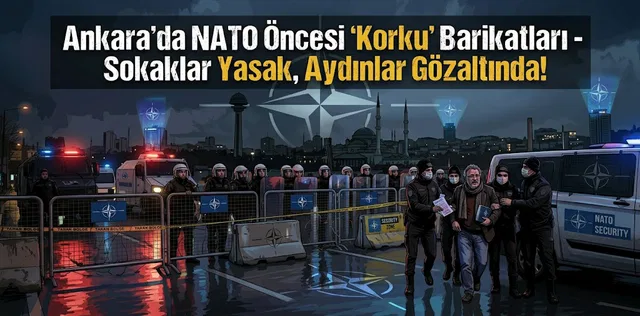
At the Hague Summit in June 2025 NATO members agreed to allocate 5 percent of their gross domestic product to defence by 2035: 3.5 percent direct military spending, 1.5 percent broader security items such as "critical infrastructure, civil resilience and the defence industry" (CSIS). The Ankara Summit of 7–8 July 2026 confirmed this target; more than 50 billion dollars of arms purchases were signed at the summit, and a 14-billion-dollar unmanned-systems initiative over five years was launched (Ankara Summit Declaration, Defence Turkey). We told how the streets of Ankara were closed before the summit, and how intellectuals were taken into custody, in Pre-NATO 'Fear' Barricades in Ankara.
NATO's capability target from Germany is also on the table: a force of 460 thousand (about 260 thousand active soldiers and 200 thousand reserves). Today there are 184 thousand soldiers in the Bundeswehr; the target relayed by Tagesspiegel is 255–270 thousand active soldiers in 2035 (Tagesspiegel). The gap is too large to be closed by gathering volunteers from the market. The return of conscription is the result of this arithmetic.
And what is the source of this money? Let us look at Germany's 2027 budget draft (Perspektive, DGB):
| Item | 2026 | 2027 draft |
|---|---|---|
| Defence budget (Einzelplan 14) | 82.2 billion euros | about 109 billion euros |
| Plus a special defence fund | 29.9 billion euros | |
| Arms purchases alone | 55.8 billion euros | |
| Health budget | 21.77 billion euros | 14.33 billion euros |
In one year 31 billion euros extra for defence, a cut of a third for health. Cuts are also planned in child benefit, housing benefit, parental allowance and unemployment benefit. The German Trade Union Confederation DGB says that a "large part" of public borrowing now flows into military spending, while high incomes and company profits are almost untaxed. This is the 2026 edition of the old "guns or butter" dilemma: cut the butter and write it to the gun.
And we know in whose factory the gun is cast. Rheinmetall's share value has multiplied since 2022. As the Left Party's peace spokesperson Desiree Becker put it, while schools crumble, record military budgets flow into the coffers of companies such as Rheinmetall (Die Linke Bundestag group). Conscription is the state's procurement of the human material needed for the profit of the arms monopolies. The arms company sells the tank; the state finds the eighteen-year-old child to put inside it.
What does youth think, what does it want?
Let us answer those who say "the young are lazy, love of country is gone" with data.
There is a deep gulf between society at large and youth. According to research by the DeZIM Institute in summer 2025 with 3,691 people, 58 percent of society supports conscription; but among those aged 18–28 this rate falls to 30 percent. When the question becomes "would you actually do military service?" the picture is even clearer: 23 percent of society, and only 14 percent of the young, say yes (DeZIM). In short, those who want conscription most are those who will not go. This is the intergenerational anatomy of the war discourse in Europe.
There is a further detail in the same research: 35 percent of Muslims, and 25 percent of those who themselves migrated to Germany, fear discrimination in military service. So the call to "serve the fatherland" is also directed at the young people whom that fatherland every day pushes aside as "foreign." The "in-betweenness" we told in Elif Eralp: "We Wrote History, Comrades" here takes a new form: citizenship rights are in dispute, but the military obligation is certain.
An explosion of conscientious objection. In Germany applications for conscientious objection were 951 in 2022. Then they rose to 1,079 in 2023, 2,249 in 2024, 3,879 in 2025. In 2026, by the end of July alone, 8,302 applications were made; this already doubles the record of 2011 (4,348), when conscription was suspended (Berliner Zeitung). Applications jumped after the forms began to arrive in January 2026. When the letter dropped into the letterbox, an abstract debate turned into a personal decision.
The source of anxiety is war and livelihood. According to the 2024 Shell Youth Study, 81 percent of young people aged 12–25 are anxious about the war in Europe, 67 percent about the economic situation; anxiety about social division and xenophobia also rose from 52 to 58 percent (DBJR). The same young people's interest in politics is rising, especially among young women.
When we set these data side by side we can summarise youth's demands as follows:
- A say over one's own life. "You decided in our name, you did not ask us." This is the most basic feeling of the strikes.
- Money for the school, not the weapon. A record military budget against crumbling school buildings, a shortage of teachers, the cost of living and the rent crisis wounds young people's sense of justice directly.
- Diplomacy, not war. The young people are not defending the Russian administration; but they do not accept the imposition that "the only solution is armament."
- Equality against discrimination. For young people of migrant origin the conscription debate is also a debate on belonging and equal citizenship.
- A future. The word in the slogan is not chance: "Zukunft." Climate crisis, housing crisis, job insecurity, and now war. This generation feels that the future itself is being stolen from it.
Our views on war: war is always to the class's harm
Dear comrades, so far we have told Germany. Now let us step back and say plainly what we think about war. Because the slogan at the school strikes is not a finding that belongs only to Germany in 2026; it is the summary of the whole history of class societies.
Whose politics is war?
You know the famous sentence of the Prussian general Clausewitz: war is the continuation of politics by other means. Lenin took this sentence and added a single question: which class's politics? To understand a war the first place we look is not the map of the front, but which class is conducting that war for which interest. Market, raw material, trade route, sphere of influence, arms order, reconstruction contract. Flags, anthems, "the honour of the nation" and "the defence of freedom" are the costume dressed over these interests.
That is why the Communist Manifesto's sentence of 1848 still holds: the workers have no country. This does not mean that workers are not attached to the land they were born on, to their languages, to their people. On the contrary: what the worker loves is the people of that land; but the title deed of that land, its factory, its bank, its arms company belong to others. When war breaks out the worker is asked to defend, by killing the worker of another country, a property that is not theirs.
It is the class that goes to the front first
There is a rule of which history has almost no exception: the rich start the war, the poor fight it, the workers pay.
- The First World War (1914–1918). About ten million soldiers died. Those who filled the trenches were French peasants, German mine workers, English textile workers, Russian muzhiks. In the same years the profits of the German arms monopoly Krupp multiplied. In the Ottoman Empire the front was filled with the children of Anatolian peasants: at Sarıkamış tens of thousands of soldiers froze to death, at Gallipoli hundreds of thousands of losses were suffered, and the songs sung for those who went to Yemen and did not return are still sung today. Those songs were sung not by pashas but by peasant mothers.
- The Second World War (1939–1945). The biggest winners of the Nazi war economy were monopolies such as Krupp, IG Farben and Siemens; in their factories millions of forced workers and concentration-camp prisoners worked as slave labour. Those who defeated Nazism were Soviet workers and peasants: a people that lost about 27 million of its people.
- Vietnam (1955–1975). Of the 27 million men of fighting age in the United States, about 80 percent of the 2.5 million who went to Vietnam came from the working class and poor families (Christian Appy, Working-Class War). The rich man's child stayed away from the front with a university deferment, with patronage, with a National Guard post. In Senator George McGovern's summary: the rich and the powerful supported the war at the outset but gave little of themselves; that responsibility fell to the poor.
- Iraq (2003). There was no conscription; this time the job was done by the poverty draft. Those who enlisted with the promise of a job, health insurance, a university scholarship were largely the young people of deindustrialised towns and poor neighbourhoods. The winners of the war were oil companies, logistics and reconstruction companies such as Halliburton, private security firms.
- Russia–Ukraine (from 2022 to today). Russian soldier deaths confirmed name by name by Mediazona and BBC Russian passed 200 thousand in February 2026. The geography of the losses is a class map: deaths per 100 thousand people are 476 in Tuva, 400 in Buryatia, 362 in Zabaykalsk, 316 in Altai; whereas rich large cities such as Moscow and St Petersburg remain "largely untouched" (Mediazona, Meduza). The Kremlin buys the young people of poor regions with high signing bonuses; the oligarchs' children live in London and Dubai. In Ukraine too those driven to the front are mostly those without money or connections; bribery scandals for exemption at recruitment offices led in 2023 to the dismissal of the heads of all regional recruitment offices. While the poor of two countries kill one another, the rich of both countries protect their fortunes.
You can add Korea, Algeria, Afghanistan, Yemen, Sudan to this list. The result does not change: it is the class that goes to the front first. The coffins return to working-class neighbourhoods, villages, shanty towns. The mothers of the fallen are mostly poor mothers.
The bill of war: first life, then bread
War takes a price from the working class twice.
The first is life: the young people who die at the front, who come back disabled, who return with trauma. Today tens of thousands of disabled soldiers returning from Ukraine leave a care burden that will last for years on their families, and mostly on women.
The second is bread. War credits, war taxes, inflation, postponed wage rises, cut social spending. The writing of 31 billion extra to defence while health is cut by a third in Germany's 2027 budget is the current example of this. The war debt is paid not by those who produce the bombs but by the workers who send their children to the front and whose tax is deducted from their wages. The "reconstruction" that comes after the war then offers the same capital groups a second round of profit: they take the money first for the destroying, then for the building.
War is a tool for silencing class struggle
War has another function, and perhaps this is the most important: to freeze class struggle inside.
In 1914 the German unions and the social-democratic party accepted, under an agreement called "Burgfrieden" (castle peace), not to strike for the duration of the war. In France this was called "Union sacrée" (sacred union). The French socialist leader Jean Jaurès, who opposed the war, was killed by a nationalist on the eve of the war. While there was an "external enemy," a strike was treason, a wage demand was defeatism, criticism was espionage.
This logic is at work today as well. The grounds of "national security," "critical infrastructure," "war preparedness" are used to narrow strike rights, freedom of assembly, freedom of the press. In Turkey we know this very well: one of the most frequent grounds for postponing strikes is "national security." When the war discourse rises, the first voice silenced is the worker's voice.
But it is also the class that ends wars
History is not only a list of victims. Those who have ended wars have most often been the workers and peasants driven to the front.
In 1917 Russian soldiers left the trenches, said "bread, peace, land" and ended the war with a revolution. In November 1918 the German sailors in Kiel refused to sail on a meaningless last naval attack and rose; the revolt spread through the whole of Germany in a few days, the emperor left the throne and the war ended. One of the factors that ended the Vietnam war was also the disintegration inside the US army, soldiers' refusal of orders, and the mass anti-war movement behind the front.
That a student from Kiel shouted "We were deceived!" on 25 September is therefore a small but meaningful rhyme of history. A hundred and eight years ago the sailors of the same city had also understood that they had been deceived.
Our position
Let us write plainly the position that follows from this history and from today's picture:
- We are against imperialist wars. Under whichever flag, in the name of whichever bloc they are conducted. Against the expansionism of Russian capital, against NATO's armament programme, against the wars of influence of the United States, China, the EU or regional powers. Not camp, but class.
- We recognise peoples' right to defend their own existence and to liberation. The resistance of a people resisting occupation, genocide, colonialism is not the same thing as the market and influence war of imperialist powers. That is why the Palestinian people's demand for freedom finds its place on the banners of the school strikes.
- Whoever pays the cost of war, the right of decision is theirs. Those who determine the arms budgets, the conscription laws, the alliance treaties must give account to those who will pay the price of that budget, that law, that treaty.
- Investment in the human being, not in armament. Every tank is a school; every warplane a hospital; every unmanned-aerial-vehicle fleet thousands of homes. A budget choice is a class choice.
- The arms monopolies should be brought under public oversight. To profit from war is not a legitimate business model. The profits, exports and lobbying of arms companies should be transparent; war profits should be taxed.
- Conscientious objection is a human right. No one can be forced to carry a weapon against their conscience.
- Peace is not a compromise between classes but a precondition of a classless world. As long as capital exists there will be competition, and as long as competition exists there will be a tendency to war. Lasting peace is possible with a society determined by human need, not by profit.
Two sides, two wars
| War for capital | War for the working class |
|---|---|
| Orders, dividends, share value | The front, the coffin, disability |
| New market, raw material, sphere of influence | Cut wages, rising prices, postponement |
| Factories without strikes, silent streets | Banned strike, suppressed demonstration |
| Reconstruction contracts | Destroyed homes, routes of migration |
| "National unity" discourse | Being made an enemy of the worker of another country |
| The decision table | The trench |
Whose children will go to the front?
Now let us carry this historical lesson back to Germany and to today.
The least discussed truth of the professional-army period is this: most of the soldiers who "chose the trade" are those who had no other choice. In Europe too a military career is most attractive to the young people of deindustrialised regions, of the provinces, of places where unemployment is high. In a country of 40 thousand young people who cannot find a vocational-training place, the Bundeswehr's advertisements target these young people. In a neighbourhood where one in four children is poor, a military-service brochure is presented as an "opportunity." When we look at the list of cities in eastern Germany that took part in the strikes, let us not forget that this region is also where deindustrialisation was lived most heavily and where the AfD takes its highest vote.
Conscription at first glance looks "equalising": the rich go too, the poor go too. But history shows that this too is classed. The rich man's child finds the report, the right of deferment, study abroad, a desk post; in Turkey this has been named openly: paid exemption from military service. The poor man's child becomes an infantryman.
There is this as well: war preparation is a classic way out that capital turns to in periods of crisis. A stagnant economy is revived with arms orders; social discontent is suppressed with the discourse of an "external enemy." That is why, in a period when the German automotive industry is contracting and factories are closing, the conversion of the car-parts factory in Wedding to producing shell casings is a symbol. The worker is told "be unemployed or produce shells," the child "come to barracks or we will call you for examination." An order that asks the son to carry at the front the shell the father produced is built on the class consuming itself.
That is why the school strikers' slogan is not a feeling but a diagnosis: The rich want war, students want a future.
Why did the Left Party become the party of the young?
The youth objection in Germany also has a counterpart at the ballot box.
In the February 2025 federal election the Left Party (Die Linke) became the first party among 18–24-year-olds with 26 percent; in this age group the AfD took 21 percent, the CDU/CSU 13 percent, the SPD 11 percent (ZDFheute). Heidi Reichinnek's TikTok videos were watched millions of times; the party put concrete livelihood questions such as housing, rent and the cost of living at the centre and took the clearest counter-position to the AfD. Party membership rose to 123 thousand at the end of 2025; a large part of the new members were young.
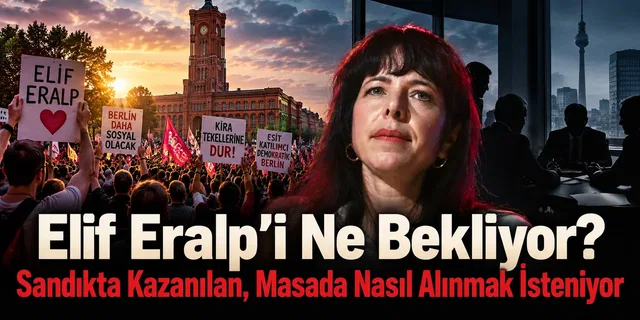
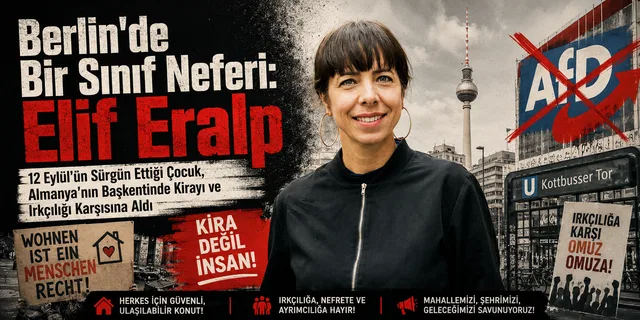
A year later, at the Berlin election of 20 September 2026, the picture sharpened further: the Left Party became the city's first party with over 25 percent, and about 47 percent of voters aged 16–24 voted for the Left Party. We told Elif Eralp's story and the obstacles before her in Elif Eralp: "We Wrote History, Comrades", What Awaits Elif Eralp? and Maricarmen's Stretcher, Elif's Key: Europe's Housing Crisis and the Class of the Home. The two headings that carried young people to the Left Party in Berlin were rent and war: the socialisation of housing companies, and a clear position against conscription and armament.
The Left Party voted in the Bundestag against the new military-service law; at Berlin, Hamburg and federal level it declared open support for the school strikes and offered counselling to the young people affected (Die Linke Bundestag group, Die Linke Hamburg). The party's "Nein zur Wehrpflicht" site guides young people who do not know how to fill in the form and how to apply for conscientious objection (faqwehrpflicht.de).
But we have to drop a comradely note, because we have to tell youth the truth. When in March 2025 the Bundestag passed the great constitutional amendment that freed defence spending from the debt brake, the Land governments of Bremen and Mecklenburg-Western Pomerania, in which the Left Party is a coalition partner, said "yes" to this package in the Bundesrat (Die Linke Bremen, ak analyse & kritik). The party leadership was against the package; the Land officials put forward the grounds of "infrastructure investment" and "Land responsibility." The result was the removal of the constitutional obstacle before armament.
This is important not in order to condemn the Left Party, but in order to recall a lesson: entering government is not entering power. The social democrats who said "yes" to the war credits in 1914 also said "responsibility." The vote young people gave the Left Party is not a blank cheque, it is a trust. When a left government to be formed in Berlin tomorrow is forced to choose between an armament budget and a housing and school budget, it can do justice to this trust only under the pressure of the youth in the street and of the unions. That the school strikes are organised independently of the parties, with their own committees, is therefore a strength.
Longing for another world: Generation Z in the street
In Gen-Z Socialism, which we wrote in June, we discussed a panic that The Economist put on its cover: a significant part of the young in the West do not trust capitalism and feel close to socialism. The ruling class's magazine tried to explain this as "naivety"; we said it was a material result of the rent crisis, of poverty, of climate destruction and of hypocrisy in the face of Gaza. We wrote that youth, in Gramsci's phrase, had begun to produce its own organic intellectuals.
The school strikes in Germany are that piece's counterpart in the street. Let us see a few connections:
- A legacy of form. The form "school strike" was left to this generation by the climate movement, by Fridays for Future. Then the young people were saying "you are burning our future"; today they say "you are spending our future on weapons." The content has widened: climate, housing, war and inequality are no longer seen as separate files but as the results of a single system. The slogan "The rich want war" at the March strike is this synthesis itself.
- A global wave. In autumn 2025 a series of youth uprisings took place from Nepal to Morocco, from Madagascar to Peru, under the name "Generation Z protests"; against corruption, unemployment, the collapse of social services. The school strikes in Germany are more regular, less explosive; but they are the form of the same anger in a rich country: "You owe us a future."
- A sense of justice. What these young people have in common is not an ideology but a sense of justice. In a city where rent eats half a wage, the presentation of a 109-billion-euro defence budget as a "necessity" while the school toilet does not work inflames this feeling. As Marx said: people do not live as they think; they think as they live.
- Peace as an identity. That the 8 May strike was timed to the day of liberation from Nazism was a conscious choice. "Never again war" (Nie wieder Krieg) was the lesson of 1945 in Germany. The young people are reminding their rulers that they have forgotten this lesson.
Let us not romanticise this generation either. A part of the same generation, especially young men, is turning to the AfD. Young women are shifting left, a part of young men to the far right; this polarisation is measured in Germany as in other countries. A longing for justice does not flow left of itself; if an organised left does not offer it a language, a programme and a path, the right fills it with "the foreigner as enemy." We discussed this at length in Why Do Workers Vote for the Right?. The value of the school strikes in Germany is precisely here: they give youth's anger a direction that says "the main enemy is in your own country, in the coffers of the arms monopolies."
Seen from Turkey: the masculinity in the replies, and our conscription debate
When you look at the replies under Conflict's post you see something else. A significant part of the most liked replies mock German youth: their "masculinity" is questioned, not wanting to do military service is equated with cowardice and womanliness, it is almost awaited that "they will be beaten to the front." Swearing and sexist humiliation get thousands of likes.
We have to take these replies seriously, because they show our society's relation to militarism. In Turkey military service was for decades constructed as a precondition of "being a man": the one who does not go to the army is not given a wife, is not given a job, is not counted as a "man." The class function of this cultural code is clear: it presents the state's disposal of youth's body as an unquestionable "nature." Yet the same system also grants those with money the possibility of buying that "sacred duty" through paid exemption from military service. Sacredness fits on a price tag.
Let us know this as well: Turkey is one of the rare Council of Europe members that does not legally recognise conscientious objection. The European Court of Human Rights has ruled against Turkey many times since the Ülke v. Turkey judgment of 2006; the UN Human Rights Committee has also repeatedly asked that conscientious objection be recognised. In Germany an eighteen-year-old can fill in the form and apply for conscientious objection; in Turkey this right still has no legal guarantee. This is a question of the rule of law as much as a question of democracy.
Turkey also has NATO's second-largest army and hosted the summit in Ankara in July. The 5 percent target applies to Turkey as well. So when we read the budget table in Germany we should also look at our own budget: the gap between the resources flowing to the defence industry and those allocated to the pensioner, the teacher, the hospital. If the young people in Germany say "to the school, not the weapon," the same question holds for us.
What we will say to those who mock German youth is simple: courage is not going when the order comes, it is being able to ask in whose interest the order is given. A seventeen-year-old student who goes into the street despite the headteacher, the police, the threat of punishment shows more courage than the one who gives a lesson in "masculinity" from behind a keyboard.
Two narratives side by side
| The ruling class's narrative | Youth's reply |
|---|---|
| "We must be war-ready in the face of the Russian threat." | It is also you who inflate the arms budget by exaggerating the threat and exhausting diplomacy; war preparedness does not bring peace. |
| "Military service is voluntary, no one is being forced." | The form is compulsory, the examination is compulsory, permission to go abroad is compulsory; you called us even though we said we had no interest. |
| "We have to spend money for security." | You cut the health budget by a third and add 31 billion to weapons; our security is school, home and work. |
| "The young are lazy, there is no love of country." | Love of country is not sacrificing the citizen's child to the profit of the arms monopolies. |
| "Military service unites society, equalises." | The rich man's child finds deferment and a report; it is again the poor man's child who goes to the front. |
| "The school strike is illegal, there is a penalty." | This is the path of those without a right taking a right; the working class too won the right to strike by striking. |
| "This is a generation's fashion, it will pass." | Four strikes in ten months, more than eight thousand applications for conscientious objection; this is not a fad, it is a generation's objection. |
| "Military service offers young people a trade and a future." | First give a vocational-training place; 40 thousand young people are waiting at the door. Vocational training instead of military service. |
| "The arms industry provides jobs for workers." | Rheinmetall's dividend rose by 40 percent; what falls to the worker is that the shell they produced returns to their son at the front. |
| "Defence of the fatherland is everyone's duty." | Then let those who take the decision walk in front: Merz to the front. |
| "Military service offers poor young people an opportunity." | In Wedding one in four children is poor; this is not an opportunity, it is the turning of poverty into a barracks. |
The movement's limits and open questions
Dear comrades, to support a movement does not mean not to criticise it. Several open questions stand before the school strikes in Germany:
Pacifism or anti-imperialism? "No to war" unites everyone; but the question "which war, why?" is disputed inside the movement. Some of the groups organising the strikes avoid taking a clear position on Gaza, Iran and Ukraine, saying "let us stay broad"; others argue that the struggle against conscription cannot last without an international perspective against all imperialist wars (WSWS). As we wrote above, our position is clear: we reject the expansionism of Russian capital and NATO's armament programme. As we said in The Same Week, Two Tables: not camp, but class. To choose one imperialist bloc against the other is nothing other than driving youth to another front. That Palestine banners marched side by side with anti-conscription banners in Berlin shows that the movement is spontaneously approaching this internationalist perspective.
The bridge from school to factory. The teachers' union GEW and some local union branches supported the strikes; the DGB also sharply criticised the budget draft. But the student strike and the workers' strike have not yet met. The Wedding example shows this distance plainly: while students marched in front of the Rheinmetall factory, the union representing the factory's workers was defending the conversion as "employment security." A trade unionism that cannot offer the worker a future other than arms production sets the student's future against the worker's bread. The solution is a programme that demands, together with the workers, the conversion of arms production into civilian production: the same benches can also produce trams, wind turbines, medical devices. The word of the workers employed in arms factories, ports and railways will be decisive in this struggle. Dockers who stopped arms shipments showed in Italy and Greece that this is possible for Gaza.
Permanent organisation. Four strikes are a success; but what will carry the fifth, the tenth strike are the school committees, university networks and neighbourhood organisations. The movement needs to strengthen its own democratic structures and not surrender to the agenda cycle of the parties and the media.
Women and migrants. The form is optional for women today; but the examples of Denmark and Sweden show that conscription can be extended to women in the name of "equality." The movement has to explain that "equality" is not taking everyone into barracks but delivering everyone from barracks. Putting the discrimination anxiety of young people of migrant origin at the centre of the movement will also strengthen it.
Concrete tasks for young comrades
- Learn and tell. Tell the school strikes in Germany, NATO's 5 percent target and its effect on budgets in your circle of friends, in your school and university communities. Share this piece and its sources.
- Look at our own budget. Prepare a table that sets Turkey's defence, health and education budgets side by side. Carry the question "to the school, not the weapon" here.
- Expose militarist language. Answer replies on social media that mock young people through "masculinity" not with swearing but with data and a question: "Whose children go to the front, whose is the arms company?"
- Talk about the right of conscientious objection. Learn the ECHR and UN decisions for the recognition of conscientious objection as a human right, follow the work of rights-defence organisations and support them within the legal framework.
- Build an internationalist bond. Get in touch with youth organisations of Turkish origin in Germany, with student networks, with the Left Party's youth structures. If you have friends studying or working in Germany, ask them to follow the Brandenburg Gate action on 2 October and the strikes after it.
- Unite. Tell climate, housing, education and opposition to war not as separate campaigns but as the results of a single system. The strength of the school strikes is precisely in this synthesis.
- Meet the class. Propose joint meetings and platforms that will bring youth movements together with unions, especially education, health and transport unions.
- Draw the class map of war. With examples from Turkey and the world, do small pieces of research that answer the question "who went to the front, who gained from the war": a village's, a neighbourhood's war losses side by side with an arms company's profit in the same years.
- Discuss the demand for conversion. Discuss how, without setting ourselves against workers employed in the arms industry, we can raise together with them the demand "civilian production, not weapons."
The rich want war, students want a future
Dear Young Comrades,
Europe's rulers told a generation that it was "the end of history," that "peace was eternal." Now the same rulers send that generation's children a form, an examination paper and a call to "be war-ready." What changed in between was not the will of the peoples of Europe but the needs of capital: markets narrowed, competition between blocs hardened, the arms monopolies grew, and the bill was again charged to youth.
In Germany's school yards, and especially in poor working-class neighbourhoods such as Wedding, something else is sprouting today. A seventeen-year-old student goes into the street despite the headteacher's threat, the newspapers' contempt, the police, and raises a banner. On that banner there is neither a national flag nor the name of an enemy country; there is only a sentence: The rich want war, students want a future.
This sentence is the summary of more than a century of experience. The common story of the Anatolian peasant who froze at Sarıkamış, of the French miner in the trenches of Verdun, of the worker's child in Vietnam, of the young person sent to the front from Tuva. Others started all of their wars; others grew rich with all of their lives.
This sentence is our sentence too. The same sentence in Karaköy, in Kadıköy, in Diyarbakır, in İzmir, in Berlin and in Paris. The future is not a barracks. The future is the world of labour, not of the weapon; of the school, not of the front; of the vocational bench, not of the UAV; of solidarity, not of enmity. The workers of other countries are not our enemies, they are our class siblings; the enemy is the one who makes us take aim at one another.
Another world is not only possible; it is being built in these young people's hands, before our eyes.
Comradely.
Knowledge belongs to everyone.
Sources
School strikes and developments in Germany
- Evrensel: Almanya'da on binlerce öğrenci zorunlu askerliği protesto etti: 'Zenginler savaş, öğrenciler gelecek istiyor', 25 September 2026
- Conflict (X): Conscription examinations and student protests in Germany, 26 September 2026
- Weddingweiser: Schulstreik gegen Wehrpflicht im Wedding
- Qiez: Schulstreik gegen Wehrpflicht – Berliner Schüler wehren sich gegen Musterungen
- Berliner Zeitung: Klassenzimmer leer für den Frieden – Der 4. Schulstreik gegen die Wehrpflicht steht bevor
- Bundeswehr: Übung Red Storm Charlie, Hamburg
- Berliner Zeitung: Keine Lust auf Kaserne – 45.000 Schüler streiken in mehr als 100 Städten, 25 September 2026
- ms-aktuell: Schüler protestieren bundesweit gegen neuen Wehrdienst und Musterungen
- ms-aktuell: Bundeswehr beginnt Musterungen auch ohne Dienstinteresse
- Ostdeutsche Allgemeine: Schulstreik gegen Wehrpflicht – Städte und Rechtslage
- SoZ – Sozialistische Zeitung: Schulstreik gegen Wehrpflicht, September 2026
- Perspektive: Am 5. Dezember wollen Schüler:innen in über 90 Städten streiken
- Nie wieder Krieg: Schulstreik am 05.03. – Erfolg wiederholt
- WSWS: Schulstreik vom 8. Mai
- Netzwerk Friedenskooperative: Schulstreik gegen Wehrpflicht 2026
- Tagesspiegel: Erste Bilanz für neuen Wehrdienst – 530 Freiwillige
- Berliner Zeitung: Mehr als 8000 Kriegsdienstverweigerer 2026
- Bundesregierung: Fragen und Antworten zum Neuen Wehrdienst
Rheinmetall, arms exports and vocational training
- Rheinmetall: Financial report FY 2025
- Entwicklungsstadt: Rheinmetall im Wedding – Autozulieferer wird zur Waffenfabrik
- WSWS: Pierburg wird Rheinmetall – Rüstungsproduktion in der Mitte Berlins
- DFG-VK: Deutsche Waffen, deutsches Geld morden mit in aller Welt
- LTO: Waffen für Israel – Bundesregierung hebt Genehmigungsstopp auf
- Bundesagentur für Arbeit: Ausbildungsmarktbilanz 2024/25
Red Wedding and the neighbourhood's poverty
- Wikipedia: Bezirk Wedding
- Wikipedia: Blutmai
- taz: Als der Wedding rot war
- Weddingweiser: Was tun gegen die Armut im Wedding und Gesundbrunnen? (Taylan Kurt)
War and class
- Army Technology: Drones now account for 80% of casualties in Ukraine-Russia war
- Mediazona: Four years of war – 200,000 confirmed dead and the geography of Russian losses
- Meduza: Four years, 200,000 confirmed dead, yet major cities remain largely untouched
- Christian G. Appy: Working-Class War – American Combat Soldiers and Vietnam (UNC Press)
Youth research and elections
- DeZIM: Junge Generation lehnt Wehrdienst klar ab
- DBJR: Shell-Jugendstudie 2024
- ZDFheute: Bundestagswahl – Warum Linke und AfD bei Jungen punkten
The Left Party
- Die Linke Bundestag group: Schulstreik gegen die Wehrpflicht
- Die Linke Hamburg: Linke unterstützt Schüler*innen
- Die Linke: Nein zur Wehrpflicht
- Die Linke Bremen: Linke Senatorinnen stimmen für Bremer Zustimmung zum Schuldenpaket
- ak analyse & kritik: Staatstragend in Mecklenburg-Vorpommern
- Sol: Gegen Sozialabbau und Militarisierung
NATO, budget and Europe
- NATO: Ankara Summit Declaration, 8 July 2026
- Defence Turkey: NATO Ankara Summit Declaration
- CSIS: What Does NATO Defense Spending Look Like Heading into the Ankara Summit?
- DGB: Bundeshaushalt 2027 zwischen Investitionen, Rüstung und Kürzungskurs
- Perspektive: Haushaltsentwurf 2027 – Rekordausgaben für die Bundeswehr, Kürzungen im Sozialbereich
- Euronews: Which European countries have mandatory and voluntary military service?
- Vision of Humanity: Conscription's Return
- French Ministry of the Armed Forces: Service national
Related pieces at Knowledge Commons
- Gen-Z Socialism: Capitalism’s New Nightmare (9 June 2026)
- Pre-NATO 'Fear' Barricades in Ankara — Streets Banned, Intellectuals in Custody! (23 June 2026)
- From the Nuremberg Stage to NATO's Barricades (5 July 2026)
- AfD's 43.8 Percent Is Not a Deviation (11 September 2026)
- Why Do Workers Vote for the Right? (19 September 2026)
- Elif Eralp: "We Wrote History, Comrades" (20 September 2026)
- What Awaits Elif Eralp? (24 September 2026)
- Maricarmen's Stretcher, Elif's Key: Europe's Housing Crisis and the Class of the Home (25 September 2026)