What Awaits Elif Eralp?
How What Was Won at the Ballot Box Is to Be Taken Back at the Table

What Awaits Elif Eralp?
How what was won at the ballot box is to be taken back at the table
Dear Young Comrades,
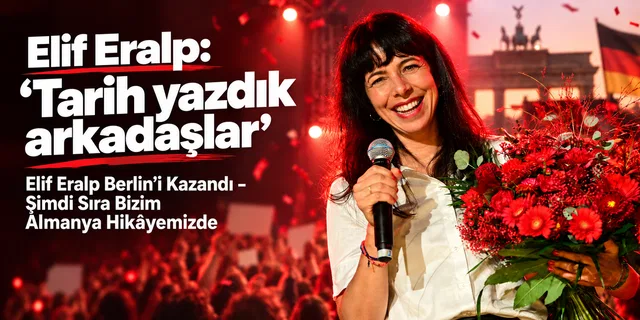
Four days ago, on the evening of 20 September, we shared a joy under the title Elif Eralp: "We Wrote History, Comrades". That joy was in the right place, and it still is. But in these four days Germany's ruling class and its parties have made one thing plain: winning at the ballot box is not the same as taking power. Least of all when the winner is the candidate of a party with "Left" in its name, the daughter of a migrant working-class family, who has written the socialisation of the rent monopolies into her programme.
In this piece we will do four things. First we will summarise the present situation in facts. Then we will weigh, one by one, the roads in front of Elif Eralp. After that we will enter the thorniest subject: the debate inside the Left Party, and the situation of Jews in Berlin; we will not take the easy way out. At the end we will expose this week's most shameful tableau: Cem Özdemir's attempt to shove the Left Party into AfD status, and the hypocrisy of the Greens.
Let us say this at the outset: this piece is neither a brief for the Left Party nor a fake "self-criticism" written in the language of its enemies. We will look through the class lens. That lens tells us this: what is really being discussed in Berlin today is not antisemitism; it is property. Antisemitism is a real problem and must be taken seriously; but the use made of it this week in Germany is a means of protecting property. Separating the two is the real work of this piece.
The present situation: what do the facts say?
The election result
According to the provisional official results (Tagesspiegel):
| Party | Share of the vote |
|---|---|
| The Left Party (Die Linke) | 25.7% |
| CDU | 18.8% |
| AfD | 16.3% |
| Greens | 14.3% |
| SPD | 12.1% (historic low) |
| BSW | 4.7% (below the threshold) |
| FDP | 2.5% (below the threshold) |
With overhang and balance seats the chamber rose to 162; 82 are needed for a majority. On the table there are, mathematically, two options:
- Left–Green–SPD ("red-green-red"): 97 seats, under Elif Eralp.
- CDU–Green–SPD ("Kenya"): 84 seats, under the CDU's Stefan Evers.
Look carefully at the second option. It means the CDU, which lost the election by a clear margin, joining the third- and fifth-placed parties and shutting the first-placed party out. It is possible as arithmetic; as democratic legitimacy it is a seizure of the ballot box. The whole of this week's noise is aimed at presenting that second option as a "moral necessity."
Why is Eralp still not mayor?
In Berlin the Governing Mayor (Regierende Bürgermeister) is not elected directly by the people; she is elected by a majority of the members of the House of Representatives (Abgeordnetenhaus). So a coalition must first be formed, then the chamber must vote. Until that day the sitting CDU Senate of Kai Wegner continues to run affairs. The road in front of Eralp looks like this:
- Friday 25 September: The Left Party's Berlin state congress will vote on opening exploratory talks with the Greens and the SPD. The co-chairs Kerstin Wolter and Maximilian Schirmer say they are sure the delegates will send Eralp to the table "with a wind at her back" (Focus).
- Exploration, then coalition negotiations: The Left Party has agreed to discuss the protection of Jewish life and the fight against antisemitism separately, before the main negotiations (ad-hoc-news).
- A membership vote: Eralp pledged before the election that the coalition agreement would be put to the party members (t-online).
- The chamber vote: Only after all of that.
The bloc opposite
The front that has formed in these four days is surprisingly wide:
- The CDU demanded that the Left Party be put under observation by the Office for the Protection of the Constitution (Verfassungsschutz). At a "Current Hour" sitting of the Bundestag on 23 September, held at the AfD's request, CDU speakers called for the Left MP Ferat Koçak to give up his seat (Bundestag).
- The AfD devoted an entire Bundestag sitting to the Berlin Left. Gottfried Curio called the fact that a majority of Muslim voters in Berlin voted Left "the first openly ethnic election in Germany." At a sitting in which racism spoke this nakedly, Beatrix von Storch said "since the war no party has used hostility to Jews to mobilise voters." That the political heirs of Nazism should take the floor claiming to protect Jews is this week's black humour.
- The SPD's federal leadership (Klingbeil and Bas) declared that the Left must not give "even a millimetre" to antisemitism and to criminal networks; Berlin's SPD tied the condition to an open pledge from every member of the Left group in the chamber (ZDFheute).
- The Greens' federal co-chair Felix Banaszak said "signing a piece of paper once is not enough"; he added that a coalition would not be formed "at any price."
- Cem Özdemir, as Minister-President of Baden-Württemberg, issued an ultimatum to Berlin. We will come to that below.
- The media, from the Axel Springer group's titles (Welt, BILD) to the liberal Tagesspiegel and Switzerland's NZZ, almost with one voice put on the front page not the election result but "the Left's Jewish problem."
What is the common denominator of this front? All of them, in different doses, stand against the socialisation of the big rent companies that Berlin's people approved with 59.1 percent in the 2021 referendum. Let us not forget that as we go on.
The real matter: what is not being discussed
In der Freitag Elsa Koester summed up the week in a single sentence: the republic is not discussing the socialisation of housing or how the social state is to be financed; it is discussing Issa Remmo and Ibrahim Ibrahim (der Freitag).
Yet Elif Eralp's programme is clear, and certain classes sit in its crosshairs:
- Some 220,000 dwellings taken from the big rent companies (Vonovia, Deutsche Wohnen and the like) and passed into public ownership.
- A rent cap in public housing.
- A fare cut on public transport.
- An extra tax on luxury real estate.
- And perhaps most important, this sentence said out loud: "We will have to take on extra credit." (t-online)
That last sentence is an open objection to Germany's constitutional dogma, the debt brake (Schuldenbremse). The same Germany, in 2025, loosened the debt brake in a single stroke for rearmament. Debt can be taken on for tanks; it cannot be taken on for tenants. The front assembled against this programme is discussing, instead of the programme, who came to a wedding of the party in Neukölln. That is not an accident.
One of Marxism's oldest lessons is this: the ruling class never defends its interest in its own name. It does not say "I am protecting my property"; it protects "the economy," "the investment climate," "the rule of law." This week in Berlin, property is being protected in the name of the safety of Jews. That is an injustice done both to propertyless Berliners and to Jews.
The debate inside the Left Party: without taking the easy way out
To expose the opposing front does not mean looking away from the problems in our own ranks. Friendship is not fawning. Let us write what happened, item by item.
What happened?
- Late August, Neukölln, Herrfurthplatz: At a rally of about a thousand people organised by the Left Party's Neukölln district organisation under the title "We are angry at capitalism," the rapper Dahabflex took the stage. During the performance the slogans "Yalla Yalla Intifada" and "Death to the IDF" were chanted, the crowd joined in, and the politicians in the hall did not intervene. The police opened a hate-speech investigation (Euronews).
- "Election intifada": The Neukölln Left politician Basem Said made his election call with this word.
- Election night, Neukölln: Issa Remmo, counted as the head of one of Berlin's known criminal networks, and the activist Ibrahim Ibrahim, known for his proximity to the FHKC (PFLP), which is on the EU terror list, came to the celebration; the latter was photographed beside the MP Ferat Koçak. Koçak later said this was "a mistake."
- An internal working group: It is reported that the Left Party's Palestine-solidarity working group (LAG) in Berlin described the 7 October 2023 massacre as an "act of resistance" and called for support for "Palestinian resistance in every form."
- An expulsion process: An expulsion process was opened against the activist Hannah Bruns.
What did Eralp do?
After the Herrfurthplatz performance Eralp spoke plainly: "Calls for violence and for people to be killed are absolutely unacceptable." She asked that how this "crossing of a line" had taken place in the Neukölln organisation be clarified and that it have consequences (as reported by the WSWS). After the election she also said "I will fight against every form of antisemitism" (SRF).
This stance, however, is being criticised from two directions at once inside the party:
- The Neukölln organisation and Palestine-solidarity circles called Eralp's reaction "a transparent election manoeuvre"; the district spokesperson Hermann Nehls argued that the song had not been planned and had been torn from its context. More left-wing critics such as the Trotskyist WSWS accused Eralp of "accompanying the right's agitation against a rally of her own party."
- The right-wing and centrist media say the opposite: Eralp condemns, but she cannot make her party listen. In taz, Frederik Eikmanns writes that the problem is not Eralp's sincerity but her authority inside the party (taz).
- Linksjugend ['solid] (Left Youth) is in any case opposed in principle to entering government. Its reason: the possible partners, the SPD and the Greens, are carrying out rearmament and austerity at federal level (ZDFheute). This objection is independent of the antisemitism debate, and it is perhaps the one that most needs to be taken seriously.
- Gregor Gysi voiced the middle path in the Bundestag: "Some of our members clearly go too far in their criticism of Israel"; but the AfD's accusations are "an insolence."
How should this be read in class terms?
These events are, from the point of view of class politics, three separate errors, and all three must be named plainly:
- "Death to the IDF" is not a class slogan. It is legitimate to criticise, in the hardest language, what the Israeli state has done in Gaza; we criticise it too. But to wish death on the soldiers of an army — that is, on working-class children who in their great majority are doing compulsory service — is nationalism, not internationalism. Even the sociologist and Left Party member Peter Ullrich, putting the suffering of Palestinians in context, says this slogan contradicts the party's orientation toward peace (taz).
- What is Issa Remmo doing on election night? The Marxist tradition has been clear from the start on the lumpenproletariat: criminal networks are not allies of the working class; they are a form of domination built over the poor of the neighbourhood. Structures that extort shopkeepers in the same neighbourhood and draw young people into the drug trade are the street-level little brother of the rent monopoly. Every "neighbourhood closeness" built with them is an error committed against Neukölln's working-class families.
- Proximity to the FHKC (PFLP) and the sanctification of 7 October as "resistance" turn the killing of civilians into politics. Class politics does not split peoples' right to live. Whoever defends the right to live of the child in Gaza also defends the right to live of the young person on the festival ground. Anything else is to reproduce, from the other side, imperialism's distinction between "valuable and worthless dead."
But this too must be said with them: in Neukölln the Left Party went into Palestinian and Arab neighbourhoods whose doors no other party knocks on. That working-class families there have lost relatives in Gaza, and that anger can take crude and wrong forms, is the unavoidable cost of making that contact. As Koester reminds us, the other parties never meet this contradiction, because they never speak with these neighbourhoods at all. The solution is not to cut the contact but to put that anger into an organised class form. That is done not by expulsions but by political education.
The situation of Jews in Berlin
Here we come to the place that most needs care. Because in this debate there is both a real fear and the use of that fear by others.
A real fear
Let us first recognise the fact. Gideon Joffe, chair of the Berlin Jewish Community, describes Jewish schools turning into shelters for children who have suffered antisemitic attacks at other schools (Jüdische Allgemeine). Josef Schuster, chair of the Central Council of Jews in Germany, accused the Left Party of "repeated antisemitic crossings of the line" in the election campaign. According to Berlin police records, from 7 October 2023 to 13 March 2026 some 12,500 incidents were recorded at Palestine actions; of these 2,205 were banned propaganda and 1,046 incitement to hatred (Euronews).
That a Jewish family's child should be sent to school with the same fear as a girl in a headscarf is equally unacceptable to us. To go on without saying this would not be class politics; it would be indifference.
But Jews are not of one voice
The ruling narrative presents "the Jews" as a single bloc, a single view, a single institution. Yet among the sharpest voices in the debate there are also Jews:
- Peter Ullrich, a researcher at the Centre for Research on Antisemitism at TU Berlin and a Left Party member: population surveys show that antisemitism is markedly more widespread on the right and declines toward the left. The function of the debate is "to weaken the Left" in order to scare the SPD and the Greens off a coalition (taz).
- Tomer Dotan-Dreyfus, a Jewish writer: Eralp should not stay on the defensive; she should target the CDU's antisemitism. He reminds us: claims that millions of euros from funds to fight antisemitism in Berlin were distributed without oversight came onto the agenda in the period of the CDU Senate (der Freitag).
- Organisations such as Jüdische Stimme für gerechten Frieden in Nahost (Jewish Voice for a Just Peace in the Middle East) have for years opposed the equating of criticism of the Israeli state with antisemitism, and for that they have met various forms of pressure in Germany, including the closing of bank accounts.
The war of definition: IHRA or the Jerusalem Declaration?
The axis of this debate that looks technical but is political is how antisemitism is to be defined. At the election debate in the Jewish Community's building, Eralp defended the Jerusalem Declaration on Antisemitism (JDA) rather than the IHRA definition adopted by the German government. Her reason: the JDA allows a "discriminating" fight against antisemitism and is used by many Jewish organisations. Daniel Botmann of the Central Council opposed this; the Council uses the IHRA (Jüdische Allgemeine).
Young comrades, why does this distinction matter? Because the IHRA definition's list of examples is suited to bringing some criticisms aimed at the founding and the policies of the Israeli state under the heading of antisemitism. In Germany this definition has been used as the legal basis for banning Palestine-solidarity actions, cutting artists' funds, and cancelling academics' talks. The JDA, for its part, aims to separate hatred directed at Jews from the criticism of a state. So this is not a dictionary debate; it is a debate over whether the state can turn its foreign policy into a penal instrument in domestic politics.
Here the biggest trap in front of Eralp also comes into view: the imposition, as the price of entering a coalition, of the IHRA and of "Staatsräson" (the doctrine that treats Israel's security as Germany's reason of state). If that is accepted, the legal frame for silencing Palestinian neighbours in the name of protecting Jews will have been approved by a Left Senate itself.
The real question
Who is threatening the safety of Jews? In Germany the greater part of antisemitic crimes is recorded in official statistics on the right. In 2019 it was a neo-Nazi who attacked the synagogue in Halle. It was the state's own institutions that destroyed the files of the NSU murders. Leading figures of the AfD belong to a party that has dismissed the Nazi past as "bird shit" and called the Holocaust memorial in Berlin a "monument of shame." That party took 16.3 percent in Berlin this time, and in the Bundestag it is putting on the role of protector of the Jews.
Even the Green MP Irene Mihalic called this accusation by the AfD a "political ladder joke" (Bundestag). We will come back to this in a moment, because another name from the same party, on the same day, was proposing that the AfD's yardstick be applied to the Left.
The great shame: Cem Özdemir and the attempt to put the Left on the AfD's scale
What did he say?
Cem Özdemir won the Baden-Württemberg election in March 2026 and became minister-president in May; the first politician of Turkish origin to reach that office in Germany. Two days after the Berlin election, on 22 September, he spoke to Welt, the Axel Springer group's paper:
"Anyone who is not clear on these matters should not even come near power in Germany." (Staatsanzeiger BW)
Welt's headline was harsher still: "This is not tolerable in the capital, and it must not come near power." Özdemir said the Left Party "must if necessary throw people out of the party," and he advised the Berlin Greens "to apply exactly this yardstick, to make no discount." As the yardstick he pointed not to official statements but to the approval of the Jewish community.
Two days later, on 24 September, on Politico's Berlin Playbook podcast, he took a further step. When the words of Left politicians were at issue, he wanted the same yardstick applied as is applied to the AfD: "This yardstick, please, should also apply to the Left." He said he did not know Eralp, but that there was "a large question mark" over whether she could make her party listen. And he came to the real matter: socialisation is "the wrong path, the wrong economic instrument"; what Berlin needs is not socialisation but "measured building" at the edges of the Tempelhof Field (Tagesspiegel, Stuttgarter Zeitung).
Put these four sentences side by side: Must not come near power. The AfD yardstick. Let them throw people out. Socialisation is wrong. The first and the third speak the language of morals; the fourth speaks the language of property. But they all come out at the same result: the party that won the election should not enter government.
Why is this a shame?
First, the equation is false. The AfD is a party some of whose state organisations have been classified by the constitutional-protection bodies as "confirmed far-right," whose leading figures have attended meetings discussing the expulsion of millions of people under the name "remigration," and which has built its programme on an ethnic concept of the people. The "firewall" (Brandmauer) drawn against this party was drawn not because of the words of individual members but because of the party's programme and identity. The Left Party's programme, whatever the unacceptable words of individual members, is built on equality, antifascism and peace. To erase the difference between a party's members who do wrong and a party whose programme itself is wrong is the crudest form of "horseshoe theory" (the liberal theory that puts the far right and the left on the same scale). This theory has done the same job since Weimar: to legitimise the centre's accommodation with the right.
Second, this yardstick does not exist in Özdemir's own house. Özdemir today governs Baden-Württemberg together with the CDU. This CDU's federal chair, Friedrich Merz, in January 2025 passed a migration motion through the Bundestag with the AfD's votes. The party that in practice demolished the firewall is the CDU. Merz is also remembered for the words in October 2025 that described migrants as a problem of the "urban picture" (Stadtbild). Özdemir does not apply the "AfD yardstick" to this partner; he signs a coalition agreement with him. The yardstick comes out when it is the left's turn.
Third, the Greens governed with this Left for seven years. From 2016 to 2023 there was an SPD–Left–Green coalition in Berlin. The Greens sat in ministerial seats in that Senate. In those years the Left's internal debates on Israel–Palestine were no different from today's. What has changed? That this time the Left is not the junior partner but the first party, and the chance that socialisation might pass from a referendum demand into a government programme.
Fourth, Özdemir also empties his own party's Berlin programme. Berlin's Greens are on a line that is warm to the idea of socialising the big rent companies. By saying "socialisation is wrong" from Stuttgart to the party organisation in Berlin, Özdemir is in fact asking them to take back the promise they gave their voters. And the alternative he proposes, opening the Tempelhof Field to development, is an idea that Berliners rejected with 64.3 percent in 2014. So Özdemir's proposal for a "democratic yardstick" is this: do not implement the referendum approved with 59.1 percent in 2021; implement the one rejected with 64.3 percent in 2014. The people's will is valid to the extent that it serves property-owners.
Fifth, he is turning Jews into an instrument. To tie the yardstick of whether a party may enter government to the approval of the leadership of a religious community is to belittle both democracy and that community. The Jews in Germany are not the guarantors of the German state's foreign policy or of the Greens' coalition arithmetic. To push them into this role also carries water to the antisemites' favourite myth that "the Jews run politics." Whoever wants to protect Jews does not make them the hostage of a political bargain.
Two children of Almancı families, two class roads
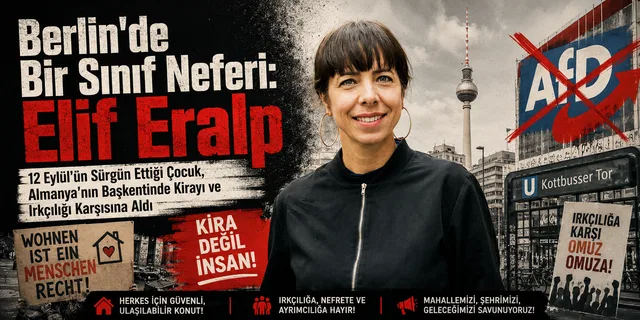
This tableau also has a bitter side for us. Cem Özdemir is the child of a guest-worker family that came to Germany to work in the 1960s. Elif Eralp is the child of a trade-union family that had to flee after 12 September. Both are children of the "Almancı" story. But the two of them wrote that story in two separate class directions.
Özdemir's road is the ladder the order offers the migrant: assimilate, adopt the state's reason, defend the order better than anyone, and a step will be opened for you too. This ladder is real, and Özdemir climbed it to the top. But the price of the ladder is to close the door on those who come behind. What Özdemir is doing to Eralp today is exactly this: the order's "good migrant" is informing on the order's "bad migrant."
Eralp's road is another: she built her career in residence and asylum law, that is, at the point where the state comes down hardest on the migrant; she questioned the property of the rent companies; she founded Links*Kanax so that migrant members would be represented inside the party. This road is not a ladder; it is a position.
Young comrades, grasp this distinction well: being of Turkish origin is not a political position. The feeling that "one of us" has arrived always misleads us when we do not ask the class question. Two people from the same root can, on the same day, be the spokespersons of two opposing classes.
The hypocrisy of the Greens: the portrait of a class party
Özdemir is not alone. His words are the clearest expression of the transformation the Greens have undergone in the last twenty years. Let us see that transformation in a table:
| What the Greens say | What the Greens do |
|---|---|
| "The firewall is not a matter for bargaining." | They form coalitions in the states with the CDU, which in practice demolished the firewall in January 2025; they propose to draw the wall against the left. |
| "Zero tolerance for antisemitism." | They see no objection to governing with the right (including the right wing inside the CDU), which is the largest source of antisemitism; they apply the yardstick only to the left. |
| "A party of peace." | They supported loosening the debt brake for rearmament; they held office in the federal government in the period when arms exports to Israel were approved. |
| "Respect for the people's will." | They propose refusing to implement the 2021 socialisation referendum and breaching the 2014 Tempelhof referendum. |
| "The rent crisis is our social problem." | As a solution they offer a recipe of "building" that does not touch the rent monopoly. |
| "Diversity and the representation of migrants." | They are trying to cut off the first migrant-origin candidate for mayor of Berlin, by the hand of their own minister-president of Turkish origin. |
| "No to a Kenya coalition" (Berlin candidate Werner Graf before the election). | After the election they are keeping on the table a formula that shuts out the first party with the third and the fifth. |
This table is not a matter of character; it is a matter of class. The Greens' social base is the highly educated, high-income, often home-owning strata of the big cities. Values such as climate, diversity and human rights hold a real place in this stratum's identity; but the moment property is touched, values and interest part, and every time interest wins. In 1998 "yes" to the Kosovo war, in 2003 "yes" to the Hartz reforms, in 2025 "yes" to the rearmament debt, in 2026 "don't touch" the rent monopoly. The Greens are capital's "progressive" face, and this face, whenever capital's interest is in danger, turns back at the same speed to its real face.
The roads in front of Elif Eralp
Now we come to the real question: what can Eralp do? In front of her five roads appear that do not exclude one another. Let us weigh the gain and the cost of each in class terms.
The first road: sit at the table, bargain over the programme
Take the congress's approval, enter exploration, treat the antisemitism question with seriousness in the pre-talks, but lock the main negotiation onto the programme: socialisation, the rent cap, borrowing, public transport. The strength of this road is this: the Left Party is the first party and the keystone of a 97-seat majority. The SPD is at a historic low with 12.1 percent; with a result its own candidate Steffen Krach called a "disaster," remaining outside government or becoming the CDU's junior partner would perhaps be the last blow for the SPD.
The cost: bargaining means concession. We do not forget that in the Left Party's past Senate partnerships (2002—2011 and 2016—2023) it joined in the sale of public housing and in budget cuts. The danger is that socialisation turns into a "study commission," the rent cap into a "pilot project," borrowing into "within constitutional limits." If that happens, Eralp becomes mayor but Berlin's tenants lose.
The second road: take the initiative on the antisemitism heading
Without bowing to the imposition of a definition, but without denying the problem either, put forward a concrete programme for the protection of Jewish life: the security of Jewish institutions, independent complaint mechanisms against discrimination in schools, investigation units against right-wing violence, education programmes that treat antisemitism and hostility to Muslims together. Inside this programme also call Jewish left voices to the table (voices such as Ullrich, Dotan-Dreyfus, Jüdische Stimme); break the narrative that reduces Jews to a single community leadership.
At the same time do what Dotan-Dreyfus proposes: come off the defensive, name the real source of the problem. Bring onto the agenda the antisemitism of the AfD and of the right inside the CDU, how the funds to fight antisemitism have been distributed, and how the right has made Jewish fear fuel for its own hostility to migrants.
The cost: being criticised from both sides. The Neukölln base will say "capitulation," the right-wing media "window-dressing." But this road has no alternative: to stay silent is to accept the other side's narrative.
The third road: draw a line in the party, but with political education
Define plainly as conduct that has no place in the party the call to violence, the sanctification of the massacre of civilians, and closeness to criminal networks. But do this not with expulsion lists, first of all with political discussion and education. To bow to Özdemir's demand to "throw them out" would be to bind the party's fate to a yardstick set by the enemy; today you throw out Dahabflex, tomorrow they will want you to throw out the MP who says "genocide in Palestine." The yardstick must be the party's own programme, not Springer's headlines.
The cost: time. And a hard internal debate with the Neukölln organisation and with the youth organisation. But this debate is also the debate over whether the party will be a class party.
The fourth road: keep open the possibility of leaving the table
If the SPD and the Greens insist on using the antisemitism heading as a means of emptying the programme, Eralp can say this plainly: "If you want to shut the first party out and form a coalition of the losers, form it; you will give the account of that to Berlin." A "Kenya" coalition would be formed with the CDU's 18.8 percent of the vote, shutting out the party that won the election by a clear margin. Such a government would be born on day one into a crisis of legitimacy, and it would carry the Left Party into a strong opposition position.
The cost: remaining outside government means postponing concrete gains such as the rent cap from today. And it means the Linksjugend line of "let us not enter government" being proved right in practice. But sometimes the one who can leave the table sits more strongly at it.
The fifth road: organise the power outside the table
This road is the condition of the other four. Bargaining power at the exploration table exists to the extent that there is an organised power outside the table. The Deutsche Wohnen & Co. enteignen campaign that won the socialisation referendum, the tenants' initiatives, Verdi and GEW's public employees in Berlin, migrant associations, youth organisations must be the outside party to the coalition process. The tens of thousands who filled the squares on election night must also be in the street in the weeks of negotiation. The most important lesson of Mamdani's experience in New York was this: the election campaign did not dissolve; it remained a movement defending the government programme.
The cost: the party leadership's inability to control this movement. But in class politics an uncontrollable power is always better than a controlled powerlessness.
Our proposal
We rank these five roads, through the class lens, as follows: without the fifth road the first turns into surrender, the fourth into isolation. The second and third roads are obligatory for the party's own moral integrity and cannot be postponed. Eralp's strength is neither in Springer's headlines nor at the SPD's table; it is in the tenants of Kreuzberg, Neukölln, Wedding, Marzahn. If that strength is organised, Eralp becomes mayor and the programme lives. If it is not organised, either she does not become mayor, or she does and the programme dies.
Table: what the bourgeois bloc says, what the class sees
| The bourgeois bloc's narrative | What the class sees |
|---|---|
| "The Left Party has an antisemitism problem." | There are problematic members and unacceptable events; but the real function of the debate is to knock the socialisation programme off the table. |
| "Eralp cannot make her party listen." | Those who tell Eralp to "discipline your party" are in fact saying "silence your base, water down your programme." |
| "The AfD yardstick should be applied to the Left." | The wall was drawn against the AfD because of its programme; the wall they want drawn against the Left is also because of its programme, but from the other side: a programme of equality. |
| "The safety of Jews stands above everything." | The safety of Jews must be protected both from those who take them hostage in a political bargain and from the right that threatens them. |
| "Socialisation is the wrong economic instrument." | 220,000 dwellings are in the hands of companies that skim a profit share from tenants' wages; whoever says "wrong instrument" does not say whose pocket they are protecting. |
| "A Kenya coalition is a democratic option." | A coalition of losers that shuts out the first party is a seizure of the ballot-box will at the table. |
| "The debt brake is a constitutional principle." | The principle that bends for tanks turns to stone for tenants. |
Looking from Turkey
This debate has a side that is familiar to us. In Turkey too, elected mayors have been removed from office on charges of "terror," and trustees appointed in their place. The pretext was every time security; the result was every time municipal budgets slipping out of oversight, and the liquidation of the urban commons. In Germany there is no trustee, there is a constitution, there is a chamber; but the logic is familiar: the voter's preference is valid to the extent that the rulers can accept it. The name of the yardstick in Turkey is "terror"; in Germany this week it is "antisemitism." In both, a real problem is being used for a purpose that is not real.
And one more note: workers from Turkey in Germany should this week see well the difference between Özdemir and Eralp. The difference between rejoicing that "one of us" has become minister-president and rejoicing that "one of us" is defending our programme is class consciousness itself.
Concrete tasks
Young comrades, what can we do in this tableau?
- Correct the language of the debate. When you meet the narrative "the Left Party is antisemitic" around you, on Turkish- and German-language social media, say both things at once: there are unacceptable events and they must be condemned; but the real function of the debate is to protect the rent monopoly. Whoever says only one of the two is either indifferent or an instrument.
- Keep the socialisation programme on the agenda. Follow the calls of the Deutsche Wohnen & Co. enteignen campaign, share them, translate them into Turkish. Throughout the coalition negotiations bring the figure "220,000 dwellings" back into every discussion.
- Make the voices of the Jewish left heard. Read and share the texts of Peter Ullrich, Tomer Dotan-Dreyfus, Jüdische Stimme. Breaking the narrative that presents Jews as a bloc of one voice is the most effective answer both to antisemitism and to its instrumentalisation.
- Carry the anger in Neukölln into an organised form. When you speak with Palestinian and Arab young people, argue for the just anger felt for Gaza to turn not into slogans of violence but into class organisation. The language of internationalism is not "death" but "the right to live."
- Speak with Green voters. Carry Özdemir's words to his voters: "You said yes to socialisation in 2021, you protected Tempelhof in 2014; today your party is turning its back on both." The Greens' base is to the left of their leadership; deepening this contradiction is our work.
- Be in the street on the days of the congress and the negotiations. Whether you have the vote or not, from the 25 September congress to the coalition vote, join the actions of the tenants' initiatives, the unions, the migrant associations. Power at the table is measured by power in the square.
- Do not forget conditional support. Our support for Eralp began at the ballot box; it did not end with the ballot box. When the coalition agreement is signed, read it with a tenant's eye: is there a timetable for socialisation? Is the rent cap binding? Is the borrowing decision clear? If not, say that plainly too.
Dear Comrades,
What is happening this week in Berlin is a scene we have known since 1919: the labourers win a gain at the ballot box or in the street, and the ruling class tries to take that gain back under another name, in another language, most of the time with a moral outrage. In 1919 the name was "order," in the 1970s "terror," today "antisemitism." But every time the thing that is not discussed is the same: who will sit in whose home, whose rent will turn into whose profit.
What awaits Elif Eralp? An easy road does not. What awaits her is the responsibility of facing her own party's wrongs, the courage not to bow to the order's false morals, and most important, the duty of carrying Berlin's tenants as far as the table. The real thing that awaits her is what we will do.
The safety of our Jewish neighbour and the voice of our Palestinian neighbour are not opposites of each other. What threatens both is the complicity between the rent monopoly and the racism of the right. What will break that complicity is neither Özdemir's ultimata nor Springer's headlines; it is organised labourers.
We won at the ballot box. Now we have to win at the table as well, and in the street.
We stand with you, Elif. But our eye is on the programme.
Comradely.
Update
24 September 2026, 11.00 (TRT): The piece was written before the Left Party Berlin's 25 September congress. Regular updates will follow with the congress decision, the course of the exploratory talks, and a possible coalition agreement.
Sources
Earlier pieces in this series
- 'Elif Eralp: "We Wrote History, Comrades"', Knowledge Commons, 20 September 2026 — bilgimusterekleri.org
- "AfD's 43.8 Percent Is Not a Deviation…", Knowledge Commons, 11 September 2026 — bilgimusterekleri.org
- "A Class Soldier in Berlin: Elif Eralp", Knowledge Commons, 29 August 2026 — bilgimusterekleri.org
- "A Communist Traveler in Berlin", Knowledge Commons, 21 July 2026 — bilgimusterekleri.org
The election result and the coalition process
- "Vorläufiges Endergebnis in Berlin: Linke erstmals stärkste Kraft – SPD mit historischem Tief", Tagesspiegel — tagesspiegel.de
- "Was die Linke für mögliche Koalitionspartner unattraktiv macht", ZDFheute — zdfheute.de
- "Linke lädt Grüne und SPD zu ‚Vorgesprächen‘ ein", Focus — focusplus.de
- "Berlin-Wahl: Antisemitismus belastet rot-grün-rote Regierungsbildung", ad-hoc-news — ad-hoc-news.de
- "Berlin-Wahl: Elif Eralp könnte Berlin regieren – wenn ihre Basis sie lässt", Handelsblatt, 18 September 2026 — handelsblatt.com
- "Linken-Kandidatin Eralp will ins Rote Rathaus: ‚Wir müssen zusätzliche Kredite aufnehmen‘", t-online, 11 September 2026 — t-online.de
- "Heftiger Disput um Weltanschauung der Berliner Linken", Deutscher Bundestag, 23 September 2026 — bundestag.de
Cem Özdemir and the Greens
- "Rot-Grün-Rot in Berlin: ‚Das ist in der Hauptstadt nicht erträglich und darf nicht in die Nähe der Macht kommen‘", Welt — welt.de
- "Özdemir: Linke muss Antisemiten notfalls rauswerfen", Staatsanzeiger BW, 22 September 2026 — staatsanzeiger.de
- "‚Das ist der falsche Weg‘: Özdemir warnt Grüne vor Koalition mit der Linken in Berlin – und lehnt Enteignungen ab", Tagesspiegel, 24 September 2026 — tagesspiegel.de
- "Özdemir warnt Grüne vor Koalition mit Linkspartei in Berlin", Stuttgarter Zeitung, 24 September 2026 — stuttgarter-zeitung.de
- "Grüne stellen Ultimatum an Berliner Linke", Werra-Rundschau, 24 September 2026 — werra-rundschau.de
- "Koalitionsvertrag für Baden-Württemberg: Özdemir und Hagel einig", ZDFheute — zdfheute.de
- January 2025 Bundestag vote and the firewall debate — lto.de
The debate inside the Left Party, and antisemitism
- Frederik Eikmanns, "Antisemitismus in der Berliner Linken: Gefahr für Elif Eralp", taz, 21 September 2026 — taz.de
- Erik Peter, interview with Peter Ullrich: "Die Debatte hat die Funktion, die Linke zu schwächen", taz, 22 September 2026 — taz.de
- Elsa Koester, "Antisemitismus: Jenseits von Issa Remmo und Ibrahim Ibrahim auf Linke-Wahlpartys", der Freitag, 21 September 2026 — freitag.de
- Tomer Dotan-Dreyfus, "Elif Eralp sollte den Antisemitismus der CDU angreifen", der Freitag, 20 September 2026 — freitag.de
- "Antisemitismus: Wie groß ist das Problem in der Berliner Linkspartei?", Euronews, 18 September 2026 — euronews.com
- "Die Linke in Berlin hat den Antisemitismus nicht im Griff", SRF — srf.ch
- "Wahlkampfdebatte im Gemeindehaus", Jüdische Allgemeine — juedische-allgemeine.de
- "Berlinwahl: Linken-Kandidatin Elif Eralp unterstützt rechte Hetze gegen Wahlveranstaltung der eigenen Partei", WSWS, 31 August 2026 — wsws.org
- "Antisemitismus: Die Berliner Linkspartei und ihr Problem mit den Juden", NZZ — nzz.ch
- "Jüdische Stimme für gerechten Frieden in Nahost", Wikipedia — en.wikipedia.org
Background
- "Elif Eralp", Wikipedia — en.wikipedia.org
- "Cem Özdemir", Wikipedia — en.wikipedia.org
- Jerusalem Declaration on Antisemitism (JDA) — jerusalemdeclaration.org
- IHRA working definition — holocaustremembrance.com