Elif Eralp: "We Wrote History, Comrades"
Elif Eralp Won Berlin — Now It Is Our Germany Story's Turn

Elif Eralp: "We Wrote History, Comrades"
Elif Eralp won Berlin — now it is our Germany story's turn
"People like me were not supposed to become mayor."
Dear Young Comrades,
Look closely at today's date: 20 September.
Forty-one years ago today, a man died in Istanbul. His name was Ruhi Su. He had cancer. Hospitals in Germany were ready to treat him. The state did not give him a passport. It did not give him one for four years. The man died waiting for treatment in a country he was not allowed to leave. This morning we wrote The Melodious Heart: Telling Ruhi Su to Young Comrades for him.
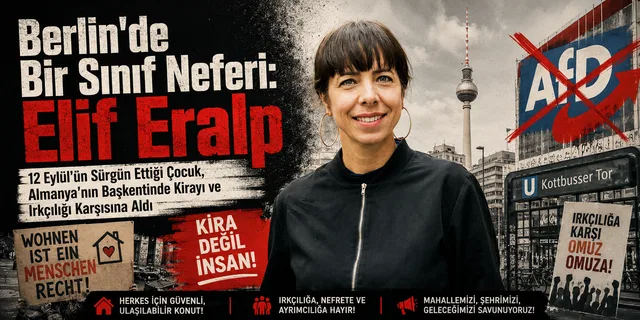
And this evening, on the same calendar day, the ballot boxes opened in Berlin. The first party came out as the Left Party. The party's candidate is the daughter of a family that fled Turkey in September 1980, a daughter who crossed the border in her mother's womb: Elif Eralp.
One man was refused a passport to go to Germany. One family was refused permission to stay in Turkey. Two separate decisions of the same state. And forty-one years later, on the same day, those two stories touched each other in Berlin.
This piece has two parts. In the first we will look at what came out of the ballot box this evening, at what was won and at what has not yet been won. In the second — and this is the real matter — we will tell our Germany story. From being seen off with drums and shawms and counted on an examination table, to the Ford strike, to being offered money to "go", to houses set on fire, to those who left by fleeing, and to the network those people built.
Because what happened in Berlin this evening is not a surprise. It is sixty-five years of accumulation breaking the surface.
Part One: The Evening of 20 September
What came out of the ballot box?
Let us begin with the figures, because the rule on this blog is clear: under every claim a figure, under every figure a source.
2,487,318 voters were registered for the Berlin House of Representatives (Abgeordnetenhaus) election. A first took place in this election: sixteen- and seventeen-year-olds voted in a state election for the first time. Turnout at 16.00 stood at 58.2 percent — above the same hour in 2023. At noon, 12.00, turnout was 27.9 percent; in 2023 at the same hour it was 23.4 percent. People took this election seriously, in other words.
The evening projections produced this table:
| Party | 20 September 2026 (projection) | 2023 | Seats (130) |
|---|---|---|---|
| The Left Party (Die Linke) | 25.4 – 25.5 percent | 12.2 percent | 36 |
| CDU | 19.4 – 20.0 percent | 28.2 percent | 28 |
| The Greens | 15.1 – 15.4 percent | 18.4 percent | 22 |
| AfD | 13.9 – 15.4 percent | 9.1 percent | 20 |
| SPD | 11.8 – 12.0 percent | 18.4 percent | 17 |
| BSW | 5.0 – 5.2 percent | — | 7 |
We are not hiding the play in the figures: the evening projections of different channels differ from one another by half a point to a point; the definitive official result will be announced when the count is complete. But the direction of the table is beyond dispute:
- The Left Party rose by thirteen points and became the first party in Berlin's history for the first time.
- The CDU lost nearly nine points.
- The SPD fell to the 12 percent band — its worst result in Berlin in the post-war era. Its own candidate, Steffen Krach, called the result a "disaster".
- The sitting CDU–SPD senate fell to 45 seats; in other words the government was brought down.
And the figure that really has to be talked about is this: 47 percent of voters aged 16–24 voted for the Left Party. Among those over 60, the Left Party lagged behind the CDU, the SPD and the AfD.
Read that twice, comrade. This is not a "youth fashion". This is a generation that cannot pay the rent, works without security and cannot see its future turning its class position into a political preference. In Germany a young labourer's anger goes either to the AfD or to the left. In Berlin it went to the left. In Saxony-Anhalt two weeks ago, as we set out in AfD's 43.8 Percent Is Not a Deviation: It Is the Bill of a Two-Hundred-Year Line and Thirty-Five Years of Dispossession, it went to the AfD. The difference is whether an organised class alternative stands opposite that anger. That is the only difference.
What was won, and what has not yet been won?
We have to be honest here, because joy built on a lie falls apart the next morning.
What was won: the Left Party is the first party. The arithmetic of a left government in Berlin exists: the Left Party + the Greens + the SPD make 74–75 seats; 66 are needed for a majority. The CDU is left with only one mathematical option (CDU + Greens + SPD ≈ 65–67), and even that is on the edge. The CDU candidate Stefan Evers accepted defeat in the evening by saying "it is natural to congratulate the strongest force among democrats".
What has not yet been won: as of this evening Elif Eralp has not taken charge of Berlin. In Germany a state parliament election does not directly elect a mayor; the first party first forms a coalition, then the parliament elects the head of government (in Berlin, by the official title, Regierende Bürgermeisterin). The ballot box opened the door; whether anyone walks through it will be decided by the bargaining of the weeks ahead.
And the knot in the bargaining is already clear: the SPD is against the expropriation of the large housing monopolies. In other words the demand that formed the heart of the Left Party's campaign is the first candidate for sacrifice at the coalition table. We say this now so that we will not be surprised three months later and ask "how did this happen".
Let us also make a correction, because it is circulating widely on social media this evening: if she is elected, Eralp will not be Berlin's first woman mayor. That title belonged to Franziska Giffey (SPD) in 2021. Eralp's firstness is something else, and heavier: she will be the first person of migrant origin, the first of Turkish origin and the first from the left to govern Berlin.
That difference is not trivial; the whole subject of this piece is precisely that difference. Because the matter is not a woman coming into office, but which class entered through which door. Giffey was a woman too, and she headed the senate that failed to implement the referendum in which the people accepted the expropriation of the housing monopolies. Representation by itself promises nothing. A programme promises.
From the right to the left: why did all of us tremble inside this evening?
Now let us leave the figures and talk about what passed through the insides of millions of people from Turkey in Germany this evening. Because this is something social science cannot measure but history determines.
This evening in Berlin, in Cologne, in Duisburg, in Hamburg, the phones rang. People who had not called one another for years called one another. People who had nothing to do with politics sat down in front of the television. Even people who would not vote for the Left Party, even people who swear at the Left Party, paused for a moment.
Why?
Because for sixty-five years the people living in this country have constantly been told "this place is not yours". That sentence was sometimes spoken by a law, sometimes by a tender specification, sometimes by a housing advert, sometimes by a police stop, sometimes by the mark a teacher gave your child. And this evening, into the highest office of the city in which that sentence was spoken for sixty-five years, walked the daughter of a family that was the addressee of that sentence.
This feeling is not class feeling, but it comes from the bottom of a class fact. Let us not mix the two:
When the right-wing Almancı rejoices this evening, he thinks this: "one of us." That is identity pride. Tomorrow morning the same man may share an anti-refugee post; he may oppose the asylum programme Elif Eralp defends. This contradiction is real, and to ignore it would be naïveté.
When the left-wing Almancı rejoices this evening, he thinks this: "a programme that took on rent, racism and cuts has won." That is class joy.
But the common root of both is the same: a status being split for the first time. And we do not belittle that common root. Because a human being tasting for the first time the feeling "I count too" is the anteroom of politicisation. The nine people killed in Hanau were not asked for their identity; no one asked "which party do you vote for". Being pushed aside is collective. That is why the moment that pushing-aside is split is also felt collectively.
But let us say this in the same breath, because comradeship is not fawning: this feeling is a beginning, not a programme. Pride does not change a tenancy agreement. The appearance of a person's surname in an office does not determine in whose class interest that office will work. Germany has had ministers, MPs and mayors of migrant origin; some of them signed deportation packages. Representation is a tool; the measure is the programme.
So let us set the measure and hold it in our hands through the whole piece:
Whether a person is one of us is measured not by how their name is written, but by where they stand on the question of who will set the rent.
Part Two: Now We Tell Our Germany Story
Let us begin with a song
Before we begin this part of the piece, do one thing: open this song and listen to it through to the end.
Have you listened? Now know one more thing.
The man singing that song had no passport at the time he sang it. Cem Karaca went to Germany before 12 September; after the coup, on the grounds that he had not complied with the call to "return to the homeland", he was stripped of citizenship and lived in Cologne for years. There he sang in Turkish, he sang in German, he made an album called Die Kanaken — "Kanake" was the word Germans used to degrade the migrant; the man took the slur and wrote it on the album cover. He was able to return to Turkey only after 1987.
In other words, the song that tells of the Almancılar is sung by a man who was forced to become one.
Keep that detail in mind, because it is the spine of this piece: those who went to Germany went by two branches — one for work, one for their lives. And both were the product of the same order.
We were seen off with drums and shawms, and counted on an examination table
30 October 1961. A labour agreement was signed between Turkey and the Federal Republic of Germany.
For the Turkish side this was a deliverance: a portion of the population flowing from village to city, unable to find work, pressing the economy as open unemployment, would be exported; foreign currency would come in return. In other words the human being was designed as an item on the balance of payments.
For the German side this was a calculation: the post-war "economic miracle" was running a labour shortage. What was needed was a worker; but a worker who was cheap, unorganised, temporary and, when necessary, sendable back.
Trains left from Sirkeci Station. On the platforms drums and shawms were played, sacrificial animals were slaughtered, handkerchiefs were waved. The people who got off at platform 11 (Gleis 11) of Munich Hauptbahnhof were, as their first task, lined up and put through a medical examination. Their teeth were counted, chest X-rays were taken, muscle strength was measured.
Stop and think over this scene, comrade. The same human being is, in their homeland, a child being seen off, and on the platform they step onto, a labour power being examined. The distance between them is two days on a train; but the category has changed completely.
By 1973 about 870 thousand workers from Turkey had gone.
And what were those people called? "Gastarbeiter" — guest worker.
Dwell on this concept, because it is the purest form of an ideological operation. The word "guest" constructs a category of labour assumed not to be permanent — and therefore not requiring citizenship, housing, education or political representation.
Labour power was called; the human being was counted as not having come.
The agreement initially envisaged "rotation": when the worker's term was up they would return, and a new one would come in their place. Firms abandoned this model quickly. Why? Not because they had a moral awakening: keeping a trained worker was cheaper than training a new one. What broke the idea of "guestness" was not conscience but a cost calculation.
Ford 1973: the Almancı also went on strike once
Now I am going to tell you the greatest moment in the history of migrant labour in Germany — a moment not told in schoolbooks, almost unknown in Turkey.
August 1973, Cologne-Niehl, the Ford plant.
Workers from Turkey used their four weeks of annual leave and came back from the homeland. The journey was long, the coaches ran late; being a few days late had for years been something that was tolerated. That year it was not. Ford's personnel management immediately dismissed 300 workers from Turkey.
24 August: 400 workers from Turkey on the evening shift began a walkout. The same day about 8,000 workers stopped work.
27 August: 12,000 workers from the morning shift joined the strike. The plant stopped.
What were the demands? Read them carefully, because these are not "migrant demands"; they are class demands:
- Reinstatement of the 300 dismissed workers
- A one-mark rise in the hourly wage
- A reduction in line speed
- An increase of annual leave to six weeks
- Abolition of the lower wage groups
- A thirteenth month's pay
- No disciplinary penalties for strikers
Look in particular at the clause "abolition of the lower wage groups". In German industry, migrant workers and women workers were systematically placed in the lowest wage group (Leichtlohngruppe). In other words the strike was attacking directly the legal splitting of labour power. In the same year, at the Pierburg plant in Neuss, women workers — the majority of them migrants — went on strike under the slogan "One mark more!" and in practice had the low-wage group reserved for women abolished.
One of the spokespersons of the strike committee was Baha Targün.
So what happened?
29 August: management offered a compromise; the workers refused.
30 August: the strike was broken. Pay attention to how it was broken: a mob made up of foremen, plant security, strike-breakers brought in from Belgium, plain-clothes police and Ford managers marched on the strikers. The strike leaders were handed over to uniformed police.
Then the accounts were settled: 27 people accused as "ringleaders" were arrested, more than 100 people were immediately dismissed, about 600 people submitted their own resignations under pressure. Baha Targün was deported to Turkey.
And now the most cutting part. During this strike, who stood where?
IG Metall — that is, Germany's strongest union — rejected the strike and called on the workers to return to work. The union's general leadership used of the strikers the phrase "extremists who have come from the whole country". The works council (Betriebsrat) refused to grant a secondment permit to the only shop-floor representative from Turkey. There was one exception: the local union official Günter Tolusch tried to mediate, and for that he was removed from his post.
The BILD headline was this: "German workers are saving Ford."
Chancellor Willy Brandt — a social democrat — called on the strikers to return to the union.
Comrade, grasp the movement here well. This was not a "Turkish–German matter". This is capital, the state, the press and the union bureaucracy lining up at the same time and in the same direction. The strike was broken by splitting the worker according to nationality. And the side that made that split was not only the boss, but the institutions counted as "the representative of the working class".
Ford 1973 is the greatest lesson of migrant labour in Germany: the migrant worker stood not outside the class, but in the class's most defenceless compartment. And the wall of that compartment was not built by capital alone.
1973: the door closed, but those inside chose to stay
Before three months had passed after the strike, on 23 November 1973, the Federal Republic took the Anwerbestopp decision: recruitment of workers from outside the EEC was stopped. The stated reason was the oil crisis; the calculation was a surplus of labour power.
The result of this decision was the exact opposite of what those who planned it expected.
Until that day the workers had been coming and going. When the door closed, everyone understood this: if you leave once, you cannot come back in. So those who stayed stayed, and they brought their families to their side. Family reunification exploded in the second half of the 1970s. Women came, children came, children started school in Germany.
In other words what ended the lie of "temporariness" was not an integration policy, but a ban. By closing the door, the state produced permanence.
Despite this the German state continued its official lie for decades: "Germany is not a country of immigration." That sentence was not innocent. It legitimised the deprivation of millions of people of political rights. A population living in a country, paying tax, producing — but assumed "not to be there".
1983: they were offered money to "go"
Now we come to the hardest fact in this piece. Many people do not know it; those who know do not talk about it enough.
28 November 1983. The Federal Republic passed a law called the Rückkehrhilfegesetz — the "Act to Promote the Willingness of Foreigners to Return".
What did the law say? Openly: go, and we will give you money.
- 10,500 Marks to anyone who left the country as a family and for good
- An additional 1,500 Marks for each child
- The condition: the whole family had to leave by 30 September 1984. Anyone who was late had 1,500 Marks deducted from the payment each month.
The target group was openly workers from Turkey.
Now let us come to the real matter, because what matters is not the amount of the prize but the part that stayed silent.
The returning worker could recover from the pension insurance only the share they themselves had paid. The share the employer had paid stayed in the fund. In other words a man works for twenty years, the employer pays contributions in his name for twenty years, the man leaves — and half of that money stays in Germany.
The amount this operation earned the state has been calculated: in the pension system alone about 2.5 billion Marks; plus savings of 90 million in unemployment benefit and 195 million Marks in child allowance.
In other words there was no "cultural anxiety" here. There was an accounting operation. People were encouraged to be deported, leaving behind a portion of labour that had been paid for but was counted as unpaid.
And the intention behind this policy is also documented: in a private conversation recorded in 1982, Helmut Kohl is reported to have said that he aimed to halve the population of Turkish origin in Germany in four years, but that this could not be said openly.
In a single sentence: They were called to the country as labour power; when they were counted as surplus they were tried to be sent back as a savings item.
Some of them went. Some of those who went could not hold on in Turkey and were ruined — they opened a shop and went under, they bought a field and could not sell it, their child could not adapt to a Turkish school. Some of them stayed. The grandchild of those who stayed won Berlin this evening.
Being in between: Almancı in Turkey, foreigner in Germany
Now let us leave the figures and look inside those people. Because "being in between" is not an identity crisis; it is the reflection of a legal status onto psychology.
In Germany a word met you: Ausländer. Foreigner. This word was not a feeling; it was a legal category: residence permit, work permit, deportability, the absence of the right to vote. In other words to say "you are a foreigner" was the polite form of saying "I can send you from here".
In Turkey another word met you: Almancı.
What was inside this word? A little envy, a little mockery. The man who arrived in a Mercedes, pulled a cassette player out of the boot, whose Turkish had gone to pieces, who had become "German-ish", who was no longer counted as fully one of us. Summer would come, the convoys would enter through Kapıkule, they would be treated as honoured guests in the village for a week, then talked about behind their backs.
Think of this picture: a human being works for eleven months as a "foreigner"; for one month they are a guest as an "Almancı". They are the host nowhere.
This is the condition literature and cinema have told dozens of times. Almanya Acı Vatan (1979), Otobüs (1974), Kırk Metrekare Almanya (1986) — all of them tell the same split. But the most direct record of that split was kept not in the academy, but on cassettes.
Record companies such as Türküola and Uzelli in Cologne, and Minareci in Munich, were founded. These companies pressed the workers' own music directly, without taking a licence from Turkey. The cassettes passed from hand to hand in factory canteens, association halls, market stalls.
Metin Türköz came to the Ford plant as a worker in 1962, worked for five years, then gave himself wholly to music. He is counted as "the first Turkish bard in Germany"; 72 records, 13 cassettes. Even the names of his songs are a class document: Almanya Destanı, Kabahat Tercümanda, Guten Morgen Herr Meister.
Yüksel Özkasap — "the Nightingale of Cologne" — came for six months, stayed, recorded about 500 türküs. Apart from radio concerts she almost never went on stage; her voice spread not from the stage but from the cassette.
There was also a school that was exactly "Germany, bitter homeland": Âşık Haydar Korkmaz, Âşık Kemteri, Âşık Seyfîli, Derviş Can, Ali Sultan.
And in 1980s West Germany the Derdiyoklar Duo played Alevi hymns with an electric saz — that sound, today being rediscovered in Europe as "psychedelic folk", is in fact a gurbet recording.
In the 1990s the second generation began to speak, and the language changed: Cartel (Erci E., Karakan, Crime Posse), Fresh Familee, TCA Microphone Mafia, Aziza A. This rap wave that rose after Solingen was not a coincidence. Their fathers burned türküs; their children made rap. Both were saying the same thing: we are here and we are not counted.
The sentence Metin Türköz spoke years later tells of a period ending: "Videos came out, then satellite dishes, our âşıklık passed into history." In other words the migrant's own cultural production was replaced by Turkey's broadcast arriving over the satellite. This too is a class matter: a community that produced its own voice was turned into a community of consumers.
Those who left by fleeing: the Germany of 12 September
Up to here we have told of those who went for work. Now let us tell of those who went for their lives. Because Elif Eralp's family is of this second branch.
In 12 September: The History, Balance Sheet, and Present of a Class Coup there are three figures, and these three figures are the subject of this piece:
- 30,000 people went to Europe as political refugees.
- 14,000 people were stripped of citizenship — the grounds were most often "not complying with the call to return to the homeland".
- 388,000 people were refused a passport.
Dwell on the third figure. The state drove some of them out; it also forbade some of them from leaving. In other words the same apparatus, at the same time, both pointed to the door and locked the door. It decided which operation it would apply to whom. This is arbitrariness itself — and arbitrariness is a technique of government.
Who were those who left? DİSK officials, trade unionists, 1402 academics, journalists, students, artists. Yılmaz Güney fled in 1981, finished Yol and Duvar in Paris, died in exile in 1984 — we have a piece on him, From the Ugly King to Yol: Reading Yılmaz Güney Through Class. Cem Karaca settled in Cologne. Melike Demirağ and Şanar Yurdatapan lived in Germany. Fuat Saka settled in Hamburg and there met the Liedermacher tradition. Germany also became a centre for Kurdish music: Şiwan Perwer, Nizamettin Arıç — a language forbidden to be spoken in Turkey was recorded onto cassette in Cologne.
And exile too had a class. Let us never skip this:
There was a section that could hold on to the academy, the media, cultural institutions in Europe. And there was a section that fell into the factory, into cleaning, into undocumented work. Of two people tried in the same case, one entered the university in Frankfurt, the other the rubbish lorry in Duisburg. The same coup, the same exile, different class outcomes. Exile is not a romantic condition; it is dispossession carried beyond the border.
But that generation did not carry only its wound to Germany. It also carried the habit of building organisation.
DİDF — the Federation of Democratic Workers' Associations — was founded in December 1980. Pay attention to the date: three months after the coup. In other words the generation driven out of the country entered the factory in Germany and one of its first jobs was to found an association. DİDF's line has been clear from the start: to organise workers of Turkish origin — Turkish and Kurdish — on the axis of class, not on the axis of nationality. Today it operates with more than forty local associations in Germany and in five further countries in Europe.
There is another trace in Berlin: the Berlin Workers' Choir. In 1975 they made the piece "Oy Kindergeld" protesting the child-allowance regulation. Think of it: a cut in a social right is being protested in the form of a türkü. Sümeyra Çakır was in that choir — whom we know in Turkey together with another name.
Those who could not go: those who stayed inside in the same years
But exile is only one face of those years. The other face stayed inside. And if we skip this while telling our Germany story, we will have told half the story.
Read the balance sheet of 12 September in the figures confirmed by the İHD and the Grand National Assembly's 2012 report:
- 650,000 people were detained.
- 1,683,000 people were filed.
- 230,000 people were tried; the death penalty was sought for 7,000 people, 517 death sentences were handed down, 50 people were hanged.
- 171 documented deaths under torture; 299 prison deaths — 144 of these passed into the record as "suspicious".
- 30,000 people were dismissed from work with the stamp "undesirable"; 3,854 teachers, 120 faculty members, 47 judges were purged.
- 23,677 associations were closed, 39 tons of books were destroyed, 937 films were banned.
The names of the prisons still stand in a generation's memory today: Diyarbakır No. 5, Mamak, Metris.
And a few names, because a figure is forgotten, a name remains:
İlhan Erdost. Publisher. On 7 November 1980 he was detained together with his elder brother; the same day he was beaten to death in Mamak. In a trial that lasted seven years, privates were sentenced; the commander who gave the order was not.
Cengiz Aksakal. Teacher, forty years old, father of three children. He was tortured at the Teacher Training School in Artvin; he died on 12 November 1980. The officers were acquitted. Turkey was convicted of 12 September torture only in 2007, at the European Court of Human Rights — as a single case.
Nurettin Yedigöl. A student of 26. On 12 April 1981 he was killed by torture in Gayrettepe; his body was lost. His mother Zeycan Yedigöl sat among the Saturday Mothers until she died.
Now set two scenes side by side, because the whole thesis of this piece is in this side-by-side:
Any morning in 1981. A young person is answering roll-call in a ward in Mamak. Another young person from the same village is clocking onto a shift on the Ford line in Cologne-Niehl. One is being tortured, the other is trying to keep up with the line speed. One is being tried in a case seeking the death penalty, the other is being shouted at by a foreman. Both came out of the same year, the same country, the same class.
And let us also write this openly: who went and who stayed was most often not a choice. Those who had a passport went; those who did not stayed. Some of those whose names were on the list were able to flee; some were caught. The difference between exile and prison is, in most cases, a difference of luck. That is why it is wrong both to romanticise exile and to heroise those who stayed inside and blame those outside. Both are the product of the same coup.
Was the account settled? Greece, in 1975, tried the junta's torturers in hundreds of cases. In Turkey that number is zero. In the Evren and Şahinkaya case a life sentence was handed down in 2014, but the file fell with the defendants' deaths; the conviction never became final. For exile there is neither an apology, nor compensation, nor a commemoration.
This is why we name Elif Eralp's winning this evening as "calling to account". Because an account that has not been asked in law still stands historically.
Ruhi Su and his comrades' Germany adventure
And so we return to the date at the beginning of the piece.
Ruhi Su went to Europe in the 1970s with the Dostlar Choir. Germany, the Netherlands, Belgium, England, France, even Australia — he gave concerts for workers from Turkey in gurbet. He sang in association halls, hired sports halls, factory canteens.
What did he sing? Set the names of two pieces side by side and the whole story comes out:
"Almanya Acı Vatan." And "Almanya'da Çöpçülerimiz."
In other words one of Turkey's most educated voices — a bass-baritone out of the state conservatoire — is burning a türkü in the middle of Europe for his fellow-countrymen collecting rubbish. This is not "the artist descending to the people". This is the artist standing beside their own class. The difference between them is the measure of all this blog's pieces on art.
Sümeyra Çakır sang the same piece in the workers' choir in Berlin. The same melody, in two countries, for the same people.
And then what happened?
In 1978 Ruhi Su was diagnosed with prostate cancer. Hospitals in Germany were ready to accept him. The state did not give him a passport. From 1981 to 1985 it did not give him one. His file waited on the desk. The man, in a country he was not allowed to leave, waiting for the hospital of the country he needed to go to, died on 20 September 1985. At his funeral 163 people were detained.
Now set two sentences side by side:
Ruhi Su was not given a passport to go to Germany. Elif Eralp's family was not given permission to stay in Turkey.
The same apparatus. The same years. The same class. Two different decisions — and the meaning of both is one: you cannot decide where you will stand.
Forty-one years later, on the same calendar day, the child of the people who were the target of those decisions knocked on the door of a capital's highest office.
We do not call this revenge. We call it calling to account.
The Turkey–Germany network: two shores of the same class
Now we come to the real thesis of this piece.
What happened in Turkey and what happened in Germany are not two separate stories. They are the application of the same order in two separate geographies. Let us put this into a table, because when they are set side by side the argument ends:
| In the same years | In Turkey | In Germany |
|---|---|---|
| The right to strike | 12 September: strikes were banned, DİSK was closed, unions were in practice bound by laws 2821–2822 | Ford 1973: the strike was broken up by police and strike-breakers, 27 arrests, 100+ dismissals, the union stood against the strike |
| The organiser's fate | The trade unionist was jailed, DİSK officials were tried | Baha Targün was deported |
| The legal splitting of labour | The subcontracted, the contracted, the tenured | Leichtlohngruppe — the lower wage group reserved for the migrant and the woman |
| The non-recognition of skill | The 1402s: the academic was thrown out of the university | No diploma equivalence was granted: the engineer worked on the assembly line |
| The role of the press | "Anarchist", "separatist" headlines | BILD: "German workers are saving Ford" |
| Houses set on fire | Maraş 1978, Çorum 1980, Sivas 1993 | Hoyerswerda 1991, Rostock 1992, Mölln 1992, Solingen 1993 |
| The protection of the perpetrator | Impunity, limitation, "insufficient evidence" | NSU: intelligence files were destroyed, families were treated as suspects |
| The right to travel | 388 thousand passport refusals, 14 thousand denationalisations | Residence permit, deportability, the 1983 "go, take the money" law |
| Political representation | The threshold, closure cases, trustees | No right to vote for those who are not citizens |
| The bill of the crisis | Devaluation, price rises, dismissals | Anwerbestopp, "Ausländerstopp", austerity packages |
Looking at this table and saying "how similar" is not enough. The real question has to be asked: why is it similar?
The answer is simple and it is the same in all this blog's pieces: because both are the product of the same logic of capital accumulation. In periods of crisis, lowering the cost of labour, dispersing organisation and turning anger sideways — these are not national traditions; they are class techniques. The language of the technique changes; the method does not.
And precisely for this reason, between the labourer in Turkey and the labourer in Germany there is not a "proposal of solidarity" but an objective commonality. One is not helping the other. Both are inside the same thing.
Without saying Turk, Kurd, Arab: the common list of those pushed aside
Now let us draw up a list. Every item on this list is the common experience of the labourer from Turkey in Germany — of the Turk, the Kurd, the Arab, the Alevi, the Syriac, the Gypsy. A difference of identity does not change a single line of this list.
- You were not hired. The same CV, a different name: field experiments show that an application with a German name markedly raises the chance of a reply, and that the gap widens further in small firms. The reply rate for a woman in a headscarf sinks to the bottom.
- You were not let into the house. The same income, the same advert, a different name — no appointment was given.
- Your child was sorted. It was measured that, on one and the same dictation text, a pupil named "Murat" received a lower mark than a pupil named "Max". And the child was directed as "not suitable for the Gymnasium".
- You worked in the heaviest jobs. Logistics, parcels, construction, cleaning, the kitchen, care. Shift work, subcontracted, without security.
- Your language was counted as a defect. Speaking Turkish was a shortcoming; speaking French was a merit.
- Your identity was stopped. Identity checks without cause, racist filing (racial profiling), a police operation in your neighbourhood.
- You were killed and declared a suspect. The real scandal of the NSU file is not in the murders but in the investigation.
- You could not vote. Hundreds of thousands of people who keep Berlin's transport, hospital, construction and kitchen standing could not go to the ballot box in this evening's election. Because they are not citizens.
Underline this last item. This is not a shortcoming of democracy; it is its class boundary. The human being accepted as labour power is refused as a citizen. Elif Eralp's demand for "the vote for everyone living in Berlin" strikes exactly this wall.
And let us also say this openly, because it is a widespread disease inside the community from Turkey in Germany: the sentence "they don't touch us, the problem is the refugees" is the noose being slipped over our own necks. The nine people killed in Hanau were not asked for their identity. The house burning in Mölln was not looked at to see "Turk or Kurd". Racism does not discriminate; whoever discriminates against racism themselves remains defenceless.
Houses were set on fire: a memory list
Let us write this section not with figures but with names. Because a figure is forgotten, a name remains.
| Date | Place | Dead |
|---|---|---|
| 22/23 November 1992 | Mölln — two families' houses were firebombed | 3 (one 10, one 14 years old) |
| 29 May 1993 | Solingen — the Genç family's house was firebombed | 5 (the youngest 4 years old) |
| 2000–2007 | NSU murders | 10 (8 of Turkish origin) |
| 19 February 2020 | Hanau | 9 |
Those who died in Solingen: Gürsün İnce, Hatice Genç, Gülüstan Öztürk, Hülya Genç, Saime Genç.
Those killed in Hanau: Gökhan Gültekin, Sedat Gürbüz, Said Nesar Hashemi, Mercedes Kierpacz, Hamza Kurtović, Vili Viorel Păun, Fatih Saraçoğlu, Ferhat Unvar, Kaloyan Velkov.
Look at the nationalities of these names: Turk, Kurd, Afghan, Romani, Bosniak, Romanian, Bulgarian. The killer did not discriminate. Because the target was not a nationality but a position: those who are not counted in this country.
Serpil Unvar, the mother of Ferhat Unvar who was killed in Hanau, founded an education initiative in her son's name. Because this community has always turned its mourning into organisation. It was so after Mölln, and after Solingen too.
And what was the state's answer in 1993? While the migrant was being burned in the street, parliament passed the Asylkompromiss: a constitutional amendment that in practice abolished the right of asylum. In other words the state protected, against racist violence, not the migrant, but the demand of racist violence.
This is the most instructive sentence in the whole piece: the far right can have its programme implemented without coming to power.
And today? The figures we compiled in What Is This Thing Called Racism? still stand: politically motivated crimes in Germany hit a record of 85,837 in 2025; 19,484 of these were of racist/xenophobic motive. The record of the independent victim-advice centres is still more concrete: 3,167 attacks, 4,298 victims — on average twelve people a day; 55 percent of the attacks of racist motive. In 1,032 attacks on Muslims and mosques, 313 suspects were identified and only three arrests were made.
Dwell on this last ratio: one thousand and thirty-two attacks, three arrests. This is not a capacity problem. This is a declaration of priority.
The official narrative and the class reading
The greater part of what is written this evening in Turkey and in Germany will sit in a certain frame. Let us set that frame and our reading side by side.
| Official / liberal narrative | Class reading |
|---|---|
| "A Turkish girl won Berlin" | The daughter of an exile family won with a programme against rent and racism; the matter is not the surname but the programme |
| "Germany's integration success" | Not integration, but the result of sixty-five years of organised resistance; the state did not accelerate this process, it delayed it |
| "Migrants are now represented" | Hundreds of thousands of labourers living in Berlin still cannot vote |
| "A democratic front against the far right won" | The establishment parties that made the far right's programme "reasonable" lost; the AfD in Berlin gained points again |
| "Young people voted left, a romantic wave" | A generation that cannot pay the rent turned its class position into a political preference |
| "Expropriation is a utopian dream" | In 2021 Berliners accepted this by popular vote; the reason it was not implemented is not impossibility but a relation of force |
| "Now is the time for coalition compromise" | Compromise most often means the pruning of the programme; what will prevent the pruning is not the parliament but the street |
What is being covered over?
Three things.
First: labour itself. In all this evening's narratives a subject is missing — the worker who gets Berlin on its feet every day. The person delivering parcels, holding a shift in the hospital, working on a building site, standing in a kitchen. If the election news is told as a story of "party leaders", both the winner and the loser are written in the wrong place.
Second: organised accumulation. Elif Eralp's candidacy did not fall from the sky. It stands on an experience accumulated for forty-five years in association halls, factory canteens, union congresses, tenants' committees, funeral and memorial ceremonies. If this accumulation is not told, the result is written to one person's charisma — and next time a "charismatic candidate" is sought.
Third: the bill of 1983. The account of the employer contributions that stayed in Germany under the return law was never closed. There is neither an apology, nor a restitution, nor a commemoration. A portion of a generation's labour is still standing in that fund.
And a fourth, as the absence of data: the number of people living in Germany on a residence permit, paying tax but unable to vote in any election, is not published regularly and in detail. That this number remains invisible is not a coincidence. What is not counted is not demanded.
Why Berlin is a laboratory — and why it is not enough on its own
The question most talked about this evening is this: is the Berlin result hope for the whole of Germany?
The honest answer: both yes and no. Let us say both.
Why specific to Berlin? Berlin is not Germany's average. The overwhelming majority of those living in the city are tenants — in other words rent, in Berlin, is not an abstract matter but a concrete property relation everyone lives every month. The population is young and the migrant density is high. There has been a tenants' movement in the city for decades, and in 2021 this movement had the expropriation of the large housing monopolies accepted by popular vote. In other words the Left Party did not build a ground from zero in Berlin; it sat on a ground that was already prepared.
Why still generalisable? Because what won was not a culture specific to Berlin, but a method: locking onto a single material question (rent), constructing that question as a question of property, going door to door and growing the party organisation. The Left Party's membership rose to 123 thousand at the end of 2025 — it doubled. This method is a portable method. Rent is rent everywhere, a cut is a cut everywhere.
And why is it not enough on its own? Because two weeks ago in Saxony-Anhalt the AfD took 43.8 percent. The same month, the same country. Where Berlin has won, the deindustrialised cities of East Germany are being lost. There is no tenants' movement there, the union is weak, there is no party organisation. A laboratory is a laboratory only if its result can be repeated elsewhere.
So the criterion is clear. Whether Berlin is hope for the whole of Germany will be determined in the months ahead by these four questions:
- Will expropriation be implemented? The fate of the 2021 referendum will by itself say what this government is.
- What answer will be given to coalition partners' demand for cuts? A left government's surrender to budget discipline is the right's greatest propaganda material.
- Will the migrant's right to vote stay on the agenda, or will it be said "now is not the time"?
- Will the party organisation continue to grow after the election, or will it withdraw into the senate corridors?
The answers given to these four questions will determine whether there is such a thing as a "Berlin model". We will not forget these four questions, and months later we will remind.
Because on this blog our principle is clear: Our support is conditional, awake and from the base. Support at the ballot box, scrutiny in the street.
Concrete tasks
Comrade, this evening you have the right to rejoice. Tomorrow morning there is work. Here is what can be done:
If you listened to the song, tell the story too. If there is someone in your house who came back from Germany — your father, your uncle, your neighbour — sit down and listen. Which year they went, which factory they worked in, how many years they stayed, why they returned. Take a record. This generation is going and no one is keeping the oral history.
Learn the 1983 law and tell it. Everywhere in this country that you hear the sentence "Germany treated us well", tell of the 10,500 Marks and the employer contributions that stayed in the fund. This is the single piece of knowledge that carries the argument from feeling to account.
Learn Ford 1973. This is the proof that the history of migrant labour is not only victimhood. Twelve thousand people stopped a plant and demanded the abolition of the lower wage groups. The young person who knows this counts themselves not a victim but a subject.
If you are in Germany and you have the vote, find those who do not use it. This evening a result came out, but many still did not go to the ballot box. Keep a list from today for the next time.
If you have no vote, you have a right of intervention. Working in the campaign, speaking in association and neighbourhood networks, carrying the argument in the workplace, is a more lasting intervention than a ballot paper.
Make contact with an organised structure. The DİDF association in the city you are in, your union's migrant commission, the tenants' initiative in your neighbourhood. A vote cast alone disperses; a vote that comes out of an association turns into organised force.
Bring the rent struggle down to building level. If the demand for expropriation remains an election slogan it dies at the coalition table. If it turns into a tenants' committee it lives.
Do not avoid arguing with the person who says "they don't touch us". That sentence is not an opinion; it is a surrender. Remind them of Hanau, of Mölln, of the NSU.
Be the follower of expropriation. In the weeks ahead this clause will be tried to be pruned in the coalition talks. Who said what, take a note. A word of which no note is kept is counted as not given.
Take on the work of building the tie with Turkey. The worker talking about rent in Berlin and the worker talking about rent in Ankara are talking about the same thing. It is not the diplomat who will build this network, but the trade unionist and the associationist.
Listen to Ruhi Su. Today, listen to "Almanya Acı Vatan" and "Almanya'da Çöpçülerimiz" one after the other. Forty-one years ago today he died and he was not allowed to leave. You can read The Melodious Heart: Telling Ruhi Su to Young Comrades from here.
Do not belittle the joy, but measure it by the programme. This evening do not say to the Almancı who is crying "what would you understand". That tear is a sixty-five-year status being split for the first time. But the next day ask: so what will happen to the rent?
Dear Young Comrades,
Sixty-five years ago we were seen off from Sirkeci with drums and shawms. On Munich's eleventh platform we were laid on an examination table. We were called "guest", we became permanent; we were called "temporary", our child was born here.
We struck, and even our union stood against us. The door closed, we brought our families to our side. We were offered money to "go", some of us went, half of our contributions stayed. Our houses were set on fire, our killers were not sought, our families were questioned. In Turkey we were "Almancı", in Germany "foreigner". We sang our türkü onto cassette, our children made rap, both said the same thing.
Some of us went for work, some of us fled for our lives. Some of those who fled were stripped of citizenship. Some of those who stayed were not given a passport — Ruhi Su was not given one even on his deathbed.
And this evening, on the very calendar day he died, the daughter of a family that had been forced to flee won Berlin.
This is not the end of a fairy tale. It is the beginning of an account.
Because Elif Eralp's winning is not a person from Turkey walking into office. It is a class that cannot pay the rent, that comes off shift and collects its child from school, whose identity is stopped, that has no right to vote, saying its own name out loud for the first time. And that name was heard this evening only in Berlin. It needs to be heard in Duisburg, in Kayseri, in Diyarbakır, in Gaziantep too.
That is why our last sentence is not a sentence of joy but a sentence of duty:
Gurbet is not a place-name. It is the name of dispossession in another language. And wherever dispossession is torn up, there gurbet ends.
We are with you, Elif. Support at the ballot box, scrutiny in the street.
Comradely.
Knowledge belongs to everyone.
Related pieces
For the lines this piece connects to you can look at our tag pages: #almanya · #anma
The Berlin and Germany line
- A Class Soldier in Berlin: Elif Eralp — 29 August 2026 (the first part of this piece)
- AfD's 43.8 Percent Is Not a Deviation: It Is the Bill of a Two-Hundred-Year Line and Thirty-Five Years of Dispossession — 11 September 2026
- A Communist Traveler in Berlin: The Dialectic of Space and the Trail of Truth — 21 July 2026
- What Is This Thing Called Racism? — 26 August 2026
The 12 September and exile line
- 12 September: The History, Balance Sheet, and Present of a Class Coup
- The Melodious Heart: Telling Ruhi Su to Young Comrades — 20 September 2026
- From the Ugly King to Yol: Reading Yılmaz Güney Through Class — 9 September 2026
The class and turn to the right line
Sources
Election results and Elif Eralp
- "Wahl in Berlin: Linke deutlich vor CDU — AfD vor Grünen und SPD", ZDFheute, 20 September 2026 — zdfheute.de
- "Hochrechnungen zur Berlin-Wahl: Linke in der Hauptstadt erstmals stärkste Kraft", Tagesspiegel, 20 September 2026 — tagesspiegel.de
- "The Left Party's Elif Eralp wins Berlin vote on anti-AfD, pro-poor campaign", The Local, 20 September 2026 — thelocal.de
- "'Berlin's Mamdani' could carry Left party to power in Berlin", The Irish Times, 20 September 2026 — irishtimes.com
- Turnout data and voter numbers: Berlin State Electoral Board press releases, 20 September 2026 — berlin.de/wahlen
- Elif Eralp, parliamentary work — elif-eralp.de · linksfraktion.berlin
- Franziska Giffey's becoming Berlin's first woman Regierende Bürgermeisterin in 2021 — berlin.de
The Ford 1973 strike
- "Wilder Streik bei Ford 1973", Wikipedia (DE) — de.wikipedia.org
- DOMiD — Documentation Center and Museum of Migration in Germany, "Wildcat strikes 1973" — domid.org
- "Das Gesicht des Ford-Streiks" (on Baha Targün), Stadtrevue — stadtrevue.de
- "Türkenstreik", Virtuelles Migrationsmuseum — virtuelles-migrationsmuseum.org
Anwerbestopp and the 1983 Return Law
- "Nach dem Anwerbestopp: Das Rückkehrhilfegesetz von 1983", Heinrich-Böll-Stiftung / heimatkunde — heimatkunde.boell.de
- Rückkehrhilfegesetz, official text — gesetze-im-internet.de
- "1973: Anwerbestopp für ausländische Arbeitskräfte", Geschichte der Gewerkschaften — gewerkschaftsgeschichte.de
Gurbet music and exile artists
- Cem Karaca, "Almancılar" — youtu.be
- Nedim Hazar, "Almanya'da Sazın Telleri" — nedimhazar.de
- Ruhi Su, "Almanya'da Çöpçülerimiz" (record credits) — discogs.com
- Cem Karaca's years of exile and the Die Kanaken album — en.wikipedia.org
12 September exile figures
- İHD balance sheets, the Grand National Assembly Coups Investigation Commission 2012 report and Bilgi Müşterekleri 12 September Dossier research notes: 650,000 detentions, 1,683,000 filings, 230,000 trials, 517 death sentences / 50 executions, 171 deaths under torture, 299 prison deaths, 30,000 political refugees, 14,000 denationalisations, 388,000 passport refusals — 12 September: The History, Balance Sheet, and Present of a Class Coup
- For the İlhan Erdost, Cengiz Aksakal and Nurettin Yedigöl files, the bianet archive — İlhan Erdost · Cengiz Aksakal (ECHR) · Nurettin Yedigöl
Racism data in Germany today
- For the compilation and its sources: What Is This Thing Called Racism? — 26 August 2026
Organisation
- DİDF — Föderation Demokratischer Arbeitervereine — didf.de
- Deutsche Wohnen & Co. enteignen campaign — en.wikipedia.org