Europe Took to the Street: The Class of an Autumn from Hormuz to the Bastille
A General Strike in France, the Cost-of-Living Revolt from Italy to Portugal, Elif Eralp's Coalition Path in Berlin, and a European View of the US Elections

Today, Thursday 5 November 2026, the unions in France came out together in a general strike. A week earlier Italy had stopped. Last Saturday young people marched in more than thirty towns in Germany, and tenants who had pitched tents in Lisbon were dispersed with batons before dawn. In the same days the Left Party in Berlin, having come first in the election, began negotiations to form a government, and on the other side of the Atlantic the Democrats took both chambers of Congress.
This piece was written to gather these apparently scattered pieces of news into a single picture. First a short summary, then the detail country by country, and at the end a class assessment.
Summary: Europe's Autumn in Seven Headings
The spark came from the war. The war that the United States and Israel opened against Iran closed the Strait of Hormuz, and energy exports from the Gulf largely stopped. In Europe the litre of diesel broke a record at the end of September, at an average of 2.24 euros. In France it reached 2.37 euros. The European Commission reckons the cost of the war to Europe at about 100 billion euros, and most of this bill is charged to the wage earner's pocket.
In France the movement walked from fuel to wages, and from wages to the budget. The wave that began on 15 September with the actions of fishers and farmers grew through secondary-school blockades, marches on three Saturdays in a row, and today's joint general strike by the CGT, the CFDT, FO, UNSA and the FSU. The list of demands is clear: a general wage rise, a higher minimum wage (SMIC), resources for public services, and tax on wealth and dividends. Last night the Assembly rejected the revenue section of the 2027 budget by 458 votes to zero.
Italy stopped on 30 October. The USB's general strike went ahead at more than 60 points despite Minister Salvini's ban decree. The union said 1.5 million people took part, the Interior Ministry 255,000. The core of the slogan: "Wages must be enough to live on", money for schools and hospitals, not for weapons.
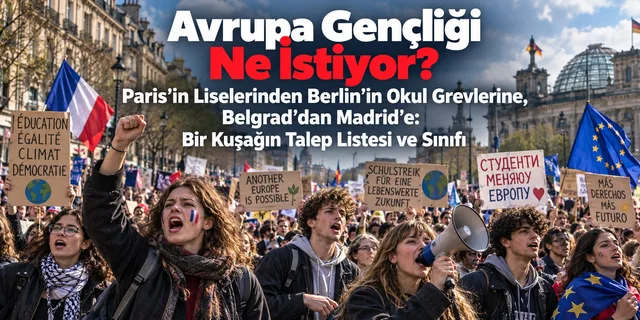
Youth became the continent's detonator. Secondary-school students in France, the "Gen Z regelt" initiative in Germany, housing movements in Spain and Portugal. The demands are the same: education, housing, climate, and no to a return to conscription.
The far right is also gathering the same anger. In France the National Rally (RN) leads the polls for the April 2027 presidential election. In Germany the AfD is first in the national polls. From Italy to Poland the far right is bidding for the fuel anger with a nationalism of "let us go back to Russian gas".
Berlin is the counter-example. In the election of 20 September the Left Party came first with 25.7 per cent. Elif Eralp's red line is the socialisation of the big housing companies. On 2 November coalition talks began with the SPD and the Greens. The federal government, meanwhile, is preparing an "investment protection" law that would make socialisation impossible in practice.
The European response to the US election: cautious joy, an unchanged dependence. Sánchez said "a vote against hate", and Merz warned that "Trump will go on governing by decree". The analysts' shared view: the tariffs will stay in place, and the pressure on NATO may grow. The conclusion the rulers have reached is that "Europe must arm itself more". That collides directly with the street's demand of "wages, not weapons".
The Spark: When Hormuz Closed, Whose Tank Ran Dry?
The root of the wave in Europe is a war. The war that the United States and Israel opened against Iran closed the Strait of Hormuz and largely stopped the Gulf's energy exports. The supply that the Russia-Ukraine war had already narrowed collapsed this time. According to European Commission figures compiled by Al Jazeera, at the end of September the average litre price of diesel in Europe broke a record at 2.24 euros. In France it reached 2.37 euros on 15 September. As reported by the Cyprus Mail, gas prices rose by about 140 per cent, and diesel doubled. In Germany energy inflation in September was 14.9 per cent. The Commission reckons the cost of the Iran war to Europe at about 100 billion euros.
The stance of the United States in this picture is instructive. When its own stocks ran low, Washington, before the election, asked Europe to release 120 million barrels from its strategic diesel reserves. If they did not, it threatened to ban diesel exports to France, Germany, Italy, Ireland and Britain. Europe answered "with one voice", proposed a smaller release, and in return asked the United States for a promise that it would not impose a unilateral export ban.
In short, even among allies the rule of "my pump first" holds. Someone in Washington took the decision for the war. The bill is paid by the service driver in Nantes, the farmer in Sicily, the tenant in Lisbon. For those who remember the fuel debate in Turkey, this picture is not foreign: what is called an "external shock" turns into an internal political decision about which class will pay how much.
France: From Fuel to Wages, from Wages to the Budget
How did the movement grow?
The stages of the wave in France followed one another in a short time. The chronology, drawn from the record of the 2026 French fuel protests, cestlagreve.fr and Euronews, is as follows:
| Date | Development |
|---|---|
| 15 September | Diesel at 2.37 euros. Fishers close the ports of Nice and Sète; farmers, construction workers and health workers join, and the roads to the Fos-sur-Mer fuel depots are blocked |
| 16 September | Prime Minister Sébastien Lecornu announces a fuel subsidy for the affected sectors, up to the ceiling the EU allows. The actions continue the next day |
| 29 September | The first day of action in the public services. Participation among teachers is 14-15 per cent according to the ministry, and 40 per cent in primary schools according to the union |
| 5 October | The inter-union coordination of the CFDT, the CGT, FO, UNSA and the FSU calls a national strike for 5 November |
| 7 October | The government releases 10 million barrels of diesel from the strategic reserves |
| 17 October | The Yellow Vests return to the street. The first large Saturday: 550,000 according to the government, 800,000 according to the organisers |
| 24 October | The second Saturday: 410,000 / 800,000 |
| 31 October | The third Saturday: 320,000 according to the Interior Ministry (70,000 in Paris), 500,000 according to the youth coordination (200,000 in Paris) |
| 3 November | After the holiday, the blockades in the lycées begin again |
| 4 November | The Assembly rejects the revenue section of the 2027 budget by 458 against, 0 in favour, 2 abstentions |
| 5 November | The general strike, and marches in more than 200 towns |
The point to watch here is this: the unions did not start the movement. First the small producers who could no longer do their own work (fishers, farmers, hauliers) blocked the roads. Then the lycée students closed the schools. The unions put a common calendar on top of this pressure only afterwards. This order shows that the organised working class did not stand in front of the movement. It came from behind and gave it a form.
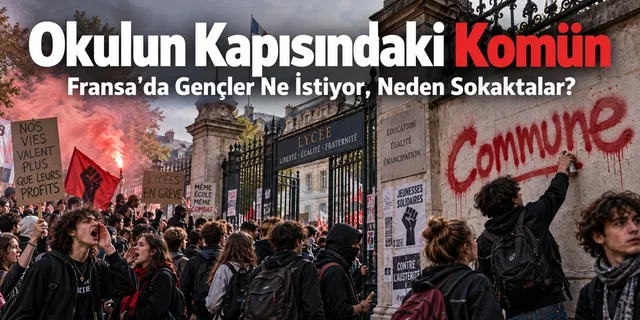
Why were the lycée students in front?
The anger of the lycée students is not only about pocket money. Crowded classes, the shortage of teachers, and the uncertainty created by Parcoursup, the university placement system, exploded when they met the fuel rise. The government's first concessions came directly in this field: more teachers, a cap on class size, and the promise of a new system in place of Parcoursup. President Macron said these steps met the young people's demands; the student organisations found them insufficient.
What we said when we spoke of the election in which young people in Serbia walked past the algorithm and beat the ballot box with plenums (in Turkish) holds here too. Youth is the section that first breaks the siege, because it has no gains and no career to lose. But its turning into a lasting power depends on its meeting the organisation in the workplace.
Today's strike: who, and what do they want?
The main call came from five confederations: the CGT, the CFDT, FO, UNSA and the FSU. Solidaires/SUD and the teachers' unions joined with separate strike notices. The railway unions and the air traffic controllers also stopped work. The list of demands is short, but very clear in class terms:
- The immediate opening of wage talks, a general wage rise, and a higher minimum wage (SMIC)
- An increase in pensions and in the civil-service pay index
- Higher social benefits, and resources for public services
- Tax justice on wealth, inheritance and dividends
- Scrutiny of the public aid given to companies (211 billion euros a year by the unions' reckoning), and conditions attached to it
On the other side stands about 43 billion euros of public saving in the draft 2027 budget. In the public finances 34,000 posts have been abolished since 2008. At France Travail, France's employment agency, 515 posts were cut in 2026, and 400 more are queued.
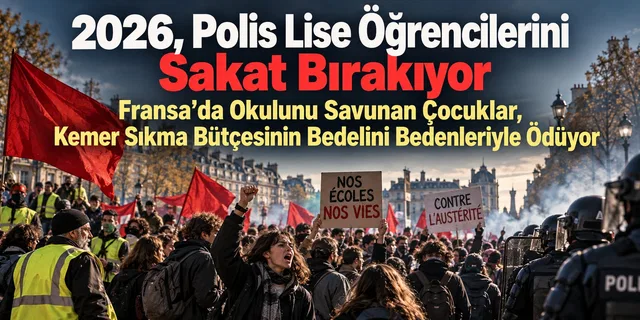
The state's answer is familiar: 70,000 police and gendarmes, special units (RAID, GIGN, BRI), a ban on the Bastille-Concorde route, a ban on demonstrations around the Élysée, a ban in the centre of Lyon. In the first counts around midday, the Interior Ministry counted 270,000 people in 180 marches outside Paris, and the CGT more than 250,000 in more than 73 towns. These are partial figures that do not cover Paris or the afternoon. The day's balance will become clear this evening.
The budget crisis: a breaking-up at the top
Yesterday evening the National Assembly rejected the revenue section of the 2027 budget law by 458 votes to zero. The text changed so much through amendments in a month of debate that in the end no one owned it. Because the revenue section was rejected, the spending section will not be debated, and the government's first draft will go to the Senate. The Lecornu government has three roads in front of it: a compromise after the Senate (a weak possibility), adoption without a vote under Article 49.3 of the Constitution (and the risk of a vote of no confidence), or a budget by decree after the 70-day period that runs out on 17 December. The 2026 budget was also passed by the same 49.3 route.
The call by David Amiel, the minister responsible for public accounts, that MPs should "not be hypnotised by the presidential election" sums up the situation. Bourgeois politics is locked onto April 2027. Neither the right nor the centre can write a budget that will meet the street's demand. A strike below, a budget lock above. France is living a classic moment in which "the rulers can no longer rule as before". But the organised political subject required for the sentence "the ruled no longer want to be ruled as before" to be tied to a revolutionary conclusion is not yet there.
Italy: "Wages Must Be Enough to Live On"
Italy's rank-and-file union, the USB, held a general strike in the public and private sectors on 30 October. Rank-and-file unions such as Cub and Usi-Cit also joined. On 27 October the Transport Minister, Matteo Salvini, signed a decree banning the strike in transport. The USB called the decree "not legitimate" and did not comply. The strike was held at more than 60 points in 18 regions. The USB announced 1.5 million participants; the Interior Ministry said 255,000.
The demands carry the historical memory of the Italian workers' movement: the return of the sliding wage scale (scala mobile), which ties wages to inflation, price controls, a cut in VAT on basic needs, higher pensions, and public money "for schools and health, not for weapons". The USB openly defines the Meloni government's policy as a "war economy".
One leg of the strike was in the ports. The same day an international port action was held, at the call of dockers in the ports of Italy, France, Greece, the Basque Country, Morocco and Turkey, against arms shipments to Israel and against Europe's rearmament. According to the USB, more than a hundred ports on four continents took part. Dockers on both shores of the Mediterranean taking up the same demand on the same day is a small but valuable example that, against a supply chain of capital that knows no border, the working class can also be a chain that knows no border.
Germany, Portugal, Spain: Housing and the Future
Germany. On 31 October the "Gen Z regelt" initiative organised marches in more than thirty towns. The organisers speak of tens of thousands of participants, some sources of more than 100,000. The demands: investment in education, health and the climate, a life that can be afforded, and no to the return of conscription. In the evening there were clashes in Frankfurt, Hamburg, Cologne and Berlin, and looting in Frankfurt. It was reported that more than 100 police officers were injured, and that 54 people aged 13-29 were detained. The media's focus on the looting made the peaceful demand of tens of thousands of young people invisible. But the list of demands itself is proof that the "Germany ready for war" project has not won the consent of the young generation.
Portugal. Against rent rises and the draft of a new rent law, thousands of people who gathered in Camões Square in Lisbon on 31 October marched to Rossio and pitched tents. On the morning of 1 November the police dispersed the sit-ins in Lisbon and Porto with shields and batons. Thirteen people were detained.
Spain. On 23 September an 87-year-old woman evicted from the home she had lived in for 70 years set off housing actions across the country. Two housing decrees of the Sánchez government were rejected in the Assembly by the votes of the PP, Vox, Junts and the UPN. Sánchez too called an early election on 5 October, for 29 November. The polls show the PP ahead, and it is said that the PP may need Vox in order to govern. Housing is thus tied either to a PP-Vox government or to a social democracy that makes housing campaign material. Meanwhile, after the year's second fatal train crash, railway workers struck for safety.
The Other Bidder for the Anger: The Far Right
The far right is also bidding for the same price anger. According to the Cyprus Mail's roundup, the National Rally in France leads the polls for the April 2027 election. According to Elabe polls, Le Pen's score has risen since the Iran war began, and Macron's has fallen. In Germany the AfD is first in the national polls and argues for the energy ties with Russia to be rebuilt. In Italy the new party of the retired general Roberto Vannacci, and in Poland Grzegorz Braun, stand on the same line. Braun's words, "I like the smell of Russian gas in the mornings", are a crude but honest summary of this line.
Gilles Ivaldi of Sciences Po says "Fuel prices are strengthening Le Pen". We discussed the mechanism of this in AfD's 43.8 Percent Is Not a Deviation. The far right promises a "solution" without touching capital, by turning class anger onto the axis of nation and the migrant. The solution promised today is also a deal with another energy monopoly, which is to say a change of boss. No one asks "why is energy in the hands of private monopolies, and why is it not public".
Berlin: Elif Eralp and the Left's Test
The election result
In the Berlin state election held on 20 September and made final by the recount of 2 October, the picture was as follows:
| Party | Vote | Seats | Change |
|---|---|---|---|
| Left Party (Die Linke) | 25.7% | 45 | +23 |
| CDU | 18.8% | 33 | -19 |
| AfD | 16.3% | 29 | +12 |
| Greens | 14.3% | 25 | -9 |
| SPD | 12.1% | 21 | -13 |
The BSW (4.7%) and the FDP (2.5%) stayed below the threshold. Turnout rose by 11 points to 74.2 per cent. The assembly has 153 seats, and the majority is 77. The Left, the SPD and the Greens together hold 91 seats. The Left Party became the first party in a state for the second time, after Thuringia (2019). Elif Eralp, who is of Turkish origin, won the Friedrichshain-Kreuzberg 1 constituency with 50.4 per cent. We introduced Eralp before the election in A Class Soldier in Berlin: Elif Eralp. AfD's 43.8 Percent Is Not a Deviation, which we wrote after the election, read this result together with Saxony-Anhalt.
The red line: the socialisation of housing
Eralp's single red line for a coalition is the carrying out of the "Deutsche Wohnen & Co. enteignen" decision that Berliners approved by referendum in 2021: the transfer to public ownership, with compensation below market value, of the homes of companies that own more than 10,000 homes. The coalition plan foresees a sum of up to 16 billion euros for compensation. Eralp's reason is plain: "The price of speculation should not be paid."
The negotiation calendar
| Date | Development |
|---|---|
| 8 October | The three parties agree on a framework that includes the rejection of antisemitism and an emphasis on Israel's right to exist together with a two-state solution. More than 100 members of the Left Party criticise the mechanism foreseen for antisemitism complaints |
| 17 October | The preliminary talks end, and the three parties propose coalition negotiations. Socialisation is part of the compromise |
| 25 October | The federal Interior Minister, Dobrindt, sets out the main lines of the draft "Investment Protection Act" |
| 26 October | Eralp calls the draft "unconstitutional and against Berlin's tenants" |
| 31 October | The Left Party congress approves the coalition negotiations by a clear majority |
| 2 November | The negotiations begin. Fourteen working groups are set up. Eralp: "It starts now, a joyful day for us" |
| 3 November | The SPD and the Greens reject the call for talks with the CDU |
There is no date yet for the election of the governing mayor (Regierende Bürgermeisterin). If the negotiations succeed, Eralp will be Berlin's first Left Party mayor.
The opposing front: the law, opposition inside the party, the campaign
There are three obstacles in front of Eralp.
The first is the federal government. The Investment Protection Act, backed by Chancellor Merz and prepared by Interior Minister Dobrindt, sets three conditions: compensation will be paid only at market value, at once and in cash, and socialisation can be carried out only "after all other instruments have been exhausted" and once its necessity has been proved. Dobrindt calls the demand for socialisation a "fetish". Yet Article 15 of the German Basic Law says openly that "land, natural resources and the means of production" may be transferred to common ownership by a law, and with compensation. The bourgeoisie is trying to disable, with an ordinary statute, an article of its own constitution the moment a chance arises that it might be used. It is instructive to see how flexible the "state under the rule of law" is when property is at stake.
The second is inside the SPD. The former mayor, Franziska Giffey, is backing the "Nicht um jeden Preis" ("not at any price") initiative, which will vote "no" in the SPD members' ballot. Her reason is the Left's stance on antisemitism, and its relation to the state, the police and the army. Merz too is calling the SPD and the Greens into a coalition led by the CDU.
The third is a systematic campaign of discredit. The argument conducted over the election-night photographs of Ferat Koçak, a Left Party member of the federal parliament, and the charges of "antisemitism", have become a means of keeping a debate on identity and security on the agenda instead of the housing question.
Its class meaning
Berlin is the most instructive example of this autumn, because it is the place where, for the first time in Europe, the anger in the street has won at the ballot box with a demand about property. The Left Party did not say "a fairer rent cap". It said "public ownership", and it won. The violence of the backlash comes from there too. But history tells us one thing more: the Left Party (under its then name, the PDS) was twice a partner in government in Berlin, in 2002-2011 and in 2016-2023, and in its first period it was a party to the sale of the public housing company GSW. Part of the Deutsche Wohnen stock that is to be socialised today is housing sold in those years. The real test is therefore not the election. It is the table of the coalition protocol and of the 14 working groups. If socialisation is not tied to a calendar and to a law, Berlin will be the name not of a victory but of a new disappointment. The road to passing this test is also clear: the neighbourhood and tenant organisation that won the 2021 referendum must stand beside the table, in the street, and as a force that supervises the negotiation.
European Responses to the US Elections
In the midterms of 3 November the Democrats took the House of Representatives and the Senate. In Texas, Talarico flipped the Senate seat to the Democrats, and in Maine Troy Jackson beat Susan Collins. We discussed the class meaning of the results inside the United States in US Election Results: A Blue Wave, the Same Shore. We had also drawn the picture before the election in The US Midterms, Techno-Capital and Algorithmic Politics (in Turkish). Here we look only at how Europe read it.
The responses from governments
From the roundups by Al Jazeera and China Daily:
- Pedro Sánchez (Prime Minister of Spain): He said Americans had voted "against hate and sexism", and that the result was part of the "unravelling" of the global far right. For Sánchez, who is heading to his own election on 29 November, this response is also a campaign message.
- Friedrich Merz (Chancellor of Germany): He recalled that Trump could get round Congress with decrees: "Why should it be different from now on?"
- Boris Pistorius (Defence Minister of Germany): He congratulated the Democrats on a "historic victory" and said Europe had to do more for its own security.
- Metin Hakverdi (the German government's Coordinator for Transatlantic Cooperation): "America chose change", but it is still Trump who decides foreign policy. Germany should not limit its relations to a single political camp.
- Jean-Noël Barrot (Foreign Minister of France): The result does not change France's need to build a stronger Europe.
- Roland Lescure (Finance Minister of France): He said they would watch whether Trump changes his stance, especially on petrol prices, "which affect people directly". An answer given in the shadow of today's strike.
- Andy Burnham (Prime Minister of Britain): He saw an opportunity for international cooperation against the cost of living, and said no country could solve this problem on its own.
- Christel Schaldemose (Vice-President of the European Parliament): "I am cautiously optimistic on Europe's behalf", but the EU must not stray from the road of standing on its own feet.
- Maroš Šefčovič (EU Trade Commissioner): Respect for the choice of the US voter, the United States is a close ally, and the contacts will continue.
- Greece: The government spokesman, Pavlos Marinakis, called the United States a "strategic ally" and said the relationship would stay strong.
- Russia: The Kremlin spokesman, Peskov, said they hoped the results would not affect Trump's "peace efforts". Deputy Foreign Minister Ryabkov recalled that the Democratic leaders' approach to Moscow was "sharply negative".
The analysts' shared view: there is no relief
Almost all of the European specialists are saying the same thing:
- The tariffs will continue. Because the tariffs rest on presidential authority, Congress can only increase oversight. Clemens Fuest of Ifo says a president squeezed in domestic politics may use the tariffs more as an instrument of foreign policy. Achim Wambach of ZEW does not expect a return to free trade.
- The pressure on NATO may grow. Five NATO diplomats who spoke to Politico are worried that a weakened Trump could pull out thousands more troops and cut the contribution to NATO's common budget.
- The difficult period is starting now. Wolfgang Ischinger, President of the Munich Security Conference, expects harsher demands. Josef Braml wrote that the hardest two years of Trump's second term may be starting now.
A class reading
There is a common sentence in all of these responses: "Europe must stand on its own feet." In Pistorius's mouth the meaning of this sentence is plain: more weapons, a larger defence budget, the return of conscription. The European bourgeoisie, that is, also draws a conclusion of rearmament from the election in the United States.
For this very reason, in the same week, Europe's rulers and its streets are saying the exact opposite of each other. The rulers say "strategic autonomy", and in Turin workers and students say "schools, not weapons". Pistorius speaks of military service, and young Germans march saying "no to conscription". The Democrats' victory does not resolve this contradiction. As we also wrote before the election, whichever party takes Congress in the United States, the relation of dependence that Europe has built with the US monopolies, and the charging of the rearmament bill to the worker, do not change.
Assessment: What Does This Autumn Show?
| What do the rulers say? | What does the street want? |
|---|---|
| "The war is an external shock, we will bear it all together" | Let those who wanted the war, and those who gain from it, pay the war's bill |
| A temporary subsidy for fuel, a release from the strategic reserve | A general wage rise, a higher minimum wage, wages tied to inflation (the sliding scale) |
| 43 billion euros of public saving, a budget without a vote under 49.3 | Resources for public services, tax on wealth and on dividends |
| "Europe must provide its own security", rearmament, conscription | Schools, hospitals and housing, not weapons |
| A ban on strikes (Salvini), a ban on routes, 70,000 police | The right to strike, the right to demonstrate, the dockers' right to stop arms shipments |
| A law to protect the investor in housing (Dobrindt) | The transfer of the big housing companies to public ownership (Berlin) |
| The far right: "Let us go back to Russian gas, let us stop the migrant" | Let energy be public, let the working class stand in international solidarity |
Five conclusions come out of this table.
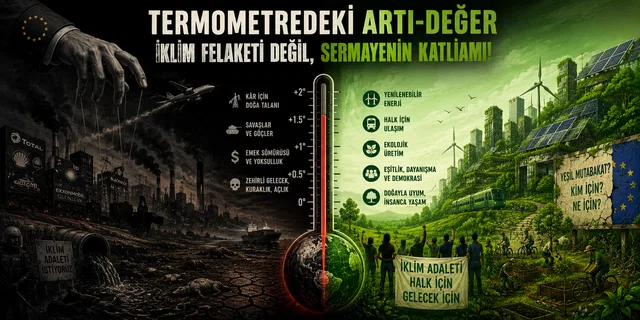
First: this is a crisis of the transfer of costs. The war raises energy prices, the energy monopolies and the arms industry gain, and states close the budget deficit by cutting the public service. When the 211 billion euros of aid to companies in France is set beside the 43 billion euros of public saving, it is plain who is being protected. As we also said in The Surplus Value on the Thermometer, the word "crisis" means a loss for one class and an opportunity for the other.
Second: the contradiction between rearmament and welfare is now in the street. The bourgeoisie of Europe is trying to get out of dependence on the United States under the name of "strategic autonomy". The price of this autonomy is the arms budget, and the source of this budget is wages and the public service. The Italian unions' definition, "war economy", is exact for this reason.
Third: youth is the spark, the working class is the engine. Lycée students in France, Generation Z in Germany, students in Serbia. Youth takes the first step everywhere. But the only power that can stop the economy is still the organisation in the workplace: the railway, the port, the school, the public service. Today's strike in France is an attempt by these two to meet. If the meeting does not last, the anger of youth is discredited with images of looting, as in Frankfurt, and it disperses.
Fourth: the far right and class politics are competing for the same anger. The far right turns the anger onto the migrant and onto "the wrong energy ally". The left, for its part, wins only when it comes forward with a concrete demand about property, as in Berlin. An abstract defence of "democracy", or relying on the Democrats in the United States, does not win this race.
Fifth: when the question of property is asked, bourgeois law hardens. In Berlin a constitutional right is being disabled by a statute the moment it becomes usable. In Italy the right to strike is being restricted by a ministerial decree. In France march routes are being banned. A right stays on paper unless an organised force protects it.
The lesson for Turkey comes from here too. There as well, fuel, electricity and rent lay on the same burden. The 2027 budget is being debated in the Plan and Budget Committee in the same week, with the same logic as in Europe. That Turkey's ports are also named in the action of the Mediterranean dockers shows that this chain reaches us too. What is needed is to weave the local counterpart of the same demands, rather than watching the movement in Europe as something that "is happening over there".
Concrete Tasks
- To follow and to translate. To bring into Turkish the texts of the inter-union coordination in France, of the USB in Italy, and of the housing movement in Berlin, and to open their lists of demands to discussion in our own unions.
- To build the wage demand through the sliding scale. The counterpart in Turkey of the "scala mobile" demand in Italy is the automatic tying of the minimum wage, and of all wages, to real inflation. To carry this onto union agendas.
- To ask housing as a question of property. The Berlin experience shows that, beyond a rent cap, the making public of big housing capital can be a demand that wins an election. To bring the tenant organisations in our cities together with this perspective.
- To stand in solidarity with port and logistics workers. To make visible in Turkey the action of the Mediterranean dockers against arms shipments, and to support the organising of port and logistics workers.
- To bring youth and workplace organisation together. To tie the movements of lycée and university youth (see Organising 2.0) to the union structures with common calendars.
- To defend a class energy programme against the far right's energy nationalism. To ask not "which country shall we buy gas from" but "in whose ownership should energy be".
Dear Young Comrades
What has happened in Europe this autumn shows that history has not frozen in one place. A strait that closed at Hormuz touched the life of a bus driver in Nantes, a student in Turin, a tenant in Lisbon. These people came together and said "we will not pay the bill". Some marched to the Bastille, some stopped a crane in the port, some went to the ballot box in Berlin and voted for housing to be public.
But we also saw this: anger on its own does not show a direction. The far right gathers the same anger too, and the same anger can also turn, in a single night, into images of looting. What turns anger into a lasting power is organisation, a clear demand, and international solidarity. What won in Berlin was not a slogan. It was a tenant organisation woven door to door over years. What stopped the economy in France was not a hashtag. It was the common calendar of five confederations.
What falls to us is not to watch these experiences, but to learn from them. We can build a more beautiful world only together, in an organised way, and with patience.
Sources
France
- Euronews: France, grève générale le 5 novembre après trois samedis de manifestations (4 November 2026)
- Euronews: Budget 2027, l'Assemblée nationale rejette le texte à l'unanimité (5 November 2026)
- C'est la grève: Grève générale et nationale le 5 novembre 2026
- franceinfo: Mobilisation du 5 novembre, live coverage
- Wikipedia: 2026 French fuel protests
- Socialist Worker: Workers take to the streets of Europe
Italy, Germany, Portugal, Spain, and the general picture
- Il Fatto Quotidiano: Sciopero generale il 30 ottobre (28 October 2026)
- USB: Sciopero Generale del 30 ottobre 2026
- Seoul Economic Daily: Cost-of-Living Protests Spread Across Europe (5 November 2026)
- CBS News: Rioters smash, loot storefronts amid cost-of-living protests in Germany
- EUobserver: Spain's 54-day sprint to the polls
- Cyprus Mail: Soaring fuel prices fuel protests and far-right gains across Europe (20 October 2026)
- Al Jazeera: Trump vs Europe as US presses for release of emergency diesel stocks (2 October 2026)
- Wikipedia: 2026 European unrest
Berlin
- Wikipedia: 2026 Berlin state election
- Tagesspiegel live blog: Linke beschließt Koalitionsverhandlungen mit Grünen und SPD
- ZDFheute: Vergesellschaftungen, Eralp hält Pläne für verfassungswidrig (26 October 2026)
- ZDFheute: Elif Eralp hat mit der Partei "Die Linke" die Wahl gewonnen
Responses to the US elections
- Al Jazeera: 'Seismic shift', world reacts to US midterm election results (4 November 2026)
- China Daily: Europe welcomes Democrats' midterm win, but sees little relief ahead (5 November 2026)
- Axios: World leaders react to 2026 midterm election results
Related pieces from Knowledge Commons
- A Class Soldier in Berlin: Elif Eralp
- AfD's 43.8 Percent Is Not a Deviation: It Is the Bill of a Two-Hundred-Year Line and Thirty-Five Years of Dispossession
- The Surplus Value on the Thermometer - Not a Climate Catastrophe, but Capital's Massacre!
- The US Midterms, Techno-Capital and Algorithmic Politics (in Turkish)
- US Election Results: A Blue Wave, the Same Shore
- They Walked Past the Algorithm: How the Plenum Beat the Ballot Box in Serbia (in Turkish)
- Organising 2.0: An Idea for a Justified Revolt
This piece is one of the living documents of Knowledge Commons. It is shared under the CC BY-SA 4.0 licence. You may copy, change and share it if you credit the source.