In the Square on 25 November, in the Kitchen on 26 November
A new edition of A Safer, Happier Life for Everyone is out

Dear Young Comrades,
On Wednesday evening we will be in the squares. On Thursday morning we will return to the same homes, workplaces and meeting rooms. This article is for that Thursday morning.
First, a Summary
- What have we published? Version 1.1.2 of A Safer, Happier Life for Everyone: A Call for Equality from a Person of the Future. It is available as an A5 PDF of 220 pages, EPUB and Markdown, under the CC BY-SA 4.0 licence. You may download, read, print, reproduce and distribute it.
- Why now? Because 25 November is the day we raise our voices against violence. But violence is produced during the other 364 days too: in the division of work at home, in economic dependence and in relationships where a "no" goes unheard. We need a text that asks what our words in the square mean at home.
- What does the book do? It understands violence not simply as the work of individual bad men but as the result of a social order. It offers figures, laws, history and theory, then asks: what will change in this home tonight?
- What is new in this edition? Labour-force figures have been updated to September 2026, femicide figures to October 2026, and gender-gap data to the 2026 report. It also discusses uncertainty around alimony and the cases following the "My Family Is Safe" operation.
- Who is it for? Everyone, but especially young comrades. And those well-meaning men who say: "I help my wife."
What Is 25 November?
On 25 November 1960, Patria, Minerva and María Teresa Mirabal were murdered in the Dominican Republic for their struggle against the Trujillo dictatorship. The three sisters became a symbol of resistance to violence, first in Latin America and then throughout the world. In 1981, Latin American and Caribbean women meeting in Bogotá declared the date a day of struggle; the United Nations formally recognised it in 1999.
Remembering these origins matters. The Mirabal sisters were murdered not in a family quarrel but while engaged in organised resistance to a dictatorship. From the beginning, 25 November has brought violence at home and violence by the state, the bedroom and the police station, the kitchen and the square into the same conversation.
This year is no different. The We Will Stop Femicide Platform is calling women from unions, professional associations and women's organisations into the streets. In Istanbul, the 25 November Platform's demonstration is at Taksim Tünel at 19:30 on Wednesday. The Left Feminist Movement has announced meeting points in 25 cities and districts. A sentence from Women's Defence's call sums up the day: "We are each other's guarantee."
We will be there too. This article does not offer a book as a substitute for the square. It asks what we should have in our hands when we return.
What Do the Figures Say?
The figures updated in this edition show the situation in which we approach 25 November.
Women killed. According to the We Will Stop Femicide Platform, at least 294 women were killed by men in 2025 and 297 women died in suspicious circumstances. In the first six months of 2026, 150 women were killed and 151 deaths were recorded as suspicious. The following months brought more deaths:
| 2026 | Women killed | Suspicious deaths |
|---|---|---|
| July | 25 | 31 |
| August | 22 | 33 |
| September | 28 | 19 |
| October | 20 | 39 |
Source: monthly reports of the We Will Stop Femicide Platform.
These figures help explain why the book starts at home. Femicides also occur within homes and intimate relationships. Fighting violence means securing conditions in which women can make decisions about their own lives and ensuring that protective orders are effectively enforced.
Another detail: in October, suspicious deaths were almost twice the number of recorded femicides. Each of these deaths must be investigated effectively and independently. A suspicious-death record does not by itself establish murder, but it makes investigating the risk of impunity essential.
The division of work at home. According to TÜİK's 2025 Time Use Survey, women spend an average of 4 hours and 3 minutes a day on household and family care; men spend 58 minutes. This difference is not merely a habit but a social order.
The labour force. According to TÜİK's September 2026 figures, the labour-force participation rate is 35.2% for women and 70.7% for men. Women's employment rate is 31.2%. In September 2026, seasonally adjusted data recorded 22.013 million women outside the labour force. Unemployment is 23.3% among young women and 10.4% among young men.
World ranking. In the World Economic Forum's 2026 report, Türkiye ranks 126th out of 145 countries.
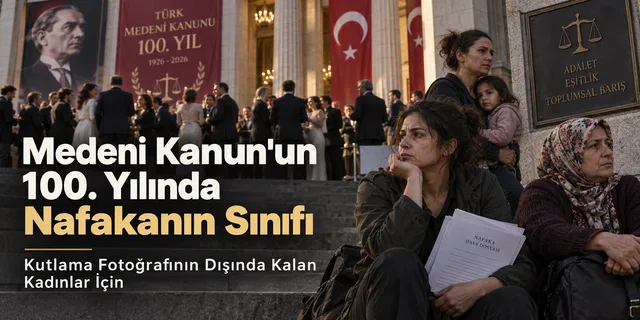
Alimony. The Constitutional Court annulled the phrase "indefinitely" in Article 175 of the Civil Code on poverty alimony; the annulment takes effect on 30 June 2027. It did not abolish alimony altogether, and the Court notes that lifelong alimony may still be possible under certain conditions. What will replace it remains uncertain: as of 23 November, the 13th Judicial Package had not been submitted to parliament. A woman considering divorce today must decide without knowing what rule will apply in seven months. We discussed this in detail in The Class of Alimony on the Civil Code's Centenary.
Together these figures reveal the lives of women who spend hours on unpaid care, face obstacles to paid work and may struggle to leave violent situations because of economic dependence. Violence is the final link in that chain. On 25 November we march against that final link; the book examines the whole chain.
Why Do We Need This Book?
For four reasons.
First, violence is not an isolated event but the result of a social order. After every murder, words such as "fit of rage", "jealousy" and "honour" circulate. They do not explain the perpetrator; they obscure the system. The mentality that treats a woman as property, and her "no" as a loss of possession, does not emerge from individual minds alone. It is fed by impunity, economic dependence, policies that leave women unprotected in the name of "protecting the family", and a division of work reproduced every day. To fight violence without understanding this is like fighting the smoke rather than the fire. We examined the budgetary and legal meaning of family-protection rhetoric in Whose Family Is Safe?.
Second, there is no security without economic independence. A woman may be unable to leave home because she has nowhere to go and no income. Childcare, women's shelters, guaranteed alimony and a pension in one's own name may look like social-policy headings, but each can be a condition for survival. That is why the book does not confine violence to a separate chapter: it reads it alongside care work, wages and property.
Third, there is a habit we must confront in our own ranks. We all know the man who marches in the front row on May Day and comes home to say, "I help my wife." The book challenges that sentence, not the man. Postponing equality until after the revolution is a polite way for men to protect their small privileges at home. An organisation that does not arrange meeting times with comrades with children in mind, leaves tea and washing-up to women, and retains language that demeans women cannot convincingly demand equality in the square. We discussed how language carries this order in Escaping the Language of Hegemony.
Fourth, young people need a text they can read on their own. This is an education often missing at school: what is consent, how can psychological violence be recognised, what does a healthy relationship look like, and which behaviours are early warnings? The book addresses these questions through scenes and questions rather than moralising. It assumes no prior reading.
What Is in the Book?
The volume consists of three books and a conclusion.
Book One: Everyday Life. The worlds of home, kitchen, work, love, sexuality and children. Most chapters follow the same path: a scene from life, the question "Why is it like this?", a vision of the same scene in a society where equality is ordinary, and finally a step that can be taken today. Topics include being a healthy, self-reliant individual, the 24 hours of household life, the making of masculinity, choosing a life partner, love, consent and psychological violence, sexuality and raising children.
Book Two: Who Built This World? The figures, laws, history and theory behind the scenes. It discusses working women's struggles in Türkiye and around the world; what feminist comrades say, first in their own words; where Marxism is strong and where it arrived late; gains and reversals in socialist experience; and responses to older comrades who claim feminists are destroying the family.
Book Three: The Life We Have Not Yet Lived. How can care cease to be a private burden and become a public right? Who owns the body? When machines work, whose time is freed? We follow one principle: describe institutions concretely, but do not prescribe the love and families of people in the future. They will build those themselves.
Conclusion and appendices. Steps that can be taken today at home, at work, in unions, organisations and neighbourhoods. The appendices include a chronology, glossary, data supplement, objections and responses, a small vocabulary for replacing the language of "help", an age-specific conversation guide for parents and support lines.
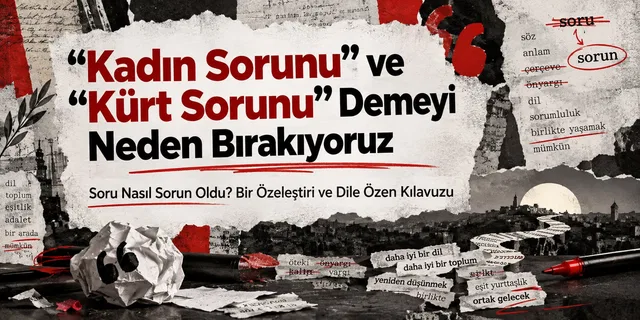
"Everyone" in the title is a deliberate choice. Liberation from male domination is not a favour bestowed on women; it is a condition for safer and happier lives for women, men, LGBTİ+ people, children and all of us. For the same reason, the book does not use "the woman question" as its own description. That phrase puts the problem onto the oppressed. The problem is not women but male domination, inequality and the property relations that reproduce them every day.
Three Places to Start for 25 November
If you do not have time to read the whole book, start with these three parts this week.
Appendix K: Programme of Urgent Demands. One page, prepared to be copied and distributed at demonstrations, workplaces and union branches. It groups demands into three circles, from childcare and an alimony guarantee fund to women's shelters and a return to the Istanbul Convention, and lists proposals for collective agreements, municipalities and neighbourhoods. For the constitutional framework of these demands, see our article on the Labour Constitution.
Part VII: Consent and Psychological Violence. Physical violence is often the end of a process. Before it come control, isolation, humiliation and control over money. This part helps readers recognise those early signs.
Appendix H: Support and Safety Resources. Emergency numbers and organisations offering legal and psychological support. We hope you will never need this page, but know where it is and show it to someone who does not.
What Changed in This Edition?
The book is a living document. Since its first publication in October 2026, we have updated the following:
- The labour-force table and chart now use September 2026 data, including young women's unemployment and the number of women outside the labour force in September.
- The August, September and October 2026 femicide reports have been incorporated.
- Global Gender Gap figures have been updated to the 2026 report.
- The latest position on alimony and the timetable for the 13th Judicial Package have been added.
- Cases brought against LGBTİ+ associations after the "My Family Is Safe" operation have been added.
- The chronology, data supplement and reading list have been updated.
The book's arguments, demands and chapter structure have not changed.
How Can We Use It?
- At home. For one week, write down every household task, including remembering and planning: who did it, how long did it take, and who thought of it? Read the result together.
- At work and in the union. Bring Appendix K's collective-agreement proposals to a branch meeting: childcare based on the total number of employees, equal leave for both parents, a written mechanism against harassment and violence, and paid leave and job security for workers experiencing violence.
- In the organisation. Start a reading group. Each part of Book One fits into one session; the "Ask Yourself" boxes at the end of chapters are designed to open discussion.
- In the neighbourhood. Ask the municipality for the women's shelter it is legally obliged to provide, neighbourhood childcare and day-care centres. Request a written response.
- Hand to hand. Print and reproduce the book; give it to a young person. You do not need to ask permission.
Where Can I Download It?
The book is licensed under CC BY-SA 4.0. You may reproduce, change and translate it with attribution and under the same licence. A book advocating shared care work should itself be a commons.
Dear Comrades,
On the evening of 25 November we will carry the banner together. The real test begins the next morning: who made breakfast, who took the child to school, who spoke at the meeting, who poured the tea, and who was heard when they said "no"?
The struggle against violence requires dismantling the dependence that makes it possible. That means childcare, shelters, secure work and a pension in one's own name; in other words, organised class struggle. But something else is needed too: learning from today to live as equals in the same home, at the same table and in the same organisation.
A happier life is not a promise but a division of work. And that division begins tonight, in this home.
We welcome your criticism. Criticising this book is one way of using it.
Esen Kalaba
Sources
- TÜİK, Time Use Survey 2025.
- TÜİK, Household Labour Force Statistics, September 2026: Apara report; Quarterly Labour Force Statistics, third quarter 2026.
- We Will Stop Femicide Platform, annual figures for 2025 and monthly reports for 2026; Diken on the August report.
- World Economic Forum, Global Gender Gap Report 2026; Turkish Minute, 22 September 2026.
- The status of the 13th Judicial Package: Milli Gazete, 23 November 2026.
- Calls for 25 November: bianet, BirGün, Yeni Yaşam, İlkses.
Related Articles
- The Class of Alimony on the Civil Code's Centenary
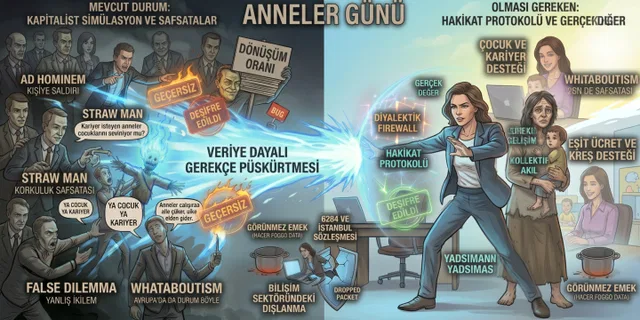
- Whose Family Is Safe?
- TÜİK: Two Figures, One Country
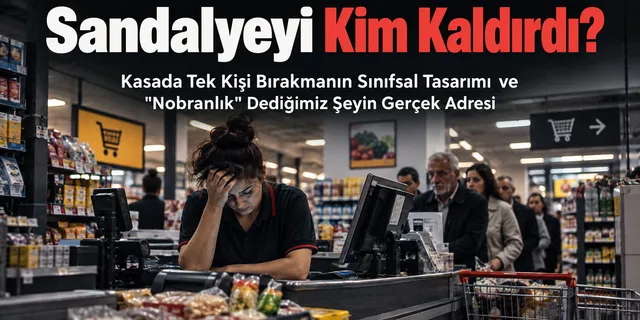
- Who Removed the Chair?
- Escaping the Language of Hegemony
- Human Rights Begin with Labour: Why a Labour Constitution?
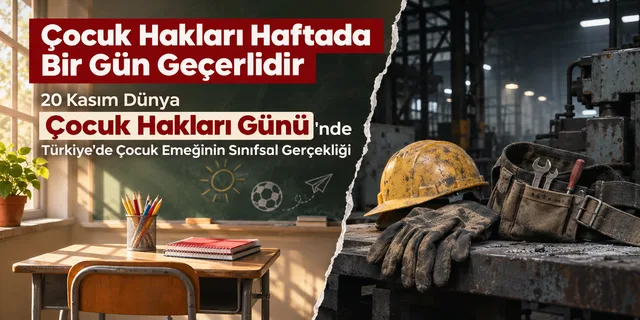
- Children's Rights Apply One Day a Week
This text is licensed under CC BY-SA 4.0.