Children's Rights Apply One Day a Week
The Class Reality of Child Labour in Turkey on World Children's Day

Dear Young Comrades,
Today is 20 November, the 37th anniversary of the adoption of the United Nations Convention on the Rights of the Child. Article 32 of the 54-article convention recognises children's right to protection from economic exploitation and work that interferes with education or harms their health. In Turkey, however, hundreds of thousands of children are part of a system in which they attend school one day a week and spend other days at a workplace. Today, speeches will repeatedly tell us that “our children are our future.” But this article will not celebrate childhood. We will ask whose childhood is taken away, how and for whose benefit.
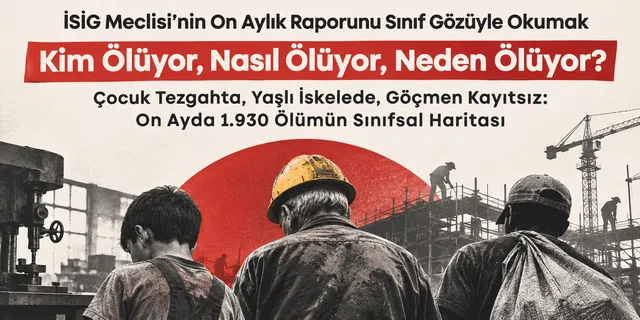
On the morning of 28 September, 17-year-old Halil İbrahim Yağız was sent to throw wire from the sixth floor of a construction site in Gaziantep's Şehitkamil district. It was his first day at work through MESEM, the vocational training centre programme. According to his brother, he had no hard hat and there was no safety net. He had been working for less than an hour when he fell and died. His family had opposed his enrolment in MESEM and wanted him to study. The ministry's response to the family was a condolence visit (Evrensel).
The headline of that report poses this article's question: Which child is sent to the sixth floor of a construction site? Not the employer's child. Not the minister's child. A child from a working family with seven children.
First, Ten Theses
- Child labour is not a deviation but part of the accumulation model. Growth based on cheap labour places children at the bottom of the labour market.
- Deaths are rising. According to the Health and Safety Labour Watch (İSİG), at least 95 children died while working during the 2025–2026 school year, 32 per cent more than the previous year. By early November 2026, it had identified at least 71 child worker deaths that year.
- The state fails to count and withholds what has been counted. TÜİK has not published a comprehensive child labour survey covering ages 5–17 since 2019. In 2026 it also omitted the labour-force table for ages 15–17 from its children's bulletin.
- MESEM institutionalises child labour through the state. Among more than half a million registered students are many children who attend school one day and work four days a week.
- The state subsidised wages for five school years. Employers received an unemployment-fund contribution covering the statutory minimum payment to MESEM students.
- Even the ministry's own figures are severe. Its response covering 2025 and 2026 reported 9,950 occupational accidents among MESEM students and 37 deaths.
- Child labour has a class and a geography. Around half of the deaths in İSİG's 13-year record occurred in agriculture and forestry. Migrant children are excluded from some official surveys.
- Poverty pushes children into work; capital pulls them in. One force comes from the impoverished household, the other from employers seeking cheap, compliant labour.
- Marx's polytechnic education is not MESEM. Combining education and production can serve human development when workers have control; when employers control it for profit, the result is exploitation.
- The answer is organisation, not charity. Restrictions on child labour were won through working-class struggle. They will have to be defended in the same way today.
Let us look more closely.
What the Numbers Say
A Record of Deaths
The state does not provide a complete record of child labour deaths. The Health and Safety Labour Watch, İSİG, keeps an independent record based on cases it can identify:
| Period | Minimum number of children who died while working |
|---|---|
| 2013–June 2026 | 862 |
| 2023–2024 school year | 66 |
| 2024–2025 school year | 72 |
| 2025–2026 school year | 95 |
| Calendar year 2025 | 94 |
| 2026, by early November | 71 |
Sources: Evrensel, 22 September 2026; Cumhuriyet, 14 June 2026; Evrensel, 2 November 2026.
Of the 95 deaths in the 2025–2026 school year, 37 occurred in agriculture, 27 in industry, 18 in construction and 13 in services. Twenty-eight children were aged 5–14 (Evrensel): nearly a third of the total. Although the law permits certain light work for 14-year-olds under specified conditions, employing children in hazardous work is unacceptable.
The October 2026 report shows another change: deaths among children aged 14 and under rose from one in October 2025 to four in October 2026. Of the 193 workers who died that October, 94 per cent were not union members. Child workers are especially likely to be left without organised protection. We will return to this at the end.
In İSİG's 13-year record, 52 per cent of child worker deaths occurred in agriculture and forestry. Şanlıurfa leads the provincial list, followed by Gaziantep, Istanbul, Adana, Konya and Antalya (Cumhuriyet). The origins of seasonal agricultural migration, Antep's textile and shoe workshops, Çukurova's fields and Istanbul's industrial estates make up a class geography of child labour.
Those Left Uncounted
What does the state contribute to this picture? In short: not counting.
İSİG says only 13–14 child worker deaths a year enter Ministry of Labour records (bianet). Its own minimum of 94 deaths in 2025 is roughly seven times that annual figure, although the institutions' scopes may differ and are not directly equivalent. Categories can hide deaths: two children aged 13 and 14 were struck by lightning while cleaning a schoolyard; a vocational student who fell 25 metres was classified as a trainee (Evrensel). A change of category does not undo a death.
TÜİK's reporting also has gaps:
- Its last comprehensive child labour survey for ages 5–17 was conducted in 2019; it reported 720,000 working children (Diken).
- The survey was conducted in October–December, when agricultural child labour is less visible, and excluded Syrian children (bianet).
- The labour-force table for ages 15–17 was omitted from the April 2026 “Statistics on Children” bulletin (Evrensel).
Even the remaining figures show an increase: the labour-force participation rate for ages 15–17 rose from 24.9 to 25.5 per cent. The previously published figure of 869,000 employed children in that age group refers to 2024, not the latest year. According to the 2026 bulletin, 36.8 per cent of children, approximately 7.86 million, faced the risk of poverty or social exclusion (Evrensel).
Including informal agriculture, street work, apprenticeships and migrant children, some researchers estimate more than two million working children (Cumhuriyet); other estimates range from three to four million (soL). These are estimates, not directly comparable official counts.
As we argued about inflation in Two Thermometers, statistics are not a neutral mirror; they are a field of class conflict. A problem that is not measured is easily excluded from politics.
MESEM: Apprenticeship Organised by the State
What Is MESEM?
A student in a vocational education centre usually attends school one day a week and works at a workplace for four; longer hours are also reported. Entry begins in ninth grade, around age 14. In 2025–2026, 509,085 students were registered in MESEM, alongside 254,060 vocational high-school students working in enterprises (Evrensel). Together they total 763,145 students; not every student can be assumed to be under 18.
The ministry presents this as vocational training. İSİG describes MESEM as a mechanism that expands child labour (İSİG report via Evrensel).
The Ministry's Own Figures
In a parliamentary response reported in September 2026, Education Minister Yusuf Tekin said that during 2025 and 2026, 9,950 MESEM students suffered occupational accidents and 37 died (Evrensel).
Only three months earlier the ministry had reported 3,080 accidents and 13 deaths since 2016 (Evrensel). The large discrepancy calls for an explanation of the scope and methods of the two responses. Without that explanation we cannot say definitively why they differ.
The records nevertheless point to serious workplace safety risks under the name of vocational education. Dividing the accident figure by a student count from a different period would not establish an individual accident rate.
Violence at Work
In October 2026 reports emerged of workplace violence against children in three provinces. In Aksaray an auto mechanic fired a shotgun at two MESEM students; in Kapaklı, Tekirdağ, a 14-year-old MESEM student was beaten for missing school and work; in Niğde a barber locked two apprentices in a toilet and beat them with an iron bar (Evrensel).
A child in the workplace is not only cheap but vulnerable: often without union representation, reliable channels for help or adequate information about contracts and rights. Such violence reproduces the old apprenticeship mentality in which a child is handed over to a master without effective protection.
Five Years of Subsidised Labour
Follow the money. The statutory minimum wage for MESEM apprentices is 30 per cent of the net minimum wage, rising to 50 per cent for 12th-grade students who have attained journeyman status. At the 2026 net minimum wage of 28,075.50 lira, the minimum for a ninth-grade student is 8,422.65 lira (Milli Gazete). For four days of work a week, that minimum is less than a third of an adult minimum wage.
A 2022 presidential decision provided for a state contribution equal to the full statutory minimum payment for MESEM students for five school years beginning in 2021–2022 (Ministry of Education). Employers paid students first and could receive reimbursement from the Unemployment Insurance Fund, financed by employee and employer contributions and state contributions. The contribution period ended after the 2025–2026 school year (BirGün). This was a direct labour subsidy to capital.
The end of the contribution does not end students' statutory wage rights or employers' obligation to pay. We should watch whether employers fulfil that obligation and whether children are pushed into undocumented work instead.
Who Pushes Children into Work, and Who Pulls Them In?
A liberal explanation often blames child labour on family ignorance or cultural habits. A Marxist explanation looks at both push and pull.
The push is in the household: wages eroded by inflation, rent and debt. As discussed in One Salary Every Ten Months, when adult wages cannot sustain a household, families may seek another income from their children. The 36.8 per cent poverty or social-exclusion risk shows the scale of pressure facing children.
The pull comes from capital: workshops, agricultural intermediaries and construction subcontractors seek cheap, compliant, unorganised labour. A state wage subsidy and an “education” label can turn that demand into an institutional force.
In the machinery chapter of Capital, Marx describes how machinery can draw women and children into production and spread the cost of family subsistence across more wage earners. Child labour can also put downward pressure on adult wages and bargaining power. It is therefore not only a children's issue but a working-class issue.
A Lesson from History
In The Condition of the Working Class in England (1845), Engels described children entering factories at nine, standing for twelve hours and suffering injury. The working-day chapter of Capital draws on factory inspectors' reports. Factory laws restricting child labour were not gifts from employers' consciences: the Ten Hours Movement, Chartists and trade unions fought for them against opposition that warned industry would collapse.
Today objections to MESEM are met with talk of a shortage of intermediate labour and the needs of industry. The machine is new; the chain is old.
What Did Marx Mean by Polytechnic Education?
We must be honest: defenders of workplace training sometimes invoke the idea of combining education with production. Marx did oppose a general ban on child labour in his Critique of the Gotha Programme. But that is only half the story.
In instructions written for the First International's Geneva Congress in 1866, Marx proposed strict age-based limits: two hours a day for ages 9–12, four for 13–15 and six for 16–17, alongside intellectual, physical and technological education. In the Gotha critique he also insisted on strict age-based regulation and measures to protect children's health. These nineteenth-century proposals should be read in their historical context, not treated as contemporary child-protection standards.
The polytechnic alternative advanced here would teach the scientific principles of production rather than tie a child to one narrow task; place education, health and development first; and give teachers, worker organisations and society control. Its goal is not profit but a rounded human being who can unite intellectual and manual activity.
The difference can be tested with the Knowledge Commons' three questions: In whose hands? Under whose control? For whose benefit?
| MESEM | A polytechnic alternative |
|---|---|
| Usually one school day and four workplace days | Education first; any practical work limited and age-appropriate |
| Narrow skills in a particular workplace | Understanding the scientific principles of production |
| Employer controls the workplace | Teachers, worker organisations and society exercise oversight |
| Minimum payment of 30 per cent of the minimum wage; a state contribution for five school years | No one profits from a child's labour |
| 9,950 occupational accidents reported | Children's health takes priority |
| Industry's demand for cheap intermediate labour | Free development combining intellectual and manual work |
| A child's class position is reinforced | Children gain tools to overcome class boundaries |
The final row matters most. While employers' children can attend private schools and universities, working people's children may be on a construction site at 14. The division discussed in our Education Dossier and The Bell Does Not Ring Equally for Everyone becomes stark here.
Children's Rights and Rights on Paper
Turkey signed the UN Convention on the Rights of the Child in 1990 and ratified it in 1995. It also ratified ILO conventions 138 on minimum age and 182 on the worst forms of child labour. The international safeguards exist on paper.
Rights, however, require a force capable of enforcing them. The 4+4+4 system fragmented compulsory education in 2012; apprenticeship became part of formal education in 2016; and MESEM was promoted aggressively after 2021. In Whose Family Is Safe? we examined the rhetoric of protecting the family. That rhetoric coexists with children being sent to construction sites.
The global picture is also troubling. ILO and UNICEF estimated that nearly 138 million children were in child labour in 2024 (UNICEF). From cobalt mines in Congo to garment workshops in Bangladesh, hazelnut fields in Turkey and shoe workshops in Antep, some supply chains carry a risk of child labour. The conditions behind specific products require concrete investigation.
The Invisible: Fields, Streets and Migration
Three groups are particularly poorly captured by official figures.
Seasonal agricultural workers' children travel with their families from Şanlıurfa, Adıyaman and Mardin to Çukurova, Konya and Black Sea hazelnut fields. Migration and harvest schedules often overlap with school. In İSİG's 13-year record, 52 per cent of child worker deaths occurred in agriculture and forestry; unsafe transport in crowded vehicles and trailers is one important risk.
Migrant children face a double invisibility. İSİG's 2013–2026 records include 98 migrant children who died while working (Cumhuriyet). One was 16-year-old Mustafa El Abbas, electrocuted by a feed machine on a farm in Antep in October (Evrensel). Racist rhetoric targets migrants as people who take jobs, while ignoring the employers who put their children to work.
Girls and domestic labour: housework, caring for siblings and piecework at home can go uncounted because it is unpaid or remains within the household. Yet that labour can also pull girls away from school.
Child Labour in the Age of Technology
At Knowledge Commons we write about technology, so one point deserves emphasis: technological change does not automatically end child labour.
- İSİG reports that children also work as motorcycle couriers in the service sector. Age verification and protection in platform and subcontracting arrangements deserve independent scrutiny.
- In Protecting the Child we discussed age verification on social media. The state concerns itself with what a child sees on a screen, while the conditions at a construction site can go uncounted. If an e-government system can be built to “protect” a child online, why can a safety net not be installed on scaffolding?
- Age verification and working conditions in digital platform work, including data labelling, also need independent scrutiny. More evidence is needed to establish the extent of child labour in this sector.
The machine is new; the chain is old. To understand invisible labour, we must examine the whole supply chain.
What Is to Be Done? Concrete Tasks
It is easy to make wishes on Children's Rights Day. Let us discuss demands.
Policy demands:
- Close MESEM. Rebuild vocational education as public, free, school-based and polytechnic. Any workplace practice must be short, closely regulated and supervised by a teacher.
- Provide 12 uninterrupted years of compulsory, free education. Abandon 4+4+4 and stop using open schooling to draw children away from formal education.
- Address child poverty directly. Provide an unconditional child benefit, a free nutritious school meal, transport and school supplies.
- Resume TÜİK's child labour survey. Conduct it in at least two seasons a year, include migrant children and make anonymised research data available while protecting privacy.
- Investigate child deaths at work. Hold employers, intermediaries and officials accountable where responsibility is established.
- Guarantee decent accommodation, schools and childcare for seasonal agricultural families. Bring labour intermediaries under public oversight.
Organisation:
- Parents should organise. Halil İbrahim's family opposed MESEM but could not prevent his enrolment alone. Parent associations can provide a collective voice.
- Teachers and education unions should document MESEM workplaces. Record where children work, for how long and under what conditions, and compare workplace reality with school records.
- Unions should make child labour their own concern. Protecting children and organising adult workers belong to the same struggle.
- Support İSİG's recording work. Local news networks, neighbourhood solidarity groups and union representatives can report deaths and accidents. This is a knowledge commons: people count what the state misses.
- Youth organisations should reach MESEM students. Expand initiatives such as the Student Union's programme against child labour and MESEM, and inform children of their rights and where to seek help.
- Document child labour in supply chains. From hazelnuts and cotton to shoes and auto repair, evidence should identify which brands' supply chains involve child labour.
In Organising 2.0 we discussed new forms of organisation for a fragmented working class. Child labour is an extreme expression of that fragmentation—and a place where organisation is urgently needed.
Dear Comrades,
Return to the October report: 94 per cent of workers who died were not union members. Child workers are particularly likely to lack union representation and collective bargaining protection. An organised class that recognises them as working-class children and stands with them is essential to protecting them.
On 20 November there will be fine speeches about children's rights. Those words must be judged alongside the policy that subsidised employers' wage payments for five school years, and alongside the deaths of Halil İbrahim and Mustafa and the violence against apprentices.
Childhood is not a gift bestowed by capitalism. It is a right that must be defended through struggle, like a shorter working day, a weekly rest day and free education. Childhood reduced to one day a week is not childhood.
So today we make a demand, not a wish: Children belong in schools, at play and in science—not in employers' profit margins.
Together we will build a world in which every child can be a child seven days a week.
Sources
İSİG reports and coverage
- At least 95 children died while working in one school year, Evrensel, 22 September 2026.
- İSİG's October report: 193 workers died, Evrensel, 10 November 2026.
- The cost of child labour: 94 deaths in 2025, bianet.
- Child labour in Turkey, Cumhuriyet, 14 June 2026.
MESEM and official data
- Which child is sent to the sixth floor of a construction site?, Evrensel, 2 November 2026.
- Ministry reports 9,950 accidents and 37 deaths, Evrensel, September 2026.
- Ministry's earlier MESEM figures, Evrensel, June 2026.
- State contribution extended for five school years, Ministry of Education, 5 January 2022; the contribution period's expiry, BirGün, 31 October 2026.
- TÜİK and the missing child labour figures, Evrensel, April 2026.
- ILO–UNICEF global estimates for 2024, UNICEF, 2025.
Classics
- Karl Marx, Capital, volume I, chapters on the working day and machinery and large-scale industry.
- Karl Marx, Instructions for the Delegates of the Provisional General Council (1866); Critique of the Gotha Programme (1875).
- Friedrich Engels, The Condition of the Working Class in England (1845).
Related Knowledge Commons articles: Education Dossier · The Bell Does Not Ring Equally for Everyone · Whose Family Is Safe? · Two Thermometers · One Salary Every Ten Months · Protecting the Child · HABAŞ Explosion · Organising 2.0.
This is a living Knowledge Commons document and will be updated as new data becomes available. Shared under the CC BY-SA 4.0 licence.