The Melodious Heart: Telling Ruhi Su to Young Comrades
From the Orphans' Home to Sansaryan Han: The State That Raised a Patriot and Then Punished Him

The Melodious Heart: Telling Ruhi Su to Young Comrades
On the forty-first anniversary of his death — a child the war left in the middle, a path of enlightenment, a country that opened that path and then shut it, and a soldier of the class who remained standing despite every cost
Dear Young Comrades,
Look closely at this voice. A bass-baritone: a voice that sang Figaro, Fidelio and Tosca on the stage of the Ankara State Opera, trained in Europe's conservatoire technique. The same voice, with a bağlama, says "the short stick will take its due from the long"; it sings Pir Sultan, Karacaoğlan, Köroğlu, Nâzım; after five months of beatings in the torture rooms of Sansaryan Han it makes a türkü of "What kind of Istanbul is this, inside a dungeon"; on its deathbed it waits for a passport. That voice fell silent on the evening of 20 September 1985 at Cerrahpaşa. Two days later thousands walking from Şişli Mosque to Zincirlikuyu staged the first mass demonstration after 12 September; the police broke it up with truncheons, 163 people were detained and held in cells for fifteen days.
Today is the forty-first anniversary of our losing Ruhi Su. We will introduce him to you; but not only as a "great folk bard". Because Ruhi Su's life is both the product and the test of this country's hundred-year struggle for enlightenment. The institutions that took a child learning the violin in an orphans' home onto the opera stage, and the institutions that sent that artist to the torture room, to prison, to exile, to the ban and to a death without a passport, are institutions of the same state. Without understanding this contradiction you can understand neither Ruhi Su nor this country. Let us begin with three questions:
- In an age when poverty stalked Anatolia, how did a war orphan become enlightened; who enlightened him, and through which institutions?
- Why did this country inflict so much on a patriot who loved it so much, the first to set the Kuvayi Milliye Destanı to music?
- What happens when an intellectual becomes a soldier of the class; how does he pay the cost; how does he remain standing?
The third question is ours. We will repeat here what we said in Víctor Jara, Chile, and the Class Legacy of Latin Resistance: the revolutionary form of commemorating those we have lost is not to weep at the graveside, but to name the work they left unfinished. The work Ruhi Su left was to take the türkü out of the museum and give it back to the language of the class. That work is not finished.
The Child the War Left in the Middle: Van 1912, Adana 1920
Mehmet was born in Van in 1912. His birthday is unknown; he did not know it himself. In the first years of the First World War, in the years when Van and the whole of eastern Anatolia were burned and wrecked, when deportation, famine, epidemic and flight piled on top of one another, he lost his family. He did not remember how old he was, who his parents were, which language they spoke. Who brought him to Adana, with which column, we do not know. What we know is this: in Adana he was given to a poor family; in that house there were beatings, hunger and work for a full belly. Then the French occupation came. In the summer of 1920, when the people of Adana withdrew into the Taurus with the great flight called "Kaç-Kaç", eight-year-old Mehmet was in that crowd.
A great deal has been written about Ruhi Su's origins. That a child orphaned in Van in 1915 was Armenian is a strong possibility, and many sources today write this as more than a possibility; Ruhi Su said throughout his life that he did not know. We will not make an identification here. What we will do is simpler and heavier: this child was a product of the great destruction Anatolia lived through between 1912 and 1922. In ten years, five wars, a genocide, an exchange of populations, a famine and orphans numbered in the millions. Ruhi Su was one of those millions. The state that commemorates him as "the great master of Turkish folk music" does not commemorate the history that made him an orphan. We do; because the memory of the class is built with what the state makes us forget.
The Orphans' Home and the Violin
At about ten years old, through the intervention of neighbours, he was taken from the house where he was beaten and placed in the Adana Darüleytam, the Orphans' Home. He later said that it was there he first learned that there was "a thing called play". In the home the beauty of his voice was noticed; in the fourth year he began violin lessons with the music teacher Mehmet Tahir. Keep that name in mind: a music teacher in an orphans' home. When we write the history of the struggle for enlightenment in Turkey, these names must be written before the great ones.
Pay attention to the mechanism here. The Darüleytam is an institution the Second Constitutional Era founded in 1915 for the orphans of the Balkan War and the First World War; the Republic took these institutions over. So what saved Mehmet was not a philanthropist's mercy, but a public structure the state built as a postwar necessity. In an age when poverty stalked Anatolia, the only condition for a child to enter the path of enlightenment was that the path be public. What we set out today in Our Education Dossier Is Out: Whose School Is It? is nothing other than this: the poor child's school exists only if it is public.
The Institutions of Enlightenment: The Path That Carried an Orphan onto the Opera Stage
Now let us follow the path Mehmet walked, stop by stop, together with the history. Because these stops are the institutional map of the struggle for enlightenment in Turkey.
1925: the Music Teachers' School examination. In 1924 the Republic founded the Musiki Muallim Mektebi in Ankara; the aim was to train music teachers for the new schools. In 1925 Mehmet, sitting the examination from the Adana Orphans' Home, passed, but he gave his place to a friend; he himself was sent to a military school in Istanbul. At the military lycée his name became "Mehmet Ruhi"; he finished Kuleli in 1931. Then came the first great choice of his life: obtaining a "unfit" report from an ear doctor, he left the military school, transferred to the Adana Teachers' School, and with his violin in his hand went back to Ankara, to the examination of the Musiki Muallim Mektebi. This time he entered. When the surname law came he chose "Su"; the reason, in his own words, was that it was "monosyllabic and easy to say". An orphan naming himself: Ruhi Su.
1936: the conservatoire. He finished the Musiki Muallim Mektebi in 1936 and that same year began work as a violinist in the Presidential Philharmonic Orchestra. That same year the Ankara State Conservatoire was founded. This founding was no accident: the composer Paul Hindemith, fleeing Nazi Germany, and the opera director Carl Ebert had been invited to Turkey; they wrote the conservatoire's programme. Ruhi Su entered the first generation of the conservatoire's newly opened Opera Department. He was asked to give up the violin; for the voice. He graduated in 1942. Bass-baritone.
These two dates, 1924 and 1936, are the dates of enlightenment's institutional leap in Turkey. In the same period the People's Houses (1932), the Turkish Language and History Institutions (1932, 1931), the university reform (1933), the Village Institutes (1940) and the Translation Bureau (1940) were founded. Under Hasan Âli Yücel's ministry the world classics were translated into Turkish; under İsmail Hakkı Tonguç's direction village children became teachers. Ruhi Su was both pupil and teacher of this leap: he sang in the "Voice and String Union" choir directed by Ahmet Adnan Saygun at the Musiki Muallim Mektebi; in the 1940s he taught voice at the Hasanoğlan Higher Village Institute. The writer Talip Apaydın, a music student at the Çifteler Village Institute, recounts seeing Ruhi Su for the first time: "We had heard his voice on the radio, we had heard that he was a voice teacher at the Hasanoğlan Village Institute, but we were seeing him for the first time." Apaydın adds: "That word of Ruhi Su's determined the line of my life." An orphan teaching voice to village children; enlightenment is chain work.
A class reading: whose enlightenment was this?
Comrade, there is something here you must stop and think about. The institutions that carried Ruhi Su from the orphans' home to the opera stage were the institutions of a bourgeois revolution. Kemalist enlightenment wanted to "raise the people" in order to break the dominance of feudal and religious ideology and to create a national bourgeoisie and a cadre that would suffice for it. This wish was sincere and its results were real: in fourteen years more than seventeen thousand teachers came out of the Village Institutes; an opera out of the conservatoire; hundreds of books from Plato to Balzac out of the Translation Bureau. Those who belittle these have not understood the history.
But this enlightenment had a limit, and the limit was in its subject. The people, in this project, were what was to be raised; not the raiser. The türkü was raw material the conservatoire would "collect and work"; not the people's own word. The intellectual would "go" to the people; the people themselves would not become intellectuals. What Ruhi Su did is precisely the crossing of this limit: he took the technique the conservatoire had given him and used it to sing the people's türkü in the people's name, in the people's language, with the people's trouble. The moment he did that, he came face to face with the state that had raised him. Because enlightenment, the moment the people begin to speak themselves as subject, becomes a danger for the bourgeoisie. Every break in Ruhi Su's life is at this point.
The "Phantom" in the Opera: Stage, Radio and the Short Stick
From 1942 to 1952 he sang for ten years at the Ankara State Opera: The Marriage of Figaro, Fidelio, Tosca, Rigoletto, Madam Butterfly, La Bohème. In the same years he directed the choir of the Faculty of Language, History and Geography; in 1944 he gave his first concert at the Ankara People's House. And from 1943 he made a programme on Ankara Radio: "Bass-baritone Ruhi Su Sings Türküler."
The programme was a scandal for that period. Singing türkü with an opera voice was attacked from two fronts at once. The "alaturka" camp said he was spoiling the türkü; the "alafranga" camp said he was staining the honour of opera with the bağlama. The name they hung on him in the corridors of the opera was "heyula": a ghost belonging neither here nor there. Yet what Ruhi Su did was neither imitation nor synthesis. In his own words, türküler were "the people's book, newspaper, petition"; there were social events inside them, and the drama and pain of those events had to be brought out with consciousness. When he sang an Alevi deyiş with opera technique, what he was doing was not "raising" that deyiş but making the revolt inside it audible.
The programme was shut two years later. The reason was that the Alevi deyişler he sang were counted as "propaganda". And a türkü: "The short stick will take its due from the long." It is told that his radio job was ended because he sang this line. Comrade, look closely at that line. The short stick will take its due from the long: this is a class sentence. The state understood that it was a class sentence before you did. A state that sees art as harmless does not ban it; if it is banning it, art is doing its work.
The Retreat of Enlightenment: From 1946 to 1952
The years Ruhi Su was thrown off the radio are the years enlightenment in Turkey began to retreat. Let us keep the chronology short; because this chronology is the record not of a single artist's turn, but of a country's:
| Year | In the country | In Ruhi Su's life |
|---|---|---|
| 1945-46 | The war ended; the US battleship Missouri arrived in Istanbul; the multi-party period began; the Tan Press was wrecked (4 December 1945) | The radio programme was shut on the grounds of "Alevi propaganda" |
| 1946-47 | Hasan Âli Yücel was removed from office; the attack on the Village Institutes as a "communist nest" began; the Truman Doctrine (1947) | On the opera stage; in the DTCF choir; voice lessons at the village institutes |
| 1948 | Sabahattin Ali was killed on the Bulgarian border; Behice Boran, Pertev Naili Boratav and Niyazi Berkes were purged from the DTCF | The academic vein of türkü collecting was cut; Ruhi Su would continue collecting on his own |
| 1950-51 | DP in power; troops to Korea; NATO membership (1952); the 1951 TKP round-up: more than 160 people detained | Arrested in November 1952 |
| 1954 | The Village Institutes were closed; sentences were handed down in the TKP trial | A five-year prison sentence; married Sıdıka Umut in prison |
What you should see in this table is this: the enlightenment that raised Ruhi Su and the reaction that put him in prison are not two separate states. It is the same state liquidating its own enlightenment as it articulated itself to international capital and NATO. Kemalist enlightenment could not tolerate the intellectuals it had created turning to the language of the people; because after 1946 the national bourgeoisie abandoned the project of "raising the people" and settled into the anti-communist front of the Cold War. In 12 September: The History, Balance Sheet, and Present of a Class Coup we showed how this line ran to 1980. Ruhi Su is that line's 1952 stop.
Sansaryan Han: Five Months
In November 1952, in the second wave of the 1951 TKP round-up, Ruhi Su and Sıdıka Umut were arrested. Both were members of the Communist Party of Turkey. Sıdıka Umut was a teacher working inside the party; the two lived together in Ankara. Ruhi Su was taken to Sansaryan Han in Istanbul: the torture centre of the Police First Branch. He stayed there five months. Beatings, the coffin cell, sleeplessness, hunger. What he later told, and what he poured into türkü, is this:
"What kind of Istanbul is this, inside a dungeon / It has neither door nor window"
Another türkü he wrote in Sansaryan Han, to Sıdıka Umut: "Mahsus Mahal." Mahsus mahal, in prison jargon, means the isolation cell. From the isolation cell Ruhi Su wrote a türkü to the woman he loved; that türkü is still sung. Then he was transferred to Ankara, to the Harbiye Military Prison; the trial was heard there. He and Sıdıka Umut married in 1954, in prison; one of the witnesses at the ceremony was Behice Boran, on trial in the same case. Both received five-year prison sentences. Ruhi Su's post at the opera had been ended the day he was arrested.
He served the rest of his sentence in Adana Prison; in the city of his childhood. He wrote the transfer journey into the türkü "Hasan Dağı". In Adana Prison he formed a choir from the prisoners, collected türküler, took them down in notation. His türkü headed "Onlar ki" is a product of those years. A man in prison forming a choir from men in prison: this scene is enough to understand what a soldier of the class is.
At the end of five years, late in 1957, he was released. But he was not free: for twenty months he lived in exile under "general security surveillance" in the Çumra district of Konya. His son Ilgın was born in 1959, in those years of exile.
The Years of the Ban: From 1959 to 1971
Ruhi Su came out of prison at forty-five, with nothing in his hands: no opera, no radio, no teaching post, a criminal record. The next twelve years are the record of how this country tried to turn an artist into "a living dead man", and of how the artist remained standing. Let us list them:
1959, the film: He sang the türküler of the film Karacaoğlan'ın Kara Sevdası. When the film was released his voice had been cut; another artist's voice had been put in its place.
1960-65, the archive: With the support of Kâzım Taşkent, founder of Yapı Kredi Bank, he spent five years collecting and archiving folk music. When the journalist Bedii Faik attacked in his column with "bank money for a communist artist", the book that was the product of the work was published under Sadi Yaver Ataman's name. Ruhi Su's five years of labour came out under someone else's name. When he was offered the option of "working alone, in a hidden room", he left the job. The stamp of "undesirable" is an instrument of labour exploitation as much as an instrument of repression: the undesirable works, the name is erased.
The 1960s, the gazino: In March 1960 he moved to Istanbul and began singing türkü on the stage of a nightclub in Taksim. An opera artist, a TKP member, on a gazino stage. There are those who tell this as a fall; we will not. In the gazino too Ruhi Su added nothing to the türkü and took nothing away; he carried the same technique, the same stance. Going on stage for one's bread is no shame for a worker. The choice Ruhi Su made in this decade, in his own words, was "to get by without bowing".
The ban: Radio and television were closed to him; that door never opened until his death. The TRT ban on Ruhi Su was a fact a journalist was still writing "still" about even in 2020.
1963-1971, İmece: Together with artist and intellectual friends he started a record series under the name "İmece" to press the work the monopoly record companies would not press. In 1971 the LP came out on the İmece label: Seferberlik Türküleri ve Kuvayi Milliye Destanı. Ruhi Su is the first person to set Nâzım Hikmet's Kuvayi Milliye Destanı to music, the first to sing it, the first to put it on record. In the year of the 12 March 1971 memorandum, in a period when even speaking Nâzım's name counted as a crime. Then in succession: Yunus Emre, Pir Sultan Abdal, Karacaoğlan (1972), Köroğlu and Şiirler-Türküler (1974), El Kapıları and Sabahın Sahibi Var (1977). In his lifetime he released sixteen forty-fives and eleven LPs; from 1978 the cassettes passed from hand to hand. That he is remembered as the man who made city intellectuals love the türkü, and made the villager loved by the city-dweller, comes from these records. But what must be remembered is the content of the records: Pir Sultan's line "If the kadis and muftis write a fatwa", Köroğlu's "The rifle was invented, manliness was undone", Karacaoğlan's Çukurova türküler, Dadaloğlu's "The decree is the padishah's, the mountains are ours". Ruhi Su did not found a folklore archive; he selected and sang Anatolia's five-hundred-year repertory of revolt. The selection itself is a class stance.
1975, the Dostlar Choir: Within Genco Erkal's Dostlar Theatre he founded an amateur choir that sang polyphonic türkü. The choir was made of young people; workers, students, teachers. Hundreds of young people passed through this choir. The name of Ruhi Su's refusal to be a "star" and his handing of his voice to a collective is the Dostlar Choir; the thing we described in Víctor Jara, Chile, and the Class Legacy of Latin Resistance when we said "art is collective labour". After his death the choir continued under the name "Ruhi Su Dostlar Choir"; it is still singing today.
1977, the passport: At sixty-five he received his first passport. In Germany, the Netherlands, Belgium, England, France and Australia he gave concerts to the workers from Turkey there. El Kapıları is those workers' türküler: exile, the factory, the foreign land.
12 September and the History of a Passport
Now we come to the last act of what this country inflicted on him. We will tell it in detail; because the detail shows that this act was not a "misfortune" but a decision.
1978: A diagnosis of prostate cancer was made. He could go abroad for treatment; he had a 1977 passport.
12 September 1980: The coup. Ruhi Su's records were seized; the work of the Dostlar Choir was in effect stopped; concerts were banned.
1981: His passport expired; he applied for an extension. The answer: "He will wait until further order." The same year he gave his last concert abroad, in Australia; before the passport had run out.
1983: His last concert. After that he could not take the stage.
1984: The magazine Nokta reported the situation. The state's statement: "No passport has been issued because no application was found." Yet the application papers were in his hands. Look closely at this sentence; ask the question we asked in "We Stopped Them All": A Monopoly's Grammar of Self-Absolution as we took institutional statements apart sentence by sentence: who is the subject of this sentence? Which category is missing from the list? Instead of saying it had not given a passport to a man on his deathbed, the state said the man had not asked for a passport.
1985: The cancer advanced. A hospital in Germany was ready for treatment. Six German writers, among them Günter Grass, wrote to the Presidency and the Prime Ministry of Turkey. International organisations of artists and writers issued appeals. For months there was no answer. In the end a limited exit permit was granted; but it was too late. Ruhi Su was in no condition to board a plane.
20 September 1985: He died at 21.09 in the Oncology Clinic of Cerrahpaşa Medical Faculty. He was seventy-three. In that day's papers there was no statement from a state official.
A journalist, thirty-five years later, wrote this in a single sentence: "He died because the state did not give him a passport." We will open this sentence a little further. Ruhi Su died of cancer; cancer is not a state policy. But access to treatment is a state policy, and that policy worked with the same logic established forty years earlier at Sansaryan Han: this man is undesirable; the treatment of the undesirable is not the state's problem. In Reading the İHD 2025 Report Through a Class Lens we had placed the prisons on the map of the class; sick prisoners are the heaviest corner of that map. Ruhi Su is the 1985 name on that list; he was not in prison, but the country was a prison to him.
22 September: the funeral
The funeral was taken from Şişli Mosque on 22 September 1985. A crowd that would not fit in the courtyard; everything martial law had banned for five years: banner, slogan, march. The crowd walked to Zincirlikuyu by way of Mecidiyeköy. Slogans were shouted; the one shouted most was "Ruhi Su is not dead, he lives". The police closed the cemetery gate; "disperse" was said; the crowd fell silent and did not move from its place. Then the truncheons came down. The crowd was driven onto the pavements; 163 people were detained. They were taken to Gayrettepe, to the First Branch; turned to the wall; seated at intervals in a cinema hall; held in cells for fifteen days by order of the martial-law command. Ahmet Nesin, one of those detained, recounts his "astonishment" at being held in a cell for fifteen days for attending a funeral, and draws attention to the number: 163 was also the number of the Turkish Penal Code article on "sharia-ism"; communism was 141 and 142. All three articles of the penal code were later repealed; but as we showed in From Obscenity to National Security: The Anatomy of a Forty-Eight-Hour Wave of Censorship, article numbers change, the function does not.
This funeral was the first mass demonstration after 12 September. The first voice of a country that had been silent for five years was a funeral. This is no coincidence; juntas cannot ban funerals, and a class often first finds its voice behind someone it has lost. Neruda's funeral in Chile (September 1973) was like this too; the first march in Santiago two weeks after the coup. Two countries, two bards, the same scene.
The grave
It did not end. Ruhi Su's monument grave at Zincirlikuyu was attacked again and again after his death. Sıdıka Su's statement in 1997: "For ten years they have been breaking his monument grave every year... they have raked the grave with bullets from all four sides." In 2009 the gravestone was wrecked again. The perpetrators were not found. That a state should fear an artist even in his grave is proof that the state knew very well what that artist had said.
Patriot and State: The Country That Would Not Give a Passport to the Man Who Sang the Kuvayi Milliye Destanı
Now we come to our second question. Ruhi Su was a man who loved this country. In saying this we are not making a cheap "he was a patriot too" defence; we are lining up the facts. For fifty years he collected, notated and sang the türküler of Anatolia; it was he who introduced Yunus, Pir Sultan, Karacaoğlan, Köroğlu and Dadaloğlu to urban generations. He was the first to set the epic of the War of Independence to music; the first to put the mobilisation türküler on record. In exile he gave concerts to workers labouring in foreign lands; he sang them "El Kapıları". When he received a passport in 1977 he could have stayed in Europe; he did not. To this man the state dealt a radio ban, dismissal, five months of torture, five years of prison, twenty months of exile, a thirty-year broadcasting ban, the seizure of records, and a death without a passport.
How is this contradiction explained? The liberal explanation says "the state's mistakes" and waits for an apology. The nationalist explanation says "he was a communist, he deserved it". Both are wrong; because both assume that "the homeland" is a single thing. The homeland is two separate things.
The country Ruhi Su loved was the country of the people who made the türkü: the orphans of Van, the cotton workers of Adana, the nomads of the Taurus, the peasants of Çumra, the factory workers of Germany. The country that would not give him a passport was the state over that people: the state that, entering NATO in 1952, put its own intellectuals in prison; that in 1980 called in the junta to carry out the IMF programme; that in 1985 postponed sending a bard for treatment "until further order". These two countries are inside the same borders but they are not the same thing. Patriotism is a class concept: loving the people's homeland and loving the state's flag are often not the same thing, and when in history the two loves have come face to face the state has declared those who love the people's homeland "traitors". Nâzım's stripping of citizenship, the exile in From the Ugly King to Yol: Reading Yılmaz Güney Through Class, Ruhi Su's passport: three examples of the same operation.
Let us say this plainly. Ruhi Su's patriotism is not in his singing the Kuvayi Milliye Destanı; it is in his continuing to sing this country's türküler even after Sansaryan Han. To say after torture "this country's people are my people" is not a personality trait; it is a class stance. The people were not those who tortured him; the apparatus over the people had done it. Those who cannot make this distinction either surrender to the state or give up on the people. Ruhi Su did neither.
A class reading against the official narrative
| Official / liberal narrative | Class reading |
|---|---|
| Ruhi Su is "the great master of Turkish folk music", "the pioneer of our polyphonic music". | Ruhi Su was a communist artist, a member of the TKP; he sang the türkü not as a "heritage" but as the petition of the class. To commemorate him without commemorating his party is to erase the condition that produced him. |
| The state "did him an injustice", "made a mistake". | The state acted consistently according to its own class logic: it built enlightenment to train a cadre; when the cadre turned to the people, it purged it. Not a mistake, a rule. |
| It was "the conditions of the period"; it was the Cold War. | The Cold War was not a weather that arrived from outside; it was a class decision the Turkish bourgeoisie took as it articulated itself to NATO. Conditions too are made by a class. |
| The passport affair was "a bureaucratic delay". | Four years from 1981 to 1985; two written refusals; one lying statement; a letter from six writers; the decision of martial law. Not a delay, a preference. |
| The events at the funeral were a "provocation". | It was the first voice of a class silenced for five years; the state knew this, which is why it threw 163 people into cells for fifteen days. |
| Today there is a TRT documentary about him; prizes are given in his name; "we have made peace". | His grave was raked with bullets; the TRT ban lasted thirty-five years; the state never said "we did not give him a passport". To make peace, a confession is first required. |
Intellectual and Class: The Anatomy of a Soldier
Now we come to our third and principal question. Ruhi Su's life is like a textbook on the relation of "intellectual and class". But this lesson must be read correctly; because it is easy to read wrongly.
The wrong reading: "A child who came from among the people studied, became an intellectual, then returned to his people." This narrative is pleasant but incomplete. Because Ruhi Su did not "return to his people"; he had never left. The institutions that carried him from the orphans' home to the opera stage were designed to detach him from the people: an "alafranga" artist, an opera soloist, a cadre. Ruhi Su took the technique this design gave him and refused the design's purpose. The difference between being an intellectual and being a soldier of the class is not a difference of knowledge; it is a difference of whom the knowledge is used for.
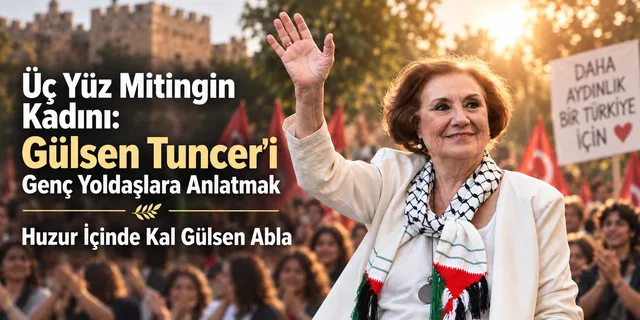
We had set out Gramsci's concept of the "organic intellectual" in The Woman of Three Hundred Rallies: Telling Gülsen Tuncer to Young Comrades: the intellectual the class produces from within itself, through its own work, and who makes that class conscious. Ruhi Su is the exact example; by three measures:
Knowledge. Collecting türkü is labour; going village to village, listening, taking down in notation, comparing variants. Ruhi Su did this for fifty years and carried what he collected not to the vitrine of "folk music" but into the present language of the class. His knowledge belonged to the class.
Side. In 1952, taking beatings for five months in Sansaryan Han, on the gazino stage in 1960, waiting for a passport in 1985, he was on the same side. For forty years he never once said "I am not actually interested in politics, I am an artist". He could have; doors would have opened. He did not.
Continuity. The work of a soldier of the class is not a single moment of heroism but continuity: founding a choir in prison, writing türkü in exile, pressing records while banned, giving concerts while dying of cancer. Ruhi Su's greatness is less in his endurance at Sansaryan Han than in his working another thirty-three years after Sansaryan Han.
Cost and remaining standing
Young comrades, we want to say one thing to you plainly. Ruhi Su's life is not a eulogy on "paying the cost". Cost is not something one is asked to pay; it is something that is exacted. Ruhi Su did not want to be tortured; he did not want to go to prison, to go into exile, to die without a passport. These things were done to him. His choice was what he would do after they were done. His choice was this: to go on working. A member of the Dostlar Choir recounts that he had a working discipline that "did not know fatigue"; rehearsal, record, concert despite the cancer. Remaining standing is not heroic endurance; it is getting up the next morning and going to work. This is something a worker knows.
And he was not alone. Sıdıka Su was a comrade who received the same sentence from the same case; she carried the same load for forty years, published his records after his death, kept the choir alive, founded the foundation. The Dostlar Choir had hundreds of young people. There were the intellectuals who founded İmece. There were the tens of thousands who took truncheons at the funeral. A soldier of the class does not remain standing alone; the class holds him up. What held Ruhi Su up was, as much as his will, the organised life around him. Remember the slogan of our piece "Event Organizing and Comradeship" Guide Is Out: to be organised is to take care. The Dostlar Choir is a musical form of this.
Neither saint nor villain
When we commemorate artists on this blog we have a principle: neither saint nor villain. We will commemorate Ruhi Su that way too. There is a criticism directed at him in türkü circles: that opera technique spoiled the "natural" voice of the türkü, that Ruhi Su's was an "urban" interpretation. Part of this criticism is just: Ruhi Su's türkü is not the türkü sung in the village; it is a conscious, worked, in a sense "written" türkü. But this is not a flaw; it is a preference, and he never hid it: he wanted to "bring out with consciousness" the drama inside the türkü. He was not imitating; he was interpreting. That this is open to discussion is proof that Ruhi Su was an artist, not a folklorist.
A second point: after 1957 Ruhi Su did not sustain an organised party life; the TKP had been broken up, and he fought with his art. There are those who write this as a lack. We will not write it so; but we will say this: art does not take the place of organisation. Ruhi Su's records reached tens of thousands, the Dostlar Choir trained hundreds of young people; but on the morning of 12 September none of this could stop the tanks. This is not Ruhi Su's fault; it is the limit of the cultural front. As we said in Víctor Jara, Chile, and the Class Legacy of Latin Resistance: the song is the voice of the class; it is not the army of the class.
What Is Covered Over?
In commemorations of Ruhi Su three things are usually covered over. Let us open them.
First, his origin. A child born in Van in 1912, orphaned in 1915. In state commemorations the question of why this child was orphaned is not asked; "he lost his family in the war years" is said, and one moves on. Yet the possibility that this country's greatest folk bard was an orphan of a genocide is not a detail to be covered over; it is this country's history itself. Ruhi Su did not know this; when he wanted to know, there was no archive from which he could learn. In Two Towers, One World: Twenty-Five Years of September 11 we had used the method of "telling it as if one knew nothing"; we are doing the same thing here: what happened in Van in 1915, how a child came to Adana — to ask this is part of commemorating Ruhi Su.
Second, his party. Ruhi Su was a member of the Communist Party of Turkey, and for this he was tried and imprisoned. In commemorations one says "leftist", "revolutionary", "dissident"; the words "communist" and "TKP" drop into the footnote. Yet what produced his art was precisely this organised relation: to endure five months in Sansaryan Han is not what an ordinary "dissident" does; it is what a party member does. To erase this is to turn him into "a harmless master", and that is exactly how the state commemorates him today.
Third, the 163 people. The 163 detentions at his funeral pass in most commemorations as a figure. Yet those 163 people are the legacy of Ruhi Su itself: those who first raised a voice in a country that had been silent for five years. Their names are not known; but Ruhi Su himself was one of them, in 1952. To commemorate a soldier of the class is also to commemorate those who took truncheons at his funeral.
Concrete Tasks
To commemorate is to do. For today and the days ahead:
- Listen in order. First Seferberlik Türküleri ve Kuvayi Milliye Destanı; then Pir Sultan Abdal, Köroğlu, Karacaoğlan; then El Kapıları; then Sabahın Sahibi Var. Listen to "Mahsus Mahal", "Bu Nasıl İstanbul", "Hasan Dağı" with their words. Do not make the türkü background music; read the petition inside it.
- Read the words. Write the lines of Pir Sultan, Dadaloğlu and Köroğlu as they stand in Ruhi Su's repertory onto a sheet of paper, and ask this: whose lines are these, written against whom? A five-hundred-year repertory of revolt was not compiled by itself.
- Open the archive of the Ruhi Su Culture and Arts Foundation. ruhisu.org.tr holds the records, the writings, the photographs and Sıdıka Su's accounts. The archive itself is a knowledge common; a foundation holds it because the state did not.
- Find the Ruhi Su Dostlar Choir. The choir is still working. Go to a rehearsal; go to a concert. A collective that hundreds of young people have sustained for forty years is more instructive than any album.
- Found a choir. We are serious. One room, ten people, one bağlama. The Dostlar Choir was founded in 1975 inside a theatre, with amateurs. The türkü, when listened to alone, is consumption; when sung together, it is organisation.
- Learn Sansaryan Han. In Istanbul Sirkeci, still standing today. Who was tortured there, who died, who from Nâzım to Ruhi Su wrote türkü there: without knowing this you cannot know the 1950s. In 12 September: The History, Balance Sheet, and Present of a Class Coup we told Mamak, Diyarbakır, Metris; Sansaryan Han is their forerunner.
- Read the Village Institutes together with Ruhi Su. An opera artist who was a voice teacher at Hasanoğlan; a village child who heard him at Çifteler, Talip Apaydın. Enlightenment is chain work; learn the place where the chain was broken (1946-1954).
- Tie the passport file to today. Today sick prisoners cannot reach treatment in prison; the İHD counts them every year. Ruhi Su's 1985 continues in today's prison infirmaries. To commemorate is to read today's list.
- Ask his origin. Read Van 1915. Learn the history Ruhi Su did not know; because that history is this country's history, and this country's folk bard is a child of that history.
- If you are an artist, choose your position. When Ruhi Su was offered "work in a hidden room", he left the job. One day you too will be told "lower your voice, erase your name, then you can work". Decide now for that day.
- If you are a computing worker, digitise the archive. Ruhi Su's records, collections and concert recordings are scattered. An open, accessible, licensed Ruhi Su archive still does not exist. This is a knowledge-commons job.
- Sing a türkü today. Not alone. "The short stick will take its due from the long." The state feared this line in 1945; it fears it today. That is why you should sing it.
Dear Young Comrades,
A child orphaned in Van learned the violin in an orphans' home in Adana; sang opera in Ankara; took beatings for five months in the cellar of a han in Sirkeci; formed a choir from prisoners in Adana; lived in exile in Çumra; sang türkü in a gazino in Taksim; wrote books whose name was erased; was the first to sing Nâzım; trained hundreds of young people in a choir; waited for a passport; died. At his funeral a country silent for five years spoke for the first time. They raked his grave with bullets.
The name of this life is the name of an album published after his death: Ezgili Yürek. But let us say what that heart worked with: with class. What made Ruhi Su Ruhi Su was not his voice; it was to whom he gave that voice. The voice could have belonged to the opera stage, to the radio, to the state. He gave his voice to the people's türkü, and the people's türkü was a class's petition. The state rejected the petition; the petition is still in our hands.
To be an intellectual is to know; to be a soldier of the class is to decide to whom you give what you know. Ruhi Su decided, and for forty years he paid the cost of that decision; but his voice was never lowered. The short stick will take its due from the long.
Comradely.
Knowledge belongs to everyone.
Related Pieces
This piece is part of the blog's memorial line.
Artist and class: Víctor Jara, Chile, and the Class Legacy of Latin Resistance · From the Ugly King to Yol: Reading Yılmaz Güney Through Class · Bertolt Brecht and the Stage of Class Struggle · Adnan Yücel's Dialectical Legacy and Unbreakable Social Consciousness · Bedahet Tosun — How Is a Life to Be Lived? · The Woman of Three Hundred Rallies: Telling Gülsen Tuncer to Young Comrades
Coups and the state: 12 September: The History, Balance Sheet, and Present of a Class Coup · Two Towers, One World: Twenty-Five Years of September 11 · From Obscenity to National Security: The Anatomy of a Forty-Eight-Hour Wave of Censorship
Education and enlightenment: Our Education Dossier Is Out: Whose School Is It? · The Computing Worker's Handbook
Organisation: "Event Organizing and Comradeship" Guide Is Out
Sources
Life story and archive:
- Ruhi Su Culture and Arts Foundation — "Türkülerin 100'ü Ruhi Su" life story (Adana Orphans' Home, Mehmet Tahir, 1925 examination, opera years, radio programme, arrest, Harbiye, Adana Prison, Çumra, Yapı Kredi archive, choirs, passport, 163 detentions).
- bianet, "Ruhi Su: Yüzyıllık Öykü" (life story on the hundredth anniversary of his birth; the reason for the surname "Su"; escape from military school; prison marriage).
- ListeList, "26 Maddede Bas Bariton Türkü Ustası Ruhi Su" (Kaç-Kaç, "a thing called play", military school and the unfit report, "Kısa çöp", Sansaryan Han türküler, "Hasan Dağı", prison choir, Ilgın Su, 16 records/11 LPs, 1978 cancer diagnosis).
- Wikipedia (EN), "Ruhi Su" and Discogs, "Seferberlik Türküleri ve Kuvayi Milliye Destanı" (İmece, 1971) — discography and years. (Sources differ on whether the first LP was 1971 or 1972; we have taken the Discogs records as the basis.)
- Türk Dili ve Edebiyatı, "Ruhi Su" (1936 Musiki Muallim Mektebi graduation and Presidential Philharmonic, 1942 conservatoire, 1943-45 radio, 1944 People's House concert, 1981 Australia).
The Village Institutes link:
- Mustafa Ekmekçi, "Cumhuriyet Çocukları" — Talip Apaydın's Çifteler account: Ruhi Su's voice teaching at the Hasanoğlan Village Institute.
Repression, arrest, passport, funeral:
- Gerçek Gazetesi, "Ruhi Su (1912-20 Eylül 1985): Operadaki heyûla" (closure of the radio programme on grounds of "propaganda", 1951 round-up, "Mahsus Mahal" at Sansaryan Han, İmece 1963, first to set Nâzım to music).
- Gazete Duvar, "Ölümünün 35. yılında andığımız Ruhi Su ve ona reva görülenler" (1981 "until further order", 1984 Nokta and the "no application was found" statement, the letters of Grass and five German writers, "he died because the state did not give him a passport", Sıdıka Su's 1997 grave statement, the TRT ban).
- soL, "Komünist ozan Ruhi Su: Kısa çöp uzundan hakkın alacak!" (TKP membership, Behice Boran as wedding witness, the reason for dismissal from the radio, 20 September 1985 at 21.09, 163 detentions).
- BirGün, "Anadolu'nun devrimci ozanı Ruhi Su" (his voice cut from the 1959 film, the Yapı Kredi archive and Bedii Faik's attack, the book's publication under another name, the "work in a hidden room" offer).
- Ahmet Nesin, "Ruhi Su cenazesi ve 15 günlük hücre", Artı Gerçek (first demonstration with banners after 12 September, Gayrettepe First Branch, the cinema hall, 15 days, the 163/141/142 note).
- Gazanfer Eryüksel, "Ruhi Su'nun Cenazesi", Çorum Haber (Şişli Mosque, the Mecidiyeköy route, the closing of the cemetery gate, silent standing against "disperse", the truncheons).
- bianet, "Su'suz Geçen 23 Yıl" (five months at Sansaryan Han, 20 months at Çumra, 1977 passport, the passport block after 12 September, 163 detentions and 15 days).
- Temel Demirer, "Türkülerin Sevdalısı Ruhi Su" (the türkü as "the people's book, newspaper, petition"; 1954 marriage; the debate on origins).