Two Towers, One World: Twenty-Five Years of September 11
What Happened That Morning, Who Did It, What the United States Turned It Into, and What That Morning Has to Do with Why the Phone in Your Pocket Listens to You Today

Two Towers, One World: Twenty-Five Years of September 11
What happened that morning, who did it, what the United States turned it into — and what that morning has to do with why the phone in your pocket listens to you today?
On the morning of 11 September 2001, at 08.46, a passenger plane that was supposed to fly from Boston to Los Angeles struck the North Tower of the World Trade Center in New York. Seventeen minutes later a second plane entered the South Tower. At 09.37 a third plane hit the Pentagon near Washington; at 10.03 a fourth went down in an empty field in Pennsylvania. Before noon both towers had collapsed. That day 2,977 people died. Today, twenty-five years later, more than a third of the people living in the world had not yet been born that morning. But all of them live in the world that morning built.
Dear Young Comrades,
We wrote this piece assuming you know nothing about September 11. That is not a slight; it is a choice of method. Because those who "know" September 11 in fact know two things: the image of the planes hitting the towers, and the narrative draped over that image for twenty-five years. To strip the narrative away and see the event, the history behind the event, and the world the event opened, separately, it is best to start from zero.
The thesis of the piece can be stated at the outset: September 11 is not an event that changed the world; it is an event that opened a door to those who wanted to change the world. The nineteen people who planned the attack, and the organization behind them, were real; the dead were real; but they did not build the world that was built after that morning. That world was built by a program already waiting, ready, before the attack. The program had a name, a document, and signatories; and in its own words it was waiting for the attack as "a new Pearl Harbor."
But first the event. Then the history. Then the consequences.
I. What happened that morning?
Four planes, three targets
Nineteen people had bought tickets on four separate planes. The flights were transcontinental, so their fuel tanks were full; that choice was not an accident: the plane was going to be used as a bomb. Shortly after takeoff the hijackers — most of them holding box-cutters — seized the cockpits.
American Airlines Flight 11 struck the North Tower at 08.46; United Airlines Flight 175 struck the South Tower at 09.03. The second impact was watched live; from that moment millions of people everywhere in the world were looking at the same image. American Airlines Flight 77 entered the west wing of the Pentagon at 09.37. The passengers on United Airlines Flight 93, learning the fate of the other planes by mobile phone, stormed the cockpit; the plane went down in a field near Shanksville at 10.03. Its target is thought to have been the Capitol or the White House.
The South Tower collapsed at 09.59, the North Tower at 10.28. In the late afternoon the 47-story Building 7 beside the towers also came down. Of the dead, 2,753 were in New York, 184 at the Pentagon, 40 in Pennsylvania; among them were 343 firefighters. A large share of the dead were office workers, waiters, cleaners, security guards who worked in the towers, and the rescue crews who went in. In the years that followed, tens of thousands of workers who breathed the dust of the wreckage fell ill; today the number who have died of those illnesses has approached — and by some counts passed — the number who died that day.
Who did it?
The attackers were members of the organization called al-Qaeda; fifteen of the nineteen were citizens of Saudi Arabia, two from the United Arab Emirates, one from Egypt, one from Lebanon. The organization's leader, Osama bin Laden, was the son of a wealthy Saudi contracting family. The organization's base was in Afghanistan, then under Taliban rule.
These facts have to be read with one point in mind: none of the attackers came from the two countries that would later be occupied. They were neither Afghan nor Iraqi. Fifteen of them were citizens of one of Washington's closest allies. The 28 pages of the U.S. Congress joint inquiry report that dealt with the Saudi connections were kept secret until 2016.
What did the official inquiry say, and what did it not say?
The 9/11 Commission Report, published in 2004, told the attack largely as an "intelligence failure": the CIA and the FBI had not shared information with each other; warnings had not been taken seriously; the title of the 6 August 2001 presidential briefing was "Bin Ladin Determined to Strike in US." The report documented these things. What it did not document was how the organization from which the attackers emerged was born, with whose money, and as part of which political program. That question was counted as "the past" in the official narrative. Yet that is where the real story begins.
A note, too, on conspiracy theories. Theories that September 11 was "an inside job," that "the buildings were brought down with explosives," have been in circulation for twenty-five years. This piece does not need those theories, because the documented fact is heavier than the theories. Who carried out the attack is clear. The real question is what was done after the attack, and that this had been planned in advance. Conspiracy theory pulls attention from the documented to the undocumentable; that is why, whatever its intention, it serves power.
II. Where did the attackers come from? Afghanistan, 1979
Al-Qaeda's birth certificate was written not in 2001 but in 1979.
In December 1979 the Soviet Union sent troops into Afghanistan to keep the socialist government in Kabul on its feet. The U.S. administration saw this as an opportunity. President Carter's national security adviser, Zbigniew Brzezinski, in an interview he gave to Le Nouvel Observateur in 1998, openly recounted that covert aid to the Afghan mujahideen had begun six months before the Soviet intervention, on 3 July 1979, and that the aim was to draw the Soviets into "their Vietnam." "What is more important," he asked, "some stirred-up Muslims or the collapse of the Soviet empire?"
Over the next decade the program the CIA ran under the name "Operation Cyclone," through Saudi money and Pakistani intelligence, armed, trained and organized Islamist fighters who came from every corner of the world. One of the wealthiest of those fighters was Osama bin Laden; the fighters' register was given a name that in Arabic means "the base" or "the record": al-Qaeda.
The Soviets withdrew in 1989. The United States withdrew too — but the weapons, the trained cadres and the ideology remained. In 1996 the Pakistani-backed Taliban took Kabul; bin Laden settled there. In 1998 he attacked the U.S. embassies in Kenya and Tanzania; in 2000, a warship in Yemen. In 2001, New York.
To tell this history is not to legitimize the attack. That has to be said, because for twenty-five years everyone who has told this history has been branded as "defending the terrorist." On the contrary: telling this history is the only way to understand the attack. Al-Qaeda was a weapon Washington created in the last great proxy war of the Cold War. The weapon turned on its owner. There was even a name for this in the CIA's own jargon: blowback.
And one thing more: the more than one million Afghans who died in the Afghanistan of the 1980s were told in the Western press as the victory of "freedom fighters." The 2,977 New Yorkers who died in 2001 were told as an "attack on civilization." This unequal weighing of the dead will meet us as a method in the later sections of this piece.
III. The program waiting ready: "a new Pearl Harbor"
The document
In September 2000, a full year before the attack, a think tank called the Project for the New American Century (PNAC) published a report titled Rebuilding America's Defenses. The report proposed increasing military spending in order to make permanent the United States' position as the sole superpower after the Cold War, a lasting military presence in the Gulf, the capacity to fight more than one war at the same time, and control of space and "cyberspace." And it contained this sentence: the transformation would take a long time "absent some catastrophic and catalyzing event — like a new Pearl Harbor."
Among PNAC's founders and signatories were Dick Cheney, Donald Rumsfeld, Paul Wolfowitz, Jeb Bush and Richard Perle. A year later these names were, respectively, vice president, secretary of defense, deputy secretary of defense and chairman of the Defense Policy Board. The report was the sequel to an open letter written to President Clinton in 1998 calling for regime change in Iraq; Iraq was already a target before the attack.
Do not read this as a conspiracy; read it as the open document of a program. No one planned September 11; but a class fraction knew in writing what such an event would be good for, and was ready when the event came. The sentence Rahm Emanuel would utter years later, during the 2008 crisis, is the most honest summary of this stance: "You never want a serious crisis to go to waste."
Within fourteen days
Three days after the attack, on 14 September 2001, Congress passed the Authorization for Use of Military Force (AUMF). This sixty-word text gave the president the authority to use "all necessary and appropriate force" against any country, organization or person he deemed related to the attack; there was no limit of time, place or target. It passed in the House of Representatives by 420 votes to 1. The single "no" vote was that of California representative Barbara Lee; on the floor she said, "let us pause and consider the consequences of the step we take today; as we act, let us not become the evil we deplore." Twenty-five years later that text is still in force and has been used as the legal basis for military operations in more than twenty countries.
On 20 September President Bush spoke to Congress: "Either you are with us, or you are with the terrorists." That sentence built the grammar of world politics for the next twenty-five years. There was no third position; to object to the war was to be on the other side.
On 26 October the USA PATRIOT Act was signed. The 342-page law was a text most members of Congress voted on without reading, and it gave the state the power of warrantless wiretapping, access to library and bank records, a definition of "domestic terrorism," and the indefinite detention of immigrants. The law's name was an acronym, and even the expansion of the acronym was propaganda: "Uniting and Strengthening America by Providing Appropriate Tools Required to Intercept and Obstruct Terrorism."
In November 2001 airport security was handed to a federal agency (the TSA). In November 2002 the Department of Homeland Security was founded, gathering twenty-two federal agencies under a single roof; the word "homeland" in its name was a word that had not been used in American politics before, one that recalled the European mid-twentieth century.
The wars
On 7 October 2001 the bombing of Afghanistan began. The Taliban fell in two months; bin Laden escaped. The war lasted twenty years.
On 11 January 2002 the first detainees were brought to the Guantánamo base at the southeastern tip of Cuba. The base had been chosen as a "lawless zone": because it was not U.S. soil, U.S. law was held not to apply; because it belonged to Cuba, Cuban law was held not to apply either. Over twenty-five years 780 people were held without trial, most of them never facing any charge; a handful of people are still there today.
On 5 February 2003 Secretary of State Colin Powell stood before the UN Security Council with a vial of powder and described Iraq as possessing weapons of mass destruction. Every important claim in that presentation was false, and Powell later called it a "blot" on his record. On 20 March 2003 Iraq was invaded. No weapons of mass destruction were found; nor was any link found between September 11 and Iraq. What was found was one of the world's largest oil reserves, and a war that never ended.
In April 2004 photographs leaked from Abu Ghraib prison: images of naked prisoners stacked on top of one another, dragged on a leash, wired to electrical cables. In December 2014 the Senate Intelligence Committee's report documented that the CIA had carried out systematic torture in secret prisons around the world under the name "enhanced interrogation techniques," that it had been of no use, and that Congress had been lied to. No one who carried out the torture, and no one who ordered it, was prosecuted. The full report is still classified.
The balance sheet
Brown University's Costs of War project has kept the balance sheet of the post-September 11 wars for fifteen years. By its latest calculations: some 940,000 people killed by direct violence; with indirect deaths from the infrastructure the war destroyed, from hunger and disease, more than 4.5 million deaths; 38 million people displaced; a cost to the U.S. budget of more than 8 trillion dollars. The overwhelming majority of the dead were civilians living in Afghanistan, Iraq, Pakistan, Syria, Yemen and Somalia.
When you set these numbers beside 2,977, you see that the "war on terror" is not a war but a ratio: more than a thousand dead for every New Yorker who died. The name of that ratio is not justice.
And in August 2021 the United States withdrew from Afghanistan. The Taliban, twenty years later, entered Kabul exactly as it had in 2001. The war's declared aim — to destroy the Taliban — had returned to zero. Its undeclared aims had been realized; we will come to those.
IV. The economy of a war: who won?
"Who won?" is the Marxist method of understanding wars. The declared aim of a war is one thing; its class function is another. The declared aim of the post-September 11 wars was to end terror; terror did not end, it multiplied. What, then, was their function?
Arms capital. The U.S. defense budget was about 300 billion dollars in 2001; by 2010 it had passed 700 billion. The share values of Lockheed Martin, Raytheon, Boeing, General Dynamics and Northrop Grumman rose over twenty years to multiples of their prewar levels. Retired generals sat on these companies' boards; former executives of these companies sat in the upper ranks of the Pentagon. The structure Dwight Eisenhower named and warned against as the "military-industrial complex" in his 1961 farewell address ceased, after September 11, to be a subject of warning and became a form of government.
Contractor capital. Iraq and Afghanistan were the most privatized wars in history. Vice President Cheney's former company Halliburton, and its subsidiary KBR, took tens of billions of dollars in no-bid contracts. Operatives of the private military company Blackwater killed seventeen civilians in Baghdad's Nisour Square on 16 September 2007; four perpetrators were convicted in 2014 and pardoned by President Trump in December 2020. War was no longer only a state policy; it was a sector.
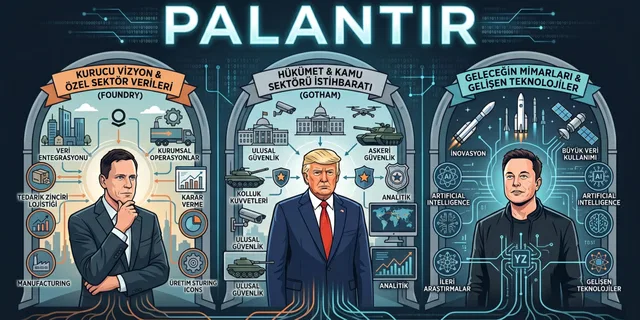
Security capital. This is the most lasting of them. After 2001 a new market was born in the United States under the name "homeland security": surveillance software, biometric identity, data fusion, "threat analysis." According to the Washington Post's 2010 "Top Secret America" investigation, at that date 1,271 public agencies and 1,931 private companies were working in counterterrorism, homeland security and intelligence; 854,000 people held "top secret" clearance. This market had a company founded in 2003 that received one of its first investments from the CIA's venture-capital arm, In-Q-Tel: Palantir. We will return to it in section eight; for now note this: Palantir is, in the full sense, a child of September 11.
Oil. That the Iraq invasion was carried out for oil was mocked in 2003 as a "conspiracy theory." In 2007 the former Federal Reserve chairman Alan Greenspan wrote in his memoirs: "I am saddened that it is politically inconvenient to acknowledge what everyone knows: the Iraq war is largely about oil."
These were the winners. The losers, besides the peoples of Iraq and Afghanistan, were the United States' own working class: the overwhelming majority of the soldiers sent to war were the children of poor states and towns; the war budget was cut from social spending; and the surveillance apparatus built for the war eventually turned on them.
V. The long history: the U.S. line from 1823 to today
What was done after September 11 was not new. What was new was the scale and the technology. The line itself is two hundred years old, and it is not possible to understand September 11 without knowing that line. This section is not a chronology; it recounts a pattern; the pattern consists, in every period, of the same four steps: the declaration of a threat, a war or intervention, a wave of domestic repression, and the expansion of capital.
Continental empire (1823—1898)
In December 1823 President Monroe declared that he would regard intervention by European states in the Western Hemisphere as "dangerous to our peace and safety." The Monroe Doctrine would, for the next two centuries, be the legal cover for the claim that Latin America was the United States' backyard. In 1845 the journalist John O'Sullivan wrote that it was America's "manifest destiny" to cover the continent from end to end. That word presented the driving of Indigenous peoples from their lands, and the annexation of what is today California, Texas, Arizona and New Mexico through the Mexican War of 1846—48, as God's plan. Colonialism was a founding principle in the United States before it was a foreign policy.
Overseas empire (1898—1945)
In February 1898 the U.S. warship Maine exploded in Havana harbor. The cause of the explosion was never established with certainty; later research pointed to a boiler accident. But William Randolph Hearst's newspapers presented the explosion as a Spanish attack and beat the drums of war with the slogan "Remember the Maine!" The United States declared war on Spain; it took Cuba, Puerto Rico, Guam and the Philippines. When the "liberated" people of the Philippines wanted independence, a war of suppression was fought in 1899—1902 in which at least two hundred thousand Filipinos died. This was the United States' first "rescue" occupation, and it set the template: an incident, a press campaign, a rescue discourse, an occupation.
In 1904 Theodore Roosevelt added his own corollary to the Monroe Doctrine: the United States could intervene in Latin America as a police power in countries that did not "fulfill the obligations of civilization." Over the next thirty years U.S. Marines landed again and again in Nicaragua, Haiti, the Dominican Republic, Honduras, Cuba and Mexico. Major General Smedley Butler, who took part in those landings and received the Medal of Honor twice, wrote a pamphlet in 1935 titled War Is a Racket: "For thirty-three years I served as a high-class muscle man for Big Business, for Wall Street and the bankers. I helped make Mexico safe for American oil interests, Haiti and Cuba for the National City Bank, Nicaragua for the house of Brown Brothers, the Dominican Republic for American sugar interests, Honduras right for the American fruit companies." Do not forget that a general wrote that paragraph.
Inside the country, the same period, the same pattern. The Espionage Act, passed in 1917 as the United States entered the First World War, was used to silence opponents of the war; Socialist Party leader Eugene Debs was sentenced to ten years in prison for speaking against the war. In 1919—20, in Attorney General Palmer's raids, thousands of immigrants, socialists and trade unionists were detained, hundreds deported. In 1942, 120,000 Japanese Americans, most of them citizens, were locked in concentration camps without any charge. Foreign war and domestic repression always arrived together. Keep the Espionage Act in mind; it will return in section seven.
The Cold War (1945—1991)
The two bombs dropped on Hiroshima and Nagasaki in August 1945 were as much the first act of the Cold War as they were the last act of the war: a show of force to the Soviet Union. In March 1947 the Truman Doctrine was declared, and its first application was Turkey and Greece: military and economic aid "against communism." NATO was founded in 1949; Turkey joined in 1952. The language of the Truman Doctrine was the template for the language of 2001: a global threat, a "free world," either with us or with them.
The real story of this period is the coups. In 1953 in Iran, Mossadegh, who had nationalized the oil, was overthrown by a coup organized by the CIA and British intelligence; the Shah's dictatorship was installed in his place. In 1954 in Guatemala, the Arbenz government, which had touched the lands of the United Fruit Company, was overthrown by the CIA's "PBSUCCESS" operation; two hundred thousand people then died in a forty-year civil war. In 1961 Lumumba in the Congo, in 1964 Goulart in Brazil, in 1965—66 Sukarno in Indonesia — in Indonesia, between five hundred thousand and a million communists and people taken for communists were slaughtered with U.S. lists. In Vietnam in August 1964 the war was widened on the pretext of a "North Vietnamese attack" in the Gulf of Tonkin; that there had been no attack was confirmed in 2005 by the NSA's own documents. More than three million Vietnamese died in the war.
And 11 September 1973. In Chile, the elected socialist president Salvador Allende was overthrown by a military coup the CIA had been preparing for years and that Nixon had backed with the instruction to "make the economy scream"; Allende died in the bombed presidential palace. The Pinochet dictatorship lasted seventeen years; tens of thousands were tortured, more than three thousand were killed or disappeared. This was also the coup that destroyed the Cybersyn control room we recalled in our piece on techno-fascism. In Latin America, when one says September 11, 1973 is understood, not 2001. Setting the two Septembers 11 side by side is instructive: in one the United States itself was attacked and the world mourned; in the other the United States destroyed a democracy and the world learned of it only years later.
A sentence, too, for 12 September 1980: on the night the coup in Turkey took place, a CIA officer in the White House is reported to have said to President Carter, "our boys did it." The coup's economic program was the IMF's 24 January decisions; the coup crushed the unions, the strikes and the left movement in order to apply that program. The pattern is the same.
Inside the country: the McCarthy period of 1947—57; the Hollywood blacklists; the purge of communists from the unions; and the FBI's COINTELPRO program from 1956 to 1971 — an illegal program in which every opposition organization, from the Communist Party to the Black Panthers, from Martin Luther King to antiwar students, was a target of infiltration, discrediting and liquidation. In 1975 the Senate's Church Committee exposed this program and passed laws to oversee surveillance so that "this would never happen again." In 2001 most of those laws were suspended.
The unipolar moment (1991—2001)
When the Soviets broke up, the debate in Washington was not "what do we do now" but "how do we make this supremacy permanent." The 1991 Gulf War was the first demonstration of this: Saddam, who had occupied Kuwait, was the man who ten years earlier had been backed against Iran. In 1992 the Pentagon's "Defense Planning Guidance" draft, from Wolfowitz's pen, wrote that the United States should prevent the rise of any rival power. In 1999 NATO bombed Yugoslavia for 78 days without a UN resolution. And in 2000 PNAC waited for "a new Pearl Harbor."
When you read this history you see that none of what was done after September 11 was invented. The false pretext (the Maine, Tonkin, weapons of mass destruction), the rescue discourse (the Philippines, Iraq), domestic repression (Palmer, McCarthy, the Patriot Act), identifying the opposition with the enemy (Debs, King, Barbara Lee), the network of military bases, the coup and the proxy war — all of it was there. September 11 added a pretext and a technology to this toolkit.
Lenin, in 1916, had defined imperialism as the monopolist stage of capitalism: the stage at which capital, no longer fitting inside its own national market, is forced to divide the world. The United States' two-hundred-year line is a long instance of that definition; the period after September 11 is the document of how far that line can go at the moment it is left without a rival.
VI. How did the world change?
The effect of September 11 was not confined to the United States' wars. Everywhere in the world, states took the same language and the same tools.
"Counterterrorism" became a universal licence
Bush's sentence "either with us or with the terrorists" gave every government in the world a licence to declare its own opposition terrorists. Russia renamed its war in Chechnya "counterterrorism" and the West's voice fell silent. China placed its repression of the Uyghurs in the same frame. Israel presented its occupation of Palestine as a front of "the same war." India, Egypt, Saudi Arabia, Colombia — each used the same word for its own domestic enemy.
In Turkey that word already had a long history; the 1991 Anti-Terror Law was widened in 2006 to fit the post-September 11 climate, and the definition of "terror" gained a flexibility stretching from armed action to the expression of thought, from membership of an organization to "propaganda for an organization." This flexibility is the common ground of the Academics for Peace, the journalists, the trade unionists, the Kurdish politicians we described in our Peace Dossier, and of the "critical infrastructure" logic we touched on in The Panopticon's Doorkeeper. After September 11 the world learned the undefinedness of the word "terror" as a technique of government.
Turkey, on the other hand, also did something on 1 March 2003: the Grand National Assembly of Turkey (TBMM) rejected the motion that would have allowed U.S. troops to pass through Turkish territory in order to occupy Iraq. That rejection was the result of an antiwar movement of hundreds of thousands walking in the squares in those days, and it was something Washington had not expected. There are two lines in Turkey's post-September 11 history: the line of the state's using the "counterterrorism" licence at home, and the line of the people's saying no to war. Twenty-five years later which of them is dominant is obvious; but that the second existed must not be forgotten.
The security state was normalized
Before 2001 you did not take off your shoes when you went to the airport. Today no one finds this strange. This small detail is the sign of a large transformation: to be watched in every domain of everyday life in the name of "security" became normal after September 11. Cameras, identity checks, "suspicious package" announcements, biometric passports, fingerprints at the border, the monitoring of bank accounts, the sharing of no-fly lists. Each of these arrived with a separate law; the pretext of all of them was the same.
And the police were militarized. In the United States, through the Pentagon's "1033 program," surplus armored vehicles, assault rifles and night-vision devices from the war were distributed to small-town police. In 2014 in Ferguson, those who demonstrated against the police who had killed an unarmed Black youth were met by armored vehicles that had come back from Iraq. The foreign war, thirteen years later, had come home to its own town.
Islamophobia became an ideology
In 2001 hate crimes against Muslims in the United States increased sixteenfold from the previous year. But the real transformation was not in the crimes; it was in legitimate politics: the discourse that saw Muslims as a "civilizational threat" found an academic cover in the popularization of Samuel Huntington's 1993 thesis of a "Clash of Civilizations," and became the main agenda of Europe's far right. The current form of racism in Europe that we described in our Germany AfD Dossier passed through this door September 11 opened: the old racism used a biological language; the new one uses the language of "culture" and "security." The result is the same.
The war produced its own enemy
The Iraq occupation created al-Qaeda in Iraq when there was no al-Qaeda in Iraq. The Baath army the occupation dispersed, and the state it destroyed, left a vacuum in Sunni regions; among the prisoners held at the United States' Camp Bucca was Abu Bakr al-Baghdadi, who would later become the leader of ISIS. In 2014 ISIS took Mosul and declared a "caliphate." The Syrian civil war, the Yemen war, the collapse of Libya, the armed groups in the Sahel — all of them are later links in the "war on terror." The war produced its own pretext, and that is why it never ended.
Waves of migration and Europe's walls
Thirty-eight million displaced people are not a statistic; they are the people who in 2015 tried to cross the Aegean, who approached four million in Turkey, who were met with barbed wire at Europe's borders. The rise of the European far right was built on top of this wave of migration; but the cause of the wave of migration was the wars Europe itself had joined. To support the war and shut the door on the war's fugitives is the most consistent hypocrisy of post-September 11 Western politics.
VII. Generations: those who remember that morning and those who do not
To understand the effect of September 11 on generations, let us think of three groups.
Those who were adults that morning — those who today have passed fifty — September 11 is a break: there is a before and an after. They had lived the end of the Cold War, the "end of history" optimism of the 1990s, and then one morning saw the world turn back into a world of war. This generation knows how new the apparatus the post-September 11 state built was; but it is also the generation that consented out of fear. The public opinion that accepted the Patriot Act, Guantánamo, torture, was this generation's public opinion.
Those who were children that morning — those born between 1985—2000 — grew up inside the war. In the United States this generation was called the "9/11 generation": the generation of the soldiers who went to Iraq and Afghanistan; the generation of the education and health spending the war budget cut, of the 2008 crisis, and of going to university in debt. This generation's political biography begins with the 2003 antiwar marches, continues with Occupy Wall Street in 2011 and the Arab Spring, and pours into the street after George Floyd in 2020. It is a generation that does not trust the state's promises but grew up inside the state's apparatus. Chelsea Manning was born in 1987, Edward Snowden in 1983; the war generation's whistleblowers also came from this generation.
Those not yet born that morning — you, those today under twenty-five — September 11 is not a memory but a condition. Airport security, cameras in the street, location permission on the phone, the use of the word "terror" for every opposition, borders closed with barbed wire, constant war news: you do not know that these had a "before," because you did not live it. This is both a disadvantage and an advantage. The disadvantage: the surveillance state looks normal to you, because you were born into it. The advantage: you do not carry the fear of September 11; it is harder for the state to silence you with the word "security," because that word has no trauma for you.
In Turkey this generational split has its own form. The generation before you lived the 1990s form of the "counterterrorism" discourse, the emptying of villages, the unsolved murders; you are living the digital form of the same discourse — prosecutions opened from a social-media share, detentions on the pretext of "propaganda for an organization," the state data leaks we described in our KVKK piece. The apparatus is the same; its technology has changed.
There is also a break between generations that needs to be dwelt on: the images of the withdrawal from Afghanistan in August 2021 — people clinging to a plane's landing gear at Kabul airport and falling — were, for your generation, the first lesson in what September 11 was. In that image you saw that twenty years of war had returned to zero, that the millions who died had died for nothing. The previous generation called that image "failure"; your generation can learn to call it "a lie." The difference matters: failure is the wrong application of the right aim; a lie is that the aim was something else from the start.
VIII. From Manning to Snowden: how the secret state was exposed
If we know today what the post-September 11 state did, we owe it not to the state's transparency but to the conscience of a few workers who worked inside that state. This section is the heart of the September 11 piece; because the disclosures did not only show what the "war on terror" was; they also showed against whom the state wanted secrecy.
Manning and WikiLeaks (2010)
On 5 April 2010 WikiLeaks published a video it named "Collateral Murder." The video showed how, on 12 July 2007 in Baghdad, a U.S. Apache helicopter raked a group of civilians that included two Reuters employees, and how it then fired on a minivan that had come to help the wounded — with two children inside. The helicopter crew's talk was on the recording too: they were laughing.
The person who leaked the video was a twenty-two-year-old private serving as an intelligence analyst in Iraq, Chelsea Manning. That same year Manning also gave WikiLeaks 91,000 Afghanistan war documents, 391,000 Iraq war documents and 251,000 diplomatic cables. The Iraq documents showed that the United States' claim "we do not keep a civilian death count" was a lie, documented tens of thousands of unrecorded civilian deaths, and documented the tortures the Iraqi police carried out in front of the United States' eyes. The diplomatic cables exposed the corruption in Tunisia and became one of the first sparks of the Arab Spring.
Manning was arrested in May 2010, held in isolation for months, and in 2013 sentenced to 35 years in prison. Obama commuted the sentence in the last days of his term; Manning served seven years. The helicopter crew who laughed at dead civilians faced no investigation.
WikiLeaks' founder Julian Assange took refuge in Ecuador's embassy in London in 2012, stayed there seven years, was dragged out of the building by police in April 2019 and held for five years in Belmarsh prison. The United States wanted to try him under the 1917 Espionage Act with a demand of 175 years in prison — a journalist, for publishing documents. In June 2024 he was released under a plea deal, in exchange for "admitting" guilt. Whatever you think of Assange's personality, the case was this: to publish a state's war crimes is espionage.
Snowden (2013)
On 5 June 2013 the Guardian published a secret court order showing that the NSA was collecting the phone records of all of Verizon's customers. The next day the PRISM program was disclosed: the NSA had direct access to the servers of Google, Facebook, Apple, Microsoft and Yahoo. In the months that followed it emerged that XKeyscore (the system that made nearly all internet traffic in the world searchable), that German chancellor Merkel's phone was being tapped, that Britain's GCHQ was copying fibre-optic cables directly, that encryption standards had been deliberately weakened.
The person who leaked the documents was a twenty-nine-year-old systems administrator working as a contractor for the NSA, Edward Snowden. He identified himself in Hong Kong; when the United States cancelled his passport he was stranded in Moscow, and he is still there. What Snowden said was simple: the apparatus built after September 11 to "watch the terrorists" was watching everyone. You did not have to be a terrorist; it was enough to exist.
Snowden's disclosure showed the real nature of the post-September 11 apparatus: the passage from targeted surveillance to mass surveillance. Old surveillance watched the suspect. New surveillance records everyone and looks for the suspect afterwards. This is not a quantitative change but a qualitative one, and it is the state form of what we called the "digital panopticon" in our Karaburun statement. In Bentham's panopticon the prisoner watches himself because he does not know whether he is being watched; in the apparatus Snowden showed, everyone is a prisoner.
The return of the Espionage Act
Now go back to 1917. The Espionage Act that sent Eugene Debs to prison was almost unused for ninety years. In eight years the Obama administration prosecuted more whistleblowers under this law than all previous presidents combined: Manning, Snowden, Thomas Drake, John Kiriakou (the only CIA officer who went to prison for making the CIA's torture public), Reality Winner, Daniel Hale (who leaked the drone program). No torturer, no drone operator, no lying minister was prosecuted. Those prosecuted were not those who told the lie but those who showed the lie.
This asymmetry is the most compact definition of the post-September 11 state: secrecy is not against the enemy; it is against the people. What would al-Qaeda have done upon learning that the NSA was collecting Verizon records? Nothing. Those who were not supposed to learn were Verizon's customers.
Who were the whistleblowers?
Pay attention to one thing: Manning was a private, Snowden a contractor, Kiriakou a civil servant, Hale an air-force analyst. None of them was a general, a minister or a company owner. They were workers inside the apparatus. The post-September 11 state built a surveillance and war industry that employed millions of people; and the weakest link in that industry was the conscience of the people who ran it. In The Panopticon's Doorkeeper we said the same thing of an artificial-intelligence company: the only thing that can stop the apparatus is the refusal of those who run it to keep running it. This is September 11's most hopeful lesson, and that is why it is the most harshly punished conduct.
IX. What does the Trump period stand for?
It is a common error to read Trump as a fact of his own, cut off from September 11. The correct reading is this: Trump is the post-September 11 apparatus taking off its liberal mask and turning inward.
This has to be seen in three stages.
Bush built the apparatus. The Patriot Act, Guantánamo, torture, indefinite detention, mass surveillance, the AUMF. All of this was built between 2001—2008, on the pretext of a "state of emergency."
Obama normalized the apparatus. Obama, elected on a promise to close Guantánamo, did not close it. He grew the drone program tenfold; in September 2011, in Yemen, he killed a U.S. citizen, Anwar al-Awlaki, by extrajudicial execution, and two weeks later his sixteen-year-old son. Section 1021 of the 2012 National Defense Authorization Act prepared the legal ground for even U.S. citizens to be held in indefinite military detention. He used the Espionage Act systematically against whistleblowers. Obama turned the state of emergency into the ordinary state: he institutionalized the apparatus so that it would look like the normal working of a state of law. This was the apparatus's most dangerous stage; because an apparatus becomes permanent when it is used not with disgust but as the normal.
Trump turned the apparatus inward. In January 2017 a travel ban on the citizens of seven Muslim countries; in 2018 the separation of children from their families at the border. In his second term, the application of the "foreign enemy" logic directly to domestic politics: the use in peacetime, against immigrants, of the 1798 Alien Enemies Act; in June 2025 the deployment of the National Guard, against the governor's will, to suppress protests against immigration raids in Los Angeles; in September 2025 the declaration of "Antifa" — not an organization, but an attitude — as a "domestic terrorist organization," and in the same days a national-security directive titled "countering domestic terrorism and organized political violence" that tasked federal agencies with targeting opposition networks, funds and persons. In March 2025 an executive order eliminating "information silos" among federal agencies opened the way to pooling all state data on citizens in a single reservoir; for the apparatus Snowden had exposed, this was a dream.
Each of these steps is the use of powers built in 2001 "for the terrorists." The concept of "domestic terrorism" is inside the Patriot Act; unlimited detention is the logic of Guantánamo; identifying the opposition with the enemy is Bush's 20 September speech. Trump did not invent; he inherited, and he changed the target: from terrorist to immigrant, from immigrant to demonstrator, from demonstrator to "left-wing networks." The target list expands by the structure of the apparatus; because the apparatus cannot justify its own existence when there is no threat.
The second thing Trump stands for is that this apparatus's class ownership becomes openly visible. In the Bush period the arms companies were the Pentagon's suppliers; in the Trump period technology capital is directly inside the government. The vice president Peter Thiel trained, the "government efficiency" unit Musk ran, the state software Palantir wrote, the election campaign crypto capital financed. This is the moment when the tendency toward "fascism that does not need a mass party," which we described in our piece on techno-fascism, settles into the state apparatus. Recall Dimitrov's 1935 definition: the open dictatorship of the most reactionary elements of finance capital. The word "open" matters; what Bush and Obama hid, Trump does openly. This does not make Trump worse; it makes him more readable.
And a third thing: Gaza. The most extreme application of the "counterterrorism" language built after September 11 has, since October 2023, been under way in Gaza with the West's full support. The concept of "terrorist infrastructure" became the indirect way of saying hospital, school and shelter. The language Bush used in Iraq, Obama in Yemen, is the language Netanyahu uses in Gaza. This piece is not about Gaza; but on the twenty-five-year balance sheet of September 11, Gaza is the logistical outcome of the "war on terror."
X. Palantir and techno-capitalist surveillance: where is the apparatus going?
A company's biography
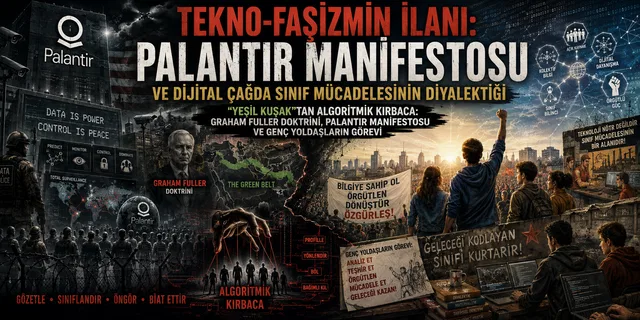
Palantir was founded in 2003 — while Iraq was being occupied — by Peter Thiel, Alex Karp and a few partners. One of its first major investors was In-Q-Tel, the venture-capital fund the CIA had founded in 1999. The company's first product, Gotham, was software that combined scattered intelligence data — phone records, bank movements, travel information, social media, camera footage — in a single interface and produced "relationship maps." Its first customers were the CIA, the NSA, the FBI and the U.S. military; it was used in Afghanistan and Iraq to map "insurgent networks." So Palantir is, exactly, the software of the post-September 11 apparatus: the layer in which the mass data collection Snowden exposed is made to mean something.
Over the next twenty years the company sold the same software in turn to police departments (in New Orleans and Los Angeles, "predictive policing"), to the immigration service, to England's public health system, to the Israeli army, and from 2025 onward directly to the core of the Trump administration. In April 2025 ICE gave Palantir a 30-million-dollar contract for a system called "ImmigrationOS": a platform that tracks immigrants in real time, "prioritizes people to be deported," and follows "those who leave of their own accord." In August 2025 the U.S. Army signed a ten-year framework agreement with Palantir worth up to 10 billion dollars. The company's market value, in 2025, reached hundreds of billions of dollars. In The Palantir Manifesto we discussed Karp's book The Technological Republic (2025): the book says Silicon Valley should serve "the defense of the West" rather than "consumer applications," and that this is a moral duty. So the company does not hide what it does; it defends it as a worldview.
Where is it going?
To guess the apparatus's direction it is enough to look at a pattern: the expansion of the target list.
In 2001 the target was the "foreign terrorist." In 2010 Gotham was mapping the "insurgent" in Afghanistan. In 2015 the same software was mapping "high-crime-risk neighborhoods" in American cities. In 2025 ImmigrationOS maps immigrants; the "domestic terrorism" directive maps opponents. As we saw in The Panopticon's Doorkeeper, even an artificial-intelligence company has begun to build a system that will file its own employees and activists. The next target is clear and is not new: the worker. Systems that detect union organizing in advance, that score strike tendency as "risk," that scan communication at the workplace, are the workplace version of the same software and have been in use for years at companies like Amazon. The algorithmic management we described in our Gig Economy Dossier has the same architecture as the state's surveillance apparatus; the difference is that one is run by the state, the other by the boss. The merger of the two — the gathering of state data and workplace data in a single pool — is the logical outcome of the apparatus.
The second direction is the passage to prediction. The post-September 11 apparatus does not content itself with investigating something that has happened; it "predicts" what will happen. Predictive policing, the "risk score," the "threat assessment": their common feature is that they turn into a target, on the grounds of statistical resemblance, a person who has not yet done anything. This abolishes the foundation of criminal law — no punishment without a crime. That was the logic of Guantánamo: you are held not because you have done something, but because you are someone who might. Artificial intelligence scales this logic.
The third direction is privatization. The surveillance apparatus is no longer a department of the state but a product the state rents. This produces two results: the apparatus, for profit, has to expand its own market — that is, it has to find more threats; and the apparatus is outside democratic oversight — Congress cannot oversee a company's algorithm, because it is a "trade secret." The Church Committee could oversee the FBI in 1975; who will oversee Palantir today?
The place where these three directions meet we call the techno-fascist tendency; and as we have said in earlier pieces, to call this "techno-feudalism" is wrong. Palantir is not a feudal lord; it is a monopolist capitalist company: it competes, it grows, it chases contracts, it sells stock. Its intertwining with the state is not a feudal relation but the digital form of the fusion of finance capital and the state that Lenin described in 1916. Putting the concept right matters; because the struggle against feudalism is a peasant revolt, and the struggle against monopolist capitalism is workers' organization.
The apparatus's weak point
The apparatus looks flawless; it is not. It has three weak points, and all three have been seen in the twenty-five-year history of September 11.
First, those who run it. Manning, Snowden, Hale; the four thousand engineers who in 2018 gathered signatures at Google against the Pentagon's Maven project; the employees at Microsoft and Amazon who came out against contracts with the Israeli army; the security-guards' strike in The Panopticon's Doorkeeper. The apparatus does not run without labor; and labor can refuse.
Second, its falsehood. Predictive systems reproduce the bias of the data they are trained on. They target the wrong people, they "clear" the wrong people. Before September 11 all the data was in hand; the attack happened anyway. Mass data does not produce security; it produces control. This is the contradiction between the apparatus's pretext and its function, and with every disclosure it becomes a little more visible.
Third, its legitimacy. Twenty-five years later the words "war on terror" have lost the force they had in 2001. The images of the flight from Afghanistan, the Iraq lie, Abu Ghraib, Gaza — each of these has worn the apparatus's "security" pretext a little thinner. An apparatus, when it is not believed, uses more force; and an apparatus that uses more force consumes its own legitimacy faster. This does not mean a spontaneous collapse; but it does mean that the field of struggle is open.
A comparative table: the official narrative, a class reading
| Official narrative | Historical-materialist assessment |
|---|---|
| September 11 was an attack on civilization and it changed the world. | September 11 furnished a pretext for a program already prepared. What changed the world was not the attack but the class fraction that used the attack. |
| The attackers were fanatics who "hate our freedom." | The attackers were the product of the movement Washington armed against the Soviets in 1979. The weapon turned on its owner. |
| Afghanistan and Iraq were occupied to dry up terror at its source. | None of the attackers came from those two countries. Iraq had been in PNAC's sights since 1998. The occupations did not dry up terror; they produced ISIS. |
| The Patriot Act and surveillance are for catching terrorists. | Snowden showed: the apparatus records everyone. Secrecy is not against the enemy but against the people; those who disclosed were prosecuted, those who tortured were not. |
| The war brought democracy and freedom. | The war brought 4.5 million dead, 38 million refugees, and trillions for arms, contractor, security and oil capital. The Taliban returned to Kabul twenty years later. |
| Trump is a deviation from the American tradition. | Trump is the unmasked, inward-turned form of the apparatus Bush built and Obama normalized. Not a deviation, a continuity. |
| Companies like Palantir are technology providers serving national security. | Palantir is the privatized, profit-driven, unaccountable form of the September 11 apparatus. The target list expands by its structure: terrorist → immigrant → opponent → worker. |
| Counterterrorism is the world's common cause. | The undefinedness of "terror" gave every state in the world a licence to declare its own opposition the enemy. Turkey included. |
| This history is an exceptional period of the United States. | It is the most developed form of a two-hundred-year pattern, from the Maine to Tonkin, from the Philippines to Chile, from Palmer to McCarthy. |
If we reduce the table to a single sentence: the official narrative tells September 11 as a beginning; we read it as an opportunity — and we ask who used the opportunity, and for what.
Three common errors
First: fleeing into conspiracy theory. To say "they brought the buildings down themselves" is to replace the documented with the undocumentable, and it pulls attention away from PNAC, the AUMF, the Patriot Act, the Senate torture report — that is, from the proven. Power's favorite opponent is the one who drops the evidence and clings to rumor; because rumor is refuted, and when it is refuted the evidence is discredited with it.
Second: legitimizing the attack. To tell al-Qaeda's history is to understand the attack; not to applaud it. The 2,977 dead were people, the overwhelming majority of them workers, and their deaths are the counterpart of no political account. Not everyone who is the enemy of imperialism is our friend; bin Laden was a reactionary, the product of Saudi capital and the Cold War, and most of the people he killed were not the children of his enemy but the children of his enemy's workers. The logic of "the enemy of my enemy" is the logic of geopolitics, not of class politics.
Third: thinking "it couldn't happen to us." The United States' apparatus may look distant. It is not. Turkey's terror legislation, surveillance infrastructure, definitions of "critical infrastructure" and the state data leaks we described in the KVKK piece are parts of the same global apparatus; in a NATO member country intelligence sharing runs both ways, and Palantir's counterparts exist in every country. The apparatus is not imported; it is global.
Concrete proposals
None of these will bring the apparatus down. But they will let you live with your eyes open in the world September 11 built before you.
1. Read the documents in their own text. The AUMF is sixty words. The PNAC report's "new Pearl Harbor" sentence is on page 51. Barbara Lee's speech is two minutes. The summary of the Senate torture report, Costs of War's figures, Snowden's first documents are public. For an evening reading group these are enough, and none of them requires commentary.
2. Watch "Collateral Murder." It is seventeen minutes. It tells what the post-September 11 war was in a way no book can. Then compare how many years Manning served with how many years the helicopter crew served.
3. Every time you hear the word "terror," ask for its definition. Who defines it, to whom is it applied, to whom is it not applied? This single question dissolves most of twenty-five years of discourse. In Turkey the answer to this question is inside the academics in our Peace Dossier and the figures in our piece on the İHD report.
4. Think of the surveillance apparatus not as a "security" question but as a "property" question. Who collects your data, in whose name, for profit? See the architectural resemblance between Palantir's ICE contract and the performance software at your workplace. Our Gig Economy Dossier and our Computing Labor Dossier tell the workplace side of this resemblance.
5. Defend the whistleblowers and make their work easier. Tell the stories of Manning, Snowden, Hale, Kiriakou. To build channels — union, press, legal support — through which a worker who sees unlawfulness at a workplace or in an institution can disclose it in safety is to invest in the apparatus's weakest point.
6. Commemorate the two Septembers 11 together. Chile 1973 and New York 2001. In both, those who died were workers; in one the United States was attacked, in the other the United States attacked. To commemorate the two together is to want the dead weighed equally, and this is the strongest antidote to twenty-five years of narrative.
7. Use your generation's advantage. You do not carry the fear of September 11. That means you do not have to show the consent the previous generation showed in the face of "security." To know that the shoe check at the airport, the location permission on the phone, and the word "terror" have a history is to know that that history can be changed.
Dear Comrades,
Twenty-five years ago one morning, nineteen people hijacked four planes and killed 2,977 people. This was a murder, and its perpetrators were known.
In the next twenty-five years, that murder was used as a pretext to kill 4.5 million people, displace 38 million, transfer 8 trillion dollars to arms, contractor and surveillance capital, occupy and destroy two countries, legalize torture, build a surveillance apparatus that records everyone, imprison those who exposed this apparatus, and in the end the apparatus turned on the people of its own founder. This too was a murder; but its perpetrators built themselves monuments.
What September 11 taught is not what terror is; it is how an event is turned into an opportunity. That morning is the moment a two-hundred-year pattern — false pretext, rescue discourse, war, domestic repression, the expansion of capital — was rebuilt with the most advanced technology. Bush built the apparatus, Obama normalized it, Trump turned it inward, Palantir wrote its software. And throughout this whole process the only force that stopped the apparatus, or at least made it visible, was the conscience of the workers who worked inside it and the resistance of the peoples who stood against it — the tens of millions who walked in six hundred cities of the world on 15 February 2003, those who brought down the motion in Ankara on 1 March.
Young comrade, you do not remember that morning. But you live in the world that morning built, and to know that that world is not "normal" is the greatest political possibility of your generation. The apparatus expects you to be afraid. For a generation that is not afraid, the apparatus has no justification.
Two towers fell; in their place a world was built. That world too can fall — and this time, we can decide what is built in its place.
Comradely.
Sources
The event and the official inquiry
- The 9/11 Commission Report (2004), full text
- National September 11 Memorial & Museum, 25th-anniversary commemoration
- Congressional Joint Inquiry, the 28 pages declassified in 2016 — National Archives
- Brookings, "The 9/11 terrorist attacks at 25: Assessing the legacy, addressing the future" (2026)
Afghanistan 1979 and the origin of al-Qaeda
- Zbigniew Brzezinski interview, Le Nouvel Observateur, 15—21 January 1998 — English translation
- Steve Coll, Ghost Wars: The Secret History of the CIA, Afghanistan, and Bin Laden, Penguin, 2004
- Mahmood Mamdani, Good Muslim, Bad Muslim: America, the Cold War, and the Roots of Terror, Pantheon, 2004
- Chalmers Johnson, Blowback: The Costs and Consequences of American Empire, Metropolitan, 2000
The program and the laws
- Project for the New American Century, Rebuilding America's Defenses, September 2000 — "a new Pearl Harbor," p. 51
- Authorization for Use of Military Force, Public Law 107-40, 18 September 2001
- Barbara Lee's floor speech of 14 September 2001
- USA PATRIOT Act, Public Law 107-56, 26 October 2001
- Senate Intelligence Committee, Report on the CIA's Detention and Interrogation Program, declassified summary, 9 December 2014
- Colin Powell's presentation to the UN Security Council, 5 February 2003 — full text
The balance sheet
- Brown University Watson Institute, Costs of War project — death, refugee and budget figures
- Dana Priest & William Arkin, "Top Secret America", Washington Post, July 2010
- Alan Greenspan, The Age of Turbulence, Penguin, 2007 — the chapter on Iraq and oil
The long history
- Smedley D. Butler, War Is a Racket (1935)
- Dwight D. Eisenhower, farewell address, 17 January 1961 — "military-industrial complex"
- Howard Zinn, A People's History of the United States, Harper & Row
- William Blum, Killing Hope: U.S. Military and CIA Interventions Since World War II, Zed Books, 2003
- Church Committee Reports (1975—76), COINTELPRO section
- NSA, Gulf of Tonkin documents, history declassified in 2005
- Peter Kornbluh, The Pinochet File: A Declassified Dossier on Atrocity and Accountability, New Press, 2003
- V. I. Lenin, Imperialism, the Highest Stage of Capitalism (1916)
The disclosures
- WikiLeaks, "Collateral Murder", 5 April 2010
- The Guardian, "The NSA Files" — the full Snowden series, 2013
- Glenn Greenwald, No Place to Hide: Edward Snowden, the NSA, and the U.S. Surveillance State, Metropolitan, 2014
- Edward Snowden, Permanent Record, Metropolitan, 2019
- Chelsea Manning, README.txt: A Memoir, Farrar, Straus and Giroux, 2022
- Freedom of the Press Foundation, dossier on the use of the Espionage Act against whistleblowers
The Trump period and Palantir
- American Immigration Council, "ICE to Use ImmigrationOS by Palantir, a New AI System, to Track Immigrants' Movements" (2025)
- ACLU, "All the Ways Palantir is Assisting Trump's Abusive Removal Campaign" (2025)
- White House, NSPM-7 "Countering Domestic Terrorism and Organized Political Violence", 25 September 2025
- White House, "Stopping Waste, Fraud, and Abuse by Eliminating Information Silos" executive order, 20 March 2025
- Alexander C. Karp & Nicholas W. Zamiska, The Technological Republic, Crown, 2025
- White House, "Patriot Day 2026, The 25th Anniversary of the September 11 Terrorist Attacks"
Related pieces from Knowledge Commons
- "The Declaration of Techno-Fascism: The Palantir Manifesto", 11 August 2026 — palantirmanifestosu
- "The Panopticon's Doorkeeper", 11 September 2026 — anthropicgozetim
- "From Futurism to Techno-Fascism", 7 September 2026 — futurizmdenteknofasizme
- "The Price of Wanting Peace", 1 September 2026 — barisistemek
- "Open Questions on the Peace Process", 8 September 2026 — barisasorular
- "KVKK's '80s Trend' Warning", 11 September 2026 — kvkk80ler
- "AfD's 43.8 Percent Is Not a Deviation", 11 September 2026 — afdnereye
- "From the Nuremberg Stage to NATO's Barricades", 5 July 2026 — nurembergnato
- "Gig Economy Dossier", 31 August 2026 — gigekonomisidosyasi
- "Karaburun at Twenty", 4 September 2026 — karaburundayiz
- "Reading the İHD 2025 Report Through a Class Lens", 5 September 2026 — ihd2025raporu
- "The Computing Worker's Handbook", 2 September 2026 — bilisimemekcisininelkilavuzu