When AI Becomes the Boss's Eye
A Class Anatomy of Workplace Surveillance

One Error in 533 Items: When AI Becomes the Boss's Eye
A class assessment of AI surveillance in the workplace — The Machine Is New, the Chain Is Old
In Brief: What Happened, and Why Does It Matter?
Dear Young Comrades,
Let us give the summary first and go into detail afterwards.
The fact. The Human Technology Institute (HTI) at the University of Technology Sydney (UTS) has published a report documenting how employers in Australia are increasingly monitoring their staff with AI-powered tools. According to The Guardian's report of 20 October 2026, the report is being submitted today to the Australian parliament's committee on artificial intelligence.
Three striking figures:
- A supermarket cashier received a final written warning because an AI system flagged them as making "too many errors". Their error rate: 0.18%, that is, one in 533 items.
- At a large fast-food chain, young workers stopped using the changing rooms because they suspected cameras had been installed in them.
- 43% of Australians know that some employers monitor their staff; but only 9% know they are being monitored in their own workplace.
The class dangers, in one sentence: AI surveillance (1) intensifies labour by tying the pace of work to the machine's norm, (2) makes the information asymmetry in the boss's favour absolute, (3) reaches into the worker's body and dignity, (4) makes organising visible before it is even born, (5) turns the worker's data into capital that will replace them, and (6) shifts the responsibility for dismissal onto "the system".
Our thesis: The problem is not "a good technology used badly". Surveillance is the digital form of the fundamental relationship of the capitalist workplace, namely the compulsion to keep surplus labour under control. That is why the solution is not "more transparent surveillance" but workers' collective control over, and right of veto on, the tools of surveillance.
Now let us go into the details.
What Does the Report Say?
The HTI report's central finding is this: CCTV, swipe-card access logs, keystroke monitoring and the tracking of workplace messaging apps have spread everywhere, from factory to office, from courier work to retail; and AI is accelerating the trend. Workers, meanwhile, often do not know they are being watched (the Guardian report as carried by Newsbeep).
Examples named in the report:
- Microsoft Teams is cited as a widespread surveillance platform. In 2026, Microsoft rolled out a feature that automatically updates an employee's location to "in the office" when they connect to the workplace Wi-Fi network.
- A fast-food restaurant is reported to have used cameras to stop workers from using their phones.
- The cashier's case appears in the written submission to the parliamentary inquiry by the SDA (Shop, Distributive and Allied Employees Association), the retail workers' union.
- The report also warns that smart glasses could be used to monitor workers covertly.
The report's legal diagnosis matters too: the "employee records exemption" and the small business exemption in Australia's Privacy Act have paved the way for the growth of workplace surveillance. In other words, while protecting privacy, the law has left out precisely the place where the worker is most vulnerable: the workplace.
HTI's recommendations are:
- Embedding privacy protections in workplace laws,
- Adding a test to the Fair Work Act of whether a form of surveillance is "appropriate",
- Giving the minister the power to ban surveillance products that pose an "unacceptable risk" to workers' rights,
- Requiring employers to consult staff on planned surveillance, and improving the quality of consent,
- Creating a dedicated mechanism through which workers can lodge privacy complaints with the Fair Work Commission.
The institute's co-director, Prof. Edward Santow, captures the essence of the report: transparency is "necessary but far from sufficient"; surveillance must be "fair and reasonable".
Within the horizon of liberal law, these are good recommendations. But the question of who sets the measure of "fair and reasonable" is left open. We will come to that question.
Reading Through Three Questions: In Whose Hands, Under Whose Control, for Whose Benefit?
We read every technology through these three questions. Let us apply them to workplace surveillance:
- In whose hands? The cameras, the software, the sensors and the data they produce are the employer's property. The software itself usually runs in the cloud of a handful of technology monopolies such as Microsoft. The worker is neither the owner nor, most of the time, even the reader of the data produced about them.
- Under whose control? The worker does not decide what the algorithm counts as an "error", as "inefficiency" or as "suspicious behaviour". The thresholds are set by management and the vendor. It was not the cashier who decided that 0.18% was "too many".
- For whose benefit? More intensive work, fewer "idle" minutes, easier dismissals, a quieter workplace. Each of these increases the surplus labour extracted per unit of time.
The answers to all three questions point to the same place: surveillance is not a neutral measuring instrument but an instrument of a class relation.
Surveillance Is Not New: From the Overseer to the Algorithm
In the first volume of Capital, Marx explains that the function of supervision in capitalist production has two faces: on the one hand, the coordination that any collective labour requires; on the other, supervision arising from the antagonism between the labourer and capital. The capitalist has bought the worker's labour power for a day, but cannot be sure of its use, that is, of how much work will actually come out of it. The foreman, the stopwatch, the time card and the speed of the assembly line are the historical tools for closing this uncertainty in the boss's favour.
Taylor's stopwatch time study was a turning point in this history: knowledge of the work was taken from the craftsman and carried to management's desk. In earlier pieces we called this mental Taylorism, and discussed how AI carries the process from manual labour to intellectual labour (The Expropriation of the General Intellect; Gig Economy Dossier).
In Bentham's panopticon, the prisoner does not know whether the guard is looking at him; so he behaves as if he were being watched at every moment. The 43% / 9% gap in Australia is exactly this: people know that surveillance exists "somewhere", but do not know whether it exists in their own workplace. The result is that the worker internalises the control. The digital panopticon makes even the guard unnecessary: the one watching is no longer a human being but a model that never tires.
The Boss's Language, the Class Reading
| The language of the boss and the vendor | The class reading |
|---|---|
| "Productivity analytics" | The intensification of labour: every idle minute counts as lost surplus labour |
| "Objective, data-driven performance evaluation" | A disciplinary tool whose threshold is set by the boss; even 0.18% can be "too much" |
| "Safety and compliance" | Control of the body; control reaching from the changing room to the toilet break |
| "Supporting hybrid work" (the Teams location feature) | Erasing the boundary between home and workplace; even the worker's geographic location becomes the boss's data |
| "Improving the employee experience" | Monitoring communication; detecting organising early |
| "Consent obtained, privacy notice signed" | Within a relationship of dependence, consent is a fiction: whoever does not sign is not hired |
| "The system made the decision" | Laundering responsibility: it is not the boss who dismisses, but "the algorithm" |
The Class Dangers: A Closer Look
The first danger: The machine's norm, the human's fault
What needs attention in the cashier's case is not the low error rate but whose norm it is. One error in 533 items is extraordinary accuracy for human labour. But the AI system compares the human not with other humans but with a machine standard presumed to be flawless. As the standard becomes mechanised, being human itself, that is, getting tired, drifting off, chatting with a customer, falls into the category of "error".
This is Taylorism in its purest form: the pace of work is no longer set by the worker's body but by the sensitivity of the measuring instrument. And the measuring instrument becomes more sensitive with every update. There is no limit to the intensification of labour; there is only the resistance of the worker.
The second danger: Information asymmetry made absolute
The 9% figure is not a statistic of ignorance but a statistic of power. The employer knows everything about the worker: what time they arrived, how many keys they pressed, who they wrote what to, where they connected to the Wi-Fi from. The worker, on the other hand, knows almost nothing about the employer, or even about the data collected on themselves.
The basic condition of collective bargaining is that both sides can bring something to the table. One of the worker's most important cards is knowledge of the labour process: the worker knows how long a job really takes, what shortcuts exist, which norm is unrealistic. Surveillance takes this knowledge from the worker and carries it into the boss's database. The bargaining table is tilted before it is even set up.
The third danger: Control reaching into the body and dignity
The changing room case is the most painful part of the report. Whether the camera was really there is secondary; the fact that young workers suspected it might be and stopped using the changing room shows how the panopticon works. When surveillance reaches into the most intimate space of the body, the worker begins to arrange their own body according to the boss's gaze.
The burden is not evenly distributed either. Fast food and retail are the lowest-paid and most precarious sectors, where young people, women and migrants work most. The harshness of surveillance is inversely proportional to the worker's bargaining power: a senior manager's keystrokes are not counted; every item the cashier scans is.
The fourth danger: Making organising visible before it is born
"Monitoring of workplace messaging", which the report mentions in passing, is perhaps the most dangerous item from a class point of view. Workers usually begin to organise through conversations among themselves: a complaint, something shared, a "what if we did the same?". If these conversations take place on the employer's own platform, organising becomes visible while it is still only an idea.
This is not speculation. In 2020, job adverts in which Amazon sought intelligence analysts to monitor "labour organizing threats" became public, and the company withdrew them after the backlash. The same year, reports emerged that Whole Foods, owned by Amazon, used a heat map scoring stores' "unionization risk". AI's capacity for text classification makes it cheaper than ever to turn this work into an automated system that scans thousands of messages and flags words of "unrest".
The ultimate aim of the panopticon is to watch not individual workers but the bonds workers form with one another.
The fifth danger: The worker's data as capital that replaces the worker
The data produced by surveillance is not used only for discipline; it is also used to build a digital model of the labour process. A call centre worker's thousands of calls, a cashier's millions of scans, an office worker's entire correspondence can become training data for the systems that will automate their job.
Here the process we have called the expropriation of the general intellect is repeated at the scale of the workplace: the worker's accumulated skill becomes a raw material that is seized on the grounds that it has already been paid for in wages. The worker contributes, for free, to training the machine that will make them redundant. In Marx's terms, this is one of the starkest examples of living labour being turned into dead labour, crystallised labour.
The sixth danger: "The system made the decision"
Was it a manager who gave the cashier the final warning, or a report generated by the system? The distinction is increasingly blurred. In August 2026, through the Luna/Andon case, we discussed the first known instance of a language-model-based "manager" recommending the dismissal of a human worker. The Australian report shows that this threshold is no longer a laboratory matter but everyday retail practice.
This is precisely the ideological function of algorithmic management: to present a class decision as a technical one. "I didn't do anything; the system says you exceeded the threshold." The worker's anger is thus left without an addressee; there is no human to object to, no reasoning to dispute. Responsibility is laundered, and the relationship is concealed.
Looking from Turkey
The debate in Australia should not seem distant to us. In Turkey, breaks measured minute by minute in call centres, steps counted with handheld terminals in warehouses, deliveries managed by ratings in courier apps, and cameras pointed at the till in retail are everyday reality. Adding an AI layer to these is not a future scenario but a matter of a purchasing decision.
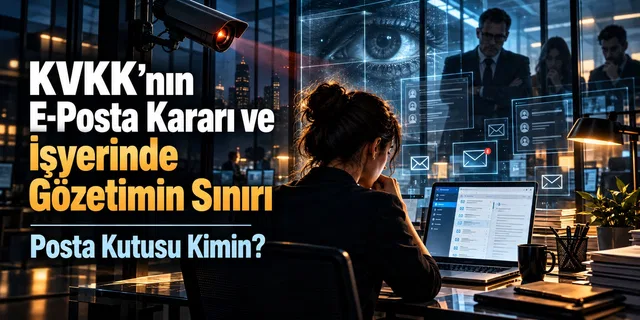
The legal ground is weaker than in Australia. Law No. 6698 on the Protection of Personal Data (KVKK) does cover the workplace, but employers can easily establish a broad scope for monitoring on the grounds of explicit consent or "legitimate interest". Employment law has no consultation or objection mechanism specific to AI surveillance. The privacy notices that workers are made to sign when they are hired are the local version of the "fiction of consent" that the Australian report also points to: whoever does not sign is not hired in the first place.
The question we asked earlier in our KVKK piece applies here too: in a country where the state cannot protect the data about us that it holds itself, who will protect our data in the workplace? The answer is clear: either we will, collectively and organised, or no one will.
There is one more thing. The low rate of union membership in Turkey makes workplace surveillance even more dangerous. In a country where organising is already done at the risk of dismissal, scanning workplace correspondence with AI is a tool that can choke unionisation in its very first conversation. That is why the warning we have insistently underlined in The Computing Worker's Handbook, "move organising communication off the boss's platform", is not a technical warning but a political one.
Where Do the Liberal Proposals Stop, and Where Do We Carry On?
We do not belittle HTI's recommendations. A consultation requirement, a power to ban and a complaints mechanism could become tools of struggle in workers' hands. But three limits need to be seen clearly:
- The "fair and reasonable" test does not answer the question "fair for whom?". The body that applies this test will also weigh productivity and the employer's "legitimate business need". With capital's competitive compulsion sitting on one side of the scales, privacy on the other side usually weighs less.
- Improving the "quality" of consent does not remove the relationship of dependence. The individual worker's consent is given under the fear of losing their job. What is meaningful is not individual consent but the right to collective approval and collective refusal.
- Transparency, as Santow himself admits, is insufficient. Knowing you are watched does not stop you being watched. In the panopticon, knowing that the guard exists does not set the prisoner free.
The horizon we propose is not surveillance done "properly", but a change in the relations of ownership and control over the tools of surveillance. Steps such as the EU AI Act's ban on emotion recognition systems in the workplace show that some limits can be drawn even within bourgeois law. But what will widen those limits is not the goodwill of the legislator; it is organised strength in the workplace.
Concrete Tasks
Dear Young Comrades, this is an analytical piece, but analysis that does not become practice is incomplete. Things that can be done in the workplace, in the union, at school:
- Take an inventory. Collectively document which monitoring tools are used in your workplace: cameras, access cards, software, messaging platforms, performance dashboards. Raising the 9% is the first step.
- Use your data protection rights. Article 11 of Law No. 6698 gives you the right to learn what data about you is being processed. Organise collective requests rather than individual ones; even the employer's reply is a source of information.
- Move organising communication off the boss's platform. Union correspondence does not happen on the workplace Teams, Slack or company email. Choose end-to-end encrypted, free software tools.
- Put surveillance clauses into collective agreements. Consultation with the union, and a union veto, before any new monitoring tool is introduced; a ban on using the collected data as grounds for discipline or dismissal; a right to human review of algorithmic decisions; a ban on using the data to train AI.
- Do not accept "the system made the decision" as an answer. For every algorithmic warning or penalty, demand in writing the reasoning, the threshold value and the name of the person responsible. Refusing to be left without an addressee is making the relationship visible.
- Take responsibility as IT workers. We are the ones who write, install and configure these systems. Sharing knowledge as those who see from the inside how surveillance tools are used against workers, and being able to say "let's not deploy this feature", is the form class solidarity takes in computing.
- Make the demand for legislation collective. Together with unions, professional chambers and digital rights organisations, voice the demand that mandatory consultation, objection and prohibition mechanisms for AI surveillance be added to employment law.
Who Holds the Eye?
Technology itself does not tell us what to do. The same image processing model can save a worker's life by warning of a cave-in risk in a mine, or it can trample on a young worker's dignity in a changing room. What makes the difference is who sits at the other end of the camera, whose property the data is, and in whose hands the decision lies.
The cashier who made one error in 533 items is facing not a flawless machine but a relationship that turns the product of their own labour against them. As long as that relationship does not change, every new sensor will be a new link added to the chain.
The machine is new, the chain is old. But the force that will break the chain is just as old, and just as close: the organised solidarity of workers standing side by side. The way to take the eye out of the boss's hands runs through seeing one another.
For better days, all together.
Sources
- The Guardian, "Workplace privacy concerns as employers use AI to monitor staff", 20 October 2026: https://www.theguardian.com/technology/2026/oct/20/workplace-privacy-concerns-employers-use-ai-to-monitor-staff
- Newsbeep (carrying Guardian Australia), "Calls to strengthen workplace privacy in Australia as employers turn to AI to track staff": https://www.newsbeep.com/au/933935/
- Zetik, "Human Technology Institute Urges Australia to Tighten Workplace Privacy Laws as AI Monitoring Hits 43%": https://www.zetik.com/news/article/story_id-p008-225071
- The News International, "Australian employers using AI to track workers without their knowledge, report warns", 19 October 2026: https://www.thenews.com.pk/latest/1420556-australian-employers-using-ai-to-track-workers-without-their-knowledge-report-warns
- Karl Marx, Capital, Volume I, Chapter 13 ("Co-operation"; Chapter 11 in the German edition), on the dual character of capitalist supervision
- Knowledge Commons, "The Expropriation of the General Intellect and the AGI Illusion": https://bilgimusterekleri.org/en/blog/sinifsalyapayzeka/
- Knowledge Commons, Gig Economy Dossier: https://bilgimusterekleri.org/en/blog/gigekonomisidosyasi/
- Knowledge Commons, The Computing Worker's Handbook: https://bilgimusterekleri.org/en/blog/bilisimemekcisininelkilavuzu/
- Knowledge Commons, "An AI Boss Fired a Human for the First Time": https://bilgimusterekleri.org/en/blog/lunabidurhele/
- Knowledge Commons, "KVKK's '80s Trend' Warning and Privacy in the Digital Age": https://bilgimusterekleri.org/en/blog/kvkk80ler/
This piece is published under a CC BY-SA 4.0 licence. It may be shared, reproduced and adapted, citing the source.