A Reply to Alphan Manas's "Why Will Capitalism End?": The Right Question, an Incomplete Theory, the Wrong Partner
Who Owns the Lights-Out Factory?

Who Owns the Lights-Out Factory?
A Reply to Alphan Manas's "Why Will Capitalism End?": The Right Question, an Incomplete Theory, the Wrong Partner
Dear Young Comrades,
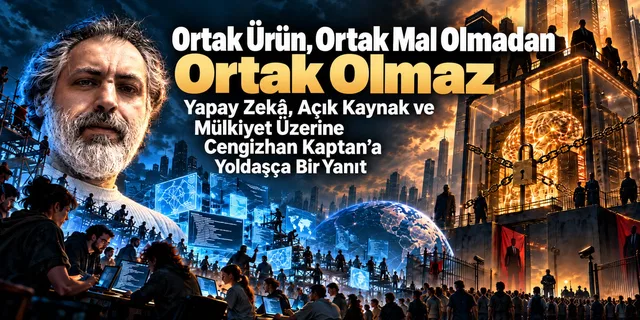
Today Alphan Manas, in a post on X linked to his long piece on Medium (in Turkish), brought an old prediction of his back onto the agenda: capitalism will come to an end around 2040. The post was read thousands of times within a few hours; dozens of replies piled up beneath it, from "capitalism overcomes everything" to "that's already the Chinese model".
I am writing this piece for two reasons. First, the question Manas asks is the right question, and a right question deserves to be taken seriously. Second, in our piece From Futurism to Techno-Fascism, published in early September, we criticised in a short paragraph the line of the Futurists Association, of which Manas is one of the founders. In that paragraph we wrote that in this discourse the future is the future of "the individual who adapts" and of the company; the words union, wage and property do not appear in it.
Today's piece is a good opportunity to test that observation. Because Manas's new text does mention wages, and property too. The union, however, is still missing. This piece explains why that gap matters.
The piece has two layers. First there is a short summary; those short of time can stop there. Then we open up the same theses in detail, with their sources.
Summary
Manas's thesis
As artificial intelligence and robotics remove human labour from production, wage income will melt away and there will be no buyers left for the goods produced; this contradiction will bring capitalism to an end around the 2040s. For Manas, the way out is not for the state to manage all production, but for it to become a minority partner in private capital through a public investment fund and to channel its share of the profits into social security. If the wrong decisions are made, the road may lead to "techno-feudalism".
What is right
- The problem of unsellable output is real. Capital that cannot sell what it produces cannot turn surplus value into money. Marx, too, sees the ultimate reason for crises in the restricted consumption of the masses.
- The question is brought to property. The question "whose will the wealth be?" is a step ahead of discourses that expect salvation or doom from technology itself.
- The fairy tale of zero marginal cost is challenged. Price is set not only by cost but also by property and monopoly.
- The transformation of the white-collar worker is recognised. Mental labour is being broken up; the share of wages in income is falling.
- It is said that a robot tax will not be enough. The issue is not individual machines but social capital.
What is missing
- There is no theory of value. The machine creates no new value; only living labour produces surplus value. The problem is not only the absence of buyers, but capital drying up its own source of profit.
- There is no subject. Capitalism does not collapse by calendar; it can also get out of a crisis through war and authoritarianism. What decides the outcome is the balance of forces between classes. The text does not mention workers, unions or strikes.
- The state is assumed to stand above classes. "A public fund that partners capital on behalf of society" already exists in Turkey: the Turkey Wealth Fund, outside the oversight of the Court of Accounts and in the hands of the executive.
- Silent partnership is not ownership. A fund that takes a 20 per cent stake but makes no decisions makes society a partner not in production but in the dividend; when pensions and healthcare are tied to profit, society's interest becomes tied to more automation and lower wages.
- History is forgotten. Sweden's Meidner plan (1976), a far more radical relative of this idea, was watered down by a massive mobilisation of capital and wound up in 1991. Capital accepts a silent partner; it does not accept a change of master.
Our answer
There is no "wealth created by machines"; there is the wealth of the social labour and the general intellect that the machines have appropriated. That is why the issue is not granting society a right to partnership, but returning to society the wealth it already produces. The way to do this is for productivity gains to be reflected in shorter working time with no loss of pay, for unions to have a binding say in automation decisions in the workplace, for public data and models to become commons, and for strategic infrastructure to be under social ownership open to democratic control. We are living not under "techno-feudalism" but under monopoly capitalism; the solution is not a return to "good capitalism".
In a single table
| Manas's proposition | The class answer |
|---|---|
| The problem is that the unemployed lose their purchasing power (a demand problem). | The problem is that capital, by removing living labour from production, dries up its own source of value (a problem of value and profit). |
| Capitalism will come to an end around 2040. | Capitalism ends not by calendar but through an organised force that ends it; otherwise it gets out of the crisis through war and authoritarianism. |
| Machines will create the wealth. | Social labour and the general intellect created the wealth; the machine is its crystallised form. |
| Let the state become a 20 per cent partner in capital on behalf of society. | Which state? The experience of the Turkey Wealth Fund showed that a "public fund" can be an instrument not of the people but of the executive. |
| The public fund should not interfere in management; it should take its share of the profits. | The essence of ownership is not the share but the power to decide; silent partnership turns society into a rentier of automation. |
| Independent, professional management will protect the fund. | Independence is protected not by regulations but by the balance of forces: oversight by workers' organisations and direct democratic participation. |
| Wrong decisions may lead to techno-feudalism. | What we are living through is not feudalism but monopoly capitalism; the solution is not a return to "good capitalism". |
| Income distribution and social security must be redesigned. | True; but gains come not through design but through struggle: wages, shorter working time and property must be discussed at the same table. |
A Detailed Reading
What Does Manas Say?
First let us summarise the text, doing it justice:
- The opening scene: Imagine a factory with the lights off and no humans working in it. Robots produce, artificial intelligence manages. The sales manager asks the boss: "If the workers don't get paid, who will buy what we produce?"
- The prediction: In 2017 he said capitalism would collapse around 2040; artificial intelligence and robotics are making that possibility concrete. 2040 is not a fixed date but a threshold.
- Intermediate observations: Zero marginal cost does not mean zero price; physical production (steel, energy, batteries, logistics) does not get cheaper, and price is also set by competition, brand and ownership structure. Artificial intelligence is transforming white-collar jobs too; the share of wages in income may fall. Each company's individually rational decision to automate may, in aggregate, collapse demand.
- The proposal: Not a system in which the state manages all production, but a "mixed economy" in which the private sector manages production and the state becomes a minority partner in productive capital through a public investment fund. An example: 80 per cent of a one-billion-dollar robotics plant is private, 20 per cent belongs to the public fund; a fifth of the profit goes to pensions, healthcare, education and care. His formula: "not the state managing production, but society becoming a partner in productive capital."
- The warning: Wrong decisions may lead from capitalism to "techno-feudalism".
For a text that has come out of Turkey's corporate futurism scene, this is not a shift to be belittled. Now let us look at what is right and what is missing.
What Is Right: What Must Be Conceded
The problem of realisation is real
The sales manager's question is one of the oldest questions in Marxism. In the third volume of Capital, Marx writes that "the ultimate reason for all real crises always remains the poverty and restricted consumption of the masses as opposed to the drive of capitalist production to develop the productive forces as though only the absolute consuming power of society constituted their limit." Capital that cannot sell what it produces cannot turn surplus value into money. Manas grasps this contradiction intuitively and correctly: what is rational for individual companies is irrational for society as a whole. That is exactly the anarchy of capitalism.
The question is not technology but property
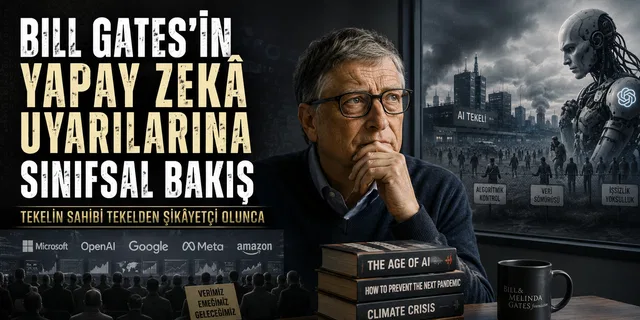
The most valuable sentence in the text is this: in the future the issue is not who will produce, but to whom the wealth created by machines will belong. This coincides with the thesis in our piece on Bill Gates's warnings: to whom the time saved belongs is a question of ownership. Every text that expects neither salvation nor doom from technology itself, and brings the discussion to property, is on the right path.
Challenging the fairy tale of zero marginal cost
While leaning on Jeremy Rifkin's thesis of the "zero marginal cost society", Manas corrects it: price is set not only by cost but also by ownership structure. This is an important piece of honesty. An extra copy of a piece of software costs next to nothing, but the licence for that software is not free; because the price is set by monopoly. That was also the conclusion we reached when criticising Elon Musk's vision of "abundance": abundance is technically possible; property relations turn it into scarcity.
The transformation of the white-collar worker
The observation that artificial intelligence is transforming mental labour, from contract review to software, from financial analysis to design, and that even if the work does not disappear the share of wages will fall, is also apt. We call this mental Taylorism: brain work is being broken up, measured and transferred to the machine, as once happened to manual labour.
That a robot tax will not be enough
Saying "giving the robot a social security number is not enough; we have to look at capital income" means moving the problem from the individual machine to social capital. That is the right direction.
What Needs Developing: Five Gaps
The first gap: If the factory's lights are off, where does the surplus value come from?
In Manas's scene the problem is only the absence of buyers. But in Marxist economics the really deep problem lies one step further back: where does value come from?
The machine creates no new value; it transfers to the product, bit by bit, the value of the past labour crystallised within it. Only living labour creates new value and surplus value. If a factory becomes entirely workerless, that factory produces no surplus value; if it makes a profit, it does so because surplus value produced by workers elsewhere flows to it through market prices and monopoly rent. That is why individual dark factories are possible, but a dark capitalism on a social scale is not.
In the fragment on machines in the Grundrisse, Marx calls this "the moving contradiction": "Capital itself is the moving contradiction, [in] that it presses to reduce labour time to a minimum, while it posits labour time, on the other side, as sole measure and source of wealth." The tendency of the rate of profit to fall in the third volume of Capital is the accounting of the same contradiction.
This difference is not an academic detail. Because Manas's diagnosis is "lack of demand", his cure is "redistributing demand": take a share of the profit and channel it into social spending. If the diagnosis is made in terms of value, the problem is not distribution but the relation of production itself. As capital dries up the source of value with its own hands, the rate of profit comes under pressure; and its response is not only automation but also suppressing wages, lengthening the working day, spreading insecurity, plundering the environment and public assets, and war. In Turkey today we see this both in the algorithmic management of couriers and in every measured click of the white-collar office worker.
The second gap: Capitalism does not collapse by calendar
Setting a date like "2040" is, as Manas himself concedes, more a prophecy than a threshold. The socialist movement went through this debate a century ago: mechanical theories of collapse, according to which capitalism would collapse spontaneously through its own internal laws, led the workers' movement either to waiting or to surrender. Crisis is not a spontaneous exit door. Capital has repeatedly managed to get out of crises through destruction, monopolisation, new markets, authoritarian regimes and war. One way out of the 1929 crisis was the New Deal; another was the Nuremberg rallies.
What decides how capitalism will end is not the speed of machines but the balance of forces between classes. In Manas's text there is no subject to change this balance. There are no workers, no unions, no strikes, no political organisation. The ones who will make the change are managers "making the right decisions" and "professional management". As we also showed in Has Neoliberalism Ended?: the end of an order is announced four times and fails to arrive four times, so long as no force is organised to end it.
The question one reader asked in the replies touches exactly this point: in an order jointly run by the state and the company, if labour no longer has a function, what power will the people have? That is the right question. The worker's historical power comes from being able to stop production. Manas's model proposes to manage a transformation that removes this power, but puts no power in its place.
The third gap: "The state on behalf of society": which state?
The load-bearing column of the model is this sentence: the state becomes a partner in productive capital on behalf of society. The question to ask here is simple: which state, on behalf of which society?
The state is not a referee standing above classes. Turkey has its own experience in this matter. The Turkey Wealth Fund, set up in 2016, brought public assets together under one roof, from Türk Telekom to Ziraat Bank, from Turkish Airlines shares to Borsa Istanbul. Its founding law kept the fund outside the oversight of the Court of Accounts, and since 2018 the chair of its board has been the President himself. In other words, "the public fund through which the state partners capital on behalf of society" already exists in Turkey; this fund is under the control not of society but of the executive, a pool of assets belonging not to the people but to those in power. In Manas's model the fund is to be protected by "independent and professional management"; but independence is secured not by a regulatory clause but by a balance of forces.
This month's agenda teaches the same lesson. As the covering of losses in the fund scandal from the budget was being debated, one of the replies on X summed up the situation in a single sentence: profits are privatised, losses are socialised. Manas, too, honestly notes the risk of loss in his example. But the loss of the 20 per cent minority partner also belongs to society, while control by the 80 per cent majority partner belongs to capital.
The fourth gap: The silent partner, the rentier society
Let us look closely at the logic of the model. The public fund takes a 20 per cent stake, "does not interfere in day-to-day management", and takes its share of the profits. This makes society a partner not in production but in the dividend. This has three consequences:
- Control does not change. What will be produced, how it will be produced, how many people will work, to whom the data will belong: the 80 per cent still decides. The essence of ownership is not the share but the power to decide.
- Society's interest is tied to capital's interest. When pensions and the health budget are indexed to profit, society's "rational" interest is more automation, lower wages and higher profits. The worker gets back with one hand what was taken with the other, by financing their own dismissal. What is called "pension fund capitalism" in the West is exactly this: the worker's savings become the capital of the funds that put the worker out of work.
- Rentierism on a world scale. Norway's oil fund is the world's largest sovereign wealth fund and feeds Norway's welfare state. But this fund holds shares in companies employing workers all over the world. Tying one country's welfare to dividends earned from the workers of other countries does not solve the class question; it exports it beyond the borders.
The fifth gap: They tried this before, and what did capital do?
Manas's proposal is not historically new, and history tells us what happened to its most radical form.
In 1976 Rudolf Meidner, an economist at the Swedish trade union confederation LO, presented the plan for wage-earner funds. Every year, large companies would transfer new shares equivalent to 20 per cent of their profits to funds managed by the unions. It had three differences from Manas's model: the stake would accumulate over time until it reached a majority, the funds would be managed not by the state but by workers' organisations, and the aim was not the dividend but the gradual transfer of decision-making power in companies to labour.
The outcome is instructive. Swedish capital organised the largest political mobilisation in its history; on 4 October 1983 an employers' march of tens of thousands of people was held in Stockholm. The plan was passed into law in watered-down form, and in 1991 a right-wing government wound up the funds. The lesson is clear: capital does not accept the transfer of ownership through a soft transition. Capital accepts a silent partner; it does not accept a change of master. That Manas's model is acceptable to capital is also a sign of why it is inadequate.
A Note on Concepts: Not Techno-Feudalism, but Monopoly Capitalism
Manas's piece ends with the warning that "wrong decisions may lead to techno-feudalism". This concept has spread in recent years, from Yanis Varoufakis to newspaper columns in Turkey; it also featured in our own pieces in July. We later openly abandoned that framework. The reason is this: the platforms' collection of rent is not a return to feudalism but the present-day form of monopoly capitalism. Wage labour, commodity production and capital accumulation continue; what has changed is the concentration of accumulation in monopolies. Saying "feudalism" makes capitalism look as though it were something good that has gone bad, and looks for the solution in "a return to healthy, competitive capitalism". But the problem is not the corruption of capitalism; it is capitalism itself.
What Is Really Left Out: Who Made the Machine?
Manas says "the wealth created by machines". This expression carries the deepest blind spot of futurist discourse.
What were today's artificial intelligence models trained on? On texts written by millions of people, on pictures they drew, on code they wrote, on questions they asked, on articles they added to Wikipedia for nothing. The social accumulation of knowledge that Marx called the "general intellect" is the raw material of these models. Those who build the data centres that run these models, those who work shifts in the factories that make the chips, the miners who dig out the cobalt, the Kenyan and Filipino data workers who label the training data: they too are the creators of this wealth.
So there is no "wealth created by machines"; there is the wealth of social labour that the machines have appropriated. This difference also changes the solution. In Manas's model, society is a party applying from outside to become a partner in the wealth created by private capital. From where we stand, society is already the owner of this wealth; the issue is not an application for partnership but restitution. The subtitle of the Socialist AI Manifesto says exactly this: the restitution of the general intellect.
A Comparison: Manas's Proposition and the Class Answer
| Manas's proposition | The class answer |
|---|---|
| The problem is that the unemployed lose their purchasing power (a demand problem). | The problem is that capital, by removing living labour from production, dries up its own source of value (a problem of value and profit). |
| Capitalism will come to an end around 2040. | Capitalism ends not by calendar but through an organised force that ends it; otherwise it gets out of the crisis through war and authoritarianism. |
| Machines will create the wealth. | Social labour and the general intellect created the wealth; the machine is its crystallised form. |
| Let the state become a 20 per cent partner in capital on behalf of society. | Which state? The experience of the Turkey Wealth Fund showed that a "public fund" can be an instrument not of the people but of the executive. |
| The public fund should not interfere in management; it should take its share of the profits. | The essence of ownership is not the share but the power to decide; silent partnership turns society into a rentier of automation. |
| Independent, professional management will protect the fund. | Independence is protected not by regulations but by the balance of forces: oversight by workers' organisations and direct democratic participation. |
| Wrong decisions may lead to techno-feudalism. | What we are living through is not feudalism but monopoly capitalism; the solution is not a return to "good capitalism". |
| Income distribution and social security must be redesigned. | True; but gains come not through design but through struggle: wages, shorter working time and property must be discussed at the same table. |
So What Should Happen? A Proposed Framework
Let us answer Manas's question not only with criticism but with a direction. These are not a detailed programme but proposals about the axis along which the debate should run:
- Productivity gains must be reflected in working time. The gains from automation should go first not to profit but to shorter working time with no loss of pay. A 32-hour week is not a utopia today but a demand that current levels of productivity can bear. This is the way not to share out unemployment socially, but to socialise free time.
- The power to decide comes before the size of the stake. If public or social ownership is to be discussed, the first question should not be "what percentage of the profit" but "who decides". In decisions on automation, dismissals and algorithmic management in the workplace, unions must have a binding say and a right of veto.
- The data society produces is society's commons. Models trained with public data, public money and public infrastructure must be open and public. "The people's data, the people's model" is not a slogan but the concrete name, in the digital age, of the question of ownership.
- Cooperative and commons models must accumulate experience. Software cooperatives, knowledge commons and public computing infrastructure are the laboratories of social ownership that can be organised starting today.
- Strategic infrastructure must be under social ownership. Infrastructure that forms the backbone of automation, such as energy, data centres and communications networks, must be managed not through minority partnership but through social ownership open to democratic control.
One More Footnote on Futurism
In our September piece we said that the line of the Futurists Association had settled in Turkey as "the title of the employer's consultant, not the worker's". Does today's text deserve a softening of that judgement? Partly, yes. Manas's text goes a step beyond the corporate futurism that says "adapt or disappear"; it asks to whom the wealth will belong, puts income distribution on the agenda, and does not say "the market will solve everything". It would not be honest to ignore that step.
But this step runs into the class limit of futurism. The future is still designed from above: the boss, the sales manager, the state, the professional fund manager. In the scene of the lights-out factory everyone speaks except the worker. Because the scene was built on the assumption that he had long since been shown the door. That is exactly the century-old tradition of futurism: removing labour from the picture of the future.
We put labour back into that picture. Not as a victim to be pitied, but as the only force able to turn the lights back on, whoever switched them off.
Concrete Tasks for Young Comrades
- Take this debate into your own workplace. Which jobs are being transformed by artificial intelligence or automation where you work? Whose work has decreased, whose workload has increased, where has the productivity gain gone? Note it down on a single page; that is the first step in turning an abstract debate into concrete data.
- Set up a reading circle. Read together the fragment on machines in the Grundrisse and chapters 13–15 of the third volume of Capital. Then discuss the story of the Meidner plan: why did a proposal that does not look so radical frighten capital so much?
- Follow the Turkey Wealth Fund. Which public assets have been transferred to the fund, by what decisions and how has the fund been used, where are the audit reports? This is the concrete face in Turkey of the debate on "capital on behalf of society".
- Ask questions in futurist talks. When "the future" is described at a congress, a company event or on a TEDx stage, ask these three questions: Who decides in this future? Who gets the productivity gain? Where is the workers' organisation?
- Join Odak 2026. The theme of the Free Software Association's conference on 13 December is "The People's Data, the People's Model". There we will discuss how the idea of restitution in this piece can be built technically and organisationally.
Dear Comrades,
Manas's sales manager asks a good question: "If the workers don't get paid, who will buy what we produce?" But he will not be the one to ask history's real question. That question will be asked by the worker waiting at the gate, who built the factory with their own hands and trained the machines with their own knowledge: Whose factory is this?
Capitalism will not end by itself in 2040 or in any other year. What will end it is a class that knows the lights-out factories, the data centres and the platforms are the product of social labour, and turns that knowledge into organisation. Let us not leave the future to the futurists; the owners of the future are those who produce it.
For better days, together.
Sources
- Alphan Manas, post on X, 18 October 2026 (in Turkish).
- Alphan Manas, I — Kapitalizm Neden Sona Erecek? (Why Will Capitalism End?), Medium, October 2026 (in Turkish).
- Knowledge Commons, From Futurism to Techno-Fascism, 7 September 2026.
- Knowledge Commons, A Class Look at Bill Gates's AI Warnings.
- Knowledge Commons, A Marxist-Dialectical Critique of Elon Musk's Vision of the Future.
- Knowledge Commons, The Expropriation of the General Intellect and the AGI Illusion.
- Knowledge Commons, Has Neoliberalism Ended?.
- Knowledge Commons, For the Restitution of the General Intellect: The Socialist AI Manifesto Is Out.
- Karl Marx, Grundrisse, the Fragment on Machines.
- Karl Marx, Capital, Volume III, Chapter 13: The Law of the Tendency of the Rate of Profit to Fall.
- Karl Marx, Capital, Volume III, Chapter 30: Money-Capital and Real Capital.
- Wage-earner funds (the Meidner plan).
- Turkey Wealth Fund.
- Norges Bank Investment Management (Government Pension Fund of Norway).
- Jeremy Rifkin, The Zero Marginal Cost Society, Palgrave Macmillan, 2014.
This piece is shared under the CC BY-SA 4.0 licence.