The Illusion of "Indigenous and National" Artificial Intelligence and the Dialectic of Imperialist Integration
From the BİLGE Project to NATO 3.0: A Class Analysis of the "National AI" Fairy Tale in Peripheral Capitalism

Dear young comrades,
We live in a historical interval in which capital and data circulate on a global scale without recognizing borders, and in which contradictions have sharpened to the extreme. Whenever the ruling class confronts a deepening economic crisis and the discontent of the masses, it wraps itself in that all-too-familiar cover in order to cloud consciousness and to blanket class realities: the rhetoric of the "indigenous and national."
When artificial intelligence comes onto the agenda, the same refrain is whispered into the ears of the masses in the bourgeois media and academy: "We are building our own artificial intelligence; we are protecting the cyber homeland; we are making our cultural codes dominant in the digital world."
Initiatives such as BİLGE (the Large Turkish Language Model Project) announced by TÜBİTAK BİLGEM, or the discourses of "digital sovereignty" whipped up around the Public Artificial Intelligence General Directorate established at the state level, constitute the concrete ground of this ideological move.
Yet as dialectical materialists, our task is not to be taken in by ornate launches, technocratic illusions, and nationalist agitation. We are obliged to look not at the external shell of things, but at the property structure of the material means of production, at industrial infrastructure, and at the relations of dependence between peripheral capitalism and central imperialism.
Come, let us smash this illusion by the dialectical method and put concrete realities on the table without leaving room for any mystical narrative.
Smashing Mystification: The Idealist Trap of the "Cultural Code" Discourse
The ruling discourse packages BİLGE and similar models as a "fortress of independence" that protects our language and values against the "cultural imperialism" of Western-centered AI systems.
From the standpoint of dialectical materialism, this approach turns social reality upside down. The discourse draws attention to superstructural institutions (language, culture, identity) and thereby conceals dependence and the transfer of value in the base (the means of production and property relations).
-
Language and the Materialist Base: Language is not an immaterial "national spirit" hanging in the air; it is a product of human social practice and of production processes. Processing a language in the digital medium cannot be treated independently of the hardware and industrial infrastructure on which that language rests.
-
The Illusion of the Software Layer: Fine-tuning work that dresses Turkish data onto foreign open-source architectures may appear to "indigenize" the language, yet it does not change the physical base on which the system runs. Software that speaks Turkish at the cognitive layer does not abolish the imperialist chip and cloud property that lie beneath it.
The Industrial Hierarchy of the Means of Production and Material Impossibility
Dear comrades, what determines the class and national character of a technology is not its uppermost layer of consumption or use, but the industrial and physical means of production at its base. Artificial intelligence is not a few lines of code behind a screen. It is a heavy industrial means of production grounded in semiconductor physics at atomic scale, in rare-earth mining, and in vast energy grids.
The production of artificial intelligence consists of three main layers bound to one another by unbreakable ties:
-
The Hardware and Semiconductor Layer: Chip design at nanometric scale, lithography machines, and semiconductor foundries. This layer is rigidly controlled by the Netherlands-based lithography monopoly ASML, the Taiwan-based foundry monopolist TSMC, and US-based design giants (NVIDIA, AMD).
-
The Data-Center and Infrastructure Layer: Server farms resting on vast electrical grids and cooling systems. This infrastructure is in the hands of the global cloud monopolies (Amazon Web Services, Microsoft Azure, Google Cloud).
-
The Software and Interface Layer: Taking open-source models, training them with Turkish data sets, and presenting them as an interface.
In peripheral capitalist countries such as Turkey, all projects marketed under the name of a "national move" occupy only and solely the tertiary software layer at the very top of this industrial pyramid.
For a country that stands at zero in chip design, lithography technology, and data-center property to declare "national sovereignty" merely because it processes Turkish data at the software layer is an illusion as far from materialist reality as hanging a local flag on an assembly line in a rented factory and saying "we carried out an industrial revolution."
Political-Economic Reality: The Comprador Transfer of Public Resources
The discourse of "indigenous and national artificial intelligence" is not only a technical impossibility; it is an economic mechanism that enables the transfer of public resources to global monopoly capital.
In the capitalist mode of production, as the organic composition of capital (the ratio of dead capital to living labor) rises, the transfer of value between imperialist centers that possess high technology and peripheral countries deepens. When the decision is taken in a peripheral country to train a "national model," the following process operates dialectically:
-
The Collection of the Public Budget: Under the name of a "National Technology Move," the state forms vast public funds and incentive budgets from the taxes of the working class.
-
The Import of Dead Capital: Thousands of graphics processors (GPUs) are imported for the training of models, or server capacity is rented from global cloud companies.
-
The Transfer of Value (Unequal Exchange): Billions of liras of social accumulation set aside from the public budget flow as foreign exchange directly into the coffers of US-centered chip and cloud monopolies.
In this picture, the local bourgeoisie and the technocratic class are not founding an independent national industry. On the contrary, they play the role of compradors (intermediaries) who purchase the high-technology products of global technology monopolies with the public budget and offer them to the domestic market. The discourse of "national artificial intelligence" is an ideological curtain drawn over this process of comprador value transfer.
The Two-Faced Political Side of Propaganda: "Cyber Homeland" Rhetoric and Palantir / NATO Integration
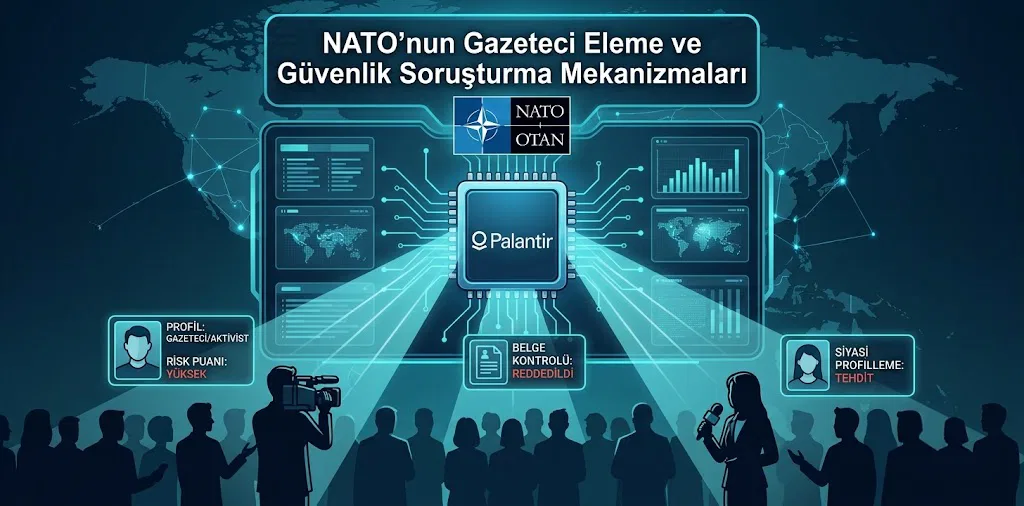
The sharpest internal contradiction of "indigenous and national" rhetoric appears in the security and surveillance policies of the state apparatus. While the propaganda "national data are secure; we are protecting the cyber homeland" is pumped to the masses, in the background the bourgeois state is linking its own mechanisms of force and control to global surveillance networks.
Today the NATO 3.0 concept aims to bind the public data, police records, intelligence flows, and urban security systems of allied countries to a single algorithmic center. Companies such as Palantir Technologies, Anduril, and Microsoft Defence are embedding their own closed AI infrastructures into states' decision-making mechanisms.
The political two-facedness lies here:
-
Ideological Propaganda: "Public data will remain inside the country; with BİLGE and the Public Artificial Intelligence General Directorate we are declaring our digital independence."
-
Concrete Materialist Practice: Remaining dependent outwardly at the level of physical processors and microcode, while grafting the data of public hospitals, the police force, and city security cameras onto the networks of the global military-technological complex.
For the bourgeois state the real issue is not "national independence," but keeping the working class and social opposition under control with refined algorithmic systems under conditions of deepening economic crisis. While integration with global surveillance companies is secured, "national move" propaganda is brought into play to absorb the reaction of the masses.
Ideological Illusions and Dialectical-Materialist Reality
The comparison between the discourses the ruling class builds around technology and objective materialist reality shows the class essence of the situation clearly:
| Axis of Analysis | Bourgeois Ideology and Two-Faced Propaganda | Dialectical-Materialist Reality |
|---|---|---|
| Criterion of "Indigeneity" | The model's speaking Turkish, its announcement by local institutions, and its "reflecting national values." | A superficial software layer whose chip, lithography, and data-center property lie abroad, and which conceals dependence. |
| Public Incentives | A strategic public investment that secures national development and digital sovereignty. | The transfer of the public budget to central imperialist chip and cloud monopolies under the cover of "technology procurement." |
| Cyber Sovereignty | Reducing external dependence and protecting data by keeping data inside the country. | A rhetorical security understanding without a physical foundation, because dependence remains at the hardware and microcode level. |
| State and Law-Enforcement Integration | An indigenous and secure AI infrastructure that increases efficiency in the public sector. | The binding of the state's apparatuses of force to imperialist surveillance networks through NATO 3.0 and Palantir integrations. |
| Class Function | The common pride and technological victory of an entire nation. | An instrument by which the comprador bourgeoisie extracts rent from the public budget and intensifies the exploitation of mental labor. |
The Material Condition of Real Sovereignty and Revolutionary Tasks
Dear comrades,
The concept of "indigenous and national artificial intelligence" is a vast ideological illusion that peripheral capitalism produces in order to cover its own structural incapacity and external dependence. While hardware, chip architecture, and vast data-center infrastructures remain the property of global capital monopolies, sticking the label "national sovereignty" onto a few lines of adaptation code seated atop these systems is to deceive the masses.
The revolutionary attitude toward artificial intelligence is neither to believe these "national move" lies and trail after capital, nor to fall into a reactionary machine-hatred (Luddism) that rejects technology wholesale.
Artificial intelligence is a product of humanity's historical collective labor. Real technological and political sovereignty cannot be won by giving Turkish names to the links of the imperialist chain of dependence. Emancipation is possible by radically questioning the global property relations that hold these infrastructures, by taking the means of production out of the hands of private capital and socializing them, and by building the class organization that will put technology directly at the service of the people and of public planning.
There are no imaginary borders drawn in the digital field; but the border between capital and labor is extremely clear!