The Card Around Our Necks
Chip Tracking at Astor: What the System Sees, Who Reads It, What It Turns Into

The Card Around Our Necks
Chip Tracking at Astor: What the System Sees, Who Reads It, What It Turns Into
Dear Young Comrades,
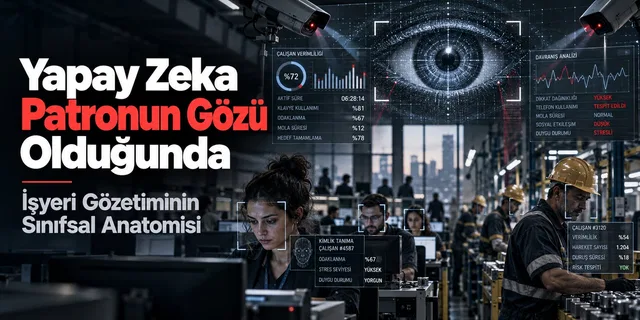
A report by Ahmet Berk Yakar in Evrensel on 25 October 2026 documents a new threshold in factory surveillance in Turkey: at Astor Enerji's switchgear factory in Ankara, workers are working with card-shaped devices they are required to wear around their necks throughout their shift. The workers call it a "chip"; the company calls it an "Integrated Safety and Process Improvement System". One worker sums up the situation in a single sentence: "People go to the toilet less now."
In this piece we will first briefly summarise what happened; then we will explain in detail how a surveillance system of this kind works technically, what data it produces and how, where the gap lies between the company's statement and the workers' testimony, what the law says, and what its counterparts around the world look like. Our aim is this: the next time the same card is handed out in another factory, the workers should have the answers to the questions "what is this, what does it do, what can I demand?"
Summary First
What happened: Astor Enerji, which manufactures transformers and switchgear, has for about three months been handing out a tracking card worn around the neck to blue-collar workers at its Ankara factory, rolling it out department by department. According to the company's reply to Evrensel, 840 employees have been given cards as part of a pilot. The cards are a product of an Ankara-based company called ENGES. The first to raise the issue was the Sincan Workers' Union (Sincan İşçi Birliği), which went to the factory gates with leaflets asking "Are we human or robots?" and said that the same system had previously been trialled at Kalyon PV.
What the company says: The cards work with short-range Bluetooth (BLE); there is no camera, microphone or GPS; they are detected only in areas inside the factory where there are receivers; the purpose is occupational safety and "process improvement"; data is reported at zone level and in "masked" form; managers access "only the limited data necessary for their duties"; there is no sanction for not carrying the card; the system complies with the KVKK (Turkey's data protection law) and Occupational Health and Safety Law No. 6331. (The company statement in Petroturk, 9 October 2026.)
What the workers experience: Taking the card off is "not possible; it is a general procedure set by the factory." When someone stays in one place, they are asked "why have you been standing still here?" Management can tell when workers have put the card down. The time spent in the toilet and in the rest area can be seen. The card was given to blue-collar workers but not to white-collar staff. Workers fear that at pay-rise time this data will turn into performance appraisal. One worker says he feels the pressure "at home and on the street too".
The technical reality: This system is an RTLS, a real-time location system. The card broadcasts an identity signal several times a second; receivers fitted to the ceiling and walls measure the strength of this signal; the software records which zone the worker is in, how long they stay there and when they are not moving, and turns this into daily, weekly and monthly reports. According to ENGES's own promotional material, the system can produce "reports for measuring employee productivity", can track the time spent at a workstation, and its location-time data can be used in human resources processes. In other words, "occupational safety" is the product's cover and "productivity" is what is inside.
The context: The chairman of the same company, Feridun Geçgel, is among the names mentioned in the fund investigation that erupted in September, whose assets were frozen and who was given a travel ban. After the Geçgel brothers made a "voluntary repayment" of 5 billion lira, the measures were lifted. In the same weeks, the toilet time of the workers in the factory was being calculated minute by minute. The order that asks the worker to account for a minute settles the account for 5 billion lira with a "voluntary repayment".
The class question: The issue is not the card itself but who puts it on whom, for what purpose and within what power relation. If there is no consent, no option to take it off, if it is unclear who accesses the data and if the data can feed into bonus, pay-rise and dismissal decisions, then what we have is not occupational safety but a digital overseer. And the answer is not individual: as Birleşik Metal-İş's BİSAM research shows, the workers' first demand is transparency and their second is a ban on using this data as grounds for dismissal. Both can only be secured through a collective agreement.
Now let us turn to the details.
A Timeline of Events
Late July 2026: According to the company's own statement, the pilot begins; the cards are handed out department by department. Workers report that they were given two different explanations during the distribution. One was told, "if something happens to you, you press the button here; in a disaster it will be easy for us to reach you"; another was told, "the aim is to see where you are during working hours, where you go and where you spend your time." Both explanations may be true; the second is the real function behind the first.
28 September 2026: Kadın İşçi raises the issue, naming Kalyon PV and Astor 3; it reports objections from DİSK President Arzu Çerkezoğlu, Derya Han of the Öz İplik-İş union and lawyer Mehpare Altaylı. The common thread: in the worker-employer relationship consent cannot be free, the purpose and retention period of the data are unclear, and women and migrant workers are affected more.
5 October 2026: İlke TV publishes the Sincan Workers' Union leaflet and a worker's testimony: "Even having my pets chipped bothered me. Now they put this around our necks like a collar." It reports that about a thousand people work in the factory, a significant number of them Nepalese workers. The story spreads to the national press under the headline "chip at the factory of the billionaire accused of the fund scam".
9 October 2026: Astor Enerji takes ownership of the system in a press statement: its name is ENGES, the pilot has been running for three months, 840 employees are covered, it uses a BLE card, there is no camera, microphone or GPS, there are fixed environmental sensors, it complies with the KVKK and Law No. 6331, and it is within the scope of ISO/IEC 27001. The decision on rolling it out will be made according to "the pilot results and employee feedback".
25 October 2026: Evrensel puts side by side the detailed testimony of two workers, the product descriptions on ENGES's own website and the company's reply. The report's most important contribution is this juxtaposition; because when the company's sentence "monitoring breaks is not our aim" and the supplier's sentence "tracks time spent at the workstation, can be used in HR processes" are read on the same page, the debate moves from the plane of intention to the plane of capability. What a system can do matters more than its owner saying what it does not do today.
How Does the System Work Technically?
Here we start from the company's own description ("BLE card", "receiver devices", "zone-level data") and ENGES's product promotion ("RTLS", "card or wristband", "daily, weekly and monthly reports") and describe the general architecture of systems of this class. We do not know every detail of the installation at Astor; but this technology is standard, and how it works is clear from the engineering literature.
Three Layers: Tag, Receiver, Server
The first layer is the tag, that is, the card around the worker's neck. Inside it are a small Bluetooth Low Energy chip, a battery, in most models an accelerometer, and a button. The card is the side that "talks": at regular intervals (typically between once and ten times a second) it broadcasts a short radio packet containing its own identification number. This packet is a few tens of bytes; it contains no name, only a number. The "no personal data" defence usually draws on this. But on the server the number is matched to a personnel number; whoever holds the matching table holds the identity.
The second layer is the receivers: what the company calls "receiver devices", small boxes fitted to the ceiling, to pillars and above doors. These are the side that "listens". Each receiver picks up the packets of all cards within range and produces three pieces of information for each packet: which card, what time, and how strong the signal is (RSSI). The receivers send these records to the server over a wired network or Wi-Fi. The density of receivers determines the system's resolution: put a single receiver in a department and you get "in this department"; put three or four and you can triangulate from signal strengths to get a point location accurate to two or three metres. Put a receiver above the toilet door and you know to the second who went in and came out, and when. The company's sentence "detected only in areas where there are receivers" is true; the question to ask is where the receivers have been placed.
The third layer is the server and the software. The raw stream, millions of lines in the form "card 4471, time 10:42:17, receiver T-12, strength -67 dBm", is turned here into meaningful events: entering a zone, leaving a zone, time spent in a zone, inactivity, entry into a restricted area, capacity exceeded, button pressed. These events are then aggregated by person, shift, department and date, and appear on screens as heat maps, timelines and reports. The "daily, weekly and monthly reports" in ENGES's promotional material are the product of this layer.
What Does "No GPS" Mean?
The company stresses that the cards have no GPS. This is true, and it means nothing. GPS does not work indoors anyway; you cannot track anyone inside a factory with GPS. BLE-based RTLS does indoors what GPS cannot: it tells you under the steel roof at which workbench, in which corridor, behind which door you are. The worker's intuition that "it's as if they've fitted us with GPS now" is technically imprecise but politically correct; inside a factory, BLE is a closer eye than GPS. The same applies to the sentence "no camera and microphone": a camera is not needed for location and time data; a camera records images, while RTLS digitises behaviour. Watching camera footage requires a person to stare at a screen for hours; an RTLS report, by contrast, says in a single column "worker X spent a total of 412 minutes in the toilet this month". That is what lowers the cost of surveillance.
How Is Inactivity Detected?
Two things the second worker in Evrensel describes are technically very important: "When we stay in one place, they say 'why have you been standing still here?'" and "they can tell when we've put the device down." What makes this possible is the accelerometer. This small sensor inside the card measures whether the card is moving. The card around the neck of a walking person vibrates constantly; a card left on a table does not vibrate at all; the card of a person sitting down moves now and then. The software distinguishes these three signatures. In the occupational safety literature this is called "man-down" or fall detection: if the card suddenly accelerates and then stays completely still, the worker may have fallen, and an alarm is generated. The same feature, with a change of setting, becomes the warning "hasn't moved for ten minutes". The hardware is the same; what differs is the threshold and to whom the warning goes. When the company says "the inactivity alarm is for occupational safety" it is not lying; but the workers know from experience that the same alarm screen prompts the foreman to ask "why have you been standing still here?"
"Telling that the card has been put down" comes from the same source: if the card stays completely still for a long time and is somewhere other than the zone where the worker is expected to be, the software generates a "card separated from wearer" event. This event makes even taking off the card to go to the toilet visible to the system. That is the technical meaning of the worker's words "it is not possible to take it off or refuse it": taking the card off is itself data.
What Is the Button For?
When the button on the card is pressed, an "emergency" event and the current location are sent to the server. This is a genuinely useful feature; it can save the life of a maintenance worker working alone. But the existence of the button does not legitimise the rest of the system. An emergency button does not need continuous location tracking: a device can be made that sends its location the moment the button is pressed and stays silent the rest of the time. The choice of a card that broadcasts continuously shows that the system was designed not for emergencies but for continuous monitoring. The same goes for evacuation roll-calls: a single receiver placed at the assembly point counts who has arrived; there is no need to record the time spent at the workbench for eight hours to do that.
The Claim About Body Temperature and Heart Rate
In the İlke TV and Kadın İşçi reports, workers say that the cards measure body temperature and heart rate. The company statement does not mention this; nor does Evrensel's report. We have to be honest: it is technically difficult for a card hung around the neck to measure heart rate reliably; pulse sensors (PPG) need skin contact and come in wristband form. ENGES's promotional material offers a "card or wristband" option; in other words, the product family includes a wristband. A temperature sensor, on the other hand, is small and cheap and can be fitted to cards; but what it measures is not body temperature but the temperature of the card's surroundings. So we cannot confirm that the cards at Astor today measure pulse; but we can say this: the same supplier's same platform can collect biometric data in wristband form, and if the pilot is deemed "successful", the next step being exactly that is technically a single purchasing decision away. The workers' concern is not speculation but a reading of the product catalogue.
What Do "Masking" and "Zone-Level Data" Mean?
This is where the company's strongest defence lies: the data is "masked", managers see it "with personal information masked", and the reports are "at zone level" (how many people are in an area, whether capacity has been exceeded, whether there has been entry into a restricted area). Let us decode these phrases technically.
Masking means showing a number or asterisks on screen instead of a name. The data is not deleted; the matching table stays on the server; whoever has authorisation opens it. In KVKK language this is called pseudonymisation, and pseudonymised data is still personal data, because it can be reversed. In a department with few workers, masking is meaningless anyway: if there are three people in the maintenance workshop on the night shift, the foreman knows without any unmasking whose line "card 4471 spent 25 minutes in the toilet" is.
Zone-level reporting, meanwhile, is an authorisation setting, not an architectural limit. If the system did not keep individual records, the question "why have you been standing still here?" could not be asked. If the question is being asked, the individual data is on someone's screen. This is the sharpest contradiction between the company's statement and the workers' testimony, and its resolution is simple: how long are the raw records kept, who sees which screen, which events go to whom as notifications? Until the answers to these three questions are given in writing, the word "masking" is a marketing term.
The Data Life Cycle
Finally, let us follow the data from the moment it is born to the moment it dies; because both the legal debate and organised struggle put a separate question to each link in this cycle.
Collection: The card broadcasts, the receiver listens. Collection is continuous and passive; the worker does not need to do anything, and not doing anything changes nothing.
Transmission: It goes from the receiver to the server over the network. Is the server in the factory or in the supplier's cloud? Does the supplier access the data? An ISO 27001 certificate is not the answer to these questions; it only documents the existence of a management system.
Processing: The raw signal turns into events, and events into metrics. This is where the words "artificial intelligence" come in. ENGES's product is described in its promotion as "AI-supported". In practice this means anomaly detection: the system learns each worker's "normal" day (in this zone at this hour, this much break) and flags deviations from normal. A system that flags deviations has two faces: it catches the worker who has fallen, and it also catches the worker who "went to the toilet too often today".
Retention: How long is the raw record kept? In France, the data protection authority CNIL found even Amazon's retention of warehouse workers' data for 31 days excessive; we describe this below. The statement in Turkey contains not a single sentence on the retention period.
Use: Occupational safety, production planning, performance, discipline. The company mentions the first two and denies the third and fourth. But the factory already has a warning system called the "yellow card", which can go as far as bonus deductions. Merging the two systems does not even require a software integration; it is enough for the foreman to look at one screen and fill in the other form.
Destruction: When and how is the data deleted? What will happen when the pilot ends? Who keeps the three-month movement map of a worker who leaves the job?
Workers and their union have the right to ask questions about each of these six links; Article 11 of the KVKK recognises this right. We will return to this in the concrete tasks below.
What the Company Says, What the Workers Experience, What the Technology Makes Possible
| Issue | Company statement | Worker testimony | What is technically possible |
|---|---|---|---|
| Purpose | Occupational safety and process improvement | "To see where we are, where we spend our time" | The same data serves both purposes; what makes the difference is the authorisation setting |
| Break monitoring | "Not our aim" | Toilet and rest time can be seen; "why have you been standing still?" is asked | Time spent in a zone is the basic output of RTLS; the supplier sells it as a "productivity report" |
| Compulsion | No sanction for not carrying it | "Taking it off or refusing it is not possible; general procedure" | Putting the card down shows up in the system as a separate event |
| Scope | 840 employees, pilot | Blue-collar workers only; not given to white-collar staff | The system can be given to everyone; not giving it is a choice |
| Data level | Zone level, masked | Individual warnings are given | Masking is reversible; without individual records no warning could be given |
| Sensors | BLE, no camera/microphone/GPS | Said to measure temperature and pulse | Accelerometer and button are standard on the card; pulse needs a wristband, which exists in the product family |
| Consent and information | Informed on handover | "I researched what data it collects by my own means" | The privacy notice, retention period and access list must be given in writing |
| Roll-out | According to pilot results and employee feedback | Some react, some say "we have no choice" | Without a feedback mechanism, "employee opinion" is the foreman's opinion |
What Does the Law Say?
We are not lawyers here; but workers need to know what they have in their hands. There are three levels: constitutional rights, the KVKK and employment law.
Article 20 of the Constitution recognises the right to request the protection of personal data and states that data may be processed only in cases provided for by law or with explicit consent. The workplace is not outside this article; the Constitutional Court's rulings on workplace email monitoring have said so many times. We wrote about this in detail on the occasion of the KVKK's email decision.
Article 4 of the KVKK (Law No. 6698) requires processing to be "limited to the purpose" and "proportionate". Proportionality means this: if the same purpose can be achieved by a less intrusive method, you cannot choose the more intrusive one. For an evacuation roll-call, a receiver at the assembly point is enough; for emergencies, a button that sends its location when pressed is enough; for restricted areas, a reader on the door is enough. Eight hours of uninterrupted individual location recording is necessary for none of these purposes. Article 5 regulates explicit consent and its exceptions; the employer will probably rely on the "legitimate interest" exception. But legitimate interest is conditional on not harming the worker's fundamental rights and freedoms, and requires a balancing test. Article 10 is the duty to inform: what data, for what purpose, to whom it is transferred, how long it is kept. The worker saying "I researched it by my own means" is proof that this duty has not been fulfilled. Article 11 gives the worker the right to apply: what data about me is being processed, to whom has it been given, delete it. You do not need to be a union member to exercise this right; but if you exercise it alone you are marked as a "troublemaker". That is why it is exercised collectively.
The Board's case law also helps: in its principle decision No. 2026/921 of 29 April 2026, dealing with the processing of biometric data for attendance tracking, the Board said two things, both of which apply directly to Astor. First: there is a structural power imbalance in the worker-employer relationship; if refusing consent may have negative consequences, consent is not based on free will. Second: even with explicit consent, processing that fails the proportionality test is unlawful. The decision concerns biometrics, not location tracking; but the principles are the same. Earlier, in its decision No. 2022/797, the Board fined an employer 500,000 lira for placing a camera near the toilets and using facial recognition at entry and exit, explicitly invoking the concept of a "reasonable expectation of privacy". A BLE receiver above the toilet door is no less intrusive than a camera near the toilets; it is only less visible.
On the employment law side, Article 419 of the Turkish Code of Obligations states that the employer may use the worker's personal data only insofar as it relates to the worker's suitability for the job or is necessary for the performance of the employment contract. Occupational Health and Safety Law No. 6331 gives the employer a duty to ensure the worker's safety; it does not give the power to monitor the worker for that purpose. Moreover, Article 18 of the same law makes it mandatory to consult employees and ensure their participation on health and safety matters. An employer who says "we put it on for occupational safety" should first have asked the health and safety committee and the employee representative. Were they asked? Judging by what the workers say, they were not.
The international framework points the same way. The ILO's 1997 code of practice on the "Protection of Workers' Personal Data" states that workers may be monitored only with prior notice, that continuous monitoring is permissible only if required for health and safety, and only with the guarantee that the data collected will not be used for disciplinary purposes. Article 88 of the EU General Data Protection Regulation provides special protection for the employment context. In Germany, Section 87 of the Works Constitution Act makes the installation of any technical system suitable for monitoring employees' behaviour or performance subject to the approval of the works council; a system installed without approval is legally invalid. There is no such co-determination mechanism in Turkey. Its absence does not mean that the employer can do as it pleases; it means that something which must be demanded is missing.
Lessons from the World: The Same Card, Different Names
The system at Astor is new for Turkey, but not for the world. A few examples show what we should expect.
Amazon France Logistique, 2024: With a decision taken in December 2023 and announced in January 2024, the French data protection authority CNIL fined Amazon 32 million euros for the monitoring system it had built at its warehouses in France using data collected from workers' handheld scanners. The system produced three indicators: the "Stow Machine Gun", which flagged a worker who scanned an item in less than 1.25 seconds as an "error risk"; "idle time", which recorded inactivity of ten minutes or more; and "latency", which recorded the passing of one to ten minutes between two scans. CNIL found this system, which put workers under pressure to feel they had to justify every break, disproportionate, and considered even the 31-day retention of the data excessive. Note: Amazon too said it had set up the system for "safety and quality". Astor's "process improvement" and Amazon's "quality" are words from the same dictionary.
Amazon's wristband patents, 2018: The company obtained a patent for a wristband worn by warehouse workers that tracks with ultrasonic signals whether the hand goes to the right shelf and warns with vibration if the movement is wrong. The patent's justification was "efficiency". In other words, when the card moves down from the neck to the wrist, not only monitoring but also steering begins; the worker's hand becomes an extension of the machine.
Tesco, Ireland, 2013: Armbands worn by workers at a distribution centre measured how long it took to pick an order and gave the worker a score; workers said going to the toilet lowered the score. The sentence an Irish warehouse worker said thirteen years ago is being said today by a metalworker in Ankara.
Sociometric badges: In the United States, companies such as Humanyze sold badges worn around employees' necks that measure who talks to whom and for how long, tone of voice and movement patterns; Hitachi marketed a similar product as a "happiness meter". The technology of these badges belongs to the same family as the card at Astor: BLE or infrared proximity, an accelerometer, server-side analytics. The difference is which event is defined. When card-to-card proximity is recorded, the system knows not only who is where but also who spends time with whom. During a period of union organising, the meaning of this data needs no explanation.
China, 2018: Reports spread that at some factories in Hangzhou, workers' "emotional state" was being monitored with EEG sensors fitted in their helmets, and that workers who appeared tired or tense were moved to other tasks. For now this is an extreme example; but this is the direction: from location to behaviour, from behaviour to the body, from the body to the mind.
The common denominator of these examples is this: every system comes in under the name of "safety" or "efficiency", stays under the name of "performance" and is used under the name of "discipline". No employer says on day one "I am going to count your breaks". The system itself says it.
The Testimony of Metalworkers in Turkey: The BİSAM Research
The workers at Astor are not alone. The research "How Does Digital Transformation Affect Workers?", announced in July 2026 by BİSAM, the research centre of the Birleşik Metal-İş union, and led by Prof. Dr. Ferit Serkan Öngel, was carried out with 665 metalworkers at 109 workplaces. Its findings are the statistics of the testimonies from Astor:
49 per cent of workers face turnstiles and card readers, 35 per cent workbench screens, 31 per cent staff attendance tracking systems, 16 per cent camera monitoring, 15 per cent work order tracking via tablets and 14 per cent performance scoring. 56 per cent do not know by what criteria the system evaluating them makes its decisions. 34 per cent say digital tracking causes excessive mental fatigue at the end of the day, 29 per cent that the feeling of constant monitoring produces stress, and 23 per cent that being monitored distracts them and increases the risk of accidents. 21 per cent think that systems installed on health and safety grounds are actually used to check how much they work. Of the 176 workers who receive a performance score, 106 report that the score affects their pay, bonus or whether they keep their job.
Two of the research findings are particularly important for Astor. First: what produces pressure is not the amount of surveillance but its individualisation. A turnstile everyone passes through does not create pressure; tablet tracking and cameras that target the individual do. The card around the neck is the purest form of the individualisation of surveillance: each worker's own number, own map, own minutes. Second: the workers' first demand is transparency. Those who want to be told clearly what data is collected make up 61 per cent of the low-pressure group and 69 per cent of the high-pressure group. Those who want a ban on using the data as grounds for dismissal rise to 58 per cent among experienced workers. BİSAM's recommendation is clear: these rights must be written into collective agreements; the pace and performance criteria set by digital systems must become subjects of collective bargaining.
Why Is This Not Occupational Safety but a Class Issue?
Dear young comrades, so far we have described the technology and the law. Now let us step back and look at the structure of the problem.
In the chapter of Capital on co-operation, Marx writes that once capital has gathered a large number of workers under one roof, a new function is born: supervision. To the extent that this supervision, like the conductor of an orchestra, is a technical necessity of production, it is indispensable; but in capitalist production it is at the same time the means by which the labour process is subordinated to capital, and for that reason it takes a despotic form. The foreman, the "overseer" and today the BLE card are the historical forms of this second function. The worker's words, "as if those men they call overseers that they send to stand over us weren't enough, now you fit us with a chip", are this analysis put into factory language.
Taylor's stopwatch was the first scientific form of supervision: the engineer stands over the worker, measures every movement to the second and determines the "one best way". The stopwatch's problem was scale; an engineer cannot stand over every worker. RTLS solves this problem: the stopwatch is hung around the worker's neck and the engineer moves to the server. This is the metal-factory counterpart of what we called "mental Taylorism" in our Karaburun declaration; there every minute of thought is counted, here every minute of the body.
The power of Bentham's panopticon comes not from the guard looking at every moment but from the possibility that he might be looking at any moment. The worker's words, "right now there is no open warning, but at pay-rise time they will do performance appraisals based on this", are proof that the panopticon is working: behaviour changes before any warning comes; people go to the toilet less. The company can rightly say "we do not monitor breaks"; there is no need, the worker monitors himself. The real product of the technical architecture we have described in this piece is not data but this internalised eye. The worker saying "I feel this pressure at home and on the street too" shows that the eye has not stayed at the factory gate. When we wrote about Anthropic's activist monitoring system we spoke of "the gatekeeper of the panopticon"; in the Ankara factory, the gatekeeper hangs around the worker's own neck.
The third point is the division within the class. The cards were given to blue-collar workers, not to white-collar staff. This is not a technical decision; during an evacuation you also need to know where the engineer is. It is a declaration of whose body can be counted and who is considered trustworthy. The presence of Nepalese workers in the factory completes the picture: the worker whose passport is held by the agency, who arrived in debt and works twelve hours in a country whose language he does not speak, is the last person who could refuse the card. Surveillance is always tested on the most vulnerable first, then spreads upwards. Evrensel wrote in July about how Nepalese workers are brought to Ankara's factories; Astor was among the companies to which an agency called Euro Nepal supplied workers.
The fourth point is the "artificial intelligence" label. It is no coincidence that the supplier markets its product as "AI-supported". The words artificial intelligence do two jobs here: they make the manager who buys it feel "modern", and they hand responsibility for the decision over to an algorithm. The sentence "the system flagged it" looks less open to challenge than the sentence "the foreman doesn't like you". Remember BİSAM's finding: 56 per cent of workers do not know the criteria of the system evaluating them. An unknown criterion is a criterion that cannot be challenged. We discussed the general framework of this order in our piece on codes of conduct: the question of who holds the leash matters more than whether the leash is smart.
The last point is the two faces of capital. In the same weeks, the owners of the same company were the subject of an investigation that ended with the liquidation of 131 funds and the arrest of 99 people; Forbes wrote that their fortune had fallen from 5.3 billion dollars to 2.7 billion dollars; and the measures were lifted with a "voluntary repayment" of 5 billion lira. We followed the fund crisis over six pieces in the Stock Market Dossier; the system that counts the worker's toilet minutes and the system that settles billions with a "voluntary repayment" are the same system. In one, nobody asks for proportionality, information or consent; in the other, there is bargaining. That is class justice.
Concrete Tasks
We write separately for Astor's workers, for the workers of the other factories where the same card will be handed out tomorrow, and for the computing workers who write these systems.
For Workers in the Factory
Do not refuse the card on your own; you will be sacked and the card will stay. Instead, make a KVKK Article 11 application collectively: "What data about me is being processed, for what purpose, to whom is it transferred, how long is it kept, who has accessed this data?" A written application creates an obligation to reply in writing, and if no reply comes within 30 days, the route to a complaint to the Board opens. Ask for the privacy notice; if there is none, that in itself is a violation. When you are asked "why have you been standing still here?", note the date, the time and who asked; these notes are the only evidence that can be set against the company's statement that "we do not carry out individual monitoring". Ask through the health and safety committee and the employee representative whether the system was presented to the committee; Article 18 of Law No. 6331 is in your hands. And most importantly: if there is no authorised union in this factory, the real answer to the card is organisation. The programme Birleşik Metal-İş set out with the BİSAM research is ready; implementing it requires a counterpart in the factory.
For Unions
Make digital surveillance a collective agreement clause. The minimum set of clauses is this: the worker's right to know all data collected about them and the evaluation criteria; a ban on using location and behavioural data in disciplinary, performance, bonus and dismissal decisions; the union's written approval before any new monitoring system is installed; a written limit on the retention period for raw data; the definition of toilets, rest areas, prayer rooms, canteens and changing rooms as areas where no receivers may be placed; an absolute ban on collecting biometric and physiological data; independent auditing of the system. The co-determination right in Germany will not come to us through a law; it will be won through agreements and then turned into law. Also apply to the KVKK for a principle decision using the Astor case: the logic of decision 2026/921 must be extended to location tracking.
For Computing Workers
Someone writes these systems; someone sets the accelerometer threshold, someone defines the "inactivity" event, someone designs the "productivity report" screen. As we wrote in The Computing Worker's Handbook, asking around whose neck the code you write will hang is a professional responsibility. If you are working on an RTLS project, push for three design decisions: switch off the individual dwell-time report by default and leave only anonymous aggregate statistics on; keep the retention period for raw records short and write it into the code; block receiver installation in private areas at the software level. These do not make the system innocent; but they leave the factory worker some room to bargain. And you are being watched too: the white-collar worker has no card around their neck, but there is agent software on their computer. We are links in the same chain.
For All of Us
This story appeared in Evrensel because a worker spoke and a reporter listened. As we wrote a few days ago, if we fall silent, the worker's voice does not leave the factory. Share the story; but share it not only with anger, but with the question "is it in your factory too?" The Sincan Workers' Union leaflet also mentions Kalyon PV; in Ankara's industrial basin there are probably already a third and fourth factory with this card. Let us map them.
The Card Is Around Our Necks, but Who Holds the Decision?
One worker said, "let us be herded during our herding hours." The pain of this sentence lies not in its resignation but in its clarity. The worker has understood what the system is better than the company's statement: this card is not a safety measure of the factory; it is the counting, on capital's behalf, of every minute of the eight hours during which labour power is bought and sold. The counting is not new; it has existed since Taylor. What is new is that the counter hangs around the worker's neck and the one counting is invisible.
We are not against technology. A button that raises the alarm when a maintenance worker working alone falls, a counter that shows who is still inside during an evacuation, a sensor that clears a zone during a gas leak: these save workers' lives. All of them can be done without continuous individual location recording; if they are not done that way, the purpose is something else. The question is not the technology itself but its ownership: whose is the server, who sets the threshold, who reads the report, who deletes the data? On the day the answers to these questions change in the workers' favour, the same card becomes a safety tool; until that day, it is a leash.
What will take the card off the necks of the 840 workers at Astor is neither a KVKK decision, nor an opinion column, nor this blog. What will take it off is the organised worker who can say "we won't wear it" in that factory and knows that saying so will not get them sacked. Our job is to make sure that when that day comes, the technical, legal and historical tools are ready in the workers' hands. This piece is part of that toolkit. The rest, as always, will be written in the factory.
Sources
Reports and statements
- Astor'da işçilere çipli takip (Chip tracking for workers at Astor) — Ahmet Berk Yakar, Evrensel, 25 October 2026
- Fon vurgununda adı geçen Geçgel'in fabrikasında işçilere çiple takip: "Tasma gibi boynumuza takıyorlar" (Chip tracking for workers at the factory of Geçgel, named in the fund scam: "They put it around our necks like a collar") — Tuğba Özer, İlke TV, 5 October 2026
- Patron işçinin kalp atışını dahi takip ediyor! (The boss even tracks the worker's heartbeat!) — Ayla Önder, Kadın İşçi, 28 September 2026
- Astor Enerji iş güvenliğini ENGES ile güçlendiriyor (Astor Enerji strengthens occupational safety with ENGES) — Soner Okur, Petroturk, 9 October 2026 (company statement)
- Geçgel kardeşlerin "fon tedbiri" kaldırıldı: 5 milyar lira iade etmişler (The Geçgel brothers' "fund measures" lifted: they repaid 5 billion lira) — Diken, 23 October 2026
- Nepal'den Türkiye'ye köle zinciri: İstihdam adı altında Nepalli işçileri pazarlıyorlar (A slave chain from Nepal to Turkey: Nepalese workers traded in the name of employment) — Yeniçağ (from Evrensel), 23 July 2026
Research, law and decisions
- Dijital Dönüşüm İşçileri Nasıl Etkiliyor? Metal İşkolunda Dijital Gözetim ve Algoritmik Yönetim (How Does Digital Transformation Affect Workers? Digital Surveillance and Algorithmic Management in the Metal Sector) — Birleşik Metal-İş / BİSAM, 30 July 2026
- Principle Decision on the Processing of Biometric Data for Attendance Tracking (2026/921) — Personal Data Protection Board, decision of 29 April 2026, public announcement of 2 June 2026
- Employee Monitoring: Lessons from CNIL's EUR 32M Fine Against Amazon France Logistique — BCLP; CNIL decision of 27 December 2023, announced on 23 January 2024, 32 million euros
- ILO, Protection of Workers' Personal Data: An ILO Code of Practice, Geneva, 1997
Theory
- Karl Marx, Capital, Volume I, Chapter 13: Co-operation
Related pieces from Bilgi Müşterekleri
- The KVKK's Email Decision and the Limit of Workplace Surveillance
- Anthropic's Activist Monitoring System
- Who Holds the Leash on Artificial Intelligence?
- The Revolt of Crystallised Labour
- The Computing Worker's Handbook
- Gig Economy Dossier
- Six and a Half Trillion: The Money Wiped Off the Exchange, the Life Missing from the Table
- We Stand with Journalists on 24 October